Gut Microbiome and Nutrient Absorption: Why a High Protein Diet Causes Bloating and How to Fix It
Gut health for bodybuilders: why high protein diets cause gas and bloating, what the research says, and a step-by-step way to fix it without cutting protein.
TL;DR. The short answer
- Bloating on a high protein diet usually comes from what reaches the colon undigested, plus add-ons in shakes and bars (lactose, sugar alcohols), not from protein being 'bad' for you.
- Short-term high protein intake has little effect on metabolism in healthy adults under 65, and a 2022 review found adverse effects in athletes to be minimal. Long-term effects of very high intakes are less certain.
- Most lifters do not need 200 g a day. A 2018 meta-analysis found no extra muscle gain beyond about 1.6 g/kg/day, so trimming intake can be a legitimate fix.
- Test one change at a time for about a week: swap the shake, check for sugar alcohols, shrink and spread portions, then add fibre slowly.
- Blood in stool, unexplained weight loss, night pain or persistent diarrhoea need a doctor, not a diet experiment.
Part of our complete guide: Carbohydrates, Fats, Fibre, Micronutrients and Hydration: The Lifter's Fueling Guide
Table of contents
Gut health for bodybuilders mostly comes down to one idea: bloating on a high protein diet is rarely about protein being toxic. It is usually about how much lands in your gut at once, what else is in the shake or bar, and how fast you changed your diet. All three are fixable without dropping your protein target.
If you are eating 200 g of protein, feel like a balloon by 4 pm and have a gym partner who has stopped sitting near you, this guide is for you. It sits under our complete guide to carbohydrates, fats and hydration, and it stays practical. For the fibre side in detail, see soluble vs insoluble fibre and gut health.
Why does a high protein diet cause bloating and gas?
Short answer: fermentation. Most of the protein you eat is broken down and absorbed in the small intestine. Whatever gets past that point lands in the colon, where trillions of bacteria treat it as food.
A 2022 review describes how gut bacteria ferment protein, and lists the products: indoles, phenols, polyamines, amines, ammonia and hydrogen sulfide (Cai et al., 2022). Hydrogen sulfide is the rotten-egg smell. If your gas smells worse since you upped your protein, that is probably why.
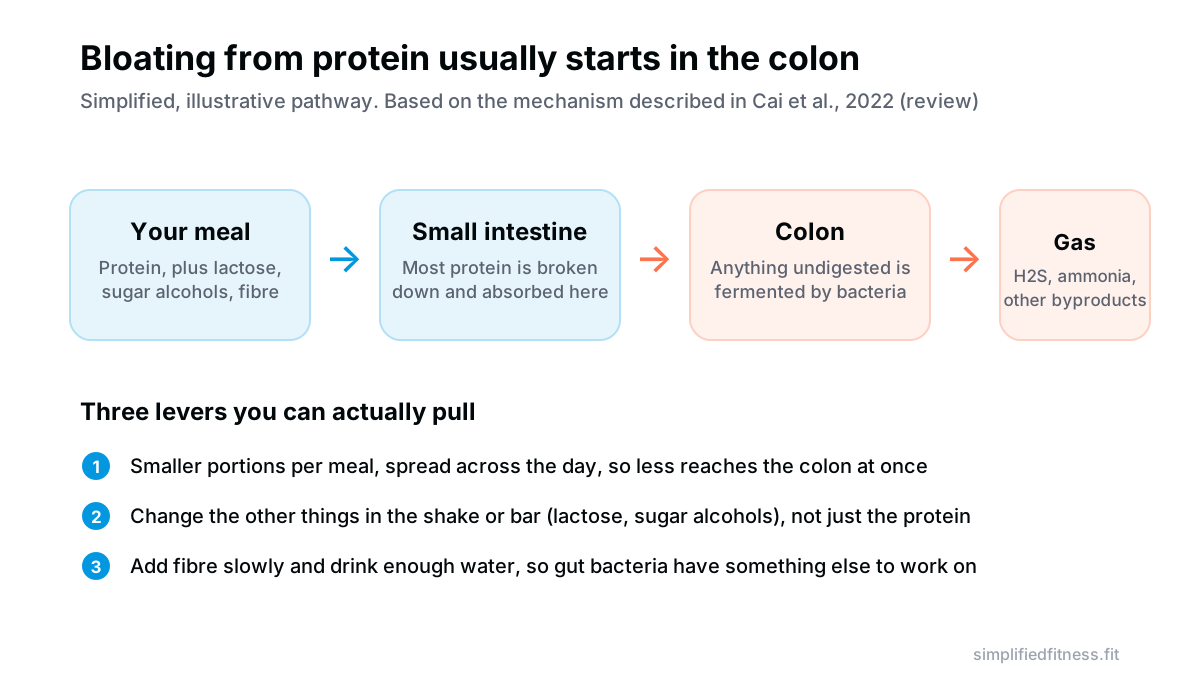
Two things to keep in perspective. First, this is a review, not a trial in lifters, and parts of it are about long-term very high intakes and disease risk, where the evidence is less settled. Second, the same review concludes that short-term high protein diets have little effect on metabolism in healthy people under 65, and that adverse effects in athletes are minimal (Cai et al., 2022).
So the smell and the gas are normal fermentation chemistry. They are annoying, not automatically dangerous.
Do you actually need 200 g of protein?
Probably not, and this is the least glamorous fix.
A 2018 meta-analysis of 49 trials (1,863 participants) found that protein supplementation improved strength and muscle size during resistance training, but intakes above about 1.62 g/kg/day produced no further gains in fat-free mass (Morton et al., 2018). For an 80 kg lifter that is roughly 130 g. Our optimal daily protein intake breakdown covers the nuance, including why some people go higher when cutting.
If you are at 200 g because “more is better” and your gut is complaining, stepping down is not a muscle-losing move. Work out a realistic target with the protein calculator and see whether the bloating eases.
Why do protein shakes cause gas?
Often the protein is innocent. The passengers cause the trouble.
Lactose. Whey concentrate typically contains some lactose, and isolates much less. If you have lactase deficiency, undigested lactose is fermented in the colon and you get gas, cramps and loose stools. If you suspect it, try a lactose-free or isolate powder. Our whey concentrate vs isolate comparison explains the difference.
Indian lifters have a useful trick here. In a study of 14 lactase-deficient adults, lactose from traditional yoghurt and fermented milks was digested and tolerated about equally well, with measured lactose maldigestion around 18-21% (Vesa et al., 1996). That is a small, short lab study, and it had no plain milk arm, so it cannot prove curd beats milk. It does fit what many people notice: curd often sits better than a glass of milk. See curd and hung curd as a protein source.
Sugar alcohols. Protein bars and “sugar free” powders often use polyols like maltitol, lactitol or isomalt. In a randomised crossover trial in 59 healthy young adults, 30-40 g of lactitol caused significantly more flatulence, borborygmi, colic and loose stools than sucrose, and the effects were dose dependent (Koutsou et al., 1996). Two bars plus a shake can add up fast.
Sucralose and aspartame are a different story. They are not sugar alcohols. In a small randomised crossover trial of 17 healthy adults, two weeks of realistic doses of either sweetener produced no obvious change in gut bacteria composition or short-chain fatty acids (Ahmad et al., 2020). That is a tiny sample and a short period, so it does not prove they never bother anyone. It does suggest you should check for ingredients ending in “-itol” before blaming sucralose.
Which foods in an Indian lifter’s diet cause the most gas?
Indian diets are protein-hungry in a fibre-heavy way. Dal, rajma, chana, soya chunks and sprouts are all useful, and all can cause gas when intake jumps.
Legumes contain fermentable carbohydrates that reach the colon. If you went from one katori of dal a day to a bowl of chana, a bowl of rajma and 50 g of soya chunks within a week, your gut is likely to protest. This is not an allergy. It is a fast change.
What tends to help:
- Soak and cook legumes thoroughly, and discard the soaking water.
- Increase portions gradually over two to three weeks.
- Pair them with rice or roti rather than eating a huge bowl on its own.
- Mix sources through the day: eggs, curd, paneer, dal, chicken or fish where you eat them.
Rotating protein sources, instead of eating the same thing three times a day, also makes it easier to spot which one is the trigger.
What is the fix? A one-week-at-a-time troubleshooting ladder
Most people try five changes at once, feel better, and learn nothing. Change one thing, wait about a week, then decide.
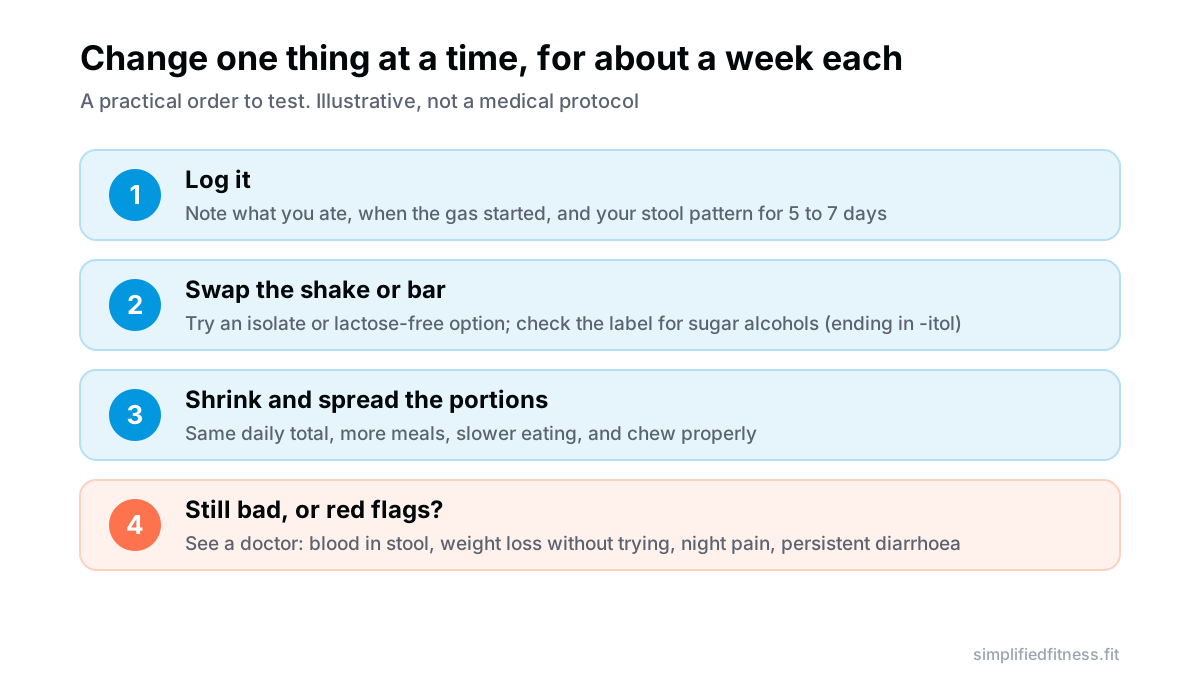
Step 1: Log it. For 5-7 days, note meals, shakes, when gas or bloating starts, and your stool pattern. Patterns jump out quickly. If it always starts 20 minutes after the shake, you have your answer.
Step 2: Swap the shake or bar. Try an isolate or lactose-free powder. Drop bars with sugar alcohols. Keep everything else the same.
Step 3: Shrink and spread portions. Keep your daily total but split it, say five meals of 30-40 g instead of three of 60-70 g. The logic is that a smaller load leaves less undigested material for colon bacteria. I did not find a trial in lifters that proves this directly, so treat it as a sensible test. See how much protein you can absorb in one meal for what is known about per-meal limits.
Step 4: Slow down and chew. Smaller food pieces are easier for digestive enzymes to work on. I could not find lifting-specific trials proving chewing cures bloating, but it costs nothing and helps if you eat in six minutes flat.
Fibre and prebiotics: help or hindrance?
Both, depending on speed. Fibre gives gut bacteria something other than leftover protein to ferment, and a protein-heavy, fibre-light plate is a common pattern in lifters who complain of gut trouble. But a sudden jump in fibre often makes gas worse for a few weeks.
Add one extra serving of vegetables, fruit, oats or lentils at a time. Wait several days. Drink more water as fibre goes up. Our fibre guide has practical targets.
Prebiotic supplements and inulin-heavy products can be harsh for some people at the start. A 2025 position statement says prebiotics and phenols may be promising for exercise-related gut symptoms but still need more research (Costa et al., 2025). Food first is a reasonable default.
What about probiotics and low FODMAP diets?
Probiotics. The evidence for lifters is thin. A systematic review of 10 randomised trials in 822 athletes found only slight evidence that probiotics improved gut symptoms during training and competition, and it could not identify a best product (Lagowska et al., 2022). The 2025 position statement goes further and lists probiotic supplementation among interventions that reported negative outcomes (Costa et al., 2025). These findings are mostly in endurance athletes and the products varied, so it is not a verdict on every probiotic. A bowl of curd is a cheaper experiment than a capsule.
Low FODMAP. FODMAPs are fermentable carbohydrates, including some found in legumes, wheat, onion, garlic and certain dairy. In irritable bowel syndrome, a 2025 network meta-analysis of 28 trials (2,338 patients) found that a low FODMAP diet was the only multi-trial dietary option shown superior to a habitual diet for bloating or distension (relative risk of not improving 0.55, 95% CI 0.37-0.80), although confidence in most comparisons was low or very low (Cuffe et al., 2025). The sports position statement also lists FODMAP manipulation among strategies with mostly consistent benefit for exercise-related gut symptoms (Costa et al., 2025).
Here is the catch. Those trials are in IBS patients, not healthy lifters with a shake problem, and the diet is a short elimination followed by reintroduction. It also removes many vegetarian protein staples. If you go there, do it with a dietitian rather than self-experimenting for months.
When bloating is not a diet problem
Diet changes are the right first move for gas that tracks with shakes, big meals or a recent jump in legumes. They are the wrong move when you have:
- blood in your stool or black stools
- weight loss you did not intend
- pain that wakes you at night
- vomiting, or diarrhoea or constipation that does not settle
- bloating that is new, persistent and getting worse
See a doctor for any of these. Conditions like lactose intolerance, coeliac disease, IBS and others can look similar, and a diagnosis is not something an article or a food log can give you.
The bottom line
Gas on a high protein diet is mostly fermentation of whatever reaches the colon, made worse by add-ons like lactose and sugar alcohols and by changing too much too fast. Check whether you need that much protein, change the shake before you change the diet, spread the load, and build fibre up slowly. For a baseline plan, our free diet plan is a sensible starting point.
Evidence in lifters specifically is limited. Much of it comes from reviews, IBS patients and endurance athletes, so treat these steps as structured experiments and pay attention to your own response.
Frequently Asked Questions
Why does a high protein diet cause bloating?
Protein that is not fully digested in the small intestine reaches the colon, where bacteria ferment it and produce gases. A 2022 review lists the fermentation products, which include hydrogen sulfide and ammonia. Try smaller portions spread across the day and see whether the gas drops.
Why do protein shakes cause gas?
Often it is not the protein itself but what comes with it, such as lactose in whey concentrate or sugar alcohols and fibres added to bars and powders. These are fermented in the colon, which makes gas. Switch to an isolate or lactose-free powder, check the label, and change only one thing at a time.
Is 200 g of protein a day too much?
For most lifters it is more than they need. A 2018 meta-analysis of 49 trials found no further gains in fat-free mass beyond about 1.62 g/kg/day, which is roughly 130 g for an 80 kg person. If your gut is struggling at 200 g, dropping towards that range costs you little muscle.
Do protein shakes cause gas because of lactose?
They can if you are lactose intolerant, since whey concentrate typically contains some lactose and isolates contain much less. Undigested lactose is fermented in the colon and produces gas. Try a lactose-free or isolate powder for a week and compare.
Do artificial sweeteners like sucralose cause bloating?
Sugar alcohols such as lactitol, isomalt and maltitol clearly cause dose-related gas and loose stools in trials, while sucralose and aspartame are different compounds. A small trial in 17 healthy adults found no change in gut bacteria after two weeks of realistic doses of either. If a bar bothers you, check for ingredients ending in -itol first.
Do probiotics help with bloating in lifters?
The evidence is thin. A 2022 systematic review of 10 trials in 822 athletes found only slight evidence that probiotics improve gut symptoms, and a 2025 position statement lists probiotic supplementation among interventions with negative outcomes in exercisers. Fermented foods like curd are an easy, low-cost thing to try before buying supplements.
Does eating protein in smaller meals reduce gas?
There is no trial in lifters that directly proves this. The logic is that smaller loads leave less undigested material for colon bacteria, and many people find it helps. Test it by keeping your daily total the same and splitting it across more meals.
Does chewing thoroughly help digestion?
Smaller food particles are easier for enzymes to work on, but I could not find lifting-specific trials showing that chewing more cures bloating. It costs nothing and slows you down, which helps if you tend to inhale meals. Treat it as a cheap experiment, not a guaranteed fix.
Should I try a low FODMAP diet for bloating?
In people with irritable bowel syndrome, a 2025 network meta-analysis of 28 trials found a low FODMAP diet was the best studied dietary option for bloating. It is a short elimination and reintroduction process, not a forever diet, and is best done with a dietitian. It also removes foods like dal, rajma and chana, so protein planning matters.
Can dal, rajma, chana and soya chunks cause gas?
Yes, legumes contain fermentable carbohydrates that many people struggle with, and big jumps in intake are the usual trigger. These carbohydrates are fermented by colon bacteria, which produces gas. Soak and cook them well, start with smaller portions, and build up over a few weeks.
Can too much fibre make bloating worse?
Yes, a sudden jump in fibre often increases gas for a while because bacteria ferment more of it. The gut generally adapts if you add fibre gradually, drink enough water and spread it through the day. Add about one extra serving at a time and wait several days before increasing again.
How long does it take to fix protein bloating?
It depends on the cause. Swapping a shake or cutting sugar alcohols can help within a few days, while fibre adjustments take a few weeks to settle. Give each change about a week so you can tell what actually worked.
When should I see a doctor about bloating?
See a doctor if you have blood in your stool, weight loss you did not intend, pain that wakes you at night, vomiting, or diarrhoea or constipation that will not settle. Those signs point to conditions that diet tinkering will not fix. Bloating that is persistent and new, even without red flags, is worth a check as well.
Sources & References
Every claim above is checked against peer-reviewed research (PubMed, U.S. National Library of Medicine) or guidance from established health bodies. How we fact-check.
- Cai J, et al. High animal protein diet and gut microbiota in human health. Crit Rev Food Sci Nutr. 2022. PMID: 33724115
- Morton RW, et al. A systematic review, meta-analysis and meta-regression of the effect of protein supplementation on resistance training-induced gains in muscle mass and strength in healthy adults. Br J Sports Med. 2018. PMID: 28698222
- Costa RJS, et al. Sports Dietitians Australia and Ultra Sports Science Foundation Joint Position Statement: A Practitioner Guide to the Prevention and Management of Exercise-Associated Gastrointestinal Perturbations and Symptoms. Sports Med. 2025. PMID: 40195264
- Cuffe MS, et al. Efficacy of dietary interventions in irritable bowel syndrome: a systematic review and network meta-analysis. Lancet Gastroenterol Hepatol. 2025. PMID: 40258374
- Ahmad SY, et al. The Effects of Non-Nutritive Artificial Sweeteners, Aspartame and Sucralose, on the Gut Microbiome in Healthy Adults: Secondary Outcomes of a Randomized Double-Blinded Crossover Clinical Trial. Nutrients. 2020. PMID: 33171964
- Koutsou GA, et al. Dose-related gastrointestinal response to the ingestion of either isomalt, lactitol or maltitol in milk chocolate. Eur J Clin Nutr. 1996. PMID: 8617186
- Vesa TH, et al. Digestion and tolerance of lactose from yoghurt and different semi-solid fermented dairy products containing Lactobacillus acidophilus and bifidobacteria in lactose maldigesters, is bacterial lactase important? Eur J Clin Nutr. 1996. PMID: 8933119
- Łagowska K, et al. Effects of Probiotics Supplementation on Gastrointestinal Symptoms in Athletes: A Systematic Review of Randomized Controlled Trials. Nutrients. 2022. PMID: 35807826

Umair Hazrami · Founder & Head Coach, Simplified Fitness
Umair Hazrami founded Simplified Fitness and the Simplified Lifter channel to cut through fitness noise. With 4+ years of consistent training and 10+ coaching clients, he writes every guide from the peer-reviewed research and links the sources so you can check them. Our editorial standards.
Educational content only, not medical advice. If you have a medical condition, are pregnant, or take medication, talk to a qualified doctor before changing your diet, supplements or training. Full disclaimer.
Keep reading
Nutrition
Alcohol and Muscle Growth: What a Heavy Night Does to MPS, Sleep and Recovery
Alcohol and muscle growth: does a heavy Saturday night wipe out your week? See what research says on MPS, REM sleep and recovery, and how to limit the damage.
7 min read

Nutrition
Ashwagandha and Cortisol: Does It Lower Stress and Boost Strength in the Gym?
Ashwagandha for lifting: what the trials show on cortisol, stress and strength gains, realistic dose (300-600 mg), who should skip it and how to buy it safely.
7 min read
Nutrition
Caffeine Sensitivity, CYP1A2 Genetics and Caffeine Cycling: Why Pre-Workout Works for Him, Not You
Caffeine sensitivity genetics explain why pre-workout gives your friend PRs and you anxiety. See what CYP1A2 and ADORA2A do, and how to find your dose.
8 min read
Nutrition
Creatine Non-Responders: Why It May Not Be Working and What to Try
Creatine non responder? Learn why roughly 1 in 4 people see little change, how baseline diet matters, and when carbs with creatine help. Studies linked.
7 min read