Why Did I Gain 3 Lbs Overnight? Glycogen, Salt, Water and Gut Content Explained
Why did I gain 3 lbs overnight? Glycogen, salt, water and food in your gut explain 1-2 kg scale jumps. See the math, the studies and a weigh-in protocol.

TL;DR. The short answer
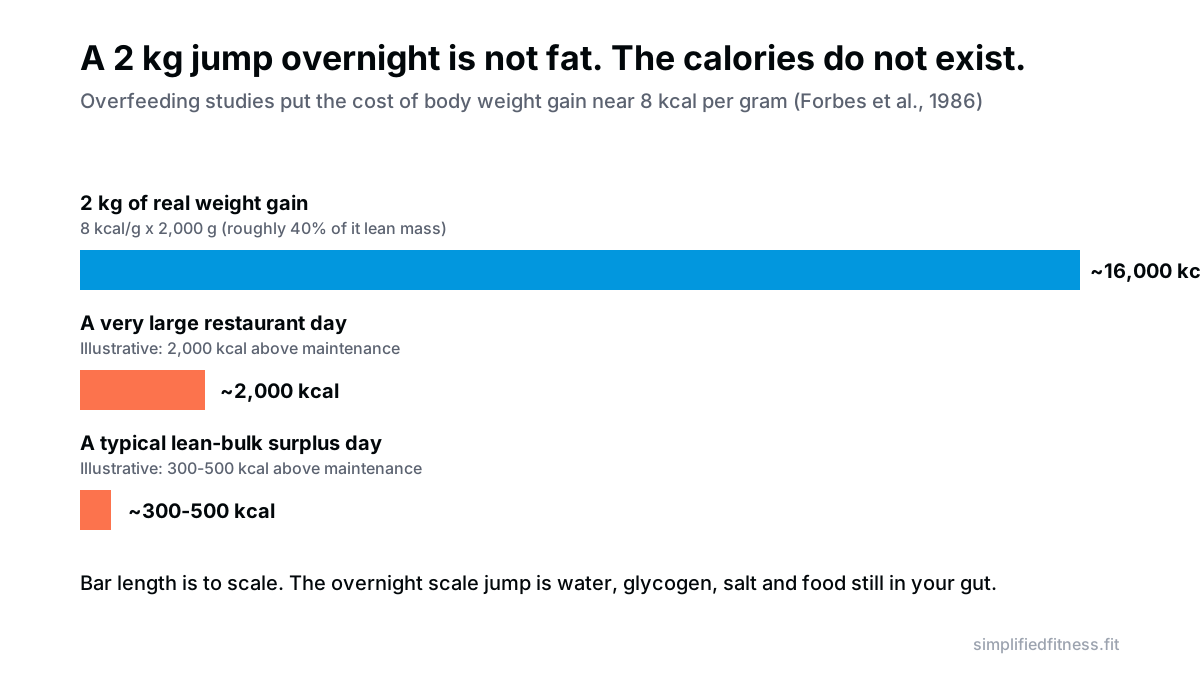
- A jump of 1-2 kg overnight is almost never fat. Real tissue gain costs roughly 8 kcal per gram in overfeeding studies, so 2 kg would need about 16,000 extra kcal.
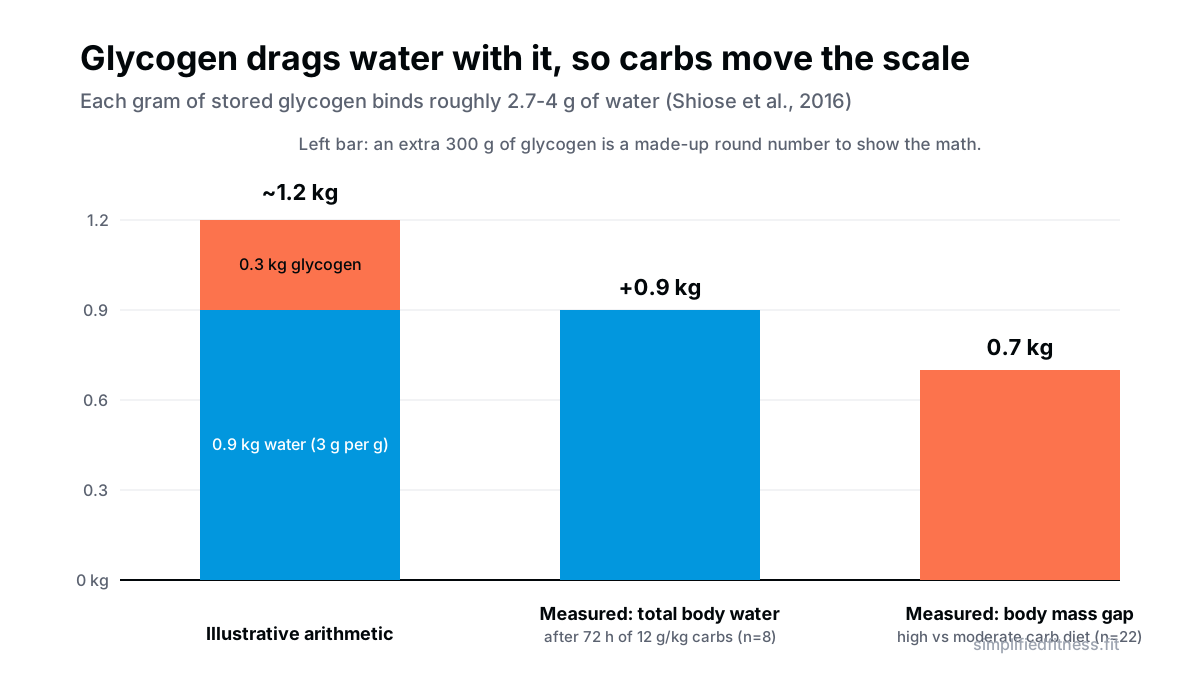
- Glycogen binds water, roughly 2.7-4 g of water per gram. A carb-heavy day or a hard training week can add around a kilo of water without any fat gain.
- Sodium mostly shifts fluid between compartments. Controlled data show high salt raised plasma volume without raising total body water, so salt may be a smaller driver than people assume.
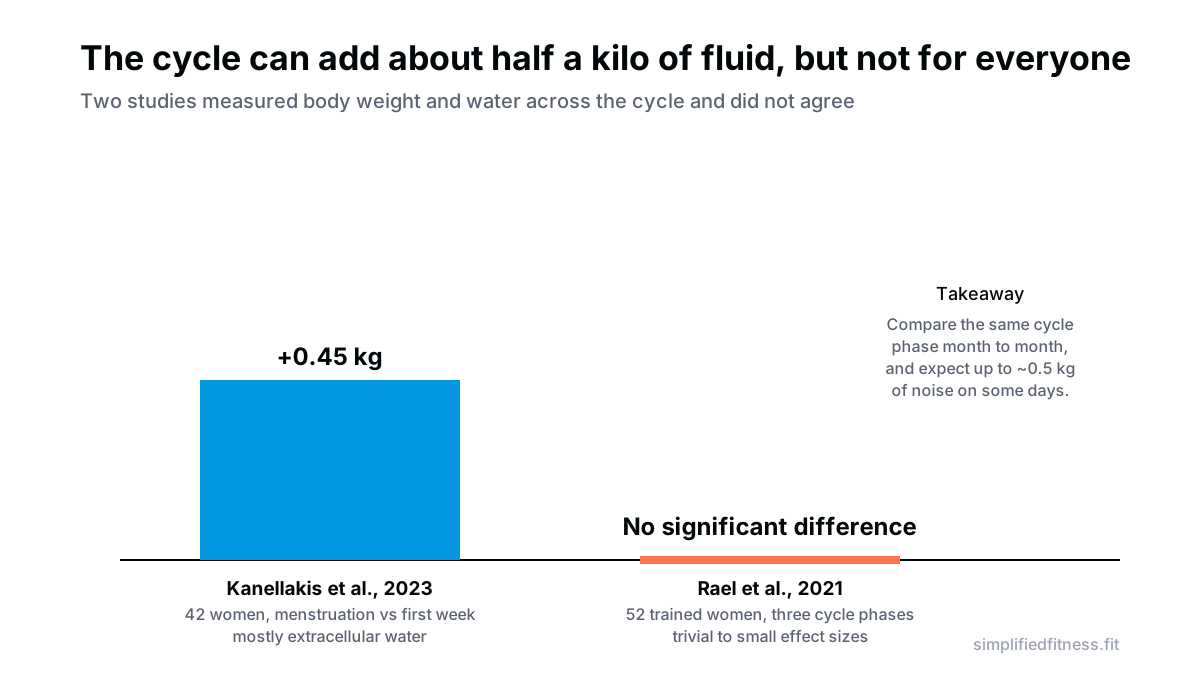
- Women may see around 0.5 kg of extra fluid around menstruation, though one study in trained women found no significant cycle effect.
- Weigh at the same time under the same conditions, then judge the weekly average and waist, not any single reading.
Part of our complete guide: Body Composition, Muscle Memory and Habits: A Lifter's Guide to Tracking
Table of contents
You stepped on the scale and it says 1.4 kg more than yesterday. So, why did I gain 3 lbs overnight? In nearly every case it is water, stored carbohydrate and food still moving through your gut, not body fat. Fat simply cannot be built that fast.
This is the single biggest emotional trigger that makes people quit a good plan. One bad weigh-in, a panic cut in calories, and the whole routine falls apart. So we will do the math, look at what the studies actually measured, and end with a simple weigh-in method. This article is the acute fluid deep dive; for the full tracking strategy see our guide to body composition, muscle memory and adherence.
Can you gain fat overnight? The calorie math
Start with thermodynamics. Overfeeding studies in people give us the energy cost of putting on body weight. A classic analysis of deliberate overfeeding found an average cost of about 8 kcal per gram of weight gained (8.05 kcal/g across 48 subjects combined), and roughly 38-44% of the gain was lean mass rather than fat (Forbes et al., 1986).
Run that forward. At about 8 kcal per gram, 2 kg of gained tissue costs about 16,000 kcal above maintenance. Even 1.4 kg (the 3 lbs) is around 11,000 kcal. A big restaurant day might put you 1,500-2,000 kcal over. That is a fraction of one kilo of tissue, never two.
What actually moves the scale overnight
Four things do most of the work: stored carbohydrate and its water, sodium and fluid distribution, the contents of your gut, and hormonal or inflammatory fluid shifts. I will take them in order of how much evidence sits behind them.
Glycogen and water: why carbs move the scale
Your muscles and liver store carbohydrate as glycogen, and glycogen is stored with water. Researchers describe it as about 2.7-4 g of water bound to each 1 g of glycogen (Shiose et al., 2016).
In that study, 8 people ate a high-carbohydrate diet of 12 g per kg body mass per day for 72 hours after a glycogen-depleting cycling session. Muscle glycogen rose from about 73 to about 169 mmol/kg wet weight, and total body water rose from 39.3 to 40.2 kg. The extra water showed up as intracellular water, mainly in the legs.
A second trial in 22 men asked a practical question: what does glycogen do to body mass? After three days of either a moderate or a high carbohydrate diet, pre-exercise muscle glycogen was 367 vs 525 mmol/kg dry weight, and body mass was 0.7 kg lower after the moderate-carb diet, with no difference in short cycling performance (Schytz et al., 2023).
Both studies are small and used young, active adults in controlled settings (the larger one only men), so treat the exact numbers as a guide. The direction is consistent: more glycogen, more water, more body mass.
This is why a pizza or biryani night (or a rice-heavy thali after weeks of low-carb eating) can show up as a bump on the scale. It is also why the first week of cutting carbs looks like dramatic fat loss and is mostly water. For the full carbohydrate picture, see our piece on dietary carbohydrates, glycogen and hypertrophy.
Sodium and water retention after a salty meal
The common story is simple: eat salt, hold water, gain weight. The evidence is a bit more nuanced, and worth knowing so you do not over-blame salt.
In a controlled metabolic-ward study, 32 healthy men ate sodium chloride amounts from 50 up to 550 mEq a day. Plasma volume rose in a dose-dependent way, by 315 ml in the highest group, but total body water did not rise and neither did body mass. The authors concluded that high sodium shifted fluid from the interstitial space into the blood rather than adding water to the body (Heer et al., 2000).
That is one study in healthy men under tightly controlled conditions, and it does not match everyday life, where salty restaurant meals also come with extra carbs and bulk. So I read it like this: salt may matter less for the scale than the folk story says, and a salty, carb-heavy meal moves the scale more through carbs and food volume than through salt alone.
What it cannot tell you is whether your own scale jumps after a salty dinner for other reasons, or how people with high blood pressure, kidney or heart conditions respond. If that is you, follow your doctor’s advice on salt rather than this article. For the gym-specific angle, we cover salt, blood pressure and active trainees and pre-workout sodium separately.
Food volume, digestion time and bowel transit
A kilo of food is a kilo on the scale until it leaves your body. A big meal, extra fluids, high-fibre foods, a long travel day, or constipation all increase the mass in your digestive tract. None of this is fat, and none of it is tracked by the number of calories.
I am not citing a specific figure here, because gut content varies a lot between people and days. The practical rule is enough: weigh after using the toilet, before eating or drinking, so this noise is as similar as possible from one morning to the next. If constipation, loose stools or blood in the stool persist, that is a doctor conversation, not a scale problem.
Hard workouts, cortisol and fluid
Hard training can leave you heavier for a day or two. The likely reasons are sore, inflamed muscle holding extra fluid and the extra carbohydrate you eat to recover. Stress and poor sleep may also nudge fluid balance through hormones such as cortisol.
I will be straight about the limits here: I did not find a study that quantifies this effect in lifters, so I will not give you a number. If you changed your program, added volume, or came back from a break and the scale is up a kilo or so, it fits this pattern. The answer is to keep going and wait.
Menstrual cycle and fluid retention
If you menstruate, hormones add another layer. The research is mixed, and I think it is worth showing both sides.
A study of 42 women measured weight, circumferences, skinfolds and bioimpedance twice a week through the cycle. Body weight was 0.45 kg higher during menstruation than during the first week of the cycle, mostly from a 0.47 kg increase in extracellular water, with no other significant body composition changes (Kanellakis et al., 2023).
A study of 52 trained women measured body composition by bioimpedance at three points in the cycle. It found no significant differences in body weight, fat mass, fat-free mass or total body water between phases, with trivial to small effect sizes (Rael et al., 2021).
Why the different results? The measurement timing differed (twice weekly versus three fixed phases), the groups differed (general versus well-trained women), and both used bioimpedance, which is itself influenced by hydration. Taken together, about half a kilo of fluid shift is a reasonable expectation for some people and not for others.
If you notice large or painful swelling, very heavy periods, or cycles that suddenly change, speak to your doctor. That is not something to sort out with a scale.
A healthy protocol for weighing yourself
The goal is not to get a “true” daily number, because there is no such thing. The goal is to reduce noise and read the trend. Here is the simple method I would use.
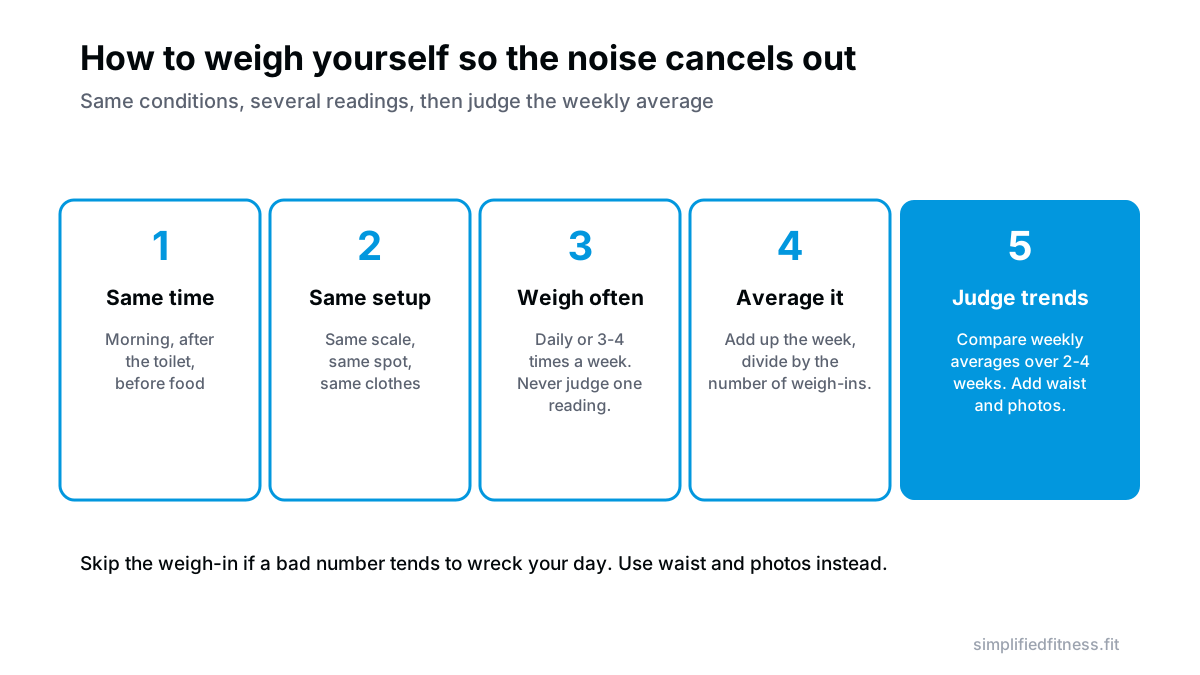
- Same time, same state. Morning, after the toilet, before food and water.
- Same setup. Same scale on a hard, flat floor, same clothing (or none).
- Weigh often enough to average. Daily or three to four times a week.
- Average the week. Add the readings and divide by the number of weigh-ins.
- Compare week to week. Judge changes over two to four weeks, along with your waist and photos. Our guide to DIY physique tracking with waist, photos and scale averages shows how.
Does frequent weighing help? A systematic review of randomized trials found no significant difference between daily and weekly weighing instructions, and that adding self-weighing to a multi-component weight-loss programme was associated with more weight loss. It also noted a lack of evidence for self-weighing as a standalone strategy (Madigan et al., 2015). In a 6-month trial of 91 overweight adults, daily self-weighing did not cause adverse psychological outcomes, and the group reported lower body dissatisfaction and higher dietary restraint (Steinberg et al., 2014).
Those trials were in adults trying to lose weight, in structured programmes. They do not prove the scale is safe for everyone. If weighing makes you anxious, drives restrictive eating, or you have a history of an eating disorder, skip the scale and track waist, photos and training numbers.
What to do when the scale jumps
- Do nothing for 2-3 days. Eat normally, drink normally, train normally.
- Do not slash carbs or salt. That just trades one swing for another.
- Check the weekly average, not the day. One high point in a flat line is noise.
- Look at a different signal. Waist, photos, and whether your lifts are going up tell you more.
- If you are really unsure, run your numbers through the calorie calculator and check your expected pace with the weight loss timeline calculator.
If your average has climbed for several weeks, that can be a real gain, and it is worth looking at calories honestly. For the opposite pattern, a stall followed by a sudden drop, see the whoosh effect and water retention while cutting. For the broader day-to-day pattern, our article on daily scale weight fluctuations, sodium, glycogen and bowels goes through it from a different angle.
When to see a doctor
Ordinary water weight comes and goes in a few days and does not come with symptoms. See a doctor if weight rises quickly together with swelling of the legs, ankles, face or around the eyes, shortness of breath, very little urine, or sudden abdominal swelling. Several medicines also cause fluid retention. Do not self-diagnose from the scale.
The bottom line
A jump of 1-2 kg overnight does not mean you gained fat. Tissue costs around 8 kcal per gram, so it would need many thousands of extra kilocalories. Glycogen and its water, food and fluid in your gut, some sodium-driven fluid shifts and, for some women, the menstrual cycle explain the daily wobble. Control your weigh-in conditions, read the weekly average, and use waist and photos as a second opinion. The scale is a rough instrument. Use it as one.
Frequently Asked Questions
Why did I gain 3 lbs overnight?
Three pounds is about 1.4 kg, and overnight that is almost certainly water, glycogen and food still moving through your gut rather than fat. Real fat gain would need roughly 11,000 kcal above maintenance in a day, which is not realistic. Check again after two or three normal days before drawing any conclusion.
Can you really gain 2 kg of fat overnight?
No, not from eating. Overfeeding studies estimate the energy cost of gained body weight at about 8 kcal per gram, so 2 kg would take around 16,000 kcal. If the scale jumped 2 kg, treat it as fluid and gut content and track the weekly average.
Why does my weight go up after a salty meal?
A salty meal makes you thirsty and your kidneys need time to clear the extra sodium, so you may hold a little more fluid for a day or so. But in a controlled metabolic-ward study, steady high salt intake raised plasma volume by about 315 ml without raising total body water or body mass, so salt alone is probably a smaller driver than the carbs and food volume that come with salty meals. Keep your salt intake steady rather than swinging between extremes, and drink normally.
How much water does glycogen hold?
Roughly 2.7-4 g of water binds to each gram of glycogen. That is why a high-carbohydrate day can add several hundred grams to a kilo to the scale. Cutting carbs works in reverse, which is why the first week of a low-carb diet shows fast weight loss that is mostly water.
Why is my weight higher after a hard workout?
Hard sessions can cause muscle soreness and inflammation that may hold extra fluid, and eating more carbs to recover refills glycogen and its water. This is plausible physiology, though I would not put an exact number on it for any one person. If the rise shows up the day after leg day and fades within a few days, it is not fat.
How long does water weight take to go away?
Most food and fluid shifts settle within 2-4 days if your routine returns to normal. Glycogen and its water depend on how many carbs you eat, so they follow your intake. If you are still up after two weeks of steady eating, treat it as a real trend and check calories.
Does the menstrual cycle change scale weight?
It can. A study of 42 women found body weight about 0.45 kg higher during menstruation than the first week of the cycle, mostly extracellular water, while a study of 52 trained women found no significant change across cycle phases. Compare the same cycle phase from month to month rather than week to week.
Why does my weight jump up and down every day?
Day-to-day readings reflect water, glycogen, sodium, food in your digestive tract and timing, not just fat. Fat changes slowly, while these other factors can move the scale by a kilo or more. Weigh under the same conditions and look at the weekly average.
Do bowel movements affect scale weight?
Yes. Food, fluid and stool in your digestive tract have mass, and how much is inside you varies with meal size, fibre, travel and constipation. This is why weighing after using the toilet and before eating keeps readings more comparable. If constipation or bowel changes persist, speak to a doctor.
What is the best time to weigh myself?
Morning, after using the toilet and before eating or drinking, gives the most comparable readings because your gut and fluid load are most similar each day. Use the same scale on a hard flat floor with the same clothing. Do it daily or three to four times a week and average the readings.
Should I weigh myself every day?
Daily weighing is fine for most people if you read the average, not the single number. A systematic review found no significant difference in weight loss between weekly and daily weighing instructions, and a 6-month trial in 91 adults found daily weighing did not cause adverse psychological outcomes. If a bad reading ruins your day or you have a history of disordered eating, skip the scale and use waist and photos.
Does creatine cause the scale to jump?
Creatine pulls water into muscle cells, so a gain of around a kilo in the first weeks is common, especially with a loading phase, and it is not fat. It is a one-time shift, not a daily wobble. Account for it by expecting a new baseline and comparing weekly averages from there.
When should I worry about sudden weight gain?
See a doctor if you gain weight fast with swelling in your legs, face or around the eyes, shortness of breath, or very little urine. Rapid unexplained gain can signal heart, kidney, liver or thyroid problems, and some medicines cause fluid retention. This article is general education, not a diagnosis.
Sources & References
Every claim above is checked against peer-reviewed research (PubMed, U.S. National Library of Medicine) or guidance from established health bodies. How we fact-check.
- Shiose K, et al. Segmental extracellular and intracellular water distribution and muscle glycogen after 72-h carbohydrate loading using spectroscopic techniques. J Appl Physiol. 2016. PMID: 27231310
- Schytz CT, et al. Lowered muscle glycogen reduces body mass with no effect on short-term exercise performance in men. Scand J Med Sci Sports. 2023. PMID: 36932633
- Heer M, et al. High dietary sodium chloride consumption may not induce body fluid retention in humans. Am J Physiol Renal Physiol. 2000. PMID: 10751219
- Kanellakis S, et al. Changes in body weight and body composition during the menstrual cycle. Am J Hum Biol. 2023. PMID: 37395124
- Rael B, et al. Body composition over the menstrual and oral contraceptive cycle in trained females. Int J Sports Physiol Perform. 2021. PMID: 33004685
- Forbes GB, et al. Deliberate overfeeding in women and men: energy cost and composition of the weight gain. Br J Nutr. 1986. PMID: 3479191
- Madigan CD, et al. Is self-weighing an effective tool for weight loss: a systematic literature review and meta-analysis. Int J Behav Nutr Phys Act. 2015. PMID: 26293454
- Steinberg DM, et al. Daily self-weighing and adverse psychological outcomes: a randomized controlled trial. Am J Prev Med. 2014. PMID: 24355668

Umair Hazrami · Founder & Head Coach, Simplified Fitness
Umair Hazrami founded Simplified Fitness and the Simplified Lifter channel to cut through fitness noise. With 4+ years of consistent training and 10+ coaching clients, he writes every guide from the peer-reviewed research and links the sources so you can check them. Our editorial standards.
Educational content only, not medical advice. If you have a medical condition, are pregnant, or take medication, talk to a qualified doctor before changing your diet, supplements or training. Full disclaimer.
Keep reading

Health & Longevity
Overcoming the All-or-Nothing Mindset: How Perfectionism Wrecks Long-Term Fitness
The all-or-nothing mindset in fitness turns one missed workout into a lost month. Here is the research, the never-miss-twice rule and a 20-minute fallback plan.
10 min read

Health & Longevity
How to Build a Gym Habit: The Behavioral Science of Sticking With It
How to build a gym habit using habit science: how long it takes, why cues and low friction beat willpower, and what identity can and cannot do for consistency.
8 min read

Health & Longevity
Best Way to Measure Body Fat: DEXA, Bod Pod, Calipers and 4C Compared
The best way to measure body fat percentage is the same tool, under the same conditions, every time. See how DEXA, Bod Pod, calipers and 4C really compare.
8 min read

Health & Longevity
Body Recomposition Limits: Who Can Recomp, and When Advanced Lifters Must Choose a Surplus or Deficit
Body recomposition limits explained: who can still lose fat and gain muscle at once, why advanced lifters stall, and how to choose a cut or lean bulk.
9 min read