Best Way to Measure Body Fat: DEXA, Bod Pod, Calipers and 4C Compared
The best way to measure body fat percentage is the same tool, under the same conditions, every time. See how DEXA, Bod Pod, calipers and 4C really compare.

TL;DR. The short answer
- No single tool gives your true body fat percentage. Even against a four-compartment (4C) reference, DXA and other common methods can be off by several percentage points for one person.
- The best way to measure body fat percentage for a lifter is to pick one method, standardise the conditions (fasted, hydrated, rested) and compare trends, not single numbers.
- Water and carbohydrate intake can shift DXA lean mass by about 2 kg in a day or two, while measured fat mass stayed unchanged in one study. Food and fluid matter.
- Skinfolds are cheap and less affected by day-to-day variability, but they depend on a skilled, consistent tester and tend to read lower than 4C criterion values.
- If a measurement frightens or confuses you, track waist, photos and strength alongside it. A single reading is a snapshot with an error bar, not a verdict.
Part of our complete guide: Body Composition, Muscle Memory and Habits: A Lifter's Guide to Tracking
Table of contents
There is no single best way to measure body fat percentage, because every common tool estimates fat from assumptions instead of measuring it directly. For a lifter, the practical answer is to choose one method, test it under the same conditions every time, and trust the trend over any single number.
That is the short version of a bigger point in our complete guide to body composition, muscle memory and adherence. A body fat reading is a snapshot with an error bar. Here is how big that error bar is for DEXA, Bod Pod, hydrostatic weighing and calipers, and how to set up your own tracking so the noise stops fooling you.
Why every method is an estimate
You cannot peel fat off a living person and weigh it. So labs split the body into compartments using indirect signals, then apply equations. A review of contemporary methods notes that all of them carry inherent problems, either in the measurement itself or in the assumptions underneath (Fosbøl and Zerahn, 2015).
The common tools measure different things:
- Skinfold calipers measure the thickness of skin and fat folds at set sites, then use an equation.
- Hydrostatic (underwater) weighing and the Bod Pod measure body density, by water displacement or air displacement.
- DEXA (DXA) uses two low-dose X-ray beams to separate fat, lean tissue and bone.
- Bioimpedance and smart scales pass a small current through the body and estimate water, then fat. We cover those in smart scales and BIA body fat accuracy.
Each conversion assumes something about a “typical” body, such as how hydrated your lean tissue is. You are not typical, and neither are you on a hot Tuesday after a salty dinner.
How does the 4-compartment model work?
When researchers need a reference, they often use a four-compartment (4C) model. Two-compartment methods split you into fat and fat-free mass and assume the fat-free part is constant. A 4C model measures extra pieces so it does not have to assume as much.
A common version combines three measurements. In one validation study of elite athletes, body volume came from air displacement plethysmography, bone mineral from DXA and total body water from deuterium dilution (Santos et al., 2010). Those feed an equation that separates fat from water, mineral and protein-rich tissue.
That is why a 4C model is treated as the criterion in research: it corrects for the very things that fool simpler tools, like unusually high bone density or watery lean tissue. It is also why you will almost never see one in a gym. It needs a Bod Pod or underwater tank, a DXA scanner and an isotope water test.
“Criterion” does not mean flawless. It means the best available yardstick to judge the others against.
DEXA scan vs Bod Pod accuracy: what the studies show
Here is the honest picture from the studies that compared common tools to a 4C model.
DEXA. In 27 elite male judo athletes, DXA changes in body fat, fat mass and lean mass were not significantly different from 4C changes at the group level. But DXA explained only 29%, 36% and 38% of the 4C change values, and the 95% limits of agreement for change in body fat percentage were -3.7 to 5.3 points (Santos et al., 2010). The authors concluded DXA did not show the expected accuracy for tracking changes in adiposity in these athletes. You will often hear that DEXA has a “2-4% margin of error”. In this study the individual spread for change was wider than that, roughly 4 to 5 points either way, though it was a small group of elite male athletes and may not match you.
Bod Pod. In 42 adult women, the Bod Pod read an average of 28.8% body fat against 30.6% from the 4C model. That is a small average underestimate, and the authors found the water fraction of fat-free mass affected the Bod Pod result (Fields et al., 2001).
Hydrostatic weighing. In that same study, body density from hydrostatic weighing was not statistically different from Bod Pod density (1.0352 vs 1.0349 g/cm3). The two density methods agree with each other, but that does not make either one the truth, since both still need assumptions to convert density to fat. I did not find a recent head-to-head trial in lifters to quote on hydrostatic weighing alone, so treat it as a close cousin of the Bod Pod.
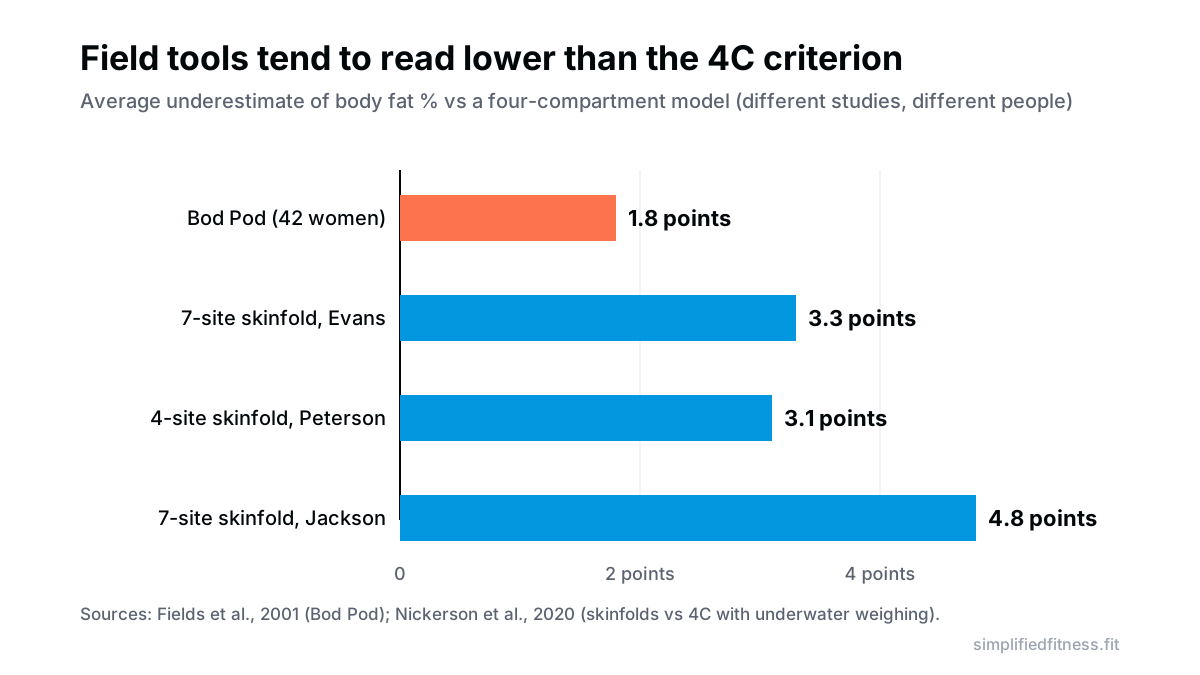
So which is better, DEXA or Bod Pod? Studies of each used different people and different references, so they cannot be ranked from these numbers alone. What they do show is that both carry error of a few percentage points for an individual.
Why DEXA results move with water and carbs
This is the part most gym-goers never hear. DEXA’s lean tissue reading includes water, and water changes fast.
In a small study of 12 active men, hard exercise in heat dropped body mass by 1.93 kg and DXA lean tissue by 1.69 kg. After a 48-hour high-carbohydrate diet (8-12 g/kg/day) to supercompensate glycogen, body mass rose 2.53 kg and lean tissue rose 2.36 kg. Measured fat mass and bone mineral did not change at any point (Toomey et al., 2017). The authors concluded carbohydrate loading and dehydration can create apparent changes in lean mass.
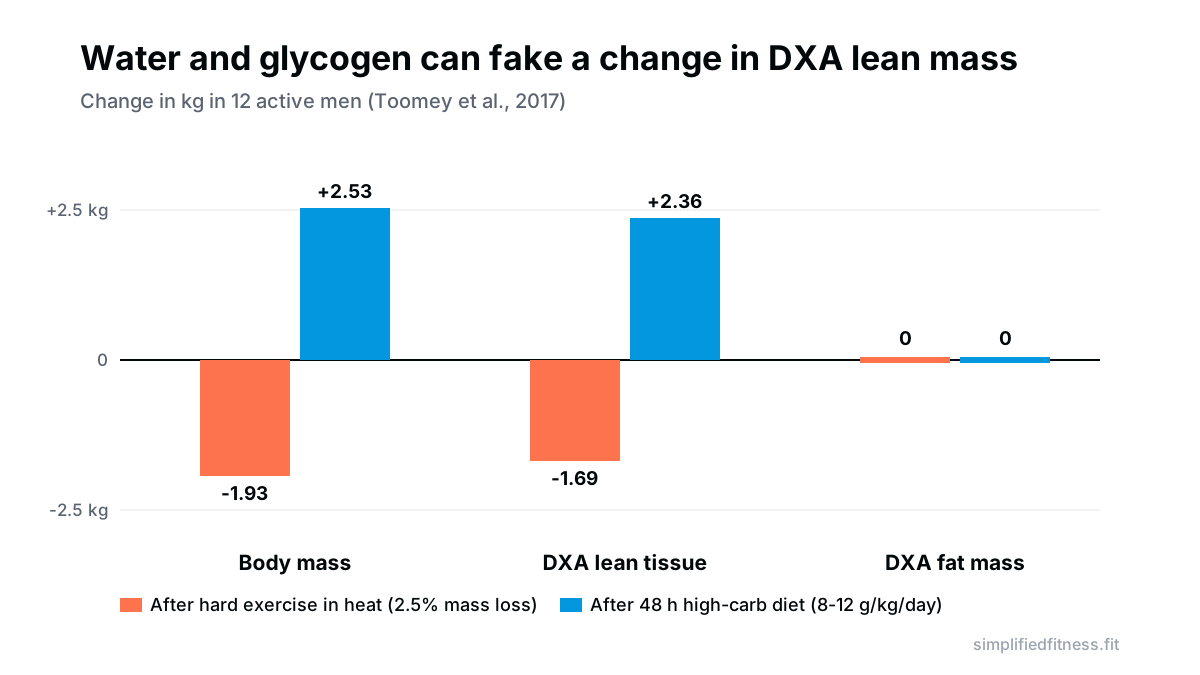
Even a glass of water counts. In a randomised trial of 46 people, 1000 mL of water significantly increased whole-body lean soft tissue on DXA, mostly in the trunk. The authors recommend keeping water under 500 mL in the 90 minutes before a scan (Sergi et al., 2026).
In athletic men, an overnight-fasted, hydrated, rested scan was compared with non-standardised scans taken after food and fluid. Standardising reduced the biological error in all models, and DXA and Bod Pod were acceptable if acute food and fluid intake stayed below 500 g (Kerr et al., 2017).
How accurate are skinfold calipers?
Calipers have a bad reputation, but the picture is more balanced than you would expect.
In 187 healthy adults (96 men, 91 women), skinfold equations were compared with 4C models. The 7-site Jackson, 7-site Evans and 4-site Peterson equations all read lower than the 4C result, by about 4.8, 3.3 and 3.1 percentage points on average, though the exact error depended on how the 4C reference was built. The authors concluded skinfolds can offer reasonable accuracy in field settings when advanced methods are unavailable (Nickerson et al., 2020).
A narrative review of methods in sport reached a counterintuitive point. DXA is preferred when you need bone mineral or limb-specific data, but skinfolds appeared least affected by day-to-day variability, hence the title “Come Back Skinfolds, All Is Forgiven” (Kasper et al., 2021). Note this is a narrative review, so it reflects the authors’ reading of the evidence rather than a pooled analysis.
Why do these findings differ from “calipers are inaccurate”? Because they answer different questions. Calipers can be off in absolute terms (they read lower) yet stable from week to week. For tracking, stability is what you want.
The catch is the tester. Calipers are only as good as the person pinching. Use the same trained person, the same sites, the same side of the body and the same time of day.
A practical way to track body fat as a lifter
Here is the setup I would suggest for most recreational lifters.
- Pick one method you can repeat. A DEXA at a clinic, a Bod Pod at a university, or calipers with the same trained tester. Avoid mixing devices.
- Standardise the conditions. Morning, overnight fasted, normal hydration, no hard session the day before, similar clothing. Keep water small (under 500 mL) in the 90 minutes before a DXA scan.
- Write down what you did. Last meal, fluid, sleep, training. Future you will thank you.
- Measure every 8-12 weeks, not weekly. Real fat change is slower than the noise.
- Read the result as a range. A 17% reading could reasonably mean a few points either side.
- Add cheap daily signals. Waist at the navel, photos in the same light, and a weekly scale average. See DIY physique tracking with waist, photos and scale averages for the full routine.
Can you trust changes over time?
Even the research reference has limits when you track change. In a 2026 study of athletes, rapid 4C models that used DXA and bioimpedance shortcuts all underestimated changes in fat mass compared with the full criterion 4C. Their precision was as good as or better than DXA alone, but the limits of agreement stayed wide (the best was -2.9% to 4.0%), so the authors advise caution at the individual level (Silva et al., 2026). This is a very recent report and has not been widely replicated.
The takeaway: a small change in percentage, say 1 or 2 points, is inside the noise for most tools. A change that shows up across your method, your waist and your photos is more believable.
If your numbers are making you anxious or driving restrictive eating, step back from the device. A registered dietitian or doctor can help if body image or food intake is becoming a problem. If you are trying to reshape your body, our guide to body recomposition limits explains what is realistic.
The bottom line
Body fat tools are useful, but none gives you a pure truth. DEXA is not magic, a Bod Pod is not infallible, and calipers are not useless. Each is an estimate, and each swings with hydration, food and the person operating it.
Choose one, repeat it under the same conditions, and judge by the trend. If you want a training plan to go with your tracking, start with our free push pull legs plan.
Frequently Asked Questions
What is the best way to measure body fat percentage?
There is no single most accurate method for everyone, because every common tool estimates body fat from assumptions rather than measuring it directly. For most lifters the best choice is whichever method you can repeat under the same conditions, since consistency beats absolute accuracy. Pick one, test fasted and hydrated, and compare your own trend over months.
How accurate is a DEXA scan for body fat?
DXA is good at the group level but less certain for one person, especially for tracking changes. In 27 elite judo athletes, the 95% limits of agreement for change in body fat percentage against a 4C model were -3.7 to 5.3 points. Treat a single DEXA number as a range, and use the same machine each time.
DEXA scan vs Bod Pod: which is more accurate?
Neither is clearly perfect, and both are compared against 4C models in research. In 42 adult women the Bod Pod read 28.8% fat against 30.6% from a 4C model, a small average underestimate. Choose the one you can access and repeat consistently rather than hunting for a winner.
What is a 4-compartment model for body fat?
A 4C model splits the body into fat, water, mineral and protein-rich tissue instead of just fat and everything else. It combines body volume (for example from air displacement), total body water (isotope dilution) and bone mineral (DXA). It is used as a research reference, so it is rarely available to gym-goers.
Is hydrostatic weighing the gold standard?
Hydrostatic weighing measures body density, but turning density into fat percentage still relies on assumptions about water and mineral content. A 4C model corrects for those, which is why researchers use it as the criterion instead. In one study, body density from hydrostatic weighing and the Bod Pod was very close in women.
How accurate are skinfold calipers?
Skinfolds can give reasonable accuracy in field settings, but they often underestimate versus a 4C reference. In 187 healthy adults, 7-site and 4-site equations read about 3 to 5 percentage points lower on average. They work best when the same trained person measures the same sites each time.
Is a 7-site skinfold better than a 4-site one?
Not clearly. In the 4C comparison, two 7-site equations and one 4-site equation all read lower than the criterion, with different average errors. Equation choice and tester skill matter more than the number of sites, so stick with one equation and one person.
Can drinking water change my DEXA result?
Yes, it can change the lean mass estimate. In a randomised trial of 46 people, 1000 mL of water significantly increased DXA whole-body lean soft tissue, mostly in the trunk. Researchers suggest limiting water to under 500 mL in the 90 minutes before a scan.
Does carb loading affect body composition scans?
It can. In 12 active men, a 48-hour high-carbohydrate diet raised DXA lean tissue by about 2.4 kg and body mass by about 2.5 kg, with no change in measured fat mass. Avoid unusual carb loading or dehydration before a scan, and keep your routine the same each time.
How often should I measure body fat?
Every 8 to 12 weeks is plenty for most people, because real changes in fat mass are slower than the measurement error. Measuring weekly mostly captures noise from water and food. Between scans, use waist, photos and the scale average instead.
How should I prepare for a body composition test?
Standardise everything you can, because food, fluid and exercise change the reading. Test in the morning after an overnight fast, with normal hydration, no hard session the day before, and similar clothing. Write your conditions down so the next test matches.
Are body fat percentages from gym machines or smart scales reliable?
They are less dependable than lab methods, and single readings can swing with hydration. Use them only as a trend under identical conditions, and do not compare numbers across devices. Our guide on smart scales covers the specific flaws in detail.
Why do different methods give different body fat numbers?
Each method measures something different, such as skin thickness, body density, X-ray attenuation or electrical resistance, then converts it to fat using equations. Those equations assume a typical person, so your result shifts depending on your hydration, bone density and build. Compare numbers only within one method.
Sources & References
Every claim above is checked against peer-reviewed research (PubMed, U.S. National Library of Medicine) or guidance from established health bodies. How we fact-check.
- Santos DA, et al. Accuracy of DXA in estimating body composition changes in elite athletes using a four compartment model as the reference method. Nutr Metab (Lond). 2010. PMID: 20307312
- Kerr A, et al. Impact of food and fluid intake on technical and biological measurement error in body composition assessment methods in athletes. Br J Nutr. 2017. PMID: 28382898
- Kasper AM, et al. Come Back Skinfolds, All Is Forgiven: A Narrative Review of the Efficacy of Common Body Composition Methods in Applied Sports Practice. Nutrients. 2021. PMID: 33806245
- Toomey CM, et al. The effect of hydration status on the measurement of lean tissue mass by dual-energy X-ray absorptiometry. Eur J Appl Physiol. 2017. PMID: 28204901
- Fields DA, et al. Comparison of the BOD POD with the four-compartment model in adult females. Med Sci Sports Exerc. 2001. PMID: 11528352
- Nickerson BS, et al. The relative accuracy of skinfolds compared to four-compartment estimates of body composition. Clin Nutr. 2020. PMID: 31036415
- Sergi TE, et al. Acute water ingestion influences lean soft tissue estimation from dual-energy x-ray absorptiometry: Implications for clinical diagnosis. Clin Nutr ESPEN. 2026. PMID: 42668016
- Silva TR, et al. Tracking changes in body composition in athletes: are rapid four-compartment models valid? Br J Nutr. 2026. PMID: 42206588
- Fosbøl MØ, et al. Contemporary methods of body composition measurement. Clin Physiol Funct Imaging. 2015. PMID: 24735332

Umair Hazrami · Founder & Head Coach, Simplified Fitness
Umair Hazrami founded Simplified Fitness and the Simplified Lifter channel to cut through fitness noise. With 4+ years of consistent training and 10+ coaching clients, he writes every guide from the peer-reviewed research and links the sources so you can check them. Our editorial standards.
Educational content only, not medical advice. If you have a medical condition, are pregnant, or take medication, talk to a qualified doctor before changing your diet, supplements or training. Full disclaimer.
Keep reading

Health & Longevity
Overcoming the All-or-Nothing Mindset: How Perfectionism Wrecks Long-Term Fitness
The all-or-nothing mindset in fitness turns one missed workout into a lost month. Here is the research, the never-miss-twice rule and a 20-minute fallback plan.
10 min read

Health & Longevity
How to Build a Gym Habit: The Behavioral Science of Sticking With It
How to build a gym habit using habit science: how long it takes, why cues and low friction beat willpower, and what identity can and cannot do for consistency.
8 min read

Health & Longevity
Body Recomposition Limits: Who Can Recomp, and When Advanced Lifters Must Choose a Surplus or Deficit
Body recomposition limits explained: who can still lose fat and gain muscle at once, why advanced lifters stall, and how to choose a cut or lean bulk.
9 min read
Health & Longevity
How Long Does It Take to Lose Muscle? A Realistic Detraining Timeline
How long does it take to lose muscle after you stop lifting? A week-by-week look at glycogen, strength and muscle size, with every study linked and sourced.
9 min read