Goal Setting That Actually Works: Process Goals vs Outcome Goals in Strength and Fat Loss
Process goals vs outcome goals in fitness: how to turn 'I want abs' into weekly habits you control, with what the goal-setting research does and does not show.

TL;DR. The short answer
- Outcome goals (a number on the scale, a 100 kg bench) set the direction, but process goals (sessions, protein days, logged sets) are what you can actually do each week.
- Meta-analyses of goal-setting trials report medium to large effects on physical activity, and the trials behind them used specific goals, not vague intentions.
- The idea that big outcome goals always cause anxiety and quitting is not clearly supported: two weight loss studies found unrealistic goals were not linked to worse results.
- Pair every outcome goal with 2-3 weekly process goals, one lead indicator you log, and a review every 4-12 weeks.
- If a goal is driving disordered eating, obsessive training or real distress, speak to a doctor or qualified mental health professional.
Part of our complete guide: Body Composition, Muscle Memory and Habits: A Lifter's Guide to Tracking
Table of contents
Process goals vs outcome goals in fitness comes down to this: an outcome goal is the result you want (a six-pack, a 100 kg bench), and a process goal is the behaviour you control this week (lift three times, hit 140 g protein, log every set). Outcome goals give you direction. Process goals give you something you can actually do on a Tuesday evening.
Most people only set the first kind, and then judge themselves by a scale or a mirror that moves slowly and unevenly. This article is part of our complete guide to body composition, muscle memory and adherence. Here we stay on goal structure: how to write goals, what the research does and does not show, and how to review them. For the habit side, see our guide to the behavioural science of gym habits.
What is the difference between process goals and outcome goals?
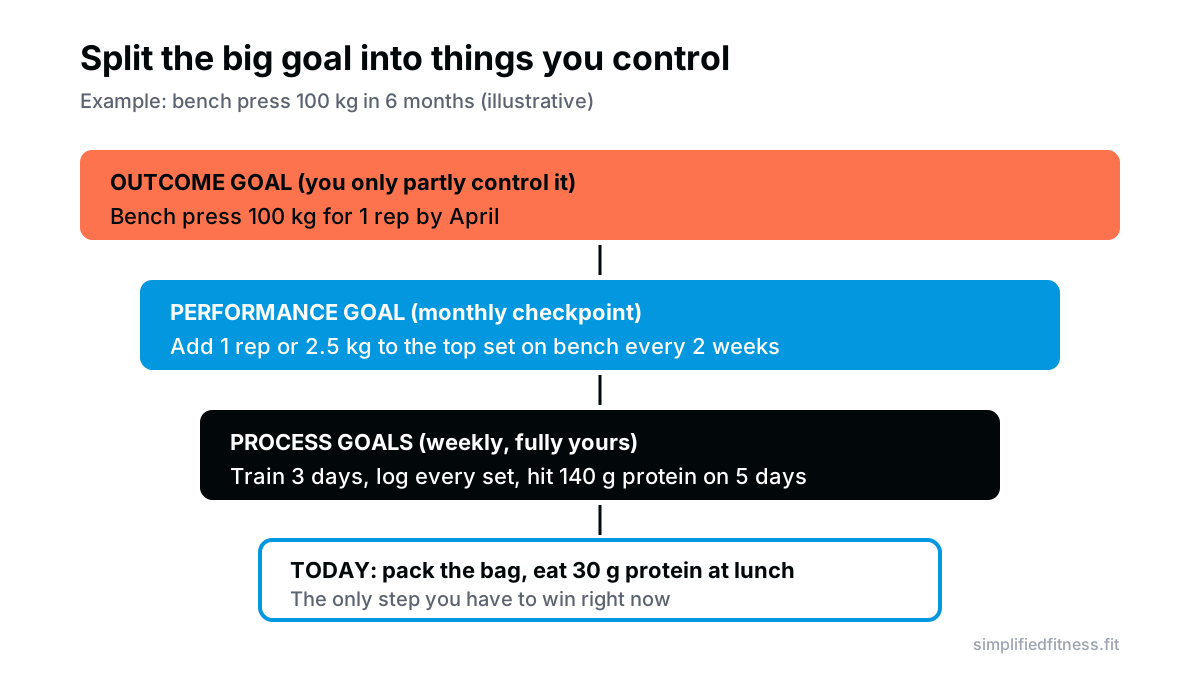
An outcome goal describes an end state: “lose 8 kg”, “get abs”, “bench 100 kg”. You only partly control it. Your body weight depends on sleep, water, hormones and genetics as much as willpower.
A process goal describes an action: “train Monday, Wednesday, Saturday”, “eat 30 g protein at lunch”, “walk 8,000 steps”. It is fully yours. You either did it or you did not.
There is a middle layer too, a performance goal: “add one rep to my top set every two weeks”. It is a measurable checkpoint that still depends partly on your body.
What does goal-setting research actually show?
The foundation here is goal-setting theory. Locke and Latham summarised 35 years of research on how goals work, the moderators of their effects and the theory’s limitations (Locke & Latham, 2002). It is mostly workplace and task research, so treat it as the framework, not as gym-specific proof.
For exercise itself, two reviews are worth knowing:
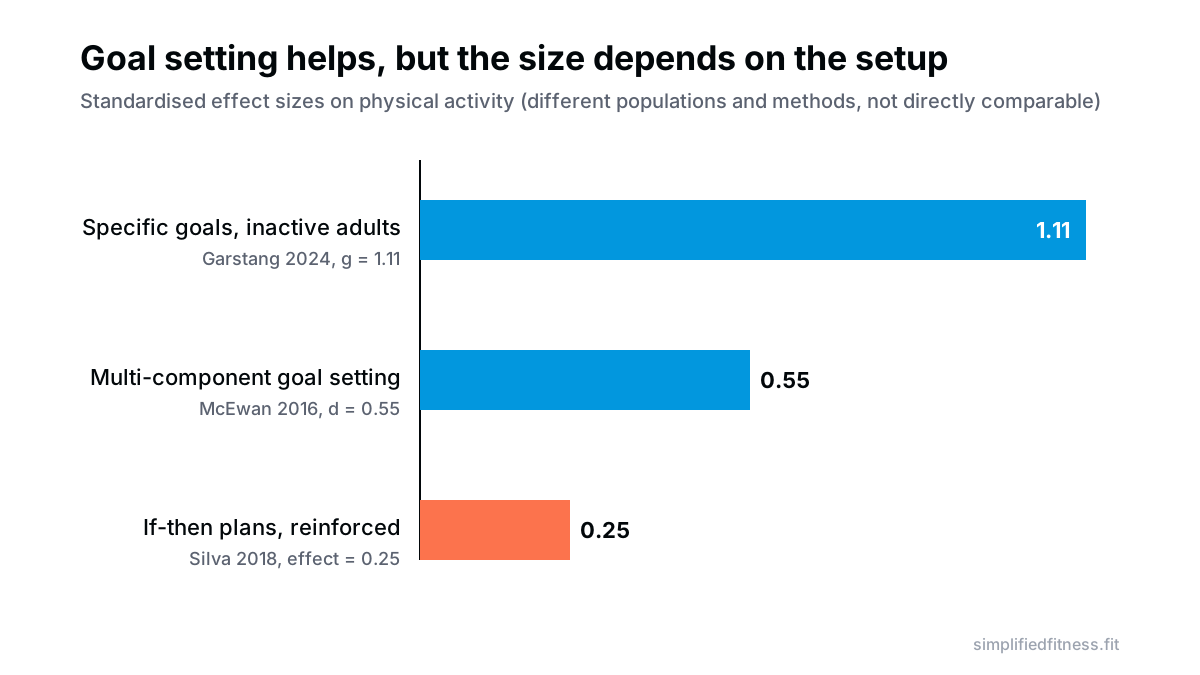
- A 2016 meta-analysis of 45 articles (5,912 participants) found multi-component goal-setting interventions had a medium positive effect on physical activity (d = 0.55) compared with controls who did not set goals (McEwan et al., 2016).
- A 2024 review of 13 studies in 1,208 insufficiently active adults found specific goals had a large effect on physical activity (g = 1.11) but only a small effect on psychological outcomes like motivation and self-efficacy (g = 0.25) (Garstang et al., 2024).
Two details in the 2024 review are interesting. All the goals used were specific ones, so it tells us little about vague goals. And interventions without rewards beat interventions with rewards (g = 1.30 vs 0.60). The authors call their findings initial insight and ask for more research on a wider range of goal types.
Do outcome goals really cause anxiety and failure?
This is the claim you will see repeated online. The honest answer is that the data are mixed.
On one side, the logic is reasonable. If a goal depends on things you cannot control, a bad week can feel like failure even when you did everything right. That is a psychological argument, and it matches what many coaches see.
On the other side, two weight loss studies from the same Minnesota group looked at how realistic people’s goals were. In 1,801 adults in a weight loss trial, goals averaged around a 16-21% loss, which is unrealistically high. In women, less realistic goals were linked to more weight loss at 24 months. In men, goals were unrelated to participation or weight loss (Linde et al., 2005). An earlier study in 302 women found goal weight losses averaging 24% and no link with psychological distress, and only a weak link with outcomes (Linde et al., 2004).
Why might the stories and the studies disagree? Those trials measured the starting goal, not what happened to people’s mood when the scale stalled. They were in overweight adults enrolled in treatment, not gym beginners chasing abs. And average results can hide individuals who do get discouraged.
My practical read: a big dream is not the problem. A plan built only on the dream is. Keep the ambition, then judge yourself by the behaviours.
How do I turn “I want six-pack abs” into a weekly plan?
Visible abs are an outcome of low body fat, which is mostly an energy balance question. You can build the plan with four questions.
- What is the outcome and by when? “Reduce my waist by 4 cm in 16 weeks” is better than “get lean”.
- What behaviours drive it? For fat loss that usually means a calorie target you can hold, enough protein, daily steps and resistance training to keep muscle.
- How many days a week can I do it in a bad week? Not a perfect week. A bad one.
- What do I log? One number per behaviour, once a day.
A worked example (illustrative, adjust to your body and schedule):
- Outcome: waist down 4 cm in 16 weeks.
- Process goals: lift 3 days a week, average 8,000 steps, hit your protein target on at least 5 days, calorie target on 5 of 7 days.
- Today: dal and paneer bhurji at lunch to start the protein count early.
For the numbers, our protein intake calculator and weight loss timeline calculator give a starting point you can adjust.
How do I turn “bench 100 kg” into process goals?
Same method, different behaviours. Say you bench 80 kg for a single and want 100 kg. That is a 20 kg jump, and beginners and intermediates progress at very different speeds, so be careful with timelines.
- Performance checkpoint: add one rep or 2.5 kg to your top set every 2 weeks.
- Process: bench twice a week, log every set with weight and reps, sleep at least 7 hours on 5 nights, eat enough protein.
- Review: every 4 weeks test your top set. If it has not moved after two cycles of good logging, change something (volume, exercise order, calories).
For logging, see how to keep a training logbook for progressive overload. If you want to estimate where you stand, the 1RM calculator turns a hard 5-rep set into an estimated max, so you do not need to test a true single every month.
Lead vs lag indicators: what should I track?
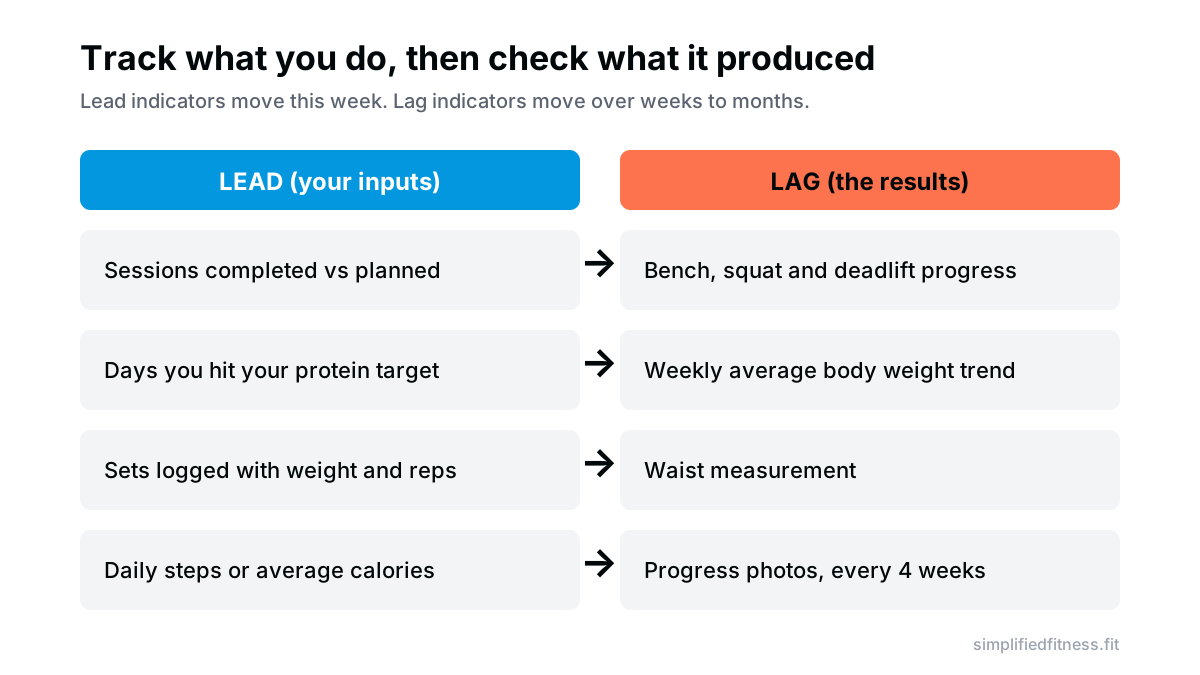
Lead indicators are the things you do. Lag indicators are the results those things eventually produce. The trouble with only watching lag indicators is the delay. Your weekly body weight trend, strength PRs and waist all respond slowly and with noise. If you only look at those, you spend weeks guessing whether the plan works.
Lead indicators change immediately, so a missed session or a low protein week shows up in the data while you can still fix it.
Evidence for self-monitoring is supportive but not perfect. A review of 22 weight loss studies found a consistent association between self-monitoring (diet, exercise, self-weighing) and weight loss, but the authors judged the evidence weak because of methodological limits, such as mostly white female samples and reliance on self-report (Burke et al., 2011). A larger review of 48 trials in adults with obesity found that goal setting and self-monitoring of behaviour predicted bigger improvements in diet and physical activity, both in the short and the long term (Samdal et al., 2017).
Daily scale readings are a noisy lag indicator. If the scale is what keeps ruining your week, read our guide to why scale weight fluctuates.
How do I keep a New Year gym resolution?
Most January plans have an outcome (“get fit”) and no process. The research on if-then planning, called implementation intentions, suggests specifics help a little. A meta-analysis of 13 randomised trials (adults aged 18 to 76) found that implementation intentions with reinforcement had a small positive effect on physical activity (0.25, 95% CI 0.05-0.45) (Silva et al., 2018).
In plain gym terms:
- “If it is Monday at 6 pm, then I walk to the gym before I sit down.”
- “If I miss a session, then I train the next day and do not wait for next Monday.”
- “If I eat out, then I order a protein dish first.”
Three things make resolutions survive past February:
- A starting goal small enough to hit in a bad week.
- A written when-and-where for each session.
- A scheduled review, so you adjust instead of quitting.
If you tend to drop everything after one missed workout, our piece on all-or-nothing thinking in fitness goes deeper on that.
How should I review my goals every quarter?
A simple rhythm works for most people:
| When | What to check | What to do |
|---|---|---|
| Weekly | Sessions done, protein days, steps | Fix one thing for next week |
| Every 4 weeks | Strength numbers, waist, weekly average weight | Keep, raise or change a process goal |
| Every 12 weeks | The outcome goal itself | Reset the target and timeline |
At the 12-week review, ask three questions:
- Did I do what I said I would do? (process)
- Did the result move? (outcome)
- If I did the process and the result did not move, is the plan wrong, or is the timeline too short?
That last question matters. Good process with no outcome means adjust the plan. Poor process with no outcome means the plan was never tested.
When should I see a doctor or professional?
Goal setting is meant to make training calmer, not more stressful. See a doctor or qualified mental health professional if goals around weight, food or training are causing panic, guilt after eating, skipped meals, training through injury or a feeling that nothing is ever enough. These can be signs of an eating or body-image problem, and a goal system will not fix them. If you have a medical condition, are pregnant, or are older and starting from scratch, check your plan with your doctor first.
The short version: set the outcome, write the weekly behaviours, log the inputs, review on a schedule, and change the plan before you change your opinion of yourself.
Frequently Asked Questions
What is the difference between process goals and outcome goals in fitness?
An outcome goal is a result, such as losing 6 kg or benching 100 kg, while a process goal is a behaviour you control, such as training three times a week or eating 140 g protein. Coaches and sport psychologists separate the two because behaviours respond to effort directly, while results respond to behaviours plus biology, time and luck. Write down both, but judge your week by the process goals.
Are outcome goals bad?
No, outcome goals are useful for choosing a direction and keeping you interested. The problem starts when they are the only thing you track, because results lag behind effort and can stall for weeks. Keep the outcome goal, then attach weekly behaviours to it so you can tell whether you are on track before the scale moves.
How do I set realistic fitness goals?
Start from your current numbers and a pace that beginners and intermediates commonly achieve, then work backwards into weekly behaviours. Realistic is a moving target, because progress in strength and muscle is fast early and slows with training age. Set a 12-week goal, review it at week 4 and 8, and adjust the target if your logged behaviours were good but the result lagged.
What are SMART goals for lifting?
SMART stands for specific, measurable, achievable, relevant and time-bound, and it is a practical checklist for writing goals. A lifting version looks like: add 2.5 kg to my incline press top set by 6 December, by training chest twice a week and logging every set. Use the checklist to make the behaviour part concrete, not only the target.
What are lead and lag indicators in the gym?
Lead indicators are inputs you can influence this week, like sessions completed or days you hit protein, while lag indicators are results like strength PRs, waist size or the scale trend. Lead indicators change first, so they tell you early whether your plan is being followed. Log one or two lead indicators weekly and look at lag indicators every 2-4 weeks.
Do unrealistic weight loss goals make people fail?
Not necessarily. A 2005 study of 1,801 people found goals were unrealistically high on average, and in women less realistic goals were linked to more weight loss at 24 months, while goals were unrelated to outcomes in men. That is one trial in overweight adults, so it does not mean extreme targets are wise. A sensible approach is to hold a big long-term dream loosely and judge yourself by behaviours.
Why do New Year gym resolutions fail?
Resolutions often fail because they state a distant outcome with no plan for the specific days, times and situations where the behaviour has to happen. Research on implementation intentions, which are if-then plans, found a small positive effect on physical activity in a meta-analysis of 13 trials, in the studies that reinforced the plans. Replace 'get fit this year' with 'Mon, Wed, Sat at 6 pm I train, and if I miss one I train the next day'.
How many days a week should my process goal be?
Choose a number you can hit in your worst normal week, not your best one. A goal of three sessions that you hit is more useful than five sessions you hit half the time, because the logged success builds the habit. Start there and raise it only after four or more weeks of hitting it.
How often should I review my fitness goals?
Review behaviours weekly and outcomes every 4 weeks, with a bigger reset every 12 weeks. Weekly checks catch skipped sessions and low-protein days while they are still cheap to fix. At the 12-week review, decide whether to keep, raise or change the goal based on what you actually logged.
Should I focus on the scale or on habits?
Use habits as the main score and the scale as a lagging check. Daily body weight swings with water, salt and food in the gut, so a single reading is a poor judge of fat loss. Track the weekly average and pair it with a habit score such as steps, protein days and sessions.
What if I hit my process goals but see no results?
First check whether the process goals really match the outcome, for example, whether 140 g protein and three sessions is enough volume for your target. Then give it enough time, because strength and body composition often need 4-8 weeks to show a clear trend. If a few reviews pass with solid logs and no movement, adjust the plan, not your opinion of yourself, and consider speaking to a coach or doctor.
Can goal setting become unhealthy?
Yes, rigid goals around weight, food or training can become obsessive for some people, especially with a history of disordered eating or body image concerns. Warning signs include panic when you miss a session, guilt around eating, or training through injury. If that sounds familiar, speak to a doctor or a mental health professional before pushing harder.
Sources & References
Every claim above is checked against peer-reviewed research (PubMed, U.S. National Library of Medicine) or guidance from established health bodies. How we fact-check.
- Locke EA, et al. Building a practically useful theory of goal setting and task motivation: a 35-year odyssey. Am Psychol. 2002. PMID: 12237980
- Garstang KR, et al. What effect do goal setting interventions have on physical activity and psychological outcomes in insufficiently active adults? A systematic review and meta-analysis. J Phys Act Health. 2024. PMID: 38560998
- McEwan D, et al. The effectiveness of multi-component goal setting interventions for changing physical activity behaviour: a systematic review and meta-analysis. Health Psychol Rev. 2016. PMID: 26445201
- Samdal GB, et al. Effective behaviour change techniques for physical activity and healthy eating in overweight and obese adults; systematic review and meta-regression analyses. Int J Behav Nutr Phys Act. 2017. PMID: 28351367
- Silva MAVD, et al. Impact of implementation intentions on physical activity practice in adults: a systematic review and meta-analysis of randomized clinical trials. PLoS One. 2018. PMID: 30427874
- Burke LE, et al. Self-monitoring in weight loss: a systematic review of the literature. J Am Diet Assoc. 2011. PMID: 21185970
- Linde JA, et al. Weight loss goals and treatment outcomes among overweight men and women enrolled in a weight loss trial. Int J Obes (Lond). 2005. PMID: 15917847
- Linde JA, et al. Are unrealistic weight loss goals associated with outcomes for overweight women? Obes Res. 2004. PMID: 15044676

Umair Hazrami · Founder & Head Coach, Simplified Fitness
Umair Hazrami founded Simplified Fitness and the Simplified Lifter channel to cut through fitness noise. With 4+ years of consistent training and 10+ coaching clients, he writes every guide from the peer-reviewed research and links the sources so you can check them. Our editorial standards.
Educational content only, not medical advice. If you have a medical condition, are pregnant, or take medication, talk to a qualified doctor before changing your diet, supplements or training. Full disclaimer.
Keep reading

Health & Longevity
Overcoming the All-or-Nothing Mindset: How Perfectionism Wrecks Long-Term Fitness
The all-or-nothing mindset in fitness turns one missed workout into a lost month. Here is the research, the never-miss-twice rule and a 20-minute fallback plan.
10 min read

Health & Longevity
How to Build a Gym Habit: The Behavioral Science of Sticking With It
How to build a gym habit using habit science: how long it takes, why cues and low friction beat willpower, and what identity can and cannot do for consistency.
8 min read

Health & Longevity
Best Way to Measure Body Fat: DEXA, Bod Pod, Calipers and 4C Compared
The best way to measure body fat percentage is the same tool, under the same conditions, every time. See how DEXA, Bod Pod, calipers and 4C really compare.
8 min read

Health & Longevity
Body Recomposition Limits: Who Can Recomp, and When Advanced Lifters Must Choose a Surplus or Deficit
Body recomposition limits explained: who can still lose fat and gain muscle at once, why advanced lifters stall, and how to choose a cut or lean bulk.
9 min read