Eating Healthy Under Social Peer Pressure: How to Train and Eat Well When Family and Friends Push Back
Eating healthy under social peer pressure is hard in Indian homes. See what research says about social influence, plus word-for-word scripts for food pushers.

TL;DR. The short answer
- Eating healthy under social peer pressure is a real obstacle, not a willpower flaw. Health behaviours do seem to cluster in families and friend groups, though the research is observational and still debated.
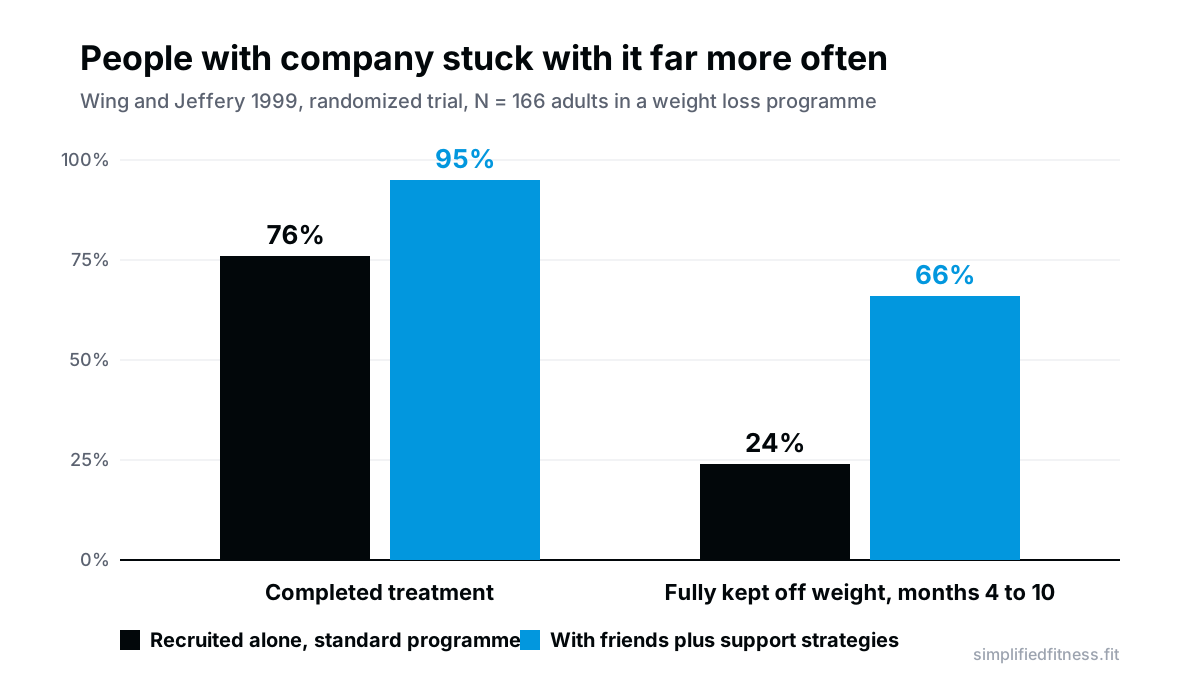
- In a randomized trial of 166 adults, people who joined a weight loss programme with friends and got social support strategies completed it more often than those who joined alone on the standard programme (95% vs 76%) and more often kept the weight off (66% vs 24%).
- Food pushing in Indian homes is usually love, not sabotage. Accept warmly, take a small portion, redirect, then be clear in one calm sentence.
- Support that respects your choices seems to work better than nagging. In one trial, autonomy support predicted better weight loss while encouraging healthy eating was linked to worse results.
- Change your environment before you try to change other people: tell one ally, find one training partner, and make the healthy default the easy one.
Part of our complete guide: Body Composition, Muscle Memory and Habits: A Lifter's Guide to Tracking
Table of contents
Eating healthy under social peer pressure is hard because food is how most families say “I love you.” Turning down a second roti can feel like turning down the person. The practical answer is not to be rigid or to cave in: it is to accept the love, adjust the portion, and be clear about your goal in one calm sentence.
This article is about the people around your plate and your gym bag. If you want the wider picture of staying consistent, start with our guide to body composition, muscle memory and adherence. For the personal side, such as cues and routines, see the behavioural science of gym habits.
Why do family and friends resist your fitness changes?
It rarely feels like support at first. You say no to mithai at a family function and an aunt looks hurt. You leave a movie plan to train and a friend jokes about you “becoming a gym guy.” Your parents ask why you need protein when “dal-roti is enough.”
A few things are usually going on, and most are not malicious.
- Food is love. In many Indian homes, feeding you is the main way care is expressed. Refusing can sound like refusing the care.
- Your change holds up a mirror. When you start training, others may quietly compare themselves with you, even if you never said a word about their habits.
- Group rules are sticky. Friend groups run on unspoken norms (we eat out on Fridays, we skip the gym when it rains). When one person changes, the norm is challenged.
- Fear and lack of information. Parents may worry about supplements, injuries, cost or lost study time. Those are concerns you can answer.
“Crab mentality” gets mentioned a lot online. Sometimes it is real. Often, though, the person is anxious, uninformed or just attached to how things were. Assuming good intent first makes every later step easier.
Do social circles really change what you eat and how you train?
Some of the best evidence comes from observational data, so read it carefully.
Christakis and Fowler followed 12,067 people in the Framingham Heart Study network from 1971 to 2003. A person’s chance of becoming obese rose by 57% (95% CI 6 to 123) if a friend became obese in a given interval. The figure was 40% for adult siblings and 37% for spouses, and the effect was not seen among neighbours (Christakis et al., 2007). The authors concluded that obesity appears to spread through social ties.
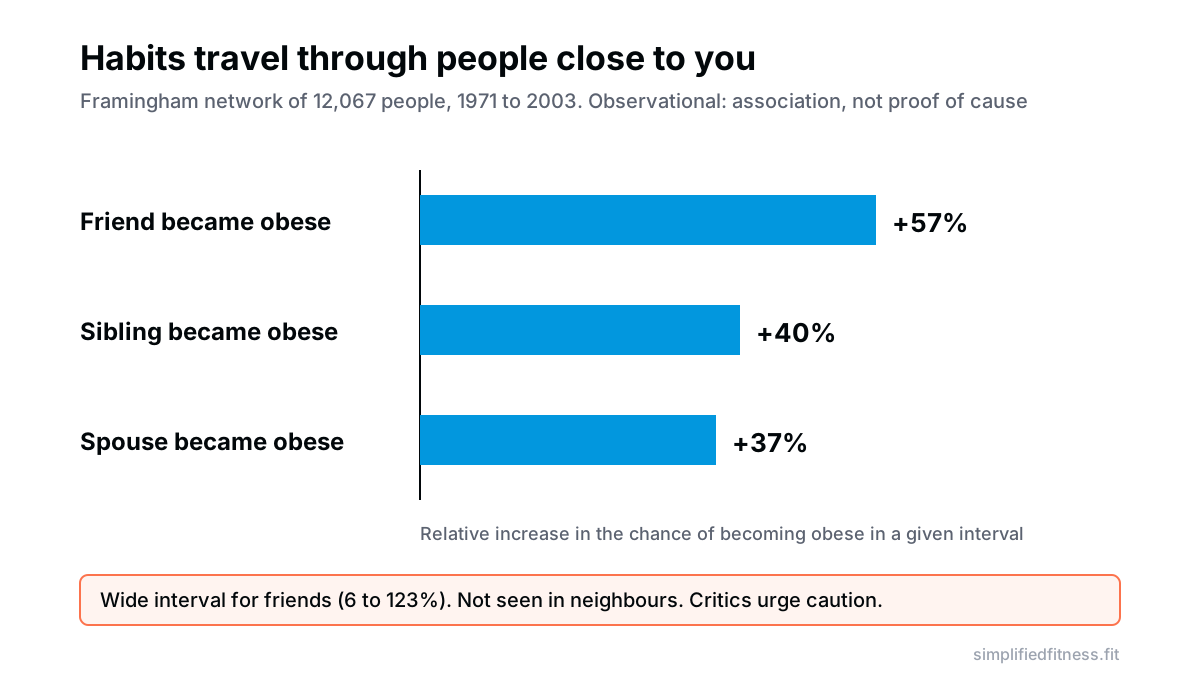
Now the other side. The confidence interval for friends is wide, and the study cannot separate influence from shared circumstances. A 2008 BMJ analysis used similar statistical methods on adolescents and found apparent “network effects” for acne, headaches and height, which should not spread socially. After adjusting for environmental confounders, those effects became smaller and insignificant (Cohen-Cole et al., 2008). That does not prove Christakis was wrong. It does mean the exact size of social contagion is uncertain.
Where does that leave you? Close ties and shared environments probably shape habits, but nobody can give you a trustworthy percentage. The cautious takeaway: your surroundings matter enough to design on purpose, and you should not blame yourself when they pull against you.
Does social support help you stick to a programme?
Experimental evidence is stronger here. Wing and Jeffery recruited 166 adults for a weight loss programme, either alone or with three friends or family members, and randomly assigned them to a standard behavioural treatment or one with added social support strategies. Those recruited with friends lost more weight at 4 months and at the 10-month follow-up. In the alone group on standard treatment, 76% completed the programme and 24% fully maintained their loss from months 4 to 10. Among those with friends plus support strategies, 95% completed and 66% maintained it (Wing & Jeffery, 1999).
Two honest caveats. This was a weight loss trial in adults from 1999, not a lifting study, and the sample was modest. Even so, a 2023 qualitative review of 35 papers on diet and activity programmes found that social support and social accountability were recurring facilitators of adherence (Deslippe et al., 2023).
The pattern is consistent: having company helps. The question is what kind.
What kind of support helps, and what backfires?
“Just eat healthy, beta” is support in the eyes of the person saying it. It may not help.
In a trial of 201 adults in a weight loss programme (mostly women), Gorin and colleagues measured different types of support. Autonomy support at 6 months, meaning support for your own choices, positively predicted weight loss at 18 months. Encouragement of healthy eating at 6 months was negatively related to later weight loss, and other directive forms of support showed no association (Gorin et al., 2014). This is an association within a trial, not proof, but it fits what many lifters notice: nagging does not work.
So when you ask your family for help, be specific and low-pressure:
- “Please do not offer me seconds. I will ask if I want more.”
- “Can we cook the sabzi with less oil on weekdays?”
- “Come for a walk with me after dinner on Sundays.”
That is autonomy support in plain language. You are in charge, they are on your side.
How do you decline food without offending anyone?
Food pushing is the daily version of this problem. Use the lightest move that works.
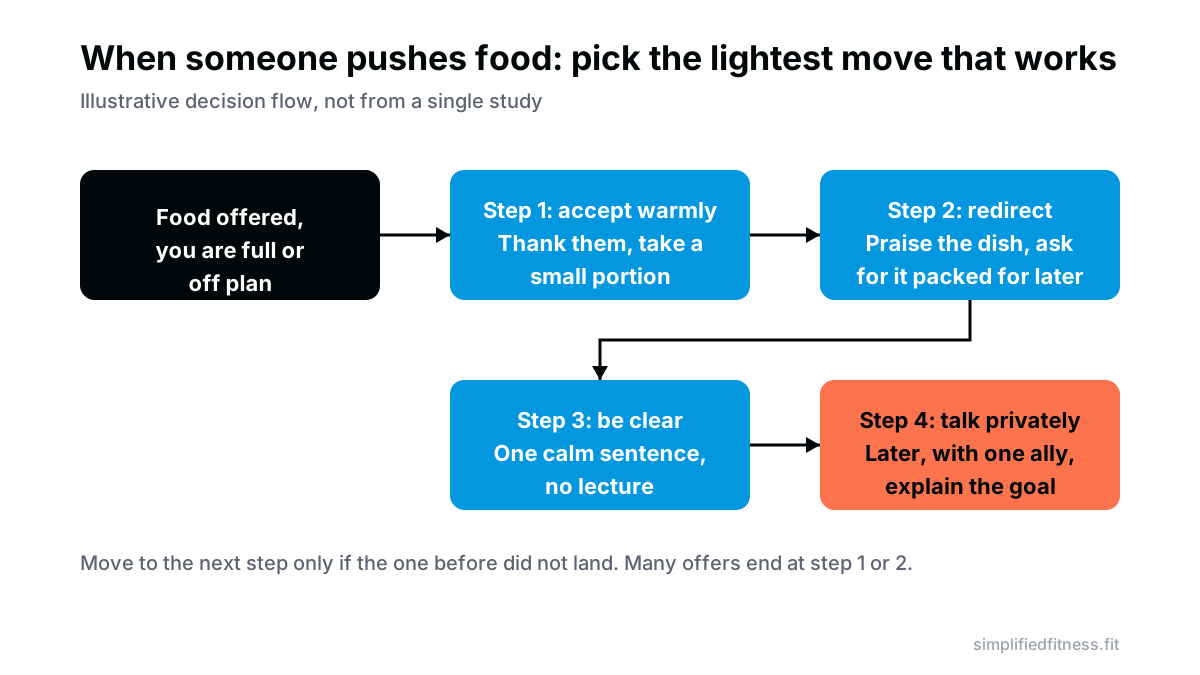
Step 1: Accept warmly, take less. “Thank you, this smells amazing. Just a little for me.” You have honoured the offer and controlled the portion.
Step 2: Redirect. Praise the dish and move the food somewhere else. “Can you pack some for my lunch tomorrow?” Mothers and hosts often love this because the effort is still valued.
Step 3: Be clear in one sentence. “I am full, and it was delicious.” Say it once, kindly, without a nutrition lecture. Explaining the macros of rasmalai to a table of relatives rarely ends well.
Step 4: Talk privately, later. If it keeps happening, speak to the person alone. “I am training for something and I am working on how much I eat. It would help me if you did not insist on seconds.”
A few small tricks:
- Leave a little food on your plate and keep eating slowly. An empty plate gets refilled.
- Serve yourself. When you hold the ladle, nobody else does.
- Start with the protein (dal, paneer, egg, chicken, curd). Protein-rich food tends to be filling, which can make the next refusal easier.
- Hold a glass of water or chaas. It keeps your hands busy.
What about festivals, weddings and eating out?
A single heavy meal does not erase weeks of good eating. Fat gain comes from a sustained surplus, not one day. Decide before you arrive: pick the two or three dishes you really look forward to, enjoy them properly, and skip the ones you would not remember tomorrow.
Then go back to your normal meals the next day, without punishing yourself. That “no punishment” part matters, and it is covered in our piece on the all-or-nothing mindset. If you are eating out with friends, our guide to dining out in India with healthy ordering hacks has practical menu choices. Alcohol is its own peer-pressure topic, and how alcohol affects muscle growth and recovery covers what is worth knowing before you say yes to the next round.
What if your family does not support you going to the gym?
This comes up often, especially for young adults and women in some households. The gym may be seen as a waste of time, an expense or even “not for us.”
I will be careful here: evidence specific to young Indian lifters is thin. A systematic review of qualitative studies on South Asian older adults found that relationships (social support from family, friends and community), beliefs (for example, that exercise is not culturally appropriate) and environment all shaped physical activity. The reviewers suggested using community resources to build group norms (Horne & Tierney, 2012). That population is older and the studies are qualitative, so treat it as a hint, not a rule.
Here is what tends to work in practice:
- Ask what the worry is. Cost? Safety? Studies? Supplements? Each has a different answer.
- Make a small, fixed deal. “Three sessions a week, 60 minutes, never during family meals. Let us review in a month.”
- Show, don’t argue. Better sleep, steadier energy and consistent attendance win more than debates.
- Address the supplement fear directly. Many parents worry about protein powder. Food comes first anyway, and our guide to convincing Indian parents about whey protein safety walks through it.
- Remove cost as an excuse. A home routine from our free workout plans is a reasonable start if gym fees are the sticking point.
How do you find a lifting community or accountability partner?
You do not have to rely on the people who resist. You can add people who do not.
Offline. Look for a regular at your gym who trains at your time. A simple “which day do you train legs?” is often enough to start. Local lifting groups and fitness clubs often welcome beginners.
Online. Pick communities where people post training logs and technique questions, not just transformation photos. A good online group makes your habit look normal.
Why it helps. The evidence on training partners is mostly lab-based. In one randomized experiment, participants did plank exercises alone and then with a virtual partner who always performed better than them. Persistence was significantly greater in every partner condition than in the individual control (Feltz et al., 2011). That was a small game-based task, not a long-term gym study, but it supports a simple idea: a slightly better partner can lift your effort.
A review of exercise adherence in community-dwelling older adults also listed multidimensional social support among eight implementation strategies, alongside things like tailored programmes and monitoring (Yang et al., 2024). Again, older adults, but the thread is consistent.
Set up your partner properly:
- Fix a time and a day. “Whenever” does not survive a busy week.
- Share your logbook or your weekly session count.
- Agree on what a missed session means (a message, not a lecture).
How do you design your environment so you need less willpower?
Changing people is slow. Changing your surroundings is fast.
At home
- Keep curd, fruit, boiled eggs, roasted chana or makhana where you can see them.
- Cook protein in batches so the default meal is a good one. (See our protein calculator for your daily target, and the free diet plan for Indian meal ideas.)
- Move sweets and namkeen out of sight, not out of the house. You are not asking anyone to give up food.
Away from home
- Pack a tiffin or a small snack so you are not choosing from a plate of options at 5 pm.
- Eat something before a party so you are not arriving hungry.
- If you travel, have a fallback routine ready. Our travel workout guide covers hotel rooms and short sessions.
In your head
- Decide in advance what you will say. Rehearsal beats improvisation.
- Pick one or two non-negotiables (for example, protein at each meal and three training sessions) and be flexible about the rest.
A qualitative review of lifestyle interventions concluded that programmes which build self-regulation skills, social engagement and personalised goals may improve adherence, and that anticipating barriers with participants is part of that (Deslippe et al., 2023). Environment design is that idea applied to a Tuesday night.
When should you talk to a professional?
Social pressure around food and bodies is usually just uncomfortable. But there are times to seek help:
- You feel anxious, guilty or secretive about eating, or you avoid family meals entirely.
- Comments about your body leave you distressed for days.
- Your training or dieting feels out of your control or is crowding out the rest of life.
Please see a doctor or a qualified mental health professional if any of that sounds familiar. Not a coach, not a script. This article is general education, not a diagnosis, and anyone with a medical condition should get personalised advice before changing diet or training.
Your goal is not to win every dinner. It is to make your fitness easy to live with, for you and for the people who love you. Be warm, be clear, find your people, and let results do the quiet persuading.
Frequently Asked Questions
How do I deal with family members who keep pushing food on me?
Accept the offer warmly, take a small portion, and say something appreciative so the food is not read as a rejection of the person. Pushing food is usually a way of showing love, so a calm and kind response ends most situations faster than an argument. At the next family meal, ask for your portion yourself so nobody needs to guess.
How do I say no to a second helping without offending anyone?
Praise the food first, then decline with a reason that is about your body and not their cooking, such as 'it was perfect, I am full'. People usually feel hurt by rejection of the dish, not by a full stomach. Keep your plate slightly full of something you are still eating, because an empty plate invites a refill.
Why do my friends make fun of me for going to the gym or eating clean?
Often your change makes people compare themselves with you, which can feel uncomfortable even if you never judged them. Group norms are sticky, and when one person shifts, the group's unspoken rules are challenged. Stay friendly, do not lecture, and keep showing up to the plans you do enjoy.
What do I do if my parents do not support my gym routine?
Start by finding out what exactly worries them, which is often study or work time, cost, safety or fear of supplements, not the gym itself. Research on South Asian older adults suggests beliefs about what is culturally appropriate and support from family strongly shape exercise, so conversations matter. Offer a trial, such as three fixed sessions a week that do not clash with family time, and review it together after a month.
Is it true that your weight is influenced by your friends?
Observational data suggest it may be. A study of over 12,000 people in the Framingham network found that a person's chance of becoming obese rose by 57% if a friend became obese, but critics warn that similar methods can find 'network effects' even for acne and headaches. Treat it as a reason to think about your circle, not as a law.
How do I handle festivals, weddings and mithai without ruining my progress?
One festival meal does not undo weeks of training, because fat gain comes from a sustained surplus, not a single day. Decide your priorities before you arrive, such as eating the one or two dishes you actually look forward to and skipping the ones you would not remember. Return to your normal meals the next day without punishing yourself.
How can I find a gym partner or a lifting community?
Ask at your own gym, join a local lifting group, or use an online community where people post training logs. A lab study found that exercising alongside a virtual partner who was better than the participant made people hold plank exercises longer, so having someone to measure yourself against can raise effort. Pick people whose habits you want to copy, and meet at a fixed time each week.
Does social support actually help with weight loss and exercise?
Yes, support seems to help, though the type matters. Wing and Jeffery's trial found better completion and maintenance when people joined with friends and used support strategies, while a trial by Gorin and colleagues found that autonomy support predicted better outcomes. Ask your people for specific, low-pressure help, such as cooking together or not offering seconds, rather than general encouragement.
Should I tell people I am trying to lose weight or build muscle?
Telling one or two trusted people is usually helpful, while announcing it to everyone can invite unwanted comments. Support that feels like pressure or monitoring can backfire, so choose people who will respect your choices. Tell them exactly what helps, for example 'please do not comment on my plate'.
What is environment design for healthy habits?
It means arranging your surroundings so the healthy option is the easiest one, such as keeping fruit and curd visible or packing a tiffin. Reviews of lifestyle programmes list the community and social environment, including accountability, among the main influences on sticking to diet and activity changes. Start with one change at home and one at the gym, and add more once those feel automatic.
Is it selfish to prioritise my fitness over family meals?
No. You can eat with your family and still keep your goals, because most plans only need a modest portion and your protein. Skipping family meals tends to create distance without improving your results. Eat together, adjust the portion and the side dishes, and let your routine fit around shared time.
What if my own family relationships are the problem, not just food?
If comments about your body, food or exercise leave you anxious, secretive or distressed about eating, take that seriously. This is not a fitness problem to solve with a better script, and a doctor or a mental health professional can help. Seek support early if food or body image feels out of your control.
Sources & References
Every claim above is checked against peer-reviewed research (PubMed, U.S. National Library of Medicine) or guidance from established health bodies. How we fact-check.
- Christakis NA, et al. The spread of obesity in a large social network over 32 years. N Engl J Med. 2007. PMID: 17652652
- Cohen-Cole E, et al. Detecting implausible social network effects in acne, height, and headaches: longitudinal analysis. BMJ. 2008. PMID: 19056789
- Wing RR, et al. Benefits of recruiting participants with friends and increasing social support for weight loss and maintenance. J Consult Clin Psychol. 1999. PMID: 10028217
- Gorin AA, et al. Autonomy support, self-regulation, and weight loss. Health Psychol. 2014. PMID: 23730718
- Deslippe AL, et al. Barriers and facilitators to diet, physical activity and lifestyle behavior intervention adherence: a qualitative systematic review of the literature. Int J Behav Nutr Phys Act. 2023. PMID: 36782207
- Horne M, et al. What are the barriers and facilitators to exercise and physical activity uptake and adherence among South Asian older adults: a systematic review of qualitative studies. Prev Med. 2012. PMID: 22846506
- Feltz DL, et al. Buddy up: the Kohler effect applied to health games. J Sport Exerc Psychol. 2011. PMID: 21808077
- Yang Y, et al. Barriers and facilitators to exercise adherence in community-dwelling older adults: a mixed-methods systematic review using the COM-B model and Theoretical Domains Framework. Int J Nurs Stud. 2024. PMID: 38823146

Umair Hazrami · Founder & Head Coach, Simplified Fitness
Umair Hazrami founded Simplified Fitness and the Simplified Lifter channel to cut through fitness noise. With 4+ years of consistent training and 10+ coaching clients, he writes every guide from the peer-reviewed research and links the sources so you can check them. Our editorial standards.
Educational content only, not medical advice. If you have a medical condition, are pregnant, or take medication, talk to a qualified doctor before changing your diet, supplements or training. Full disclaimer.
Keep reading

Health & Longevity
Overcoming the All-or-Nothing Mindset: How Perfectionism Wrecks Long-Term Fitness
The all-or-nothing mindset in fitness turns one missed workout into a lost month. Here is the research, the never-miss-twice rule and a 20-minute fallback plan.
10 min read

Health & Longevity
How to Build a Gym Habit: The Behavioral Science of Sticking With It
How to build a gym habit using habit science: how long it takes, why cues and low friction beat willpower, and what identity can and cannot do for consistency.
8 min read

Health & Longevity
Best Way to Measure Body Fat: DEXA, Bod Pod, Calipers and 4C Compared
The best way to measure body fat percentage is the same tool, under the same conditions, every time. See how DEXA, Bod Pod, calipers and 4C really compare.
8 min read

Health & Longevity
Body Recomposition Limits: Who Can Recomp, and When Advanced Lifters Must Choose a Surplus or Deficit
Body recomposition limits explained: who can still lose fat and gain muscle at once, why advanced lifters stall, and how to choose a cut or lean bulk.
9 min read