Muscle Dysmorphia and Realistic Physique Expectations: What Fitness Influencers Don't Show You
Muscle dysmorphia is a distressing fixation on being too small. Learn the warning signs, how fitness photos mislead, and what a natural physique looks like.

TL;DR. The short answer
- Muscle dysmorphia (sometimes called bigorexia) is a form of body dysmorphic disorder: a distressing preoccupation with not being muscular enough, often despite looking muscular to others.
- In an early case-control study, most ordinary weightlifters showed little psychopathology, so lifting hard is not the problem. Distress, lost time with friends, and rigid compulsions are.
- A 2020 experiment in 223 men found that viewing fitspiration images increased body dissatisfaction compared with neutral images, so the feed you scroll matters.
- In a small 1995 study, drug-free athletes topped out at a normalized FFMI of about 25. Physiques far beyond that are rarely reachable without drugs, though it is a preliminary screening figure, not a law.
- If body worry is taking over your day, see a GP, psychologist or psychiatrist. This article is education, not a diagnosis.
Part of our complete guide: Body Composition, Muscle Memory and Habits: A Lifter's Guide to Tracking
Table of contents
Muscle dysmorphia is a form of body dysmorphic disorder where you become pathologically preoccupied with not being muscular enough, often while looking muscular to everyone else. It is different from normal gym ambition. The difference is distress and lost life, not how hard you train.
This article is part of our body composition, muscle memory and adherence guide. It covers what muscle dysmorphia is, how fitness media quietly sets impossible standards, and what a natural physique realistically looks like. I am not a clinician and this is not a diagnosis. If anything here sounds like you, the last section tells you who to talk to.
What is muscle dysmorphia (bigorexia)?
Muscle dysmorphia is a subtype of body dysmorphic disorder. The core feature is a preoccupation with being too small or insufficiently muscular. Many people know it as “bigorexia”, a nickname rather than a medical term.
The first controlled look at it in lifters is useful because it separates the condition from ordinary training. Researchers interviewed 24 men with muscle dysmorphia and 30 comparison weightlifters. The affected men scored higher on body dissatisfaction, eating-attitude problems, steroid use, and lifetime mood, anxiety and eating disorders. They described shame and impaired social and work life. The comparison weightlifters, by contrast, showed little pathology (Olivardia et al., 2000).
Read that twice. Lifting seriously did not make the comparison group sick. The condition is a minority outcome.
Where it belongs diagnostically is still debated. A 2020 systematic and meta-analytic review of 40 papers found preliminary support for muscle dysmorphia as a clinically valid presentation, but not enough evidence to decide whether it is best classed as a specifier of body dysmorphic disorder or its own condition. It found two symptom patterns, a behavioral type and a cognitive/behavioral type (Cooper et al., 2020).
Bigorexia symptoms: ambition or warning sign?
No single behavior proves anything. A pattern with real distress is what matters. From the research descriptions, the markers include feeling small despite clear size, compulsive checking, rigid routines, shame, and a life that shrinks around the gym.
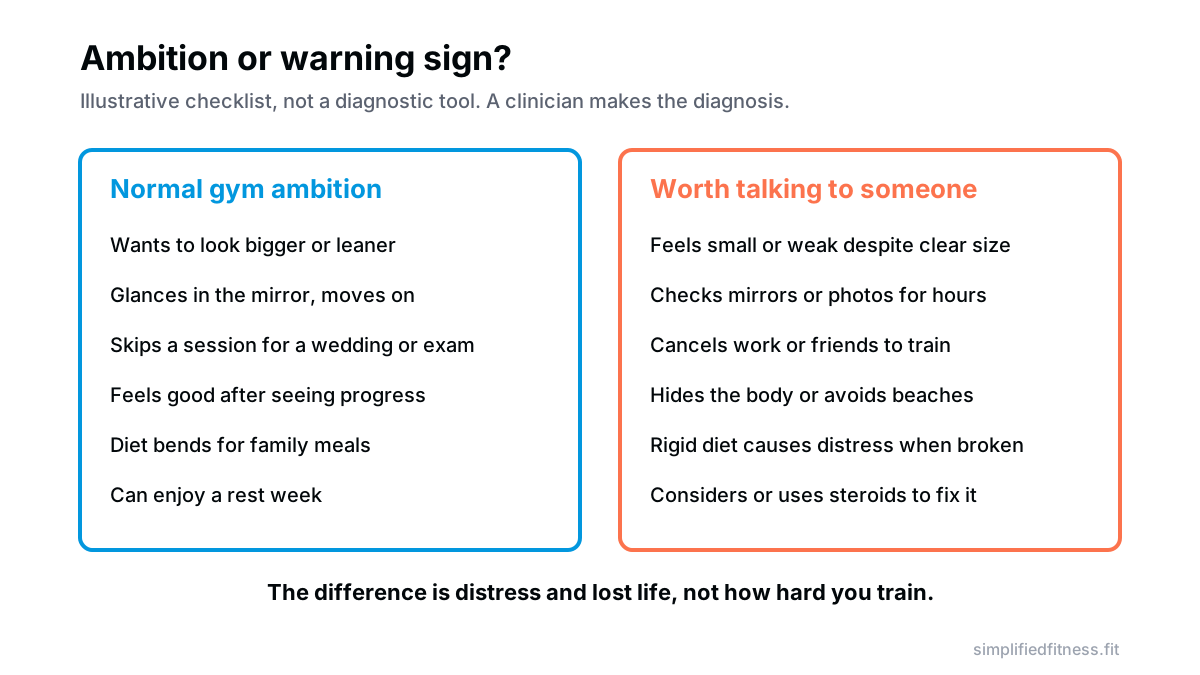
In the gym, this looks like someone who skips a cousin’s wedding because it clashes with leg day and then feels sick about missing a session. Or someone who weighs rice to the gram, panics when a meal is off plan, and still sees a “small” person in the mirror. One bad week does not count. A pattern that hurts does.
How does fitness media warp what you think is normal?
Here is the uncomfortable part. Even if you do not have muscle dysmorphia, your feed is quietly resetting your sense of normal.
A content analysis of 1,000 random Instagram images from men’s fitspiration hashtags found most showed highly muscular upper bodies with low body fat. Men were often shown posing passively rather than doing anything related to health or fitness, and the authors concluded the content glamorizes an appearance ideal with little focus on health (Angrish et al., 2024).
Does viewing it actually do anything? A 2020 study in 223 men used a phone app for 7 days. Each time, participants were randomly shown fitspiration, thinspiration or neutral images. Compared with neutral images, fitspiration raised body dissatisfaction, lowered mood and increased the urge to build muscle. Men who already had higher muscularity dissatisfaction and a tendency to compare appearance were hit hardest (Yee et al., 2020). That was a short-term experiment, so it shows an immediate effect, not lifelong harm.
How do influencers look so lean in photos?
Think of a photo as a moment, not a lifestyle. Several things stack up:
- Lighting and angle. Overhead light and a slightly low camera carve out shadows. The same body under flat bathroom light looks different.
- Pump. A few sets and a carb-heavy meal fill muscle. It is not studied in the sources I cite, but any lifter knows the mirror changes after training.
- Tan, oil and tight shorts. These sharpen contrast.
- Editing and filters. Apps make it easy to alter an image, and some creators do.
- Single-day leanness. Being that lean for one shoot is a different thing from living there.
- Drugs. Undisclosed, and impossible to see in a photo.
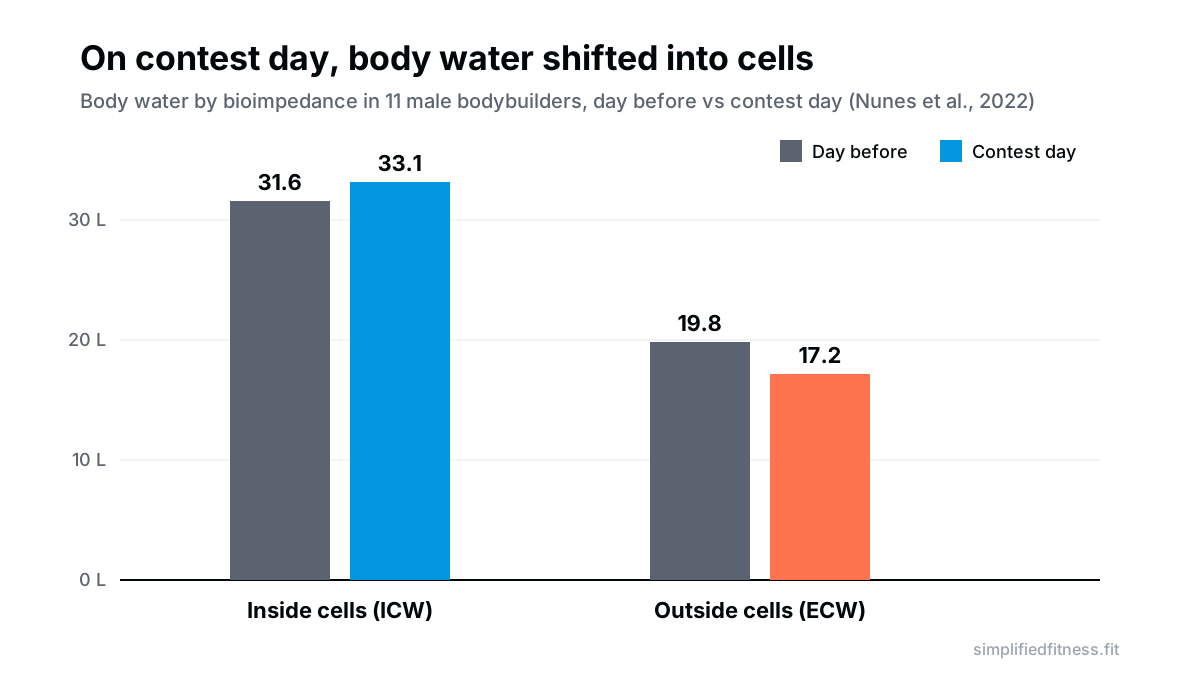
Competition prep gives one measured example. In a pilot study of 11 male bodybuilders, bioimpedance showed that from the day before to contest day, water inside cells rose from about 31.6 to 33.1 L while water outside cells fell from about 19.8 to 17.2 L. The authors concluded the final-day strategies shifted fluid from outside to inside the cells (Nunes et al., 2022). It is small and it only covers body water, but it shows that stage looks are partly engineered, within a day.
What does a realistic natural physique look like?
Nobody can give you your ceiling. Genetics, height, bone structure and training years all matter. But there is one researched benchmark, with caveats.
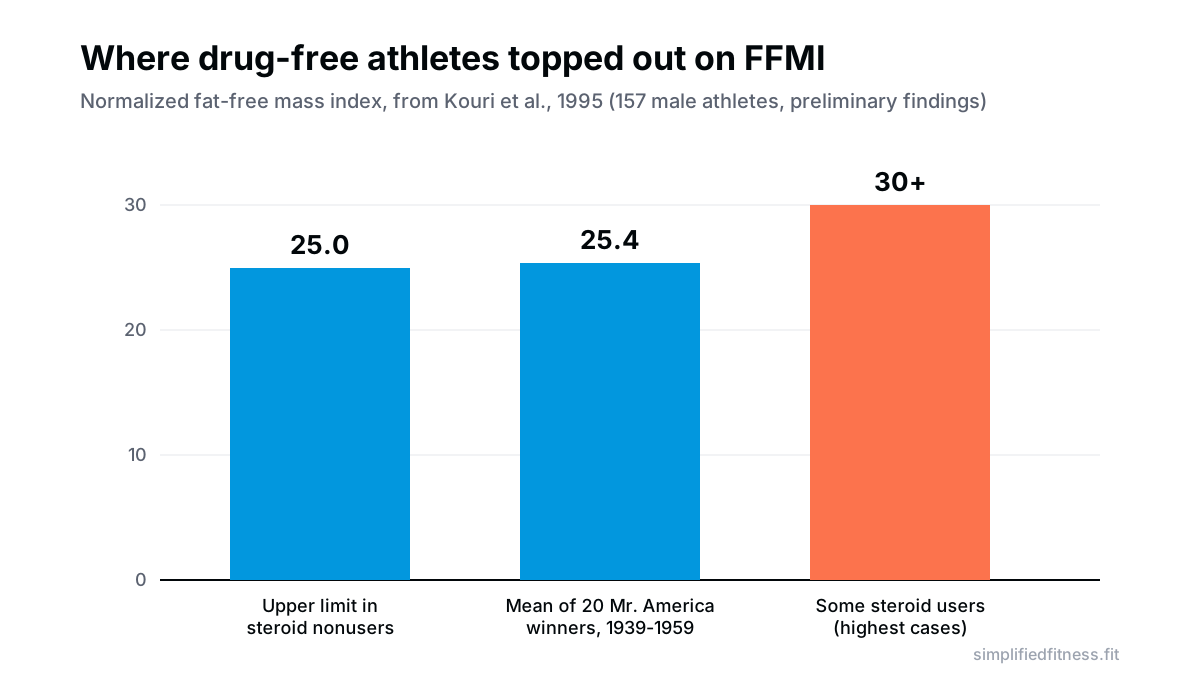
FFMI is fat-free mass in kg divided by height in metres squared. Kouri and colleagues studied 157 male athletes (83 steroid users, 74 nonusers) and normalized values to a 1.8 m height. Athletes who had not used steroids extended up to a limit of 25.0. Twenty Mr. America winners from the pre-steroid era (1939-1959) averaged an estimated 25.4. Many steroid users easily exceeded 25.0, and some passed 30. The authors called the findings preliminary (Kouri et al., 1995).
Be careful with how you use this:
- It is a small, older, preliminary sample, not a law of nature.
- It rests on body fat estimates, which carry error (see how accurate body fat measurement is).
- Online formulas that predict a max muscular weight from your wrist and ankle are popular, but I have not found peer-reviewed validation in the sources I checked here, so treat them as rough guesses.
- Individuals vary, and an outlier is not automatically using drugs.
Practically, a normalized FFMI around 25 is a very muscular physique. Most people reading this are many years from it. You can check your own estimate with the FFMI calculator, and pair it with the body fat calculator. For how much change is even available in a year, see our piece on who can recomp and how far, and why people differ in lifting responders.
Is “fake natty” a fair accusation?
You will see comment sections full of it. The honest answer is that you usually cannot tell from a photo or a single video. An FFMI far above 25 raises eyebrows statistically, but size alone is not proof, and accusing strangers is not useful for your own mental health.
What helps is a shift in framing. Treat unverified claims of “natural” as marketing. Do not use a stranger’s body as the yardstick. Follow people who show their training, their numbers and their bad days.
There is also a real health reason to care. Non-medical steroid use carries serious risks that doctors warn about, so chasing an influencer’s look with drugs is a poor trade. If you are tempted, speak to a doctor first.
Can muscle dysmorphia be treated?
Yes, and that is the hopeful part. A 2025 randomized trial enrolled 59 male gym-goers with a diagnosis of muscle dysmorphia and a history of steroid or performance drug use. Twelve weeks of weekly online cognitive behavioral therapy (CBT) reduced muscle dysmorphia symptoms and related distress compared with a waitlist group, with benefits sustained at 3-month follow-up (Çınaroğlu et al., 2025). It was open-label and short, in a specific group, so it is encouraging rather than final.
The point is simple: this is not a character flaw. It responds to treatment.
How to build physique peace
None of this requires you to stop caring about how you look. It requires you to aim at something you control.
- Clean up the feed. Mute or unfollow accounts that leave you feeling smaller. The 2020 experiment is a reason to treat this as seriously as your program.
- Measure what is real. Same-light photos every 4 weeks, waist measurement, and strength numbers in a log. Our guide to DIY physique tracking shows how.
- Switch to process goals. Hit your sessions, protein and sleep, as in process vs outcome goals.
- Watch perfectionism. Rigid rules that break you after one missed meal are the pattern described in all-or-nothing fitness thinking.
- Protect the rest of life. Keep the cousin’s wedding. Eat the festival sweets. Muscle is built over years, so one meal changes nothing.
- Pick a reference body that is realistic. Your own body six months ago beats a stranger on a stage.
For a simple training structure without the noise, see our free push, pull and legs plans.
When to see a doctor
Talk to a GP, psychologist or psychiatrist if body worry takes hours of your day, if you feel intense shame or avoid people and places because of your body, if you rely on rigid rules that cause distress, or if you are thinking about steroids or other drugs to fix how you feel about your size. In India, a GP can refer you onward, and many psychologists now offer online sessions. If you ever feel unsafe or hopeless, call 112 or go to the nearest hospital right away. Tele MANAS, India’s free government mental health helpline, is on 14416 or 1-800-891-4416.
If you are a parent or coach of a teenager who is training intensely and always feels small, a calm conversation and a doctor visit beat a lecture about influencers.
The bottom line
Muscle dysmorphia is real, treatable, and not the same as caring about your body. Most lifters do not have it. But most lifters are exposed to a feed that makes ordinary progress look like failure. Photos are moments, some physiques come from drugs, and a drug-free ceiling exists even if nobody can give you your exact number. Measure your own trend, protect the rest of your life, and ask for help if the worry stops being useful.
Frequently Asked Questions
What is muscle dysmorphia?
Muscle dysmorphia is a form of body dysmorphic disorder in which a person becomes pathologically preoccupied with their muscularity, usually feeling too small or too thin. Researchers describe it as a recognised specifier of body dysmorphic disorder in DSM-5, though a 2020 meta-analytic review found the evidence insufficient to say whether it is best classed that way or as its own condition. If this sounds familiar, speak to a doctor or psychologist rather than trying to diagnose yourself.
What are the symptoms of bigorexia?
Bigorexia is a popular name for muscle dysmorphia, and the typical features are constant worry about being too small, compulsive mirror or photo checking, rigid training and diet rules, and skipping social or work commitments to train. These patterns appear in the research on men with the condition, who also reported shame and impairment in daily functioning. Ask yourself whether the worry causes real distress or costs you relationships, and if yes, book an appointment with a mental health professional.
Is muscle dysmorphia common in gym-goers?
Exact numbers in adult lifters are unclear, but the condition is a small minority outcome rather than the norm. An Australian survey of 3,618 adolescents estimated a point prevalence of 2.2% in boys and 1.4% in girls using self-report measures, and the authors say interview-based studies are needed to confirm that. Do not assume you have it just because you care about your physique; look at distress and life impact instead.
Is wanting to be bigger the same as muscle dysmorphia?
No, wanting to build muscle is normal and healthy for most lifters. In the 2000 case-control study, men with muscle dysmorphia differed sharply from comparison weightlifters, who showed little psychopathology. The line is distress and impairment, so ask whether your training serves your life or has started to run it.
Do fitness influencers use steroids?
Some do and some do not, and from a photo alone nobody can tell, including me. A 1995 study found drug-free athletes reached a normalized FFMI of about 25 while some steroid users went past 30, which is why extreme size is a hint but never proof. The practical move is to stop treating any single creator's body as the benchmark for what your own training should produce.
How do fitness influencers look so lean in photos?
Lighting, angle, pump, tan, and sometimes editing apps all help, and for contests competitors manipulate body water in the final day. A pilot study of 11 bodybuilders found intracellular water rose while extracellular water fell between the day before and contest day, which changes how the physique looks. Judge your own progress with consistent photos, waist measurements and strength, not against someone's best-lit frame.
What is a realistic natural physique?
It varies with genetics, height, frame and years of consistent training, so there is no single answer. One preliminary dataset found a normalized FFMI of about 25.0 as the upper limit among non-steroid-using athletes, which corresponds to a very muscular but not cartoonish look. Use that as a rough ceiling, check your own number with our FFMI calculator, and focus on the next year of progress.
What is FFMI and is it reliable?
FFMI is fat-free mass in kilograms divided by height in metres squared, and Kouri and colleagues added a height correction to normalize it to 1.8 m. It depends on a good body fat estimate, and the original study was a small, preliminary one. Treat it as a rough screen, not a verdict on whether someone is natural.
Does social media cause muscle dysmorphia?
Research shows social media can worsen body dissatisfaction but has not shown that it causes muscle dysmorphia on its own. In a 7-day experiment in 223 men, fitspiration images raised muscularity-related urges and body dissatisfaction versus neutral images, and men with high baseline muscularity dissatisfaction were most affected. Curate your feed, mute accounts that make you feel small, and follow ones that teach training.
Can muscle dysmorphia be treated?
Yes, psychological treatment shows promise. A 2025 randomized trial of 59 male gym-goers with muscle dysmorphia and a history of steroid or performance drug use found that 12 weeks of cognitive behavioral therapy reduced symptoms more than a waitlist control, though it was open-label and short. See a clinician experienced in body image or eating disorders to find out what fits you.
Should I stop lifting if I think I have muscle dysmorphia?
Not necessarily, because lifting itself is not the cause, and many people keep training in a healthier way. The issue is the compulsion and distress around it, which therapists work on directly. Talk to a professional, and consider shifting your goals toward strength, health and consistency rather than appearance alone.
Is it safe to use steroids to look like influencers?
No, non-medical steroid use carries serious health risks, including heart, hormonal and mental health problems that doctors commonly warn about. Our research here covers body image rather than steroid safety, but the trial above shows that men who used performance drugs and had muscle dysmorphia benefited from therapy. If you are tempted, speak to a doctor first and treat the temptation as a reason to talk about body image, not to chase a number.
Sources & References
Every claim above is checked against peer-reviewed research (PubMed, U.S. National Library of Medicine) or guidance from established health bodies. How we fact-check.
- Olivardia R, et al. Muscle dysmorphia in male weightlifters: a case-control study. Am J Psychiatry. 2000. PMID: 10910793
- Cooper M, et al. Muscle dysmorphia: a systematic and meta-analytic review of the literature to assess diagnostic validity. Int J Eat Disord. 2020. PMID: 32737999
- Mitchison D, et al. Prevalence of muscle dysmorphia in adolescents: findings from the EveryBODY study. Psychol Med. 2022. PMID: 33722325
- Yee ZW, et al. The differential impact of viewing fitspiration and thinspiration images on men's body image concerns: an experimental ecological momentary assessment study. Body Image. 2020. PMID: 32977202
- Angrish K, et al. Flex Friday: a content analysis of men's fitspiration on Instagram. Body Image. 2024. PMID: 38061212
- Kouri EM, et al. Fat-free mass index in users and nonusers of anabolic-androgenic steroids. Clin J Sport Med. 1995. PMID: 7496846
- Nunes JP, et al. Changes in intra-to-extra-cellular water ratio and bioelectrical parameters from day-before to day-of competition in bodybuilders: a pilot study. Sports (Basel). 2022. PMID: 35202062
- Çınaroğlu M, et al. Cognitive behavioral therapy for muscle dysmorphia and anabolic steroid-related psychopathology: a randomized controlled trial. Pharmaceuticals (Basel). 2025. PMID: 40872474

Umair Hazrami · Founder & Head Coach, Simplified Fitness
Umair Hazrami founded Simplified Fitness and the Simplified Lifter channel to cut through fitness noise. With 4+ years of consistent training and 10+ coaching clients, he writes every guide from the peer-reviewed research and links the sources so you can check them. Our editorial standards.
Educational content only, not medical advice. If you have a medical condition, are pregnant, or take medication, talk to a qualified doctor before changing your diet, supplements or training. Full disclaimer.
Keep reading

Health & Longevity
Overcoming the All-or-Nothing Mindset: How Perfectionism Wrecks Long-Term Fitness
The all-or-nothing mindset in fitness turns one missed workout into a lost month. Here is the research, the never-miss-twice rule and a 20-minute fallback plan.
10 min read

Health & Longevity
How to Build a Gym Habit: The Behavioral Science of Sticking With It
How to build a gym habit using habit science: how long it takes, why cues and low friction beat willpower, and what identity can and cannot do for consistency.
8 min read

Health & Longevity
Best Way to Measure Body Fat: DEXA, Bod Pod, Calipers and 4C Compared
The best way to measure body fat percentage is the same tool, under the same conditions, every time. See how DEXA, Bod Pod, calipers and 4C really compare.
8 min read

Health & Longevity
Body Recomposition Limits: Who Can Recomp, and When Advanced Lifters Must Choose a Surplus or Deficit
Body recomposition limits explained: who can still lose fat and gain muscle at once, why advanced lifters stall, and how to choose a cut or lean bulk.
9 min read