Smart Scales and BIA Accuracy: Why Bioelectrical Impedance Misreads Body Fat
Are smart scales accurate for body fat? See what studies show on BIA error, hydration swings and foot-to-foot limits, plus how to use your scale properly.

TL;DR. The short answer
- Smart scales are accurate for body weight but not for body fat. In one study of 15 BIA devices, the average error in a single body fat reading ranged from -3.5 to +11.7 percentage points versus a lab four-compartment model.
- A BIA scale does not measure fat. It sends a weak current through your body, measures resistance, and plugs it into a regression equation, so changes in water and salt can look like changes in fat or muscle.
- Eating or drinking before stepping on shifts the reading only slightly in one trial (about 1 percentage point of body fat), but heat, dehydration and rehydration can move estimates more.
- Foot-to-foot scales send current mainly through the lower body, and studies show they are better at group averages than individual readings.
- Use the scale for weight under the same conditions every morning, look at weekly averages, and treat body fat percentage as a rough trend at best.
Part of our complete guide: Body Composition, Muscle Memory and Habits: A Lifter's Guide to Tracking
Table of contents
Are smart scales accurate? For body weight, yes. For body fat percentage, not in the way the screen suggests. The number is an estimate built from electrical resistance and a formula, and in published comparisons the error for a single reading can be several percentage points in either direction.
That does not make the scale useless. It means you have to know what it is measuring. This article sits inside our complete guide to body composition, muscle memory and adherence, and it zooms in on bathroom scales. For lab methods, see body fat measurement methods like DEXA and calipers.
How does a smart scale measure body fat?
It doesn’t, not directly. The technique is called bioelectrical impedance analysis (BIA). When you stand on the plates, the scale sends a tiny, painless current through your body and measures how hard it is to push through.
The logic is simple. Body water carries salts, and salty water conducts electricity well. Muscle holds a lot of water, so it conducts well. Fat holds less, so it resists more. The scale then plugs that resistance, plus your height, weight, age and sex, into a regression equation to estimate fat-free mass. Fat mass is whatever is left over.
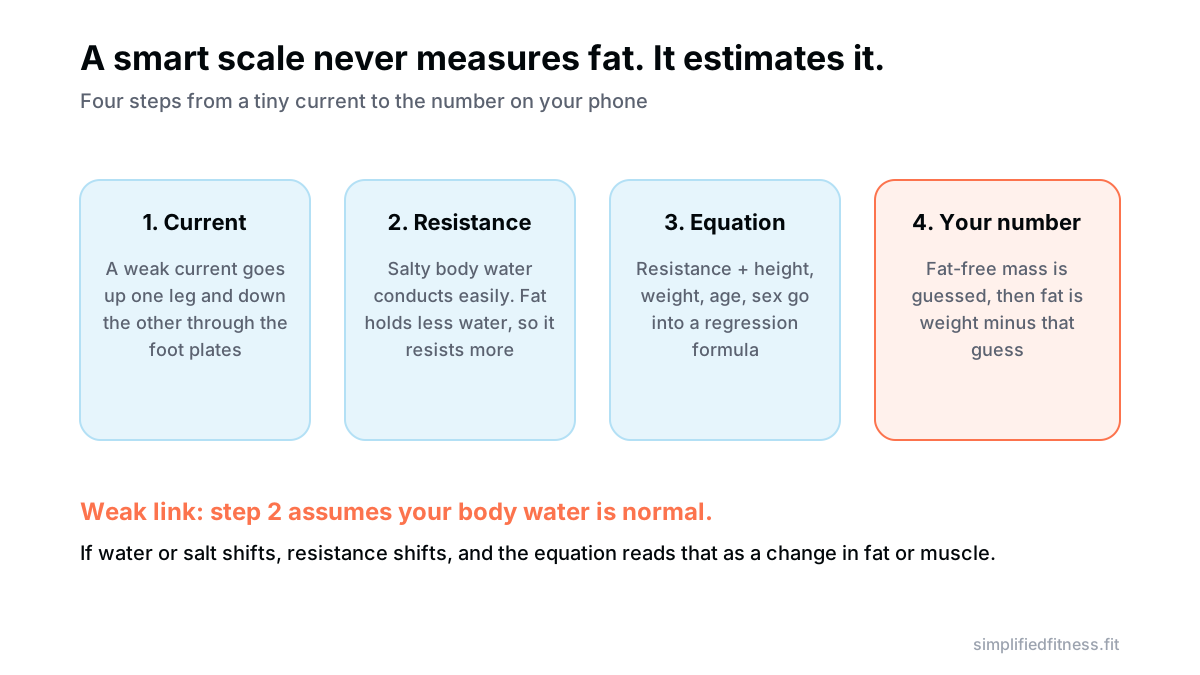
Notice the weak link. The equation assumes your body water is in a normal, stable state. If it is not, resistance changes and the equation reads that as a change in your body.
Are bioelectrical impedance scales accurate against lab methods?
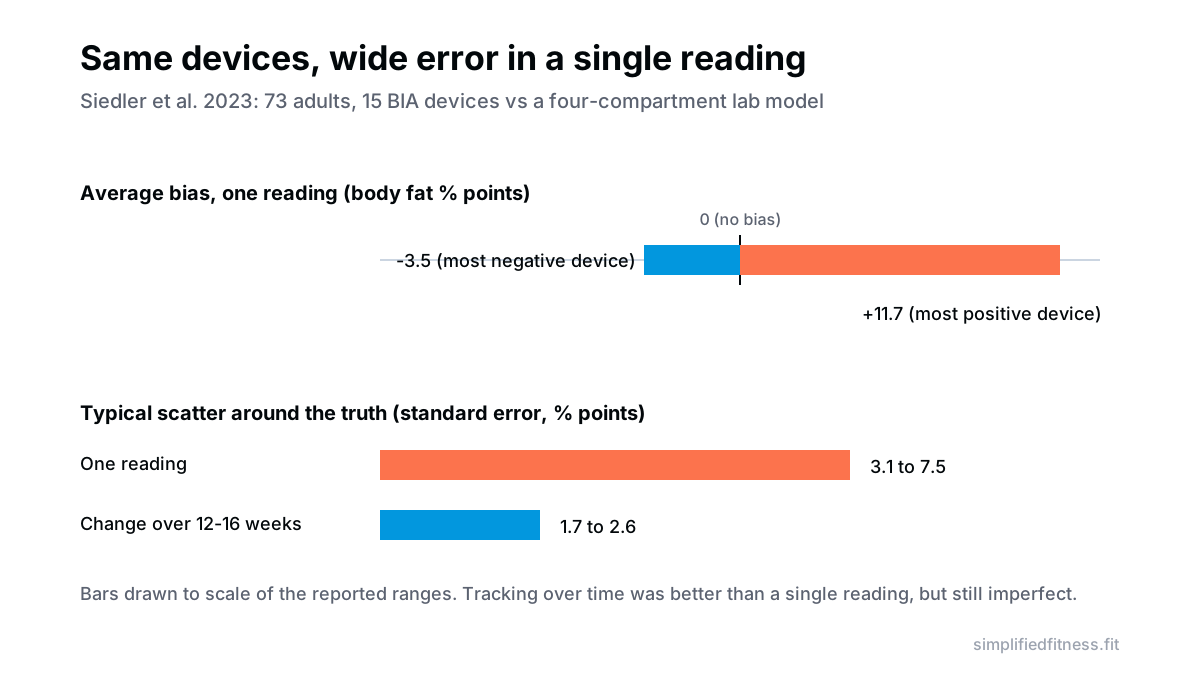
Here is the best direct evidence. A 2023 study tested 15 BIA devices (14 consumer-grade, one research-grade) on 73 healthy adults aged 19-50 and compared each against a four-compartment laboratory model (Siedler et al., 2023).
Two things stand out:
- Repeatability was high. Test-retest precision error was 0.0 to 0.49%. The scale gives you nearly the same number if you step on twice in a row.
- Accuracy was not. The average error against the lab model ranged from -3.5 to +11.7 percentage points depending on the device, and the typical scatter around the truth (standard error) was 3.1 to 7.5 percentage points.
Repeatable is not the same as correct. A scale can be consistently wrong.
An older study points the same way. In 110 adults compared with DXA, two commercial devices (one hand-to-hand, one foot-to-foot) underestimated body fatness, and the authors concluded that regional devices are limited by a lack of precision and accuracy (Lukaski and Siders, 2003).
Why foot-to-foot scales cannot see your upper body
A standard bathroom scale has electrodes under your feet. The current travels through your legs and lower trunk. Your arms, shoulders and chest are not part of the circuit, so the scale has to infer them from the lower body and from the equation.
Studies suggest this costs accuracy at the individual level. In 106 adults compared with MRI and DXA, foot-to-foot devices had systematic bias for body fat percentage, and the 95% limits of agreement for individual readings were as wide as -14.5 to +8.6 percentage points for the widest bipolar instrument. The tetrapolar device (hands and feet) was narrower at -6.6 to +4.6. The authors concluded bipolar devices give accurate results for group estimates, but tetrapolar designs should be preferred for individuals (Bosy-Westphal et al., 2008).
Athletes show the same pattern. In 33 NCAA Division I male athletes, foot-to-foot BIA looked acceptable for group averages of body fat percentage, but a proportional bias meant it was not valid for individual body fat estimates (Nickerson et al., 2019).
Wagner (2022) adds one more reason for caution. In 11 active adults, the trunk’s impedance moved in the opposite direction to the limbs after a hydration change, which shows that different body segments respond differently to fluid shifts (Wagner, 2022). It is a very small study, so treat it as a hint, not a rule.
Why does my smart scale fluctuate?
Because water moves, and the scale reads water. Here is what the research says about the common triggers.
Food and drink. In 55 adults using a foot-to-foot device, impedance rose after meals and fluids, and an electrolyte drink and both meals raised estimated body fat by a median of about 1 percentage point. The authors judged that small and within the technique’s imprecision (Androutsos et al., 2015). So a glass of water is not going to wreck your reading, but a few of these small effects stack.
Day to day. In the 2003 study, over five consecutive days, body mass varied about 1% while predicted body fatness varied 2-10% for the upper-body device and 3-5% for the lower-body device. That was tested in just 10 adults, but it shows why daily body fat readings bounce. The fat did not change. The water did.
Heat, sweat and rehydration. In 56 wrestlers who dropped about 3.5% of body mass, impedance rose with dehydration, but it had not returned to baseline two hours after rehydration, even though urine and blood markers had (Utter et al., 2012). In Wagner’s 11 adults, heat-induced dehydration and salty-water hyperhydration led to different body fat estimates, even though the device’s total body water estimate did not change significantly. That matters for anyone training in a hot Indian summer.
Menstrual cycle. In 25 women measured daily for one cycle, resistance, weight and fat-free mass estimates differed between cycle phases, and sodium intake explained a significant share of the error in resistance. Percent body fat did not differ significantly, but small hydration-related weight changes were flagged as a possible confound (Gleichauf and Roe, 1989). This is an old, small study, so I would not lean on it beyond “water shifts matter.”
Can a smart scale show body fat going the wrong way?
Yes, and this is the case that causes the most anxiety. If you are dropping weight fast, for example in a crash diet, a hot spell or after cutting carbs (which lowers glycogen and the water stored with it), body water changes quickly. The scale, which is reading water-related resistance, may mis-assign that change.
The evidence here is indirect but consistent. In 43 older women, only 2 of 7 BIA equations detected the fat-free mass gain that DXA measured after 12 weeks of resistance training (0.65 kg), and the authors concluded single-frequency BIA equations may not be accurate enough to track changes (Nascimento et al., 2020). Older women are a different group from a 25-year-old lifter, so we cannot assume the same size of error applies to you.
In obese patients losing an average of 24 kg on a very-low-energy diet, BIA overestimated fat-free mass relative to underwater weighing. The gap was no bigger during weight loss than before it, but it was large enough that the authors concluded the two methods could not be used interchangeably to monitor change (Carella et al., 1997). Again, a specific group in an extreme situation, but it shows that BIA and lab methods can tell different stories about the same weight loss.
There is also evidence of a different kind of bias. In 188 healthy adults, a 50 kHz BIA device underestimated fat mass, and the authors linked this to extra extracellular water in people carrying more body fat (Nescolarde et al., 2023). The bias is not random noise. It can depend on who you are.
Do smart scales measure muscle mass accurately?
Treat the muscle figure with more suspicion than the fat figure. The scale estimates fat-free mass (muscle, organs, bone, water) and then reports a muscle number derived from it. Nothing in the circuit identifies muscle specifically.
In the 2020 Withings Body Cardio validation, 20 young adults were compared with air displacement plethysmography. Body mass was very accurate (mean absolute percent error 0.15%). Fat-free mass had a 5.6% error and fat mass 25.8%, and the authors advised using the scale cautiously for fat and fat-free mass (Collier et al., 2020). That is one device in a small sample. I could not find independent validation for Renpho in the literature I checked, so I would not assume it is better or worse.
How to use a smart scale properly
The scale is a decent weight tracker. Use it like one.
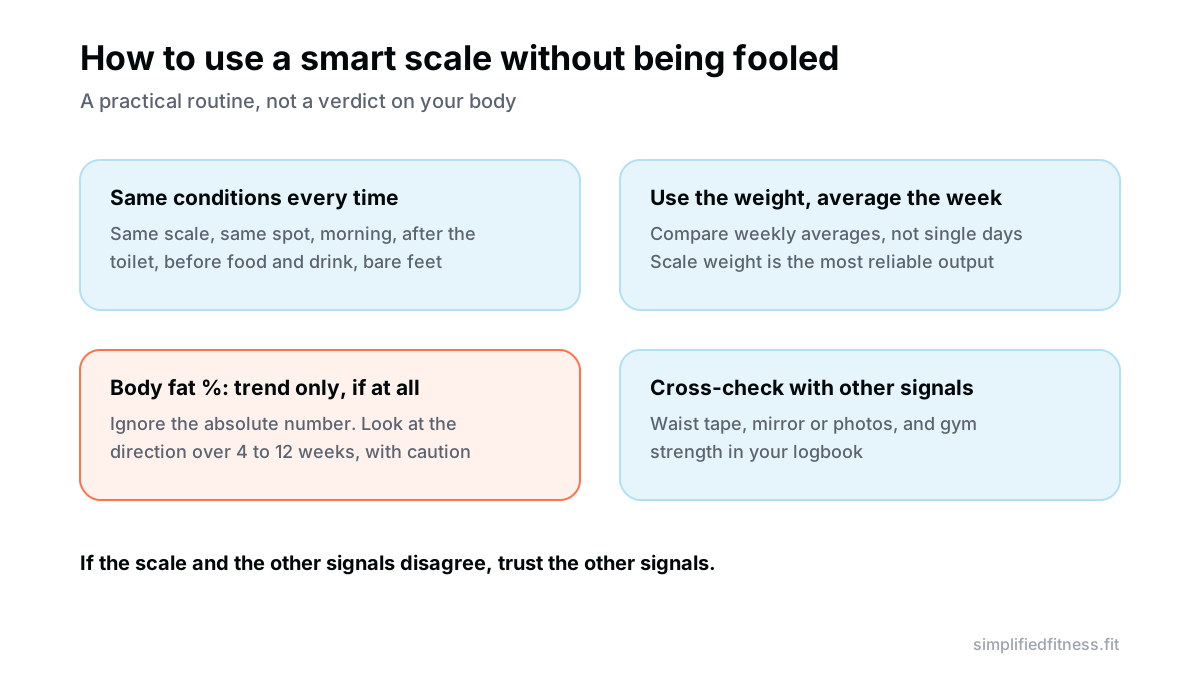
- Weigh in the same conditions. Same scale, same spot on a hard floor, first thing in the morning after the toilet and before food or drink. Bare feet, clean and dry.
- Look at weekly averages. Add up seven mornings and divide by seven. Compare that to last week. Our guide to scale weight fluctuations from water, sodium and glycogen explains the normal noise.
- Treat body fat percentage as a rough trend. Ignore the absolute number. If you look at all, look at the direction over 4-12 weeks, and only alongside other signals.
- Cross-check. Measure your waist (our waist-to-height ratio calculator makes this easy), take photos, and watch your lifts. See DIY physique tracking with waist, photos and scale averages.
- If you want a number, the free body fat calculator uses a tape measure and gives an estimate with its own, different error.
In a hot climate, add one rule. Do not weigh straight after a sweaty session or a long day outdoors, and do not compare that reading to your fresh-morning ones.
Who should be careful with smart scale readings
Most BIA devices carry a warning for people with pacemakers or other implanted electronic devices, and for pregnancy. Check the manual, and ask your doctor if you are unsure. If you have a medical condition affecting fluid balance (kidney, heart or liver disease), the number is even less meaningful, and your doctor’s measurements matter more than any home scale.
Also watch your relationship with the number. If the body fat reading triggers restrictive eating or obsessive checking, it is fine to hide it or stop using it. If food or body image is taking over your thinking, speak to a doctor or a qualified mental health professional.
The bottom line
Smart scales are accurate for weight and unreliable for body fat in individuals. Studies show repeatable readings with wide accuracy error, sensitivity to water and salt, and weaker performance in foot-to-foot designs. Some models may help you track direction over weeks, but the evidence is mixed and the sample sizes are often small.
Weigh consistently, average the week, and let your waist, photos and strength vote alongside the scale. If you want a training plan that gives you something better to track, start with our free push pull legs plan.
Frequently Asked Questions
Are smart scales accurate for body fat?
Not for an exact number. In a 2023 comparison of 15 BIA devices against a four-compartment lab model, the average error in a single body fat reading ranged from -3.5 to +11.7 percentage points depending on the device. Use the scale for weight and treat body fat as a rough guide.
How does a smart scale measure body fat?
It passes a very small electrical current through your body and measures how much it resists. Water-rich lean tissue conducts better than fat, so the scale feeds the resistance plus your height, weight, age and sex into a regression equation to estimate fat-free mass. Body fat is then your weight minus that estimate, which is why errors in the estimate become errors in fat.
Why does my smart scale body fat change from day to day?
Because the scale reads electrical resistance, which shifts with body water, salt and recent food or drink. In a 5-day study of 10 adults, day-to-day variation in predicted body fat from foot-to-foot devices was 3-5%, versus about 1% for body mass. Weigh at the same time under the same conditions and ignore single-day moves.
Does drinking water before weighing change body fat on a smart scale?
Slightly. In a trial of 55 adults using a foot-to-foot device, an electrolyte drink and high-fat or high-carb meals raised body fat percentage by a median of about 1 percentage point. That is small but not zero, so weigh before eating and drinking if you can.
Can a smart scale show body fat going up when I am losing fat?
It can, because the device is inferring fat from water-related resistance, not seeing fat. Research on hydration changes shows that BIA estimates of body fat can differ across hydrated and dehydrated states even when total body water estimates barely move. If the number contradicts your waist, photos and strength, trust those instead.
Are Withings and Renpho scales accurate?
Brand does not guarantee accuracy. A 2020 study of the Withings Body Cardio in 20 young adults found body mass was accurate but fat mass had a mean absolute percent error of 25.8%, so the authors advised caution. I could not find independent validation for Renpho, so treat its body fat reading the same way.
Can foot-to-foot scales measure upper body fat?
They are not designed to. The current travels mainly between the feet, so the scale infers the rest of your body from lower-body resistance and an equation. Research comparing regional devices to DXA found that foot-to-foot and hand-to-hand devices lacked precision and accuracy for whole-body fatness.
Do smart scales measure muscle mass accurately?
Not reliably. They estimate fat-free mass, which includes water, organs and bone, then label part of it as muscle. In older women doing 12 weeks of resistance training, only 2 of 7 BIA equations detected the fat-free mass gain that DXA picked up.
Is a smart scale better than nothing for tracking progress?
Yes, for weight. Body weight is measured accurately by these scales, and weekly averages are useful. For body fat, a consistent scale used in consistent conditions may show a rough direction, but it can mislead during fast water changes.
What is the best time to use a smart scale?
First thing in the morning, after using the toilet and before eating or drinking, in the same place and with bare, clean, dry feet. Consistency matters more than the exact time because it keeps water and salt shifts out of your comparisons. Avoid weighing right after a workout, sauna, or a very salty meal.
How accurate is a DEXA compared with a smart scale?
DXA is a better reference than a bathroom scale, but it is not perfect either. Smart scales are validated against DXA or multi-compartment models, and many show wide individual error against them. Our guide on clinical methods covers what DXA can and cannot tell you.
Do hot weather and sweating affect smart scale readings in India?
They can. Heat and sweat change body water, and studies using heat chambers show BIA body fat estimates differ across hydration states. After a hot-weather workout or a long commute, wait until you have rehydrated and eaten normally before reading anything into the number.
Should I stop using my smart scale?
Not necessarily, but change how you use it. Keep the weight, drop the obsession with body fat percentage, and cross-check with your waist and gym numbers. If the number makes you anxious, hiding the body fat screen is a perfectly sensible option.
Sources & References
Every claim above is checked against peer-reviewed research (PubMed, U.S. National Library of Medicine) or guidance from established health bodies. How we fact-check.
- Siedler MR, et al. Assessing the reliability and cross-sectional and longitudinal validity of fifteen bioelectrical impedance analysis devices. Br J Nutr. 2023. PMID: 36404739
- Lukaski HC, et al. Validity and accuracy of regional bioelectrical impedance devices to determine whole-body fatness. Nutrition. 2003. PMID: 14559320
- Bosy-Westphal A, et al. Accuracy of bioelectrical impedance consumer devices for measurement of body composition in comparison to whole body magnetic resonance imaging and dual X-ray absorptiometry. Obes Facts. 2008. PMID: 20054195
- Nickerson BS, et al. Validity of foot-to-foot bioelectrical impedance for estimating body composition in NCAA Division I male athletes: a 3-compartment model comparison. J Strength Cond Res. 2019. PMID: 30789577
- Androutsos O, et al. Impact of eating and drinking on body composition measurements by bioelectrical impedance. J Hum Nutr Diet. 2015. PMID: 25158295
- Wagner DR. Bioelectrical impedance changes of the trunk are opposite the limbs following acute hydration change. J Electr Bioimpedance. 2022. PMID: 35855420
- Utter AC, et al. The validity of multifrequency bioelectrical impedance measures to detect changes in the hydration status of wrestlers during acute dehydration and rehydration. J Strength Cond Res. 2012. PMID: 21964427
- Nascimento MA, et al. Agreement between bioelectrical impedance and dual-energy X-ray absorptiometry to track changes in fat-free mass after resistance training in older women. J Strength Cond Res. 2020. PMID: 29794894
- Collier SR, et al. Withings Body Cardio versus gold standards of pulse-wave velocity and body composition. J Pers Med. 2020. PMID: 32168728
- Nescolarde L, et al. Fluid-dependent single-frequency bioelectrical impedance fat mass estimates compared to digital imaging and dual X-ray absorptiometry. Nutrients. 2023. PMID: 37960291
- Gleichauf CN, Roe DA. The menstrual cycle's effect on the reliability of bioimpedance measurements for assessing body composition. Am J Clin Nutr. 1989. PMID: 2816797
- Carella MJ, et al. Serial measurements of body composition in obese subjects during a very-low-energy diet (VLED) comparing bioelectrical impedance with hydrodensitometry. Obes Res. 1997. PMID: 9192399

Umair Hazrami · Founder & Head Coach, Simplified Fitness
Umair Hazrami founded Simplified Fitness and the Simplified Lifter channel to cut through fitness noise. With 4+ years of consistent training and 10+ coaching clients, he writes every guide from the peer-reviewed research and links the sources so you can check them. Our editorial standards.
Educational content only, not medical advice. If you have a medical condition, are pregnant, or take medication, talk to a qualified doctor before changing your diet, supplements or training. Full disclaimer.
Keep reading

Health & Longevity
Overcoming the All-or-Nothing Mindset: How Perfectionism Wrecks Long-Term Fitness
The all-or-nothing mindset in fitness turns one missed workout into a lost month. Here is the research, the never-miss-twice rule and a 20-minute fallback plan.
10 min read

Health & Longevity
How to Build a Gym Habit: The Behavioral Science of Sticking With It
How to build a gym habit using habit science: how long it takes, why cues and low friction beat willpower, and what identity can and cannot do for consistency.
8 min read

Health & Longevity
Best Way to Measure Body Fat: DEXA, Bod Pod, Calipers and 4C Compared
The best way to measure body fat percentage is the same tool, under the same conditions, every time. See how DEXA, Bod Pod, calipers and 4C really compare.
8 min read

Health & Longevity
Body Recomposition Limits: Who Can Recomp, and When Advanced Lifters Must Choose a Surplus or Deficit
Body recomposition limits explained: who can still lose fat and gain muscle at once, why advanced lifters stall, and how to choose a cut or lean bulk.
9 min read