The Lifelong Muscle Dividend: What Decades of Lifting Do for Aging and Longevity
Lifting weights for aging longevity: what the research says about strength, muscle loss, bone and survival, and how to build a muscle pension from your 30s.

TL;DR. The short answer
- For lifting weights for aging longevity, strength is the marker to watch: a 2018 meta-analysis of about 1.9 million adults linked higher grip strength to a 31% lower risk of death (HR 0.69). That is an association, not proof.
- Strength is lost faster than muscle size. At age 75, longitudinal studies show roughly 3-4% of strength lost per year in men against under 1% of muscle mass.
- In older adults, progressive resistance training raised strength and hip bone density (about 2.8%) across 14 trials, though the bone result was far less certain than the strength result.
- Observational data show the biggest drop in death risk at modest doses: about 30-60 minutes a week of muscle-strengthening, not hours.
- Have a heart condition, osteoporosis, a recent fall or new unexplained weakness? See your doctor before starting or changing a program.
Part of our complete guide: Body Composition, Muscle Memory and Habits: A Lifter's Guide to Tracking
Table of contents
Lifting weights for aging longevity is not about looking good at 70. It is about keeping the strength that lets you stand up, climb stairs, carry shopping and avoid the spiral that follows a fall. Large cohort data link higher strength with a lower risk of death, and trials in older adults show lifting can improve strength and some bone measures. The causal story is still partly inferred. This piece sits inside our body composition, muscle memory and adherence guide as the “why bother for the next 40 years” chapter.
Does lifting weights help you live longer?
Probably, yes, but the proof is observational, so be careful with the word “cause”.
A 2022 meta-analysis pooled 16 prospective cohort studies of adults and found muscle-strengthening activity was associated with a 10-17% lower risk of all-cause mortality, cardiovascular disease, total cancer, diabetes and lung cancer (Momma et al., 2022). It did not find an association with some site-specific cancers (colon, kidney, bladder, pancreatic).
The dose curve matters more than the headline. The biggest risk reduction, roughly 10-20%, showed up at about 30-60 minutes a week of muscle-strengthening, with a J-shaped pattern for all-cause mortality, CVD and cancer. The authors say the effect of higher volumes is unclear.
Read that again. Not 10 hours. About one hour a week.
The caveat is the usual one for cohort data. People who lift may also sleep better, smoke less and see doctors more. Statistical adjustment helps, but it cannot remove every difference. So the safe reading is “consistently associated with lower risk”, not “lifting adds X years”.
Why strength predicts mortality better than size
When researchers measure strength, the signal is strong. A 2018 meta-analysis of 38 studies, about 1.9 million participants and 63,087 deaths found that higher handgrip strength was associated with a lower all-cause mortality risk (HR 0.69; 95% CI 0.64-0.74) (García-Hermoso et al., 2018). The association was slightly stronger in women (HR 0.60) than men (HR 0.69). Higher knee extension strength went with 14% lower risk (HR 0.86).
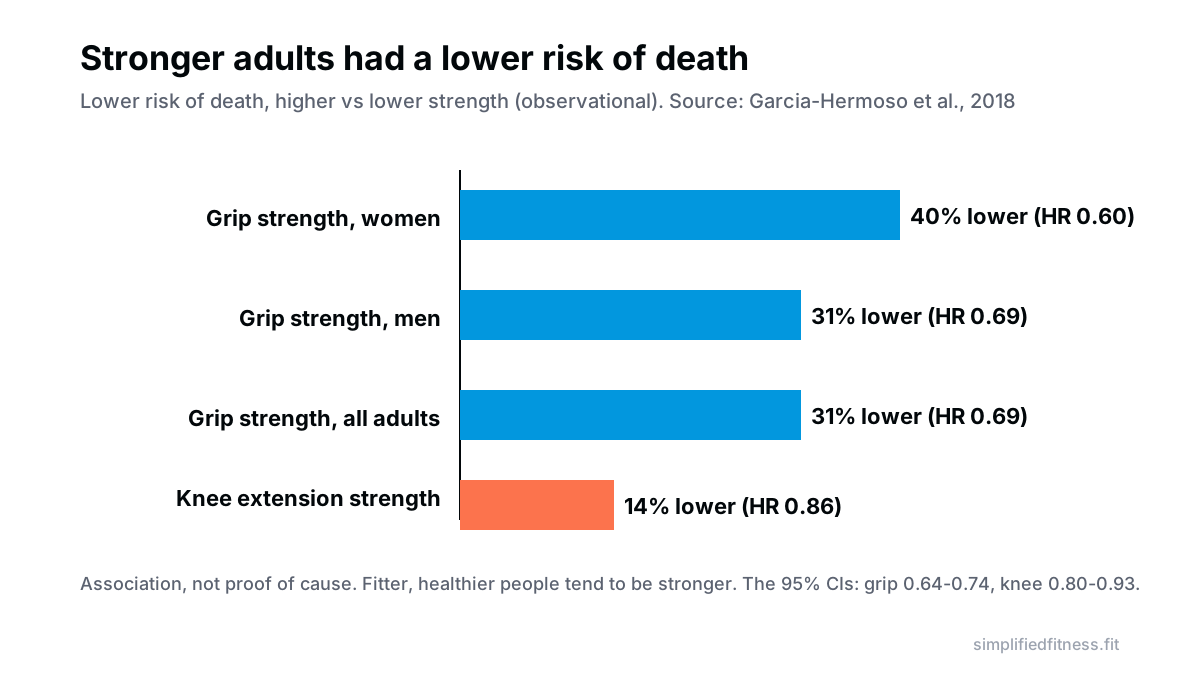
Does size matter? Less than you would think. The Health ABC study followed 2,292 adults aged 70-79 for about 4.9 years. Quadriceps and grip strength were strongly related to death, while muscle size by CT or DXA was not strongly related. Adjusting for muscle area only slightly weakened the strength link (Newman et al., 2006). The authors concluded that strength, as a marker of muscle quality, mattered more than quantity.
I would not over-read this as “size is irrelevant”. The Health ABC group was older, the follow-up short, and other studies find some value in lean mass. But it shifts the goal. Build muscle, and measure it by what you can lift.
Sarcopenia, dynapenia and the curves nobody shows you
Sarcopenia is age-related loss of muscle mass. Dynapenia is loss of strength. They are related but they do not travel together.
A 2012 quantitative review found cross-sectional studies show a median loss of about 0.47% per year in men and 0.37% in women. Longitudinal studies at age 75 show mass lost at 0.80-0.98% per year in men and 0.64-0.70% in women, while strength falls 3-4% per year in men and 2.5-3% in women. In studies that measured both, strength was lost 2-5 times faster than mass (Mitchell et al., 2012). The review also notes that loss of strength is a more consistent risk for disability and death than loss of mass.
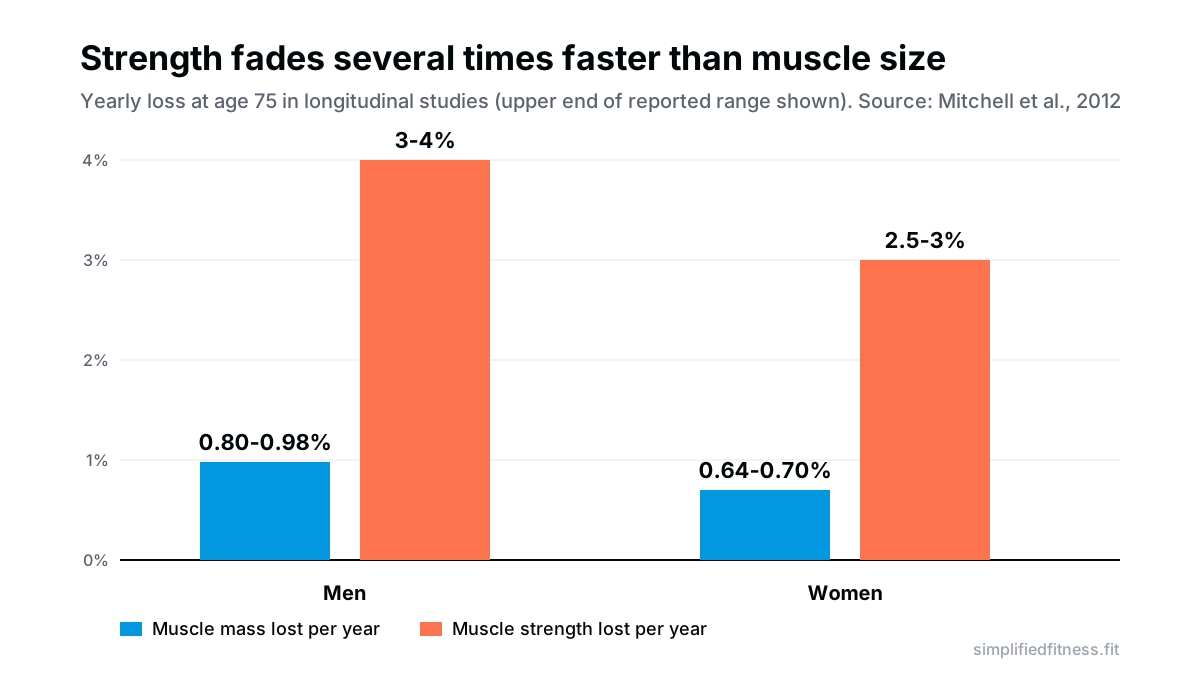
Here is the gym translation. A man in his 50s can keep the same bodyweight and not notice a thing, while his leg strength quietly drops. The first sign is often a chair that suddenly feels low or a flight of stairs that needs the handrail. Testing yourself every few months on a lift like the leg press or a sit-to-stand catches it earlier. Our guide on strength training for older adults, sarcopenia and dynapenia covers that side in detail.
What happens inside muscle after decades of training?
The popular story here is poetic, so let me stick to what the human evidence actually shows.
Ageing muscle loses motor neurons, which leaves some fibres without a nerve supply. Some of those fibres are adopted by surviving neurons, which in this research were mostly slow-type ones. The result is more slow fibres and “fibre-type grouping” in biopsies (Mosole et al., 2022).
Mosole and colleagues compared biopsies from 70-year-old men with a lifelong history of high-level physical activity against controls. The active group showed more reinnervation, with greater fibre-type grouping, almost entirely of the slow type. The authors suggest lifelong exercise helps the body save fibres that would otherwise be lost by recruiting them into different, mainly slow, motor units, which helps maintain muscle size, structure and function.
Three honest limits:
- The participants were lifelong high-level exercisers, not specifically lifters.
- It is a small biopsy study, so it shows an association in a specific group.
- It says nothing about whether resistance training is better than endurance work at protecting motor units. I could not find evidence in this search that settles that, so I will not claim it.
What I can say: the nervous system is part of the story, not just the muscle. Staying active for decades, rather than in short bursts, is the pattern these seniors shared.
Is muscle really an endocrine organ?
In a limited sense, yes. Contracting muscle releases proteins called myokines that act on the muscle itself and on other organs. A 2017 review describes roles in fuel oxidation, inflammation, insulin sensitivity, body weight regulation and cognitive function, and suggests their major function is to protect muscle function and exercise capacity (Hoffmann and Weigert, 2017).
I am deliberately not listing which myokine does what for your brain or your fat. Much of that evidence is mechanistic, from cells, animals or short human studies, and the review itself frames some applications as promising future directions. Treat the “endocrine organ” idea as a reasonable biological reason that muscle matters beyond movement, not a calculator for health outcomes. The same goes for claims that lifting “rejuvenates your mitochondria”. The direct human evidence is thin, so I will leave that one out.
Can you build muscle in your 60s and 70s?
Yes, with realistic expectations. A 2023 network meta-analysis of 42 randomized trials included 3,728 older people with sarcopenia (median age 72.9 years, median follow-up 12 weeks). Resistance exercise, with or without nutrition, and resistance combined with aerobic and balance training were among the most effective interventions for quality of life. Resistance and balance training plus nutrition gave the biggest handgrip improvement (mean difference 4.19 kg against usual care, just under the 5 kg the authors treat as a meaningful change), and resistance-based combinations improved gait speed and chair-stand performance (Shen et al., 2023).
Note the limits. Trials were short, most participants were women, and the outcomes were quality of life, strength and function rather than muscle size. These are older people with diagnosed sarcopenia, so results may not carry over to a fit 50-year-old, in either direction.
Practical read for lifting in your 60s and 70s:
- Get cleared by a doctor if you have heart disease, uncontrolled blood pressure, osteoporosis or joint problems.
- Start with machines and supported movements, like leg press, seated row and chest press.
- Progress slowly. Add a rep, then a little weight.
- Pair it with protein. See our protein needs for older adults.
- Be patient. These are 12-week trials; real change takes months.
For the specifics of training from your 40s onward, see our guide to resistance training over 40, 50 and 60.
Bones: the other half of the pension
Muscle and bone decline together. A 2022 meta-analysis of 14 randomized trials in adults aged 65 and older found progressive resistance training increased muscle strength and femur/hip bone mineral density (mean difference 2.77%; 95% CI 0.44-5.10), but not lumbar spine density (O’Bryan et al., 2022).
The authors note the certainty was greater for strength than for bone, because the bone results varied a lot between trials (I2 98.6% against 78.1%). Combined resistance plus weight-bearing exercise, lower volume and higher loads favoured bone gains.
So: lifting looks helpful for hip bone, with the usual “more research needed” caution. Diet matters too, and our article on calcium, vitamin D and bone density for lifters covers the nutrition side.
How to build your muscle dividend from today
The plan is boring on purpose. Boring is what survives 40 years.
| Life stage | Minimum effective plan | Main goal |
|---|---|---|
| 20s-30s | 2-3 full-body or split sessions a week | Build a reserve, learn technique |
| 40s-50s | 2-3 sessions, protect joints, keep heavy sets | Hold strength, keep joints happy |
| 60s and beyond | 2-3 supervised or simple sessions, plus walking | Preserve leg strength and balance |
Practical anchors:
- Frequency: Two sessions a week with 20-30 minutes of actual lifting each lands you in the roughly 30-60 minute weekly range where the observational benefit looked largest. Longer sessions are fine; the data just do not show extra benefit beyond that range.
- Exercises: Squat or leg press, a hinge, a press, a row and a pull-down. Use our free workout plans if you want a ready template.
- Progression: Add load or reps when the top of the range feels controlled.
- Protein: Check your own target with the protein intake calculator. In India, dal, curd, paneer, soya and eggs (if you eat them) all work.
- Test yourself: Every three months, check a rep max on a safe lift, a sit-to-stand count or your grip.
When to see a doctor
Lifting is generally safe for most adults, but see a doctor first if you have chest pain, unexplained breathlessness, known heart disease, osteoporosis, a recent fracture or a fall, or new unexplained weakness. Sudden weakness on one side, numbness or trouble speaking is an emergency: call your local emergency number straight away. This article is education, not medical advice, and I cannot diagnose anything.
For the big-picture philosophy behind all of this, read our lifter manifesto for lifelong fitness.
Frequently Asked Questions
Does lifting weights help you live longer?
Probably, though the evidence is observational. A 2022 meta-analysis of 16 cohort studies linked muscle-strengthening activity to a 10-17% lower risk of all-cause mortality and several major diseases. People who lift may also differ in other healthy habits, so treat it as a strong signal rather than a guarantee. Two sessions a week is a realistic place to start.
How much does muscle strength predict mortality?
Higher grip strength was linked to a 31% lower risk of death (HR 0.69) in a 2018 meta-analysis of about 1.9 million adults, and higher knee extension strength to a 14% lower risk. Strength likely reflects overall health as well as causing it. Build it anyway, because strength is trainable and it is the number that moves fastest with consistent lifting.
Is muscle mass or muscle strength more important for longevity?
In older-adult research, strength has tracked mortality better than size. The Health ABC study of 2,292 adults aged 70-79 found quadriceps strength strongly related to death while muscle area added little. So train for strength as well as size, using progressive loading on big lifts.
What is the difference between sarcopenia and dynapenia?
Sarcopenia is the age-related loss of muscle mass, while dynapenia is the loss of strength. A 2012 review notes they follow different timelines, with strength falling 2-5 times faster than mass in studies that measured both. That is why a stable scale weight or good-looking arms can hide a strength problem, so test your strength rather than just your size.
At what age do we start losing muscle?
Cross-sectional studies show a median loss of about 0.47% per year in men and 0.37% in women across adulthood, though results vary by method and population. Longitudinal studies at age 75 report faster loss, roughly 0.6-1% a year. Starting to lift in your 30s and 40s builds a bigger reserve to draw from later.
Can you still build muscle in your 60s and 70s?
Yes, older adults can respond to resistance training, though trials are short and the groups studied are specific. A 2023 network meta-analysis of 42 trials in older people with sarcopenia found resistance-based exercise improved quality of life, grip strength and physical function; it did not focus on muscle size. Begin with lighter loads, learn the lifts and progress slowly.
Does lifting protect your bones?
It appears to help. A 2022 meta-analysis of 14 trials in adults aged 65 and over found resistance training raised femur/hip bone density by about 2.77% but did not clearly change lumbar spine density. The bone evidence was much more variable than the strength evidence. If you have osteoporosis, ask your doctor which lifts suit you.
Is muscle really an endocrine organ?
Yes, in the sense that working muscle releases signalling proteins called myokines. A 2017 review describes roles in fuel use, inflammation, insulin sensitivity and even cognition, but much of this comes from lab and short-term human work. Treat it as a plausible mechanism, not a proven reason to expect specific health outcomes.
Do you need to lift for hours to get the longevity benefit?
No. In the 2022 meta-analysis, risk reduction for all-cause mortality was greatest at about 30-60 minutes a week of muscle-strengthening, with a J-shaped curve beyond that. Whether more than this adds benefit is unclear. Two or three focused full-body sessions is a sensible target.
Is lifting better than cardio for longevity?
The evidence suggests you want both. In the 2022 meta-analysis, combined muscle-strengthening and aerobic activity was linked to lower all-cause, cardiovascular and cancer mortality than doing neither. The studies measured lifting independent of aerobic activity, so they do not show one beating the other. Lift two days and walk or cycle most days.
What are the best exercises for aging well?
Big compound movements that load the legs and trunk give the most return, such as squats, hip hinges, presses and rows. Leg strength matters because knee extension strength was linked with mortality in the 2018 meta-analysis. Use a version you can control, such as a box squat or leg press, and add load gradually.
How much protein do older lifters need?
Protein advice for older adults is often set higher than for young adults, and our article on anabolic resistance explains why. In a 2023 network meta-analysis in older adults with sarcopenia, adding nutrition to exercise gave a larger grip strength gain than exercise alone. Try our protein calculator and spread intake over meals, including dal, paneer, curd and eggs if you eat them.
Is it too late to start lifting at 50 or 60?
No. Trials in older adults, including people with diagnosed sarcopenia, still found benefits from resistance exercise. You will not get back 30 lost years, but you can plausibly slow the slope from here. Start light with supervised technique, and check with your doctor if you have any heart, joint or bone condition.
Sources & References
Every claim above is checked against peer-reviewed research (PubMed, U.S. National Library of Medicine) or guidance from established health bodies. How we fact-check.
- García-Hermoso A, et al. Muscular strength as a predictor of all-cause mortality in an apparently healthy population: a systematic review and meta-analysis of data from approximately 2 million men and women. Arch Phys Med Rehabil. 2018. PMID: 29425700
- Newman AB, et al. Strength, but not muscle mass, is associated with mortality in the Health, Aging and Body Composition study cohort. J Gerontol A Biol Sci Med Sci. 2006. PMID: 16456196
- Mitchell WK, et al. Sarcopenia, dynapenia, and the impact of advancing age on human skeletal muscle size and strength; a quantitative review. Front Physiol. 2012. PMID: 22934016
- Momma H, et al. Muscle-strengthening activities are associated with lower risk and mortality in major non-communicable diseases: a systematic review and meta-analysis of cohort studies. Br J Sports Med. 2022. PMID: 35228201
- Mosole S, et al. Reinnervation of Vastus lateralis is increased significantly in seniors (70-years old) with a lifelong history of high-level exercise (2013, revisited here in 2022). Eur J Transl Myol. 2022. PMID: 35234026
- Shen Y, et al. Exercise for sarcopenia in older people: a systematic review and network meta-analysis. J Cachexia Sarcopenia Muscle. 2023. PMID: 37057640
- O'Bryan SJ, et al. Progressive resistance training for concomitant increases in muscle strength and bone mineral density in older adults: a systematic review and meta-analysis. Sports Med. 2022. PMID: 35608815
- Hoffmann C, et al. Skeletal muscle as an endocrine organ: the role of myokines in exercise adaptations. Cold Spring Harb Perspect Med. 2017. PMID: 28389517

Umair Hazrami · Founder & Head Coach, Simplified Fitness
Umair Hazrami founded Simplified Fitness and the Simplified Lifter channel to cut through fitness noise. With 4+ years of consistent training and 10+ coaching clients, he writes every guide from the peer-reviewed research and links the sources so you can check them. Our editorial standards.
Educational content only, not medical advice. If you have a medical condition, are pregnant, or take medication, talk to a qualified doctor before changing your diet, supplements or training. Full disclaimer.
Keep reading

Health & Longevity
Overcoming the All-or-Nothing Mindset: How Perfectionism Wrecks Long-Term Fitness
The all-or-nothing mindset in fitness turns one missed workout into a lost month. Here is the research, the never-miss-twice rule and a 20-minute fallback plan.
10 min read
Health & Longevity
How to Build a Gym Habit: The Behavioral Science of Sticking With It
How to build a gym habit using habit science: how long it takes, why cues and low friction beat willpower, and what identity can and cannot do for consistency.
8 min read

Health & Longevity
Best Way to Measure Body Fat: DEXA, Bod Pod, Calipers and 4C Compared
The best way to measure body fat percentage is the same tool, under the same conditions, every time. See how DEXA, Bod Pod, calipers and 4C really compare.
8 min read

Health & Longevity
Body Recomposition Limits: Who Can Recomp, and When Advanced Lifters Must Choose a Surplus or Deficit
Body recomposition limits explained: who can still lose fat and gain muscle at once, why advanced lifters stall, and how to choose a cut or lean bulk.
9 min read