Muscle Memory Biology: Myonuclei, Epigenetics and Why Lost Muscle Often Returns Faster
Muscle memory biology explained: what myonuclei and DNA methylation studies show, where the human evidence conflicts, and what it means after a long break.

TL;DR. The short answer
- Muscle that was trained before tends to carry biological traces (extra nuclei, altered DNA methylation, retained proteins) that may help it regrow. Which of these matters most in humans is still debated.
- The myonuclear domain theory says growth needs more nuclei, and those nuclei might stay after muscle shrinks. Mouse data support this strongly, but human data are mixed, with a 2022 meta-analysis finding human myonuclei were lost in atrophy.
- Epigenetic memory is the newer explanation: some genes stay chemically 'switched on' (hypomethylated) after training stops, as seen in a 2018 human biopsy study.
- Practical regain speed in humans is faster than first-time building in several trials, but a 2024 biopsy trial found extra nuclei did not clearly speed up retraining. Treat the benefit as likely, not guaranteed.
- If you took months or years off, restart sensibly and progressively. The biology may help you, but tendons and joints still need time.
Part of our complete guide: Body Composition, Muscle Memory and Habits: A Lifter's Guide to Tracking
Table of contents
Muscle memory is real, but the biology is less settled than gym folklore makes it sound. Muscle that was trained before seems to keep cellular traces that may help it regrow faster, though researchers still argue about which trace matters most.
If you are returning after a layoff, this is the science behind that “it came back quickly” feeling. It sits inside our wider guide to body composition, muscle memory and adherence, and here we stay at the cellular level. For the practical restart plan, see our guide to returning to the gym after a long break.
What does muscle memory actually mean?
In everyday gym talk, it means your bench or squat feels familiar again after months away. That part is mostly the nervous system relearning coordination, and it returns fast.
Researchers use the term more narrowly. In a review of the field, Sharples and colleagues describe skeletal muscle as something that can be “primed” by earlier training so that it adapts better to later retraining, even after a long break (Sharples et al., 2023). Two leading explanations are discussed: a “cellular” one (nuclei) and an “epigenetic” one (chemical tags on DNA). The review also suggests they may work together.
What is the myonuclear domain theory?
A muscle fibre is one enormous cell with many nuclei along its length. Each nucleus runs the machinery for a patch of surrounding cytoplasm, its “domain.” Make the fibre bigger and, according to the theory, you eventually need more nuclei to keep supply up.
Where do new nuclei come from? Satellite cells, the stem cells that sit against the fibre. Gundersen’s 2016 review describes how fibres recruit nuclei from activated satellite cells before hypertrophic growth, and proposes that this higher nuclear count could be retained even through severe atrophy (Gundersen, 2016). More nuclei would mean a fibre that grows faster when overloaded again. That is the “memory.”
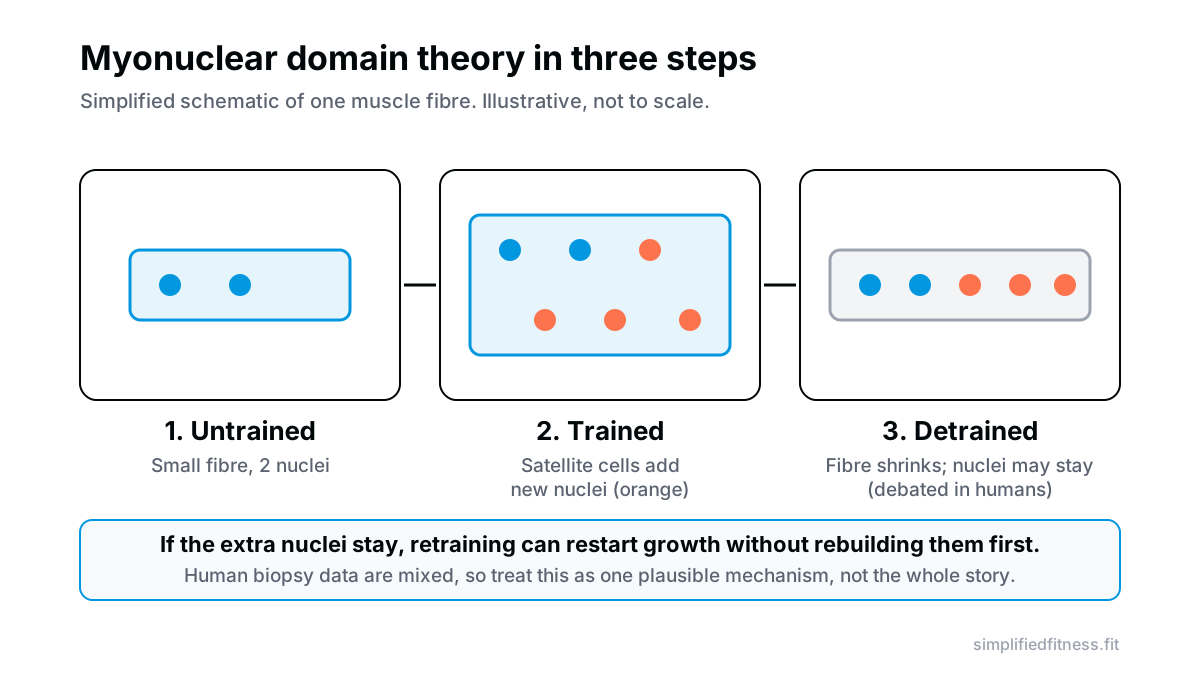
Support from human data exists. In older men, changes in type II fibre size correlated with changes in myonuclear number (correlations between 0.40 and 0.73) with a stable domain size, which the authors say supports the theory (Blocquiaux et al., 2020). Note the sample: myonuclei were analysed in only six older men.
For the stem cell side in more depth, see our article on satellite cells and myonuclear addition in hypertrophy.
Do myonuclei stay during detraining? What the studies disagree on
This is where honest reading matters, because the studies point in different directions.
Evidence for permanence. In live imaging of mouse muscle, new nuclei were added before fibres grew much, and the old and new nuclei were retained through severe atrophy from denervation lasting a considerable part of the animal’s lifespan (Bruusgaard et al., 2010). The same group later reported no loss of myonuclei during hindlimb suspension in rodents, arguing earlier findings of nuclear loss may reflect difficulty separating myonuclei from other nuclei (Bruusgaard et al., 2012).
In humans, a 2024 trial had twelve untrained adults train one arm for 10 weeks, stop for 16 weeks, then retrain both arms. Myonuclei in type 2 fibres rose by about a third on average and were maintained after detraining, leaving 33 percent more nuclei in the previously trained muscle than in the control arm (Cumming et al., 2024).
Evidence against. A 2022 systematic review and meta-analysis of 147 articles concluded that myonuclei are not permanent but are lost in periods of atrophy and with ageing, particularly in humans, and suggested epigenetics may matter more (Rahmati et al., 2022). A mouse study found myonuclei gained during hypertrophy were lost with detraining in several muscles, with complete reversal within 6 months in two of them, though the soleus resisted (Murach et al., 2020).
Why might they differ? Species (mouse versus human), the muscle studied, how atrophy was induced, and how long and how severe the atrophy was all differ. Rahmati’s team noted that in the rodent studies, atrophy of 30 percent or more was associated with lower nuclear content. Methods for counting myonuclei have also been a known problem in this field.
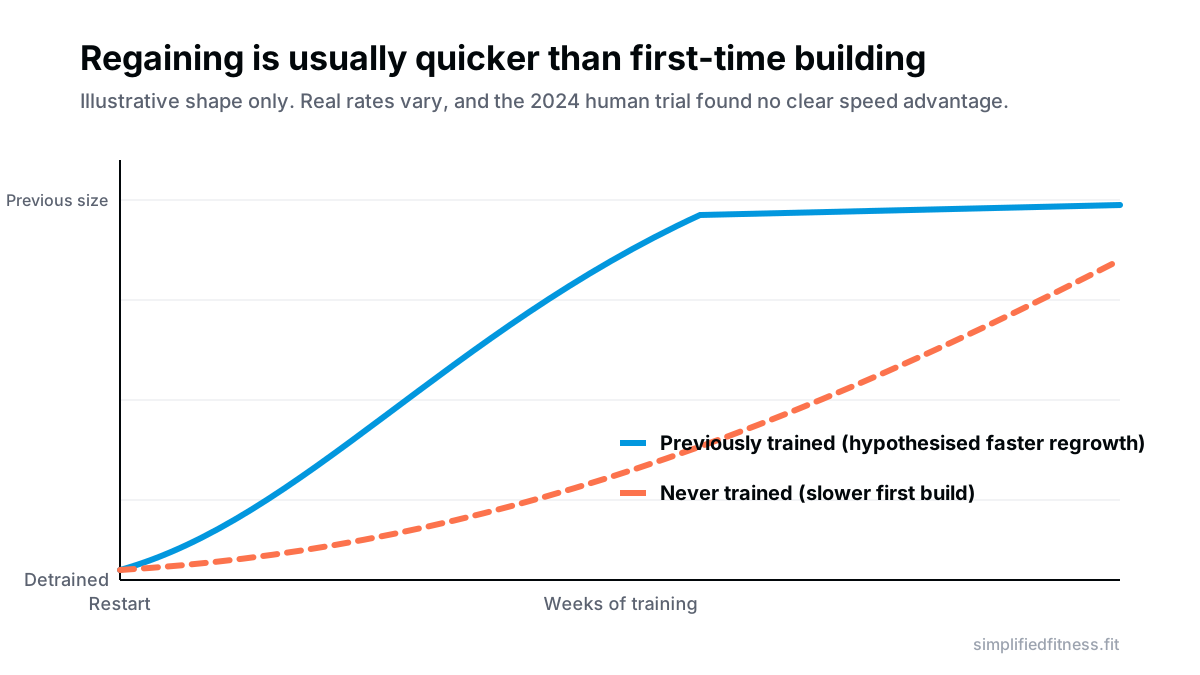
The sting in the tail. Even where nuclei were retained in humans, the 2024 trial did not find a clearly better response to retraining: the change in type 2 fibre size was not different between the previously trained and control arms, so the authors said the physiological benefit remains to be determined (Cumming et al., 2024).
What is epigenetic muscle memory?
Epigenetics means chemical tags that change how easily genes switch on, without changing the DNA sequence. The best-studied tag here is DNA methylation. Hypomethylation (fewer methyl tags) is generally associated with genes being more readily expressed.
In 2018, Seaborne and colleagues took human muscle biopsies through loading, unloading (muscle mass back to baseline) and reloading. They found more hypomethylated sites after reloading (18,816 CpGs) than after the first loading (9,153). Several genes, including AXIN1, GRIK2, CAMK4 and TRAF1, stayed hypomethylated even during unloading, which the authors interpret as a memory of earlier hypertrophy. Other genes (such as UBR5 and SETD3) showed the largest gains in hypomethylation, expression and muscle mass after reloading (Seaborne et al., 2018).
Protein-level work adds a hint. In a 2025 trial, 17 untrained adults did 10 weeks of training, 10 weeks off and 10 weeks of retraining (with a separate control group). Some proteins, including calpain-2, which the authors describe as a recently identified epigenetic muscle memory gene, stayed elevated after detraining. Other proteins, mainly those involved in aerobic energy metabolism, reversed (Hulmi et al., 2025).
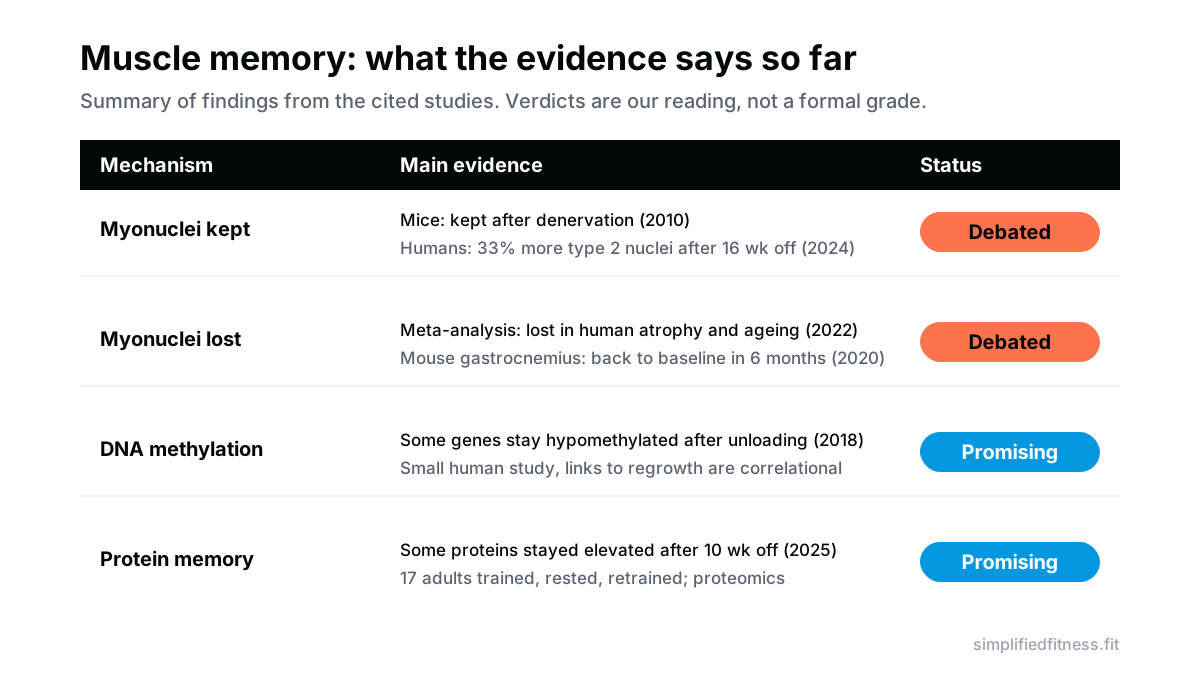
Caveats are real: these are small biopsy studies in untrained volunteers, and retained marks are associations. They do not prove the marks caused faster regrowth.
How fast do you regain lost muscle?
The practical question, and the evidence is encouraging for short and moderate breaks:
- 3-week break, young untrained men: no significant drop in muscle size or 1RM after the break, and growth on retraining was similar to initial training (Ogasawara et al., 2011).
- Repeated 3-week breaks: 14 men training in 6-week blocks with 3-week breaks gained similar muscle size and strength to men training continuously for 24 weeks (Ogasawara et al., 2013).
- 12 weeks off, older men: detraining caused a modest strength loss (5-15 percent), and under 8 weeks of retraining restored the earlier 1RM level (Blocquiaux et al., 2020).
What is missing is tidy human data for breaks of a year or more. That is the situation many readers are in, and honestly nobody can give you an exact timeline from this research alone. For how quickly size and strength fade in the first place, see detraining timelines.
What does this mean if you took months or years off?
A cautious reading of the research gives a few practical points.
- Expect a head start, not a free pass. Prior training probably helps, but human trials differ on how much.
- Restart lighter than your old numbers. Use our 1RM calculator to estimate a working weight, then begin well below it.
- Keep a minimum going during busy phases. Because human myonuclei may be lost over long atrophy, a little training likely beats none. Our article on how little training keeps muscle covers this.
- Eat enough protein while you rebuild. Vegetarian lifters can lean on dal, paneer, curd and soya chunks, plus eggs if they eat them.
- Train the basics hard but progressively. Overload is the signal that recruits satellite cells in the first place. If you are unsure how to structure it, our muscle hypertrophy guide is the place to start, and the free push day plan gives you a simple template.
Does muscle memory work the same for everyone?
Probably not. Gundersen noted that myonuclei are harder to recruit in the elderly, and Blocquiaux’s group stressed that ageing blunts the response to training and to training interruptions (Blocquiaux et al., 2020). Most trials use young or untrained volunteers, and mouse results do not always carry over to humans.
Two cautions. First, this is a biology article, not medical advice. If you have a medical condition, are older, or return after an injury or illness, check with a doctor or physiotherapist before you restart. Second, none of this suggests you should deliberately take long breaks. The best muscle memory is the muscle you never lose.
The bottom line
Muscle memory has a plausible biological basis. Extra nuclei, DNA methylation tags and retained proteins have all been reported in muscle from previously trained people, and several short-break trials show smooth comebacks. But human myonuclei may not be permanent, and the 2024 biopsy trial did not show a clear speed advantage from extra nuclei.
The sensible position: regrowth after a layoff is likely to be quicker than starting from zero, you cannot count on a specific timeline, and a gradual, progressive restart beats a heroic first week. Then, ideally, you stay consistent so you never need the memory at all.
Frequently Asked Questions
What is muscle memory in bodybuilding?
Muscle memory is the observation that muscle you built before comes back faster after a layoff than it took to build the first time. Researchers think this reflects lasting cellular traces such as extra myonuclei, epigenetic tags and retained proteins, alongside better movement skill [(Sharples et al., 2023)](https://pubmed.ncbi.nlm.nih.gov/37154489/). After a break, expect to regain faster than a beginner, but start lighter than your old numbers.
What is the myonuclear domain theory?
It proposes that each nucleus in a muscle fibre looks after a limited volume of cytoplasm, so a fibre needs more nuclei to grow large. In older men, changes in type II fibre size tracked changes in nucleus number, consistent with the theory [(Blocquiaux et al., 2020)](https://pubmed.ncbi.nlm.nih.gov/32017951/). In practice, this is why consistent hard training matters for long-term size.
Do myonuclei disappear when you stop training?
The evidence is mixed. Mouse studies found myonuclei were retained through severe atrophy [(Bruusgaard et al., 2010)](https://pubmed.ncbi.nlm.nih.gov/20713720/), while a 2022 meta-analysis found human myonuclei were lower after atrophy and with ageing [(Rahmati et al., 2022)](https://pubmed.ncbi.nlm.nih.gov/35961635/). Do not assume your extra nuclei are permanent, and keep some training going if you can.
What are satellite cells and why do they matter for muscle memory?
Satellite cells are muscle stem cells that sit beside fibres and can fuse into them, donating new nuclei during growth. According to Gundersen's review, previously untrained fibres recruit nuclei from activated satellite cells before hypertrophy occurs [(Gundersen, 2016)](https://pubmed.ncbi.nlm.nih.gov/26792335/). Regular overload training is what activates this process, so the practical lever is simply training hard and progressively.
What is epigenetic muscle memory?
It means training leaves chemical marks on DNA (methylation) that change how easily certain genes switch on, and some marks persist after training stops. In a human study, some genes stayed hypomethylated after muscle mass returned to baseline and showed larger changes after retraining [(Seaborne et al., 2018)](https://pubmed.ncbi.nlm.nih.gov/29382913/). It is a promising explanation, so use it as encouragement, not a promise.
How fast do you regain lost muscle?
In young untrained men, a 3-week break did not stop muscle gains when training resumed [(Ogasawara et al., 2011)](https://pubmed.ncbi.nlm.nih.gov/21771261/), and in older men under 8 weeks of retraining restored the earlier strength level [(Blocquiaux et al., 2020)](https://pubmed.ncbi.nlm.nih.gov/32017951/). Longer breaks have less direct data. Plan on several weeks to a few months, and ramp loads gradually over the first few weeks.
Is muscle memory neural or in the muscle itself?
Both are plausible. Movement skill and coordination are neural and return quickly, while the cell-level traces (nuclei, methylation, proteins) are in the muscle tissue itself. Bruusgaard and colleagues noted that muscle memory was traditionally credited to neural factors until a local mechanism in muscle was identified [(Bruusgaard et al., 2010)](https://pubmed.ncbi.nlm.nih.gov/20713720/). Practise your main lifts again early so the skill side catches up.
Does muscle memory last forever?
Nobody knows for humans. Gundersen suggested human myonuclei could be stable for at least 15 years and might even be permanent [(Gundersen, 2016)](https://pubmed.ncbi.nlm.nih.gov/26792335/), but the later meta-analysis disagreed that myonuclei are permanent [(Rahmati et al., 2022)](https://pubmed.ncbi.nlm.nih.gov/35961635/). Treat memory as helpful but not unlimited, and avoid very long gaps where you can.
Does muscle memory work for older adults?
Partly. In a small study of older men, strength came back within 8 weeks of retraining after 12 weeks off, and fibre size and nuclei increased again after 12 weeks [(Blocquiaux et al., 2020)](https://pubmed.ncbi.nlm.nih.gov/32017951/). Gundersen noted nuclei are harder to recruit in the elderly. Older lifters should restart earlier rather than later and progress gradually.
Can I take a planned break and still grow?
Short breaks appear tolerable. Young men doing 6-week blocks separated by 3-week breaks gained similar muscle size and strength to men training continuously for 24 weeks [(Ogasawara et al., 2013)](https://pubmed.ncbi.nlm.nih.gov/23053130/). The sample was 14 untrained men, so do not stretch it to long layoffs. A 1-2 week deload is a safer use of this idea than a month off.
Does muscle memory apply to fat loss or only muscle?
The research discussed here is about muscle fibres, not fat tissue. The cited studies measure myonuclei, DNA methylation and proteins in muscle biopsies. For fat loss, focus on the usual levers of energy balance and consistency, and use our [calorie calculator](/tools/calorie-calculator) to set a starting target.
Should I train differently to build more lasting muscle memory?
There is no proven protocol designed to maximise muscle memory. Mouse work found nuclei were added early in overload, before fibres grew much [(Bruusgaard et al., 2010)](https://pubmed.ncbi.nlm.nih.gov/20713720/), which suggests the stimulus is overload itself. Train close to failure with progressive overload and stay consistent.
Do I need to see a doctor before restarting after a long break?
If you have chest pain, breathlessness, dizziness, joint swelling, or a medical condition, check with a doctor before restarting. This article covers cell biology and cannot assess your health. Otherwise, begin with light loads and build up over several weeks.
Sources & References
Every claim above is checked against peer-reviewed research (PubMed, U.S. National Library of Medicine) or guidance from established health bodies. How we fact-check.
- Gundersen K. Muscle memory and a new cellular model for muscle atrophy and hypertrophy. J Exp Biol. 2016. PMID: 26792335
- Seaborne RA, et al. Human skeletal muscle possesses an epigenetic memory of hypertrophy. Sci Rep. 2018. PMID: 29382913
- Bruusgaard JC, et al. Myonuclei acquired by overload exercise precede hypertrophy and are not lost on detraining. Proc Natl Acad Sci U S A. 2010. PMID: 20713720
- Rahmati M, et al. Myonuclear permanence in skeletal muscle memory: a systematic review and meta-analysis of human and animal studies. J Cachexia Sarcopenia Muscle. 2022. PMID: 35961635
- Cumming KT, et al. Muscle memory in humans: evidence for myonuclear permanence and long-term transcriptional regulation after strength training. J Physiol. 2024. PMID: 39159314
- Blocquiaux S, et al. The effect of resistance training, detraining and retraining on muscle strength and power, myofibre size, satellite cells and myonuclei in older men. Exp Gerontol. 2020. PMID: 32017951
- Bruusgaard JC, et al. No change in myonuclear number during muscle unloading and reloading. J Appl Physiol. 2012. PMID: 22582213
- Murach KA, et al. Muscle memory: myonuclear accretion, maintenance, morphology, and miRNA levels with training and detraining in adult mice. J Cachexia Sarcopenia Muscle. 2020. PMID: 32881361
- Hulmi JJ, et al. Human skeletal muscle possesses both reversible proteomic signatures and a retained proteomic memory after repeated resistance training. J Physiol. 2025. PMID: 40183698
- Sharples AP, et al. Skeletal muscle memory. Am J Physiol Cell Physiol. 2023. PMID: 37154489
- Ogasawara R, et al. Effects of periodic and continued resistance training on muscle CSA and strength in previously untrained men. Clin Physiol Funct Imaging. 2011. PMID: 21771261
- Ogasawara R, et al. Comparison of muscle hypertrophy following 6-month of continuous and periodic strength training. Eur J Appl Physiol. 2013. PMID: 23053130

Umair Hazrami · Founder & Head Coach, Simplified Fitness
Umair Hazrami founded Simplified Fitness and the Simplified Lifter channel to cut through fitness noise. With 4+ years of consistent training and 10+ coaching clients, he writes every guide from the peer-reviewed research and links the sources so you can check them. Our editorial standards.
Educational content only, not medical advice. If you have a medical condition, are pregnant, or take medication, talk to a qualified doctor before changing your diet, supplements or training. Full disclaimer.
Keep reading

Health & Longevity
Overcoming the All-or-Nothing Mindset: How Perfectionism Wrecks Long-Term Fitness
The all-or-nothing mindset in fitness turns one missed workout into a lost month. Here is the research, the never-miss-twice rule and a 20-minute fallback plan.
10 min read

Health & Longevity
How to Build a Gym Habit: The Behavioral Science of Sticking With It
How to build a gym habit using habit science: how long it takes, why cues and low friction beat willpower, and what identity can and cannot do for consistency.
8 min read

Health & Longevity
Best Way to Measure Body Fat: DEXA, Bod Pod, Calipers and 4C Compared
The best way to measure body fat percentage is the same tool, under the same conditions, every time. See how DEXA, Bod Pod, calipers and 4C really compare.
8 min read

Health & Longevity
Body Recomposition Limits: Who Can Recomp, and When Advanced Lifters Must Choose a Surplus or Deficit
Body recomposition limits explained: who can still lose fat and gain muscle at once, why advanced lifters stall, and how to choose a cut or lean bulk.
9 min read