Returning to the Gym After a Long Break: A 4-Week Ramp-Up Plan
Returning to gym after a break? Use this 4-week ramp-up to skip crippling soreness, protect your tendons and regain muscle fast. Sets, RIR and protein included.

TL;DR. The short answer
- After a break of two months or more, start at roughly 4-6 hard sets per muscle per week, stop 3-4 reps short of failure, and add sets and effort over four weeks. Your old working weights are a target to rebuild toward, not a day-one test.
- Lost muscle and strength usually come back faster than they were first built. Earlier training may leave a cellular 'memory' (such as extra myonuclei), though human data are mixed. Tendons and connective tissue are the slower part, which is why strength can feel ahead of your joints.
- Severe soreness is mostly a first-session problem. A single bout of unfamiliar eccentric work protects against damage in later bouts (the repeated bout effect), so a gentle first week likely buys you some protection.
- Keep protein around 1.6 g/kg a day (about 100 g for a 62 kg person). In a meta-analysis of trials, gains in fat-free mass stopped improving above roughly 1.6 g/kg/day.
- Pain that is sharp, localised, getting worse, or sits at a tendon or joint is not normal soreness. Back off and see a doctor or physio, especially if you are returning after an injury.
Part of our complete guide: Body Composition, Muscle Memory and Habits: A Lifter's Guide to Tracking
Table of contents
The best way of returning to gym after a break is to start well below your old numbers: about 4-6 hard sets per muscle in week one, stopping 3-4 reps short of failure, then adding sets and effort across four weeks. You are not starting from zero, but your tendons and your tolerance for soreness are behind your memory of what you used to lift.
This guide is the practical, execute-it-on-Monday version of the biology covered in our muscle memory and body composition pillar. It also builds on how muscle memory works and how fast you actually lose muscle. Here we turn all of that into a four-week plan.
Why returning to the gym after a break goes wrong
The classic mistake is simple. You remember benching 80 kg for sets of 8, so you load 80 kg on day one. The first set feels fine. By set three your form is ragged, and two days later you cannot lift your arms to wash your hair.
Your head remembers the old numbers. Your body does not owe you them.
Three things lag behind your memory:
- Muscle damage tolerance. Unfamiliar hard work, especially the lowering part of a lift, causes more soreness and damage when you have been away.
- Connective tissue. Tendons adapt on their own timeline, and it is slower than the one for strength.
- Skill and rhythm. Bar path, bracing and the feel of a working set fade faster than most people admit.
None of this means you have to start with the empty bar for months. It means the first month is for rebuilding the platform, not testing it.
Does muscle memory mean I can skip the ramp?
Muscle memory is real enough to be encouraging, but not a licence to skip the ramp.
A 2016 review described a cellular model in which muscle fibres that grew large gain extra nuclei (myonuclei), and appear to keep them even after the fibre shrinks. Fibres with more myonuclei seem to regrow faster when overloaded again (Gundersen, 2016). The review framed long-lasting memory in humans as an open question and noted that myonuclei are harder to recruit in the elderly. A later meta-analysis went further and found that human myonuclei were lost during periods of atrophy, which suggests other mechanisms such as epigenetic marks may matter more (Rahmati et al., 2022).
Human retraining data points the same direction. In a study of older men, 12 weeks of resistance training increased knee extension strength and power by about 10 to 36%. After a detraining period, strength and power fell modestly, and less than eight weeks of retraining brought 1RM back to post-training levels (Blocquiaux et al., 2020). Twelve weeks of retraining was linked with type II fibre growth and more satellite cells and myonuclei. Only 6 of the older men had biopsies, so the cellular side of that study is small.
A separate trial in 14 young men compared continuous training with repeated cycles of 6 weeks of training and 3 weeks off. Overall gains in muscle size and strength were similar between the groups over 24 weeks (Ogasawara et al., 2013). A short break did not stop progress when training resumed.
The takeaway: a decent ramp does not slow your rebound. It tends to protect it, because you avoid the injury or the week-long soreness that would have cost you more sessions.
Why do tendons recover slower than muscle?
Short answer: they adapt on a different, slower clock, and a hot day-one session can outpace them.
In one study, 8 people did 3 months of isometric knee extension training. Strength rose by 29.6% after 2 months and 40.5% after 3 months. But muscle cross-sectional area and tendon stiffness did not change until after about 2 months, and became significantly higher by the end of the 3 months (Kubo et al., 2010). The authors concluded that adaptations of tendon and muscle shape to training are slower than adaptations in muscle function.
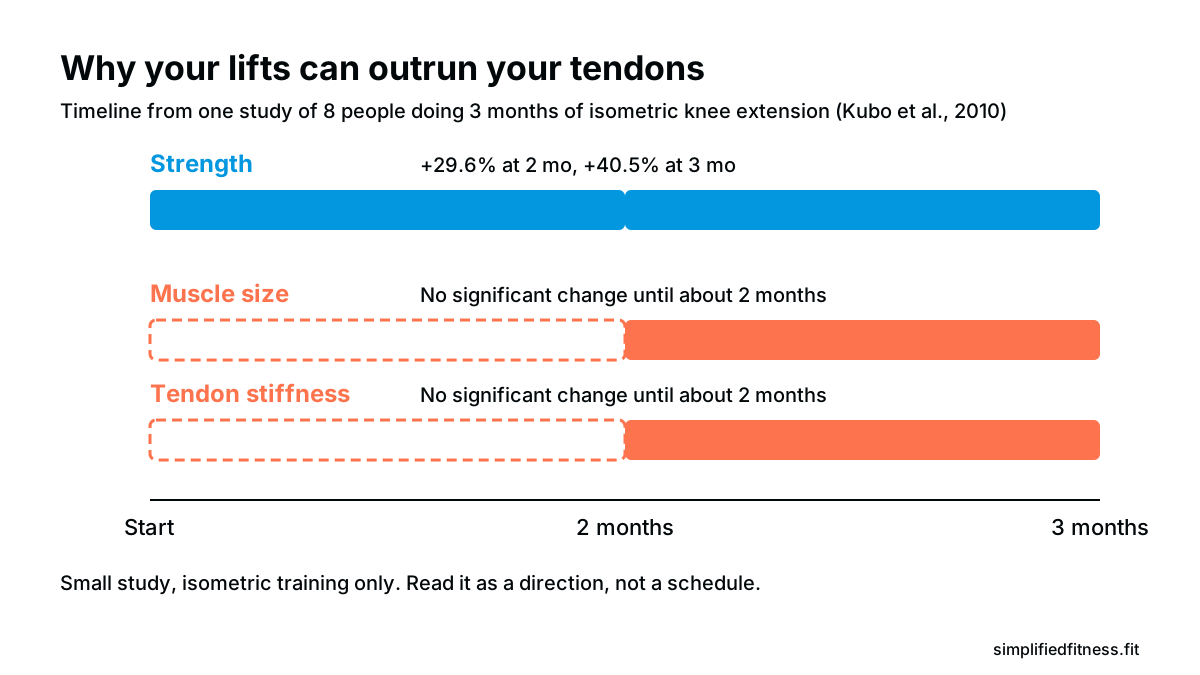
Read that carefully. It was a small study of isometric training in previously untrained people, not lifters returning from a layoff. It does not tell you your tendon is weak. It does show why strength can feel quick while connective tissue is still catching up, which is the reason a gradual ramp makes sense.
Why do I get crippling soreness after the first session back?
Because the first session after a layoff is the most damaging one you will do for months.
A repeated bout effect has been described for decades: a single bout of eccentric exercise protects against muscle damage from later eccentric bouts. A review of the mechanisms lists neural, mechanical and cellular adaptations, and notes that a unified explanation is still missing (McHugh, 2003).
A study of 10 young men tracked muscle damage across a training block. Damage after the first session was highest, lower at 3 weeks and minimal at 10 weeks. Interestingly, the early protein synthesis response was not linked to muscle growth, while later responses, once damage had settled, were strongly correlated with hypertrophy (Damas et al., 2016).
Read together, they say something useful. In that study, early damage did not seem to drive growth. If anything, the early damage phase seems to be a poor use of your recovery budget. A gentle first week gets you the protection without the wreckage.
That is the entire logic of the ramp. Keep reps in reserve, keep the set count modest, and let the body build its shield before you push.
The 4-week return-to-gym protocol
This protocol is an evidence-informed template, not a protocol tested in a trial. It follows the research logic above and standard coaching practice. Adjust it if you are older, if you were off for years, or if you are coming back from an injury.
Rules for all four weeks:
- Train 2-3 full-body days a week with at least one rest day between sessions.
- Pick 6-8 familiar exercises. No new, fancy movements.
- Use RIR (reps in reserve) to set effort, not your old weights.
- Log every set: load, reps, RIR. (Our guide to progressive overload shows how.)
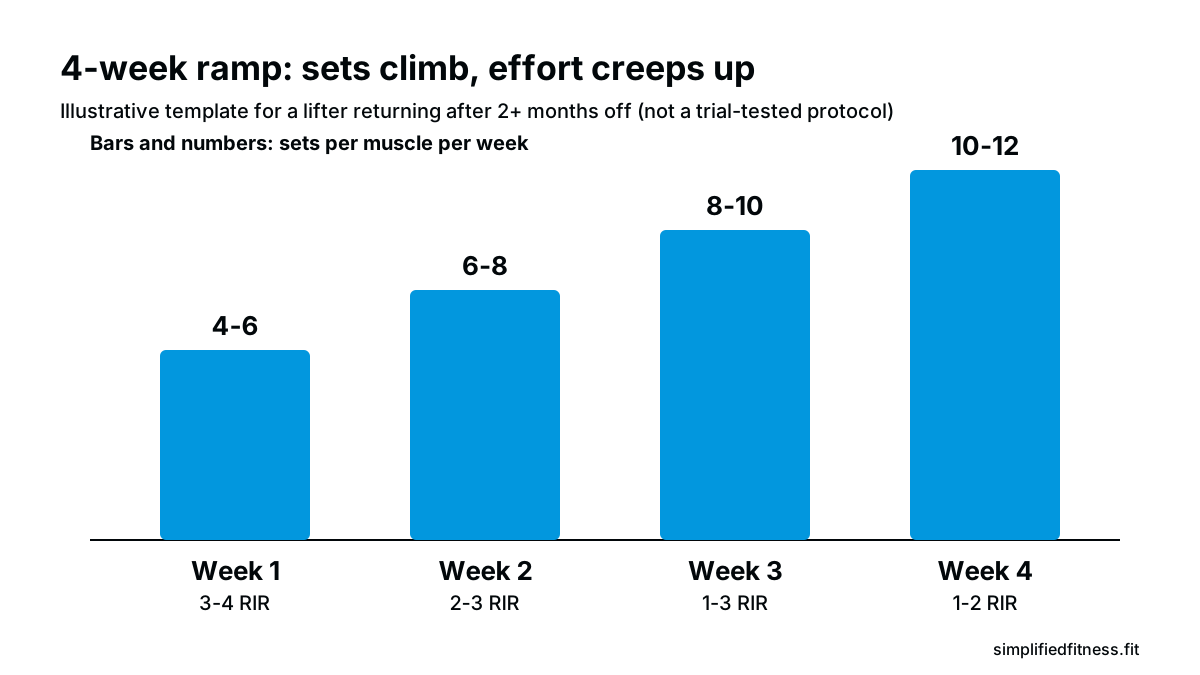
| Week | Weekly hard sets per muscle | Effort (RIR) | Load guide | Goal |
|---|---|---|---|---|
| 1 | 4-6 | 3-4 | Whatever lets you hit the reps with room to spare | Get the pattern back, limit soreness |
| 2 | 6-8 | 2-3 | Add small weight only when reps are clean | Build tolerance |
| 3 | 8-10 | 1-3 | Roughly 80-90% of your old loads if they feel easy | Rebuild working volume |
| 4 | 10-12 | 1-2 | Approach old loads on your best lifts | Return to normal training |
Notes on how to use it:
- Sets are hard sets, meaning ones taken close enough to failure to count. Warm-ups do not.
- Week 1 should feel almost too easy. If you finish each session thinking you could have done more, you got it right.
- If soreness is still limiting you on day two or three, hold the current week for another week instead of advancing.
- A first-week session might look like a squat variation, a press, a row, a hamstring curl, a lateral raise and a few sets of core, 1-2 sets of each.
If you want to check your effort calibration, the RIR and RPE load calculator can help translate reps in reserve into a working weight. For ready-made sessions, our free workout plans include push, pull and leg days you can slot into the ramp.
What if I still want more volume?
A bigger starting dose is not wrong if you were consistent for years and the break was short. The cost of starting slightly low is small, because the ramp is only four weeks long. The cost of starting too high is a missed session or two. When in doubt, go lower.
For context on how little training it takes to hold muscle once you have it, see our piece on maintenance volume. One trial in 70 adults found that reducing training to one-third or one-ninth of the original dose preserved muscle growth in the young but not in the older participants (Bickel et al., 2011). That is a maintenance finding, not a return-to-training one, but it shows that age changes how much loading you need.
How to rebuild muscle fast without wrecking yourself
“Fast” has a ceiling, and the ceiling is recovery. A few levers that actually matter:
- Frequency over heroics. Two or three smaller sessions a week beat one brutal one. Our training volume and frequency guide explains why spreading sets works.
- Progress one variable at a time. Add reps, then load, then sets. Do not change all three in the same week.
- Sleep and walking. Boring, but they decide whether Tuesday’s session recovers by Thursday.
- Respect lengthening-phase soreness. If your hamstrings or quads are still sore, do not stack another hard session on them.
For how to dial in effort between sets and rep ranges, see our guide to load, rep ranges, RIR and rest intervals.
Protein and food during the retraining phase
You do not need a special diet. You need enough protein, enough total food, and some consistency.
A meta-analysis of 49 randomised trials (1,863 participants) found that protein supplementation modestly improved gains in fat-free mass and strength during resistance training, and that benefits for fat-free mass did not increase beyond total protein intakes of about 1.62 g/kg/day (Morton et al., 2018). The effect was smaller with increasing age. The average gain in fat-free mass from supplementation was 0.30 kg, so protein helps, but it is not a magic switch.
In practice, 1.6 g/kg means about 100 g of protein a day for a 62 kg person and about 130 g for an 80 kg person. You can calculate yours with the protein intake calculator.
A mostly vegetarian Indian day (eggs optional) that lands around 100 g or a little more might look like:
- Breakfast: 3 egg whites with 1 whole egg or 150 g paneer bhurji, plus 2 rotis
- Lunch: 1.5 katori (about 250 g cooked) dal, rice, 200 g curd
- Snack: 30 g roasted chana or a whey scoop
- Dinner: 100 g soya chunks (dry weight) curry with roti
Rough numbers, and you can swap in chicken or fish. Our Indian high-protein nutrition guide has the full breakdown. If you want the budget version, soya chunks, eggs, dal and curd are the cheapest protein per rupee in most Indian kitchens.
Do not crash-diet during the ramp. Retraining while in a steep deficit makes soreness and fatigue worse, and it is a bad time to experiment.
Coming back after an injury?
This ramp assumes you took time off for ordinary reasons such as work, travel or a mild illness. If the break was for an injury or surgery, the starting load should come from your doctor or physiotherapist, not from a blog. Our guide to returning after an injury covers how to use pain ratings to progress.
When to see a doctor or physio
Normal post-workout soreness is dull, spread across the muscle belly and eases within a few days. Seek medical advice if you notice:
- Sharp or stabbing pain, especially at a tendon or joint
- Pain that gets worse day after day
- Swelling, heat or visible bruising
- Dark, cola-coloured urine or severe, unusual weakness after a hard session (this can signal a serious condition and needs urgent care)
- Pain that returns in the same spot every time you train
Short of those, soreness that is manageable and fading is part of coming back.
The bottom line
You are not starting from zero, but you are not where you left off either. Spend four weeks rebuilding: modest sets, plenty of reps in reserve, familiar exercises and steady protein. Let your old numbers come back to you rather than chasing them on day one, and treat sharp or worsening pain as a reason to stop and get checked.
Frequently Asked Questions
How long does it take to get back in shape after a long break?
Strength usually returns faster than most people expect, often within a few weeks to a couple of months depending on how long you were off and how trained you were. In one trial of older men, less than eight weeks of retraining restored 1RM strength lost during detraining, while fibre growth was measured after 12 weeks. Plan on 4 weeks of ramp-up, then judge progress by your log, not the mirror.
How do I start working out again after months off?
Start with 2-3 full-body sessions a week at a light, repeatable effort. Beginning well below your old loads limits muscle damage while your body re-adapts. Use the 4-week ramp in this article and write down every set.
How do I avoid extreme soreness when returning to the gym?
Keep the first week light, stay 3-4 reps from failure, and avoid piling on new exercises. A single earlier bout of eccentric work protects against damage in the next one, so a gentle first week lowers soreness in week two. Add sets gradually rather than doubling them in one jump.
Should I lift my old weights when I come back?
No, not on day one. Muscle, tendon and nervous system do not return on the same schedule, and your old numbers were built over months. Work back toward them across several weeks while keeping reps in reserve.
Is muscle memory real?
Faster regain after a break is well documented, but the reason is debated. A 2016 review proposed that fibres keep extra myonuclei after training, while a 2022 meta-analysis found human myonuclei are lost during atrophy. Either way, older men in one trial recovered their strength quickly on retraining. Treat muscle memory as a likely tailwind, not a guarantee.
How many sets per muscle should I do in week one?
A reasonable starting point is 4-6 hard sets per muscle for the week, spread over two or three sessions. That is low enough to limit damage and high enough to restart adaptation. Move up by about 2 sets per muscle each week if recovery is good.
How close to failure should I train when returning?
Stay around 3-4 reps in reserve (RIR) in week one, then drift toward 1-2 RIR by week four. Lower effort early keeps muscle damage down while technique and tolerance return. Use the RIR calculator if you struggle to judge it.
How much protein do I need while retraining?
Around 1.6 g/kg of body weight per day is a solid target for most healthy adults. A meta-analysis of 49 trials found protein supplementation helped gains in fat-free mass up to roughly that total intake and not beyond it. Spread it across 3-4 meals, using dal, paneer, curd, eggs, soya or whey to get there.
Why do my joints and tendons hurt even though my muscles feel fine?
Tendons adapt on a different timeline than muscle strength, and in one small study tendon stiffness did not change until about two months of training. If your strength feels ahead of your joints, the load may be outpacing connective tissue. Reduce load or volume, and see a doctor or physio if pain is sharp, persistent or at one specific tendon.
Can I regain muscle after an injury?
Often yes, but the plan depends on the injury and what your clinician has cleared, so this ramp is not the right tool on its own. Get medical clearance first and let a physio guide loading near the injured area. Our [post-injury return guide](/blog/returning-to-gym-post-injury-traffic-light-model) covers how to use pain as a guide.
Is a full-body or split routine better for coming back?
Full-body 2-3 days a week is usually the easiest way to restart. It spreads volume so no single muscle takes a huge hit, and each muscle gets trained often enough to practise the movement. You can move to an upper/lower or push/pull/legs split once the ramp is done.
Do I need a deload week after returning?
Not usually during the first four weeks, because the ramp itself is lighter than your old training. If you feel run-down, sleep poorly or your performance drops two sessions in a row, trim sets by about a third for a few days. After that, a normal progressive plan applies.
Sources & References
Every claim above is checked against peer-reviewed research (PubMed, U.S. National Library of Medicine) or guidance from established health bodies. How we fact-check.
- Gundersen K. Muscle memory and a new cellular model for muscle atrophy and hypertrophy. J Exp Biol. 2016. PMID: 26792335
- Blocquiaux S, et al. The effect of resistance training, detraining and retraining on muscle strength and power, myofibre size, satellite cells and myonuclei in older men. Exp Gerontol. 2020. PMID: 32017951
- Ogasawara R, et al. Comparison of muscle hypertrophy following 6-month of continuous and periodic strength training. Eur J Appl Physiol. 2013. PMID: 23053130
- Kubo K, et al. Time course of changes in muscle and tendon properties during strength training and detraining. J Strength Cond Res. 2010. PMID: 19996769
- McHugh MP. Recent advances in the understanding of the repeated bout effect: the protective effect against muscle damage from a single bout of eccentric exercise. Scand J Med Sci Sports. 2003. PMID: 12641640
- Damas F, et al. Resistance training-induced changes in integrated myofibrillar protein synthesis are related to hypertrophy only after attenuation of muscle damage. J Physiol. 2016. PMID: 27219125
- Morton RW, et al. A systematic review, meta-analysis and meta-regression of the effect of protein supplementation on resistance training-induced gains in muscle mass and strength in healthy adults. Br J Sports Med. 2018. PMID: 28698222
- Bickel CS, Cross JM, Bamman MM. Exercise dosing to retain resistance training adaptations in young and older adults. Med Sci Sports Exerc. 2011. PMID: 21131862
- Rahmati M, et al. Myonuclear permanence in skeletal muscle memory: a systematic review and meta-analysis of human and animal studies. J Cachexia Sarcopenia Muscle. 2022. PMID: 35961635

Umair Hazrami · Founder & Head Coach, Simplified Fitness
Umair Hazrami founded Simplified Fitness and the Simplified Lifter channel to cut through fitness noise. With 4+ years of consistent training and 10+ coaching clients, he writes every guide from the peer-reviewed research and links the sources so you can check them. Our editorial standards.
Educational content only, not medical advice. If you have a medical condition, are pregnant, or take medication, talk to a qualified doctor before changing your diet, supplements or training. Full disclaimer.
Keep reading

Health & Longevity
Overcoming the All-or-Nothing Mindset: How Perfectionism Wrecks Long-Term Fitness
The all-or-nothing mindset in fitness turns one missed workout into a lost month. Here is the research, the never-miss-twice rule and a 20-minute fallback plan.
10 min read

Health & Longevity
How to Build a Gym Habit: The Behavioral Science of Sticking With It
How to build a gym habit using habit science: how long it takes, why cues and low friction beat willpower, and what identity can and cannot do for consistency.
8 min read

Health & Longevity
Best Way to Measure Body Fat: DEXA, Bod Pod, Calipers and 4C Compared
The best way to measure body fat percentage is the same tool, under the same conditions, every time. See how DEXA, Bod Pod, calipers and 4C really compare.
8 min read

Health & Longevity
Body Recomposition Limits: Who Can Recomp, and When Advanced Lifters Must Choose a Surplus or Deficit
Body recomposition limits explained: who can still lose fat and gain muscle at once, why advanced lifters stall, and how to choose a cut or lean bulk.
9 min read