Gym Burnout and Apathy: Why Training Feels Like a Chore and How to Fix It
Gym burnout is a normal fatigue signal, not laziness. Learn how to tell tired muscles from a tired mind and the science-backed ways to get your drive back.

TL;DR. The short answer
- Gym burnout is a common mix of physical and mental fatigue, not a character flaw. The first job is working out which one you have: a tired body usually needs a deload, a tired mind usually needs variety, choice or a new goal.
- Self-determination theory says motivation rests on three needs: autonomy (you chose this), competence (you are improving) and relatedness (you belong). A 2019 meta-analysis of 74 studies found interventions improved autonomy and competence more than relatedness.
- Variety helps. A 2023 systematic review of 28 studies linked variety in physical activity with more enjoyment, interest and adherence, though the authors say more experiments are needed.
- Rest is not always the answer. In one trial of trained lifters, a full week off mid-program did not change muscle growth and led to smaller strength gains than training straight through.
- Low mood, loss of interest in most things for weeks, poor sleep or feeling hopeless are not gym problems. Speak to a doctor.
Part of our complete guide: Body Composition, Muscle Memory and Habits: A Lifter's Guide to Tracking
Table of contents
If the gym has started to feel like a chore, you are probably dealing with gym burnout, a normal mix of physical and mental fatigue that many lifters hit at some point. It is not laziness and it is not proof you “lost the fire.” It is a signal, and the useful move is to work out what it is telling you.
This article is about the motivational and psychological side. If you suspect the problem is mostly physical, start with our guide to adherence and body composition and the deload week explainer. Here we will separate tired muscles from a tired mind, look at what self-determination theory says about staying motivated, and build a plan to break the rut.
What does gym burnout actually look like?
Gym burnout symptoms are rarely dramatic. You still turn up, mostly. But it feels flat.
Typical signs:
- Dread before a session, not pain, just “ugh”
- Scrolling your phone between sets, going through the motions
- Skipping workouts you would once have fought to keep
- Progress that used to feel good now feels like nothing
- Training the same split, same exercises, same order for many months
Sports psychologists describe athlete burnout as emotional and physical exhaustion, devaluing the activity, and a reduced sense of accomplishment (Lonsdale et al., 2009). The research behind that comes from competitive athletes, so treat it as a useful lens rather than a diagnosis for a recreational lifter. Still, those three pieces map well to what people describe: tired, “why bother,” and “none of this counts.”
Is it physical fatigue or mental burnout?
This is the question that decides what you do next, and getting it wrong is an easy mistake to make. People who are physically run down push harder on willpower. People who are bored take a week off and come back just as flat.
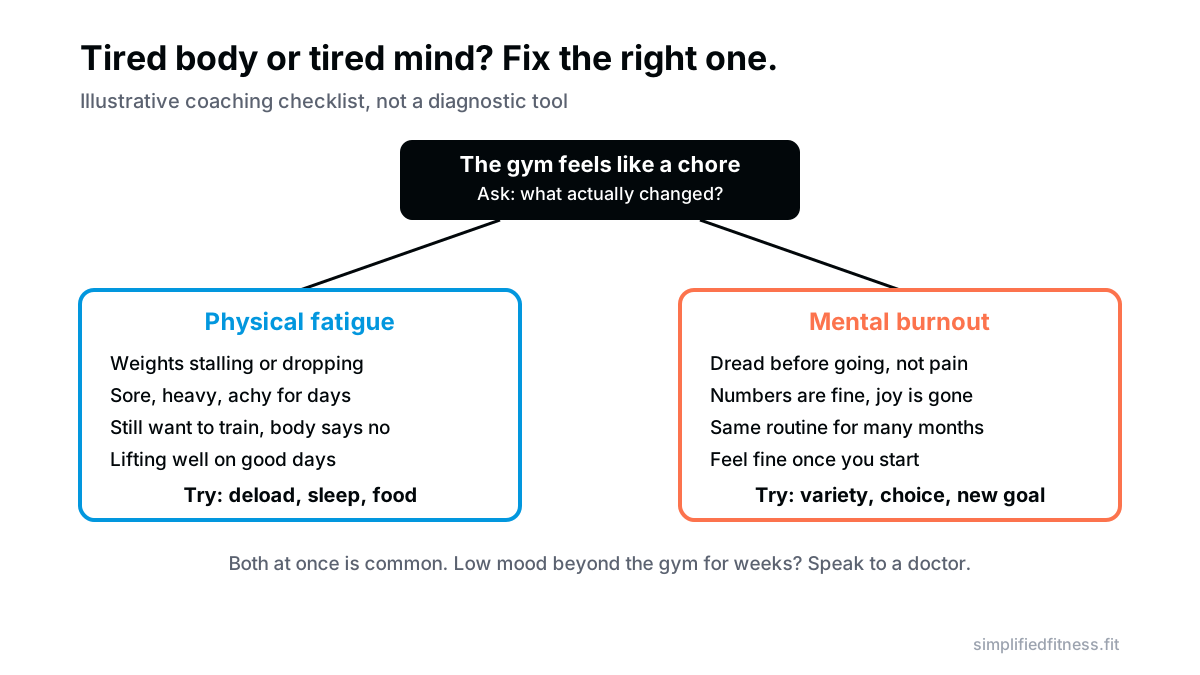
Rough guide from a coaching point of view:
| Signal | Leans physical fatigue | Leans mental burnout |
|---|---|---|
| Barbell numbers | Dropping or stuck | Mostly fine |
| Body | Sore, heavy, achy for days | Feels okay |
| Desire to train | Want to, body refuses | Do not want to, body would cope |
| After you start | Feels worse as you go | Feels fine after 10 minutes |
| Routine | Recent jump in volume or stress | Same plan for months |
You can have both. The 2013 joint consensus statement of the European College of Sport Science and the American College of Sports Medicine describes a spectrum, from short-term performance dips that recover (functional overreaching) to non-functional overreaching and overtraining syndrome, where fatigue, performance decline and mood disturbance can linger (Meeusen et al., 2013). The same statement notes that none of the markers currently used meet all criteria for general use. In plain terms, there is no blood test or app score that settles it for you. Your log, your sleep and how you feel are the working tools.
If your fatigue and falling performance persist despite rest, that goes beyond ordinary gym burnout. See our article on overtraining syndrome versus non-functional overreaching and speak to a doctor.
A quick way to check the physical side: use the RIR and RPE calculator to see whether your usual working weights are feeling much harder than they should. If a set you normally leave 2 reps in reserve now feels like a grind, your body is asking for a lighter week. Our signs you need a deload checklist goes into this properly.
Why do I feel like this? The self-determination view
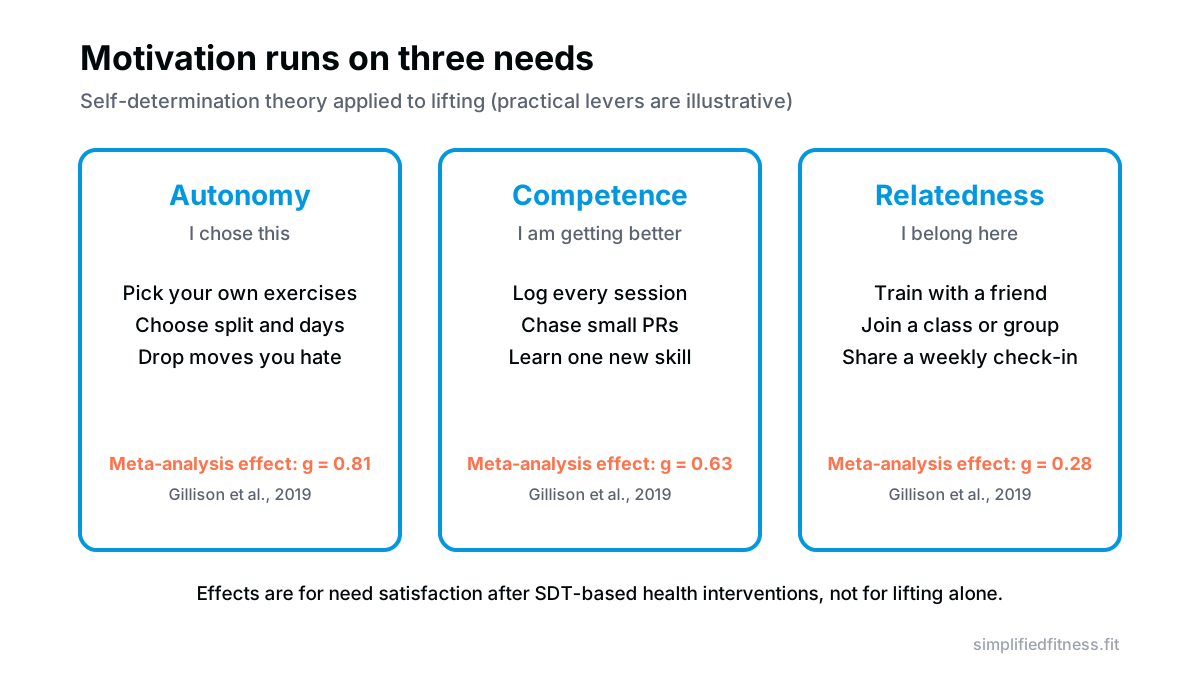
Self-determination theory (SDT) is one of the most used frameworks for exercise motivation. It proposes three basic psychological needs:
- Autonomy: feeling that you chose this and own it
- Competence: feeling that you are getting better at it
- Relatedness: feeling connected to other people through it
When these needs are met, motivation tends to become “autonomous,” meaning you train because you value it or enjoy it. When they are blocked, training feels like an obligation.
The evidence is reasonably consistent but not perfect. A 2025 systematic review of seven systematic reviews concluded that competence, intrinsic regulation and identified regulation were determinants of physical activity across age groups, and that interventions should prioritise competence and autonomous motivation over external pressures or rewards (Xu et al., 2025). The authors also noted earlier reviews had been inconclusive, which is why they pooled them.
For burnout specifically, a cross-sectional study of 201 elite Canadian athletes found that competence, autonomy and self-determined motivation together accounted for a large share of the differences in burnout symptoms (for global burnout, R² = 0.74) (Lonsdale et al., 2009). Cross-sectional means a snapshot, so it shows association, not cause. And these are elite athletes, so the size of the effect in an ordinary lifter may differ. The direction, though, matches common sense: feeling forced and feeling stuck go with feeling burned out.
What can you actually do about each need?
A 2019 meta-analysis of 74 studies (80 percent RCTs or cluster RCTs) looked at techniques used in SDT-based health programs. Weighted effects on perceived autonomy support were g = 0.84, autonomy g = 0.81, competence g = 0.63, relatedness g = 0.28 and motivation g = 0.41 (Gillison et al., 2019). Two caveats. These are general health behaviour programs, not lifting-specific, and no single technique worked well alone: the authors concluded a supportive environment needs several techniques working together.
Translating that to the gym:
- Autonomy: choose your own exercises within a structure. If you hate leg extensions, swap them for something else that trains quads. A plan you resent is a plan you will drop.
- Competence: make progress visible. A simple training log and small targets (one more rep, 2.5 kg more) beat vague goals. Our guide to keeping a training logbook shows how.
- Relatedness: train with a friend, join a class, or just tell someone your weekly plan. Effects were smallest here in the meta-analysis, so treat it as a helper, not the whole answer.
There is also gym-specific evidence, though it is small. In a 16-week community barbell program with 43 adults (average age about 45, mostly women), self-efficacy and intrinsic motivation were associated with more positive feelings during training and better adherence, and lifting heavier relative loads went with more favourable emotional responses (Martinez Kercher et al., 2025). Association only, no control group. Still, it hints that feeling capable under a real bar may be more motivating than ploughing through light, joyless sets.
How do I break out of a training rut?
A common trap is changing everything at once. New split, new diet, new gym, 6 days a week. Two weeks later they are worse off.
Change one variable at a time and keep the things that drive results: hard sets close to failure, progressive overload, enough protein and sleep.
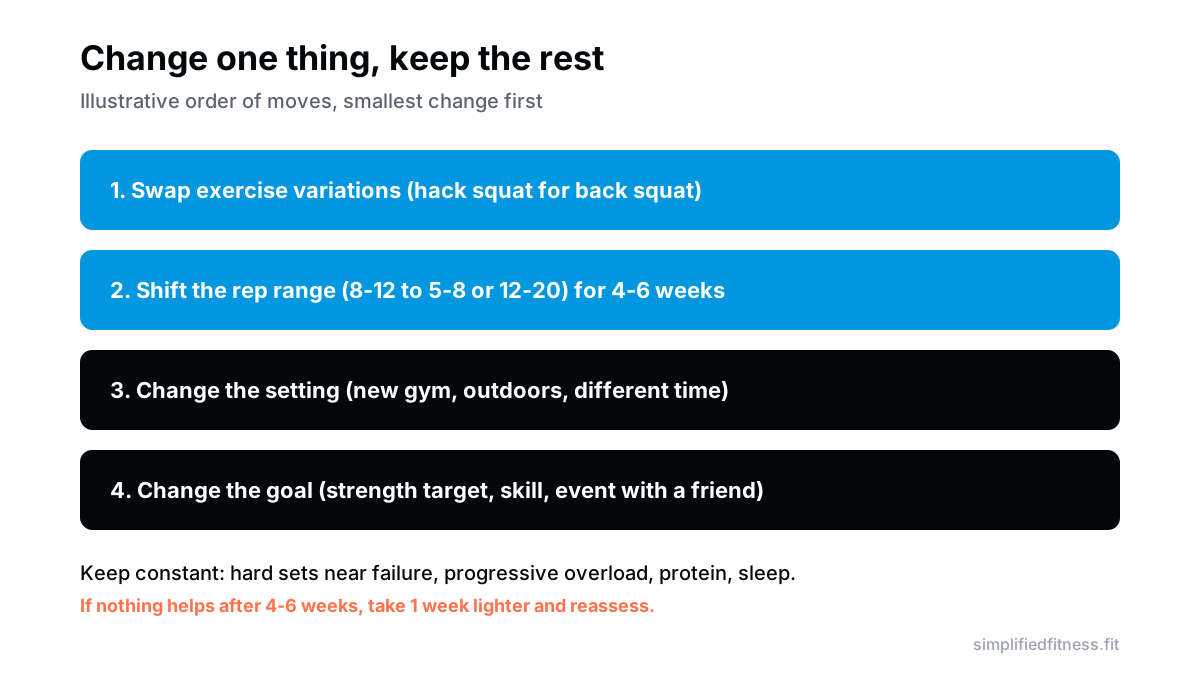
Step 1: Rotate exercise variations
Swap your main lifts for close relatives for a block of 4-6 weeks. Back squat to hack squat or leg press. Flat barbell bench to incline dumbbell press. Barbell row to chest-supported row. Your muscles care about tension and effort, and many exercises provide both, so you lose little and gain novelty.
Step 2: Shift the rep range
If you have lived at 8-12 for a year, try a block of heavier 5-8 work on the big lifts and 12-20 on isolation work. See our guides on double progression and rep range periodization for how to do it without losing progression.
Step 3: Change the setting or the schedule
Different gym, different time of day, an outdoor session, or a friend’s gym on weekends. A new setting can make familiar training feel different. If you always train after a draining workday, moving to mornings may be the whole fix.
Step 4: Give yourself a new target
Chasing “bigger” forever is vague. Pick something specific and concrete: a first strict pull-up, a bodyweight squat for reps, a 100 kg deadlift, a short event with a friend. Our piece on process versus outcome goals helps you choose well.
If you want a ready-made structure with different exercise choices, our free push, pull and leg day plans are an easy starting point.
Does taking time off fix burnout?
Sometimes, but not always, and not as much as people hope. Rest fixes physical fatigue. It does little for boredom.
One randomised trial in 39 resistance-trained young adults compared a one-week full break at the midpoint of a 9-week high-volume program with training straight through. Muscle growth, local endurance and power did not differ. Continuous training produced larger lower-body strength gains, and slightly better scores on a readiness-to-train questionnaire (Coleman et al., 2024). The participants were young and trained, the program was high volume, and nine weeks is short, so do not read it as “never deload.” It does suggest a total layoff is not automatically the best cure, particularly if you are not physically wrecked.
A practical middle path:
- If sore, heavy and stalling: take a lighter week (see how to deload), improve sleep, check you are eating enough
- If numbers are fine but you are flat: keep training, change the variables above
- If both: do a lighter week with new exercises in it
Life load matters too. Exams, a new baby, long work hours or a family crisis can drain you before you ever reach the gym. In that case, shrinking the plan to a minimum is not failure. See our guide to fitness during life stress.
What if it is the all-or-nothing trap?
A lot of burnout is perfectionism wearing a gym t-shirt. Miss one session and the week feels ruined, so you skip the rest. A simple rule helps: a short, easy session counts. Ten minutes of your first two lifts still keeps the habit alive and often turns into a full workout once you are there. For more on this, read all-or-nothing mindset in fitness and the wider science of gym habits and adherence.
Indian lifters have a few extra pressures. Hot months make midday sessions miserable, so move training to early morning or evening and keep a lighter indoor backup. Festival weeks, family events and exam seasons are predictable, so plan a minimum routine of 2 sessions rather than quitting and restarting. None of this needs a perfect diet either: dal, curd, paneer, eggs and roti-based meals can cover your needs without turning food into another source of stress.
A 4-week reset plan
- Week 1: Triage. Note whether you are physically or mentally flat. Sleep properly, eat enough, and do 2-3 shorter sessions.
- Week 2: Change one thing. Swap 2-3 exercises or shift one lift to a different rep range.
- Week 3: Add a target. Pick a specific lift or skill goal and log it.
- Week 4: Review. Is it a bit more fun? Keep what works. If not, try the next rung.
When to see a doctor
Gym burnout is a training problem. Depression, anxiety, thyroid problems, iron deficiency, sleep disorders and other medical issues can look similar. Speak to a doctor if you have had low mood or loss of interest in most things for two weeks or more, big changes in sleep or appetite, hopeless thoughts, unexplained fatigue that rest does not fix, or repeated illness. If you ever feel unsafe, contact local emergency services or a crisis line straight away. This article is general education and cannot diagnose anything.
Frequently Asked Questions
What are the symptoms of gym burnout?
Common signs are dreading sessions, going through the motions, skipping workouts you used to enjoy and feeling little reward from progress. Researchers describe burnout in athletes as exhaustion, devaluing the activity and a reduced sense of accomplishment. Note which of those you recognise, because it tells you whether to rest, change things up or talk to someone.
Why does the gym feel like a chore all of a sudden?
Usually the work has become something you have to do rather than something you chose to do. Self-determination research links pressure and external reasons with worse motivation, and choice and competence with better motivation. Give yourself a say again by picking your exercises, your days or a goal that is actually yours.
How do I know if I need a deload or just a change?
If your lifts are stalling, you ache for days and recovery feels poor, suspect physical fatigue and try a lighter week. If your numbers are fine but you feel dread and boredom, suspect mental burnout and change exercises, rep ranges or setting. Many people have a bit of both, so a lighter week with fresh exercises is a reasonable first test.
Is gym burnout the same as overtraining syndrome?
No. Overtraining syndrome is a more serious state of prolonged maladaptation with performance decline, fatigue and mood disturbance that is diagnosed after other causes are ruled out. Most gym burnout is milder and fixable with changes to the program and routine. If you have long lasting fatigue and falling performance despite rest, see a doctor.
How long should I take off from the gym when burned out?
There is no proven number, but a short break of a few days to a week is a sensible starting point if you are physically run down. A trial in trained lifters found a one-week full break did not hurt muscle size, though strength gains were smaller than training continuously. If you are mentally flat rather than physically tired, a change of routine often works better than total rest.
Does changing my workout routine really help motivation?
It can. A 2023 systematic review found variety in physical activity was associated with greater enjoyment, interest and adherence, though most evidence was not specific to lifting. Change one thing at a time, such as an exercise variation or rep range, so you keep the progressive overload that drives results.
How do I get motivated to lift when I have zero motivation?
Lower the bar so starting is easy, for example commit to a short session of just your first two exercises. Competence feeds motivation, and research on self-determination shows that feeling capable supports staying active. Often, once you start, the session carries on, but stopping early is also fine.
Should I force myself to go to the gym when I do not feel like it?
Sometimes, but not every time. Occasional low-motivation days are normal and a short, easy session often beats skipping. If dread is constant for weeks, pushing harder through it usually backfires, so adjust the plan rather than only adding willpower.
Can working out with a friend fix gym burnout?
It can help with the relatedness need, which is one of the three needs in self-determination theory. The 2019 meta-analysis found relatedness effects were smaller than autonomy and competence effects, so a partner works best alongside choice and visible progress. Pick someone who encourages you rather than adds pressure.
Can I be burned out and still make progress in the gym?
Yes. Burnout is about how you feel toward training, and your numbers can keep moving while the joy fades. That is the cue to protect enjoyment now through variety and goals, before it turns into skipped sessions.
Does too much rigid structure cause gym burnout?
It can for some people. Research on athlete burnout found that autonomy and competence, together with self-determined motivation, accounted for much of the variation in burnout symptoms in elite athletes, though that study was cross-sectional. Build in some flexibility, such as choosing one or two accessory exercises each session.
When should I see a doctor about low motivation?
See a doctor if you have had low mood, loss of interest in most activities, changes in sleep or appetite, or hopeless thoughts for two weeks or more. These can signal depression or another medical issue rather than gym burnout. Fatigue that does not lift with rest, unexplained weight change or repeated illness are also good reasons to get checked.
Sources & References
Every claim above is checked against peer-reviewed research (PubMed, U.S. National Library of Medicine) or guidance from established health bodies. How we fact-check.
- Meeusen R, et al. Prevention, diagnosis, and treatment of the overtraining syndrome: joint consensus statement of the European College of Sport Science and the American College of Sports Medicine. Med Sci Sports Exerc. 2013. PMID: 23247672
- Gillison FB, et al. A meta-analysis of techniques to promote motivation for health behaviour change from a self-determination theory perspective. Health Psychol Rev. 2019. PMID: 30295176
- Eather N, et al. The provision and experience of variety in physical activity settings: a systematic review of quantitative and qualitative studies. J Sport Exerc Psychol. 2023. PMID: 37169353
- Coleman M, et al. Gaining more from doing less? The effects of a one-week deload period during supervised resistance training on muscular adaptations. PeerJ. 2024. PMID: 38274324
- Martinez Kercher VM, et al. Affective responses to barbell-based resistance training in a 16-week barbell-based strength training program for recreationally active adults. Sports (Basel). 2025. PMID: 40137812
- Xu Z, et al. Does self-determination theory associate with physical activity? A systematic review of systematic review. Int J Psychol. 2025. PMID: 40256835
- Lonsdale C, et al. Athlete burnout in elite sport: a self-determination perspective. J Sports Sci. 2009. PMID: 19437185

Umair Hazrami · Founder & Head Coach, Simplified Fitness
Umair Hazrami founded Simplified Fitness and the Simplified Lifter channel to cut through fitness noise. With 4+ years of consistent training and 10+ coaching clients, he writes every guide from the peer-reviewed research and links the sources so you can check them. Our editorial standards.
Educational content only, not medical advice. If you have a medical condition, are pregnant, or take medication, talk to a qualified doctor before changing your diet, supplements or training. Full disclaimer.
Keep reading

Health & Longevity
Overcoming the All-or-Nothing Mindset: How Perfectionism Wrecks Long-Term Fitness
The all-or-nothing mindset in fitness turns one missed workout into a lost month. Here is the research, the never-miss-twice rule and a 20-minute fallback plan.
10 min read

Health & Longevity
How to Build a Gym Habit: The Behavioral Science of Sticking With It
How to build a gym habit using habit science: how long it takes, why cues and low friction beat willpower, and what identity can and cannot do for consistency.
8 min read

Health & Longevity
Best Way to Measure Body Fat: DEXA, Bod Pod, Calipers and 4C Compared
The best way to measure body fat percentage is the same tool, under the same conditions, every time. See how DEXA, Bod Pod, calipers and 4C really compare.
8 min read

Health & Longevity
Body Recomposition Limits: Who Can Recomp, and When Advanced Lifters Must Choose a Surplus or Deficit
Body recomposition limits explained: who can still lose fat and gain muscle at once, why advanced lifters stall, and how to choose a cut or lean bulk.
9 min read