Vacation Workout Routine: Keep Your Muscle Without a Gym
Need a vacation workout routine? Learn when resting on holiday is fine, plus a 20-minute bodyweight and resistance band session for trips longer than 2 weeks.
TL;DR. The short answer
- For a trip of about a week, taking the whole week off from lifting is a reasonable plan. Short breaks are unlikely to cost you meaningful muscle, and a rested lifter often returns fresh.
- On trips longer than 2 weeks, 2-3 short sessions a week of bodyweight and band work, taken close to failure, is a sensible way to hold your muscle and strength.
- Low-load training can build similar muscle to heavy training when sets are taken close to failure, so push-ups, split squats and rows can do real work. Heavy-load strength gains are better with heavier weights.
- One weekly session was enough to hold strength in professional footballers over 12 weeks, so even a bare-minimum routine counts.
- Heavy drinking can blunt the muscle-building response after a hard session, but a few drinks on holiday are not a reason to skip the trip's fun.
Part of our complete guide: Body Composition, Muscle Memory and Habits: A Lifter's Guide to Tracking
Table of contents
If you are heading off for a week or so, you probably do not need a vacation workout routine at all. A short break is unlikely to cost you meaningful muscle, and resting can leave you fresher. If the trip runs past two weeks, a 20-minute bodyweight and band session two or three times a week is a sensible way to hold what you have built.
This sits inside our wider guide to body composition, muscle memory and adherence. For the science of how little training holds muscle, read maintenance volume first. This article is the travel version: what to do on a trip, and what to skip without guilt.
Should you even train on a 7-day vacation?
Honestly, often no. Most lifters worry about holidays far more than their muscles do.
Muscle is not fragile. In one two-phase trial, 70 adults trained three days a week for 16 weeks, then either stopped completely or kept going at reduced doses for 32 weeks. Strength gained in the first phase was largely retained throughout complete detraining, with only a slight drop at the final time point (Bickel et al., 2011). That was 32 weeks, not 7 days.
Another small study puts breaks in a different light. Fourteen young men did bench press for 24 weeks, either continuously or in cycles of 6 weeks of training separated by 3-week breaks. Overall gains in muscle size and strength ended up similar between the two groups (Ogasawara et al., 2013). It was a small, single-exercise study in beginners, so treat it as reassurance rather than a rule. Still, it hints that a short break is not a disaster.
If you get restless, one gentle session is fine. Just do not turn your holiday into a second job. For what actually happens to muscle during longer gaps, see detraining timelines.
When is a vacation workout routine worth doing?
Longer trips change the maths. The evidence on exactly how long is too long is thin, and it depends on age and training history.
In the Bickel trial, reduced maintenance doses (one-third or one-ninth of the original) preserved muscle growth in the young adults (20-35) but not in the older adults (60-75) (Bickel et al., 2011). So if you are over 60, you may want to be a bit more consistent on a long trip.
A second data point comes from professional footballers. After a 10-week program, one group did a single strength session per week in season and another did one every second week. Over 12 weeks, the weekly group held on to strength and sprint performance, while the fortnightly group lost some of both (Rønnestad et al., 2011). That was 14 athletes, so it is a small trial, but it supports a simple idea: one decent weekly session is better than none on a long stretch.
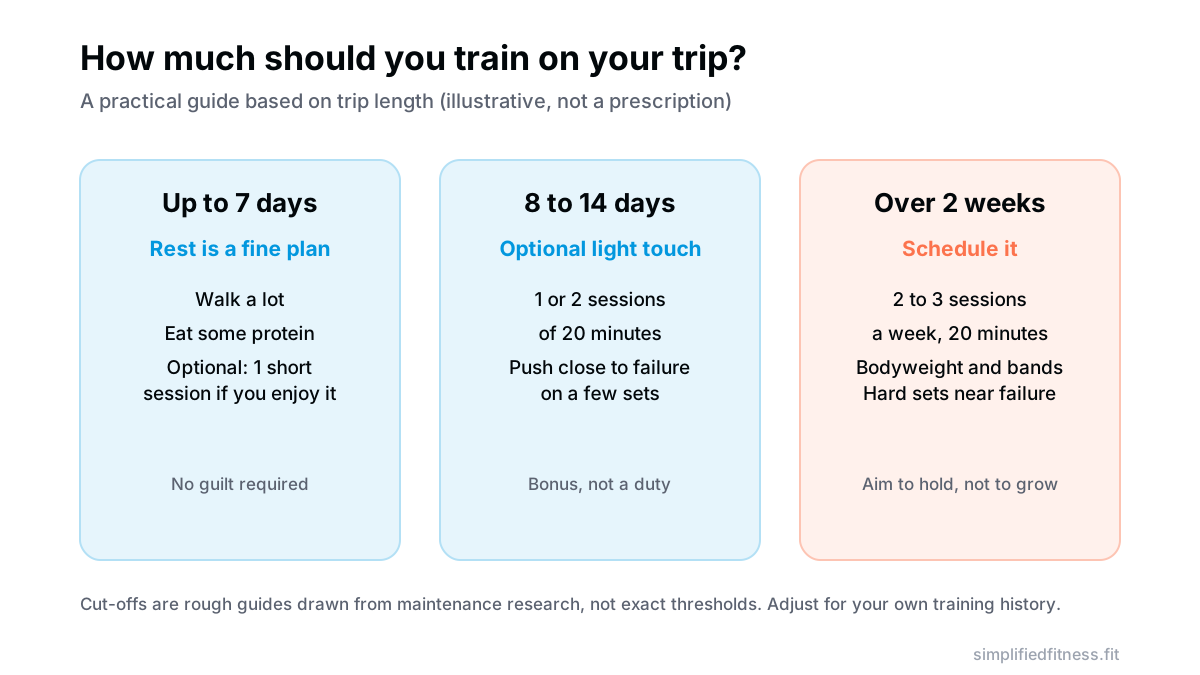
My practical cut-offs, not research-derived thresholds:
- Up to 7 days: rest is fine.
- 8-14 days: one or two optional short sessions.
- Over 2 weeks: schedule 2-3 sessions of about 20 minutes.
Can bodyweight and bands really maintain muscle?
Yes, with one condition: the sets have to be hard.
A systematic review of 21 trials compared low-load training (60% of 1RM or less) with high-load training, with all sets taken to failure. Muscle growth was similar between the two, while heavier loads were better for 1RM strength (Schoenfeld et al., 2017). So light loads can work. Your strength on a heavy barbell may slip slightly, but muscle can be maintained.
Effort matters here. In an 8-week trial of 25 untrained men, low-load training to failure grew the quadriceps (7.8%), while low-load training stopped short of failure did not produce a significant change (2.8%) (Lasevicius et al., 2022). It was untrained men, one leg exercise, so cautious extrapolation is wise.
For bodyweight movements specifically, an 8-week trial in 18 young men found that push-ups, adjusted to match 40% of a 1RM bench press, produced similar gains in triceps and chest thickness as the bench press (Kikuchi et al., 2017). In another small study, 13 sedentary young women trained for 6 weeks with progressive bodyweight movements or barbell squats, and both groups gained strength and muscle thickness. Body fat only dropped in the barbell group (Wei et al., 2023). These were untrained participants and very small groups, so the lesson is encouragement, not a guarantee for experienced lifters.
What does the 20-minute travel session look like?
Pick five movements and make each one hard. Rest about 60-90 seconds between sets.
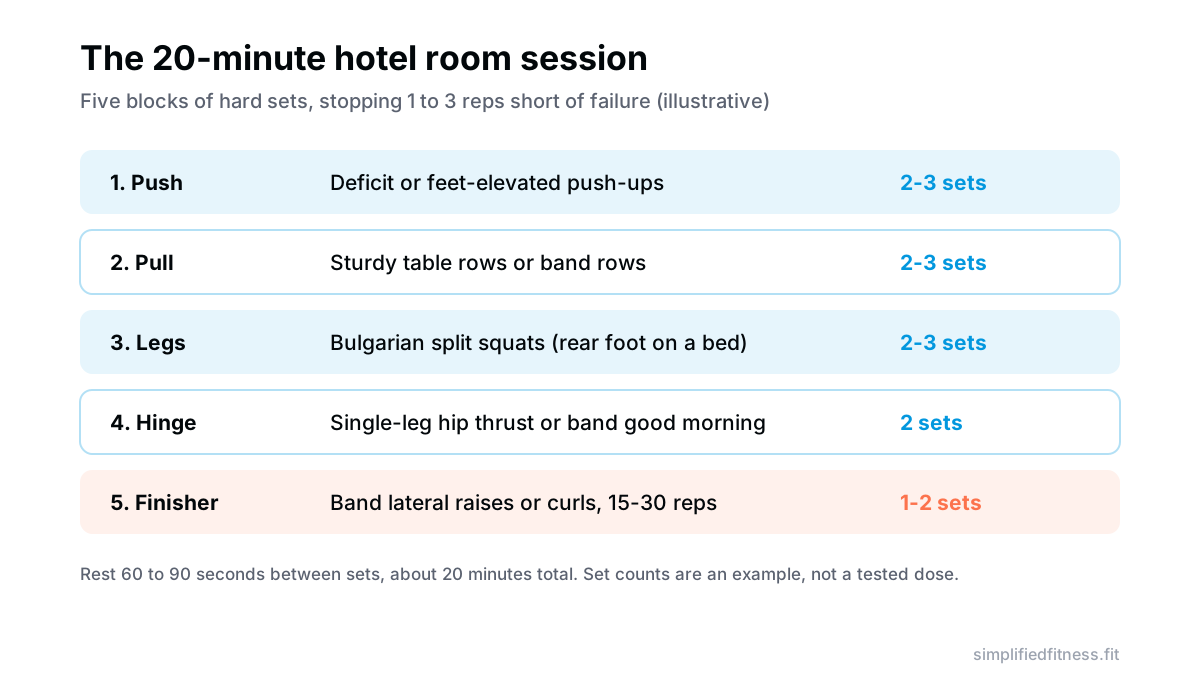
Push: feet-elevated or deficit push-ups (hands on two books or chairs so your chest drops lower). Add a pause at the bottom if reps get easy.
Pull: this is the hard one without equipment. Use a sturdy table for bodyweight rows, a doorframe-anchored band, or a band under your foot. Slow lowering makes them harder.
Legs: Bulgarian split squats with your rear foot on a bed or chair. Slow 3-second lowering. Each leg counts as a separate set.
Hinge: single-leg hip thrusts off the bed, or band good mornings.
Finisher: band lateral raises or curls for 15-30 reps. Light loads work when you get close to failure.
For effort, you want sets that end with maybe 1-3 reps left. If you are not sure how that feels, our RIR and RPE calculator can help calibrate. Two or three sets per block is plenty.
Hotel gym workout plan: how to use a small gym
Many hotel gyms have light dumbbells, a bench and a cable machine. That is enough for a decent session.
Build around two or three compound lifts, such as dumbbell presses, goblet squats and rows, then add a couple of isolation sets. Use higher reps (12-20) if the dumbbells are light, and slow them down. If you want to see our standard splits, our push day, pull day and leg day plans can be trimmed to fit. For more on the equipment side, see our hotel gym and travel workouts guide.
Resistance band travel routine tips
Bands are light, cheap and fit in a shoe. A few ideas make them work harder:
- Slow the lowering phase to 3 seconds.
- Pause for a second at the point of peak tension.
- Double the band or step further from the anchor for more load.
- Use them for what bodyweight cannot do easily: rows, lateral raises, face pulls and curls.
Check bands for nicks before each trip, since a snapped band can hurt.
How do you handle food and alcohol on vacation?
Without guilt, mostly. A holiday is not a diet test.
Aim for some protein at most meals: dal, paneer, curd, eggs, fish or chicken if you eat them, depending on where you are. You do not need to hit your normal gym-day targets. If you want a rough number for the trip, use our protein calculator. For airports, road trips and hotel breakfasts, see our guide on travel nutrition strategies.
Alcohol is worth a note. In a small randomized crossover trial, 8 active men did hard resistance and cycling exercise, then drank a large dose of alcohol (about 12 standard drinks). Muscle protein synthesis after exercise was lower by 24% when alcohol came with protein and 37% when it came with carbohydrate, compared with protein alone (Parr et al., 2014). That was a heavy dose in a very small group. It does not mean a beer with dinner ruins your gains. Our deeper piece on alcohol and muscle growth covers the nuance.
If you cross many time zones, sleep may matter more than training for the first few days. Our jet lag guide covers resetting your rhythm.
When you get home
Ease back in. For most people a few days of slightly lower volume feels right, then back to normal. Our guide to returning to the gym after a long break covers the first week.
If you have an injury, a medical condition, or are returning after illness, check with a doctor or physiotherapist before resuming hard training. Persistent pain, dizziness or chest discomfort during exercise deserves medical advice, not more reps.
The bottom line
Enjoy the trip. For about a week, rest is a perfectly good plan. For longer stays, 2-3 short, hard bodyweight and band sessions a week are a sensible way to hold your muscle. Get the effort right, eat some protein, and let the rest go.
Frequently Asked Questions
Should I work out on vacation?
It is optional on a trip of around a week. Short breaks in training are unlikely to cost meaningful muscle, and a few days of rest can leave you fresher. If you enjoy moving, keep it light and fun, and treat any training as a bonus.
Will I lose muscle if I take a week off?
Probably very little. There is little evidence that a single week off costs meaningful muscle, and strength is even stickier: in one trial, strength gained over 16 weeks was largely retained through 32 weeks of complete detraining. Resume your normal routine when you get home.
How long can you go without lifting before losing muscle?
There is no single cut-off, and it depends on your training history and age. In a young-adult group in one trial, muscle size was preserved with a reduced dose, while older adults needed more. For trips beyond 2 weeks, scheduling a few short sessions is a cautious way to reduce the risk.
Can you build muscle with bodyweight exercises only?
Yes, especially if you are newer to training or the exercise is hard enough. An 8-week trial in young men found push-ups at a matched load built similar muscle thickness to bench press at 40% of 1RM. Make the movements harder with elevation, tempo and single-leg variations.
Do I need to train to failure with bodyweight exercises?
Getting close to failure matters more when loads are light. In an 8-week study of untrained men, low-load sets stopped short of failure produced smaller and non-significant gains in quadriceps size, compared with low-load sets to failure. You do not have to fail every rep, but finish sets with 1-3 reps left.
What is the best resistance band travel routine?
A simple full-body session with a push, a pull, a squat pattern, a hinge and one arm or shoulder finisher covers most of what you need. Bands add tension for rows, presses and lateral raises when you do not have weights. Use slow lowering phases and stop each set 1-3 reps short of failure.
Is a hotel gym workout plan worth doing?
It can be, if the gym has dumbbells and a cable stack, but it is not essential. Hotel gyms are usually small, so build the session around two or three compound movements and a couple of isolation sets. Bring a band as backup in case the room is crowded or closed.
How many days a week should I train on holiday?
For trips over 2 weeks, 2-3 short sessions a week is a practical target. Professional footballers in one trial held leg strength with a single weekly session over 12 weeks, so even one session has research support. For trips under a week, zero is also a perfectly fine answer.
Can I use a hotel bed and doorframe for a workout?
Yes. A bed supports rear-foot-elevated split squats and single-leg hip thrusts, a sturdy table supports bodyweight rows, and a chair supports deficit push-ups or dips. Check that furniture is stable before loading it.
How should I handle food and alcohol on vacation?
Eat normally, aim for some protein at most meals and enjoy local food without tracking every bite. Large amounts of alcohol have been shown to reduce muscle protein synthesis after hard exercise in one small trial, so avoid drinking heavily right after a session. Do not let one big dinner turn into a week of guilt.
Will a two-week break make me fat?
A short break rarely undoes months of progress, though scale weight may rise a little from extra salt, carbs and water. Much of a quick jump is likely fluid, not fat. Walk daily, eat protein, and return to your normal routine afterward.
Is it better to rest or train when jet lagged?
If you are exhausted, rest and sleep usually serve you better than forcing a hard session. A short, easy session can help you feel normal again, but stop short of failure on the first days. Keep the first session light and build back over a few days.
What should I do when I get back from a long trip?
Go back to your usual program but ease in with slightly lower volume for the first week. Strength and muscle tend to return quickly after a short layoff, though you may feel rusty. Our guide to returning to the gym lays out a sensible first week.
Sources & References
Every claim above is checked against peer-reviewed research (PubMed, U.S. National Library of Medicine) or guidance from established health bodies. How we fact-check.
- Bickel CS, et al. Exercise dosing to retain resistance training adaptations in young and older adults. Med Sci Sports Exerc. 2011. PMID: 21131862
- Schoenfeld BJ, et al. Strength and hypertrophy adaptations between low- vs. high-load resistance training: a systematic review and meta-analysis. J Strength Cond Res. 2017. PMID: 28834797
- Kikuchi N, et al. Low-load bench press and push-up induce similar muscle hypertrophy and strength gain. J Exerc Sci Fit. 2017. PMID: 29541130
- Lasevicius T, et al. Muscle failure promotes greater muscle hypertrophy in low-load but not in high-load resistance training. J Strength Cond Res. 2022. PMID: 31895290
- Wei W, et al. Effects of progressive body-weight versus barbell back squat training on strength, hypertrophy and body fat among sedentary young women. Sci Rep. 2023. PMID: 37598268
- Ogasawara R, et al. Comparison of muscle hypertrophy following 6-month of continuous and periodic strength training. Eur J Appl Physiol. 2013. PMID: 23053130
- Rønnestad BR, et al. Effects of in-season strength maintenance training frequency in professional soccer players. J Strength Cond Res. 2011. PMID: 21873897
- Parr EB, et al. Alcohol ingestion impairs maximal post-exercise rates of myofibrillar protein synthesis following a single bout of concurrent training. PLoS One. 2014. PMID: 24533082

Umair Hazrami · Founder & Head Coach, Simplified Fitness
Umair Hazrami founded Simplified Fitness and the Simplified Lifter channel to cut through fitness noise. With 4+ years of consistent training and 10+ coaching clients, he writes every guide from the peer-reviewed research and links the sources so you can check them. Our editorial standards.
Educational content only, not medical advice. If you have a medical condition, are pregnant, or take medication, talk to a qualified doctor before changing your diet, supplements or training. Full disclaimer.
Keep reading

Health & Longevity
Overcoming the All-or-Nothing Mindset: How Perfectionism Wrecks Long-Term Fitness
The all-or-nothing mindset in fitness turns one missed workout into a lost month. Here is the research, the never-miss-twice rule and a 20-minute fallback plan.
10 min read

Health & Longevity
How to Build a Gym Habit: The Behavioral Science of Sticking With It
How to build a gym habit using habit science: how long it takes, why cues and low friction beat willpower, and what identity can and cannot do for consistency.
8 min read

Health & Longevity
Best Way to Measure Body Fat: DEXA, Bod Pod, Calipers and 4C Compared
The best way to measure body fat percentage is the same tool, under the same conditions, every time. See how DEXA, Bod Pod, calipers and 4C really compare.
8 min read

Health & Longevity
Body Recomposition Limits: Who Can Recomp, and When Advanced Lifters Must Choose a Surplus or Deficit
Body recomposition limits explained: who can still lose fat and gain muscle at once, why advanced lifters stall, and how to choose a cut or lean bulk.
9 min read