How Long Does It Take to Lose Muscle? A Realistic Detraining Timeline
How long does it take to lose muscle after you stop lifting? A week-by-week look at glycogen, strength and muscle size, with every study linked and sourced.

TL;DR. The short answer
- Studies in trained people suggest little real muscle is lost in the first 2 weeks off. Several-day drops in how full your muscles look are more likely fuel and water than tissue, though this has not been measured directly in lifters.
- Maximal strength is usually the stickiest quality. In one trial of 12 power athletes, bench press fell 1.7% and squat 0.9% after 14 days, neither significant.
- Muscle size tends to fade before maximal strength does. In two small studies it returned toward pre-training levels within 1-5 months, while strength stayed above baseline.
- Muscle does not turn into fat. Fat gain after a break comes from eating more than you now burn, which you can manage with protein, daily steps and slightly smaller portions.
- Short breaks are rarely a problem. Older adults and anyone off for several months should expect a slower rebuild and ramp back gradually.
Part of our complete guide: Body Composition, Muscle Memory and Habits: A Lifter's Guide to Tracking
Table of contents
If you are asking how long does it take to lose muscle, the research-based answer is: longer than most lifters fear. In trained people, two weeks off appears to cost very little real muscle, and the “flat” look after a few days is more likely stored fuel and water than lost tissue. Size usually fades over months, and maximal strength tends to hang on even longer.
That is the short version. Below is what the studies actually measured, where they disagree, and what to do if you are about to take sick leave, travel or just a long break. This sits inside our wider guide to body composition, muscle memory and adherence, so we will keep the focus on timelines.
How long does it take to lose muscle? The short timeline
Nobody has tracked a single lifter week by week from day one to month three, so this timeline is stitched together from separate studies of different people. Treat it as a pattern, not a stopwatch.
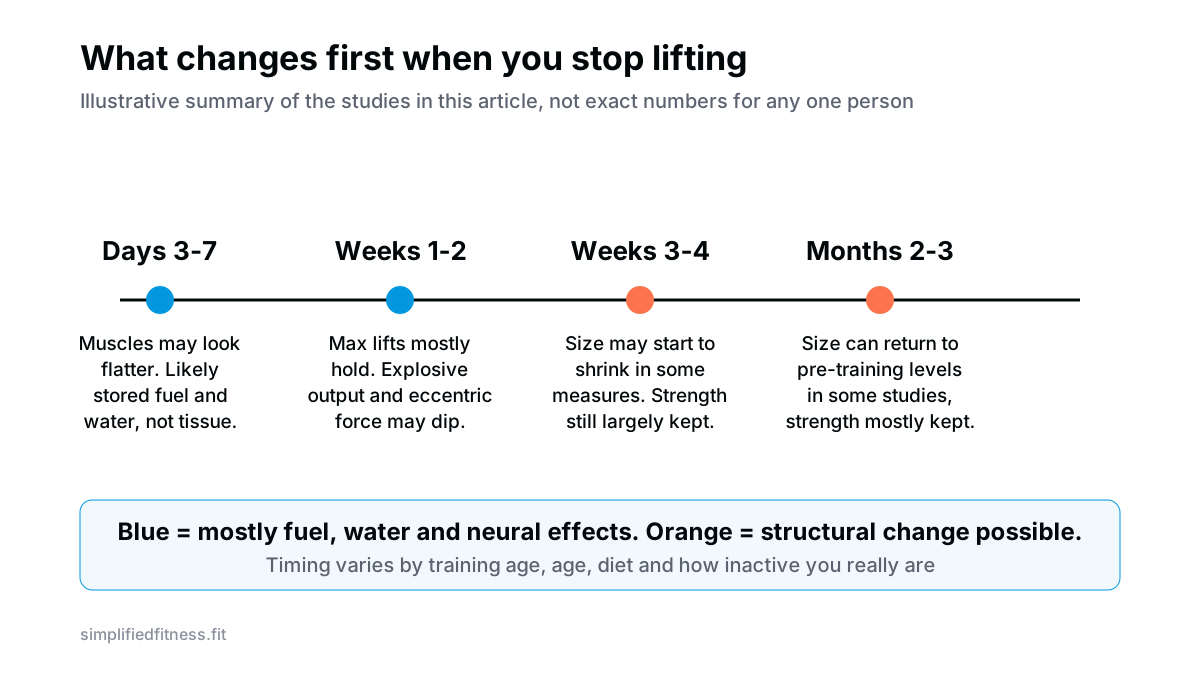
| Time off | What may change | How confident are we |
|---|---|---|
| Days 3-7 | Muscles may look flatter or feel softer | Plausible, not directly measured in lifters |
| Weeks 1-2 | Small dips in explosive output and eccentric strength; one study saw type II fibre area fall about 6%; max lifts mostly hold | Moderate, small studies in strength athletes |
| Weeks 3-4 | Some fibre or size measures may start to shrink | Low to moderate, few studies |
| Months 2-3 and beyond | Size can return toward pre-training levels; strength often still above baseline | Moderate, small studies in untrained to recreational people |
Why do muscles look smaller after 5 days off?
Your muscles store carbohydrate as glycogen, and glycogen holds water. When you stop training and eat the same or less, some of that stored fuel can be used up or simply not topped up, and the muscle may look less full.
How much water goes with glycogen is debated, but a study in nine aerobically trained volunteers found that each gram of glycogen was stored with at least about 3 g of water in human muscle, and sometimes more (Fernandez-Elias et al., 2015). That study looked at recovery after hard cycling in the heat, not at lifters taking a week off, so it supports the mechanism but does not prove the size of the effect after a gym break.
This is why a flat-looking week off is not a reliable sign of muscle loss. The reverse is also true: muscles often look fuller again within a few days of eating well and training. If you want to understand how carbs influence this, see our piece on carbohydrates, glycogen and hypertrophy, and for the scale side of the story read why scale weight fluctuates with water and sodium.
2 weeks without the gym: what the studies found
Two small studies looked at about 14 days off in strength athletes, and they tell a similar story with a twist.
In 1993, researchers had 12 power athletes stop resistance training for 14 days. Free weight bench press changed by -1.7%, parallel squat by -0.9%, and vertical jump by +1.2%, none of them significant. Eccentric knee extension force fell in every subject, by about 12% on average, and type II fibre area fell about 6.4% (Hortobagyi et al., 1993).
A 2026 study of 20 elite powerlifters used the same 14 days. Reactive strength index, rate of force development in an isometric pull and sprint performance dropped significantly, along with less quadriceps muscle activation. Muscle thickness and cross-sectional area did not change significantly (Yilmaz et al., 2026). The authors call their interpretation tentative.
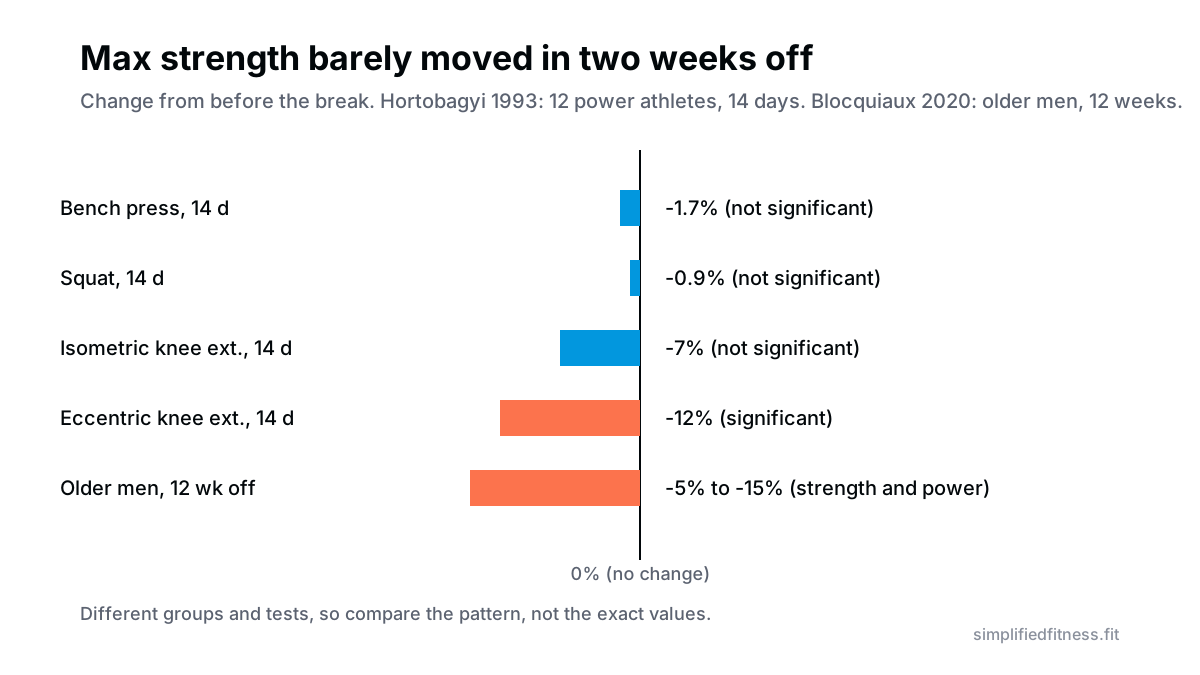
Put together, two weeks off seems to affect how quickly and smoothly your muscles fire more than how much muscle you carry. Both studies were small and in highly trained men, so we cannot say the same holds for beginners, women or older lifters.
Do you lose strength or size first?
Many lifters assume strength vanishes faster than size. The research we found points mostly the other way, with some exceptions.
- Kubo et al. (2010): In 8 people who trained isometric knee extension for 3 months and then stopped for 3 months, strength and neural activation did not change during detraining, yet muscle cross-sectional area returned to pre-training levels at 1 month and tendon stiffness at 2 months (Kubo et al., 2010).
- Psilander et al. (2019): In 19 men and women (9 men, 10 women) who trained one leg, muscle thickness and fibre area returned to baseline during 20 weeks of detraining, but strength stayed elevated (Psilander et al., 2019).
- Bickel et al. (2011): In a 70-person trial, strength gained over 16 weeks was largely retained through 32 weeks of detraining, with only a slight reduction at the last time point (Bickel et al., 2011).
So why does the “neural decay” idea persist? The two-week studies above did find dips in power, force development and eccentric strength, which are heavily influenced by how well your nervous system recruits muscle. Maximal strength on a lift you practise is more stable. The most careful reading is that skill and speed dip early, size fades more slowly, and maximal strength is the last to go.
All three long studies used beginners or untrained people over short training blocks, so a lifter with years of training may behave differently.
What about three months or longer?
For longer breaks, the best summary we found is in older adults. A 2022 meta-analysis of six studies found a significant gain in muscle size with training, and no significant loss after 12-24 weeks of cessation (Cohen’s d -0.60, 95% CI -1.21 to 0.01), but a significant loss after 31-52 weeks (d -1.11) (Grgic, 2022). That 12-24 week result sits right at the edge of significance, so it is better read as “loss is not clearly detectable yet” than as “no loss”.
Strength in older adults can also hold up reasonably well. In a study of older men, 12 weeks off cost a modest 5-15% of knee extension strength and power, and less than eight weeks of retraining brought one-rep max strength back to its post-training level (Blocquiaux et al., 2020).
Bickel’s trial also found that the older group needed more weekly training than the young to hold their muscle fibre size. Both maintenance doses held the young group’s size, but not the old group’s, so older lifters are likelier to lose size during a break (Bickel et al., 2011). If that is you, even a small amount of training during the break is worth the effort. Our guide to how little training keeps muscle covers that in detail.
Does muscle turn into fat when you stop lifting?
No. Muscle and fat are separate tissues, and one does not convert into the other. What people see is two things happening at once: muscle slowly gets smaller, and fat can increase if energy intake stays the same while daily activity drops.
For most of us in India, the usual culprit is eating habits that were built around training. Big rice portions, extra roti or a snack after the gym can quietly become a surplus once the sessions stop. You do not need to eat less protein. Keep dal, paneer, curd, eggs or soya in your meals, and trim carbs and fried snacks slightly if your waist measurement starts to rise. Use our protein calculator to keep your target steady.
Will a break hurt your gains? Maybe less than you think
If you want a reason to stop worrying about short breaks, consider a trial of 14 young men. One group trained continuously for 24 weeks. The other did three 6-week training cycles separated by 3-week breaks. Overall gains in muscle cross-sectional area and strength ended up similar (Ogasawara et al., 2013). It was a small, short trial in young men doing only bench press, so it does not mean breaks are better. It does show that a few weeks off did not erase months of progress.
The idea of “muscle memory” is related. We cover the cell biology in muscle memory, myonuclei and epigenetics. Note that in Psilander’s study, retraining was not clearly better in a previously trained leg, so the cellular explanation is still unsettled even though people do report getting back to their old level faster.
What to do if you are about to take time off
A few steps are enough:
- Keep protein steady. The same daily total you were using, spread over your normal meals.
- Walk. 6,000-8,000 steps a day keeps energy balance from drifting, and it is easy in a hot climate early in the morning or after sunset.
- Do something if you can. Even two short sessions a week of squats, push-ups and rows is better than nothing. Our vacation and travel workout guide shows how.
- Sleep. Illness and travel disrupt sleep, and sleep is one of the cheapest recovery tools you have.
- Do not train through illness. If you have a fever, chest symptoms or an injury, rest and see a doctor.
What should you do when you come back?
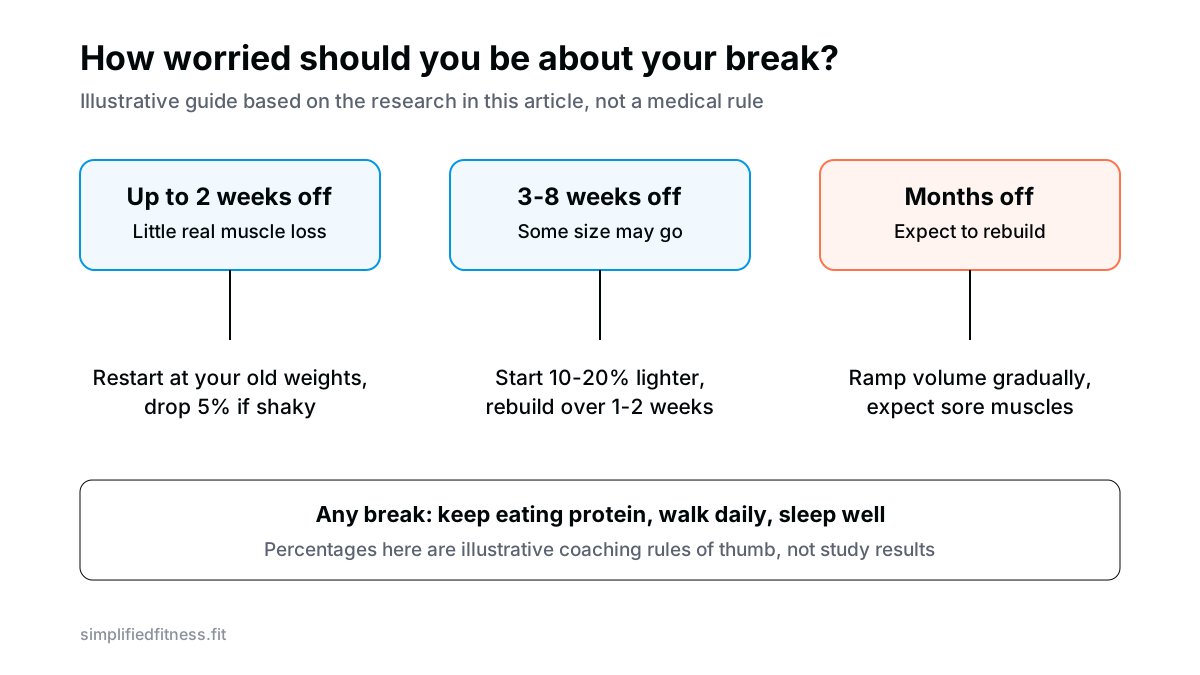
The most common mistake here is trying to prove nothing was lost by going straight back to your old numbers. Start a bit lighter, keep a rep or two in reserve and build up over a week or two. Your strength usually returns faster than it was first built, but your joints, tendons and tolerance for volume need time. Our full guide on returning to the gym after a long break has a week-by-week restart.
Where the evidence is thin
A few honest caveats:
- Most detraining studies are small, often with 8 to 20 people.
- Short-term studies in strength athletes (14 days) have not directly measured glycogen or whole-muscle water, so the “it is just water” explanation is inferred from mechanism, not shown in those athletes.
- Several long studies used untrained people, older adults or a single leg exercise, which may not match a lifter with years of experience.
- Studies differ in what they measure (muscle thickness, fibre area, cross-sectional area, 1RM, isometric force), so results are not interchangeable.
The bottom line
A week or two off will not undo your progress, and the early flat look is likely fuel and water. Muscle size tends to fade over months, strength often outlasts it, and older lifters should be more careful. If you are travelling, ill or just tired, rest, eat enough protein, move daily, and come back lighter than you left. If you notice rapid, unexplained muscle loss or weakness, see a doctor rather than assuming it is the break.
Frequently Asked Questions
How long does it take to lose muscle after stopping the gym?
Studies suggest that real muscle loss in trained people is small in the first 2 weeks and becomes more measurable over months. Size seems to fade before strength does, and strength is often largely retained for a long time. If you are off for under a month, focus on restarting rather than worrying about lost muscle.
Will I lose muscle in 2 weeks without the gym?
Probably very little. In 12 power athletes, 14 days off produced no significant change in bench press, squat or jump height, though type II fibre area fell about 6.4%. Plan to walk, eat protein and train again as soon as you can, rather than forcing a workout while you are ill.
Why do my muscles look smaller after a week off?
Muscles that look flatter after several days off are most likely holding less glycogen and water, not losing tissue. In humans, glycogen has been reported to be stored with at least about 3 g of water per gram, so a small change in stored fuel can change fullness. Eat your usual carbohydrates and protein, and expect the look to return within days of training.
Does muscle turn into fat when you stop lifting?
No, muscle and fat are different tissues and one cannot convert into the other. What happens is that muscle may slowly shrink while fat can increase if you keep eating as much as before but burn fewer calories. Keep daily steps up and trim portions slightly if your waist is creeping up.
How fast do you lose strength after stopping training?
In most of the studies reviewed here, maximal strength dropped slowly, if at all, over weeks. Explosive measures and eccentric strength seem to dip sooner, for example eccentric knee extension fell about 12% after 14 days in power athletes. Expect your first sessions back to feel a bit rusty, then recover quickly.
Is it better to rest completely or do something during a break?
The studies here did not find that a complete break of a week or two erased progress, and one small trial built breaks into the plan without losing overall gains. For longer breaks, reduced training helps: in one trial, a third or even a ninth of the usual weekly dose held muscle size in young adults, though older adults needed more than either dose. If you can fit one or two simple sessions a week, you will usually keep more than if you do nothing.
How long does it take to lose muscle if you are older?
Older adults may lose size sooner than younger people. A meta-analysis of six studies found no significant muscle size loss after 12-24 weeks off, but a significant loss after 31-52 weeks. A trial of 70 adults also found that older people needed a higher maintenance dose than younger people to hold muscle fibre size, so older lifters should try to keep training.
Do I lose gains faster if I am a beginner?
We did not find a direct beginner versus advanced comparison, so the honest answer is that nobody knows precisely. Several studies in untrained people found strength staying above baseline for months after stopping, so early gains are not fragile. Restart gradually and keep your sessions consistent.
Does muscle memory really exist?
Strength clearly comes back faster than it was first built, but the cellular explanation is still debated. A human study found no extra myonuclei after training and no better retraining response in a previously trained leg, so it could not confirm the cellular theory. Regardless of mechanism, expect to rebuild faster than you built the first time.
How should I restart after a long break?
Start lighter than your old working weights. After a few weeks off, build back over 1-2 weeks; after several months off, use a longer ramp of about four weeks, because your coordination and tolerance for volume return before your joints and tendons are used to it. Take extra care if the break followed an injury or illness, and see a doctor if you have ongoing pain.
Can a planned break actually help muscle growth?
It may not hurt. In 14 young men, training cycles with 3-week breaks produced similar overall muscle growth to continuous training over 24 weeks. This was a small trial, so treat it as an interesting finding rather than a reason to stop training.
Should I take supplements to stop losing muscle during a break?
There is no supplement shown in this research that prevents detraining. Consistent protein intake, sleep and movement are the practical tools. If you want to look at protein targets, use our protein calculator.
When should I see a doctor about muscle loss?
See a doctor if you lose muscle or strength quickly without a clear reason such as injury, illness or bed rest, or if you have weakness on one side, pain, or unexplained weight loss. Rapid unexplained change can have causes that have nothing to do with training. A doctor can check what is going on rather than guessing from the mirror.
Sources & References
Every claim above is checked against peer-reviewed research (PubMed, U.S. National Library of Medicine) or guidance from established health bodies. How we fact-check.
- Hortobagyi T, et al. The effects of detraining on power athletes. Med Sci Sports Exerc. 1993. PMID: 8371654
- Yılmaz U, et al. Multidimensional physiologic adaptations to a 14-day detraining period in elite powerlifters: neuromuscular, morphological, and hormonal responses. J Strength Cond Res. 2026. PMID: 42213892
- Fernandez-Elias VE, et al. Relationship between muscle water and glycogen recovery after prolonged exercise in the heat in humans. Eur J Appl Physiol. 2015. PMID: 25911631
- Kubo K, et al. Time course of changes in muscle and tendon properties during strength training and detraining. J Strength Cond Res. 2010. PMID: 19996769
- Psilander N, et al. Effects of training, detraining, and retraining on strength, hypertrophy, and myonuclear number in human skeletal muscle. J Appl Physiol. 2019. PMID: 30991013
- Bickel CS, et al. Exercise dosing to retain resistance training adaptations in young and older adults. Med Sci Sports Exerc. 2011. PMID: 21131862
- Grgic J. Use it or lose it? A meta-analysis on the effects of resistance training cessation (detraining) on muscle size in older adults. Int J Environ Res Public Health. 2022. PMID: 36360927
- Ogasawara R, et al. Comparison of muscle hypertrophy following 6-month of continuous and periodic strength training. Eur J Appl Physiol. 2013. PMID: 23053130
- Blocquiaux S, et al. The effect of resistance training, detraining and retraining on muscle strength and power, myofibre size, satellite cells and myonuclei in older men. Exp Gerontol. 2020. PMID: 32017951

Umair Hazrami · Founder & Head Coach, Simplified Fitness
Umair Hazrami founded Simplified Fitness and the Simplified Lifter channel to cut through fitness noise. With 4+ years of consistent training and 10+ coaching clients, he writes every guide from the peer-reviewed research and links the sources so you can check them. Our editorial standards.
Educational content only, not medical advice. If you have a medical condition, are pregnant, or take medication, talk to a qualified doctor before changing your diet, supplements or training. Full disclaimer.
Keep reading

Health & Longevity
Overcoming the All-or-Nothing Mindset: How Perfectionism Wrecks Long-Term Fitness
The all-or-nothing mindset in fitness turns one missed workout into a lost month. Here is the research, the never-miss-twice rule and a 20-minute fallback plan.
10 min read

Health & Longevity
How to Build a Gym Habit: The Behavioral Science of Sticking With It
How to build a gym habit using habit science: how long it takes, why cues and low friction beat willpower, and what identity can and cannot do for consistency.
8 min read

Health & Longevity
Best Way to Measure Body Fat: DEXA, Bod Pod, Calipers and 4C Compared
The best way to measure body fat percentage is the same tool, under the same conditions, every time. See how DEXA, Bod Pod, calipers and 4C really compare.
8 min read

Health & Longevity
Body Recomposition Limits: Who Can Recomp, and When Advanced Lifters Must Choose a Surplus or Deficit
Body recomposition limits explained: who can still lose fat and gain muscle at once, why advanced lifters stall, and how to choose a cut or lean bulk.
9 min read