Body Recomposition Limits: Who Can Recomp, and When Advanced Lifters Must Choose a Surplus or Deficit
Body recomposition limits explained: who can still lose fat and gain muscle at once, why advanced lifters stall, and how to choose a cut or lean bulk.

TL;DR. The short answer
- Body recomposition has limits that depend mostly on training age and starting body fat. Beginners, people returning after a layoff and people carrying extra fat can often lose fat and gain muscle together. Lean, advanced natural lifters usually cannot do both at a useful speed.
- Recomp in trained people is possible but slow. In a 2026 trial of resistance-trained adults on high protein (about 2.5 g/kg), fat-free mass rose by roughly 1 kg in 10 weeks with or without a moderate deficit, but the participants were young and averaged about 26 kg/m2 BMI, so it does not prove advanced lifters can do this.
- A meta-analysis of resistance training in an energy deficit found lean mass gains were impaired compared with training at maintenance or above, while strength gains were similar. A deficit of about 500 kcal/day was enough to prevent lean mass gains on average.
- If your measurements (waist, strength, body weight trend) have not moved for 8-12 weeks, your recomp has stalled. Pick one direction: a short cut if you are above your target leanness, or a small surplus if you are already lean.
Part of our complete guide: Body Composition, Muscle Memory and Habits: A Lifter's Guide to Tracking
Table of contents
Body recomposition limits are real, and they depend mostly on how long you have trained and how much body fat you carry. Beginners, people coming back after a layoff and people with extra body fat can often lose fat and gain muscle at the same time. Lean, advanced natural lifters mostly cannot, at least not at a speed worth waiting for.
This guide sits inside our body composition, muscle memory and adherence guide. Here we focus on one question: where does the “lose fat and build muscle together” idea stop working, and what do you do when it does?
Who can body recomp, and who cannot?
Think of it as a spectrum, not a yes or no.
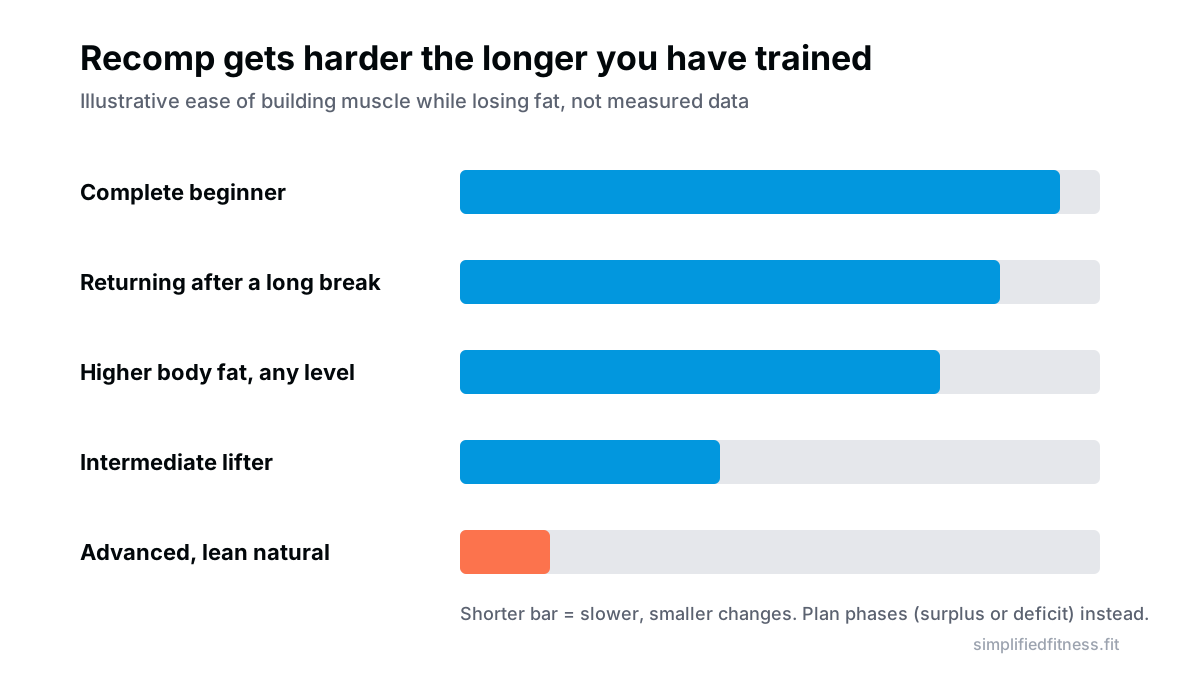
Usually can recomp
- Complete beginners. Almost any decent program is a big new stimulus.
- People returning after months or years off. Lost muscle tends to come back faster than it was first built (the biology is in our muscle memory explainer).
- People with more body fat. Stored fat is an energy reserve the body can draw on while muscle is being built.
Can recomp, but slowly
- Intermediate lifters with a few years of consistent training, especially if protein and training quality have been sloppy until now.
Rarely recomp in a way you can see
- Advanced, lean naturals. They have already collected most of the easy gains, and they have little spare fat to fuel new tissue.
This is a generalisation. Individual responses vary a lot, and the research on advanced lifters is thin.
Why does an energy reserve matter?
Building muscle takes protein and energy. If you eat in a deficit, the energy has to come from somewhere, and for people with plenty of body fat that source is available. A leaner person has much less to give.
That is why the usual advice for lean lifters is to separate the goals. The International Society of Sports Nutrition position stand says fat loss diets are driven by a sustained caloric deficit, while diets aimed at accruing lean mass are driven by a sustained surplus. It also notes that slower rates of weight loss can better preserve lean mass in leaner people (Aragon et al., 2017).
What does the research say about deficits and muscle gain?
A 2022 meta-analysis pooled randomized trials where people did resistance training in an energy deficit for at least 3 weeks. Lean mass gains were impaired compared with people training without a deficit (effect size -0.57), while strength gains were comparable. Their meta-regression suggested that a deficit of about 500 kcal per day prevented gains in lean mass on average (Murphy and Koehler, 2022). The authors concluded that people training to build lean mass should avoid prolonged energy deficiency.
Read that carefully. It does not say you lose muscle in any deficit. It says the average gain shrinks, and strength can keep moving even when size does not. That is also why strength can improve for months on a cut while the mirror says “no change”.
What if protein is very high and training is hard?
There is a counter-example worth knowing. In a 4-week trial, 40 young men were put on a hypoenergetic diet (about a 40% reduction versus requirements) and trained hard six days a week with resistance exercise plus intervals. One group ate 1.2 g/kg/day of protein and the other ate 2.4 g/kg/day. The higher protein group gained 1.2 kg of lean mass and lost 4.8 kg of fat, while the lower protein group gained 0.1 kg of lean mass and lost 3.5 kg of fat (Longland et al., 2016).
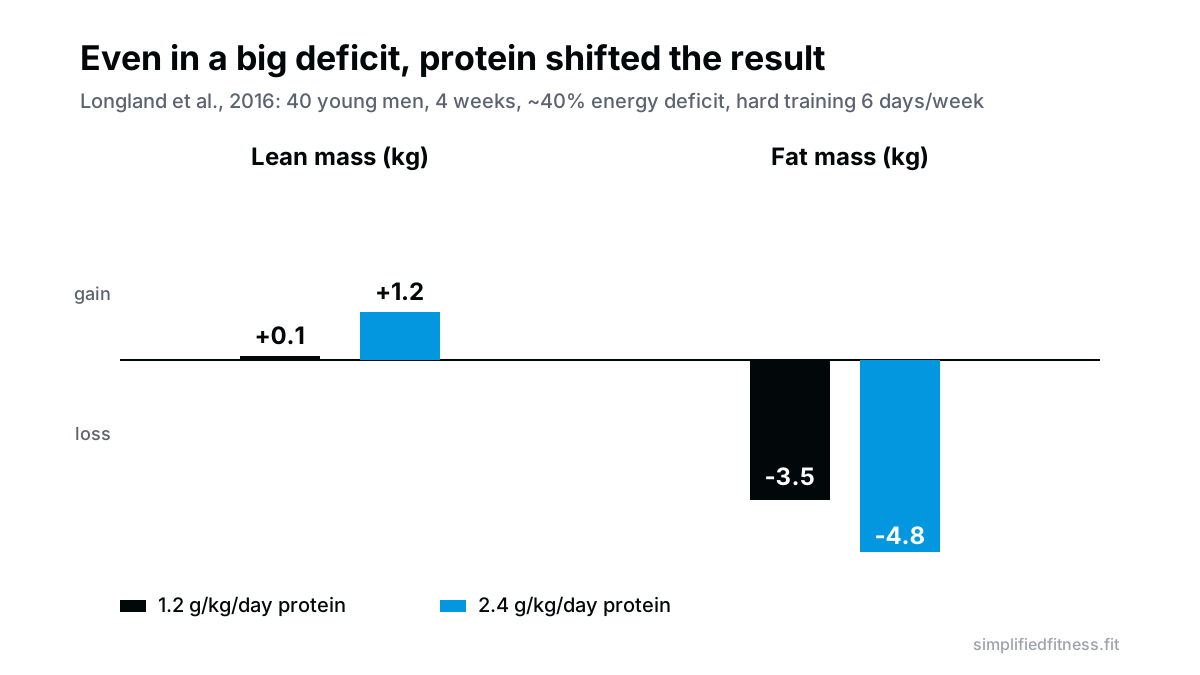
That sounds like a recomp miracle, but the limits matter. The participants were young men, the trial lasted 4 weeks, the training load was extreme, and the abstract does not describe them as advanced lifters. It supports protein as a lever, not the idea that anyone can add muscle in any deficit forever.
A 2026 randomized trial in resistance-trained participants (average age about 23 years, BMI about 26) compared a high-protein maintenance-calorie diet and a high-protein moderate deficit against a control group on the same training. Both diet groups gained fat-free mass (about 1 kg) over 10 weeks. The deficit group lost more fat on paper (about 2.9 kg versus 1.4 kg), though the difference between groups was not statistically significant (Vargas-Molina et al., 2026). Protein was about 2.5 g/kg/day. The sample was only 30 people, the study was short, and the participants were not described as advanced lifters, so it shows recomp is possible in trained people who still carry some extra body fat, not that it works for everyone forever.
Why do advanced lifters hit a wall?
Three things stack up.
- Less room to grow. The faster the early gains, the more your body adapts. Later, the same program produces much less.
- Less spare energy. When you are already lean, a deficit starts to cost you something.
- Measurement noise is bigger than the signal. If the real change is a few hundred grams of muscle over several months, a scale or a smart watch cannot show it. (See our guide on how accurate body fat measurement methods are.)
The most common mistake here is staying in a vague “eat around maintenance and train hard” zone for a year because it feels safe. You are never cutting hard enough to get lean and never eating enough to grow. Slow progress, but no clear phase.
How to tell if your recomp has stalled
Give a recomp a fair test of 8-12 weeks. Track three things:
- Waist circumference, measured at the same point each morning. Our DIY physique tracking guide covers the method.
- Strength on 3-4 main lifts, using the same rep range and a similar effort.
- Bodyweight trend, as a weekly average rather than daily readings.
If all three are flat after 8-12 weeks, the recomp has stalled. If waist is dropping and strength is climbing, keep going. Mixed signals (waist down, strength flat) can mean a slow cut working fine.
When to stop recomping: cut or lean bulk?
Once the recomp has stalled, choose by what you see in the mirror, not by what is trendy.
| Your situation | Likely better move | Why |
|---|---|---|
| Lean already, want more size | Lean bulk | Muscle gain is supported by a surplus (ISSN position stand) |
| Higher body fat than you want, size is fine | Cut | A sustained deficit drives fat loss |
| Unsure, newer to lifting | Stay at maintenance with high protein a bit longer | Beginners often still respond |
| Lean and already low energy, poor recovery | Eat more for a block | Deficits can impair lean mass gains |
If you pick a cut, go slowly. In a trial of elite athletes who trained with weights 4 times a week, a target weight loss rate of about 0.7% of body weight per week let athletes gain lean body mass (+2.1%) while losing fat, whereas a faster target of 1.4% per week (they actually averaged about 1% a week) left lean mass unchanged. Fat mass fell in both groups (31% versus 21%) (Garthe et al., 2011). It was a small trial (24 athletes), but the direction fits the ISSN advice that slower loss helps leaner people preserve muscle. Keep training volume up too. A review of resistance-trained athletes in caloric restriction found that studies with at least 10 weekly sets per muscle group showed low-to-no lean mass loss, mostly in women, although the authors said the evidence was not conclusive (Roth et al., 2022). For help on the deficit itself, see setting an optimal caloric deficit.
If you pick a lean bulk, keep the surplus small. In an 8-week trial of 17 completers (resistance-trained, mixed experience), bigger surpluses mainly raised fat gain rather than boosting muscle thickness or squat strength, though bench press 1-RM rose more in the largest surplus group (Helms et al., 2023). The authors point out the study was small and limited to moderate-volume training for 8 weeks. Our lean bulking guide covers how to set it up.
A practical plan by training level
Beginner or returning lifter (under about a year of consistent training)
- Train 3-4 days a week with progressive overload.
- Eat at maintenance or a small deficit with high protein. A meta-analysis found extra protein stopped adding muscle beyond about 1.6 g/kg/day on average (Morton et al., 2018), so 1.6-2.2 g/kg is a sensible range that leaves a margin in a deficit. Use the protein calculator.
- Judge results at 12 weeks.
Intermediate lifter
- A slow recomp can work if you were under-eating protein or training inconsistently. If gains are clearly flat after 8-12 weeks, move to a defined phase.
Advanced lifter
- Skip the recomp dream. Choose a short cut or a lean bulk and run it for 8-12 weeks at a time.
- Keep training volume steady or rising.
Vegetarian lifters in India can reach these protein numbers with paneer, curd, dal, soya chunks and eggs if they eat them. It takes planning, which is why a cut on a vegetarian diet needs the protein number written down in advance. Our calorie calculator is a good first step to estimate maintenance before you choose a direction.
What about the “recomp” hype?
Social media shows before and after photos that mix up a beginner’s first year, lighting, and a pump. Real, lasting recomp happens, but it tends to belong to specific people at specific stages. For a more general look at how to set up recomp nutrition, see our guide to losing fat and building muscle at the same time. If you are skinny fat and unsure which path to take, read the skinny fat decision guide.
When to see a doctor
Body composition goals should never come at the cost of health. Speak to a doctor or registered dietitian before a significant deficit if you have a medical condition, take regular medication, are pregnant or breastfeeding, or have ever had disordered eating. Constant fatigue, dizziness, missed periods or persistent low mood during a cut are signs to stop and get advice.
The bottom line
Body recomposition limits come down to training age, body fat and patience. Beginners, returners and people with more fat can often change both sides of the equation. Lean, advanced lifters get a very slow version at best.
When you stall for 8-12 weeks, stop negotiating with yourself. Pick a cut or a lean bulk, set a protein target, keep the lifting hard, and re-measure. If you want a training plan to run alongside, start with our free push pull legs plan.
Frequently Asked Questions
Can advanced lifters recomp?
Probably only very slowly, and the effect is often too small to measure with a scale. Research on truly advanced lifters is thin. Years of training have already used up most of the easy muscle gain, so the body has little reason to add tissue without a calorie surplus. If you are lean and experienced, run a dedicated lean bulk or a short cut instead.
Who can body recomp most easily?
Beginners, people returning after months off, and people with more body fat have the best odds. These groups have a large training stimulus to respond to (or a large energy reserve in fat tissue, or both). Start with consistent lifting and enough protein, and track waist and strength rather than the scale.
Why is recomp harder when you are lean?
Building muscle costs energy and raw material, and a lean person has less stored body fat to draw on while eating in a deficit. A meta-analysis of resistance training in an energy deficit found lean mass gains were impaired compared with training without one. If you are already lean, plan separate phases rather than expecting both goals at once.
How long should I recomp before giving up?
Give it 8-12 weeks with good training, adequate protein and a steady maintenance-level intake. If waist, strength and body weight trend have not meaningfully changed by then, the recomp has stalled. At that point choose a cut or a lean bulk and commit to it.
Should I eat at maintenance to recomp?
Maintenance is a reasonable default if you are a beginner or returning lifter and want to stay flexible. In one 2026 trial, both a maintenance-calorie and a moderate-deficit high-protein diet produced fat-free mass gains in young resistance-trained participants. Keep protein high and judge the result on trends over 8-12 weeks.
How much protein do I need to recomp?
Higher intakes seem to help when calories are low. In a 4-week trial, men eating 2.4 g/kg/day in a deficit gained more lean mass and lost more fat than men eating 1.2 g/kg/day. A meta-analysis found extra protein stopped adding muscle beyond about 1.6 g/kg/day on average, so 1.6-2.2 g/kg is a practical range, and you can use the protein calculator to get a number for your weight.
Is a calorie deficit or a surplus better for building muscle?
A surplus supports muscle gain better, and a deficit supports fat loss better. A meta-analysis found that deficits impair lean mass gains from resistance training. Pick the phase that matches your priority instead of trying to maximise both at once.
How big should a lean bulk surplus be?
Small. In an 8-week trial of resistance-trained lifters, larger surpluses mostly increased fat gain rather than muscle growth, though the sample was small. Aiming for a modest surplus, a few hundred kcal a day for many lifters, is a sensible place to start and then adjust by weekly weight trend.
How slowly should I cut to keep muscle?
Slower tends to protect lean mass better. In a trial of elite athletes, a target loss of about 0.7% of body weight per week let athletes add lean mass while losing fat, whereas a faster target of 1.4% per week (about 1% achieved) left lean mass unchanged. Keep resistance training hard and protein high during the cut.
Does skinny fat count as a recomp case?
Often yes, especially if you are relatively new to lifting. Low muscle mass with moderate body fat resembles the beginner profile where simultaneous change is more realistic. We cover that decision in detail in our skinny fat guide.
How do I know my recomp has stalled?
Look for flat waist measurement, flat or falling strength on main lifts, and a flat bodyweight trend over 8-12 weeks. One bad week means nothing, but a long plateau across all three means your current approach has run out of room. Switch to a defined cut or lean bulk and re-measure after another 8-12 weeks.
Do women recomp differently from men?
The research is thinner for women, so firm conclusions are hard. One review of lean mass sparing during caloric restriction noted that women tended to spare more lean mass than men on average. Use the same measurement approach and be cautious about copying male-based numbers.
Should I see a doctor before changing my diet for body composition?
See a doctor or registered dietitian if you have a medical condition, take medication, have a history of disordered eating, or plan an aggressive deficit. Body composition goals should never come at the cost of health. Persistent fatigue, missed periods or dizziness during a cut are reasons to stop and get checked.
Sources & References
Every claim above is checked against peer-reviewed research (PubMed, U.S. National Library of Medicine) or guidance from established health bodies. How we fact-check.
- Longland TM, et al. Higher compared with lower dietary protein during an energy deficit combined with intense exercise promotes greater lean mass gain and fat mass loss: a randomized trial. Am J Clin Nutr. 2016. PMID: 26817506
- Murphy C, et al. Energy deficiency impairs resistance training gains in lean mass but not strength: A meta-analysis and meta-regression. Scand J Med Sci Sports. 2022. PMID: 34623696
- Helms ER, et al. Effect of Small and Large Energy Surpluses on Strength, Muscle, and Skinfold Thickness in Resistance-Trained Individuals: A Parallel Groups Design. Sports Med Open. 2023. PMID: 37914977
- Roth C, et al. Lean mass sparing in resistance-trained athletes during caloric restriction: the role of resistance training volume. Eur J Appl Physiol. 2022. PMID: 35146569
- Garthe I, et al. Effect of two different weight-loss rates on body composition and strength and power-related performance in elite athletes. Int J Sport Nutr Exerc Metab. 2011. PMID: 21558571
- Vargas-Molina S, et al. Comparison of two nutritional protocols in body re-composition of resistance-trained participants. Eur J Appl Physiol. 2026. PMID: 41940947
- Aragon AA, et al. International society of sports nutrition position stand: diets and body composition. J Int Soc Sports Nutr. 2017. PMID: 28630601
- Morton RW, et al. A systematic review, meta-analysis and meta-regression of the effect of protein supplementation on resistance training-induced gains in muscle mass and strength in healthy adults. Br J Sports Med. 2018. PMID: 28698222

Umair Hazrami · Founder & Head Coach, Simplified Fitness
Umair Hazrami founded Simplified Fitness and the Simplified Lifter channel to cut through fitness noise. With 4+ years of consistent training and 10+ coaching clients, he writes every guide from the peer-reviewed research and links the sources so you can check them. Our editorial standards.
Educational content only, not medical advice. If you have a medical condition, are pregnant, or take medication, talk to a qualified doctor before changing your diet, supplements or training. Full disclaimer.
Keep reading

Health & Longevity
Overcoming the All-or-Nothing Mindset: How Perfectionism Wrecks Long-Term Fitness
The all-or-nothing mindset in fitness turns one missed workout into a lost month. Here is the research, the never-miss-twice rule and a 20-minute fallback plan.
10 min read

Health & Longevity
How to Build a Gym Habit: The Behavioral Science of Sticking With It
How to build a gym habit using habit science: how long it takes, why cues and low friction beat willpower, and what identity can and cannot do for consistency.
8 min read

Health & Longevity
Best Way to Measure Body Fat: DEXA, Bod Pod, Calipers and 4C Compared
The best way to measure body fat percentage is the same tool, under the same conditions, every time. See how DEXA, Bod Pod, calipers and 4C really compare.
8 min read

Health & Longevity
How Long Does It Take to Lose Muscle? A Realistic Detraining Timeline
How long does it take to lose muscle after you stop lifting? A week-by-week look at glycogen, strength and muscle size, with every study linked and sourced.
9 min read