How to Keep a Training Logbook: Track Weights, Reps and RIR to Keep Progressing
How to track workouts in a logbook: the exact fields to record, app vs notebook, and a simple rule for beating last week's numbers every session.

TL;DR. The short answer
- Record the exercise, machine setup, working weight, reps for every set and RIR (reps in reserve). Add one short note when something unusual happened.
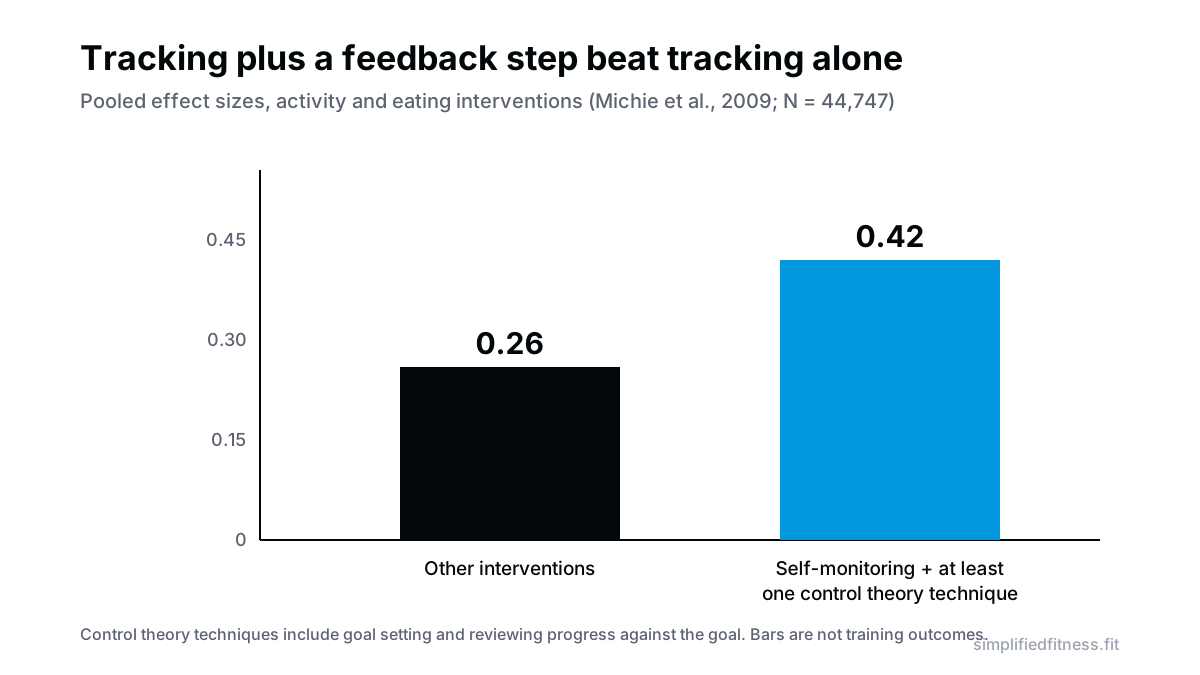
- In a large meta-regression of activity and eating programmes, self-monitoring explained more of the differences between studies than any other technique, and pairing it with another control theory technique such as goal setting did better (effect size 0.42 vs 0.26).
- A notebook or an app both work. The better one is whichever you will actually open before and after every set.
- Read last week's line before each exercise and give yourself one clear target: one more rep, or a small jump in load once you hit the top of your rep range.
- Progress can come from load or from reps. In a 10-week trial in untrained young adults, both produced similar strength and muscle gains.
Part of our complete guide: Body Composition, Muscle Memory and Habits: A Lifter's Guide to Tracking
Table of contents
If you have ever wondered how to track workouts in a logbook without turning the gym into an office job, the short answer is one line per exercise: the setup, the working weight, the reps for each set, and how many reps you had left (RIR). Write it straight after the set, and read last week’s line before you start the next one.
That is the whole system. The rest of this guide covers why it works, what each field is for, whether an app or a notebook is better, and how to use the numbers so they actually change what you lift. It sits inside our wider guide to body composition, muscle memory and adherence, because a logbook is mostly an adherence tool.
Why training by feel keeps people stuck
Picture a lifter who trains hard for years, feels tired after every session, and uses roughly the same dumbbells they used two years ago. Nothing is “wrong”. They just never wrote anything down, so every Monday is a fresh guess.
Muscle needs a reason to adapt, and the usual reason is a gradually increasing challenge. The ACSM position stand on progression in resistance training says progressive protocols are necessary to keep stimulating adaptation (ACSM, 2009). You cannot reliably increase a challenge you cannot remember. Memory is especially bad at the details that matter: was it 22 kg for 8, or 20 kg for 10?
A logbook removes the guessing. It does not make you stronger by itself. It makes the target visible. If you want the full theory of how to build progression across months, our progressive overload, deloads and plateaus guide covers it. This article is about the practical tracking side.
Does tracking workouts actually work?
Honest answer: the direct evidence for lifting logbooks is thin, and the best evidence comes from the wider behaviour change literature.
A meta-regression of 122 evaluations (N = 44,747) of physical activity and healthy eating interventions found an overall pooled effect size of 0.31. Among the 26 behaviour change techniques coded, self-monitoring explained the greatest amount of the differences between studies (13%). Interventions that combined self-monitoring with at least one other control theory technique were more effective than the rest (0.42 vs 0.26) (Michie et al., 2009).
In plain words: writing things down helped most when it was paired with something like goal setting or comparing against a goal. That fits the logbook idea, because last week’s numbers are your goal.
Two more pieces, with caveats. A meta-analysis of four randomized trials in 269 patients with cardiovascular disease found self-monitoring increased daily steps (Kanejima et al., 2019). That is walking in cardiac patients, not lifting in gym-goers. And a systematic review found physical activity interventions that provided feedback were more effective than those without it (d = 0.73, wide 95% CI 0.09 to 1.37), though the authors noted brief interventions and high risk of bias in many studies (Krukowski et al., 2024).
What to record in a workout journal
Keep the mandatory list short. The more fields you add, the more likely you are to quit by February.
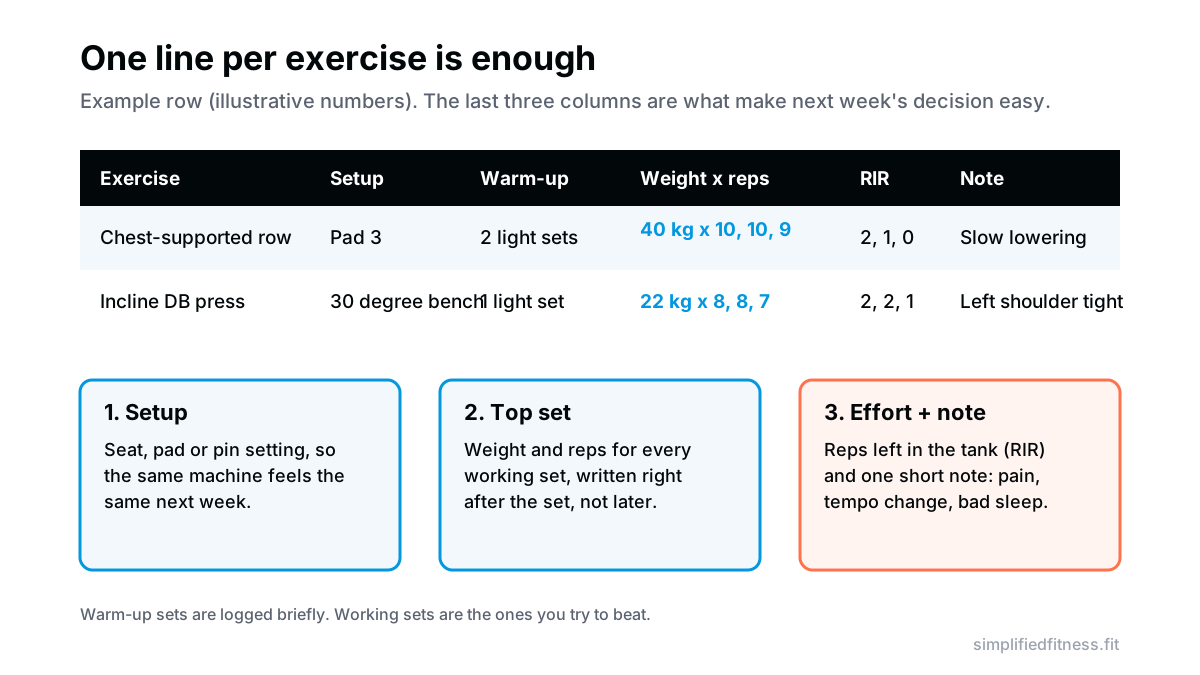
1. Exercise and setup. For free weights, the name and bench angle. For machines, the seat height, pad position or pin setting. Machine setup changes the mechanics and range of motion, so a “heavier” week may just be a different seat. If you struggle to find the right setting for your body, see our guide on adapting range of motion to your anthropometry.
2. Warm-up. One brief note, such as “2 light sets”. You are not trying to beat warm-ups.
3. Working weight and reps for every set. Write 40 x 10, 10, 9 rather than only “40 kg x 10”. The drop from 10 to 9 tells you something. For bodyweight lifts, log added load or the exact rep count.
4. RIR. Reps in reserve is how many more good reps you could have done. Without effort, the numbers are hard to interpret: 40 kg x 10 as a comfortable set and 40 kg x 10 as a grinder are not the same performance. Our RIR and RPE scale guide explains the scale in more detail, and you can convert between scales with the free RIR and RPE calculator.
5. One short note. Poor sleep, shoulder twinge, slower tempo, hot gym, skipped breakfast. Three words is plenty.
How accurate is your RIR guess?
Fair question, since RIR is a judgement call. In 24 resistance-trained men and women doing bench press at 75% of 1RM, predictions of 1 and 3 RIR were fairly accurate (mean absolute error 0.65 reps), with a slight tendency to underpredict how many reps remained (Refalo et al., 2024). A separate study of 58 trained and untrained adults on machine-based single-joint exercises found predictions were more accurate closer to failure and in later sets (Remmert et al., 2023).
So treat RIR as a useful estimate, not a measurement. Be a bit cautious on the first set of an exercise and when you are far from failure. For a deeper look, see how accurately lifters gauge RIR.
What you can skip
Calories burned, “feel” scores out of ten for every set, and long essays. If you want volume numbers later, you can count hard sets per muscle from your log, as covered in hard sets vs tonnage.
Gym logbook vs fitness app: which is better?
I could not find trial evidence that one format produces more strength than the other. So the useful question is friction: which one will you open at set two when you are tired and your hands are chalky?
| Paper notebook | Phone app | Spreadsheet | |
|---|---|---|---|
| Shows last session automatically | No, you flip back | Usually yes | Yes if you keep one row per lift |
| Speed of entry | Fast, but handwriting | Fast after setup | Slower on a small screen |
| Distractions | None | Notifications, phone checking | Some |
| Charts and trends | Manual | Built in | DIY |
| Cost | A few rupees | Free to paid | Free |
| Battery or Wi-Fi needed | No | Battery, sometimes signal | Battery |
My own rule of thumb: if you check your phone between sets anyway, an app costs you nothing extra. If your phone eats ten minutes every time you unlock it, use a notebook. Either way, keep it in the same place, a gym bag pocket or a pinned note, so starting is automatic.
How to use your logbook before every set
Writing numbers down is half the job. The other half is reading them. This is the “control theory” part that appeared to make self-monitoring work better in the Michie review.
Before each exercise, look at last session’s line and decide on exactly one target:
- If you hit the top of your rep range on all working sets with reps in reserve, add a small amount of load and restart at the bottom of the range.
- If not, keep the same weight and try to add one rep on at least one set.
- If your note says you were sick, tired or in pain last time, repeating the same numbers is a reasonable target.
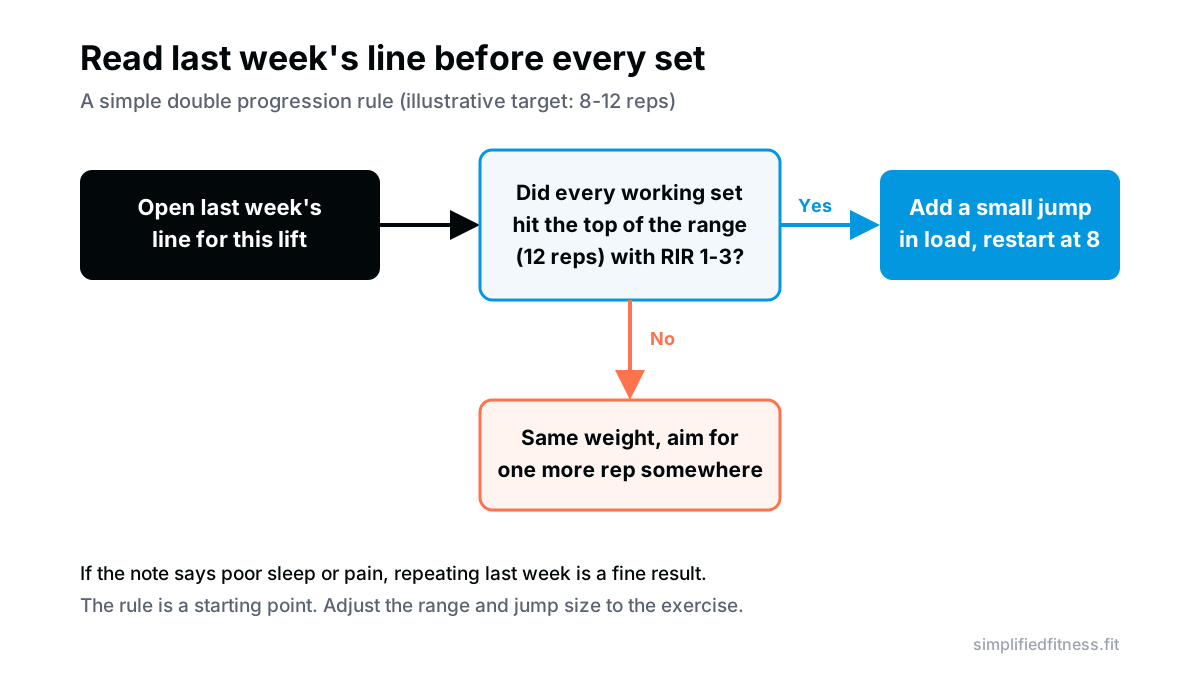
This is double progression. The ACSM position stand recommends a 2-10% load increase when you can perform the current workload one to two reps over the desired number (ACSM, 2009). The exact percentage matters less than having a rule that you can apply without thinking.
Progress is not only more weight
A common mistake is treating the plate as the only scoreboard. In a within-subject trial, 39 previously untrained young adults trained one leg with load progression and the other with repetition progression for 10 weeks. Leg extension strength and quadriceps size increased in both, with no difference between methods (Chaves et al., 2024). That was early-stage training in untrained people, so I would not assume the same holds for advanced lifters. The takeaway is more modest: adding reps is real progress too, and a logbook captures it.
There is also evidence that muscle growth can occur across a wide range of loading zones rather than one magic rep range (Schoenfeld et al., 2021). That is a narrative review proposing a new framework, so treat it as an argument, not a verdict. Practically, pick a range you can train hard in, and keep it stable long enough for the log to show a trend. Our guide to progressive overload on machines vs free weights shows how this plays out on different equipment.
When the numbers go down
Sometimes the log shows a drop. That is not failure, it is information. Look at the note column first. Short sleep, a heavy week at work, exams, a hot gym in May, or a skipped meal can all show up in a set.
One flat or lower session means very little. Three or more flat sessions on the same lift, with decent sleep and food, is the point to review your programme. Our systematic guide to troubleshooting lifting plateaus walks through that process.
If pain, dizziness, chest discomfort or an injury shows up in your notes repeatedly, that is a reason to see a doctor or physiotherapist, not just to adjust your numbers. A logbook cannot diagnose anything.
A simple 10-minute setup
- Pick a format today: notebook, app or spreadsheet. Do not research apps for a week.
- Write your current main lifts and last known working weights from memory. Mark them “estimate”.
- Next session, record every working set for every exercise. It will feel slow for two weeks, then automatic.
- Add your first target before each lift using the double progression rule above.
- Every four to six weeks, flip back through and circle the lifts that have not moved.
If you want a structured plan to log inside, our free push day, pull day and leg day templates give you a fixed exercise list so your log stays consistent. For keeping the habit going when motivation drops, see the behavioural science of gym habits.
Frequently Asked Questions
How do you track workouts in a logbook?
Write one line per exercise with the setup, working weight, reps for each set and how many reps you had left (RIR). Log it right after the set so you do not rely on memory. Before your next session, read that line first and decide on a single target to beat.
What should I record in a workout journal?
At minimum record the exercise, weight, reps per set and RIR. For machines also note the seat height or pin position, because it changes how the exercise feels. A one-line note about pain, sleep or tempo helps you explain a bad day instead of guessing.
Is a notebook or a fitness app better for tracking workouts?
Neither is proven better for lifting results, so pick the one with the least friction for you. Apps show your last session automatically and do the maths, while a notebook has no notifications and never runs out of battery. Try one for four weeks and switch only if you keep skipping entries.
Does tracking workouts actually help you get stronger?
There is no trial I know of that tests lifting logbooks directly, but self-monitoring is one of the best-supported techniques across physical activity and healthy eating research. A 2009 meta-regression found it explained the largest share of the differences between studies. Treat it as a strong, low-cost habit rather than a guarantee.
How do I track progressive overload?
Compare today's working sets with the same exercise from last session, at the same setup. Progress means more load, more reps at the same load, or the same numbers with better control. Only count it if the reps were done with similar effort and range of motion.
What is RIR and how do I log it?
RIR stands for reps in reserve, the number of reps you could still have done at the end of a set. Write it as a number such as 2 or 0 next to the set. Trained lifters have been found to predict it fairly accurately on the bench press, though estimates tend to be better closer to failure.
Should I log warm-up sets?
Log them briefly, not in detail. A note like two light sets is enough, because warm-ups are not the sets you are trying to beat. What matters is that you do the same warm-up pattern so your first working set feels comparable week to week.
How often should I look back at my logbook?
Read the last entry for each exercise before you start it, every session. Do a longer review every four to six weeks to see trends and stalled lifts. A single bad session says very little, but three flat weeks in a row is worth acting on.
What if I did not hit my numbers this week?
That is normal and does not mean you lost progress. Sleep, stress, food and heat all change performance, which is why the note column exists. Repeat the same weight next session and aim for one extra rep before you change anything.
How do I know when to increase the weight?
A common approach is double progression: pick a rep range such as 8-12, and once all your working sets reach the top of the range with reps left in reserve, add a small amount of weight. The ACSM position stand suggests a 2-10% load increase once you can do one to two reps over your target. On isolation lifts with small plates, smaller jumps are easier to manage.
Do I need to track every single exercise?
Track the main lifts and the exercises you most want to progress. If logging everything makes you quit, drop accessories to a quick note of the weight and reps. A simple log you keep is better than a detailed one you abandon.
Can I use a spreadsheet instead of an app?
Yes, a spreadsheet is a good middle ground. Use one row per exercise and columns for date, setup, weight, reps and RIR so you can scan last week quickly. Keep it on your phone's home screen so opening it takes one tap.
Why do I keep lifting the same weights for years?
Without numbers, it is easy to mistake familiar effort for progress. Training by feel often means you stop at the same comfortable point each week. A logbook makes the target visible, which turns a vague intention to get stronger into a specific number to beat.
Sources & References
Every claim above is checked against peer-reviewed research (PubMed, U.S. National Library of Medicine) or guidance from established health bodies. How we fact-check.
- Michie S, et al. Effective techniques in healthy eating and physical activity interventions: a meta-regression. Health Psychol. 2009. PMID: 19916637
- Kanejima Y, et al. Self-monitoring to increase physical activity in patients with cardiovascular disease: a systematic review and meta-analysis. Aging Clin Exp Res. 2019. PMID: 29714027
- Krukowski RA, et al. Impact of feedback generation and presentation on self-monitoring behaviors, dietary intake, physical activity, and weight: a systematic review and meta-analysis. Int J Behav Nutr Phys Act. 2024. PMID: 38178230
- Chaves TS, et al. Effects of resistance training overload progression protocols on strength and muscle mass. Int J Sports Med. 2024. PMID: 38286426
- American College of Sports Medicine. American College of Sports Medicine position stand. Progression models in resistance training for healthy adults. Med Sci Sports Exerc. 2009. PMID: 19204579
- Refalo MC, et al. Accuracy of intraset repetitions-in-reserve predictions during the bench press exercise in resistance-trained male and female subjects. J Strength Cond Res. 2024. PMID: 37967832
- Remmert JF, et al. Accuracy of predicted intraset repetitions in reserve (RIR) in single- and multi-joint resistance exercises among trained and untrained men and women. Percept Mot Skills. 2023. PMID: 37036795
- Schoenfeld BJ, et al. Loading recommendations for muscle strength, hypertrophy, and local endurance: a re-examination of the repetition continuum. Sports (Basel). 2021. PMID: 33671664

Umair Hazrami · Founder & Head Coach, Simplified Fitness
Umair Hazrami founded Simplified Fitness and the Simplified Lifter channel to cut through fitness noise. With 4+ years of consistent training and 10+ coaching clients, he writes every guide from the peer-reviewed research and links the sources so you can check them. Our editorial standards.
Educational content only, not medical advice. If you have a medical condition, are pregnant, or take medication, talk to a qualified doctor before changing your diet, supplements or training. Full disclaimer.
Keep reading

Health & Longevity
Overcoming the All-or-Nothing Mindset: How Perfectionism Wrecks Long-Term Fitness
The all-or-nothing mindset in fitness turns one missed workout into a lost month. Here is the research, the never-miss-twice rule and a 20-minute fallback plan.
10 min read

Health & Longevity
How to Build a Gym Habit: The Behavioral Science of Sticking With It
How to build a gym habit using habit science: how long it takes, why cues and low friction beat willpower, and what identity can and cannot do for consistency.
8 min read

Health & Longevity
Best Way to Measure Body Fat: DEXA, Bod Pod, Calipers and 4C Compared
The best way to measure body fat percentage is the same tool, under the same conditions, every time. See how DEXA, Bod Pod, calipers and 4C really compare.
8 min read

Health & Longevity
Body Recomposition Limits: Who Can Recomp, and When Advanced Lifters Must Choose a Surplus or Deficit
Body recomposition limits explained: who can still lose fat and gain muscle at once, why advanced lifters stall, and how to choose a cut or lean bulk.
9 min read