Maintenance Volume: How Little Training Keeps Muscle for Months
Maintenance volume can be as low as one-third to one-ninth of your usual training. See what the Bickel trial found, and how to plan a busy-season routine.

TL;DR. The short answer
- In the Bickel 2011 trial, young adults kept the muscle they had built on one-third or one-ninth of their training dose for 32 weeks, as long as they kept training.
- Older adults (60-75) did not hold on to muscle fibre size at those doses, so they likely need roughly 2 sessions a week and 2-3 sets per exercise.
- Strength is far stickier than size. In Bickel, strength gained in training was largely retained even in the group that stopped training for 32 weeks.
- A 2021 review concludes that keeping the load (relative intensity) heavy matters most, while frequency and volume can drop a lot.
- A practical busy-season plan is 1-2 full-body sessions a week, 1-3 hard sets per exercise, and the same working weights you already use.
Part of our complete guide: Body Composition, Muscle Memory and Habits: A Lifter's Guide to Tracking
Table of contents
Maintenance volume is far lower than most lifters assume. In a landmark trial, young adults held on to the muscle they had built while training at one-third or even one-ninth of their earlier dose for 32 weeks. The catch: they kept the loads heavy, and older adults did not get the same result.
If you are heading into exam season, a deadline crunch or a new baby, that is good news. You do not have to choose between a full programme and nothing. This article sits inside our guide to body composition, muscle memory and adherence, and it answers one practical question: how little can you do and still keep what you built?
What did the Bickel maintenance study actually do?
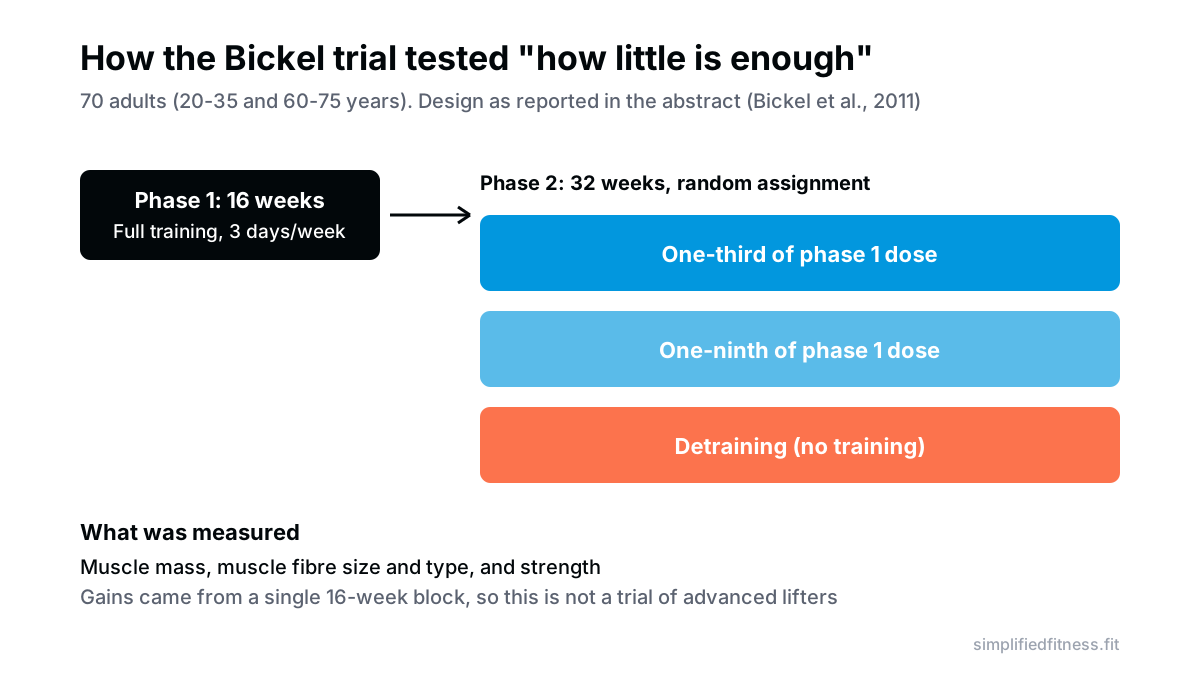
The study everyone cites is Bickel, Cross and Bamman, published in 2011. Seventy adults took part, split into a young group (20-35 years) and an older group (60-75 years). Everyone first did resistance training 3 days a week for 16 weeks. Then, for 32 weeks, they were randomly assigned to one of three paths: stop training, train at one-third of the phase 1 dose, or train at one-ninth of it (Bickel et al., 2011).
The authors expected older adults to need more. They were right.
So how little training can maintain muscle?
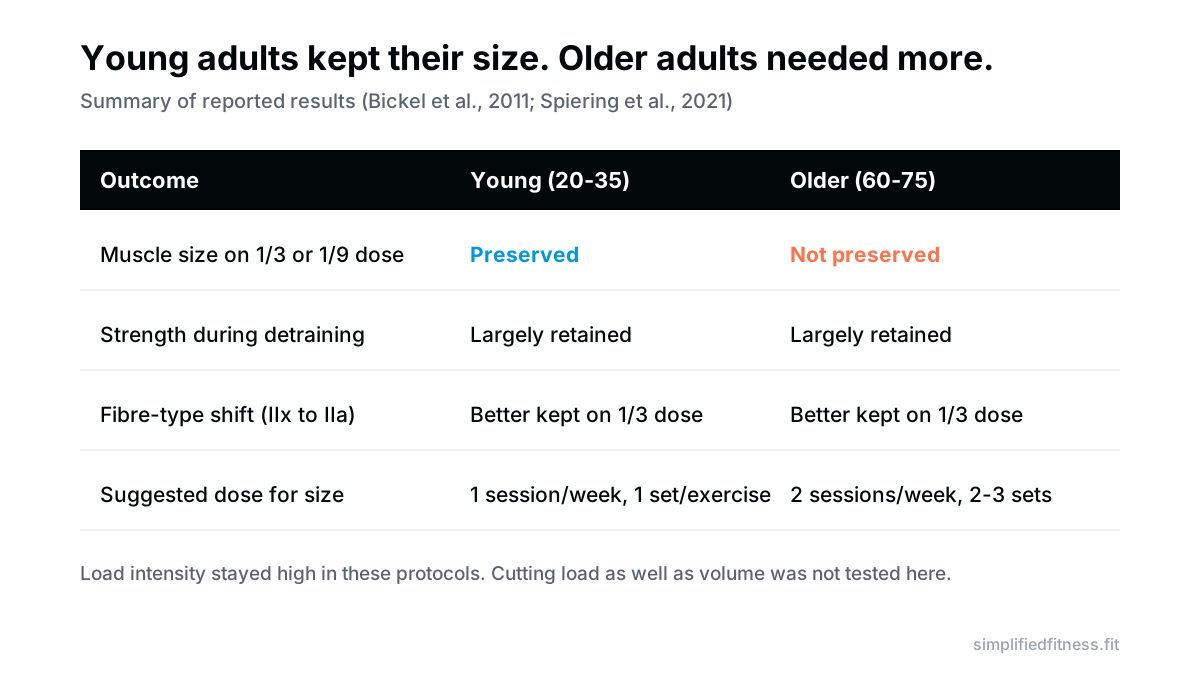
Here is what the abstract reports. In the young group, both reduced doses preserved the muscle growth from phase 1. The one-third group actually showed additional muscle fibre growth. Strength gained in phase 1 was largely retained throughout the detraining period too, with only a slight dip at the final time point (Bickel et al., 2011).
Read that last part again. Even the group that stopped training for 32 weeks kept most of their strength. Size is a different story, and fibre-type changes also reversed in the detraining group. Those details matter if you care about how you look and move, not just a number on a bar.
A 2021 narrative review by Spiering and colleagues pulled this together. It concluded that strength and muscle size, at least in younger people, can be maintained for up to 32 weeks with as little as one strength session a week and one set per exercise, as long as relative load is kept (Spiering et al., 2021). Their main takeaway was that intensity seems to be the key variable, despite big cuts in frequency and volume.
That is the whole idea of maintenance volume. Keep the signal (heavy loads). Trim the dose (sets and sessions).
Do older adults need more maintenance volume?
Yes, and this is where the brief version of the study often gets garbled online.
In Bickel, neither reduced dose preserved muscle fibre growth in the 60-75 group. Their strength gains, though, were well preserved: the authors report that specific strength (strength relative to muscle size) stayed at or above the level of untrained young adults (Bickel et al., 2011). The review’s practical translation is that older people may need up to 2 sessions a week and 2-3 sets per exercise to maintain muscle size (Spiering et al., 2021).
I would not read this as “old people cannot maintain muscle.” It means the minimum is higher and the margin for error is smaller. If you are in your 60s or older, treat two proper sessions a week as the floor. If you have heart disease, joint problems or take medication that affects exercise tolerance, talk to your doctor before changing your training.
Why load matters more than volume
Think about what a set is for. Muscle responds to being asked to produce high force. A heavy set of 8 does that. Ten light sets of 20 do something else, and you pay for it in time and fatigue.
The 2021 review’s finding, that intensity is the key variable, fits with this. When you cut volume, keep the bar heavy. Do not drop to light weights “because I only have 20 minutes.” A short session at your normal working weights beats a long one with half the load.
A second small trial points the same way on frequency. In 33 untrained young men, 8 weeks of training was followed by 8 weeks at either one or two sessions a week (roughly half the earlier volume-load), or no training. The reduced groups showed no significant change in half-squat 1RM or thigh muscle size, while the group that stopped lost 22.6% of its 1RM and 5.4% of thigh cross-sectional area. The authors concluded that frequency did not matter as long as volume-load was equated (Tavares et al., 2017).
Maintenance volume vs growth volume
None of this means low volume is optimal. When the goal is to build, more weekly sets tend to produce more muscle. A meta-analysis of 15 studies found each extra weekly set was associated with about 0.37% more muscle gain, with a graded dose-response overall (Schoenfeld et al., 2017).
So the two ideas do not conflict. Building takes a bigger dose. Holding what you have takes a much smaller one. For the detailed set ranges on the building side, see our guide to volume landmarks (MV, MEV, MAV, MRV) and the weekly set dose-response curve for hypertrophy. For a bodybuilding-style framing of the same floor, see maintenance volume (MV) and retaining muscle in busy phases.
How to design a 1-day or 2-day maintenance workout
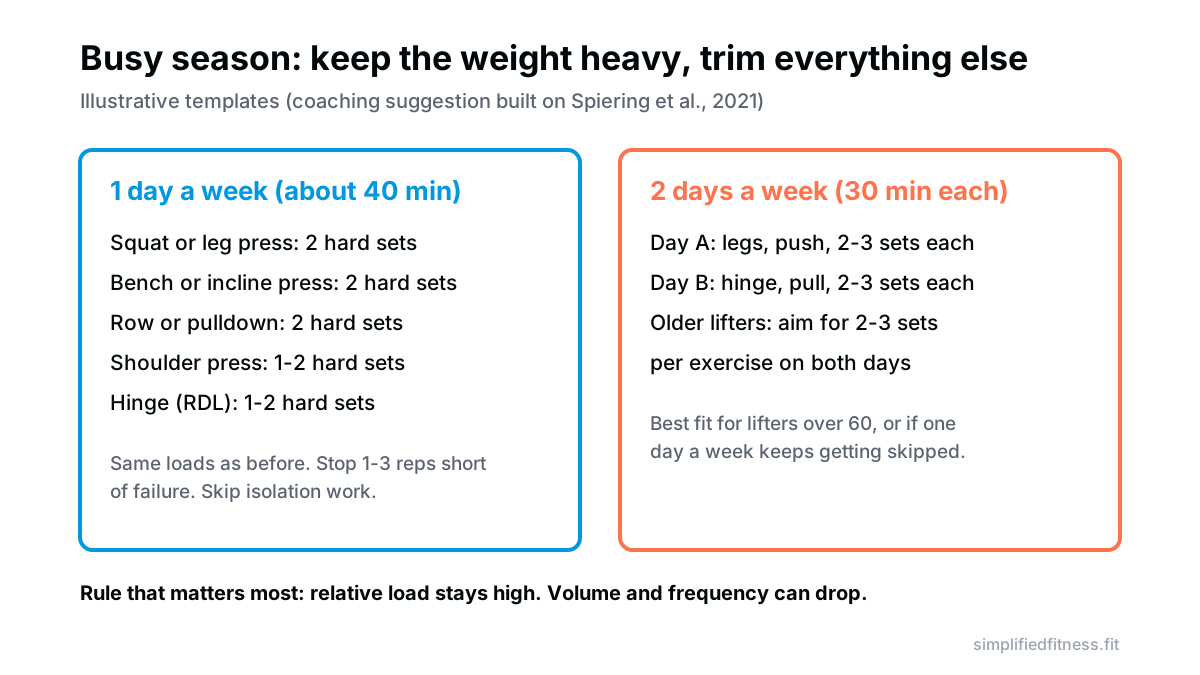
The studies give us the principles. The exact templates below are my coaching suggestions, not protocols from a trial. Adjust them to your recovery and your exercise selection.
One day a week (about 40 minutes), best for younger lifters:
- A squat or leg press: 2 hard sets
- A bench or incline press: 2 hard sets
- A row or lat pulldown: 2 hard sets
- A shoulder press: 1-2 hard sets
- A hinge such as a Romanian deadlift: 1-2 hard sets
Two days a week (about 30 minutes each), best for lifters over 60 or anyone who keeps skipping the single session:
- Day A: legs and push, 2-3 sets each
- Day B: hinge and pull, 2-3 sets each
A few rules to keep it honest:
- Same working weights. If you benched 70 kg for 8 before the busy phase, bench 70 kg for 8.
- Stop 1-3 reps short of failure. Hard enough to count, easy enough to recover from when sleep is short.
- Compounds first. One lift per movement pattern gives the most return per minute.
- Skip the extras. Arm isolation, abs circuits and extra shoulder volume can wait.
- Write the top set down. If your top-set weight or reps slip for two weeks running, add a set or a session.
Want a template to start from? Our push, pull and leg day plans have the exercises laid out, and the training volume calculator shows what your weekly sets add up to. If you want a ready-made two-day structure, see our 2-day-per-week lifting routine for busy professionals.
What maintenance volume does not cover
Be careful about what these trials did not test.
- Advanced lifters. The main trials used people who were untrained before their first training block. Experienced lifters may behave differently, and I would check the numbers every few weeks rather than assume.
- Very long gaps. The longest direct data here is 32 weeks. Beyond that, we are guessing.
- Skill and endurance work. Bickel and Tavares measured muscle and strength. Lifts that need technique (heavy squats, Olympic lifts) or high-rep endurance may feel rustier after a long low-volume spell. That is a coaching expectation, not a result from these studies.
- Diet. Maintenance is easier when you eat enough protein and are not in a steep calorie deficit, but these studies were not about nutrition.
If you want to see what happens when training stops entirely, we cover the timelines in how fast you lose muscle when you detrain. If your busy phase is a holiday, see vacation and travel workouts. And if you have been away a long time, our guide to returning to the gym after a long break covers the restart.
A related idea is that cutting volume is not always a loss. Minimal-dose training is also a way to protect long-term consistency, and a 2022 review notes that lower session volumes may feel better and support adherence (Fyfe et al., 2022).
Quick plan for your next busy phase
- Decide your floor: one session a week if you are young, two if you are over 60 or if one keeps getting skipped.
- Pick 4-5 compound lifts.
- Keep your normal working weights.
- Do 1-3 hard sets per lift, stopping 1-3 reps before failure.
- Log your top sets.
- When life calms down, add 1-2 sets per lift per week until you are back to normal.
Maintaining is not quitting. It is a deliberate low-dose plan, and for months at a time the research suggests it can work far better than people expect.
If you have a medical condition or an injury, check with your doctor before changing how you train.
Frequently Asked Questions
How many sets do you need to maintain muscle?
A 2021 review suggests younger people can maintain muscle size for up to 32 weeks with as little as 1 session a week and 1 set per exercise, if the load stays heavy. Older adults may need up to 2 sessions a week and 2-3 sets per exercise. If you want a safety margin, start with 2-3 hard sets per exercise and cut down only if you stay stable.
What is maintenance volume?
Maintenance volume is the lowest amount of weekly training that keeps the muscle and strength you already have, without trying to add more. In the research it is expressed as a fraction of your previous dose, such as one-third or one-ninth. In practice, it means fewer sets and fewer sessions while the weights on the bar stay the same.
What did the Bickel et al. maintenance study find?
Seventy adults trained for 16 weeks, then spent 32 weeks on one-third of that dose, one-ninth of it, or no training. Both reduced doses preserved muscle growth in young adults but not in older adults, and strength was largely retained even during detraining. It was a single trial with previously untrained participants, so treat it as strong guidance rather than a guarantee.
Can you really maintain muscle on one workout a week?
For younger people, probably yes, for a few months. A 2021 review states that strength and muscle size can be maintained for up to 32 weeks with as little as one strength session a week and one set per exercise, provided the relative load is kept. Make that one session full-body and heavy rather than a light, long workout.
Do older adults need more training to maintain muscle?
Yes, according to the Bickel trial. Adults aged 60-75 did not preserve myofiber hypertrophy on either reduced dose, though their strength stayed well preserved. If you are in this group, aim for 2 sessions a week with 2-3 sets per exercise and check with a doctor or physio if you have joint or heart concerns.
Is intensity or volume more important for maintaining muscle?
Intensity, meaning how heavy the load is relative to your max, appears to matter most. The 2021 Spiering review concluded that intensity is the key variable, despite large cuts in frequency and volume. Keep your working weights and trim the number of sets instead.
How long can I train at maintenance volume?
The Bickel trial followed people for 32 weeks, so that is the longest window with direct data. Beyond that, we do not have good evidence either way. If your busy period runs longer, treat the plan as a bridge and bring volume back up when life allows.
Will I lose strength if I only train once a week?
Probably not much, if the weights stay heavy. In an 8-week study of untrained men, once or twice a week at roughly half the volume-load kept squat 1RM and thigh muscle size, while stopping completely lost about 22.6% of 1RM. Keep one heavy session and track your top sets so you notice any drift early.
Does maintenance training work for advanced lifters?
We do not know as well. The key trials used previously untrained people who trained for 8-16 weeks first, so results in people with years of training are less certain. Advanced lifters often report holding size well on low volume, but that is experience, not trial data, so check your own numbers every few weeks.
What should a maintenance workout look like?
Pick one exercise per big pattern: a squat or leg press, a press, a row or pulldown, and a hinge. Do 1-3 hard sets of each at your usual weights, stopping 1-3 reps before failure. Skip isolation work and finish in 30-45 minutes.
Should I do cardio or just lifting when I am short on time?
They are separate dials. The 2021 review found that endurance can be kept for up to 15 weeks with as little as 2 sessions a week if intensity is maintained. So a short hard cardio session and a short heavy lifting session can each hold their own on very little time.
When do I go back to normal volume?
Return to normal when the busy period ends, or sooner if your top-set weights or reps start dropping for two weeks in a row. Add sets back gradually, for example 1-2 extra sets per exercise per week. Use our training volume calculator to see where your weekly sets sit.
Do I need more protein when training less?
Do not cut protein just because you are training less. Muscle is maintained by the combination of a training signal and enough protein, and this article does not cover the protein studies in detail. Use our protein calculator to set a daily target for your body weight.
Sources & References
Every claim above is checked against peer-reviewed research (PubMed, U.S. National Library of Medicine) or guidance from established health bodies. How we fact-check.
- Bickel CS, et al. Exercise dosing to retain resistance training adaptations in young and older adults. Med Sci Sports Exerc. 2011. PMID: 21131862
- Spiering BA, et al. Maintaining physical performance: the minimal dose of exercise needed to preserve endurance and strength over time. J Strength Cond Res. 2021. PMID: 33629972
- Tavares LD, et al. Effects of different strength training frequencies during reduced training period on strength and muscle cross-sectional area. Eur J Sport Sci. 2017. PMID: 28316261
- Fyfe JJ, et al. Minimal-dose resistance training for improving muscle mass, strength, and function: a narrative review of current evidence and practical considerations. Sports Med. 2022. PMID: 34822137
- Schoenfeld BJ, et al. Dose-response relationship between weekly resistance training volume and increases in muscle mass: a systematic review and meta-analysis. J Sports Sci. 2017. PMID: 27433992

Umair Hazrami · Founder & Head Coach, Simplified Fitness
Umair Hazrami founded Simplified Fitness and the Simplified Lifter channel to cut through fitness noise. With 4+ years of consistent training and 10+ coaching clients, he writes every guide from the peer-reviewed research and links the sources so you can check them. Our editorial standards.
Educational content only, not medical advice. If you have a medical condition, are pregnant, or take medication, talk to a qualified doctor before changing your diet, supplements or training. Full disclaimer.
Keep reading

Health & Longevity
Overcoming the All-or-Nothing Mindset: How Perfectionism Wrecks Long-Term Fitness
The all-or-nothing mindset in fitness turns one missed workout into a lost month. Here is the research, the never-miss-twice rule and a 20-minute fallback plan.
10 min read

Health & Longevity
How to Build a Gym Habit: The Behavioral Science of Sticking With It
How to build a gym habit using habit science: how long it takes, why cues and low friction beat willpower, and what identity can and cannot do for consistency.
8 min read

Health & Longevity
Best Way to Measure Body Fat: DEXA, Bod Pod, Calipers and 4C Compared
The best way to measure body fat percentage is the same tool, under the same conditions, every time. See how DEXA, Bod Pod, calipers and 4C really compare.
8 min read

Health & Longevity
Body Recomposition Limits: Who Can Recomp, and When Advanced Lifters Must Choose a Surplus or Deficit
Body recomposition limits explained: who can still lose fat and gain muscle at once, why advanced lifters stall, and how to choose a cut or lean bulk.
9 min read