Working Out During Exams, a New Baby or a Big Move: The 2-Day Minimum That Keeps Your Gains
Working out during exams, night shifts or a newborn? Here is the 2-session, 30-minute plan and stress triage that protects your muscle and your sanity.

TL;DR. The short answer
- When life gets brutal, drop to two full-body sessions of about 30 minutes a week. Trials on maintenance training suggest this is often enough to hold on to most strength, and in younger adults, much of the muscle too.
- Adding a punishing 6-day split during exams, an 80-hour work week or a newborn usually backfires, because training is one more stressor stacked on top of poor sleep. Stress and short sleep can blunt recovery and strength.
- Strength is sticky. In one 32-week trial, strength gained over 16 weeks was largely retained even with no training at all, while muscle size needed a small ongoing dose, especially in older adults.
- Nutrition during a crunch needs only three anchors: a protein source at most meals, enough water, and food you will actually eat. Skip the macro weighing.
- Movement also helps the stress itself. Reviews show exercise reduces depressive and anxiety symptoms, including after childbirth, but if low mood or anxiety is heavy or lasting, see a doctor.
Part of our complete guide: Body Composition, Muscle Memory and Habits: A Lifter's Guide to Tracking
Table of contents
Working out during exams, a newborn, a house move or a brutal work stretch comes down to one rule: shrink the plan, keep the habit. Two full-body sessions of about 30 minutes a week is a realistic floor that, in the trials we have, holds on to most of your strength and often much of your muscle.
This is the compassionate end of our guide to body composition, muscle memory and adherence. The aim is not to optimise. The aim is to get through a hard chapter without losing what you built and without adding one more thing to feel guilty about.
Why does a 6-day split fail during a stressful season?
Your body does not sort stress into “gym stress” and “life stress”. Exam pressure, an 80-hour week, a baby who wakes every two hours and an unpacked flat all draw on the same recovery budget. Researchers call the cumulative cost of that load allostatic load, and it is a useful framework, though it is a concept rather than a number you can measure at home.
Training is a stressor too. A good one, when the rest of your life is stable. During a crunch it is the thing most likely to tip you from “tired” into “wrecked”.
Here is what the research does show, with the usual caveats:
- In 31 undergraduate resistance-training students, higher life-event stress and higher perceived stress were both linked to slower recovery of muscle force in the first hour after hard leg work (Stults-Kolehmainen et al., 2012). It was a small, short-term study, so treat it as a hint, not a rule.
- A systematic review of 17 studies (rated moderate or weak in quality) found that several consecutive nights of sleep restriction could reduce force output in multi-joint lifts, though not single-joint ones (Knowles et al., 2018).
So the 6-day split you planned in January is exactly the wrong tool in the week of your finals. You will train worse, recover worse and probably quit by Thursday.
How much training does it take to keep your muscle?
Less than most people fear. The cleanest trial on this question is Bickel’s. Seventy adults trained three days a week for 16 weeks. They were then randomised for 32 weeks to stop training, or to continue at one-third or one-ninth of the original dose (Bickel et al., 2011).
What happened:
- In the young group (20-35 years), both reduced doses preserved the muscle growth from phase 1. The one-third dose even led to extra muscle fibre growth.
- In the older group (60-75 years), neither reduced dose preserved muscle fibre size.
- In both groups, strength gained in phase 1 was largely retained during total detraining, with only a slight drop at the final time point.
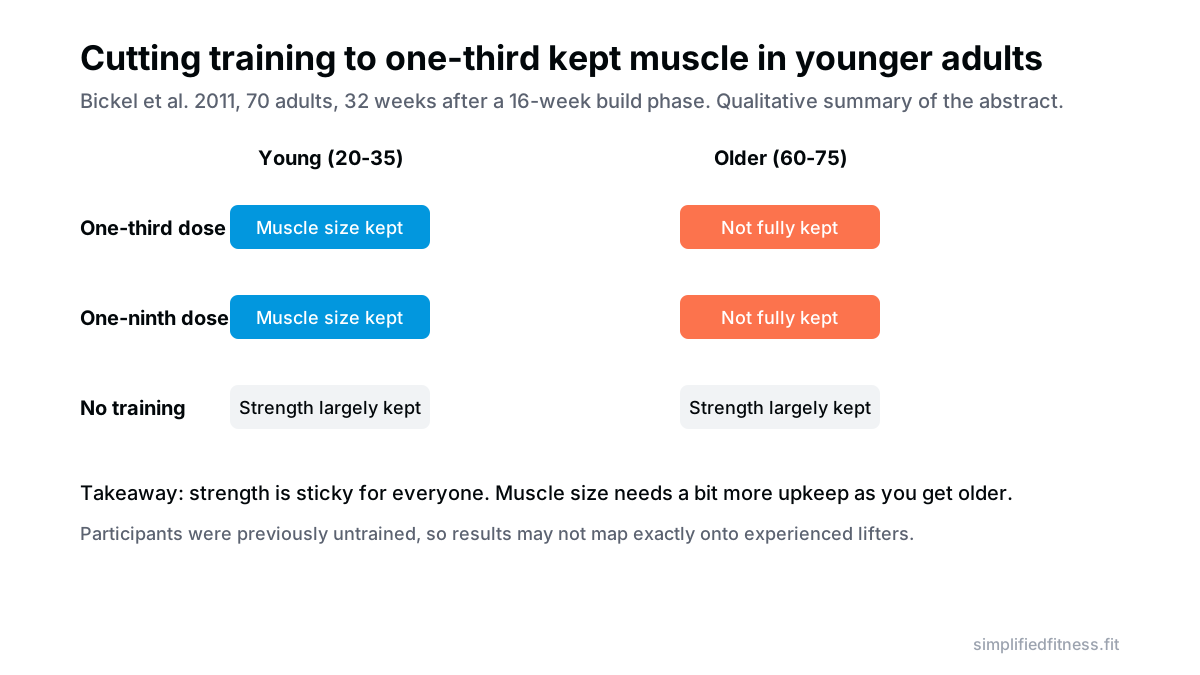
A few honest limits. These were previously untrained people who built muscle for 16 weeks, not experienced lifters with years behind them. And the “dose” was a fraction of a three-day plan, not a prescription of “two sessions”. But the direction is encouraging, and we cover it in more detail in how little training keeps muscle.
A separate trial in previously sedentary older women found something similar and slightly different. Training once a week still let leg-press strength rise by about 5 percent versus a 3 percent drop in non-trainers. But the quadriceps size gained earlier was lost, down about 5 percent (Walker et al., 2018). Reduced frequency protected strength but not muscle mass, in that population.
Why two sessions rather than one? A meta-analysis of frequency studies found that training a muscle twice a week gave larger growth than once a week when volume was matched (Schoenfeld et al., 2016). That is about building, not just maintaining, so it is not a hard law for a crunch. But two sessions is the lowest number that keeps each muscle getting touched more than once.
What does the 2-session, 30-minute emergency routine look like?
Think “whole body, few lifts, heavy enough to matter”. You are not trying to progress. You are trying to remind your muscles what they are for.
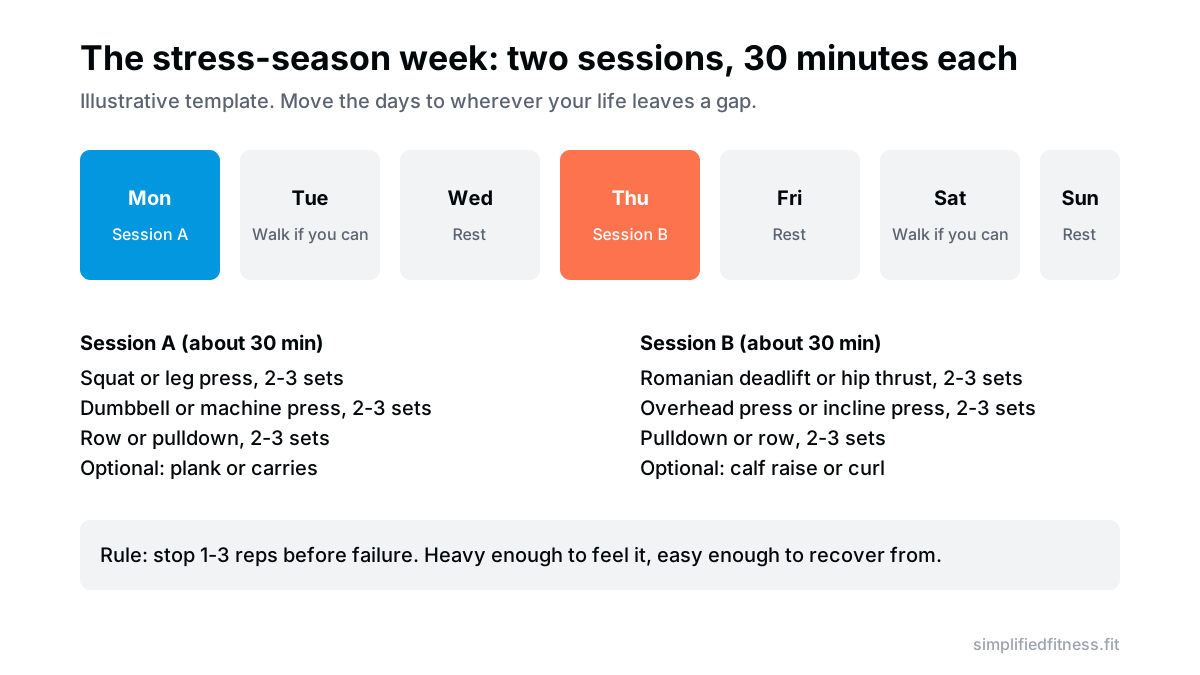
Session A
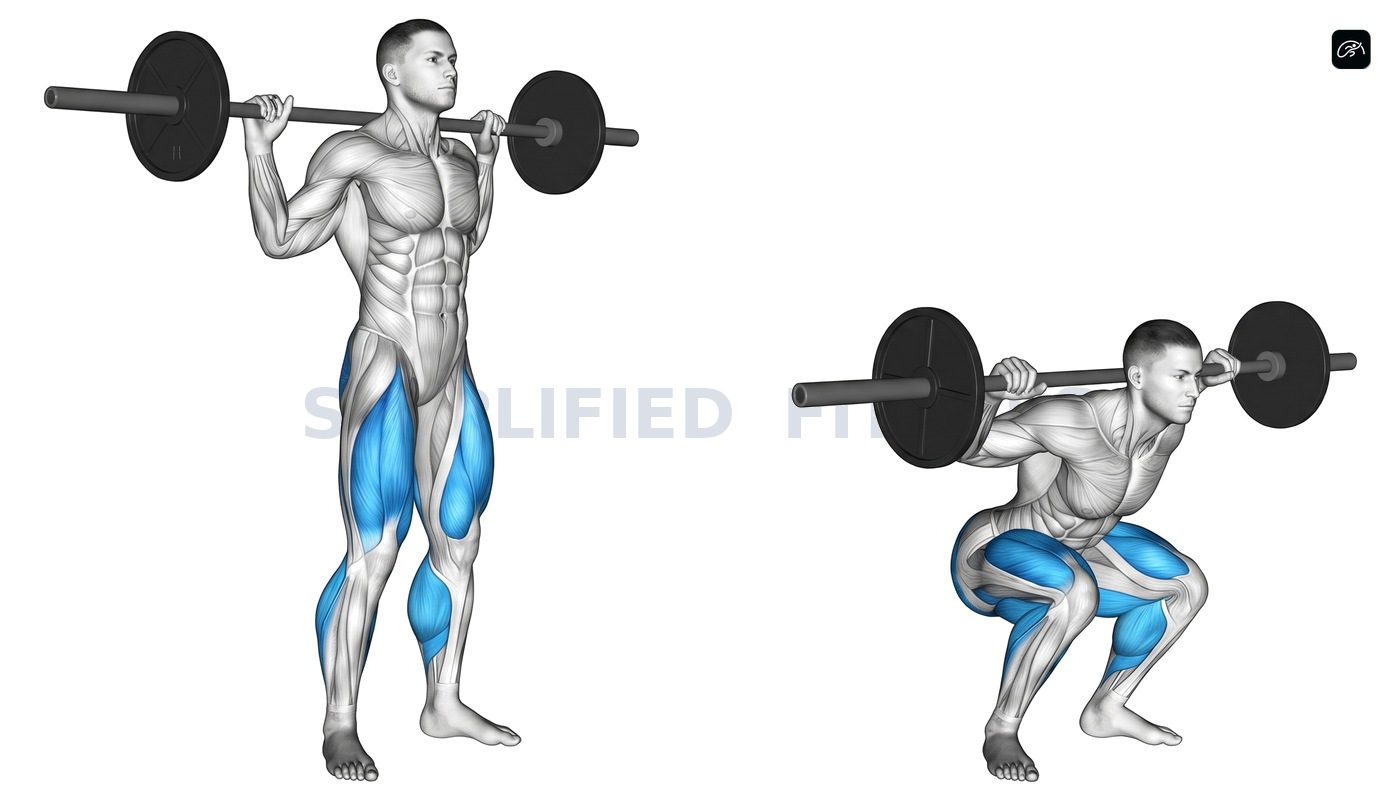
- A squat pattern (back squat, goblet squat or leg press), 2-3 sets
- A pressing pattern (dumbbell press or push-ups), 2-3 sets
- A pulling pattern (row or pulldown), 2-3 sets
Session B
- A hinge pattern (Romanian deadlift or hip thrust), 2-3 sets
- A vertical or incline press, 2-3 sets
- A pulling pattern, 2-3 sets
Rules for the stress season:
- Stop 1-3 reps short of failure. No grinding, no ego sets. Failure is expensive recovery you cannot afford this week.
- Keep the weights honest. Lighter than usual is fine. Featherweight is not, because muscle needs a reasonably hard stimulus.
- Do not add cardio guilt. If you can fit a walk, great.
- Pick the time once. Same slot, same days, no negotiating.
If you need ready-made sessions, our push, pull and leg day plans can be trimmed: take your top two lifts from each and stitch them together.
What if even 30 minutes is too much?
Then you use the lower tiers. Think of fitness in a rough triage, like a hospital ward.
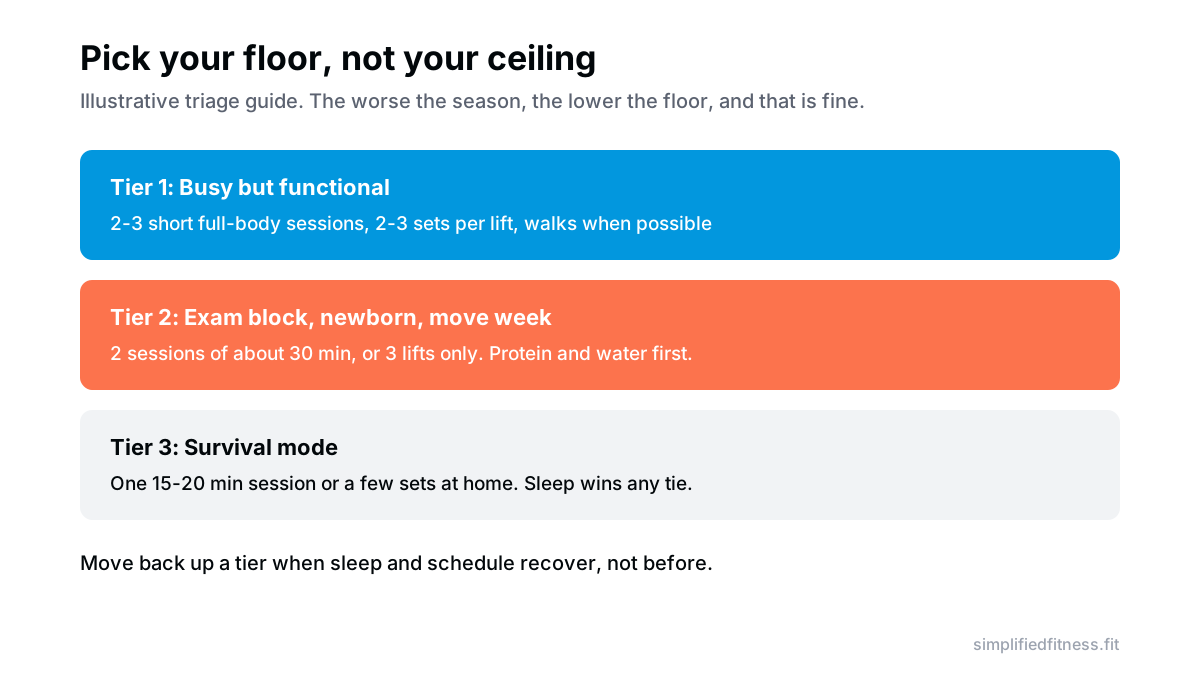
Tier 1, busy but functional: 2-3 short full-body sessions, walks when possible.
Tier 2, exams, newborn, moving week: two sessions of about 30 minutes, or just three lifts.
Tier 3, survival mode: one 15-20 minute session, or a handful of sets at home. If the choice is between that and an hour of sleep, take the sleep.
Strength tends to hang around for weeks after you stop, as Bickel’s trial suggests, so a tough fortnight of Tier 3 is not going to erase your progress. If you are worried about what a longer pause costs, we break it down in detraining timelines, and when you are ready to come back, see returning to the gym after a long break.
Working out during exams: how to fit it around revision
Exam season has a specific trap. You feel you should study every waking hour, so exercise is the first thing cut, which then makes sleep and focus worse.
A practical approach:
- Anchor sessions to study breaks. A 30-minute workout after a long block works as a reset.
- Protect sleep first. If you stayed up late, shorten the session or make it a walk. A review of sleep restriction found strength losses mainly in compound lifts, so go lighter on squats and presses rather than skipping everything (Knowles et al., 2018).
- Use a hostel or home option. Dumbbells, a backpack with books for goblet squats, push-ups and a doorway row all count. No gym trip required.
- Skip the extra caffeine to cover the gap. The review mentions caffeine as one strategy for sleep-deprived training, but late caffeine can cost you tomorrow’s sleep, so keep it early in the day.
Fitness routine for new parents: what is realistic?
A newborn rewrites your schedule, and your sleep. The honest goal for the first months is not a PR. It is a few sessions that make you feel like yourself.
Two things worth knowing. First, exercise helps mood. A 2025 meta-analysis of 35 studies (4,072 people) found that postpartum exercise reduced depressive symptoms, with a moderate effect, and also reduced anxiety symptoms by a smaller amount (Deprato et al., 2025). The authors estimated that about 350 MET-min a week, roughly 80 minutes of moderate activity such as brisk walking or resistance training, was needed for at least a moderate reduction in depressive symptoms.
Second, the right timing depends on you. Delivery type, tearing, pelvic floor symptoms and diastasis recti all change what is sensible. We are not clinicians, so check with your doctor, midwife or a pelvic health physiotherapist before returning to lifting.
For the parent who gets clearance:
- Two short full-body sessions, whenever the baby sleeps or the other parent is home
- Walks with the pram as your “cardio”
- Home dumbbells or bands, so you never lose time travelling
- Swap sessions between partners if you can, so each of you gets a window
If you feel persistently low, anxious, hopeless or unable to cope, that is not a fitness problem. Please talk to your doctor or midwife. Exercise can help, but it is not a replacement for care.
Gym schedule for a busy job or a job transition
A new job, a relocation or a huge deadline blows up your routine in a different way. You lose the old gym, the old timing and the old energy.
- Pick the nearest gym, not the best gym. A cheaper, closer option beats a brilliant one you cannot reach.
- Train before the day eats you. Early slots are less likely to be cancelled by meetings or traffic.
- Keep a short list of default workouts. Two full-body sessions you can run without thinking save decision energy.
- Plan for travel. Our travel and hotel gym guide is the same idea for planned trips. This article is for the unplanned kind where you do not have a choice.
What should I eat during a high-stress period?
Skip the obsessive macro weighing. During a crunch it becomes another stressor.
Use three anchors:
- Protein at most meals. Dal with curd, paneer bhurji, eggs, soya chunks, chana, sprouts or chicken. A review on protecting muscle during energy deficit reported that 1.6-2.4 g/kg a day, or high-quality protein meals (15-30 g of whey in the studies reviewed), helped attenuate muscle loss when calories were low (Pasiakos et al., 2015). That is about energy deficit, so if you are eating enough, the lower end is a reasonable aim rather than a strict target. Our protein calculator can give you a personal number.
- Water you can see. Keep a bottle on your desk or by the bed. In hot weather, add a pinch of salt or a nimbu pani if you are sweating a lot.
- Food you will actually eat. Convenience beats perfection. Roti with sabzi and dal, rice with curd and eggs, a banana and a handful of peanuts all work.
What if the stress is not fading?
This is where fitness advice runs out. If low mood, anxiety or exhaustion has lasted weeks, or you feel unsafe, see your doctor. An umbrella review of 97 reviews found physical activity had medium effects on depression, anxiety and psychological distress compared with usual care (Singh et al., 2023). But most of those reviews were rated critically low in quality, and exercise is a support, not a treatment replacement.
If you are in India, Tele MANAS, the government’s free mental health helpline, is available on 14416 or 1-800-891-4416. In an emergency, call 112 or go to the nearest hospital. Do not wait for the exams to be over.
The bottom line
When life gets heavy, drop to two sessions, keep the lifts simple, protect your sleep and eat protein without counting everything. You are not falling behind. You are holding the line until you can build again.
For the bigger picture, see our guide to why all-or-nothing thinking wrecks consistency.
Frequently Asked Questions
Should I work out during exams?
Yes, but keep it short and low-drama. Exercise reduces symptoms of depression, anxiety and distress in reviews of trials, and a 30-minute session is easy to fit around revision. Aim for two sessions a week, and cut one if you are sleeping badly.
How many days a week do I need to train to keep my muscle?
For most people, two full-body sessions a week is a sensible floor. In a trial with a 32-week maintenance phase, young adults who cut training to one-third of the original dose kept the muscle they had built, though they had been untrained before the study. Keep the weights heavy and the sets few, rather than doing long easy sessions.
Will I lose muscle if I only train twice a week during a stressful period?
Probably not much, if the sessions are hard enough and your protein is reasonable. Strength in particular is retained well for weeks and months. Plan to build again when life settles.
What is the best fitness routine for new parents?
A short full-body session, twice a week, plus walks with the pram on the days you can manage. Postpartum exercise is linked to fewer depressive symptoms in meta-analyses, but the timing of returning to training after birth depends on your delivery and recovery. Ask your doctor or a pelvic health physio before you start.
Is it safe to exercise after having a baby?
Many people can start gentle activity soon after an uncomplicated birth, but it varies a lot, especially after a caesarean or any complications. Your body needs time to heal, so there is no prize for rushing. Get clearance from your doctor or midwife, and stop and seek advice if you notice pain, heavy bleeding or leaking.
How do I keep working out with an 80-hour work week?
Shrink the session, not the habit. Two 30-minute full-body workouts, or even a 20-minute version on the worst weeks, keep the routine alive. Train at the same fixed slot, ideally near work or home, so you spend no time deciding.
Should I skip the gym when I am sleep deprived?
Sometimes. A systematic review found that several nights of restricted sleep can reduce force output in multi-joint lifts such as squats and presses. If you slept very little, cut sets and keep a couple of reps in reserve, or swap in a walk.
Does stress make it harder to recover from workouts?
It can. In a study of 31 resistance-training students, higher life stress and perceived stress were linked to slower recovery of muscle force in the first hour after hard leg work. That is a small, short-term study, but it fits the common-sense idea that heavy training plus heavy stress is a poor mix.
What should I eat during a stressful period if I cannot track macros?
Keep three anchors: protein at most meals, enough fluids, and simple foods you do not need to think about. In Indian terms that is dal, paneer, curd, eggs, soya chunks, chana or chicken with roti or rice. Protein is the one number worth caring about.
How much protein do I need when life is stressful?
There is no special stress dose, but a review of studies in energy deficit points to 1.6-2.4 g/kg a day as protective for muscle when calories are low. If you are eating normally, the lower end is a reasonable target. Use our protein calculator to get a personal number.
Is walking enough if I cannot lift at all?
Walking is a good floor for your mood and heart, but it will not fully replace lifting for muscle and strength. In one maintenance trial, older adults lost their newly built muscle size unless they kept training at a higher dose. Even one short bodyweight or dumbbell session a week is worth squeezing in.
How do I restart properly after a stressful period ends?
Go back to your normal routine in steps rather than jumping straight to your old volume. Add a third session, then a fourth, over a few weeks. Expect the first week to feel clumsy, because that is normal.
Is it okay to take a full break from training?
Yes, sometimes it is the right call, for example around a medical issue, or when you are truly running on empty. Strength tends to hold up well over a short break. If it stretches beyond a few weeks, restart with lighter loads and build back.
Sources & References
Every claim above is checked against peer-reviewed research (PubMed, U.S. National Library of Medicine) or guidance from established health bodies. How we fact-check.
- Bickel CS, et al. Exercise dosing to retain resistance training adaptations in young and older adults. Med Sci Sports Exerc. 2011. PMID: 21131862
- Deprato A, et al. Impact of postpartum physical activity on maternal depression and anxiety: a systematic review and meta-analysis. Br J Sports Med. 2025. PMID: 39500542
- Knowles OE, et al. Inadequate sleep and muscle strength: Implications for resistance training. J Sci Med Sport. 2018. PMID: 29422383
- Singh B, et al. Effectiveness of physical activity interventions for improving depression, anxiety and distress: an overview of systematic reviews. Br J Sports Med. 2023. PMID: 36796860
- Stults-Kolehmainen MA, et al. Psychological stress impairs short-term muscular recovery from resistance exercise. Med Sci Sports Exerc. 2012. PMID: 22688829
- Pasiakos SM, et al. Optimized dietary strategies to protect skeletal muscle mass during periods of unavoidable energy deficit. FASEB J. 2015. PMID: 25550460
- Walker S, et al. Maximum dynamic lower-limb strength was maintained during 24-week reduced training frequency in previously sedentary older women. J Strength Cond Res. 2018. PMID: 29570597
- Schoenfeld BJ, et al. Effects of resistance training frequency on measures of muscle hypertrophy: a systematic review and meta-analysis. Sports Med. 2016. PMID: 27102172

Umair Hazrami · Founder & Head Coach, Simplified Fitness
Umair Hazrami founded Simplified Fitness and the Simplified Lifter channel to cut through fitness noise. With 4+ years of consistent training and 10+ coaching clients, he writes every guide from the peer-reviewed research and links the sources so you can check them. Our editorial standards.
Educational content only, not medical advice. If you have a medical condition, are pregnant, or take medication, talk to a qualified doctor before changing your diet, supplements or training. Full disclaimer.
Keep reading

Health & Longevity
Overcoming the All-or-Nothing Mindset: How Perfectionism Wrecks Long-Term Fitness
The all-or-nothing mindset in fitness turns one missed workout into a lost month. Here is the research, the never-miss-twice rule and a 20-minute fallback plan.
10 min read

Health & Longevity
How to Build a Gym Habit: The Behavioral Science of Sticking With It
How to build a gym habit using habit science: how long it takes, why cues and low friction beat willpower, and what identity can and cannot do for consistency.
8 min read

Health & Longevity
Best Way to Measure Body Fat: DEXA, Bod Pod, Calipers and 4C Compared
The best way to measure body fat percentage is the same tool, under the same conditions, every time. See how DEXA, Bod Pod, calipers and 4C really compare.
8 min read

Health & Longevity
Body Recomposition Limits: Who Can Recomp, and When Advanced Lifters Must Choose a Surplus or Deficit
Body recomposition limits explained: who can still lose fat and gain muscle at once, why advanced lifters stall, and how to choose a cut or lean bulk.
9 min read