DIY Physique Tracking: Waist, Photos, Scale Averages and Strength
How to track fitness progress without DEXA: a free 4-signal protocol using a 7-day scale average, waist measurement, photos and a logbook, with the evidence.
TL;DR. The short answer
- You can track fitness progress without DEXA by combining four free signals: a 7-day rolling scale average, a weekly waist measurement, a monthly photo set and a training logbook.
- A single daily weigh-in is mostly noise. Average the last 7 mornings and compare week to week, because one reading cannot separate fat from water or food volume.
- Waist circumference and waist-to-height ratio predict cardiometabolic risk better than BMI in a large meta-analysis, but they are not an exact visceral fat scan, so treat them as a trend.
- Photos only work if light, distance, pose, time of day and camera height stay identical, and you compare them side by side every 4 weeks, not every day.
- If the signals conflict, wait 3-4 weeks and act on a pattern across two or more of them. If you have a medical condition or a history of disordered eating, check with a doctor before tracking closely.
Part of our complete guide: Body Composition, Muscle Memory and Habits: A Lifter's Guide to Tracking
Table of contents
If you want to know how to track fitness progress without DEXA, the answer is four free signals used together: a 7-day rolling scale average, a weekly waist measurement, a photo set every month and a training logbook. None of them is perfect. Together they give you a picture that is good enough to make decisions, and it costs nothing.
This guide is the practical, at-home companion to the wider body composition, muscle memory and adherence guide. If you want to know how far the paid machines can be trusted, start with body fat measurement methods compared. Here we skip the lab and build a routine you can run on a bathroom floor.
Why do you need a system at all?
Because your eyes and your scale both lie, in different ways.
The mirror changes with light, pump and mood. The scale changes with water, salt, food in your gut and, for many women, the menstrual cycle. Each one alone can make a good month look like a failure. Using four signals means one bad reading cannot talk you out of a working plan.
The most common tracking mistake is checking one number, once a day, and reacting emotionally to it. The fix is to measure more things, less often, and look for agreement.
Signal 1: how do you use a 7-day rolling scale average?
Weigh yourself each morning under the same conditions: after the toilet, before food or drink, in similar clothing. Write the number down. Each day, average your last 7 weights. That moving figure is your trend. Compare this week’s average with last week’s.
To calculate it: add the last 7 morning weights, divide by 7. Tomorrow, drop the oldest number, add the newest, divide again.
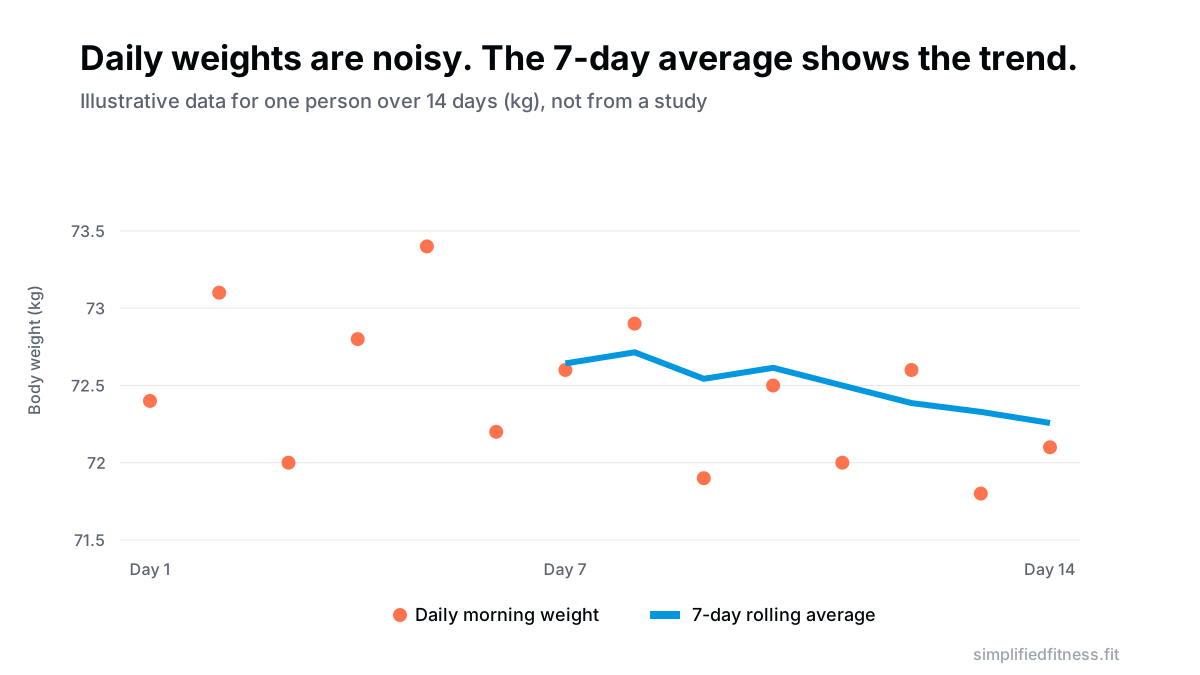
The day-to-day swings are not fat. Water, sodium and digestion explain most of them, and we cover the mechanisms in our article on scale weight fluctuations. You do not need to understand each cause. You just need to stop reading single days.
Does daily weighing help or hurt?
The evidence is reassuring for most adults, with caveats. A meta-analysis of randomised trials found only one study that tested self-weighing as a standalone strategy, and it showed no evidence of benefit (-0.5 kg, 95% CI -1.3 to 0.3). When self-weighing was added to multi-component weight loss programmes, results were better, and there was no significant difference between daily and weekly weighing (Madigan et al., 2015). In other words, the scale helps when it sits inside a plan. It is not a plan by itself.
On the worry that daily weighing is bad for your head, a 6-month randomised trial in 91 overweight adults found no adverse psychological outcomes from daily self-weighing (Steinberg et al., 2014). Those were overweight adults attempting weight loss, though, so the result does not cover everyone. If the scale makes you anxious, or you have a history of disordered eating, skip it and lean on the other three signals.
Signal 2: how do you measure waist circumference for progress?
The tape measure answers a different question from the scale: is the middle of your body getting smaller?
Why waist and not just weight?
Waist circumference and waist-to-height ratio (WHtR, your waist divided by your height) are linked to health risk. A systematic review and meta-analysis of 31 papers covering more than 300,000 adults found that WHtR discriminated cardiometabolic risk factors better than both waist circumference and BMI (Ashwell et al., 2012). A broader review of 78 studies reported a mean WHtR boundary value of 0.5 in both men and women, which supports the simple message of keeping your waist below half your height (Browning et al., 2010). A consensus statement goes further and recommends falling waist circumference as an important treatment target for reducing health risk (Ross et al., 2020).
Notice what those studies tested: screening for risk. They did not show that waist tracks your visceral fat precisely.
How do you measure it consistently?
The number you get depends on how you measure. A study of 123 Asian Indian adults compared 11 protocols that differed by anatomical site, posture, breathing phase and time since last meal. Means differed between protocols, mostly by small amounts, and the authors argued for standardising all of these factors (Agarwal et al., 2009). Another study in 542 adults found that site mattered, particularly in women, though repeat reproducibility at each site was high (Mason and Katzmarzyk, 2009).
So the site you choose matters less than sticking with it. My suggested routine:
- Pick the navel level and never switch.
- Measure the same morning each week, before eating.
- Stand relaxed, feet together, tape level around the body.
- Read after a normal exhale. Do not suck in.
- Snug tape, no skin dents.
- Take 2-3 readings and write down the average.
Then divide by your height to get WHtR, or use our waist-to-height ratio calculator.
Signal 3: what is the right progress photo protocol?
Photos catch changes the tape and scale miss, such as shoulders getting rounder or the lower back looking different. But they are the easiest signal to ruin with inconsistent conditions.
I could not find a trial that tested the best lighting for progress photos, so treat what follows as practical, repeatability-focused advice rather than a proven standard.
- Light: one fixed spot, one light direction. A window to one side at the same time of day works well. Avoid switching between overhead bulbs and daylight.
- Distance and height: mark a spot on the floor and rest the phone on the same shelf or stack of books every time.
- Poses: front, side, back, relaxed. Same posture and same breathing every time, with no flexing in one set and relaxed in the next.
- Timing: morning, before eating, same day of the month. Skip the post-workout pump.
- Clothing: the same shorts, or the same underwear.
- Rhythm: every 4 weeks. Compare them side by side, not from memory.
Digital rather than mirror? Even better, because you can overlay them. Keep them in a locked folder if privacy matters to you.
Signal 4: how does your logbook track muscle?
Strength is the signal that tells you whether you are keeping or building muscle while the other numbers move. If your main lifts hold steady or rise while you diet, that is encouraging. If they drop over several weeks, something is off: calories may be too low, sleep may be poor or protein may be short.
Strength is not the same as muscle, since technique and nervous system also change, especially for beginners. But as a practical check it is hard to beat, and it is free. Log the exercise, load, reps and how hard the set felt. Our guides on keeping a training logbook and the free push, pull and leg day plans show how.
The weekly routine in one view
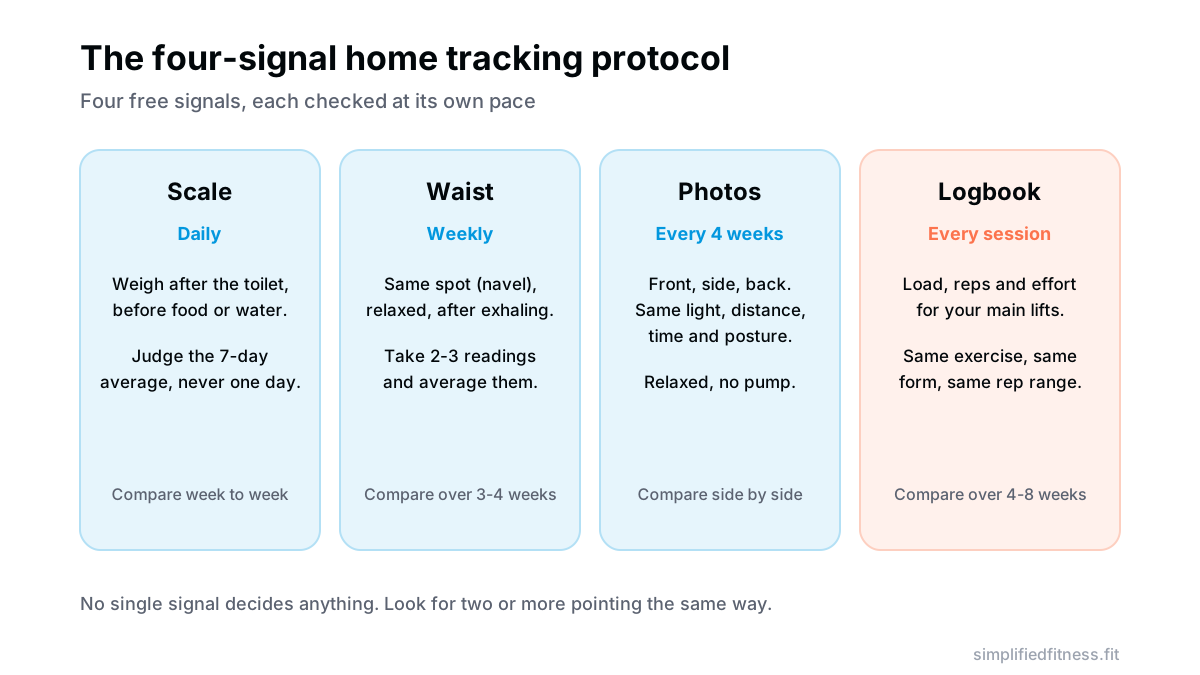
A sample week might look like this:
- Every morning: weigh, log, update the 7-day average.
- Same morning each week: measure waist (2-3 readings).
- Every session: log your main lifts.
- Every 4 weeks: take a photo set and compare it with the last.
- Once a month: review all four together and decide whether to change anything.
For vegetarian lifters in India, nothing here changes. The tools are the same whether you eat dal, paneer and curd or chicken and eggs. What matters is that your protein and calories are steady enough that the numbers mean something. If you are unsure, use the protein calculator.
What if the signals contradict each other?
They will. Here is how I would read the common clashes. This is a rule of thumb, not a diagnosis, and it assumes you are healthy and training consistently.
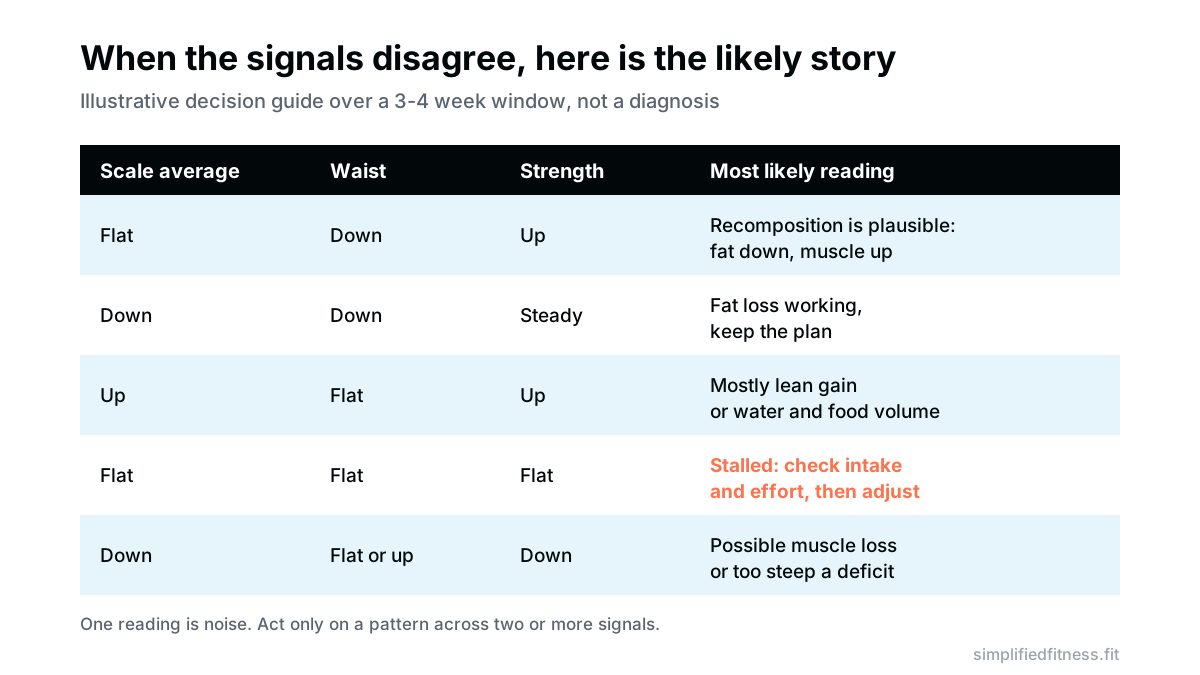
- Scale flat, waist down, lifts up: this is consistent with fat loss alongside muscle gain, but confirm with photos. Our guide to body recomposition limits explains who this works for.
- Scale down, waist down, lifts steady: the plan is working.
- Everything flat for 3-4 weeks: now is the time to adjust. See breaking fat loss plateaus before cutting calories further.
- Scale down, lifts down: you may be losing muscle or dieting too aggressively. Ease the deficit, raise protein and check your sleep.
When should you be cautious about a shrinking waist?
Intentional waist loss is usually a good sign. Unintentional is different. A cohort of 58,132 Chinese adults aged 40 and over found U-shaped associations: both gaining and losing waist circumference were linked with higher all-cause mortality than a stable waist (Yuan et al., 2022). This is observational data in middle-aged and older adults, so it cannot tell us the cause, and it does not apply to someone dieting on purpose. But if your weight or waist drops without trying, or alongside fatigue or other symptoms, see a doctor rather than a tape measure.
What this protocol cannot do
It cannot give you a body fat percentage with a decimal point. DEXA, calipers and smart scales have their own error margins, which we cover in the pieces on measurement methods and smart scales and BIA. A body fat figure is rarely needed to decide what to do next, though. If your lifts are rising, your waist is steady or shrinking and your photos look better, you are heading the right way.
It also should not replace medical care. If you live with diabetes, heart or kidney disease, are pregnant or have a history of disordered eating, talk to your doctor before tracking intensely or changing your diet.
Frequently Asked Questions
How can I track fitness progress without a DEXA scan?
Use four free signals together: a 7-day rolling average of morning weight, a weekly waist measurement, a progress photo set every 4 weeks and a training logbook. No single one is accurate on its own, but when two or three point the same way the picture is reliable enough to act on. Pick a fixed day each week to review them so you do not overreact to daily changes.
Is waist circumference a good way to track fat loss?
It is a useful trend marker, not a precise one. Consensus guidance supports waist circumference as a vital sign alongside BMI, yet an MRI study of 181 adults with overweight or obesity found that tape and ratio measures could not estimate visceral fat volume reliably. Measure at the same spot, under the same conditions, and judge changes over several weeks.
Where exactly should I measure my waist?
Pick one site and never change it. Studies show the number shifts with site, posture, breathing phase and time since a meal, so a consistent spot (many people use the navel) matters more than which spot you choose. Stand relaxed, measure after a normal exhale, keep the tape snug but not pressing, and take two or three readings.
What is waist-to-height ratio and what is a good number?
It is your waist circumference divided by your height, using the same units. A systematic review of 78 studies found a mean boundary value of 0.5 for both sexes, which gave rise to the message to keep your waist below half your height. Use it as a screening guide, not a verdict, and use our waist-to-height ratio calculator to get yours.
How do I calculate a 7-day rolling average of my weight?
Add your last 7 daily weights and divide by 7, then repeat each day with the newest 7. The average smooths out water, salt and food-volume swings so the underlying trend shows. Compare this week's average with last week's rather than comparing single mornings.
Should I weigh myself every day?
For most people it is fine, and a 6-month trial of 91 overweight adults found daily weighing did not cause adverse psychological outcomes. A meta-analysis found no significant difference in weight loss between daily and weekly weighing, so you can choose either. If weighing makes you anxious or you have a history of disordered eating, skip it and rely on waist, photos and strength.
What is the best lighting for progress photos?
Use the same spot, the same light source and the same time of day every time, because overhead or side lighting changes how shadowed your muscles look. Soft, even light from one fixed direction is easier to repeat than a bright overhead bulb. There is no trial-tested best setup, so repeatability is the goal.
How often should I take progress photos?
Every 4 weeks is a practical rhythm for most people. Visible changes in physique are slow, so daily or weekly photos mostly show lighting, posture and pump differences. Take front, side and back shots and compare them side by side.
Why did my weight stay the same but my waist went down?
That pattern can fit fat loss alongside some muscle gain, which is body recomposition, but it can also reflect water, salt or digestive differences. The scale cannot tell fat from lean tissue, while the tape reflects the abdomen specifically. Confirm it with strength going up and photos over 3-4 weeks before you call it recomposition.
Why did my waist go up but my weight is down?
Bloating after a heavy or salty meal, a measuring-site slip or digestive timing can all raise the tape reading without any fat gain. The waist is also affected by posture and breathing phase, as measurement studies show. Re-measure under the same conditions on another day and judge the 3-4 week trend.
Do I need to track strength if I am only trying to lose fat?
Yes, it is the quickest safety check that you are keeping muscle. If your main lifts hold steady or rise during a deficit, a big muscle loss is unlikely, while falling lifts across several weeks hint at too steep a deficit, poor sleep or low protein. Log load, reps and effort for a few key lifts each session.
Is losing waist size always a good sign?
Usually, but not always. A large Chinese cohort of 58,132 adults aged 40 and over found that both gaining and losing waist circumference were linked with higher mortality than a stable waist, so unexplained shrinkage can reflect illness. If your waist or weight drops without trying, see a doctor.
How long before I can trust my numbers?
Give any change 3-4 weeks before judging it, because daily and weekly numbers move with water, salt and the menstrual cycle. Two or more signals agreeing over that window is more trustworthy than one signal on one day. If nothing moves across the month, then adjust food or training, not before.
Sources & References
Every claim above is checked against peer-reviewed research (PubMed, U.S. National Library of Medicine) or guidance from established health bodies. How we fact-check.
- Ashwell M, et al. Waist-to-height ratio is a better screening tool than waist circumference and BMI for adult cardiometabolic risk factors: systematic review and meta-analysis. Obes Rev. 2012. PMID: 22106927
- Browning LM, et al. A systematic review of waist-to-height ratio as a screening tool for the prediction of cardiovascular disease and diabetes: 0.5 could be a suitable global boundary value. Nutr Res Rev. 2010. PMID: 20819243
- Ross R, et al. Waist circumference as a vital sign in clinical practice: a Consensus Statement from the IAS and ICCR Working Group on Visceral Obesity. Nat Rev Endocrinol. 2020. PMID: 32020062
- Michel S, et al. Anthropometric estimators of abdominal fat volume in adults with overweight and obesity. Int J Obes. 2023. PMID: 36750691
- Agarwal SK, et al. Waist circumference measurement by site, posture, respiratory phase, and meal time: implications for methodology. Obesity. 2009. PMID: 19165166
- Mason C, et al. Variability in waist circumference measurements according to anatomic measurement site. Obesity. 2009. PMID: 19343017
- Madigan CD, et al. Is self-weighing an effective tool for weight loss: a systematic literature review and meta-analysis. Int J Behav Nutr Phys Act. 2015. PMID: 26293454
- Steinberg DM, et al. Daily self-weighing and adverse psychological outcomes: a randomized controlled trial. Am J Prev Med. 2014. PMID: 24355668
- Yuan Y, et al. Analysis of changes in weight, waist circumference, or both, and all-cause mortality in Chinese adults. JAMA Netw Open. 2022. PMID: 35939299

Umair Hazrami · Founder & Head Coach, Simplified Fitness
Umair Hazrami founded Simplified Fitness and the Simplified Lifter channel to cut through fitness noise. With 4+ years of consistent training and 10+ coaching clients, he writes every guide from the peer-reviewed research and links the sources so you can check them. Our editorial standards.
Educational content only, not medical advice. If you have a medical condition, are pregnant, or take medication, talk to a qualified doctor before changing your diet, supplements or training. Full disclaimer.
Keep reading

Health & Longevity
Overcoming the All-or-Nothing Mindset: How Perfectionism Wrecks Long-Term Fitness
The all-or-nothing mindset in fitness turns one missed workout into a lost month. Here is the research, the never-miss-twice rule and a 20-minute fallback plan.
10 min read

Health & Longevity
How to Build a Gym Habit: The Behavioral Science of Sticking With It
How to build a gym habit using habit science: how long it takes, why cues and low friction beat willpower, and what identity can and cannot do for consistency.
8 min read

Health & Longevity
Best Way to Measure Body Fat: DEXA, Bod Pod, Calipers and 4C Compared
The best way to measure body fat percentage is the same tool, under the same conditions, every time. See how DEXA, Bod Pod, calipers and 4C really compare.
8 min read

Health & Longevity
Body Recomposition Limits: Who Can Recomp, and When Advanced Lifters Must Choose a Surplus or Deficit
Body recomposition limits explained: who can still lose fat and gain muscle at once, why advanced lifters stall, and how to choose a cut or lean bulk.
9 min read