Cortisol and Resistance Training: Acute Workout Spikes vs Chronically High Cortisol
Cortisol and muscle growth explained: the spike during a workout is normal, while chronic high cortisol from poor sleep and stress is the real muscle risk.
TL;DR. The short answer
- A cortisol rise during and after a hard lifting session is a normal response, and the research I could find does not show it blunting long-term muscle growth.
- The muscle-wasting effect of cortisol is documented with sustained, high exposure (glucocorticoid drugs, Cushing's syndrome), not with a normal 60-90 minute workout.
- There is no good evidence for a 45-minute rule. Session quality and recovery matter more than the clock.
- Poor sleep, heavy life stress and too much volume with too little recovery are the realistic ways lifters end up with a stressed system.
- Persistent exhaustion, unexplained weight gain, easy bruising or muscle weakness that does not improve with rest deserve a doctor visit, not a supplement.
Part of our complete guide: Sleep, Circadian Timing & Systemic Recovery: How Lifters Maximize Anabolic Rest & CNS Recovery
Table of contents
Short answer: cortisol rises during and after hard lifting, and that is a normal response, not a muscle-melting event. The real concern with cortisol and muscle growth is sustained high exposure, which the research ties to muscle loss in conditions like Cushing’s syndrome and long-term steroid medication.
If you have been told to cut every session at 45 minutes “before cortisol kicks in”, you have been handed an old bodybuilding rule with thin evidence. This article separates the acute spike from the chronic problem. For how sleep fits into recovery overall, see our sleep, circadian timing and systemic recovery guide.
What does cortisol actually do?
Cortisol is a glucocorticoid hormone released by your adrenal glands. It is not a villain. It helps your body mobilise fuel and cope with stress, and it follows a daily rhythm, higher in the morning and lower at night.
Hard exercise is a stressor, so cortisol goes up. A review of hormonal responses to resistance exercise describes cortisol as one of the hormones that rises most after high-volume, moderate-to-high intensity work with short rests, alongside testosterone and growth hormone (Kraemer and Ratamess, 2005). The same paper calls cortisol “catabolic”, which is where the fear comes from. But “catabolic” is a description of what the hormone does at high, sustained levels. It is not a verdict on every spike. To be fair to that review, it argued the acute hormone response matters for growth. The training trials below tested that idea directly and did not find it.
Is a cortisol spike during a workout bad?
No, and here is the best evidence for why it is not the thing deciding your gains.
Acute hormone elevations after training turn out not to matter much for hypertrophy. In a 15-week study, 12 young men trained one arm with a protocol that kept hormones low and the other arm identically, followed by heavy leg work to raise hormones. Growth hormone, IGF-1 and testosterone rose a lot after the second protocol. Muscle size and strength gains were the same in both arms (West et al., 2010).
Another study had 10 young men train one leg for 8 weeks. Systemic hormones did not change after exercise, yet the trained leg grew and the untrained leg did not (Wilkinson et al., 2006).
Both studies are small and in young men, and they focused on anabolic hormones. Wilkinson and colleagues did measure cortisol, and it did not change after the one-leg sessions, so neither trial tests what a big cortisol rise does over months. But the pattern is consistent. Local mechanical tension in the muscle drives growth. Systemic hormone swings after a session are not the steering wheel. I could not find a study showing that a normal post-workout cortisol rise reduces long-term muscle gain.
Cortisol and muscle growth: when does it actually cause muscle loss?
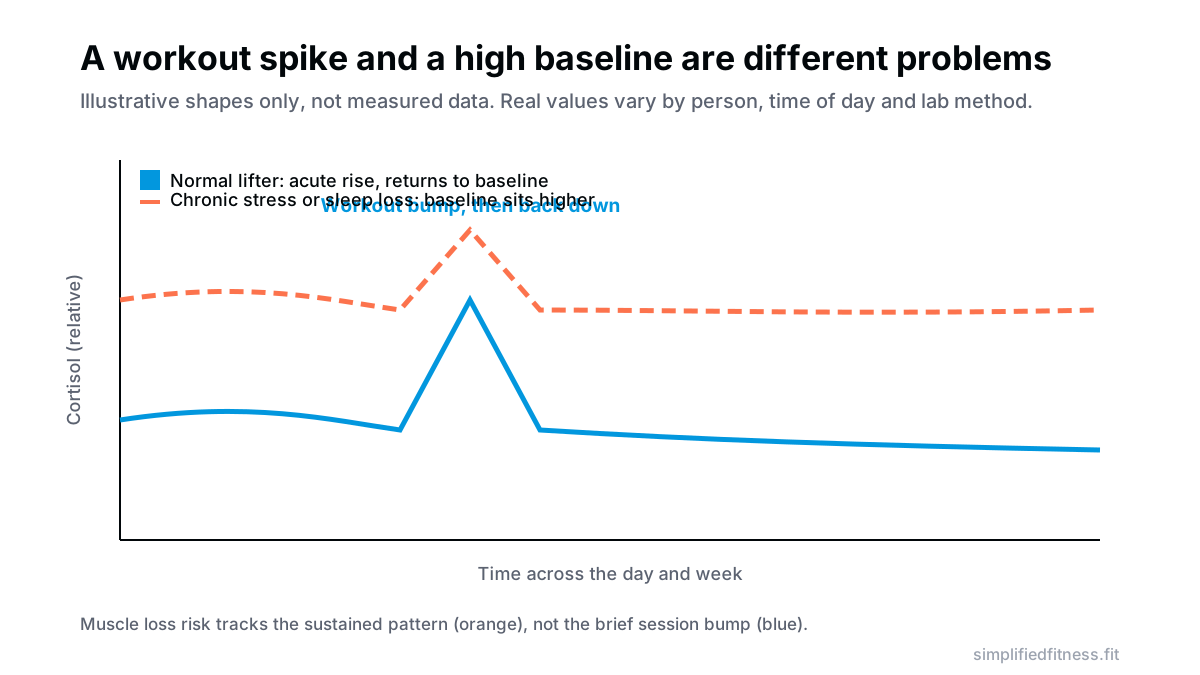
At sustained, high exposure. A review of glucocorticoid-induced atrophy describes it as affecting fast-twitch, glycolytic muscle, with reduced fibre size and myofibrillar protein, through increased protein breakdown and decreased protein synthesis (Schakman et al., 2013). Much of that research comes from disease states and animal or cell models, so it shows a mechanism, not what happens in your training week.
The human version is Cushing’s syndrome, pathologic cortisol excess. Reviews list proximal muscle weakness among its classical features, together with comorbidities such as cardiovascular disease (Nieman, 2015). The same review notes that many signs, like weight gain and hypertension, are common in the general population and not all appear in every patient. That is why you cannot self-diagnose from a blood pressure reading and a bad week.
Does a 60-minute workout spike cortisol too much?
I could not find a study that sets a duration cutoff where cortisol turns a normal session harmful. The 45-minute rule is usually justified with the idea that testosterone falls and cortisol rises as you go longer. Even if that hormone pattern is true, the trials above suggest those acute shifts do not decide your growth.
There is still a good reason to keep sessions reasonable, and it has nothing to do with hormones. Fatigue builds, rep quality drops, and the last 20 minutes can turn into junk volume. If your sets are still crisp at minute 70, nothing here says you must stop. If you are watching the clock because you are dragging, the problem is fatigue. Our piece on managing workout duration and the physiological drop-off covers how to judge that.
And if you are asking whether the post-workout window is a hormone spike you must exploit, that is a separate myth, which we cover in post-workout hormone spikes and hypertrophy.
What actually pushes cortisol up for weeks?
The realistic list for a lifter is sleep loss, psychological stress and a training load your recovery cannot match. The evidence on each is less tidy than the internet suggests.
Poor sleep. A 2024 meta-analysis of 24 studies found no significant difference in cortisol after acute sleep deprivation overall, in 21 crossover studies or in 3 RCTs. Studies using serum samples did show higher cortisol, so the result depends on how it is measured (Chen et al., 2024). In a trial of 10 resistance-trained women, nine nights of 5-hour sleep increased salivary cortisol area under the curve by 42%, slowed lower-body bar speed by up to 15% and raised perceived effort, while total volume load barely changed (Knowles et al., 2022). Small sample, females only, but it shows what bad sleep looks like in a gym: the same weight just feels harder and moves slower. We go further in sleep restriction and muscle catabolism.
Too much training stress. This one is less intuitive. An endocrine study of 51 people found athletes with overtraining syndrome (n = 14) had a lower cortisol response to an insulin tolerance test than healthy active athletes, and lower cortisol 30 minutes after waking (Cadegiani and Kater, 2017). So the neat story of “overtrain, cortisol goes up, muscle melts” does not match what that study found. The state is better described as a stressed system with altered hormonal regulation, and it needs medical input rather than DIY fixes. See overtraining syndrome vs non-functional overreaching for how to tell the stages apart.
Life stress. Work deadlines, exams and family pressure count as stress, even if they do not show up in your training log. I did not review trials on stress interventions here, so see our article on psychological stress and muscle repair.
Acute spike vs chronic elevation at a glance
| Acute exercise rise | Chronic elevation | |
|---|---|---|
| Cause | A hard training session | Pathologic excess, steroid drugs, or a long-term stressed state |
| Duration | Hours, back toward baseline | Weeks to months |
| Evidence on muscle | No negative effect on growth found in the trials above | Atrophy documented in disease states and models |
| What to do | Keep training, eat, sleep | Review sleep, volume, stress; see a doctor if symptoms persist |
What should I do instead of fearing cortisol?
Run the list in order. Most lifters never get past step one or two.
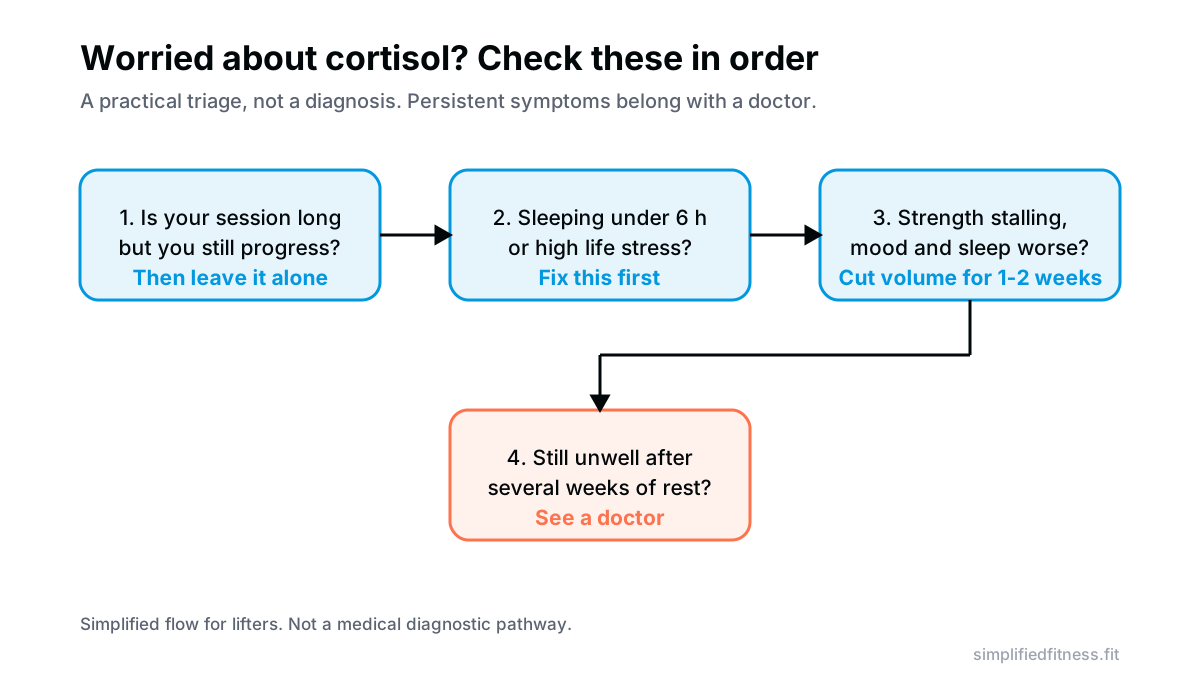
- Judge sessions by progress. If your lifts climb and recovery is fine, session length is not your problem.
- Protect sleep. Aim for a regular 7-9 hours. Seven hours at the same time every night beats a chaotic mix of 5 and 10.
- Eat enough. A big deficit stacked on heavy volume is a double hit. Use the protein calculator to set a daily target, and make sure dal, paneer, curd, eggs or soya are on the plate daily.
- Match volume to recovery. If strength is stalling and sleep and mood are slipping, trim sets for 1-2 weeks. The training volume calculator helps you see how much you are doing. Our muscle hypertrophy guide covers sensible weekly volume.
- Mind the heat. In an Indian summer, training in a hot gym on poor sleep makes everything feel harder. Hydrate and shift sessions to cooler hours if you can.
When should you see a doctor?
If you have persistent exhaustion that does not improve with rest, muscle weakness (especially climbing stairs or standing from a chair), unexplained weight gain, high blood pressure, easy bruising or wide purple stretch marks, speak to a doctor. Those are the kinds of signs reviews of Cushing’s syndrome describe, and they are not a lifter problem you can fix with programming. Screening uses specific tests such as the 1 mg dexamethasone suppression test, urine free cortisol or late-night salivary cortisol (Nieman, 2015). Do not self-diagnose from a home kit or a single reading.
Also tell your doctor if you take steroid tablets, inhalers or creams regularly. Those can affect muscle and should not be stopped without medical advice.
The bottom line
Cortisol is not the enemy. It rises when you lift hard, it falls back, and the trials I found do not link that spike to smaller muscles. What costs you progress is the slow stuff: short sleep, constant stress, and a training load your recovery cannot cover.
Run your sessions on quality, not a stopwatch. If you want a structure that keeps volume sensible, start with our free plans.
Frequently Asked Questions
Does cortisol break down muscle?
At sustained high levels, yes. Reviews of glucocorticoid-induced atrophy describe increased protein breakdown and reduced protein synthesis in muscle. A short rise during a workout is a different situation, so focus on sleep and stress rather than fearing the session.
Is a cortisol spike after a workout bad?
No, it is part of the normal response to hard exercise. Reviews describe acute hormone rises after resistance exercise as expected, and one 15-week trial found that raising hormones after training did not change muscle growth. Do not try to suppress it with supplements or by cutting good sessions short.
Should I keep workouts under 45 minutes to avoid cortisol?
There is no solid evidence for a 45-minute cutoff. Longer sessions may feel worse because fatigue builds and quality drops, which is a performance reason, not a hormone one. Stop when your sets get sloppy, and see our guide on workout duration for how to judge that.
Does high cortisol cause muscle loss in lifters?
Muscle loss is documented in conditions of prolonged cortisol excess, such as Cushing's syndrome or long-term steroid medication. In otherwise healthy lifters the evidence is far thinner, and the realistic concern is that poor sleep and stress hurt training quality. Protect sleep first and review your weekly volume.
Does lack of sleep raise cortisol?
Sometimes, but the evidence is mixed. A 2024 meta-analysis of 24 studies found no significant overall difference after acute sleep deprivation, though serum measurements did show higher cortisol. Aim for a consistent 7-9 hours anyway, because sleep loss hurts training in other ways.
What are signs of chronically high cortisol?
Cushing's syndrome is the medical condition of cortisol excess, and its features include proximal muscle weakness, weight gain, high blood pressure and wide purple stretch marks. Many of these signs are common in the general population, so they cannot be self-diagnosed. If several apply, ask a doctor for proper testing.
Can I test my own cortisol with a home kit?
Home saliva kits exist, but a single reading says little because cortisol swings through the day. Clinicians use specific protocols such as late-night salivary cortisol or dexamethasone suppression. If you are worried, get tested through a doctor rather than guessing.
Does overtraining raise cortisol?
Not as simply as people assume. One study of athletes with overtraining syndrome found a blunted cortisol response to an insulin tolerance test and lower cortisol after waking, not a permanently high level. Treat the label as a medical question and cut training stress while you get advice.
Is morning or evening training better for cortisol?
Cortisol is naturally higher in the morning, and that alone is no reason to avoid morning lifting. I found no trial showing morning sessions blunt muscle growth because of cortisol. Train when you can be consistent and sleep well.
How do I lower cortisol naturally for muscle gain?
You do not need to lower normal cortisol, and trying to blunt it is not supported by good evidence. What helps is the boring list: regular sleep, adequate food, sensible volume and managing life stress. Fix whichever of those is weakest first.
Do ashwagandha or cortisol blockers help muscle growth?
I did not review supplement trials for this article, so I will not claim a benefit. Cortisol is a normal hormone and blocking it is not a proven way to build muscle. Spend that money on food and fix sleep first.
Can too much cardio raise cortisol and kill gains?
The studies I reviewed focus on resistance training, so I would not claim a cardio-specific effect. Large total training loads without enough food and sleep can pile up as fatigue. Keep cardio at a level where your lifting still progresses.
Sources & References
Every claim above is checked against peer-reviewed research (PubMed, U.S. National Library of Medicine) or guidance from established health bodies. How we fact-check.
- Kraemer WJ, et al. Hormonal responses and adaptations to resistance exercise and training. Sports Med. 2005. PMID: 15831061
- West DW, et al. Elevations in ostensibly anabolic hormones with resistance exercise enhance neither training-induced muscle hypertrophy nor strength of the elbow flexors. J Appl Physiol. 2010. PMID: 19910330
- Wilkinson SB, et al. Hypertrophy with unilateral resistance exercise occurs without increases in endogenous anabolic hormone concentration. Eur J Appl Physiol. 2006. PMID: 16972050
- Schakman O, et al. Glucocorticoid-induced skeletal muscle atrophy. Int J Biochem Cell Biol. 2013. PMID: 23806868
- Nieman LK. Cushing's syndrome: update on signs, symptoms and biochemical screening. Eur J Endocrinol. 2015. PMID: 26156970
- Chen Y, et al. The effect of acute sleep deprivation on cortisol level: a systematic review and meta-analysis. Endocr J. 2024. PMID: 38777757
- Knowles OE, et al. Sustained sleep restriction reduces resistance exercise quality and quantity in females. Med Sci Sports Exerc. 2022. PMID: 36136596
- Cadegiani FA, et al. Hypothalamic-pituitary-adrenal (HPA) axis functioning in overtraining syndrome: findings from endocrine and metabolic responses on overtraining syndrome (EROS)-EROS-HPA axis. Sports Med Open. 2017. PMID: 29222606

Umair Hazrami · Founder & Head Coach, Simplified Fitness
Umair Hazrami founded Simplified Fitness and the Simplified Lifter channel to cut through fitness noise. With 4+ years of consistent training and 10+ coaching clients, he writes every guide from the peer-reviewed research and links the sources so you can check them. Our editorial standards.
Educational content only, not medical advice. If you have a medical condition, are pregnant, or take medication, talk to a qualified doctor before changing your diet, supplements or training. Full disclaimer.
Keep reading

Recovery
Active Recovery on Rest Days: Walking, Light Cycling and Mobility
Active recovery vs passive rest for lifters: what the research says about walking, light cycling and mobility, plus a 20-minute rest day routine you can copy.
7 min read
Recovery
Afternoon Caffeine Cutoff: Half-Life, Deep Sleep and Pre-Workout
Afternoon caffeine cutoff for lifters: how caffeine's half-life cuts sleep time and deep sleep even if you fall asleep fine, plus a practical cutoff by bedtime.
9 min read
Recovery
Blue Light, Melatonin and Screen Time: Do Blue-Blockers Actually Help You Sleep?
Blue light screen time melatonin suppression is real, but do blue-blocking glasses fix it? See what the trials found and the free fixes that matter more.
7 min read

Recovery
Is Your CNS Fried? CNS Fatigue vs Plain Lethargy in the Gym
Is my CNS fried from lifting? See what central fatigue really is, how fast it recovers and how to tell it from low motivation or poor sleep. Studies linked.
9 min read