Morning vs Evening Workouts: Which Is Better for Muscle, Consistency and Sleep?
Morning vs evening workouts for bodybuilding: what research says on strength, muscle growth, sleep and consistency, plus how to pick your best training slot.

TL;DR. The short answer
- For muscle and strength, the time of day matters little. A 2019 meta-analysis of 11 studies found similar strength gains and similar muscle growth whether people trained in the morning or the evening.
- Strength is usually a bit higher in the evening at baseline, but regular training in the morning can narrow that gap, so the body adapts to the slot you repeat.
- Evening training does not reliably ruin sleep in healthy adults. Hard sessions ending an hour or less before bed are the most likely to cause trouble.
- The best workout time is the one you keep for months. Pick a slot that survives your work, family and commute, then protect it.
- Morning lifters should warm up for longer. Struggling with poor sleep, a medical condition or chest pain during training? Speak to a doctor.
Part of our complete guide: Sleep, Circadian Timing & Systemic Recovery: How Lifters Maximize Anabolic Rest & CNS Recovery
Table of contents
The best time to lift is the time you will still be lifting at six months. For muscle and strength, the research shows only small differences between morning and evening sessions, and the body adapts to the slot you repeat.
If you are stuck on morning vs evening workouts for bodybuilding, you are probably deciding between a 6 am alarm and a 6 pm gym full of people waiting for the cable stack. This guide gives you the evidence on strength, muscle growth and sleep, then a simple way to choose. It sits inside our wider guide to sleep, circadian timing and systemic recovery.
Morning vs evening workouts for bodybuilding: what the research says
Start with the cleanest evidence. A 2019 systematic review and meta-analysis pooled 11 studies of moderate and good quality where people did the same training at different times of day (Grgic et al., 2019). Four findings stand out:
- At baseline, strength was greater in the evening than in the morning.
- Training in the morning raised morning strength to levels similar to evening strength.
- Training in the evening kept the usual evening advantage in place.
- Strength gains and muscle size gains were similar in both groups, regardless of when training took place.
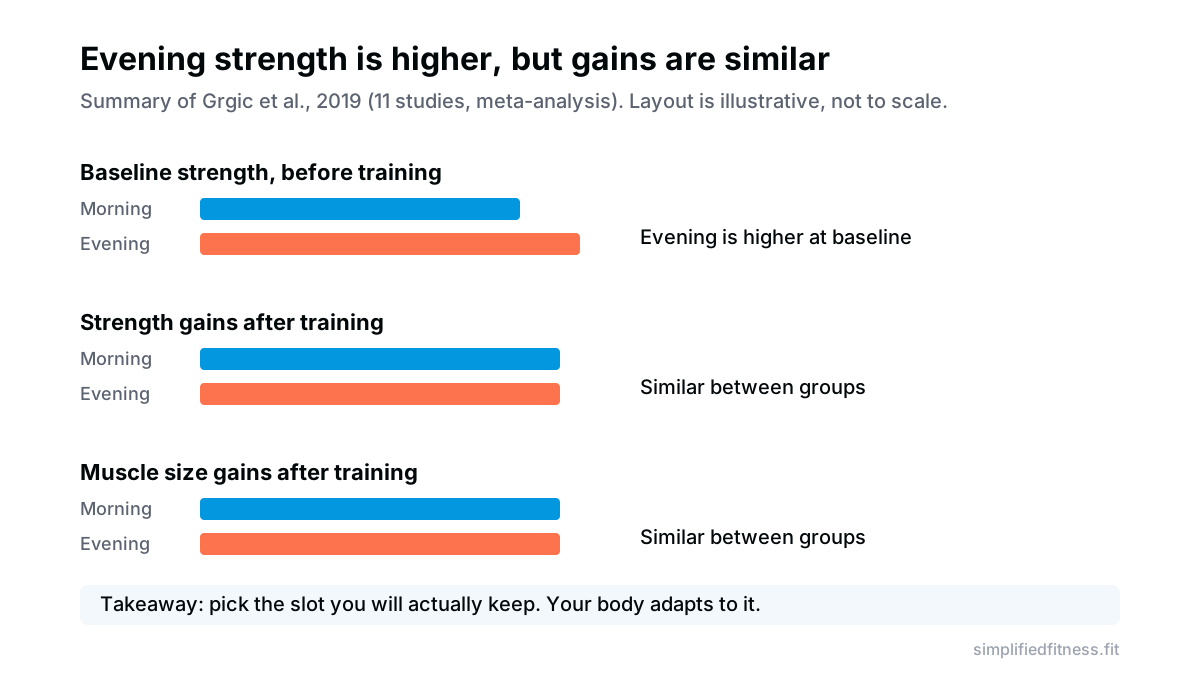
So there is a daily rhythm in how strong you feel, but it does not translate into a big difference in results. Think of it like a car that runs a little cooler at dawn. The engine is the same one.
There is one nuance. In a 24-week randomized trial of 42 young men doing combined strength and endurance training, all groups gained leg press strength and muscle size, but during weeks 13-24 the evening groups gained more muscle mass (Küüsmaa et al., 2016). The authors noted that timing seemed to matter only after 12 weeks of training. That was combined training in young men, with small groups, so it is a reason to be curious rather than a reason to change your life.
Why do I feel stronger in the evening?
Your body is not the same machine at 7 am and 6 pm. In a small study of 16 recreationally active adults, body temperature, whole-body flexibility, lateral spine movement and grip strength all rose from 8:00 to a peak around 16:00 (Edwards et al., 2026). Arousal peaked even earlier, at midday.
That matches the older picture. A 2012 review described early morning lows and late afternoon peaks in anaerobic performance, which is the kind of effort a heavy set of squats demands (Chtourou et al., 2012).
In the gym this looks like a bench press that feels heavy on the first set at 7 am and perfectly fine at 6 pm. Your 1RM did not change. Your warmth, alertness and joint feel did.
Lifting early morning: pros and cons
Pros
- Fewer things can wreck the plan. Meetings, family calls and a late bus are less likely at 6 am.
- Cooler hours in a hot climate. If summer afternoons in Delhi or Hyderabad are brutal, an early session is easier on the body.
- Emptier gym. You rarely wait for the rack.
- Done before the day gets going, which many people find helps adherence.
Cons
- Lower body temperature and arousal. In the Edwards study, a 30 minute warm-up raised ear temperature by about 0.58 C and whole-body flexibility by about 2.4 cm compared with a 5 minute warm-up.
- You may sleep less if you do not move bedtime earlier. Research on sleep restriction links it with weaker maximal strength in compound lifts when nothing is done to boost motivation (Knowles et al., 2018).
- Eating can be awkward. Training on nothing and training after a heavy meal both feel bad.
Evening training: pros and cons
Pros
- Best feel for strength. Strength tends to be higher in the evening, so heavy sets often feel smoother.
- You have had a few meals, so energy is usually good.
- It can be a clean break from work stress.
Cons
- Crowded gym, especially after office hours, which means longer waits and a broken session order.
- Evenings are easy to lose. Overtime, family plans or tiredness all attack a 7 pm session.
- Possible sleep effects, covered next.
Does an evening workout ruin sleep?
Usually not. The fear comes from older advice that told people to avoid exercise at night. A 2019 systematic review and meta-analysis of 23 studies in healthy adults found that evening exercise did not hurt sleep. It increased slow-wave sleep slightly (+1.3 percentage points), and the authors concluded the data do not support the idea that evening exercise harms sleep (Stutz et al., 2019). They did flag that sleep onset, total sleep time and efficiency might be impaired after vigorous exercise ending an hour or less before bedtime. They also noted that some of the moderator findings disappeared when one study was removed, so those details are fragile.
A 2021 meta-analysis of 15 acute evening high-intensity studies (194 participants, healthy adults aged 18-50) found that hard exercise ending 0.5-4 hours before bed reduced REM sleep by about 2.3%, with no other significant sleep changes. The authors’ bottom line was that high-intensity exercise 2-4 hours before bedtime does not disrupt sleep in healthy young and middle-aged adults (Frimpong et al., 2021).
A 2026 review of morning versus evening exercise (16 RCTs in the meta-analysis) found no clear overall advantage of morning over evening exercise for most sleep outcomes (Souabni et al., 2026). Evening exercise was linked to a bit more time awake after falling asleep, but the authors cautioned that small-study effects may be involved, and that effects were clearer at higher intensities.
Those are healthy, mostly young adults, and individual responses vary. If you have insomnia, sleep apnoea, a heart condition or any ongoing sleep problem, talk to a doctor before changing your routine.
Best workout time for consistency
This is where the practical decision lives. In a cross-sectional study of 69 active adults, 37 were classed as temporally consistent exercisers. Morning exercisers (n = 16) logged somewhat more exercise than evening exercisers (n = 21), for example 368 vs 325 minutes of actigraph-measured moderate-to-vigorous activity over a week (Brooker et al., 2021). That is an association in a small sample, and it does not prove mornings cause better adherence. People who love mornings may just be more organised.
What we can say is that your brain loves a cue. The same time, the same place, the same pre-workout routine makes the session automatic. That is coaching experience, not a trial result, but the logic is simple: every extra decision is another way to skip.
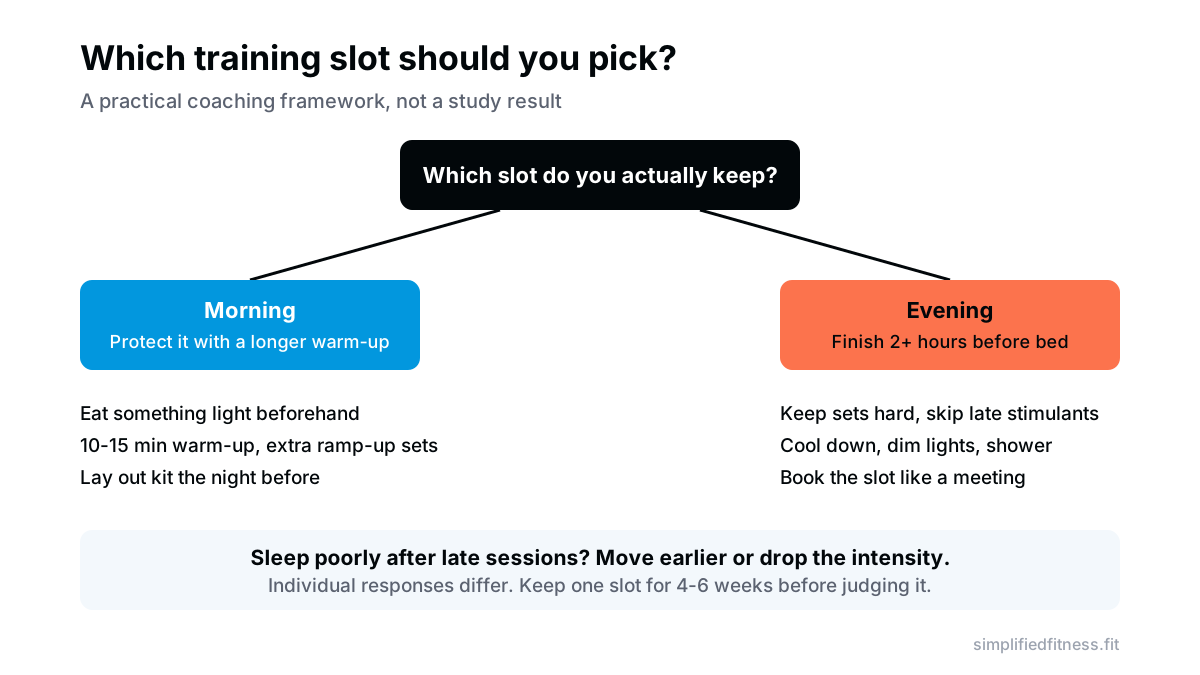
Ask yourself three questions:
- When is my day most predictable? Pick that slot.
- When do I have energy for hard sets, not just attendance?
- Which slot will I still defend in an exam week, festival season or a busy quarter?
Can you train your body to like your slot?
Mostly yes. The 2012 review concluded that adaptations tend to be greater at the time of day when training is regularly performed (Chtourou et al., 2012). The meta-analysis findings above fit that: morning training raised morning strength toward evening levels.
So if you are forced into mornings, do not assume you are stuck with weak sessions. The first couple of weeks at 6 am can feel rough, so give the new slot at least four weeks before you judge it.
The reverse is also fair. If you have trained at 7 pm for years and then switch to early mornings, the first sessions may feel flat. That is a transition cost, not a verdict on early training.
Morning vs evening at a glance
| Factor | Morning | Evening |
|---|---|---|
| Strength feel | Often lower early on | Often higher |
| Muscle and strength gains | Similar in meta-analysis | Similar in meta-analysis |
| Warm-up need | Longer (10-15 min) | Usually shorter |
| Sleep | No clear problem, if you still get enough hours | Mostly fine; avoid very hard work in the last hour before bed |
| Gym crowd | Usually quieter | Usually busier |
| Schedule risk | Low, if you sleep early | Higher (overtime, family plans) |
| Hot weather | Cooler | Warmer, especially in summer |
How to choose, in practice
- Default to the slot with the fewest conflicts. Not the slot that sounds most hardcore.
- Lock it in for 4-6 weeks. Tracking one variable at a time tells you far more than hopping between slots.
- Fix the details. Mornings need a longer warm-up and a light snack. Evenings need a cutoff for caffeine and a wind-down.
- Match sleep to the slot. A 5 am alarm with a 1 am bedtime is not a plan.
- Protect the sessions you can. Even when you miss your slot, a shorter version at another time beats skipping. Our push-day and leg-day templates are easy to trim.
Timing also interacts with other recovery levers. If you want to see how a daily strength rhythm plays out, read our companion article on circadian rhythms and peak strength in the afternoon. For sleep setup, see the sleep hygiene checklist for lifters. If you work odd hours, the shift workers lifting guide is more relevant. And if you want to protect muscle while keeping a long bedtime wind-down, our guide to eating before bed covers that. Get a sense of your daily protein with our protein calculator.
When to see a doctor
Chest pain, fainting, unusual breathlessness or palpitations during training need medical advice, whatever the clock says. The same goes for long-term sleep problems, loud snoring with daytime sleepiness, or insomnia that lasts weeks. People with diabetes or blood pressure medication should ask their doctor before changing training time, as the effects of timing on glucose and blood pressure are still being studied.
The bottom line
Morning vs evening is a small question dressed up as a big one. The research shows similar strength and muscle gains at either time, a real but modest evening edge in how strong you feel, and no consistent harm to sleep from evening training in healthy adults unless the session is very hard and ends close to bedtime. Choose the slot that fits your life, warm up properly if it is early, give the habit a month, and stop negotiating with the alarm.
Frequently Asked Questions
Is it better to workout in the morning or evening for muscle growth?
Neither is clearly better. A 2019 meta-analysis found muscle size gains were similar regardless of the time of day people trained. Choose the slot you can repeat every week, because consistent hard training is what builds muscle.
Are you stronger in the evening than in the morning?
On average, yes. The same meta-analysis found greater strength in the evening hours at baseline, which is commonly linked to higher body temperature and arousal later in the day. If you train in the morning, an extra warm-up and a few ramp-up sets help you get closer to your evening numbers.
Does working out at night ruin your sleep?
For most healthy adults, no. A 2019 meta-analysis of 23 studies found evening exercise did not worsen sleep and even slightly increased slow-wave sleep, though vigorous exercise ending an hour or less before bed may hurt sleep onset and efficiency. If you notice you lie awake, finish earlier or lower the intensity.
How close to bedtime can I lift?
A 2021 meta-analysis found that high-intensity exercise ending 2-4 hours before bed did not disrupt sleep in healthy young and middle-aged adults. Individual tolerance varies. Test a 2 hour gap and move earlier if your sleep suffers.
What is the best time of day to work out for consistency?
The time you can protect from other commitments. Observational data on 69 active adults found that morning exercisers logged somewhat more exercise than evening exercisers, though that is an association, not proof that mornings cause better adherence. If your evenings are unpredictable, mornings are often easier to defend.
Why do I feel stiff and weak lifting early in the morning?
Body temperature and arousal are lower early in the day, and flexibility and grip strength tend to be lower too. In one small study of 16 adults, a 30 minute warm-up raised temperature by about 0.6 C and improved whole-body flexibility versus a 5 minute warm-up. Allow 10-15 minutes of warming up and extra light sets before your first working set.
Can I train my body to perform better in the morning?
Probably, to a degree. A 2012 review concluded that adaptations tend to be greater at the time of day when training is regularly performed. Keep the same slot for several weeks before judging it.
Is it okay to lift fasted in the morning?
Many people do fine, but this article does not cover fasted training in depth. If you feel dizzy or flat, have a banana, curd or a small bowl of poha 30-60 minutes before. Individual tolerance varies, so use whatever lets you train hard.
Does morning or evening exercise burn more fat?
The evidence is not clear enough to pick a winner. Fat loss depends mainly on your overall energy balance and consistent training over months. Choose the time that helps you stick to your plan, and see a doctor if you have diabetes or blood pressure concerns before changing routines.
Is the gym more crowded in the evening?
Often, yes. Many commercial gyms are busiest straight after office hours, roughly 6 to 8 pm, which can lengthen rest periods and limit equipment access. Ask your gym about its quiet hours. If crowds break your rhythm, plan a backup exercise order or train in a quieter window.
What if I only have time at night after a long workday?
Train at night. The research does not show a meaningful muscle disadvantage, and a 2026 review concluded that flexible timing that prioritizes adherence and individual constraints is supported. Keep a wind-down routine and stop stimulants like pre-workout and late tea or coffee.
Does sleep deprivation make the timing question matter more?
Sleep matters more than the clock. A 2018 systematic review found that several nights of restricted sleep can reduce maximal strength in compound lifts. If an early slot means cutting sleep short every night, protect your sleep first and adjust the training slot second.
Should I switch times if I'm not progressing?
Only after you have checked sleep, food, volume and progression. Timing is rarely the bottleneck. If you do switch, keep the new slot for 4-6 weeks so the change has a fair test.
Sources & References
Every claim above is checked against peer-reviewed research (PubMed, U.S. National Library of Medicine) or guidance from established health bodies. How we fact-check.
- Grgic J, et al. The effects of time of day-specific resistance training on adaptations in skeletal muscle hypertrophy and muscle strength: A systematic review and meta-analysis. Chronobiol Int. 2019. PMID: 30704301
- Küüsmaa M, et al. Effects of morning versus evening combined strength and endurance training on physical performance, muscle hypertrophy, and serum hormone concentrations. Appl Physiol Nutr Metab. 2016. PMID: 27863207
- Chtourou H, et al. The effect of training at a specific time of day: a review. J Strength Cond Res. 2012. PMID: 22531613
- Stutz J, et al. Effects of evening exercise on sleep in healthy participants: a systematic review and meta-analysis. Sports Med. 2019. PMID: 30374942
- Frimpong E, et al. The effects of evening high-intensity exercise on sleep in healthy adults: a systematic review and meta-analysis. Sleep Med Rev. 2021. PMID: 34416428
- Souabni M, et al. Effects of morning versus evening exercise on sleep: a systematic review of comparative studies with a meta-analysis of randomized controlled trials. Sleep Med Rev. 2026. PMID: 42632303
- Brooker PG, et al. Does the time-of-day of exercise influence the total volume of exercise? A cross-sectional analysis of objectively monitored physical activity among active individuals. J Phys Act Health. 2021. PMID: 34243167
- Edwards BJ, et al. Is there a diurnal variation in flexibility in extreme morning and evening-types where a standardised approach has been employed: effect of an extended warm-up in the morning? Chronobiol Int. 2026. PMID: 41574600
- Knowles OE, et al. Inadequate sleep and muscle strength: implications for resistance training. J Sci Med Sport. 2018. PMID: 29422383

Umair Hazrami · Founder & Head Coach, Simplified Fitness
Umair Hazrami founded Simplified Fitness and the Simplified Lifter channel to cut through fitness noise. With 4+ years of consistent training and 10+ coaching clients, he writes every guide from the peer-reviewed research and links the sources so you can check them. Our editorial standards.
Educational content only, not medical advice. If you have a medical condition, are pregnant, or take medication, talk to a qualified doctor before changing your diet, supplements or training. Full disclaimer.
Keep reading

Recovery
Active Recovery on Rest Days: Walking, Light Cycling and Mobility
Active recovery vs passive rest for lifters: what the research says about walking, light cycling and mobility, plus a 20-minute rest day routine you can copy.
7 min read

Recovery
Afternoon Caffeine Cutoff: Half-Life, Deep Sleep and Pre-Workout
Afternoon caffeine cutoff for lifters: how caffeine's half-life cuts sleep time and deep sleep even if you fall asleep fine, plus a practical cutoff by bedtime.
9 min read

Recovery
Blue Light, Melatonin and Screen Time: Do Blue-Blockers Actually Help You Sleep?
Blue light screen time melatonin suppression is real, but do blue-blocking glasses fix it? See what the trials found and the free fixes that matter more.
7 min read

Recovery
Is Your CNS Fried? CNS Fatigue vs Plain Lethargy in the Gym
Is my CNS fried from lifting? See what central fatigue really is, how fast it recovers and how to tell it from low motivation or poor sleep. Studies linked.
9 min read