Sleep Architecture for Athletes: Deep Sleep, REM and Growth Hormone
Sleep architecture for athletes explained: what deep sleep and REM do, how growth hormone fits in, and what evidence says about muscle recovery and trackers.

TL;DR. The short answer
- Sleep architecture is the pattern of NREM (light and deep) and REM stages you cycle through every night. Deep slow-wave sleep is front-loaded in the first half of the night, REM is back-loaded toward morning.
- In men, roughly 70% of sleep-related growth hormone pulses coincide with slow-wave sleep, and the sleep-onset pulse is often the main daily output. That is a correlation in lab studies, not proof that more deep sleep builds more muscle.
- One night of total sleep loss cut muscle protein synthesis by 18% in a small trial of 13 healthy adults, so protecting total sleep matters more than chasing a deep-sleep number.
- Consumer trackers disagree with lab sleep studies on stages. Use them for trends in sleep time and consistency, not as a nightly verdict on deep sleep.
- Snoring, gasping, or daytime exhaustion despite enough hours is a reason to see a doctor, not to buy another gadget.
Part of our complete guide: Sleep, Circadian Timing & Systemic Recovery: How Lifters Maximize Anabolic Rest & CNS Recovery
Table of contents
Sleep architecture for athletes is simply the pattern of stages your brain cycles through each night: light NREM, deep slow-wave NREM and REM. Deep sleep is packed into the first half of the night and is when most growth hormone release happens in men. REM is packed into the second half. Both come from full nights, which is why the practical advice is boring and effective: protect total sleep first.
This article is the science foundation for our wider sleep, circadian timing and systemic recovery guide. Here we stick to what happens inside the night, and what the research does and does not say about it.
What is sleep architecture, in plain gym language?
Think of a night as a repeating loop rather than one long block. Each loop is often described as lasting roughly 90 minutes, though it shifts between people and through the night. A loop moves from light NREM into deep NREM (also called slow-wave sleep), then into REM, then starts over.
The loops are not identical. Early in the night you spend more time in deep NREM. Later, deep sleep thins out and REM periods get longer.
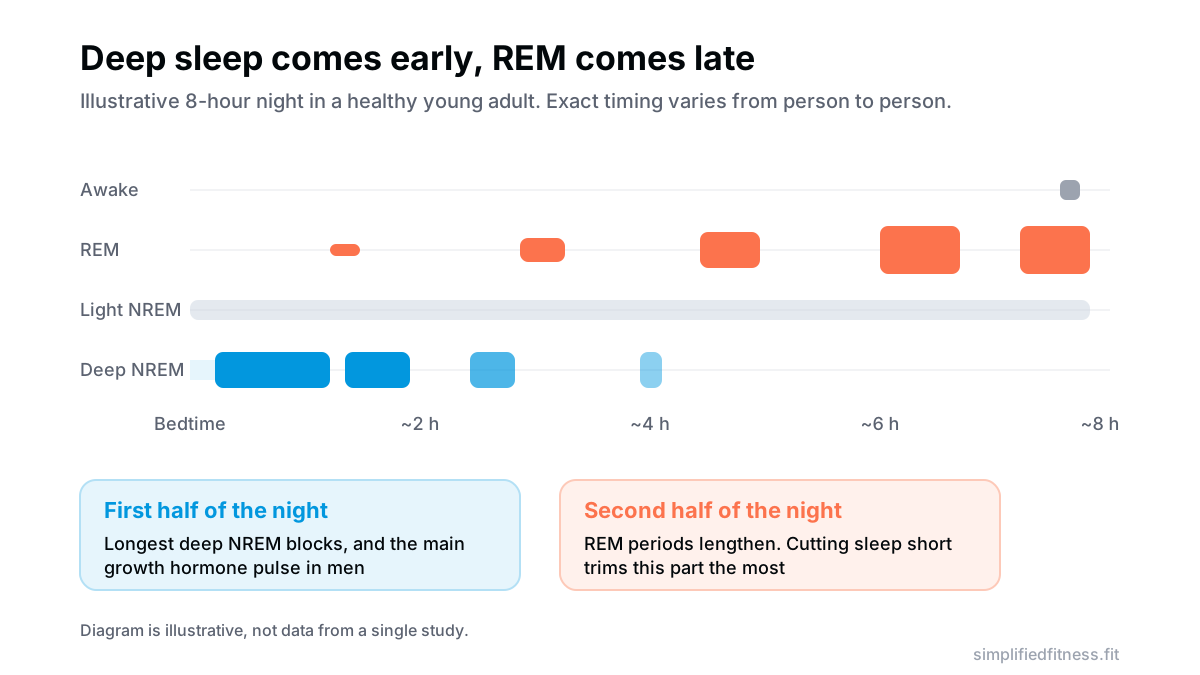
Why should a lifter care? Because the stages are not interchangeable. That figure is illustrative, and your own night will look different, but the shape (deep early, REM late) is the part that holds up.
Slow-wave sleep and growth hormone: how strong is the link?
Slow-wave sleep is the stage most often tied to physical recovery, and the best-documented reason is growth hormone (GH).
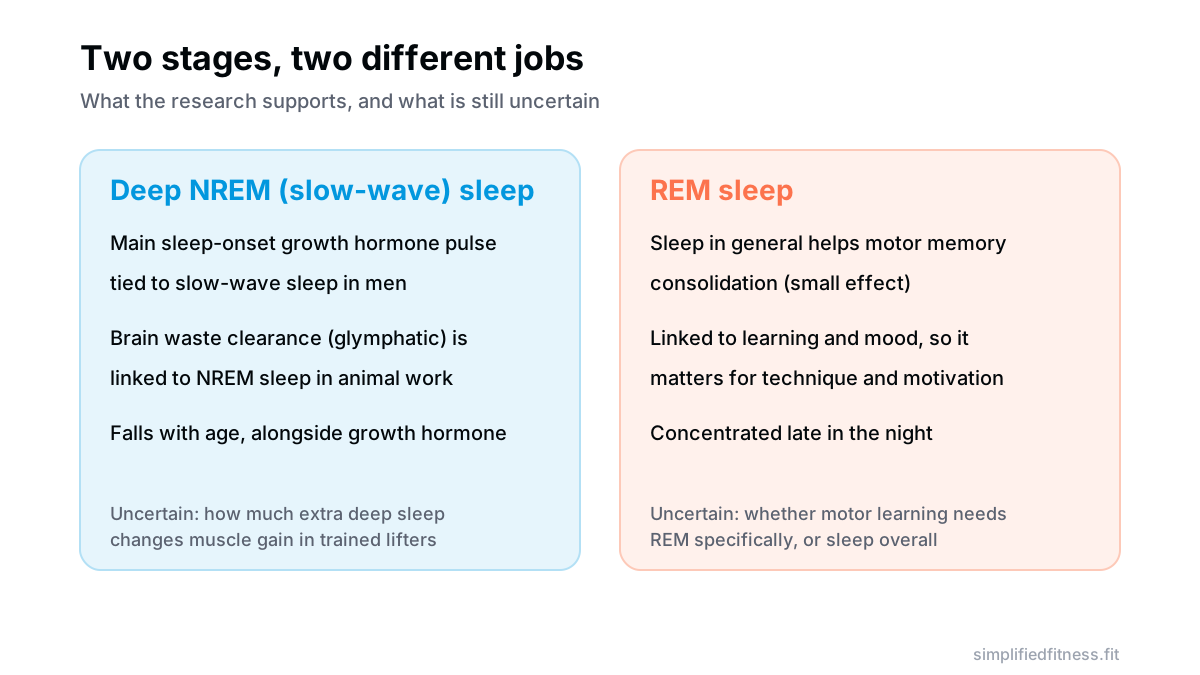
In adults, the most reproducible GH pulse occurs shortly after sleep onset, alongside the first phase of slow-wave sleep. In men, approximately 70% of the GH pulses during sleep coincide with slow-wave sleep, and the amount of GH released correlates with the amount of slow-wave sleep at that time (Van Cauter & Plat, 1996).
You may have seen “70-80% of daily growth hormone comes from deep sleep” in articles. The abstract we can verify says about 70% of the pulses during sleep, in men. It does not say 70-80% of the daily total, so we do not use that number.
Another review adds nuance. In healthy young men the sleep-onset pulse is generally the major or even the only daily episode of active GH secretion, but in women, daytime pulses are frequent (Van Cauter & Copinschi, 2000). So “sleep is your big GH window” fits men better than women.
Age matters too. Slow-wave sleep and GH secretion both fall with age, with the same timeline. The 1996 review notes a two- to threefold drop in total 24-hour GH between ages 30 and 40 (Van Cauter & Plat, 1996).
Does more deep sleep mean more muscle?
This is where the marketing gets ahead of the science.
The sleep-GH link is real. But does the hormone pulse itself build muscle in a trained lifter? Evidence says probably not on its own. In a 15-week study, 12 young men trained each arm on separate days. One arm did curls alone, which left hormones at baseline. The other did the same curls followed straight away by heavy leg work, which raised GH, IGF-1 and testosterone. Muscle size and strength gains were similar in both arms (West et al., 2010). That study looked at exercise-induced hormone spikes, not sleep GH, so we are drawing an indirect conclusion. But it argues against treating any single GH pulse as the engine of hypertrophy.
A more defensible way to think about it: sleep protects the conditions muscle needs. Which brings us to what happens when you lose it.
What actually happens to muscle when sleep is cut?
In a randomized crossover trial of 13 healthy young adults (seven men, six women), one night of total sleep deprivation reduced postprandial muscle protein synthesis by 18% compared with a normal night. Cortisol was 21% higher and testosterone 24% lower the next day (Lamon et al., 2021). Markers of protein breakdown did not differ.
Two cautions. This was a single night of no sleep at all, which is harsher than most people’s real-life bad nights. And the sample was small. The authors suggest these acute changes could be a mechanism behind the body composition changes seen with chronic sleep loss, but this study cannot prove that.
The takeaway is not “one bad night destroys gains.” It is that sleep loss shifts the environment in the wrong direction, so repeated short nights are worth fixing. Our deeper look at that is in sleep restriction, muscle catabolism and fat loss.
What does the brain do during deep NREM sleep?
Besides GH release, deep NREM is the stage tied to brain “housekeeping.”
The glymphatic system is a fluid pathway that helps move waste out of brain tissue. A 2025 study in Cell identified tightly synchronized oscillations in norepinephrine, blood volume and cerebrospinal fluid as the strongest predictors of glymphatic clearance during NREM sleep, and found the sleep aid zolpidem suppressed those oscillations and glymphatic flow (Hauglund et al., 2025). This work used animal experiments such as optogenetic stimulation, so it shows a mechanism in animals, not a proven effect on lifting performance in humans.
Practical read: the stage matters, and more sedation is not the same as better sleep.
What does REM sleep do for a lifter?
REM sleep is tied to learning, memory and emotional processing. For a lifter, two things matter: technique and motivation.
A meta-analysis of 48 studies (53 sleep groups, 53 wake groups) found a small overall benefit of sleep for motor memory consolidation (g = 0.43), with a small effect for finger tapping (g = 0.47) and a medium effect for mirror tracing (g = 0.62) (Schmid et al., 2020). Notice what that does and does not show. It supports sleep helping you consolidate a new movement pattern. It does not isolate REM as the driver, and these were lab tasks, not squat technique.
So if you are learning the back squat or a new overhead press pattern, sleeping on it is not a myth. Whether REM specifically is responsible is still unsettled.
Does hard training change your sleep architecture?
Sometimes, but results are mixed. In a crossover trial of 19 young adults, evening high-intensity interval training was followed by a decrease in REM sleep, with no significant change in NREM sleep, and better declarative memory retention (Frisch et al., 2024). That is one small study of one protocol.
Other trials of different exercise types and timing have reported different patterns, so do not treat this as a rule. Practically: if hard evening sessions leave you wired, move them earlier. If they do not, keep them. Our sleep hygiene checklist for lifters covers what to adjust first.
Can your tracker see your deep sleep?
Not reliably. A multicenter study compared 11 consumer devices (including Apple Watch 8, Oura Ring 3, Fitbit Sense 2, Galaxy Watch 5 and Google Pixel Watch) with lab polysomnography in 75 participants. Epoch-by-epoch stage agreement varied a lot: the best macro F1 score was 0.69 and the lowest was 0.26. Some wearables did better on the deep stage than others (Lee et al., 2023). Most of the authors work for Asleep, the company behind SleepRoutine, one of the tested apps that scored well on wake and REM, and they declared stock holdings in it. Worth knowing when you read the favourable results.
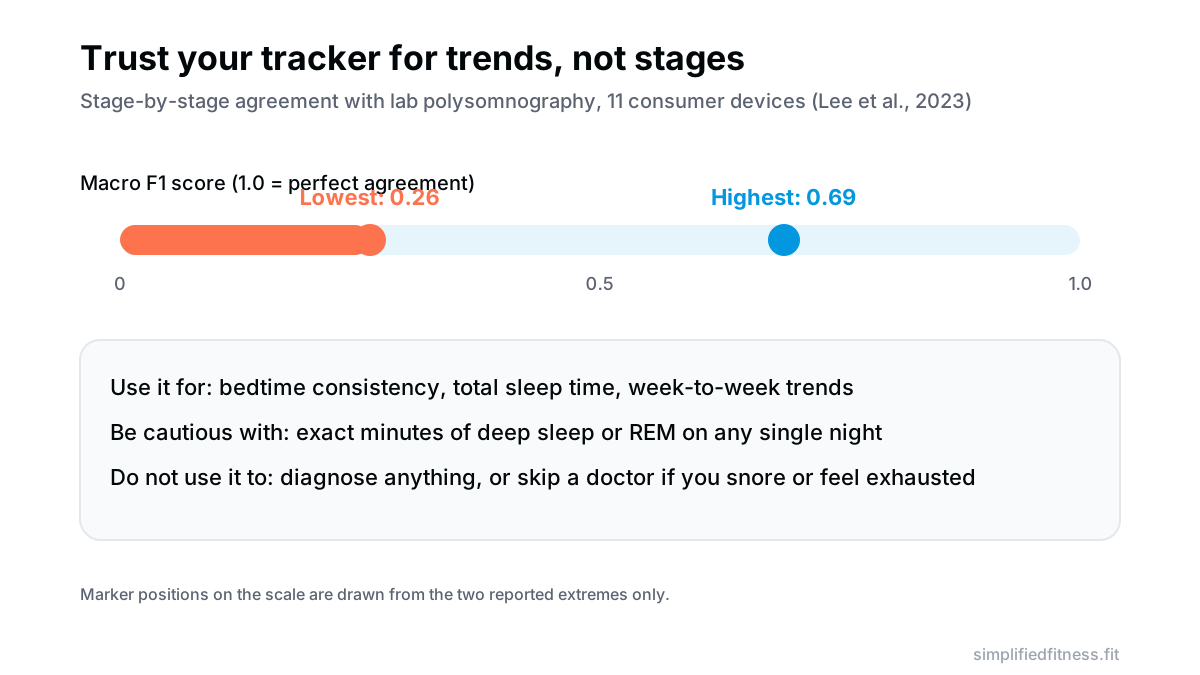
What to do with that. Use a tracker for trends: how long you are in bed, how consistent your bedtime is, how a week of hard training feels. Do not rebuild your program around one night of “low deep sleep.” For brand-by-brand detail, see our wearable recovery tracker comparison.
How to protect deep sleep and REM without gadgets
None of this needs a subscription. What helps both stages is the boring set:
- Fixed wake time. It anchors everything else, and it protects the REM-rich final hours.
- Enough hours. Many adults function best around 7-9 hours, though needs vary.
- Caffeine cut-off. Late caffeine can fragment sleep. Our guide to the afternoon caffeine cutoff has the detail.
- Cool, dark room. In a hot Indian summer, a fan, curtains and a lighter dinner can matter more than any supplement.
- Alcohol. A late drink may feel like it helps you fall asleep, but it is a common reason people wake unrefreshed.
If you want a structure to train around all this, start with our free push pull legs plan.
When to see a doctor
Sleep architecture is not something you diagnose at home. See a doctor if you snore loudly, wake gasping, have been told you stop breathing in your sleep, or are exhausted every day despite enough time in bed. Muscular lifters with thick necks are not exempt from sleep apnea. A sleep study is the proper test, and a wearable cannot replace it.
The bottom line
Deep slow-wave sleep arrives early and is closely linked to the main sleep-onset GH pulse in men. REM arrives late and is linked to learning and mood. Both depend on a full, regular night.
The science is more modest than the marketing. Nobody has shown that boosting deep sleep alone builds more muscle in trained people. What is shown is that losing sleep can hurt protein synthesis, raise cortisol, and make training feel harder. So skip the hacks, fix the schedule, and judge your sleep by how you train and feel over weeks, not by one tracker score.
Frequently Asked Questions
What is sleep architecture?
Sleep architecture is the structure of your night: how you move through light NREM, deep NREM (slow-wave) and REM sleep in repeating cycles. Each stage has different brain activity and hormonal activity, which is why two people sleeping 7 hours can feel very different the next day. Track how consistent your bedtime and wake time are before worrying about stage percentages.
How long is one sleep cycle?
A typical cycle is often described as about 90 minutes, though it varies between people and across the night. Each cycle passes through lighter NREM, deeper NREM and REM, with deep sleep dominating early cycles and REM growing longer later. Plan sleep in whole cycles only loosely; getting enough total hours matters more than hitting exact multiples.
How much deep sleep do I need for muscle recovery?
There is no research-backed deep sleep target for lifters, and the amount naturally falls with age. Studies link slow-wave sleep to growth hormone release, but they have not shown that more deep sleep produces more muscle in trained people. Aim for enough total sleep (many adults do best around 7-9 hours) and keep your schedule regular.
Does deep sleep release growth hormone?
Yes, in a link that is well documented in lab studies. In adults the most reproducible growth hormone pulse occurs soon after sleep onset alongside the first phase of slow-wave sleep, and in men about 70% of sleep-related pulses coincide with it. Protect the first few hours of your night, since that is when this pulse typically happens.
Does growth hormone from sleep build muscle?
Probably not in the way gym marketing suggests. In a 15-week training study, raising growth hormone, IGF-1 and testosterone after exercise did not improve muscle growth or strength in young men. Treat sleep as protection for training quality and recovery, not as a growth hormone hack.
What does REM sleep do for athletes?
REM sleep is linked to learning, memory and mood. A meta-analysis of 48 studies found that sleep gives a small benefit to motor memory consolidation (g = 0.43), though it does not isolate REM as the cause. Keep your wake time consistent so late-night REM is not cut short by early alarms.
NREM vs REM sleep for bodybuilding: which matters more?
Neither can be ranked with confidence. Deep NREM is tied to growth hormone and tissue repair processes, while REM is tied to learning and mood, and both come from simply getting full nights. Aim for enough total sleep instead of trying to bias one stage.
Can I boost deep sleep with supplements or sleep aids?
No supplement has solid proof of reliably increasing deep sleep in healthy lifters. In animal work, the sleep drug zolpidem suppressed the norepinephrine oscillations tied to brain waste clearance, a reminder that more sedation is not the same as better sleep. Fix schedule, caffeine timing, room temperature and darkness first.
How accurate are Oura, Apple Watch and Fitbit for deep sleep?
Only moderately. In a study of 11 consumer trackers against lab polysomnography in 75 participants, stage agreement scores (macro F1) ranged from 0.26 to 0.69. Use trackers to watch trends in sleep time and consistency, and do not change your training because one night showed low deep sleep.
Does hard training increase deep sleep?
The evidence is mixed. A small crossover trial found evening high-intensity interval training reduced REM sleep and did not significantly change NREM sleep in 19 young adults. Train when it fits your life, and judge your sleep by how rested you feel over a few weeks.
Why does one bad night wreck my training?
A single night of total sleep deprivation lowered muscle protein synthesis by 18%, raised cortisol 21% and lowered testosterone 24% in a small trial of 13 healthy adults. After a bad night, keep the session but trim volume or stop a rep or two earlier.
When should I see a doctor about my sleep?
See a doctor if you snore loudly, gasp or stop breathing at night, or feel exhausted every day despite 7-9 hours in bed. These can signal conditions such as sleep apnea, which a wearable cannot diagnose. A sleep study is the proper test, and treatment can change how you train and feel.
Sources & References
Every claim above is checked against peer-reviewed research (PubMed, U.S. National Library of Medicine) or guidance from established health bodies. How we fact-check.
- Van Cauter E, et al. Physiology of growth hormone secretion during sleep. J Pediatr. 1996. PMID: 8627466
- Van Cauter E, et al. Interrelationships between growth hormone and sleep. Growth Horm IGF Res. 2000. PMID: 10984255
- Lamon S, et al. The effect of acute sleep deprivation on skeletal muscle protein synthesis and the hormonal environment. Physiol Rep. 2021. PMID: 33400856
- Hauglund NL, et al. Norepinephrine-mediated slow vasomotion drives glymphatic clearance during sleep. Cell. 2025. PMID: 39788123
- Schmid D, et al. Sleep-dependent motor memory consolidation in healthy adults: A meta-analysis. Neurosci Biobehav Rev. 2020. PMID: 32730847
- Lee T, et al. Accuracy of 11 wearable, nearable, and airable consumer sleep trackers: prospective multicenter validation study. JMIR Mhealth Uhealth. 2023. PMID: 37917155
- West DW, et al. Elevations in ostensibly anabolic hormones with resistance exercise enhance neither training-induced muscle hypertrophy nor strength of the elbow flexors. J Appl Physiol. 2010. PMID: 19910330
- Frisch N, et al. An acute bout of high-intensity exercise affects nocturnal sleep and sleep-dependent memory consolidation. J Sleep Res. 2024. PMID: 38112275

Umair Hazrami · Founder & Head Coach, Simplified Fitness
Umair Hazrami founded Simplified Fitness and the Simplified Lifter channel to cut through fitness noise. With 4+ years of consistent training and 10+ coaching clients, he writes every guide from the peer-reviewed research and links the sources so you can check them. Our editorial standards.
Educational content only, not medical advice. If you have a medical condition, are pregnant, or take medication, talk to a qualified doctor before changing your diet, supplements or training. Full disclaimer.
Keep reading

Recovery
Active Recovery on Rest Days: Walking, Light Cycling and Mobility
Active recovery vs passive rest for lifters: what the research says about walking, light cycling and mobility, plus a 20-minute rest day routine you can copy.
7 min read
Recovery
Afternoon Caffeine Cutoff: Half-Life, Deep Sleep and Pre-Workout
Afternoon caffeine cutoff for lifters: how caffeine's half-life cuts sleep time and deep sleep even if you fall asleep fine, plus a practical cutoff by bedtime.
9 min read
Recovery
Blue Light, Melatonin and Screen Time: Do Blue-Blockers Actually Help You Sleep?
Blue light screen time melatonin suppression is real, but do blue-blocking glasses fix it? See what the trials found and the free fixes that matter more.
7 min read
Recovery
Is Your CNS Fried? CNS Fatigue vs Plain Lethargy in the Gym
Is my CNS fried from lifting? See what central fatigue really is, how fast it recovers and how to tell it from low motivation or poor sleep. Studies linked.
9 min read