Sleep Apnea in Muscular Lifters: Neck Size, Oxygen Dips and CPAP
Sleep apnea in bodybuilders is real: thick necks, heavy snoring and tired mornings can signal it. See the research, how testing works and what CPAP can do.

TL;DR. The short answer
- Sleep apnea in bodybuilders and other muscular lifters is a recognised problem. In one study of 58 collegiate football players, 35% had mild-to-moderate obstructive sleep apnea (OSA), a rate the authors describe as higher than in the general population.
- A big neck, a high BMI and heavy snoring raise the odds, but muscle itself is not a diagnosis. Only a sleep test (home or in-lab) confirms OSA.
- CPAP is the first-line treatment for adults with OSA and sleepiness, with strong guideline backing. Whether it speeds muscle growth has not been tested directly, so expect better sleep and energy, not a guaranteed physique change.
- CPAP does not reliably raise testosterone in men with OSA, according to two meta-analyses, so do not expect it to act as a hormone fix.
- Loud snoring plus unrefreshing sleep, witnessed pauses in breathing or morning headaches is a reason to see a doctor, especially if you use testosterone or steroids.
Part of our complete guide: Sleep, Circadian Timing & Systemic Recovery: How Lifters Maximize Anabolic Rest & CNS Recovery
Table of contents
If you have a 43 cm (17 inch) neck, snore like a diesel engine and wake up wrecked after eight hours in bed, sleep apnea in bodybuilders and other muscular lifters is worth taking seriously. Obstructive sleep apnea (OSA) means your airway keeps narrowing or closing during sleep, so breathing dips and your brain half-wakes to restart it. Muscle is not the problem by itself, but extra body mass and a thick neck can both shrink the airway, and only a sleep test can tell you whether you have it.
This is the clinical side of recovery. For the wider picture on sleep timing, see our complete guide to sleep, circadian timing and systemic recovery. This article is educational, not a diagnosis. If your symptoms match, book a doctor.
What is sleep apnea, and why do muscular lifters get it?
In OSA, the muscles and soft tissue around the throat relax during sleep and the airway narrows. Airflow drops, oxygen can dip, and the brain triggers a brief arousal so you start breathing normally again. You often do not remember it. You just feel flat the next day.
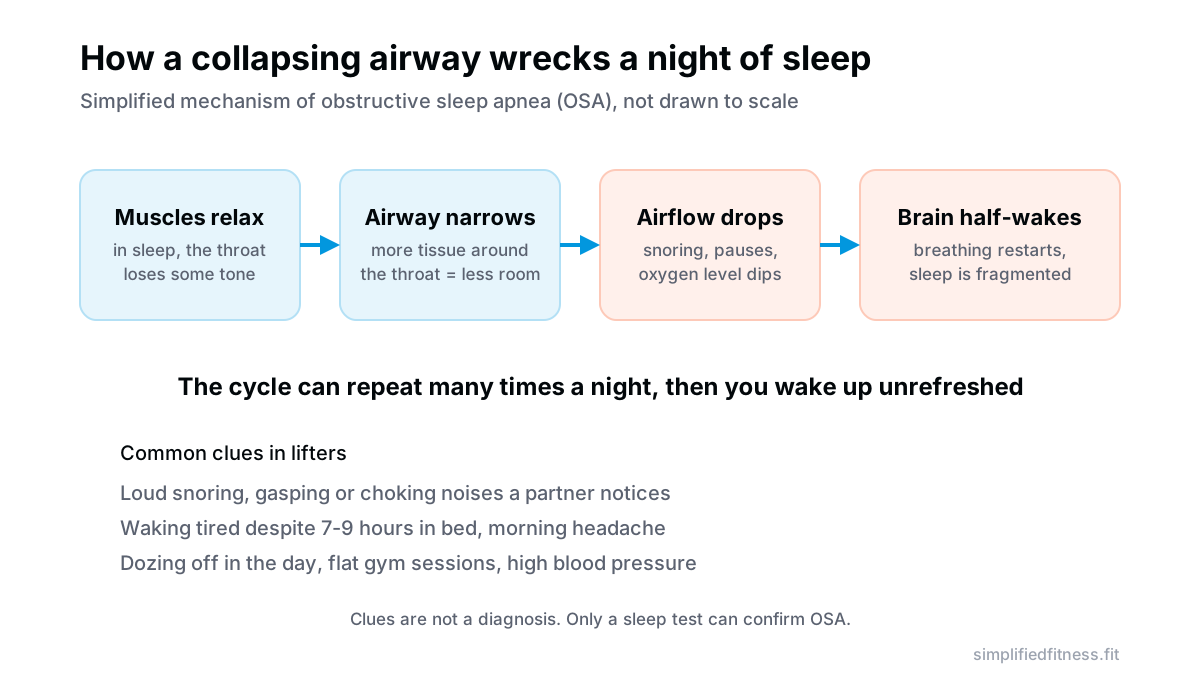
Why lifters? Three things stack up:
- Neck and throat size. More tissue around the throat leaves less room for air.
- Body mass. Bulking pushes BMI up, and BMI does not separate muscle from fat. Heavier athletes, especially linemen and forwards in contact sports, are over-represented in the research.
- Male sex and age. Both are risk factors that screening tools count.
The mechanism is simple. It is the numbers that surprise people.
How common is sleep apnea in bodybuilders and strength athletes?
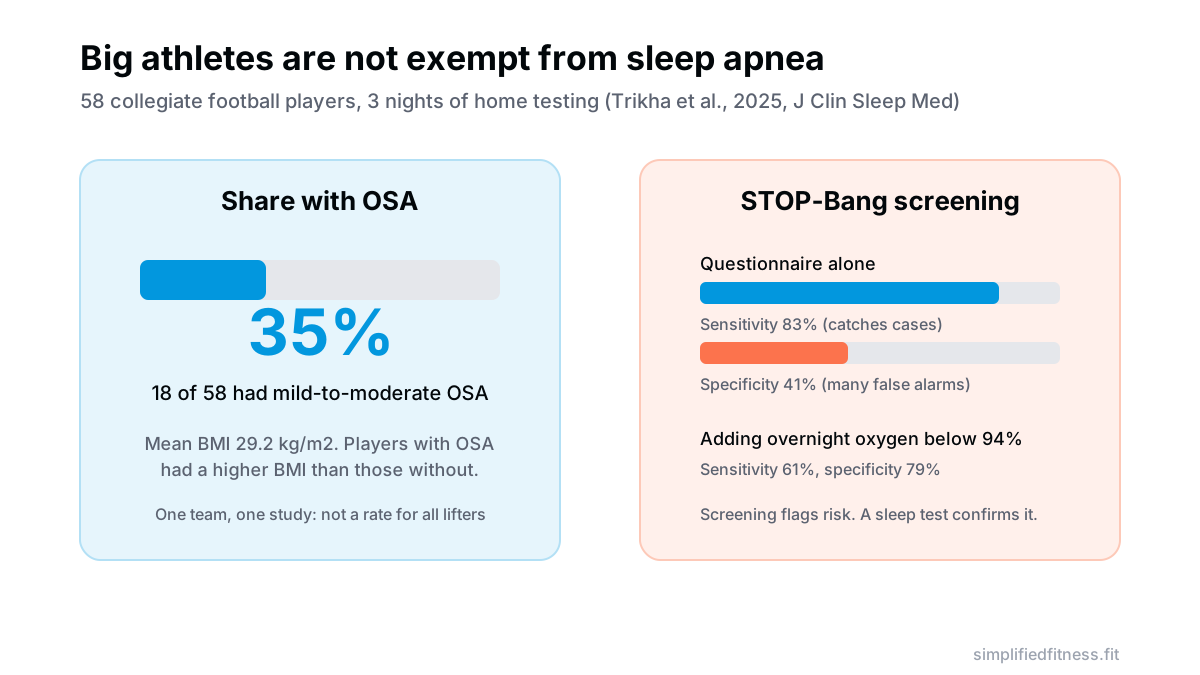
Nobody has run a large study on bodybuilders specifically. The nearest evidence comes from other big-bodied athletes, and it is small-sample and sport-specific, so treat it as a warning signal, not a prevalence figure for all lifters.
- Collegiate football players (2025): 58 young, healthy men wore a home sleep device for three nights. Thirty-five percent (18 players) had mild-to-moderate OSA, and those with OSA had a higher BMI. The authors say football players show OSA at a higher rate than the general population (Trikha et al., 2025).
- College linemen versus track athletes: 21 linemen and 19 track athletes completed questionnaires and body measurements. The linemen had an average neck circumference of 44.36 cm, BMI of 35.87 kg/m2 and body fat of 29.20%, and showed more self-reported apnea symptoms and poorer sleep quality (Peck et al., 2019). That is a risk profile, not a diagnosis.
A thick neck from direct neck training is a separate question. If you are building yours on purpose, our neck hypertrophy guide covers how, and it is worth knowing the airway trade-off exists.
Snoring, tiredness and a big neck: what are the warning signs?
The STOP-Bang questionnaire, built to screen for OSA, asks about snoring, tiredness, observed apnea, high blood pressure, BMI, age, neck circumference and male sex. In general populations, a score of 3 or more has high sensitivity for moderate-to-severe OSA, and the probability rises as the score climbs (Chung et al., 2016).
Here is the catch for lifters. In the football study, STOP-Bang had a sensitivity of 83% but a specificity of only 41%, so it caught most cases but flagged many people who did not have OSA. Adding overnight oxygen saturation below 94% improved specificity to 79% at the cost of sensitivity (61%) (Trikha et al., 2025). Muscular people can score points on BMI and neck size whether or not they have OSA, which may help explain the false alarms and is one reason a questionnaire is a starting point only.
Warning signs worth acting on:
- Loud, habitual snoring, with gasping or choking
- Pauses in breathing that a partner has seen
- Waking tired despite 7-9 hours, or with a morning headache or dry mouth
- Dozing in meetings, on the bike or at traffic lights
- Flat sessions, poor focus and stalled lifts for no training reason
- High blood pressure, especially if it is hard to bring down
Does sleep apnea affect muscle growth and testosterone?
Here the evidence is thinner than the internet suggests, so let us separate what is known from what is plausible.
Known: poor sleep affects training in general. Our guide on sleep restriction and muscle catabolism covers the research on short sleep, and the sleep architecture article explains why deep sleep matters. OSA fragments sleep, so it is reasonable to expect similar effects on energy and session quality.
Plausible but not proven: that untreated OSA directly blunts muscle protein synthesis or growth in lifters. I could not find trials measuring that in people with OSA, so I will not claim it.
Testosterone is mixed. OSA is associated with lower testosterone in men, but that is tangled up with obesity and age. When researchers looked at whether CPAP raises testosterone, a meta-analysis of 12 studies (388 patients, mostly cohort studies and two randomized trials) found no significant change in total testosterone, with a mean difference of 1.08 and a confidence interval that crossed zero (Cignarelli et al., 2019). An earlier 2014 meta-analysis of 7 studies (232 men) also found no change in total testosterone after CPAP (Zhang et al., 2014). So do not buy a CPAP expecting it to behave like a testosterone booster.
Do steroids and testosterone make it worse?
This matters for a subset of lifters. A 2021 review found that testosterone therapy likely plays a small role in worsening or inducing OSA, possibly time-limited, and that clinicians may be cautious in people with severe OSA (Payne et al., 2021). Almost all of that evidence is from medical testosterone replacement, not the much higher doses sometimes used in bodybuilding, and the data on those higher doses is thin. The honest answer is: probably a risk, size unknown.
If you use testosterone or other performance-enhancing drugs and you snore heavily, tell your doctor. They can only protect you if they know. Our broader natural testosterone boosters audit is a more useful place to start if you are chasing hormone health without drugs.
How do you test for sleep apnea at home?
A questionnaire cannot diagnose OSA. The American Academy of Sleep Medicine guideline is explicit: clinical tools and prediction algorithms should not be used to diagnose OSA in adults without polysomnography or a home sleep apnea test (HSAT). It recommends either polysomnography or HSAT with a technically adequate device for uncomplicated adults at increased risk of moderate-to-severe OSA. If a single HSAT is negative or inconclusive, polysomnography should follow, and polysomnography rather than HSAT is preferred for people with significant heart or lung disease, a history of stroke, chronic opioid use and some other conditions (Kapur et al., 2017).
In practice:
- Note your symptoms and ask whoever shares your room about snoring and pauses.
- See a GP or sleep physician (in India, a pulmonologist or ENT with a sleep lab is common). Bring the snoring evidence.
- Get an HSAT or an in-lab sleep study as advised. A test result gives you the severity, which decides the treatment.
A smartwatch alert can prompt you to go, but it is not a diagnosis.
What does CPAP actually do for a lifter?
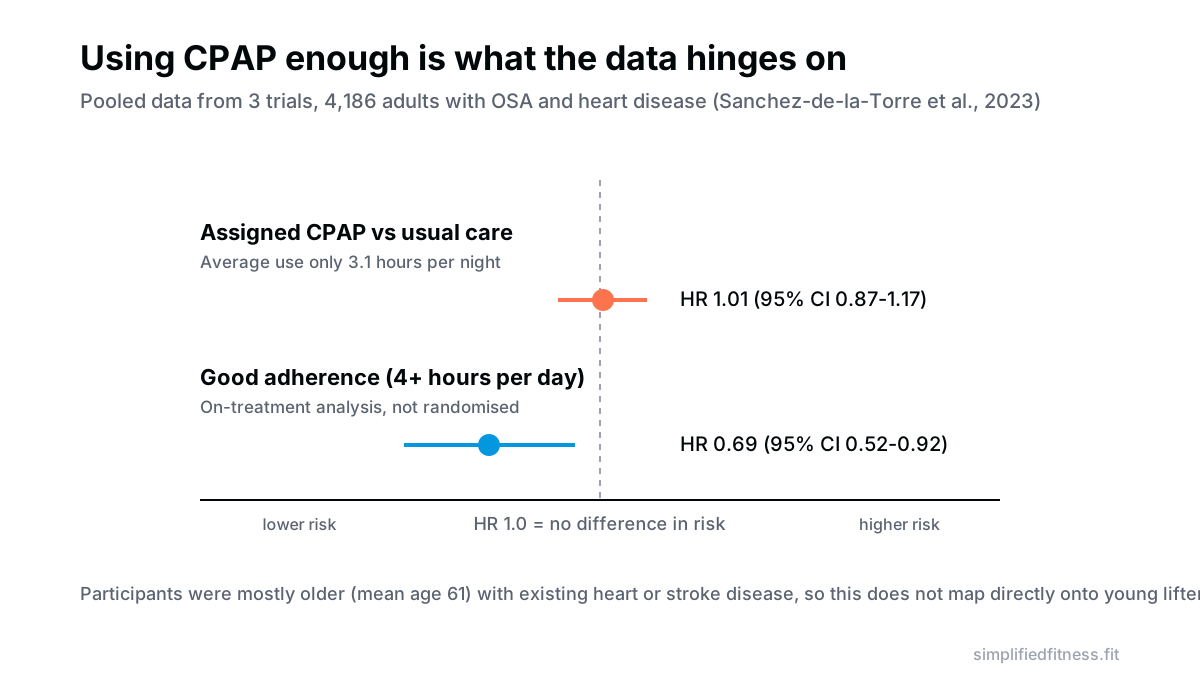
CPAP (continuous positive airway pressure) blows gentle air through a mask to hold the airway open. The American Academy of Sleep Medicine strongly recommends PAP over no therapy for adults with OSA and excessive sleepiness, and suggests it for impaired sleep-related quality of life and for people who also have hypertension (Patil et al., 2019).
What to expect, and what not to:
- Reasonable to expect: less snoring, fewer breathing events, and for many people, less daytime sleepiness. Response varies, and the first weeks often involve mask-fit fiddling.
- Do not expect: an overnight transformation, a testosterone jump, or guaranteed faster muscle growth. Nobody has tested the muscle claim directly.
- Practical: mask fit and follow-up make or break adherence, which is why guidelines stress education and troubleshooting when starting PAP.
Treat “CPAP will restore your gains” as a hopeful inference. Better sleep should help training quality, and that is a sensible reason to treat OSA, but the proof is not there yet.
Other things that help alongside treatment
CPAP is not the only lever, and these work with it, not instead of it.
- Weight and waist. In a randomized trial, 89 men with moderate-to-severe OSA on CPAP (all with BMI of 25 or more) either continued usual care or added an 8-week programme of diet change, aerobic exercise and sleep hygiene. The programme group’s apnea-hypopnea index fell by 51%, and 15% reached complete OSA remission at the end of the programme, rising to 29% of those followed up at 6 months (Carneiro-Barrera et al., 2022). Participants were middle-aged (mean age 54), not young athletes. That applies most to heavier lifters, and a managed cut should be run with your doctor’s input. Our waist-to-height calculator is a simple way to track it.
- Sleep position and alcohol. Back sleeping and late alcohol tend to worsen snoring. Both are easy to test for yourself.
- Sleep basics. Dark, cool, regular times. Our sleep hygiene checklist for lifters covers the routine.
Do not stop CPAP because you lost weight. Let your sleep doctor re-test first.
When should you see a doctor?
Book an appointment if you have loud snoring plus unrefreshing sleep, witnessed breathing pauses, morning headaches, falling asleep at inappropriate times, or high blood pressure you cannot explain. Seek urgent care for chest pain, fainting or severe breathlessness. If you drive for work, treat sleepiness at the wheel as a serious red flag.
The bottom line
Muscle is not the enemy, but a thick neck, high BMI and heavy snoring are a combination worth testing, not ignoring. Football data show OSA appears in athletic men, screening questionnaires are blunt for muscular people, and only a sleep test confirms it. CPAP has strong support for treating sleepiness, with unproven promises about muscle and testosterone. Fix the diagnosis first, then train around it. If you want a structured routine while you sort it out, use our free push pull legs plan and keep sessions sensible on tired days.
Frequently Asked Questions
Can bodybuilders get sleep apnea?
Yes. Studies in college football players, including linemen, show OSA and risk factors for sleep-disordered breathing in large athletes. Extra body mass and a thick neck can narrow the airway during sleep, even in people who look lean. If you snore loudly and wake tired, ask a doctor about a sleep test.
Does a thick neck cause sleep apnea?
A larger neck circumference is a recognised risk factor, because more tissue around the throat leaves less room for air. In a study of college football linemen, average neck circumference was 44.36 cm and the group showed higher sleep apnea risk than track athletes. A big neck raises suspicion but does not prove OSA, so a sleep test is the only way to know.
What neck size is a risk for sleep apnea?
There is no single cut-off that diagnoses OSA, and the thresholds in screening tools were built on general populations, not muscular lifters. Neck circumference is one item among several, alongside snoring, tiredness, blood pressure, BMI, age and sex. Measure your neck, but judge risk by your symptoms and ask a doctor about testing.
Is snoring a sign of sleep apnea in lifters?
Loud, habitual snoring is one of the main warning signs, particularly when it comes with gasping, choking or pauses someone else has seen. Snoring alone can be harmless, but combined with daytime tiredness it deserves a proper check. Ask your partner or record yourself for a few nights and take that to your doctor.
Why am I tired all day even though I sleep 8 hours?
Time in bed is not the same as quality sleep, and repeated breathing interruptions can fragment sleep without you remembering waking. OSA is one possible cause, but low iron, poor sleep habits, stress and under-eating can also do it. See a doctor if tiredness is persistent, and rule out the simple causes at the same time.
How do I test for sleep apnea at home?
A doctor can arrange a home sleep apnea test, a portable device you wear for a night or more that records breathing and oxygen. The American Academy of Sleep Medicine recommends polysomnography or a technically adequate home test for uncomplicated adults at increased risk of moderate-to-severe OSA. App-based snoring trackers and questionnaires alone cannot diagnose it.
Can a smartwatch or app diagnose sleep apnea?
No. Guidelines say questionnaires and prediction tools should not replace a sleep test for diagnosis, and consumer wearables are not diagnostic devices. They can flag a pattern worth following up, such as repeated oxygen dips. Treat any alert as a reason to book a medical test, not as an answer.
Does CPAP help muscle growth?
There are no trials I could find that measured muscle growth on CPAP in lifters, so any claim of faster gains is a reasonable inference, not proven. What CPAP does have strong evidence for is reducing excessive sleepiness in adults with OSA. Better sleep and more energy could support training quality, so judge it by how you feel and perform.
Does CPAP raise testosterone?
Not reliably. A 2019 meta-analysis of 12 studies and 388 men found no significant change in total testosterone with CPAP, and a 2014 meta-analysis reached a similar conclusion. Low testosterone in OSA often goes with obesity and age, so CPAP alone may not fix it. If you suspect low testosterone, get it checked by a doctor rather than treating the sleep problem as the cure.
Can steroids or testosterone make sleep apnea worse?
Possibly. A review found testosterone therapy may play a small, sometimes time-limited role in worsening OSA, and clinicians may be cautious in people with severe OSA. Most evidence is from medical testosterone replacement, not bodybuilding doses. If you use any performance-enhancing drug and snore heavily, tell your doctor honestly so you can be assessed safely.
Will losing weight cure sleep apnea?
Weight loss can reduce OSA severity in people who are overweight, but it is not guaranteed to cure it. In a randomized trial of 89 men with moderate-to-severe OSA on CPAP, an 8-week lifestyle programme cut the apnea-hypopnea index by 51% and 15% reached complete remission. Do not drop CPAP by yourself; let your sleep doctor reassess you after weight changes.
Is sleep apnea dangerous?
Untreated moderate-to-severe OSA is linked with higher cardiovascular risk and daytime sleepiness, which is a hazard when driving. A 2023 meta-analysis in people with heart disease found that good CPAP adherence (4+ hours a day) was associated with fewer repeat cardiovascular events. That analysis was in older adults, so see a doctor early instead of assuming you are safe because you are young and strong.
Can I still train hard if I have sleep apnea?
Usually yes, once you have been assessed and treated. Regular training can help control body weight and blood pressure, which matter for OSA. If you get chest pain, severe breathlessness or fainting during training, stop and see a doctor promptly.
Sources & References
Every claim above is checked against peer-reviewed research (PubMed, U.S. National Library of Medicine) or guidance from established health bodies. How we fact-check.
- Trikha SRJ, et al. Prevalence and predictors of obstructive sleep apnea in collegiate football players. J Clin Sleep Med. 2025. PMID: 40135688
- Peck B, et al. Examination of risk for sleep-disordered breathing among college football players. J Sport Rehabil. 2019. PMID: 29035666
- Chung F, et al. STOP-Bang questionnaire: a practical approach to screen for obstructive sleep apnea. Chest. 2016. PMID: 26378880
- Kapur VK, et al. Clinical practice guideline for diagnostic testing for adult obstructive sleep apnea: an American Academy of Sleep Medicine clinical practice guideline. J Clin Sleep Med. 2017. PMID: 28162150
- Patil SP, et al. Treatment of adult obstructive sleep apnea with positive airway pressure: an American Academy of Sleep Medicine clinical practice guideline. J Clin Sleep Med. 2019. PMID: 30736887
- Sanchez-de-la-Torre M, et al. Adherence to CPAP treatment and the risk of recurrent cardiovascular events: a meta-analysis. JAMA. 2023. PMID: 37787793
- Cignarelli A, et al. Effects of CPAP on testosterone levels in patients with obstructive sleep apnea: a meta-analysis study. Front Endocrinol. 2019. PMID: 31496991
- Payne K, et al. Obstructive sleep apnea and testosterone therapy. Sex Med Rev. 2021. PMID: 32636155
- Zhang XB, et al. Efficacy of continuous positive airway pressure on testosterone in men with obstructive sleep apnea: a meta-analysis. PLoS One. 2014. PMID: 25503098
- Carneiro-Barrera A, et al. Effect of an interdisciplinary weight loss and lifestyle intervention on obstructive sleep apnea severity: the INTERAPNEA randomized clinical trial. JAMA Netw Open. 2022. PMID: 35452108

Umair Hazrami · Founder & Head Coach, Simplified Fitness
Umair Hazrami founded Simplified Fitness and the Simplified Lifter channel to cut through fitness noise. With 4+ years of consistent training and 10+ coaching clients, he writes every guide from the peer-reviewed research and links the sources so you can check them. Our editorial standards.
Educational content only, not medical advice. If you have a medical condition, are pregnant, or take medication, talk to a qualified doctor before changing your diet, supplements or training. Full disclaimer.
Keep reading

Recovery
Active Recovery on Rest Days: Walking, Light Cycling and Mobility
Active recovery vs passive rest for lifters: what the research says about walking, light cycling and mobility, plus a 20-minute rest day routine you can copy.
7 min read
Recovery
Afternoon Caffeine Cutoff: Half-Life, Deep Sleep and Pre-Workout
Afternoon caffeine cutoff for lifters: how caffeine's half-life cuts sleep time and deep sleep even if you fall asleep fine, plus a practical cutoff by bedtime.
9 min read
Recovery
Blue Light, Melatonin and Screen Time: Do Blue-Blockers Actually Help You Sleep?
Blue light screen time melatonin suppression is real, but do blue-blocking glasses fix it? See what the trials found and the free fixes that matter more.
7 min read
Recovery
Is Your CNS Fried? CNS Fatigue vs Plain Lethargy in the Gym
Is my CNS fried from lifting? See what central fatigue really is, how fast it recovers and how to tell it from low motivation or poor sleep. Studies linked.
9 min read