Wearable Recovery Trackers (Oura, Whoop, Apple Watch): What Sleep Metrics Actually Matter?
Are wearable recovery trackers accurate enough to plan lifting around? See what Oura, Whoop and Apple Watch measure well, what they guess, and how to use them.
TL;DR. The short answer
- Wearable recovery trackers are reasonably good at telling when you slept and for how long, and at overnight resting heart rate. In one lab study of six devices, sleep versus wake agreement with polysomnography was 86-89%.
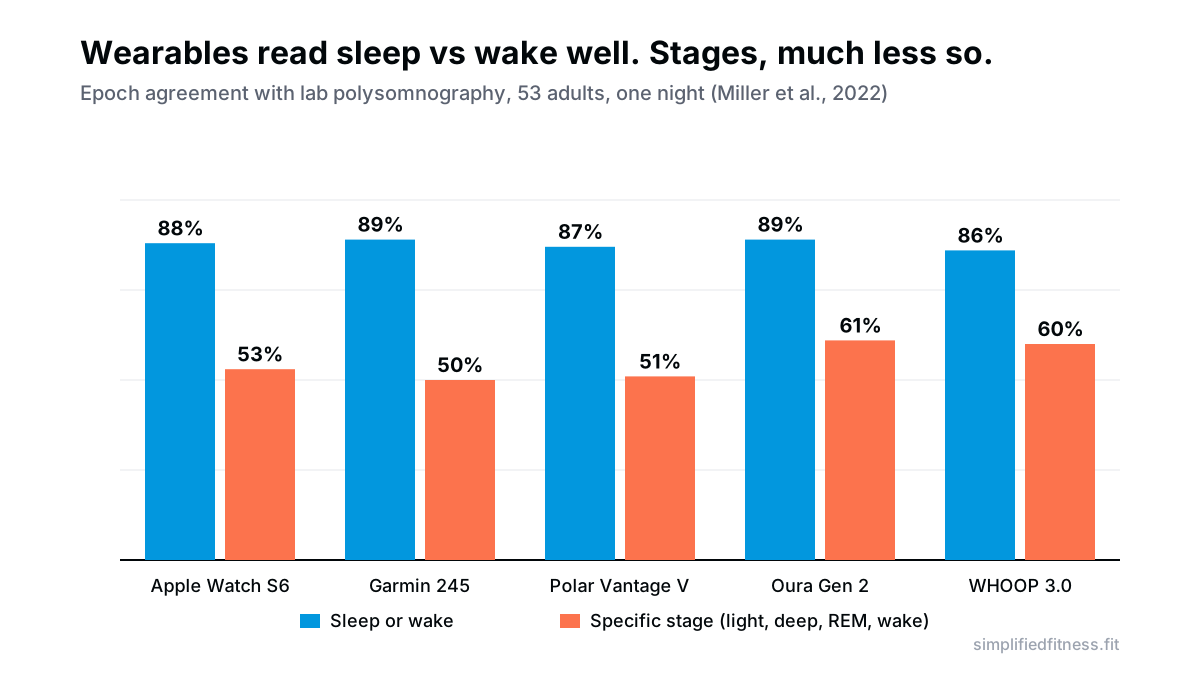
- They are much weaker at sleep stages. In the same study, agreement for light, deep, REM and wake together was only 50-61% across Apple Watch, Garmin, Polar, Oura and WHOOP.
- Overnight HRV from a ring or strap tracks an ECG fairly well, but accuracy differs by device, and a single day's red or green score is not a reliable training instruction.
- Use a 7-day trend against your own baseline, then cross-check with how you feel, how warm-up sets move and how you slept, instead of obeying one daily score.
- If a tracker makes you anxious about sleep, or you feel persistently exhausted whatever the numbers say, stop checking it and speak to a doctor.
Part of our complete guide: Sleep, Circadian Timing & Systemic Recovery: How Lifters Maximize Anabolic Rest & CNS Recovery
Table of contents
Wearable recovery trackers are good at some things and bad at others. They are reasonably reliable for when you slept, how long, and your overnight resting heart rate. They are weak at telling deep sleep from REM, and a single red or green recovery score is not a training order.
If you are building a sleep and recovery routine, start with our complete guide to sleep, circadian timing and systemic recovery. This article does one narrower job: it separates what your Oura ring, WHOOP strap or Apple Watch can genuinely tell you from what is closer to a confident guess, and shows how a lifter can use the useful part without getting spun around by the rest.
How do wearable recovery trackers actually work?
Most rings, straps and watches use the same basic trick. A light sensor on the skin (photoplethysmography, or PPG) measures pulse from changes in blood flow. An accelerometer measures movement. From those two signals, an algorithm estimates when you were asleep, your heart rate, and the tiny beat-to-beat variation called heart rate variability (HRV).
Notice what is missing: brain waves. Real sleep staging, done in a sleep lab with polysomnography (PSG), reads EEG from your head. A wearable never sees your brain. It infers “deep” or “REM” from heart rate patterns and movement, using a model trained on lab data.
That is why the numbers split into two groups. Heart rate and timing are directly measured. Sleep stages and recovery scores are inferred.
Are Oura, Whoop and Apple Watch accurate for sleep duration?
Mostly yes, with an error you should know about.
In a 2022 lab study, 53 healthy adults slept one night in a sleep laboratory wearing six devices at once (Apple Watch S6, Garmin Forerunner 245, Polar Vantage V, Oura Gen 2, WHOOP 3.0 and Somfit) alongside polysomnography. For simple sleep versus wake classification, agreement with PSG was 86-89% for all of them, and the authors concluded that all six are valid for assessing the timing and duration of sleep (Miller et al., 2022). The research group receives support from WHOOP, though the authors state WHOOP was not involved in this study.
A 2024 study of 35 adults with healthy sleep, comparing Oura Gen 3, Fitbit Sense 2 and Apple Watch Series 8 against PSG, found a similar picture: sensitivity for detecting sleep was 95% or higher for every device (Robbins et al., 2024).
Now the caution. A 2025 meta-analysis pooled 24 studies and 798 participants across many wrist-worn devices, including Fitbit, WHOOP, Garmin and Apple Watch. It found significant differences from PSG in total sleep time, sleep efficiency, sleep latency and time awake after sleep onset, and concluded that these devices are not as reliable as PSG for those parameters, though still useful for tracking general sleep patterns (Lee et al., 2025). Total sleep time, for example, differed by roughly 17 minutes on average (the abstract reports a mean difference of -16.9 minutes).
Put those together and the practical reading is clear. Your tracker will not give you the exact minute you fell asleep. It will tell you whether you slept about 5 hours or about 8, and that is what you need.
How accurate are sleep trackers at REM and deep sleep?
This is where the marketing runs ahead of the science.
The same 2022 study checked the harder task: labelling each 30-second period as wake or a specific sleep stage. Agreement with PSG dropped to 53% for Apple Watch, 50% for Garmin, 51% for Polar, 61% for Oura and 60% for WHOOP. Kappa values (a measure of agreement beyond chance) were 0.20-0.44 for the five wearables. The authors concluded that all six devices need improvement for assessing specific sleep stages (Miller et al., 2022).
The 2024 Boston study adds detail. Stage sensitivity ranged from 50% to 86% depending on device and stage. The Oura ring’s estimates were not statistically different from PSG for wake, light, deep or REM sleep in that sample. Fitbit overestimated light sleep by about 18 minutes and underestimated deep sleep by about 15. Apple Watch underestimated wake by about 7 minutes and deep sleep by about 43 minutes, and overestimated light sleep by about 45 minutes (Robbins et al., 2024). One author is on Oura’s medical advisory board, and the sample was healthy adults on a single lab night, so it is encouraging for Oura but not the last word.
So when your app says “47 minutes of deep sleep,” treat it as a rough band, not a lab result. Deep sleep matters for recovery (we cover why in sleep architecture and slow wave sleep for athletes), but you cannot reliably count it from your wrist. What you can do is protect the conditions that produce it, which is the sleep hygiene checklist for lifters.
Can HRV from a ring or watch be trusted?
Better than stages, with caveats.
A 2025 study compared overnight resting heart rate and HRV from five devices against ECG across 536 nights in 13 healthy adults. Oura Gen 4 and Gen 3 showed the highest agreement for both measures. For HRV, mean absolute percentage error was about 6% for Oura Gen 4 and 7% for Gen 3, versus 8% for WHOOP 4.0 (rated moderate), 11% for Garmin Fenix 6 and 16% for Polar Grit X Pro (Dial et al., 2025).
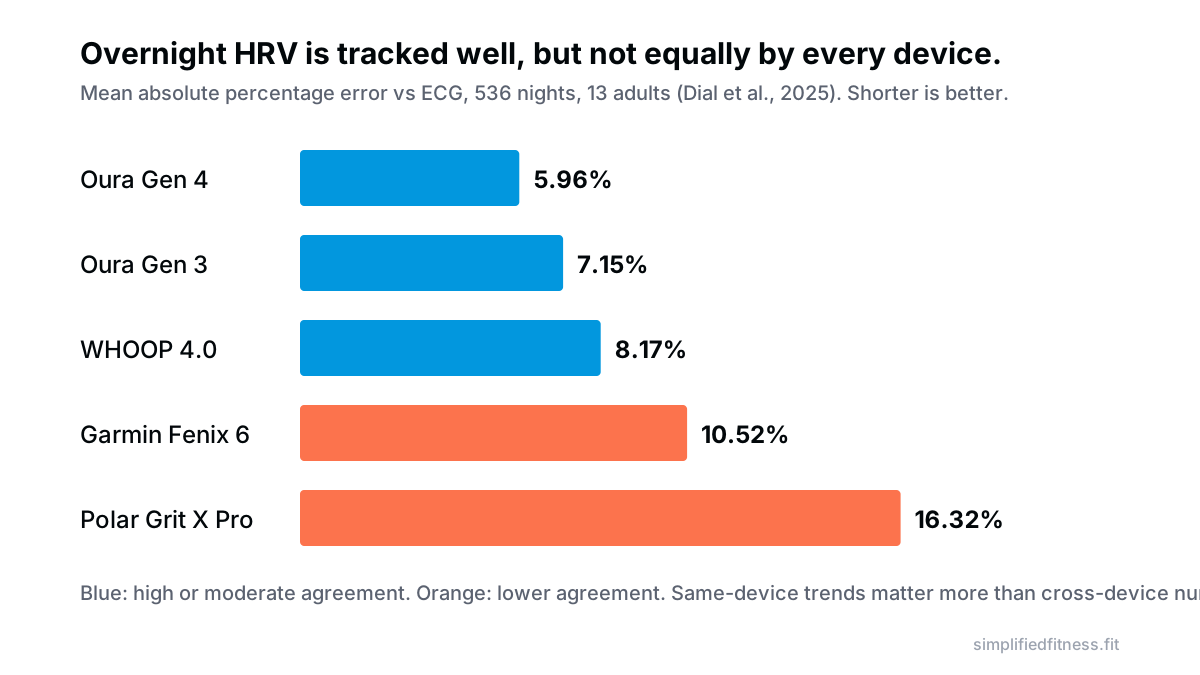
Two honest limits. Thirteen people is a small sample, and all were healthy. And that study did not include Apple Watch. The 2022 six-device study also compared HRV with ECG, Apple Watch included, but its abstract does not report how each device did. So if you wear an Apple Watch, use its HRV as a loose trend and not a number to chase.
One more issue is easy to miss. Accurate HRV does not automatically mean useful HRV. Measuring the number correctly is one question. Whether that number should change your training is another. For that, we need to look at what happens when people actually train by it.
Does HRV-guided training work for lifters?
The evidence is thinner than the apps imply.
A 2021 meta-analysis of HRV-guided endurance training (8 studies, 198 participants) found a medium-sized benefit for submaximal physiological measures (g = 0.30) but only small, non-significant effects on performance and VO2peak, with fewer non-responders to training in the HRV-guided groups (Duking et al., 2021). That is endurance work, not lifting.
For strength, I found one small trial. In 21 older women, scheduling recovery between resistance sessions by RMSSD (an HRV measure) did not improve muscle size, strength or function compared with a fixed schedule over 7 weeks. Both groups improved (Bittencourt et al., 2024). Small sample, older women, seven weeks: it tells us little about a 25-year-old lifter running push pull legs, but it does not give a reason to believe HRV scores will beat a sensible plan.
For the physiology of HRV, how it relates to training load and what it can and cannot tell you, see our deeper piece on HRV and recovery in concurrent training.
Whoop vs Oura vs Apple Watch for lifters: a quick comparison
This table summarises only what the studies above support. It is not a product ranking.
| Question | What the evidence shows | How much to trust it |
|---|---|---|
| Did I sleep, and for how long? | 86-89% sleep/wake agreement with PSG across six devices (Miller 2022) | Good, with tens of minutes of error per night |
| Deep and REM minutes? | 50-61% stage agreement across five wearables (Miller 2022) | Low. Rough band only |
| Overnight resting heart rate? | Oura closest to ECG, WHOOP moderate, Polar poor in one 13-person study (Dial 2025) | Good for the better devices |
| Overnight HRV? | Oura best, WHOOP moderate, Garmin and Polar lower (Dial 2025) | Moderate. Compare within one device |
| Recovery or readiness score? | No trial shows it improves lifting outcomes | Unproven. Use as a prompt only |
| Apple Watch overnight HRV? | Tested in Miller 2022, but device-level HRV results not in the abstract | Unclear. Loose trend only |
The decision for most lifters is simpler than the brand war suggests. A device that you actually wear every night, that is comfortable, and whose subscription you can afford long term beats a marginally more accurate one you take off after a month. In India, where a ring or strap plus subscription can cost a meaningful slice of a monthly gym and food budget, it is worth asking whether that money buys more recovery than an extra 100 g of paneer or dal a day would.
How should I use a recovery score for the gym?
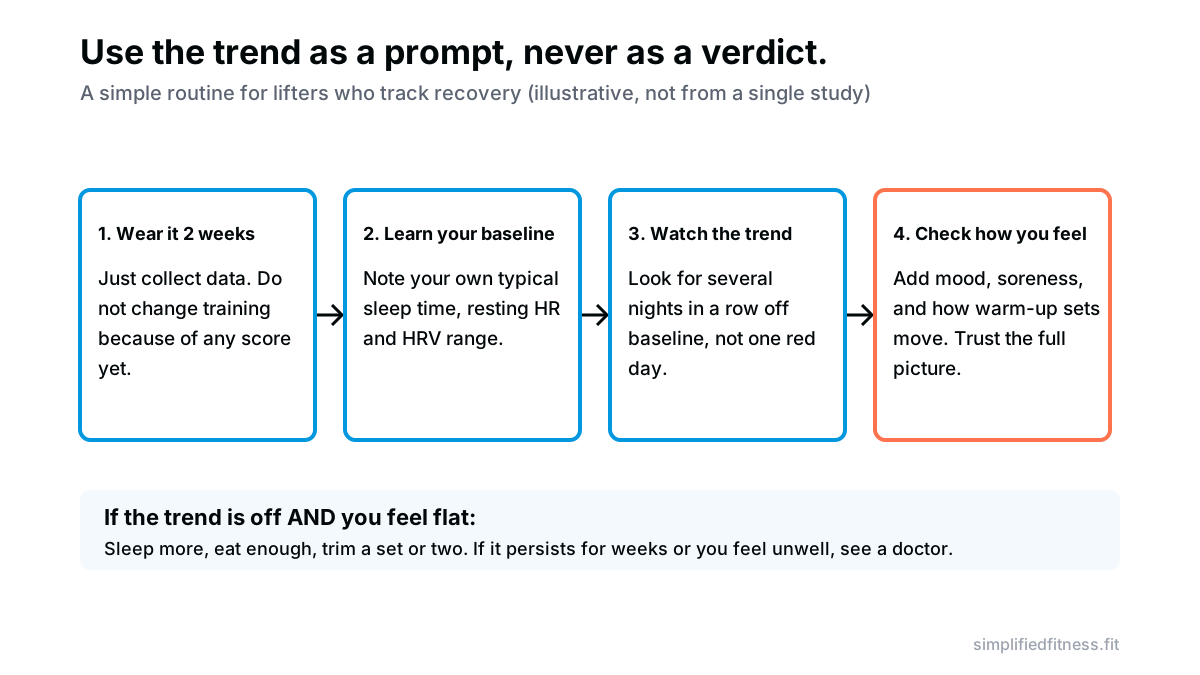
Use the 7-day trend against your own baseline. Ignore the single-day colour.
Here is what that looks like in practice. A common mistake with these devices is reacting to one night. A late dinner, two drinks, a hot room (this is a real factor in an Indian summer without AC), a hard leg session the day before or a mild cold can all push HRV down and resting heart rate up for a day or two. That is noise, not a verdict on your training.
A simple routine:
- Weeks 1-2: wear it, change nothing. You are learning your normal range.
- After that: glance at the weekly average of resting heart rate and HRV, not the daily value.
- If both drift the wrong way for several days: ask what changed. Sleep, stress, food, illness, a sudden jump in volume?
- Then cross-check with the gym. Are warm-up sets feeling heavier than usual? Is the bar speed down? Is your motivation flat?
- Only if the trend and the feel agree: trim a set or two, take an easier day, or sleep more. Do not cancel training because of a colour.
Quantifying effort in the gym helps too. Rating how hard each set felt (our RIR and RPE calculator explains the scale) gives you a recovery signal that costs nothing and responds to what your body is actually doing.
If persistent low readiness is the pattern, the problem may be more than a rough week. Our article on overtraining syndrome versus non-functional overreaching covers how to tell them apart.
What is orthosomnia, and can sleep tracking backfire?
Yes, it can.
In 2017, clinicians described patients who sought treatment for self-diagnosed sleep problems because their tracker showed light or restless sleep. Some chased “perfect” sleep numbers, and the tracker data felt more convincing to them than validated measures such as PSG or actigraphy. The authors named the pattern orthosomnia (Baron et al., 2017). That was a case report and clinical commentary, not a prevalence study, so it shows the problem exists, not how common it is.
The mechanism is easy to follow. You see a poor stage breakdown, you worry, you lie awake, the next night is worse, and the cycle feeds itself. Meanwhile the stage number was a rough estimate anyway.
Signs it is happening: you feel fine until you open the app, you go to bed anxious about your score, or you start skipping social plans to protect a number. If that sounds like you, turn off sleep stage displays, stop checking in the morning for a few weeks, or take the device off.
Sleep matters for lifting, but you do not need perfect sleep to progress. A systematic review of 17 studies (moderate or weak quality) found that consecutive nights of restricted sleep could reduce force output in multi-joint lifts, while a single night with no sleep had little effect on strength (Knowles et al., 2018). Consistency across weeks matters more than any single night, which is exactly why a trend view is the healthy one. For late-day habits that quietly wreck sleep, see the afternoon caffeine cutoff guide.
When to see a doctor
A wearable is a wellness gadget, not a diagnostic device. See a doctor if you have:
- constant fatigue or sleepiness despite 7-9 hours in bed
- loud snoring, gasping or witnessed pauses in breathing
- chest pain, fainting or palpitations
- an unusually high or irregular resting heart rate that does not settle
- low mood or anxiety that is affecting daily life
A normal score does not rule these out, and an alarming score does not confirm them. Your symptoms matter more than the app.
The bottom line
Wearable recovery trackers are decent sleep diaries and decent overnight heart rate monitors. They are not sleep labs, and their recovery scores have not been shown to improve lifting results. Trust duration, resting heart rate and slow multi-day trends. Be sceptical about deep and REM minutes and about any single daily colour.
If a tracker helps you notice that your sleep slipped and you fix it, it has paid for itself. If it makes you anxious, take it off and train by feel, food and a good plan. Start with our free push pull legs plan, and pair it with the sleep hygiene checklist for a free recovery upgrade.
Frequently Asked Questions
Are Oura, Whoop and Apple Watch accurate for sleep tracking?
They are fairly accurate for sleep timing and duration but much less accurate for sleep stages. In a lab study of 53 adults, all six tested devices agreed with polysomnography on sleep versus wake 86-89% of the time, but only 50-61% when also labelling specific stages. Use them to see your sleep pattern, not to judge how many minutes of deep sleep you got.
How accurate are sleep trackers at measuring REM and deep sleep?
Not very accurate for any individual night. A 2024 study of Oura, Fitbit and Apple Watch found sensitivity for sleep stages ranged from 50% to 86%, and the Apple Watch underestimated deep sleep by about 43 minutes on average. Treat stage numbers as rough estimates and focus on total sleep and consistency.
Is Oura or Whoop more accurate for HRV?
In one 2025 comparison against ECG over 536 nights, Oura devices showed the highest agreement for overnight HRV, with WHOOP 4.0 rated moderate. The study had only 13 healthy adults, so the ranking should be held loosely. What matters more is using one device consistently so your own trend is comparable.
Can I plan my workouts around my Whoop recovery score?
Use it as one input, not as the boss. Recovery scores combine HRV, resting heart rate and sleep into a single number, and the algorithm behind the colour is proprietary. I found no trial showing that following it improves strength training results. If the score is red but you feel fine and your warm-up sets move well, train as planned and keep an eye on the trend.
Does HRV on Apple Watch work for lifting?
Apple Watch has been validated for sleep versus wake in lab studies. A 2022 lab study did check its HRV against ECG, but the abstract does not report device-level HRV results, and Apple Watch was not in the larger 2025 overnight HRV comparison. Beyond that, research on HRV-guided strength training is thin. Treat any HRV reading as a rough readiness hint, not a lifting instruction.
Should I train less if my HRV is low?
Not automatically. One low reading can reflect alcohol, a late meal, heat, illness, travel or simple day-to-day noise. If your HRV is below your normal range for several days in a row and you also feel flat, trim a set or two or add a rest day, and see a doctor if you feel unwell.
What is orthosomnia?
Orthosomnia is anxiety or insomnia caused by an obsessive quest for perfect sleep numbers. Sleep clinicians described patients who sought treatment because their tracker showed light or restless sleep, even though the data felt more convincing to them than validated measures. If checking your score makes sleep worse, stop looking at it for a few weeks.
How many nights does a tracker need to learn my baseline?
There is no universal number, but at least two weeks of wearing it consistently gives you a reasonable picture of your own normal range. Your baseline is personal, so comparing yourself to other people's HRV or recovery numbers is not useful. Compare this week to your last few weeks instead.
Do sleep trackers overestimate or underestimate total sleep?
On average, wrist-worn devices differ from polysomnography. A 2025 meta-analysis of 24 studies and 798 participants found significant differences in total sleep time, sleep efficiency, sleep latency and time awake after sleep onset. Expect an error of tens of minutes on a given night and judge the weekly pattern instead.
Do I need a wearable to recover well from lifting?
No. Consistent sleep, enough food and protein, and a sensible volume plan do the heavy lifting for recovery, and none of them requires a gadget. A tracker is an optional feedback tool for people who find it useful, not a requirement for progress.
What is better than a wearable for judging recovery?
Simple, free signals often work as well. How you feel, how heavy your warm-up sets feel, your mood and motivation, and whether your performance is trending up over weeks tell you a lot. Our RIR and RPE calculator helps you judge effort, and you can log a quick 1-5 readiness rating before each session.
When should I see a doctor about my tracker data?
See a doctor if you have persistent fatigue, loud snoring with daytime sleepiness, chest pain, fainting, or an unusually high or irregular resting heart rate, whatever the app says. A wearable cannot diagnose a medical condition, and a clean score does not rule one out. Bring your concerns and, if helpful, your trend data to the appointment.
Can a tracker tell me how many hours of sleep I really need?
No. It can show how long you were probably asleep, but your need depends on how you function, not on a tracker target. If you wake rested and your training is going well, your sleep is probably adequate. If you are dragging, the fix is usually more consistent time in bed, not more data.
Sources & References
Every claim above is checked against peer-reviewed research (PubMed, U.S. National Library of Medicine) or guidance from established health bodies. How we fact-check.
- Miller DJ, et al. A validation of six wearable devices for estimating sleep, heart rate and heart rate variability in healthy adults. Sensors (Basel). 2022. PMID: 36016077
- Lee YJ, et al. Performance of consumer wrist-worn sleep tracking devices compared to polysomnography: a meta-analysis. J Clin Sleep Med. 2025. PMID: 39484805
- Dial MB, et al. Validation of nocturnal resting heart rate and heart rate variability in consumer wearables. Physiol Rep. 2025. PMID: 40834291
- Robbins R, et al. Accuracy of three commercial wearable devices for sleep tracking in healthy adults. Sensors (Basel). 2024. PMID: 39460013
- Baron KG, et al. Orthosomnia: are some patients taking the quantified self too far? J Clin Sleep Med. 2017. PMID: 27855740
- Duking P, et al. Monitoring and adapting endurance training on the basis of heart rate variability monitored by wearable technologies: a systematic review with meta-analysis. J Sci Med Sport. 2021. PMID: 34489178
- Bittencourt D, et al. Effects of individualized resistance training prescription with heart rate variability on muscle strength, muscle size and functional performance in older women. Front Physiol. 2024. PMID: 39742158
- Knowles OE, et al. Inadequate sleep and muscle strength: implications for resistance training. J Sci Med Sport. 2018. PMID: 29422383

Umair Hazrami · Founder & Head Coach, Simplified Fitness
Umair Hazrami founded Simplified Fitness and the Simplified Lifter channel to cut through fitness noise. With 4+ years of consistent training and 10+ coaching clients, he writes every guide from the peer-reviewed research and links the sources so you can check them. Our editorial standards.
Educational content only, not medical advice. If you have a medical condition, are pregnant, or take medication, talk to a qualified doctor before changing your diet, supplements or training. Full disclaimer.
Keep reading

Recovery
Active Recovery on Rest Days: Walking, Light Cycling and Mobility
Active recovery vs passive rest for lifters: what the research says about walking, light cycling and mobility, plus a 20-minute rest day routine you can copy.
7 min read
Recovery
Afternoon Caffeine Cutoff: Half-Life, Deep Sleep and Pre-Workout
Afternoon caffeine cutoff for lifters: how caffeine's half-life cuts sleep time and deep sleep even if you fall asleep fine, plus a practical cutoff by bedtime.
9 min read
Recovery
Blue Light, Melatonin and Screen Time: Do Blue-Blockers Actually Help You Sleep?
Blue light screen time melatonin suppression is real, but do blue-blocking glasses fix it? See what the trials found and the free fixes that matter more.
7 min read

Recovery
Is Your CNS Fried? CNS Fatigue vs Plain Lethargy in the Gym
Is my CNS fried from lifting? See what central fatigue really is, how fast it recovers and how to tell it from low motivation or poor sleep. Studies linked.
9 min read