Sleep Hygiene for Lifters: Bedroom Temperature, Darkness, Noise and a Wind-Down Routine
A sleep hygiene checklist for lifters: bedroom temperature, darkness, noise and a wind-down routine, with what the studies show and what they do not.
TL;DR. The short answer
- A sleep hygiene checklist for lifters comes down to four things: a cool bedroom, a dark room, low noise, and the same short wind-down every night. No single one is magic, and together they cost very little.
- Heat is the best-supported environmental culprit. In one lab study of adults over 65, a 30 C bedroom cost about 26 minutes of sleep versus 27 C, and another study found the warmest bedroom fifth had 3.4% lower sleep efficiency.
- No study here proves an exact 'ideal' temperature. Treat 18 C as a common suggestion, not a rule, and in an Indian summer aim for as cool as you can get plus a fan.
- Room light before bed can cut melatonin, and light in the bedroom has been linked to poorer sleep in older adults. Dimming evening lights and covering LEDs is cheap and low risk.
- Sleep hygiene tips alone are not a treatment for insomnia. If you have struggled for weeks, snore heavily or wake gasping, see a doctor.
Part of our complete guide: Sleep, Circadian Timing & Systemic Recovery: How Lifters Maximize Anabolic Rest & CNS Recovery
Table of contents
A good sleep hygiene checklist for lifters has four parts: a cool bedroom, a dark room, low noise, and the same short wind-down every night. None of these is a magic switch, but together they remove the most common things that keep you awake or wake you up.
You train hard, eat enough protein, and still toss around for an hour. Before you buy another supplement, fix the room. This article is the practical setup guide that sits under our wider piece on sleep, circadian timing and systemic recovery. I will tell you what the research supports, where it is thin, and what I would try first.
Why lifters should care about the bedroom at all
Sleep is where a lot of your recovery lives. A review of sleep in athletes concluded that sleep deprivation has clear negative effects on performance, including submaximal strength and endurance, and that improving sleep quality is simple and effective (Vitale et al., 2019).
The research on lifting specifically is more mixed than gym talk suggests. We cover it in our piece on sleep restriction and muscle loss. The short version: a systematic review found that a single night without sleep had little effect on strength, but consecutive nights of restricted sleep could reduce force in multi-joint lifts (Knowles et al., 2018). Study quality was moderate to weak, so treat it as a trend rather than a rule.
Here is the catch. Most of the bedroom studies below are observational, or small, or done in older adults. They show associations, not guarantees. So think of this checklist as low-cost experiments with a good rationale, not a prescription.
What is the optimal bedroom temperature for deep sleep?
Here is the honest answer: nobody has pinned down one perfect number. What the studies do agree on is direction. Hotter bedrooms tend to mean worse sleep.
Part of the reason is biology. To fall asleep, your core body temperature needs to drift down, and your hands and feet help by dumping heat. A warm room makes that job harder. That mechanism is the common explanation, and it is why a cooler room is the standard advice.
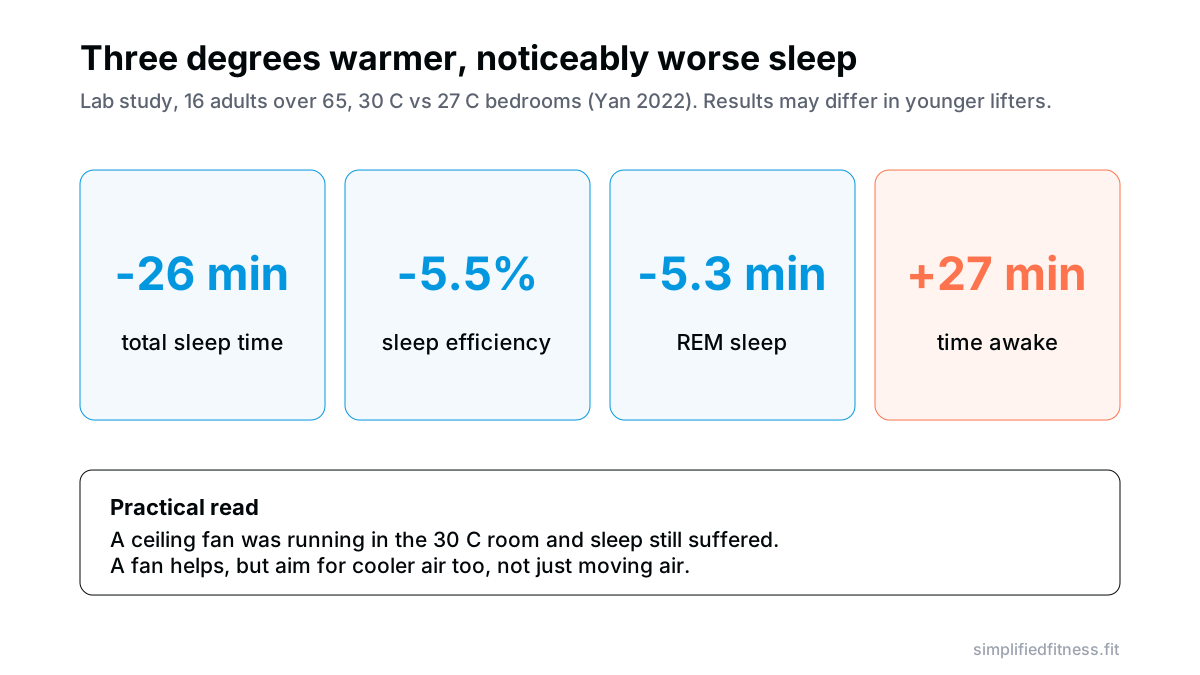
Now the numbers. In a lab study of 16 adults over 65, a 30 C bedroom led to 26.3 fewer minutes of total sleep, 5.5% lower sleep efficiency, 5.3 fewer minutes of REM sleep and 27.0 more minutes awake compared with 27 C (Yan et al., 2022). A ceiling fan was running in the 30 C room. That matters for a hot country.
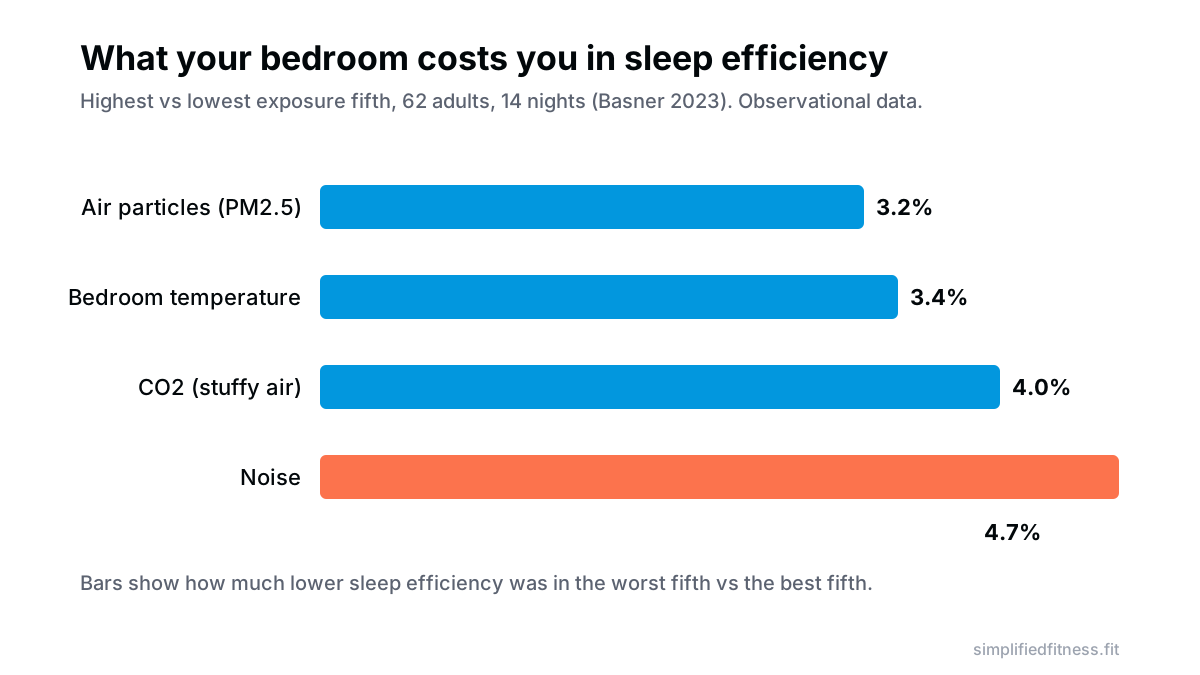
A second study tracked 62 adults at home for 14 nights. Sleep efficiency in the highest temperature fifth was 3.4% lower than in the lowest fifth (Basner et al., 2023). Average age was about 48, so closer to many of us, though still not a group of lifters.
What about 18 degrees Celsius?
You will see 18 C (65 F) quoted everywhere. I could not confirm that exact figure from the studies I read, so I will not sell it as proven. It is a reasonable target if you have air conditioning. If you do not, it is likely out of reach for much of the hot season in many parts of India.
So aim for relative gains instead. Close curtains by day to keep sun off the walls, open windows when it cools at night, and run a fan. Switch to a light cotton sheet. Sleep with the fan aimed to move air across you, not just in your face.
Does a warm shower really help?
It sounds backwards, but it can. A meta-analysis of 17 included studies (13 with comparable data) found that a warm shower or bath at 40-42.5 C improved self-rated sleep quality and sleep efficiency, and when taken 1-2 hours before bed for as little as 10 minutes, shortened the time to fall asleep (Haghayegh et al., 2019).
The proposed mechanism: warm water increases blood flow to your palms and soles, which helps your body shed heat afterward, so your core drops further. The authors say research is still limited, especially on best timing and duration. In an Indian summer you may prefer a lukewarm version. I would not call that proven, so treat it as a test.
Do blackout curtains and eye masks improve sleep quality?
Light is the second lever. Your brain uses light to decide when night starts, and melatonin is part of that signal.
In a study of 116 young adults living in a research centre, room light (under 200 lux) in the 8 hours before bed suppressed melatonin, delayed melatonin onset in 99.0% of people and shortened melatonin duration by about 90 minutes versus dim light (Gooley et al., 2011). That is ordinary room lighting, not a phone screen. (Screens are their own story, covered in our article on blue light and melatonin.)
What about light while you are actually in bed? In 857 older adults, those in the brightest bedroom light quartile had higher odds of subjective insomnia (adjusted OR 1.61) and poorer actigraphy-measured sleep (Obayashi et al., 2014). It was a cross-sectional design, so it cannot prove light caused the problem.
A practical darkness checklist
- Dim the main lights an hour or two before bed. Use a lamp.
- Cover or turn away standby LEDs on chargers, TVs and routers.
- Try blackout curtains if streetlights or early sun reach your bed.
- If curtains are not possible, an eye mask is a low-cost test.
- For toilet trips, use a dim night light, not the overhead tube.
I did not find a solid trial of blackout curtains or eye masks in healthy lifters, so this part rests on the light-and-melatonin mechanism, not on direct proof. Cheap and low risk, though.
Does bedroom noise matter if you do not wake up?
Possibly yes. In the same 14-night home study, sleep efficiency in the noisiest fifth was 4.7% lower than in the quietest fifth (Basner et al., 2023). The participants’ comfort ratings suggested they had got used to it, so you can feel fine and still sleep worse.
A larger update of the WHO noise review looked at traffic noise and self-reported sleep. When questions mentioned noise, each 10 dB rise in night noise was linked to higher odds of being highly sleep disturbed: OR 2.18 for aircraft, 2.52 for road and 2.97 for rail (Smith et al., 2022). When noise was not mentioned, the odds were lower and the evidence quality low to very low. That gap is a good reminder to read these numbers cautiously.
What to do about it:
- Close the window facing the road, if heat allows. Trade-offs are real in summer.
- Move your bed away from the noisy wall.
- Try earplugs if your partner or street cannot be changed.
- Steady white noise may mask sudden sounds, but I did not find evidence on it for lifters, so test it quietly.
- Silence phone notifications. Use do not disturb.
One more thing in the same dataset: carbon dioxide went with 4.0% lower sleep efficiency in the worst fifth. A tightly shut room with two people breathing in it gets stuffy. A cracked door or a bit of airflow helps. Clean air may matter too, since particles were linked to 3.2% lower efficiency.
What does a good wind-down routine look like?
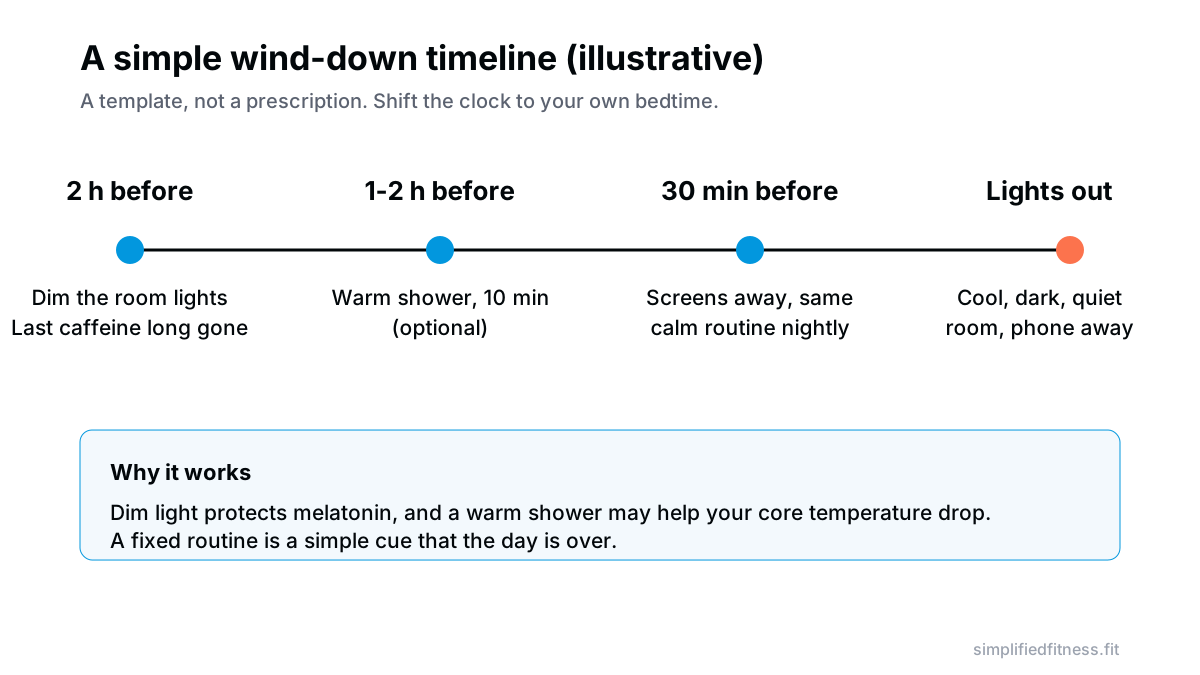
Humans love routines because they work as signals. The same few calm steps, done at the same time, tell your brain the day is ending. No study here tested a 30-minute window specifically, so take that as a practical starting point, not a proven dose.
Here is a template. Pick two or three, not all of them.
- Stop caffeine early. Our piece on the afternoon caffeine cutoff explains the timing.
- Dim the lights an hour or two out.
- Warm shower, about 10 minutes, 1-2 hours before bed (optional).
- Put the phone on charge across the room.
- Do something dull: stretch, read a paper book, write tomorrow’s lifts.
- Lights out at a similar time each night, weekends included where you can.
Hungry at night? Do not lie there hungry, but do not eat a huge meal either. We go through it in the article on pre-bed eating and sleep quality.
How to fall asleep fast after a late gym session
Late lifters have a special problem: you finish at 8 or 9 pm, your heart rate and body temperature are up, and the gym lights were bright. The routine above still applies, but you need a bridge between the barbell and the pillow.
- Cool down for 5-10 minutes with easy walking.
- Eat something sensible and drink water.
- Take a lukewarm or warm shower.
- Dim the lights as soon as you are home.
- Leave your phone for later.
If you can move sessions earlier, do it. If you cannot, protect the wind-down instead. We compare timing in our article on morning versus evening training.
Is sleep hygiene enough? Where the research is weak
Be wary of anyone who sells sleep hygiene as a cure. A 2025 meta-analysis of 42 randomized trials (4,245 adults) found sleep hygiene education improved Insomnia Severity Index scores by 3.4 points on average, but it was inferior to cognitive behavioral therapy for insomnia (CBT-I) (Ruan et al., 2025). Most of the trials (85.71%) had a high overall risk of bias.
So here is how I would read the two sides. Sleep hygiene helps a bit and is cheap, which is why it is a good first step. For ongoing insomnia, structured CBT-I looks stronger. Those two facts do not conflict.
When to see a doctor
Environmental tweaks will not fix every sleep problem. See a doctor if:
- poor sleep has lasted several weeks and affects your days,
- you snore loudly, stop breathing, or wake choking or gasping,
- you feel heavily sleepy during the day despite 7-9 hours in bed,
- you are using alcohol or sleeping tablets to get through the night.
Muscular, thick-necked lifters are not immune to sleep apnea. We explain the signs in sleep apnea in muscular lifters. A wearable can give you rough sleep trends, but our guide to wearable recovery trackers explains why you should not over-trust the numbers.
Putting it together this week
- Night 1-3: lower the temperature as far as you comfortably can and set up a fan.
- Night 4-6: cover LEDs, dim evening lights, add curtains or a mask.
- Night 7 onward: address noise and lock in a short wind-down.
- Log how long it takes to fall asleep, and how your main lifts feel.
If you want to see whether better sleep shows up in your training, our training volume calculator can help you track weekly sets. Compare your numbers over a month, not a day.
Good sleep will not replace good programming. It makes everything else you already do work a little better.
Frequently Asked Questions
What should be on a sleep hygiene checklist for lifters?
Keep the bedroom cool, dark and quiet, and use the same short wind-down routine at about the same time each night. These cover the main environmental factors that research links to poorer sleep. Start with the one that is worst in your room, usually heat or light, and fix it first.
What is the optimal bedroom temperature for deep sleep?
There is no single proven number, but studies consistently find hotter bedrooms are linked to worse sleep. Falling asleep involves your core temperature dropping, and a warm room makes that harder. Aim for the coolest temperature that feels comfortable, use a fan, and lighten your bedding.
Is 18 degrees Celsius the best temperature for sleep?
18 C is a commonly quoted figure, but the studies reviewed here compared warmer and cooler rooms rather than testing 18 C against everything else. In many Indian homes it is simply not reachable without an expensive air conditioner. Aim to be cooler than you are now, then judge by how quickly you fall asleep.
Do blackout curtains improve sleep quality?
Blackout curtains have not been tested head to head in a large trial that I could find, but bedroom light at night was linked to worse sleep in 857 older adults. Light also suppresses melatonin, the hormone that signals night. If streetlights or early sun wake you, blackout curtains or an eye mask are a cheap thing to try.
Does an eye mask help you sleep better?
Evidence for eye masks in healthy people is thin, so treat it as a low-cost experiment rather than a proven fix. The reasoning is sound, because less light reaching your eyes means less melatonin suppression. Try it for a week and keep it only if you fall asleep faster or wake less.
Does noise hurt sleep even if I do not wake up?
It can. In a 14-night study of 62 adults, the noisiest bedroom fifth had 4.7% lower sleep efficiency, even though people rated comfort similarly. Sound can still disturb sleep without fully waking you. Use earplugs, a closed door or steady white noise if you cannot lower the sound.
Does white noise help or hurt sleep?
The evidence I reviewed was about unwanted noise, not white noise, so I cannot say it helps. A steady, low sound may mask sudden noises like horns or neighbours, which is the likely mechanism. If you try it, keep it quiet, steady and away from your pillow.
How can I fall asleep fast after a late gym session?
Cool down, eat if you are hungry, take a warm shower and dim the lights. A meta-analysis found a 40-42.5 C shower or bath taken 1-2 hours before bed shortened the time to fall asleep, even at 10 minutes. If you train late often, see our morning versus evening training article for scheduling options.
Does a warm shower before bed help you sleep?
A meta-analysis of 17 studies (13 with data that could be pooled) found it can improve sleep quality and shorten sleep onset, but the authors note the research is limited. The warm water pulls blood to your hands and feet, which helps your core cool afterward. Take it 1-2 hours before bed rather than right at lights out.
How long should a wind-down routine be?
About 30 minutes is a practical starting point, though no study here tested that exact length. What matters more is repeating the same calm steps nightly so your brain links them with sleep. Pick two or three steps you will actually do, such as dim lights, stretch and read a paper book.
Is sleep hygiene enough to fix insomnia?
Not always. A 2025 meta-analysis of 42 trials found sleep hygiene education improved insomnia scores, but it did worse than cognitive behavioral therapy for insomnia (CBT-I). Most of those trials had a high risk of bias. If poor sleep lasts weeks and affects your days, ask your doctor about CBT-I.
Does bad sleep really hurt my lifting?
Yes, mostly in compound lifts and over several nights. A systematic review found consecutive nights of sleep restriction could reduce force output in multi-joint movements, though study quality was moderate to weak. Fix the environment first, then track your main lifts for a few weeks to see if they respond.
When should I see a doctor about my sleep?
See a doctor if you have trouble sleeping for more than a few weeks, loud snoring with gasping or choking, or heavy daytime sleepiness. These can signal conditions such as sleep apnea that a cooler room will not fix. Bring your sleep notes, caffeine habits and training schedule to the appointment.
Sources & References
Every claim above is checked against peer-reviewed research (PubMed, U.S. National Library of Medicine) or guidance from established health bodies. How we fact-check.
- Vitale KC, et al. Sleep Hygiene for Optimizing Recovery in Athletes: Review and Recommendations. Int J Sports Med. 2019. PMID: 31288293
- Basner M, et al. Associations of bedroom PM2.5, CO2, temperature, humidity, and noise with sleep: An observational actigraphy study. Sleep Health. 2023. PMID: 37076419
- Yan Y, et al. Experimental study of the negative effects of raised bedroom temperature and reduced ventilation on the sleep quality of elderly subjects. Indoor Air. 2022. PMID: 36437666
- Haghayegh S, et al. Before-bedtime passive body heating by warm shower or bath to improve sleep: A systematic review and meta-analysis. Sleep Med Rev. 2019. PMID: 31102877
- Gooley JJ, et al. Exposure to room light before bedtime suppresses melatonin onset and shortens melatonin duration in humans. J Clin Endocrinol Metab. 2011. PMID: 21193540
- Obayashi K, et al. Association between light exposure at night and insomnia in the general elderly population: the HEIJO-KYO cohort. Chronobiol Int. 2014. PMID: 25025617
- Smith MG, et al. Environmental Noise and Effects on Sleep: An Update to the WHO Systematic Review and Meta-Analysis. Environ Health Perspect. 2022. PMID: 35857401
- Knowles OE, et al. Inadequate sleep and muscle strength: implications for resistance training. J Sci Med Sport. 2018. PMID: 29422383
- Ruan JY, et al. Effects of sleep hygiene education for insomnia: A systematic review and meta-analysis. Sleep Med Rev. 2025. PMID: 40449065

Umair Hazrami · Founder & Head Coach, Simplified Fitness
Umair Hazrami founded Simplified Fitness and the Simplified Lifter channel to cut through fitness noise. With 4+ years of consistent training and 10+ coaching clients, he writes every guide from the peer-reviewed research and links the sources so you can check them. Our editorial standards.
Educational content only, not medical advice. If you have a medical condition, are pregnant, or take medication, talk to a qualified doctor before changing your diet, supplements or training. Full disclaimer.
Keep reading
Recovery
Active Recovery on Rest Days: Walking, Light Cycling and Mobility
Active recovery vs passive rest for lifters: what the research says about walking, light cycling and mobility, plus a 20-minute rest day routine you can copy.
7 min read
Recovery
Afternoon Caffeine Cutoff: Half-Life, Deep Sleep and Pre-Workout
Afternoon caffeine cutoff for lifters: how caffeine's half-life cuts sleep time and deep sleep even if you fall asleep fine, plus a practical cutoff by bedtime.
9 min read
Recovery
Blue Light, Melatonin and Screen Time: Do Blue-Blockers Actually Help You Sleep?
Blue light screen time melatonin suppression is real, but do blue-blocking glasses fix it? See what the trials found and the free fixes that matter more.
7 min read
Recovery
Is Your CNS Fried? CNS Fatigue vs Plain Lethargy in the Gym
Is my CNS fried from lifting? See what central fatigue really is, how fast it recovers and how to tell it from low motivation or poor sleep. Studies linked.
9 min read