Resetting Sleep Rhythms After Travel and Jet Lag: Light, Meals, and Melatonin
How to beat jet lag fast athletes can use: a time-zone protocol built on light, meals, movement and low-dose melatonin, with the evidence and its limits.

TL;DR. The short answer
- There is no instant fix. Your body clock adapts at roughly 1.5 hours a day after westward travel and 1 hour a day after eastward travel, so a 6-hour shift takes about 4-6 days to fully settle.
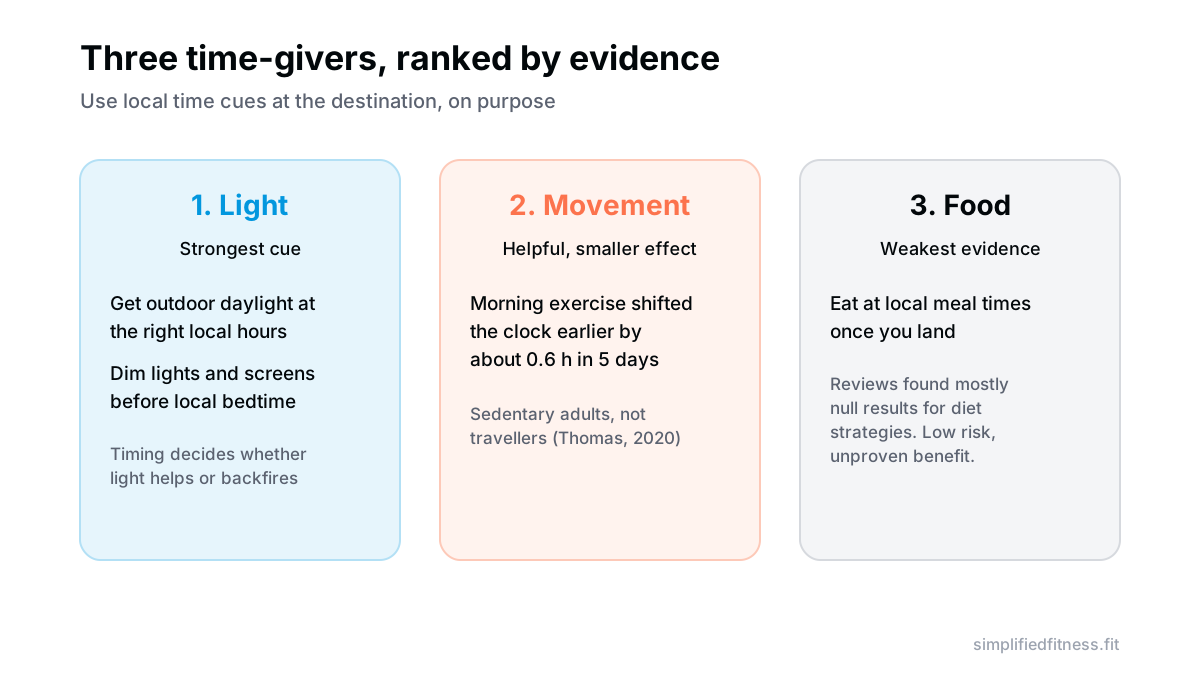
- Light is the strongest time cue. Getting daylight at the right local hours, and dimming lights before local bedtime, does most of the work.
- Melatonin taken near the new local bedtime reduced jet lag in 9 of 10 trials in a Cochrane review, with 0.5-5 mg working similarly. Take it at the wrong time and it can slow adaptation.
- Evidence for fasting and meal timing as jet lag fixes is weak, and a systematic review of non-drug strategies found mostly null results. Eating at local meal times once you land is low risk, not proven.
- Ease back into heavy lifting over the first few days. Cut volume, keep reps in reserve, and save your top sets for when sleep is normal.
Part of our complete guide: Sleep, Circadian Timing & Systemic Recovery: How Lifters Maximize Anabolic Rest & CNS Recovery
Table of contents
If you are asking how to beat jet lag fast as an athlete, the honest answer is that you can shorten it but not skip it. Your body clock shifts roughly 1-1.5 hours a day, so the job is to feed it strong local time cues (light, meals, movement and sleep) and, if you want, add a well-timed low dose of melatonin. This sits inside our wider guide to sleep, circadian timing and recovery.
Think of a lifter landing six time zones away with a squat session booked for day two. The goal is not a perfect reset by Tuesday. It is to feel human by Wednesday and lift well by the weekend.
Why jet lag hits lifting so hard
Jet lag is your internal clock being out of step with the day and night at your destination. Your core temperature, hormones, alertness and gut all follow that internal schedule, so for a few days you are sleepy at noon and wide awake at 3am.
Two things drive the pain. One is circadian misalignment. The other is plain travel fatigue: cramped seats, dry cabin air, skipped meals and bad sleep. A consensus statement from 26 sleep and sports researchers notes both, and also admits that the evidence for managing them in athletes is limited, so recommendations are consensus-based rather than firmly proven (Janse van Rensburg et al., 2021).
Does it actually show up in performance? In an analysis of Major League Baseball games, jet lag effects were mostly seen after eastward travel, with very limited effects after westward travel (Song et al., 2017). In 11,481 NBA games, eastward jet lag was associated with worse home-team results, including a points differential lower by about 1.3 points (Leota et al., 2022). These are observational data from team sports, so they show an association, not what happens to your deadlift. But the direction matters for planning.
How long does jet lag last?
A rough rule from the CDC Yellow Book chapter on jet lag: people adapt at an average of about 1.5 hours per day after westward travel and 1 hour per day after eastward travel (Riedy and Williams, 2025). The reason is that the human body clock runs slightly longer than 24 hours, so delaying is easier than advancing.
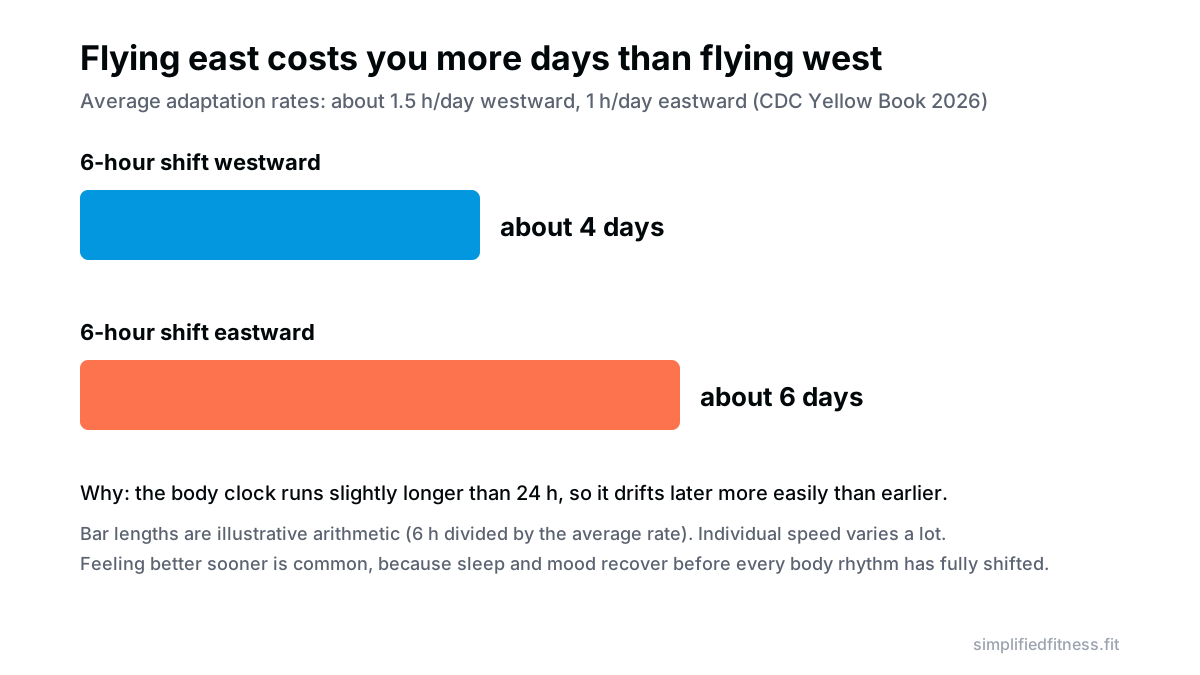
Run the arithmetic for six time zones: roughly 4 days west, roughly 6 days east. That is a back-of-envelope estimate, and people vary a lot. Many feel functional before every rhythm has fully shifted.
What are the three time-givers for resetting your circadian rhythm after travel?
Researchers call them zeitgebers, or time-givers: cues the clock uses to set itself. For travel, the useful ones are light, movement and food. They are not equally strong, and the evidence is not equally good.
Light: the strongest cue
In a lab study of 36 people, one hour of bright white light (about 8000 lux) shifted circadian timing earlier or later depending on when it was given, with about 2.2 hours between the largest delay and the largest advance, while dim background light (under 3 lux) produced no discernible shift (St Hilaire et al., 2012). The effect depended on when in the circadian cycle the light was given. That is the catch for travellers: light at the wrong time can push your clock the wrong way.
Practically, the commonly taught approach is to seek daylight in your new local morning when flying east (you need to move earlier), and local late afternoon or early evening when flying west (you need to move later), and to dim lights and screens in the hours before local bedtime. For very large shifts (8 or more time zones) the “right” window can land at awkward hours, and getting it backwards is a real risk. A sleep clinician or the consensus travel toolbox can help you map it for your exact route (Janse van Rensburg et al., 2021).
Outdoor daylight is far brighter than most indoor lighting, which is why a 20-30 minute walk is more useful than sitting by a hotel window. In India or the Gulf, this is easy to do early in the day; at midday in summer, wear a cap and carry water.
Movement: helpful, but a smaller lever
In a trial of 52 young, sedentary adults, five days of morning exercise advanced the body clock by about 0.62 hours, while evening exercise did not shift it on average (Thomas et al., 2020). Early chronotypes actually shifted later with evening exercise. These were not travellers, so treat it as a hint rather than a jet lag protocol: morning outdoor training at your destination combines light and movement, and it is unlikely to hurt.
Food: low risk, unproven
“Fast on the flight, eat on local time” is popular online. The evidence is thinner than the confidence. A systematic review of 13 non-drug jet lag studies (light, activity, diet and others) found that 9 reported no significant change, 3 mixed findings and 1 positive. The authors suggest this partly reflects poorly designed circadian interventions (Bin et al., 2019). So the null result does not prove diet is useless; it shows we lack good proof either way.
A sensible middle ground: eat at local meal times once you land, front-load a protein-rich breakfast (eggs, paneer bhurji, curd with dal chilla) in the new morning, and skip heavy meals right before local bedtime. If you want food strategies for the journey itself, see our guide to travel nutrition on flights and road trips.
Does melatonin work for jet lag, and what dose?
Melatonin has the best direct trial evidence of the tools here. A Cochrane review of 10 randomized trials found that 9 reported melatonin, taken close to target bedtime at the destination (10pm to midnight), reduced jet lag after flights crossing five or more time zones (Herxheimer et al., 2002). Key details from that abstract:
- Dose: 0.5-5 mg daily worked similarly, though 5 mg helped people fall asleep faster and sleep better than 0.5 mg. Doses above 5 mg did not appear more effective.
- Formulation: 2 mg slow-release looked relatively ineffective, suggesting a short-lived higher peak works better.
- Direction: benefit was likely greater the more time zones were crossed, and smaller for westward flights.
- Timing: taken early in the day, it can cause sleepiness and delay adaptation to local time.
- Safety: occasional short-term use appeared safe, with a low incidence of other side effects. Case reports suggested people with epilepsy or on warfarin may come to harm.
These trials are older, product quality varies, and the review itself called for better study of melatonin’s pharmacology and quality control. For the wider picture on dosing outside of travel, see our low-dose melatonin guide.
If you take warfarin or other medication, have epilepsy, are pregnant, or have any medical condition, check with your doctor or pharmacist before using melatonin.
A simple jet lag protocol for lifters
Here is how I would put it together for a six-hour shift. This is a practical synthesis of the sources above, not a tested protocol.
- Before you fly. If you can, shift bedtime and morning light an hour or so toward the destination for 2-3 days. Pack an eye mask, earplugs and a cap.
- On the plane. Set your watch to destination time at boarding. Sleep only if it fits destination night. Drink water and skip alcohol, which tends to disrupt sleep.
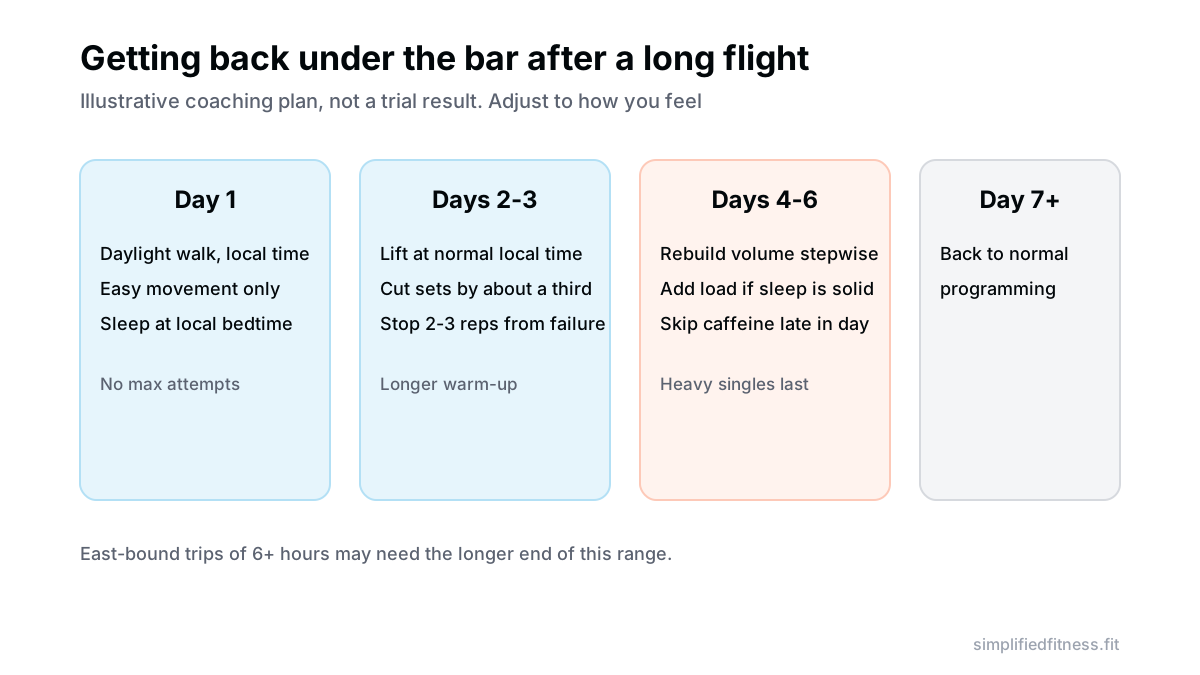
- Day 1. Get daylight at the right local hours. Eat at local meal times. Do a light walk or mobility session, not a hard workout. Dim lights early in the evening and take melatonin at local bedtime if you have decided to use it.
- Days 2-3. Lift at your normal local training hour, but with fewer sets and reps in reserve.
- Days 4-6. Rebuild volume stepwise. Save heavy singles and testing for when you are sleeping normally.
Caffeine, naps and the hotel gym
Caffeine can bridge the afternoon slump, but late-day doses will wreck your first local night. Use it early in the local day and cut it off about 9 hours before bed (see the caffeine cutoff guide). If you nap, keep it short and early so it does not steal sleep pressure from the night.
For a hotel setup, our guide to hotel gym workouts for maintaining muscle covers what to do with limited equipment, and our sleep hygiene checklist covers the room: dark, cool and quiet.
For trips of only a couple of days, staying on home sleep hours can be the smarter option, since adaptation would be limited anyway. The American Academy of Sleep Medicine guidance for frequent travellers lists maintaining home-base hours during short trips as one of its strategies (Riedy and Williams, 2025).
When to see a doctor
Jet lag is temporary. If sleep problems, extreme fatigue, low mood or digestive symptoms last well beyond a couple of weeks after you are home, or if you travel across time zones very often and feel persistently run down, see a doctor or sleep specialist. They can also advise on prescription options, which are outside what we cover here.
The bottom line
Jet lag is a timing problem, and you solve timing problems with timing. Use light first, local sleep and meals second, melatonin as an optional tool at the right local time, and treat the first few days of training as a ramp, not a test. Expect about 4 days west and 6 days east for a 6-hour shift, and be wary of anyone promising a 24-hour reset.
Frequently Asked Questions
How do I beat jet lag fast as an athlete?
You cannot erase it overnight, but you can shorten it. Your body clock moves about 1-1.5 hours a day, so the goal is to give it strong local time cues, mainly daylight at the right hours, regular local meal times and sleep at local night. Start shifting your sleep a day or two before you fly if your schedule allows it.
How long does jet lag last after crossing 6 time zones?
A rough estimate is 4 days flying west and 6 days flying east, based on average adaptation rates of 1.5 and 1 hours per day. Individual speed varies a lot, and symptoms often ease before every body rhythm has caught up. Plan lighter training for the first few days rather than expecting a clean reset.
Why is flying east harder than flying west?
The human body clock runs slightly longer than 24 hours, so it finds it easier to delay (go to bed later) than to advance (go to bed earlier). Flying east forces an advance. Expect to need more recovery days and use light and sleep timing more carefully.
How much melatonin should I take for jet lag?
A Cochrane review found daily doses between 0.5 and 5 mg were similarly effective, with 5 mg helping people fall asleep faster and sleep better than 0.5 mg. Doses above 5 mg were not more effective. Start at the low end, take it near local bedtime, and check with a doctor if you are on warfarin or have epilepsy.
When should I take melatonin for jet lag?
The Cochrane review found melatonin worked best when taken close to the target bedtime at the destination, roughly 10pm to midnight local time. Taken early in the day, it can cause sleepiness and delay adaptation. Set a phone alarm for local bedtime so you do not guess.
Does morning sunlight really reset your body clock?
Light is the main time cue for the human clock, and its effect depends on when you get it. In one lab study, one hour of bright light (about 8000 lux) moved the clock earlier or later depending on when it was given, with about 2.2 hours between the biggest delay and the biggest advance, while dim light had no clear effect. After a long trip, the timing is trickier, so match light to the direction you need to shift.
Should I fast on the flight to reduce jet lag?
There is little solid evidence that fasting fixes jet lag in athletes. The reviews that looked at diet strategies found mostly no clear effect. Eating around local meal times at your destination and staying hydrated is a reasonable, low-risk habit, but do not expect it to replace light and sleep timing.
Can exercise help reset my body clock?
It might help a little. In a trial of 52 young sedentary adults, five days of morning exercise moved the body clock earlier by about 0.6 hours, while evening exercise did not. Outdoor morning training at your destination is a sensible way to combine light and movement.
Should I train hard right after landing?
It is usually smarter not to. Sleep loss and circadian misalignment can blunt performance, and elite sport data show eastward jet lag is linked to worse results. Do easy movement on day one, then rebuild intensity as your sleep settles.
Is jet lag worse for heavy lifters and athletes?
Athletes are affected by the same biology as everyone else, but performance dips are easier to notice. In major league baseball and basketball data, eastward travel was associated with worse home-team results. Plan for a few lighter days instead of assuming you will be exempt.
Do I need to adjust my sleep before I travel?
It can help for trips of several time zones if your schedule allows. Shifting bedtime and light exposure in the direction of travel by an hour or so a day gives the clock a head start. If you cannot, focus on strong local cues from the first morning you land.
Is melatonin safe to take for jet lag?
The Cochrane review concluded occasional short-term use appears safe in adults, with a low rate of other side effects. Case reports suggested people with epilepsy or those taking warfarin may come to harm. If you take medication or have a medical condition, ask your doctor or pharmacist first.
Should I stay on home time for a short trip?
For very short trips, keeping your home sleep hours can be a sensible option because adaptation would be limited anyway. It is one of the strategies the American Academy of Sleep Medicine guidance lists for short stays. Use blackout curtains and plan meetings and training around your home body clock.
Sources & References
Every claim above is checked against peer-reviewed research (PubMed, U.S. National Library of Medicine) or guidance from established health bodies. How we fact-check.
- Herxheimer A, et al. Melatonin for the prevention and treatment of jet lag. Cochrane Database Syst Rev. 2002. PMID: 12076414
- Janse van Rensburg DC, et al. Managing travel fatigue and jet lag in athletes: a review and consensus statement. Sports Med. 2021. PMID: 34263388
- Janse van Rensburg DCC, et al. How to manage travel fatigue and jet lag in athletes? A systematic review of interventions. Br J Sports Med. 2020. PMID: 32303523
- Bin YS, et al. What works for jetlag? A systematic review of non-pharmacological interventions. Sleep Med Rev. 2019. PMID: 30529430
- Halsey ES, et al., editors. CDC Yellow Book 2026: Health Information for International Travel. Chapter: Jet Lag Disorder (Riedy SM, Williams SG). 2025. PMID: 41818499
- St Hilaire MA, et al. Human phase response curve to a 1 h pulse of bright white light. J Physiol. 2012. PMID: 22547633
- Thomas JM, et al. Circadian rhythm phase shifts caused by timed exercise vary with chronotype. JCI Insight. 2020. PMID: 31895695
- Song A, et al. How jet lag impairs Major League Baseball performance. Proc Natl Acad Sci U S A. 2017. PMID: 28115724
- Leota J, et al. Eastward jet lag is associated with impaired performance and game outcome in the National Basketball Association. Front Physiol. 2022. PMID: 35784873

Umair Hazrami · Founder & Head Coach, Simplified Fitness
Umair Hazrami founded Simplified Fitness and the Simplified Lifter channel to cut through fitness noise. With 4+ years of consistent training and 10+ coaching clients, he writes every guide from the peer-reviewed research and links the sources so you can check them. Our editorial standards.
Educational content only, not medical advice. If you have a medical condition, are pregnant, or take medication, talk to a qualified doctor before changing your diet, supplements or training. Full disclaimer.
Keep reading

Recovery
Active Recovery on Rest Days: Walking, Light Cycling and Mobility
Active recovery vs passive rest for lifters: what the research says about walking, light cycling and mobility, plus a 20-minute rest day routine you can copy.
7 min read
Recovery
Afternoon Caffeine Cutoff: Half-Life, Deep Sleep and Pre-Workout
Afternoon caffeine cutoff for lifters: how caffeine's half-life cuts sleep time and deep sleep even if you fall asleep fine, plus a practical cutoff by bedtime.
9 min read
Recovery
Blue Light, Melatonin and Screen Time: Do Blue-Blockers Actually Help You Sleep?
Blue light screen time melatonin suppression is real, but do blue-blocking glasses fix it? See what the trials found and the free fixes that matter more.
7 min read

Recovery
Is Your CNS Fried? CNS Fatigue vs Plain Lethargy in the Gym
Is my CNS fried from lifting? See what central fatigue really is, how fast it recovers and how to tell it from low motivation or poor sleep. Studies linked.
9 min read