Shift Workers Lifting Guide: Sleep, Meals and Workouts on Rotating Schedules
Shift workers lifting guide for nurses and night-shift staff: how to time sleep, meals and workouts on rotating shifts, with the research behind each tip.

TL;DR. The short answer
- You can build muscle on rotating shifts. Show up for 2-4 hard sessions a week, protect one anchor sleep block, and accept that bar speed and effort will dip on short-sleep days.
- Lifting before the shift, after your main sleep, is the safest slot. Training right after a night shift, when you are at your sleepiest and about to sleep, is the weakest.
- Light is the lever you control. In a small study of 12 night nurses, bright light in the middle of the night shift plus dark glasses on the way home gave the best alertness and daytime sleep.
- In lab trials, eating a full meal at night worsened glucose tolerance compared with fasting at night. Put the big meals before and after the shift, and keep the 2-4 a.m. food light.
- See a doctor if sleepiness is dangerous (drowsy driving), if you cannot sleep at all after nights, or if your blood sugar, mood or heart health worry you.
Part of our complete guide: Sleep, Circadian Timing & Systemic Recovery: How Lifters Maximize Anabolic Rest & CNS Recovery
Table of contents
Yes, you can build muscle on rotating shifts, but you have to stop planning your week like a 9-to-5 lifter. Fix one anchor sleep block, train after waking and before work, eat your big meals either side of the night, and scale effort to how you slept. That is the whole shift workers lifting guide in one breath, and it sits inside our wider guide to sleep, circadian timing and recovery.
This page covers the practical side for nurses, security staff, factory and call-centre workers and anyone whose roster flips. For how to lay out the gym week itself, see structuring workout splits around shift work and high-stress careers.
Why shift work makes lifting harder
Your body clock expects light and food in the day and sleep at night. Night work flips the demand, and the clock does not flip with it.
A study of 52 intensive care workers tracked sleep with wrist actigraphy and urinary melatonin. Sleep was most restricted between consecutive night shifts (about 5.7 hours) and consecutive day shifts (about 5.8 hours), with the worst stretch, about 5.2 hours, between an evening and an early day shift. Alertness and reaction time were most impaired on night shifts because their body clocks had not adapted (Ganesan et al., 2019).
That matters in the gym. Not because muscle stops growing, but because short sleep hits the lifting itself.
Does lack of sleep hurt muscle growth and strength?
It hurts some things more than others, and the research is mixed.
A systematic review of 17 studies (quality rated moderate or weak) found that one night of total sleep deprivation had little effect on muscle strength, while consecutive nights of sleep restriction could reduce force output in multi-joint lifts, though not single-joint ones. Hormone results were conflicting (Knowles et al., 2018).
A later crossover trial gave 10 resistance-trained women nine nights at 5 hours in bed versus 7 hours or more. Total volume load fell by less than 1%, but bar speed on lower-body compound lifts was up to 15% slower, velocity loss within back squat sets was up to 7% greater, and session perceived effort rose 11% (Knowles et al., 2022). Salivary cortisol and training distress also went up.
What does that mean for you? Tired lifters can often still hit the numbers, but it feels harder and the bar moves slower. Both studies are small and lab based, and neither followed muscle size over months, so nobody can say how much growth you lose. The honest read: poor sleep makes training worse before it makes it impossible, so protect sleep first and expect some bad days.
How to sleep on a rotating shift schedule
You will not get perfect sleep. You can get a protected block.
- Anchor sleep. Choose one block of 6-7 hours you defend on every pattern, and add a shorter nap on a night shift.
- Dark room. Blackout curtains, a sleep mask, a fan or AC for the heat, earplugs. Our sleep hygiene checklist covers the bedroom setup. In an Indian summer, daytime heat can wreck sleep, so cooling matters.
- Tell the house. Phone on do not disturb, family told that this is “night”, not “available”.
- Do not stack early starts. The ICU data showed an early day shift right after an evening shift was as restrictive as night work, so avoid that sequence when you have a say in the roster.
Light: blocking it in the morning, using it at night
Light is the main signal your clock listens to. You can use it deliberately.
In one study, 12 night-shift nurses went through three conditions for four days each. A 4-hour bright-light exposure of 4,000-6,000 lux at work from 01:00 to 05:00 improved alertness and daytime sleep, and adding light attenuation in the morning (sunglasses on the way home) improved both more (Yoon et al., 2002).
A separate lab study of 19 healthy people simulating permanent night work combined four 15-minute bright light pulses per shift, dark sunglasses outside, scheduled dark-bedroom sleep and afternoon light. Their body clocks shifted to a “compromise” position, and those who shifted closer to target performed better on nights and slept enough after them (Smith et al., 2009).
Both are small, short and partly lab-based, so treat them as a promising toolkit and not a guarantee. A reasonable version for real life:
- Get bright light at work during the night, especially the middle hours of the shift.
- Wear dark sunglasses (or blue-light blocking glasses) on the commute home.
- Dim the lights and screens before bed, as covered in our piece on blue light and melatonin.
- On days off, decide whether to flip back or stay on nights, because half-and-half confuses the clock.
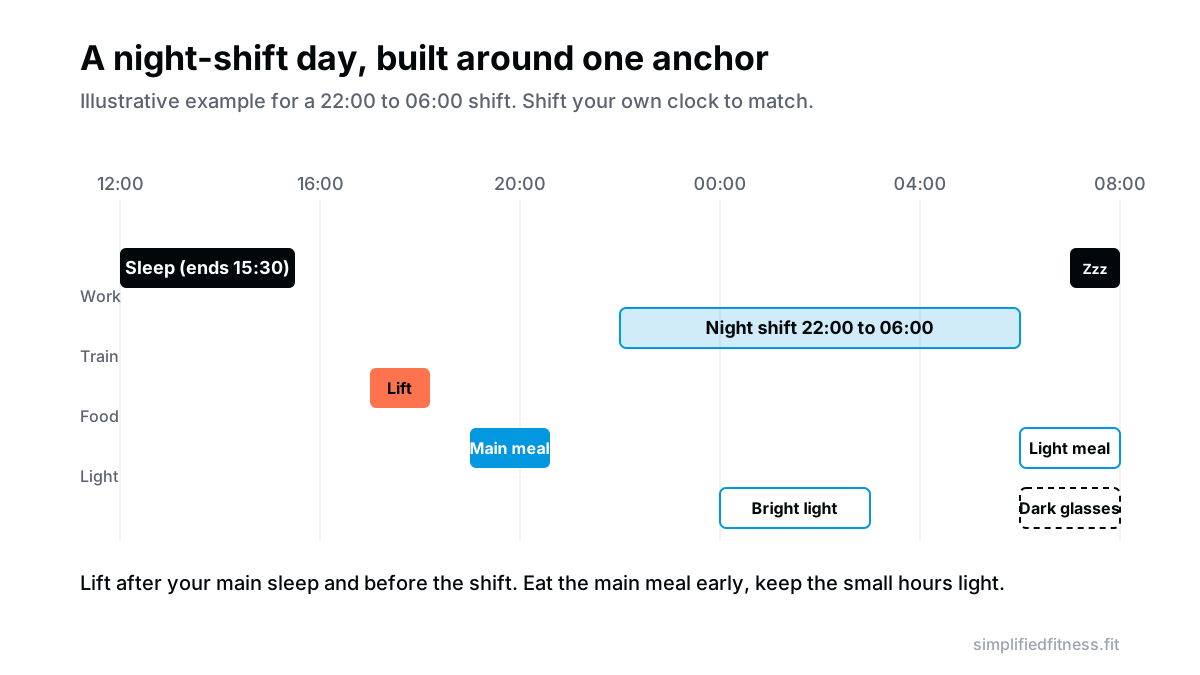
When should shift workers eat and train?
Meal timing on night shifts
If you only change one thing about food, change when the largest meals land.
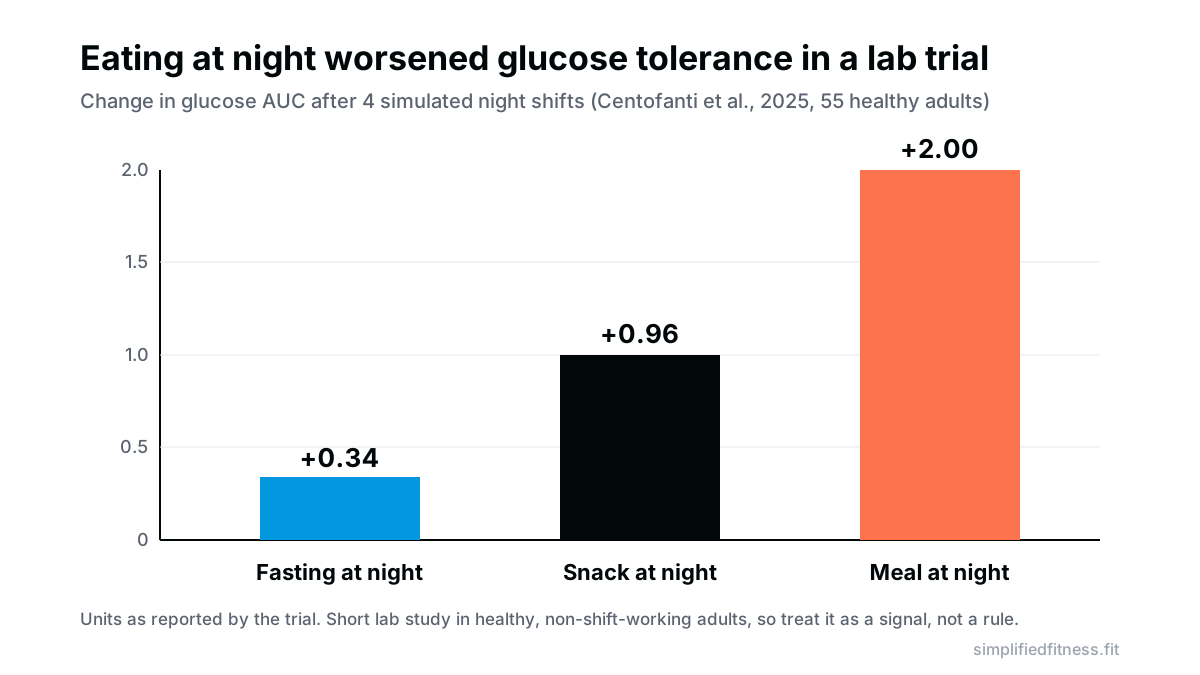
In a lab trial, 55 healthy adults did four simulated night shifts and were assigned to fasting, a snack, or a full meal at night. Night work impaired insulin sensitivity in all groups, but glucose tolerance was clearly worse with a meal at night (+2.00) or a snack (+0.96) than with fasting at night (+0.34). The authors concluded meal timing has a clear effect on glucose metabolism during simulated night work (Centofanti et al., 2025).
Real night workers are not lab volunteers. In a 4-week pilot crossover trial of 19 night-shift workers with abdominal obesity, an overnight fast from 01:00 to 06:00 (with energy redistributed across the day) did not change postprandial triglyceride or glucose response. Adherence was 95%, and body weight was about 0.9 kg lower, an exploratory finding (Leung et al., 2021).
So: one controlled lab trial points to a clear effect, one small field pilot found no change in the primary markers. The cautious takeaway is to move the heavy eating away from 1-5 a.m. when you can, without starving yourself.
A workable Indian-kitchen pattern for a 22:00 to 06:00 shift:
- 18:30-19:30, main meal: dal, rice or roti, paneer or chicken, a big sabzi. This is your fuel for the lift and the night.
- Before 01:00, if hungry: a small portion, such as curd with a handful of roasted chana or an egg.
- After 06:00, on the way to bed: something light, such as curd and fruit, or a glass of milk with a banana. Heavy parathas and fried food right before sleep can hurt sleep for some people, see our note on eating before bed.
- Protein: keep the daily total on target on every pattern. Work out your number with the protein calculator.
Total calories are not the main culprit, either. A meta-analysis of 12 studies (4,726 shift workers vs 10,367 day workers) found no difference in reported energy intake (Bonham et al., 2016), which is why timing gets the blame.
Workout timing around a shift
The cleanest slot is after your main sleep and before leaving for work.
Three reasons. You have slept, so you are at your best. You can eat before and after. And the 2018 review suggested training before prolonged wakefulness as one strategy for people facing inadequate sleep (Knowles et al., 2018). That review did not test night shift specifically, so I am applying it by analogy.
What about lifting right after the night shift? Try to avoid it. You are at your lowest alertness, your reaction time is worse, and a hard session just before bed can make it harder to fall asleep. If that slot is the only one, do a shorter session at moderate effort and watch how your sleep changes.
Coffee helps a bit, within limits. The same review lists caffeine as a way to support training on short sleep, and a small pilot of 6 adults found 200 mg of caffeine just before a 30-minute 03:30 nap improved attention afterward (Centofanti et al., 2020). Keep caffeine in the first half of the shift. Our caffeine cutoff guide explains why.
How to adjust lifting volume to your sleep
Do not follow a fixed program. Follow a rule.
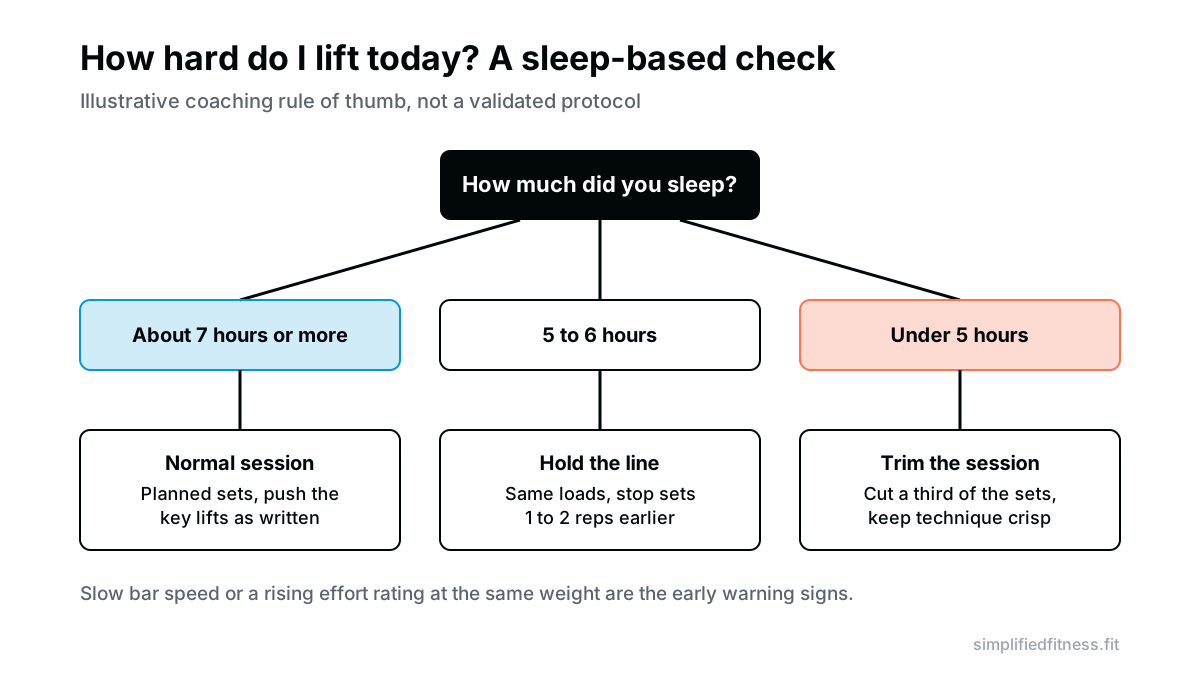
The Knowles trial suggests that bar speed and perceived effort are the early warning signs. So:
- Slept 7 hours or more: train as written.
- 5-6 hours: keep your loads, stop each set with 1-2 reps still in the tank. It is a coaching rule of thumb, not a tested protocol.
- Under 5 hours: drop roughly a third of the sets, keep technique tidy, and leave the heavy single for another day. Same caveat: a rule of thumb, not a tested protocol.
Weekly volume still matters, so make up the missing sets on a better day. Use the RIR and RPE calculator if you are unsure how hard a set really was.
A split that survives rotating shifts is boring: two or three full-body sessions, or upper-lower, floating wherever your rested windows land. Start from the free training plans and slide the days around.
When to see a doctor
Shift work is linked with sleep problems and metabolic risk, and a handful of symptoms deserve a professional.
See a doctor if you:
- nod off while driving or at work
- cannot sleep even when you have the chance (possible shift work disorder)
- snore loudly with gasping or morning headaches (possible sleep apnoea)
- have high blood sugar, blood pressure or a family history of diabetes
- feel persistently low, anxious or exhausted
Nothing here is a diagnosis, and any of these deserve a proper assessment. If you are on medication such as insulin, do not change meal timing without talking to your doctor first.
The bottom line
Rotating shifts make lifting harder, not impossible. Anchor one sleep block, lift between waking and work, put the big meals before and after the night, and let the quality of your sleep decide the quality of the session.
The research here is genuinely limited: mostly small trials, simulated shifts and healthy volunteers. So treat each tip as a sensible experiment, track how your sleep and lifting respond over two or three weeks, and keep what works.
Frequently Asked Questions
Can you build muscle working night shifts?
Yes. Nothing in the research reviewed here suggests night work by itself stops muscle growth when training, protein and sleep are reasonable, though no study has tracked muscle gain in shift workers directly. The real cost is practical: short, broken sleep lowers bar speed and raises effort, so you have to manage the schedule. Pick fixed training slots after your main sleep and keep protein high on every shift pattern.
What is the best time to lift on night shift?
For most people it is after waking from the main sleep and before leaving for work. You are rested, fed and your circadian pressure is not yet working against you, and a systematic review suggests training before prolonged wakefulness can help when sleep is short. Avoid lifting immediately after a night shift, when you are the most fatigued.
Should I train after a night shift before bed?
It is usually a poor trade. You are at your sleepiest, performance on night shift is already impaired, and a hard session close to bed can delay sleep for some people. If it is the only slot you have, keep it short and moderate and see how you sleep afterwards.
How should I sleep on a rotating shift schedule?
Protect one anchor sleep block of 6-7 hours in a dark, cool room and add a nap if you can. Actigraphy in 52 intensive care workers found sleep was shortest between consecutive night shifts and consecutive day shifts, so the aim is to stop it dropping further. Use blackout curtains, an eye mask, earplugs and a phone on do not disturb.
Do blue-light blockers or sunglasses help after a night shift?
Small studies suggest dark glasses on the way home can help. In 12 night-shift nurses, bright light at work plus light attenuation in the morning gave the best alertness and daytime sleep. Wear dark sunglasses on the drive home and avoid bright screens before sleep, though the evidence is from small samples.
When should I eat on night shift?
Eat your main meal before the shift and a lighter meal after it, and keep food small between midnight and 6 a.m. In a lab trial of 55 healthy adults, glucose tolerance worsened in the meal-at-night and snack-at-night groups versus fasting at night. Plan a small protein-rich snack before 1 a.m. if you get truly hungry.
Will night shifts make me fat or break my metabolism?
Night work is linked with metabolic problems, but not because shift workers eat more overall, as a meta-analysis of 12 studies found similar energy intake. Circadian misalignment and meal timing are the likelier suspects. Keep an eye on waist, blood sugar and blood pressure, and talk to your doctor about regular checks.
Is caffeine okay on night shift?
Used carefully, yes. Caffeine can help alertness and a systematic review lists it as a way to support training on poor sleep. Take it in the first half of the shift and stop at least 6 hours, ideally 8 or more, before you plan to sleep, as our caffeine cutoff guide explains.
How much should I cut my training volume after bad sleep?
There is no validated rule, but the studies point to quality dropping before volume does. In resistance-trained women, nine nights at 5 hours in bed cut volume load by under 1% but slowed lower-body bar speed and raised perceived effort. If a session feels unusually heavy, keep the loads and stop sets 1-2 reps earlier.
Do naps help lifters on shift work?
They can help alertness, but the evidence is thin. A small pilot (6 adults) found 200 mg of caffeine taken just before a 30 minute nap at 03:30 improved attention and fatigue afterwards. Keep naps to 20-30 minutes and allow time to shake off grogginess before driving or lifting.
Should I do the same split every week when my shifts change?
Use a fixed weekly structure, not fixed days. Two or three full-body sessions, or a simple upper-lower split, can slide to wherever your best-rested slots land. Hit weekly sets, not weekday names.
When should a shift worker see a doctor about sleep?
See one if you fall asleep at the wheel, cannot sleep even when you have the chance, snore loudly with gasping, or feel persistently low or anxious. These can signal shift work disorder, sleep apnoea or another condition that needs assessment. This guide is not a diagnosis.
Sources & References
Every claim above is checked against peer-reviewed research (PubMed, U.S. National Library of Medicine) or guidance from established health bodies. How we fact-check.
- Knowles OE, et al. Inadequate sleep and muscle strength: Implications for resistance training. J Sci Med Sport. 2018. PMID: 29422383
- Knowles OE, et al. Sustained Sleep Restriction Reduces Resistance Exercise Quality and Quantity in Females. Med Sci Sports Exerc. 2022. PMID: 36136596
- Ganesan S, et al. The Impact of Shift Work on Sleep, Alertness and Performance in Healthcare Workers. Sci Rep. 2019. PMID: 30874565
- Yoon IY, et al. Bright light exposure at night and light attenuation in the morning improve adaptation of night shift workers. Sleep. 2002. PMID: 12003167
- Smith MR, et al. Practical interventions to promote circadian adaptation to permanent night shift work: study 4. J Biol Rhythms. 2009. PMID: 19346453
- Centofanti S, et al. Fasting as an intervention to alter the impact of simulated night-shift work on glucose metabolism in healthy adults: a cluster randomised controlled trial. Diabetologia. 2025. PMID: 39422718
- Leung GKW, et al. Does rearranging meal times at night improve cardiovascular risk factors? An Australian pilot randomised trial in night shift workers. Nutr Metab Cardiovasc Dis. 2021. PMID: 33994064
- Bonham MP, et al. Energy intake of shift workers compared to fixed day workers: A systematic review and meta-analysis. Chronobiol Int. 2016. PMID: 27303804
- Centofanti S, et al. A pilot study investigating the impact of a caffeine-nap on alertness during a simulated night shift. Chronobiol Int. 2020. PMID: 32819191

Umair Hazrami · Founder & Head Coach, Simplified Fitness
Umair Hazrami founded Simplified Fitness and the Simplified Lifter channel to cut through fitness noise. With 4+ years of consistent training and 10+ coaching clients, he writes every guide from the peer-reviewed research and links the sources so you can check them. Our editorial standards.
Educational content only, not medical advice. If you have a medical condition, are pregnant, or take medication, talk to a qualified doctor before changing your diet, supplements or training. Full disclaimer.
Keep reading

Recovery
Active Recovery on Rest Days: Walking, Light Cycling and Mobility
Active recovery vs passive rest for lifters: what the research says about walking, light cycling and mobility, plus a 20-minute rest day routine you can copy.
7 min read
Recovery
Afternoon Caffeine Cutoff: Half-Life, Deep Sleep and Pre-Workout
Afternoon caffeine cutoff for lifters: how caffeine's half-life cuts sleep time and deep sleep even if you fall asleep fine, plus a practical cutoff by bedtime.
9 min read

Recovery
Blue Light, Melatonin and Screen Time: Do Blue-Blockers Actually Help You Sleep?
Blue light screen time melatonin suppression is real, but do blue-blocking glasses fix it? See what the trials found and the free fixes that matter more.
7 min read

Recovery
Is Your CNS Fried? CNS Fatigue vs Plain Lethargy in the Gym
Is my CNS fried from lifting? See what central fatigue really is, how fast it recovers and how to tell it from low motivation or poor sleep. Studies linked.
9 min read