Circadian Rhythm and Strength: Why You Peak in the Late Afternoon
Circadian rhythm strength peak explained: why you lift more at 4-7 pm than at 7 am, what body temperature really does, and how to plan PR days.
TL;DR. The short answer
- Maximal strength and power are usually a few percent higher in the late afternoon or early evening than in the early morning. In the studies below the gap ranged from roughly 2% to 8%, depending on the test.
- Core body temperature rises through the day and tracks the pattern, but warming up in the morning to evening temperatures did not bring strength or sprint output up to evening levels in three small lab trials. Temperature is part of the story, not all of it.
- Morning testosterone and cortisol are both higher than in the evening, yet force is lower. Hormone curves do not explain why you feel weak at 7 am.
- For muscle and strength gains over weeks, training in the morning or evening produced similar results in a meta-analysis and a 2026 trial. Pick the slot you can keep.
- If a PR attempt or meet is at a specific time, practise at that time. Individual chronotype matters, so your own log beats the average.
Part of our complete guide: Sleep, Circadian Timing & Systemic Recovery: How Lifters Maximize Anabolic Rest & CNS Recovery
Table of contents
You are not imagining it. The circadian rhythm strength peak sits in the late afternoon or early evening, and on average people produce a few percent more force and power then than at 7 am. A big part of that is your body clock, not your motivation. Studies of short maximal efforts put the peak somewhere between about 4 pm and 8 pm (Mirizio et al., 2020). This is one part of our guide to sleep, circadian timing and systemic recovery.
Here we stay on the mechanism: what actually changes through the day, how big the effect is, and how to plan PR days around it. If you want the longer-term question, whether to train in the morning or evening to build muscle, see morning vs evening training adaptations.
How big is the afternoon strength peak?
Smaller than gym folklore suggests, and bigger than zero.
The brief version: in young, mostly male, lab-tested groups, evening values come out a few percent higher on most strength and power tests. Here is what individual studies found.
- Untrained men (n = 72 in the total group): maximal isometric leg press and knee extension force were about 4.4% and 4.3% higher in the evening than in the morning (Küüsmaa et al., 2015).
- Ten resistance-trained men: average force in bench press and back squat varied by about 3.3% and 2.6% across the day, and grip strength was about 4.6-6.5% higher in the evening (Pullinger et al., 2019).
- Twelve trained men doing repeated 3-second sprints: performance was roughly 8% lower in the morning (Pullinger et al., 2018).
- A meta-analysis of professional and semi-professional team sport athletes found lower countermovement jump height in the morning, but no difference in isometric strength or squat jump (Martin-López et al., 2024).
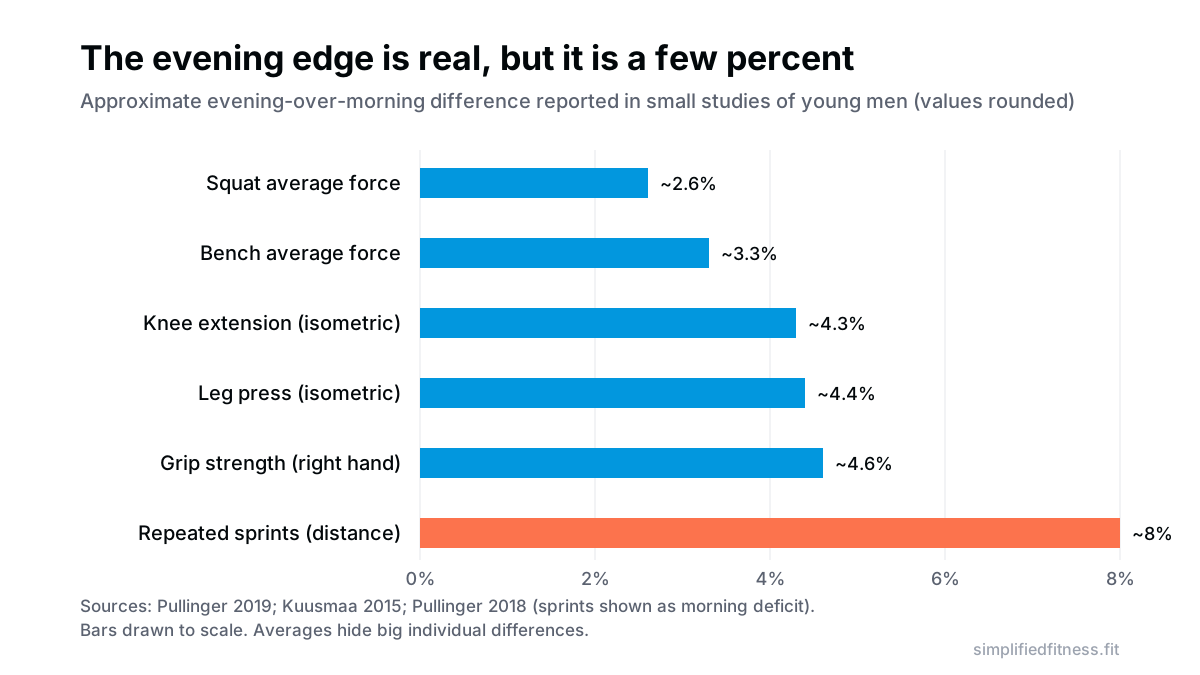
So the circadian rhythm strength peak is a nudge, not a cliff. A 3% bump on a 100 kg squat is 3 kg. That can be the difference between a clean PR and a grinder, but it will not turn a 100 kg squatter into a 130 kg squatter.
Why do I feel weak in the morning?
Several things move together. Researchers attribute the daily pattern to a mix of motivational, central (nervous system) and peripheral (muscle) factors, plus higher core and muscle temperature in the evening (Edwards et al., 2013). Short maximal efforts also appear to be shaped by body temperature, hormones, mood and a circadian clock inside skeletal muscle itself (Mirizio et al., 2020).
Translated into gym terms, the morning version of you is cooler, stiffer, a bit sleepier and slower to fire muscle hard. Fair enough.
In the gym this shows up as a first warm-up set that feels strangely heavy, a bar that moves slower at the same load, and a top set that is “fine” but not exciting.
Does body temperature explain the circadian rhythm strength peak?
This is the popular explanation, and it is only partly right.
Resting core temperature is higher in the evening. In one study, rectal temperature was about 0.56 degrees C higher than in the morning, and muscle temperature was about 0.31 degrees C higher (Edwards et al., 2013). Reasonable guess: warm up the morning body to that level and you should strength-match the evening.
The researchers tested exactly that in 10 active men. After an extended active or passive warm-up, morning rectal temperature reached evening values, but strength and power did not rise to evening values.
A later study in 10 resistance-trained men repeated the idea with bench press and back squat. An extended morning warm-up matched evening rectal temperature and the morning-to-evening differences in force and velocity were still there (Pullinger et al., 2019). In 12 trained men doing repeated sprints, heating to an “optimal” 38.5 degrees C in the morning did not match evening sprint output either (Pullinger et al., 2018).
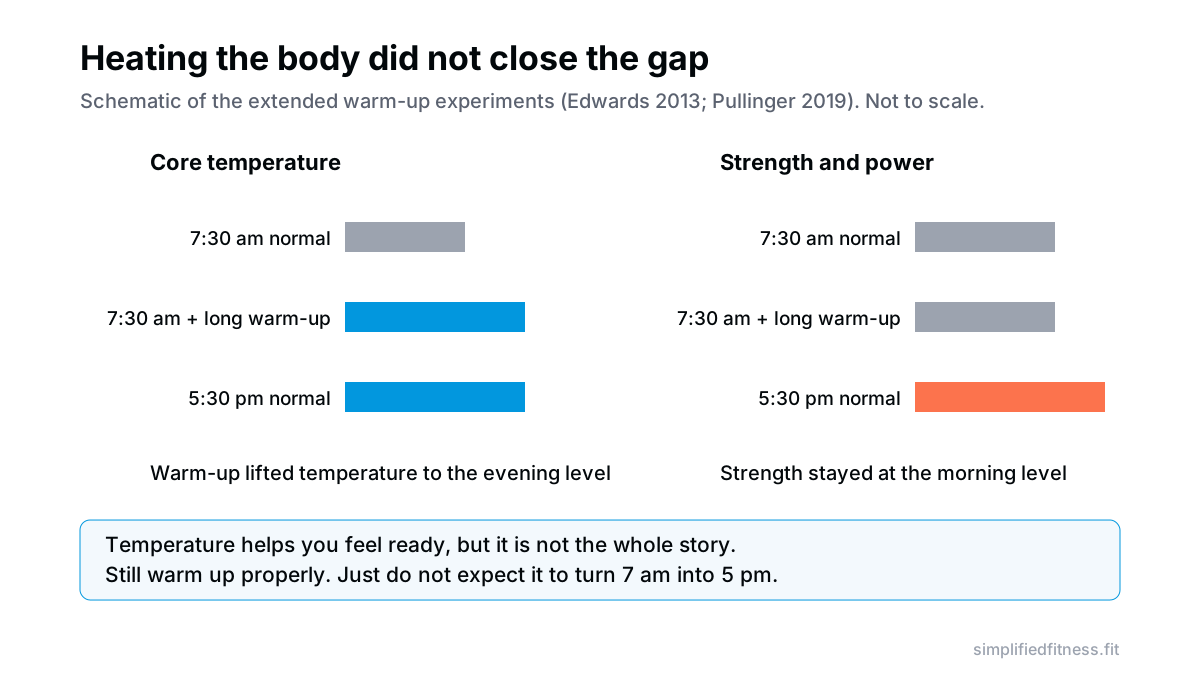
These were small studies in young men with short protocols. They are good evidence that temperature alone is not the switch, not proof that it plays no role.
Do cortisol and testosterone explain it?
Not well. It is tempting to read a hormone chart and say strength follows testosterone. The data say otherwise.
In the Jyväskylä study of untrained men, serum testosterone and cortisol both followed normal daily rhythms with higher values in the morning, while maximal force was higher in the evening (Küüsmaa et al., 2015). So the hormone peak and the strength peak are at opposite ends of the day.
The same paper split people by how their measured strength actually changed across the day (not by questionnaire chronotype). Eight were high morning performers, 19 were high evening performers and 45 were neutral. The morning types were stronger in the morning, by around 5.7-10.8% on leg tests. The evening types gained as much as 13.5-16.1% in the evening.
That leads straight to an important point.
Your chronotype changes the picture
The averages hide real individual differences. A 2026 study of 44 healthy young adults found maximal knee extensor torque and fatigue resistance were better in the evening overall, and chronotype explained about 47% of the variation in each person’s evening-minus-morning difference. Habitual sleep midpoint and its night-to-night variability did not (Hesketh et al., 2026).
Put simply: if you are a natural night owl, expect a bigger afternoon swing. If you are a lark, your curve may be flatter or shift earlier. We have not seen studies on lifters in Indian schedules specifically, so treat all of this as a starting hypothesis and check it against your own log.
Can you train around the clock?
Yes, to a degree. Your body adapts to the time you train.
A review of time-specific training reports that regular morning training can raise morning performance to near the usual evening level, while regular evening training keeps the evening advantage and may even widen the gap (Chtourou and Souissi, 2012). The authors note that the underlying mechanisms are not well understood.
The 2019 meta-analysis of 11 studies agrees on the pattern. Morning training can raise morning strength to evening-like levels, and evening training maintains the evening advantage (Grgic et al., 2019).
If you must train at 6 am before work, expect a few weeks of the clock catching up. Do not judge the schedule by week one.
Does the best time matter for building muscle?
For raw performance on the day, yes a little. For long-term growth, much less.
- The Grgic meta-analysis found similar strength gains and similar increases in muscle size whether people trained in the morning or the evening, once frequency and volume were matched (Grgic et al., 2019).
- A 2026 randomised trial split 36 healthy adults into a control group, a morning group (6-10 am) and an evening group (4-8 pm). The exercise groups trained 3 times a week for 6 weeks. Both improved insulin sensitivity, muscle thickness and knee extensor torque, with no significant difference between timing groups (Dighriri et al., 2026).
These are short trials in young, healthy people. We do not know whether small differences would show up over years. So the practical read is cautious: afternoon is good for peak output, but it is not a requirement for progress.
How to use this: PR days, programming and Indian schedules
Here are the moves that make sense given the evidence.
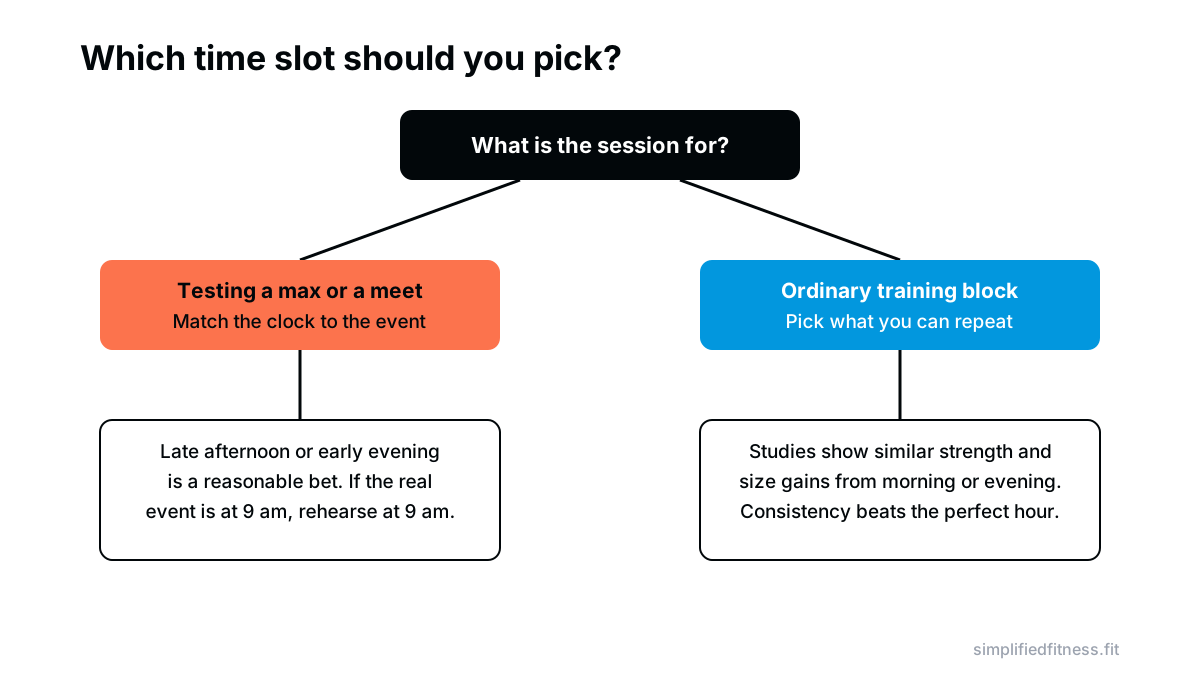
- Schedule top singles and PR attempts for late afternoon or early evening when you can. Average output tends to be higher then.
- If your competition or test happens at a fixed time, rehearse at that time. The review above suggests adaptation is time-specific.
- If you only have mornings (common with office hours and long commutes), do not panic. Add a few more ramp-up sets and a few minutes of dynamic movement. Our guides on warm-up protocols for working sets and a 7-minute dynamic warm-up cover the details.
- Estimate rather than test. If you cannot train at your best hour, use the 1RM calculator with a hard set of 3-6 reps, which may be less sensitive to a sluggish single.
- Keep conditions consistent when comparing progress. A “lower” morning lift might simply be the clock, so log the time next to each session.
- Watch the heat. In an Indian summer, a 5 pm session in a hot gym is not the same as a lab at 22 degrees C. We did not find trials on heat and time-of-day strength, so use thirst, sweat and common sense rather than assuming an afternoon slot always wins.
Not sure where to slot sessions around work? Start with the free push pull legs plan and adjust days before worrying about hours.
When to talk to a doctor
Normal daily swings are small. If you feel unusually weak, dizzy or breathless regardless of the hour, or your strength drops sharply and stays low over weeks, that is not a circadian effect. Persistent fatigue, palpitations, chest pain, unexplained weight change or very poor sleep are worth raising with a doctor rather than solving with a training schedule.
The bottom line
The circadian rhythm strength peak is real, usually modest and shared with a lot of individual variation. Core temperature moves with it, but heating yourself in the morning did not erase it in three small trials. Hormones do not explain it. And for long-term gains, morning and evening training look similar.
Use the afternoon when you can for big attempts, and train when you can be consistent the rest of the time.
Frequently Asked Questions
Why am I weaker in the morning?
Most people produce a little less force and power early in the day, and the gap is typically a few percent rather than a collapse. Core temperature, muscle temperature, nerve drive and alertness all sit lower after sleep. Warm up longer, lift a little lighter on the first set, and save big attempts for later if you can.
What is the best time of day to lift weights?
For raw performance on a given day, late afternoon to early evening tends to be best. For long-term muscle and strength gains, studies find little difference between morning and evening training. The best time is the one you will actually repeat three or four times a week.
Is it true that strength peaks between 4 pm and 7 pm?
Reviews of short maximal efforts such as sprints, jumps and isometric contractions place the peak between about 4 pm and 8 pm. Individual curves vary with chronotype, sleep and habit. Test yourself: log your top set for the same lift at two different times and compare.
Does body temperature affect how strong you are?
It is associated with performance, but the link is not simple. Raising morning core temperature to evening levels with a long warm-up did not lift strength or power to evening values in three small lab studies. Warm up thoroughly anyway, because it still helps you move well and feel ready.
Can a warm-up fix morning weakness?
A good warm-up helps, but the research suggests it does not erase the morning deficit. A 2013 study raised morning rectal temperature to evening levels and strength did not follow. Use ramp-up sets to groove the pattern and accept that your first working sets may feel heavier.
Do cortisol and testosterone explain afternoon strength?
Not very well. In a study of untrained men, serum testosterone and cortisol were both higher in the morning, while maximal leg force was higher in the evening. Hormones may play a role in adaptation, but they are not a good explanation for same-day force. Do not plan your day around hormone peaks.
Should I train in the morning or evening to build muscle?
Based on current evidence, either works. A 2019 meta-analysis found similar strength and size gains from morning and evening training when other variables were matched, and a 2026 trial in young adults reported the same. Choose the time that fits work, family and sleep.
Can I train myself to be strong in the morning?
Partly. Reviews report that regular morning training can raise morning performance to near evening levels, while evening training keeps the evening advantage. Give it several weeks of consistent morning sessions before judging. Keep the rest of your routine, sleep included, steady.
Does chronotype change when I peak?
Yes, it appears to. In a 2026 study of 44 young adults, chronotype explained about 47% of the variation in the evening-minus-morning strength difference. Early birds may show a smaller evening edge than night owls. If you are a morning person, test at your own best hours.
Should I attempt a 1RM in the morning or evening?
If the event is at a set time, test near that time. If it is open, late afternoon is a reasonable choice because average performance tends to be higher. Whatever you pick, keep conditions the same across attempts so you can compare numbers fairly.
Is it bad to train early if I am not a morning person?
Not bad, just a bit harder. Training time did not change gains much in the trials we have, but early sessions may need a longer warm-up and more patience. Protect your sleep so you are not stacking a circadian dip on top of a short night.
Does time of day matter for beginners?
Less than showing up. Most of the timing studies are in young, healthy, often active adults, and a beginner's progress is driven by consistent training and enough food. Choose a time you can keep for months.
Sources & References
Every claim above is checked against peer-reviewed research (PubMed, U.S. National Library of Medicine) or guidance from established health bodies. How we fact-check.
- Martin-López J, et al. Influence of time-of-day on neuromuscular performance in team sport athletes: a systematic review and meta-analysis. Front Sports Act Living. 2024. PMID: 39896341
- Mirizio GG, et al. Time-of-Day Effects on Short-Duration Maximal Exercise Performance. Sci Rep. 2020. PMID: 32528038
- Küüsmaa M, et al. Effects of time-of-day on neuromuscular function in untrained men: Specific responses of high morning performers and high evening performers. Chronobiol Int. 2015. PMID: 26361893
- Edwards BJ, et al. Does raising morning rectal temperature to evening levels offset the diurnal variation in muscle force production? Chronobiol Int. 2013. PMID: 23281719
- Pullinger S, et al. Effects of an active warm-up on variation in bench press and back squat (upper and lower body measures). Chronobiol Int. 2019. PMID: 30585502
- Pullinger SA, et al. Diurnal variation in repeated sprint performance cannot be offset when rectal and muscle temperatures are at optimal levels (38.5°C). Chronobiol Int. 2018. PMID: 29566344
- Grgic J, et al. The effects of time of day-specific resistance training on adaptations in skeletal muscle hypertrophy and muscle strength: A systematic review and meta-analysis. Chronobiol Int. 2019. PMID: 30704301
- Dighriri A, et al. The impact of the time of day on muscle and metabolic responses to resistance exercise in healthy adults: A randomised controlled trial. Exp Physiol. 2026. PMID: 41231202
- Hesketh SJ, et al. Time-of-Day Variation in Knee Extensor Strength and Fatigue Is Associated With Circadian Phenotype in Healthy Young Adults. J Biol Rhythms. 2026. PMID: 42861693
- Chtourou H, Souissi N. The effect of training at a specific time of day: a review. J Strength Cond Res. 2012. PMID: 22531613

Umair Hazrami · Founder & Head Coach, Simplified Fitness
Umair Hazrami founded Simplified Fitness and the Simplified Lifter channel to cut through fitness noise. With 4+ years of consistent training and 10+ coaching clients, he writes every guide from the peer-reviewed research and links the sources so you can check them. Our editorial standards.
Educational content only, not medical advice. If you have a medical condition, are pregnant, or take medication, talk to a qualified doctor before changing your diet, supplements or training. Full disclaimer.
Keep reading

Recovery
Active Recovery on Rest Days: Walking, Light Cycling and Mobility
Active recovery vs passive rest for lifters: what the research says about walking, light cycling and mobility, plus a 20-minute rest day routine you can copy.
7 min read
Recovery
Afternoon Caffeine Cutoff: Half-Life, Deep Sleep and Pre-Workout
Afternoon caffeine cutoff for lifters: how caffeine's half-life cuts sleep time and deep sleep even if you fall asleep fine, plus a practical cutoff by bedtime.
9 min read

Recovery
Blue Light, Melatonin and Screen Time: Do Blue-Blockers Actually Help You Sleep?
Blue light screen time melatonin suppression is real, but do blue-blocking glasses fix it? See what the trials found and the free fixes that matter more.
7 min read

Recovery
Is Your CNS Fried? CNS Fatigue vs Plain Lethargy in the Gym
Is my CNS fried from lifting? See what central fatigue really is, how fast it recovers and how to tell it from low motivation or poor sleep. Studies linked.
9 min read