Sleep Restriction and Muscle Loss on a Cut: What 5.5 vs 8.5 Hours Did in the Nedeltcheva Study
Does sleep deprivation cause muscle loss when cutting? In the Nedeltcheva trial, 5.5 hours of sleep meant less fat lost and 60% more fat-free mass lost.
TL;DR. The short answer
- In the 2010 Nedeltcheva trial, 10 overweight adults ate the same reduced-calorie diet for 14 days. On 5.5 hours of sleep opportunity they lost 55% less of their weight as fat and 60% more fat-free mass than on 8.5 hours.
- Fat-free mass is not the same as muscle. It includes muscle but also water and organs, and the study was small, so the exact numbers are a warning sign, not a precise prediction.
- Short sleep raises hunger and appetite, can blunt muscle protein synthesis (18% lower after one night of total sleep deprivation in 13 young adults) and raises cortisol, which fits with the body composition result.
- In a trial of resistance-trained women, a week and a half of short sleep cost lifting quality (bar speed and perceived effort) more than total sets and reps.
- If you are cutting, treating 7-9 hours as part of the diet is a sensible, low-cost way to protect muscle. Persistent sleep problems or heavy snoring are worth discussing with a doctor.
Part of our complete guide: Sleep, Circadian Timing & Systemic Recovery: How Lifters Maximize Anabolic Rest & CNS Recovery
Table of contents
Sleep deprivation and muscle loss while cutting are linked, and one trial shows it more clearly than most. When 10 overweight adults ate the same reduced-calorie diet, they lost a smaller share of their weight as fat and more fat-free mass on 5.5 hours of sleep than on 8.5 hours (Nedeltcheva et al., 2010).
The study is small and the headline numbers get repeated loosely online, so this guide goes through what it actually measured, what else the research says, and what to do about it. It sits inside our wider guide to sleep, circadian timing and systemic recovery.
If you have been running a deficit on five hours a night and wondering why the scale moves but the mirror does not, read on.
What did the Nedeltcheva sleep restriction study find?
The design is what makes it interesting. It was a randomized crossover trial, so every person did both conditions. Ten overweight, non-smoking adults (7 men, 3 women, average age 41, average BMI 27.4) did two 14-day blocks of moderate calorie restriction in random order, one with 8.5 hours of sleep opportunity and one with 5.5 hours. Same people, same diet type, different sleep.
The results, straight from the abstract:
- Weight lost as fat: 1.4 kg on 8.5 hours vs 0.6 kg on 5.5 hours. That is a 55% smaller share of weight loss coming from fat.
- Fat-free mass lost: 1.5 kg on 8.5 hours vs 2.4 kg on 5.5 hours. That is 60% more.
- Short sleep also came with higher hunger, signs of stronger neuroendocrine adaptation to calorie restriction, and a shift toward burning less fat for fuel.
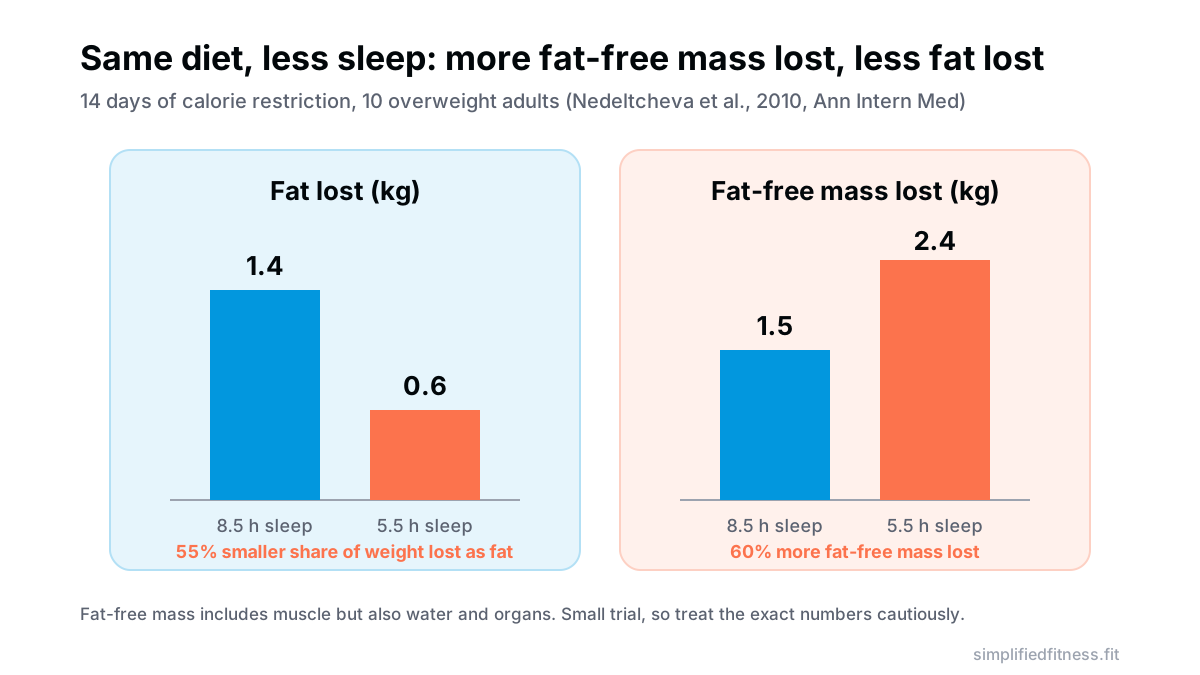
The authors concluded that the amount of sleep contributes to keeping fat-free mass when energy intake drops, and that too little sleep may weaken the usefulness of typical diets.
How reliable is this study?
Good question, and the honest answer is: suggestive, not definitive.
In its favour: randomized crossover design, a controlled laboratory setting, and the result lines up with other work on sleep and metabolism.
Against: the authors flag the limitation themselves, that the nature of the study limited its duration and sample size. Ten adults, two weeks, overweight and middle-aged. We do not know that the same split happens in a trained 25-year-old lifting four days a week. Lifting and high protein intake might shift the picture, and this trial does not tell us either way.
So the sensible reading is: sleep restriction during a deficit plausibly costs lean tissue, and it is cheap to avoid. That is a better framing than “catastrophic,” and it is also the one the evidence supports.
How does lack of sleep affect muscle protein synthesis and hormones?
A mechanism helps explain why the trial result is believable.
In a 2021 crossover study, 13 healthy young adults (7 men, 6 women) had one night of total sleep deprivation and one night of normal sleep. After the sleepless night, muscle protein synthesis after eating was 18% lower, plasma cortisol was 21% higher and testosterone was 24% lower. Markers of protein breakdown did not differ (Lamon et al., 2021). The authors describe this as anabolic resistance and a procatabolic environment.
Two cautions. This was a single night of total deprivation, which is harsher than most people’s habitual 5-6 hours, and the group was small. And the breakdown markers did not change, so the effect here is “building less,” not “breaking down more.”
Cortisol shows up in longer-term work too. In ten resistance-trained women who spent nine nights on 5 hours in bed, salivary cortisol area under the curve rose by 42% (Knowles et al., 2022). Across the literature, though, hormonal responses to lifting under poor sleep are conflicting (Knowles et al., 2018). Read hormone numbers as supporting evidence, not as a number to track.
Cortisol is not the villain here. We cover why in cortisol and resistance training.
Why does short sleep make fat loss harder?
Muscle is half the story. Fat loss is the other half, and appetite is where short sleep hits hard.
In a 2004 crossover trial, 12 young men had two days of restricted sleep and two days of extended sleep under controlled food intake. Restriction cut leptin (the fullness hormone) by 18%, raised ghrelin (the hunger hormone) by 28%, and raised hunger by 24% and appetite by 23%, especially for calorie-dense, carb-heavy foods (Spiegel et al., 2004).
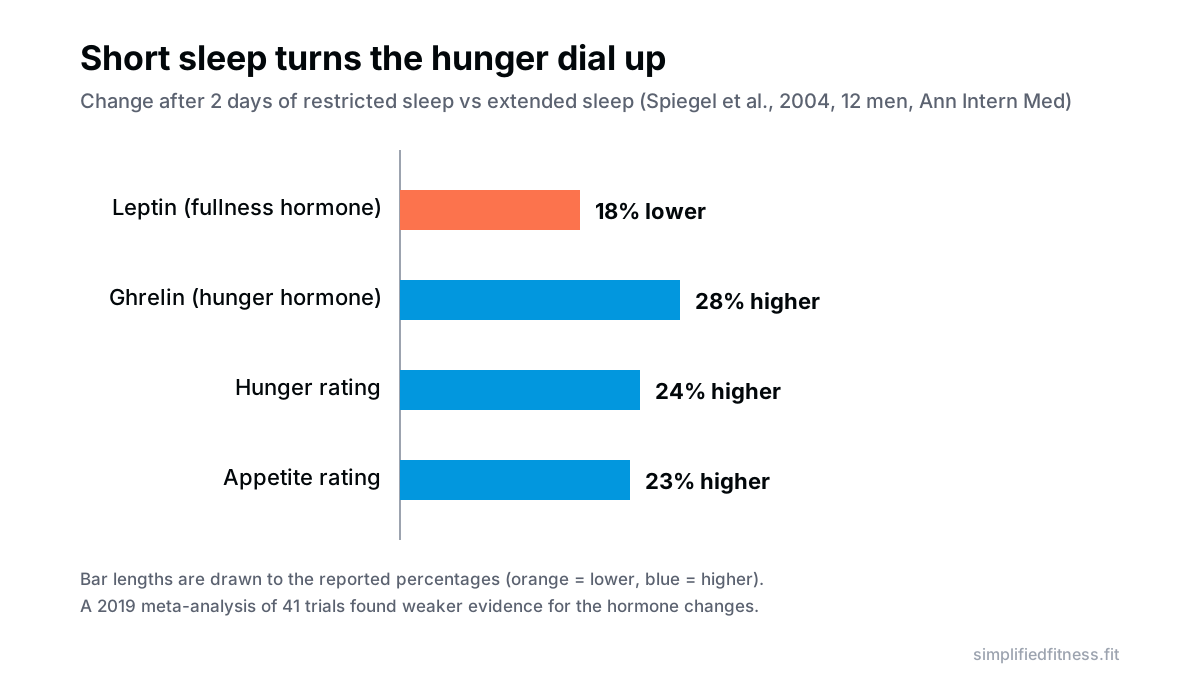
Now the conflict. A 2019 meta-analysis of 41 randomized trials found sleep restriction raised subjective hunger (13.4 points on a 100 mm scale) and increased intake by about 252.8 kcal a day, but did not find strong evidence for a change in average leptin or ghrelin or in energy expenditure (Zhu et al., 2019).
Why the difference? The 2004 study measured daytime hormone profiles in 12 men; the meta-analysis pooled many designs, and hormone measures vary a lot between studies. The consistent part is behavioural: more hunger and more eating. For your cut, the practical takeaway is the same either way. A tired brain wants more food, and often the sugary, fatty kind.
That is also why some people find the diet “stops working” after a bad week. A few hundred extra kcal a day can erase a deficit without you ever noticing.
Does short sleep hurt your training while cutting?
It can, but in a more subtle way than people expect.
A systematic review of 17 studies (rated moderate or weak in quality) found one night of total deprivation had little effect on strength, while several nights of restriction could reduce force in multi-joint lifts but not single-joint ones (Knowles et al., 2018). The authors suggest training with others or using caffeine can help offset it.
In the 2022 trial of ten resistance-trained women, nine nights at 5 hours changed volume load by less than 1%. But mean bar speed in lower-body compound lifts was up to 15% slower, velocity loss within a set was up to 7% greater in back squats, and session perceived exertion was 11% higher (Knowles et al., 2022).
In plain gym language: you still get your sets and reps done, but they feel heavier and move slower. On a cut that is a problem, because the stimulus for keeping muscle is hard, well-executed sets.
How many hours of sleep protect muscle while cutting?
No trial has pinned an exact number for muscle retention. The Nedeltcheva comparison used 8.5 hours as the protective condition and 5.5 as the harmful one, so the useful range sits between them and above. A target of 7-9 hours in bed is a sensible, commonly recommended range for adults.
Count time asleep, not time in bed. Someone in bed from 11:30 p.m. to 5:30 a.m. with a phone in hand has less than six hours of sleep.
What should you do about it on a cut?
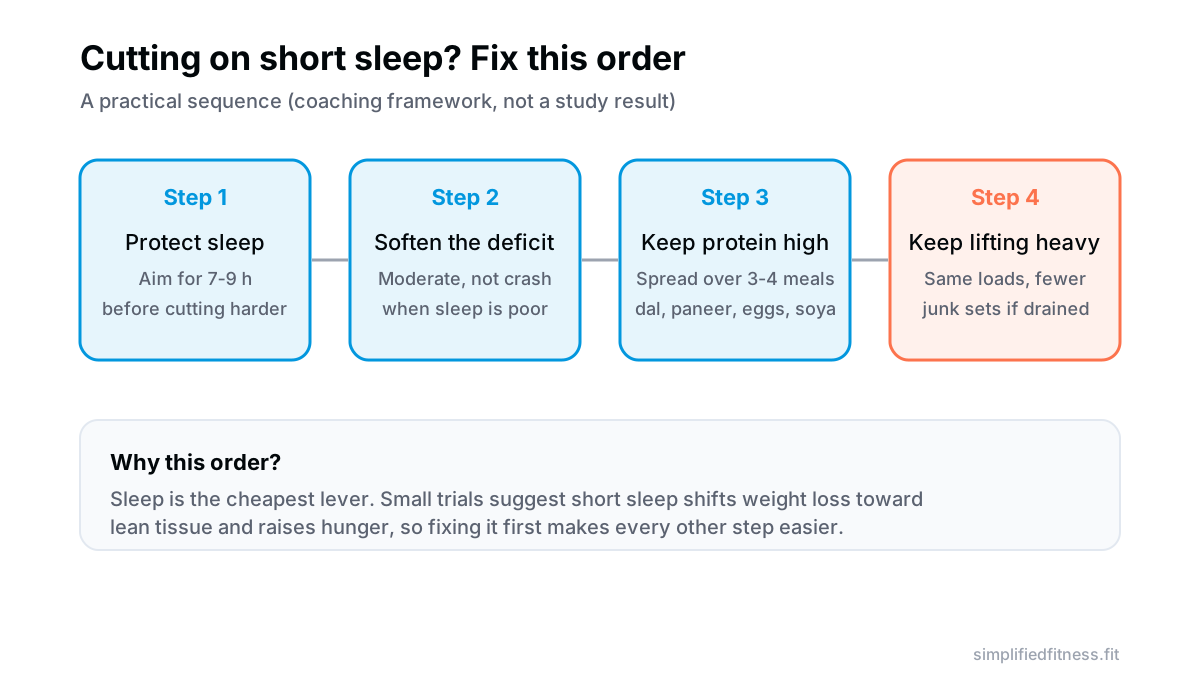
Here is a plain order of operations. It is a coaching framework drawn from the research above, not a protocol tested as a whole.
- Fix sleep before you cut harder. If the scale stalls and you are on 5-6 hours, extra cardio is the worst response. Sleep first.
- Run a moderate deficit when sleep is poor. A smaller deficit gives you more margin for lean tissue. Our guide to moderate vs aggressive deficits goes into how to choose, and the calorie calculator gives you a starting figure.
- Keep protein high. It will not cancel out short sleep, but it is a separate lever on muscle retention. Our high-protein cutting guide covers the numbers, and the protein calculator gives a target for your body weight. In an Indian vegetarian diet, spread dal, paneer, curd, soya and eggs (if you eat them) across 3-4 meals.
- Keep lifting heavy. Keep your main lifts and trim junk volume if you are wiped out.
- Fix the sleep itself. Cool, dark room (relevant in an Indian summer without AC), fixed wake time, caffeine in the morning only. Our sleep hygiene checklist for lifters has the details, and slow-wave sleep and growth hormone explains what you are protecting.
What the research does not tell us
Being straight about the gaps:
- No lifters in the headline trial. It tested overweight adults, not trained people on a high-protein cut.
- Short duration. 14 days says little about 16-week cuts.
- Lean mass is not muscle. Water and organ tissue are included in fat-free mass.
- Hormone data is inconsistent. Some studies find cortisol rises and testosterone falls, others find mixed results.
- Individual variation is large. Some people tolerate short sleep better than others, and we cannot tell in advance who.
None of this makes the advice wrong. It means the case rests on a consistent direction across several studies, not on one precise number.
When to talk to a doctor
If you sleep 8 hours and still wake exhausted, snore loudly, have partners noticing pauses in your breathing, or have had insomnia for weeks, see a doctor. These can have treatable causes, and no sleep hack replaces that check. This article is general information, not medical advice.
The bottom line
Sleep deprivation and muscle loss during a cut are connected by a handful of small but consistent studies. Dieters sleeping 5.5 hours lost a smaller share of weight as fat and more fat-free mass than the same people sleeping 8.5 hours. Short sleep also raises hunger and lowers training quality.
You do not need a perfect routine. Treat sleep as part of your diet: aim for 7-9 hours, keep the deficit moderate, keep protein and heavy lifting in place, and check your results over weeks, not days.
Frequently Asked Questions
Does lack of sleep cause muscle loss when cutting?
Evidence suggests it can tilt the balance that way. In the Nedeltcheva trial, dieters sleeping 5.5 hours lost 60% more fat-free mass than the same dieters sleeping 8.5 hours. The study was small (10 people) and fat-free mass is not purely muscle, so protect your sleep and keep protein and lifting in place.
What did the Nedeltcheva sleep restriction study find?
Ten overweight adults followed 14 days of moderate calorie restriction twice, once with 8.5 hours and once with 5.5 hours of sleep opportunity. With less sleep, the proportion of weight lost as fat fell by 55% (1.4 vs 0.6 kg) and fat-free mass loss rose by 60% (1.5 vs 2.4 kg). The authors concluded that sleep helps maintain fat-free mass during energy restriction, so aim for a full night while dieting.
Is the 55% less fat and 60% more muscle claim accurate?
Partly. The paper reports 55% less fat as a share of weight lost and 60% more loss of fat-free mass, not specifically muscle. Fat-free mass also includes water and organ tissue, so reading it as pure muscle overstates the finding. Use it as a directional warning rather than an exact figure.
How many hours of sleep do I need to keep muscle on a cut?
There is no trial that sets an exact number for muscle retention. The Nedeltcheva comparison used 8.5 hours as the better condition, and most guidelines for adults point to 7-9 hours. Aim for the middle of that range and judge it by how you feel and perform in the gym.
Does sleep deprivation lower muscle protein synthesis?
One small crossover study found one night of total sleep deprivation reduced postprandial muscle protein synthesis by 18% in 13 healthy young adults. That suggests anabolic resistance, though it was a single night and a small group, so it may not map directly onto months of mild sleep debt. The takeaway is to avoid stacking all-nighters on top of a deficit.
Does poor sleep raise cortisol and lower testosterone?
In the same 13-person study, one night of sleep deprivation raised plasma cortisol by 21% and lowered testosterone by 24%. In resistance-trained women, nine nights at 5 hours increased salivary cortisol by 42%. Hormone results across studies are not fully consistent, so use this as a reason to sleep more rather than a number to chase.
Why does lack of sleep make me hungrier?
In a 2004 trial of 12 young men, two days of restricted sleep lowered leptin by 18%, raised ghrelin by 28% and raised hunger by 24%. A 2019 meta-analysis of 41 trials confirmed more hunger and about 253 extra kcal eaten per day, though it found weaker evidence for hormone changes. If you are tired, plan your meals ahead so hunger does not decide for you.
Can I eat more protein to offset short sleep?
Higher protein is a sound habit on a cut, but there is no trial showing it fully cancels the effect of short sleep. Protein supports muscle retention through a different pathway than sleep does. Use both: keep protein high and fix sleep rather than choosing one.
Does short sleep ruin my lifting performance?
It can lower the quality of your sets more than the number of them. In resistance-trained women, nine nights at 5 hours changed volume load by less than 1%, but lower-body bar speed dropped by up to 15% and session effort rose 11%. If you are drained, keep your main lifts and trim extra junk volume.
Is one bad night of sleep a problem on a cut?
A single poor night is unlikely to undo a cut. Most of the worrying data comes from sustained restriction over days to weeks. Get back to a normal schedule the next night rather than compensating with extra cardio or a harsher deficit.
Should I cut calories less if I am sleeping badly?
It is a reasonable call. The Nedeltcheva result suggests a deficit may cost more lean mass when sleep is short, so a moderate deficit gives you more margin. Use our calorie calculator to set a modest target, and revisit it once sleep improves.
Does caffeine fix the muscle loss from poor sleep?
No. Caffeine can help you push harder in the gym when you are tired, which a systematic review lists as one coping strategy, but it does not replace sleep. It also tends to delay the next night's sleep if taken late. Keep it to the morning or early afternoon.
When should I see a doctor about my sleep?
See a doctor if you snore loudly, stop breathing at night, wake unrefreshed despite 8 hours in bed, or have had weeks of insomnia. These can point to treatable conditions such as sleep apnoea. Do not try to diagnose it yourself or fix it with supplements alone.
Sources & References
Every claim above is checked against peer-reviewed research (PubMed, U.S. National Library of Medicine) or guidance from established health bodies. How we fact-check.
- Nedeltcheva AV, et al. Insufficient sleep undermines dietary efforts to reduce adiposity. Ann Intern Med. 2010. PMID: 20921542
- Lamon S, et al. The effect of acute sleep deprivation on skeletal muscle protein synthesis and the hormonal environment. Physiol Rep. 2021. PMID: 33400856
- Spiegel K, et al. Brief communication: Sleep curtailment in healthy young men is associated with decreased leptin levels, elevated ghrelin levels, and increased hunger and appetite. Ann Intern Med. 2004. PMID: 15583226
- Zhu B, et al. Effects of sleep restriction on metabolism-related parameters in healthy adults: A comprehensive review and meta-analysis of randomized controlled trials. Sleep Med Rev. 2019. PMID: 30870662
- Knowles OE, et al. Inadequate sleep and muscle strength: Implications for resistance training. J Sci Med Sport. 2018. PMID: 29422383
- Knowles OE, et al. Sustained sleep restriction reduces resistance exercise quality and quantity in females. Med Sci Sports Exerc. 2022. PMID: 36136596

Umair Hazrami · Founder & Head Coach, Simplified Fitness
Umair Hazrami founded Simplified Fitness and the Simplified Lifter channel to cut through fitness noise. With 4+ years of consistent training and 10+ coaching clients, he writes every guide from the peer-reviewed research and links the sources so you can check them. Our editorial standards.
Educational content only, not medical advice. If you have a medical condition, are pregnant, or take medication, talk to a qualified doctor before changing your diet, supplements or training. Full disclaimer.
Keep reading

Recovery
Active Recovery on Rest Days: Walking, Light Cycling and Mobility
Active recovery vs passive rest for lifters: what the research says about walking, light cycling and mobility, plus a 20-minute rest day routine you can copy.
7 min read
Recovery
Afternoon Caffeine Cutoff: Half-Life, Deep Sleep and Pre-Workout
Afternoon caffeine cutoff for lifters: how caffeine's half-life cuts sleep time and deep sleep even if you fall asleep fine, plus a practical cutoff by bedtime.
9 min read
Recovery
Blue Light, Melatonin and Screen Time: Do Blue-Blockers Actually Help You Sleep?
Blue light screen time melatonin suppression is real, but do blue-blocking glasses fix it? See what the trials found and the free fixes that matter more.
7 min read

Recovery
Is Your CNS Fried? CNS Fatigue vs Plain Lethargy in the Gym
Is my CNS fried from lifting? See what central fatigue really is, how fast it recovers and how to tell it from low motivation or poor sleep. Studies linked.
9 min read