Psychological Stress and Recovery: How Life Stress Slows Muscle Repair and Strength Gains
Psychological stress and recovery go together: studies link high life stress to slower strength gains and slower muscle recovery. Here is what to change.
TL;DR. The short answer
- Two small studies in university students found that higher life stress was linked to smaller 12-week strength gains and to slower recovery of muscle force over 96 hours after a hard session.
- These are observational findings in young, mostly novice lifters. They show an association, not proof that stress alone caused the difference.
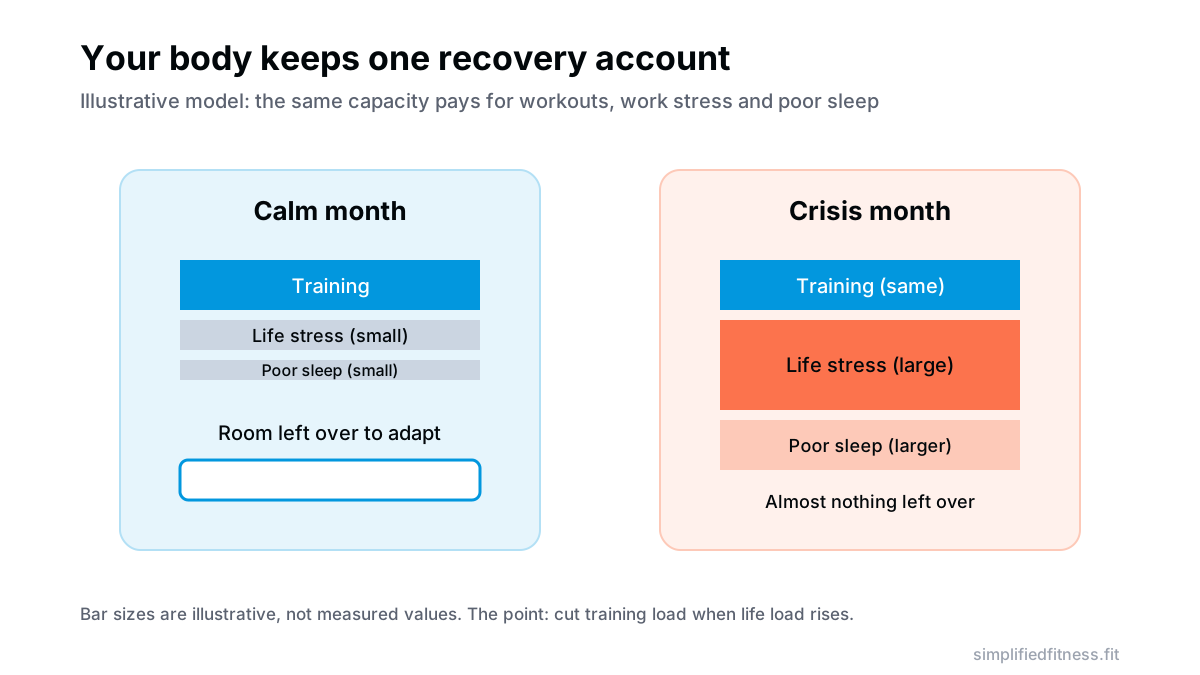
- Training stress and life stress seem to draw on the same recovery capacity, so the practical fix is to lower training volume, not to quit training.
- Lifting itself tends to reduce anxiety in randomized trials, so training through a rough patch is usually worth it if the dose is right.
- If stress comes with weeks of low mood, panic or very poor sleep, see a doctor or mental health professional. Do not try to out-train it.
Part of our complete guide: Sleep, Circadian Timing & Systemic Recovery: How Lifters Maximize Anabolic Rest & CNS Recovery
Table of contents
If your lifts have stalled during a divorce, a layoff or a brutal work quarter, the training plan may not be the problem. Research on psychological stress and recovery suggests that high life stress is linked to smaller strength gains and slower return of muscle force after hard sessions. The evidence is small and observational, so it is a strong hint rather than a law.
This article sits inside our complete guide to sleep, circadian timing and systemic recovery. Here we look at what the stress studies actually found, what they cannot tell us, and how to adjust training when life is the heavier load.
Does stress really slow muscle growth and strength?
Partly yes, with caveats. Almost all the direct evidence comes from one research group working with university students in weight-training classes. It is not a huge body of work, and nobody has randomly assigned people to a divorce.
Still, the findings point the same way. Higher stress goes with worse adaptation and worse recovery. Nothing in the literature says stress shuts muscle growth off. What it suggests is a slower, harder road.
One more honest note. “Muscle growth” is rarely measured in these studies. They measure strength and force. We will use “progress” loosely, but those are the outcomes with data behind them.
What did the Bartholomew study find?
Bartholomew and colleagues followed 135 undergraduates in weight-training classes that met twice a week for 12 weeks. After a two-week familiarisation period, students completed a questionnaire on stressful life events, plus a social support questionnaire, and tested their 1RM on the bench press and squat. The researchers then split them into low and high stress groups using median splits (Bartholomew et al., 2008).
After 12 weeks, the low-stress group had a significantly larger increase in both bench press and squat than the high-stress group. Strength gains were unrelated to social support in either group. The authors concluded that high life stress may reduce a person’s ability to adapt to weight training.
Limits matter here. These were students, mostly novices, and stress was self-reported. People who report more stress may also sleep less, skip sessions or eat worse, and the abstract does not separate those. A median split also throws away information, so the “high” and “low” groups were relative to each other, not clinical categories.
Does stress slow recovery after a single hard session?
A second line of work looked at the days right after a workout. In 2014, 31 resistance training students completed stress questionnaires, then did a heavy leg session (a 10RM leg press test plus six sets at 80-100% of 10RM). Researchers then measured maximal isometric force, perceived energy, fatigue and soreness at roughly 24-hour intervals for 96 hours (Stults-Kolehmainen et al., 2014).
Life event stress significantly moderated how force recovered, and the relationship held even after adjusting for fitness, workload and training experience. Perceived energy, fatigue and soreness were also moderated by life stress. In every analysis, higher stress was associated with worse recovery.
Perceived stress (how stressed people felt) moderated force and energy recovery but not fatigue or soreness. So the two stress measures were not identical in what they predicted.
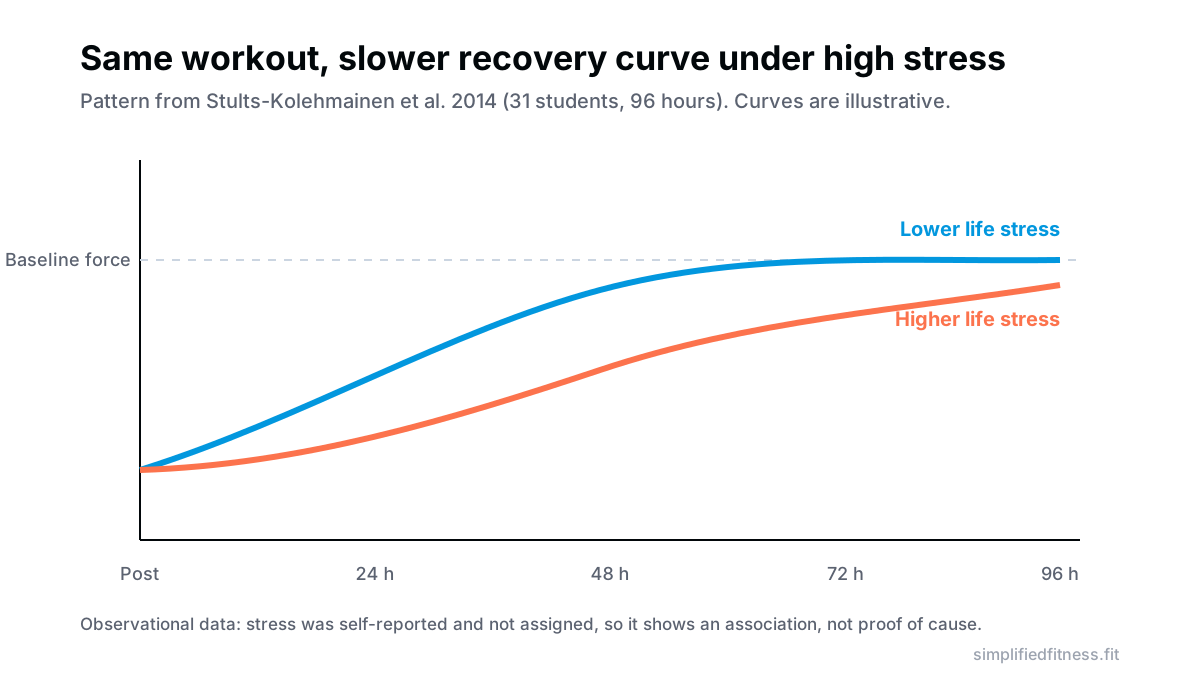
The same group looked at the first hour after exercise in 31 students with an identical protocol (apparently the same sample) and found that life stress moderated force recovery there too, though not the psychological ratings (Stults-Kolehmainen & Bartholomew, 2012).
Why would life stress slow muscle repair?
Here is where we have to be careful. The studies above show the association. They did not measure the mechanism. So what follows is plausible reasoning, not established fact in lifters.
Sleep. Stress wrecks sleep, and sleep restriction can reduce force in multi-joint lifts. A systematic review of 17 studies (rated moderate or weak quality) found that consecutive nights of sleep restriction could reduce force output of compound, but not single-joint, movements (Knowles et al., 2018). In elite soccer, reviewers describe sleep loss as potentially impairing glycogen repletion and muscle damage repair, though they note the need for more research (Nedelec et al., 2015). If you want the sleep side in depth, start with our piece on sleep restriction and muscle catabolism.
Motivation and effort. A stressed, distracted lifter often grinds less hard. Knowles and colleagues suggested group training or caffeine can help offset the motivation dip after poor sleep. Not a physiological block, but it matters for results.
Hormones and the nervous system. Stress raises cortisol and shifts autonomic tone. That is often blamed for stalled gains, but the human data on cortisol and long-term adaptation is more mixed than gym talk suggests. We separate acute spikes from chronic patterns in cortisol and resistance training: acute vs chronic reality.
You will sometimes see claims that stress “reduces satellite cell activation”. I could not find human lifting trials that show this, so treat it as a hypothesis, not a finding.
How do I know stress is hurting my training?
There is no validated stress test for lifters. Watch for a cluster across one to two weeks rather than one bad day:
- Warm-up sets feel heavier than normal
- Soreness hangs around longer than it used to
- Sleep is short or broken most nights
- You are dreading sessions you usually enjoy
- Rep PRs have gone backwards, not just flat
Monitoring methods vary. A 2020 review of 90 studies found that perceptual measures such as RPE and reps in reserve correlated well with resistance training performance, while many lab-based physiological markers were impractical outside research settings (Helms et al., 2020). That favours simple tools: how a set feels, plus how fast the bar moves. If you need a refresher on rating effort, see our guide to the RIR and RPE scale, and use the RIR/RPE calculator to translate numbers.
How to adjust training when life is the heavier load
There are no trials of stressed lifters testing specific adjustments, so what follows is coaching practice built on the logic above. Treat it as a starting point.
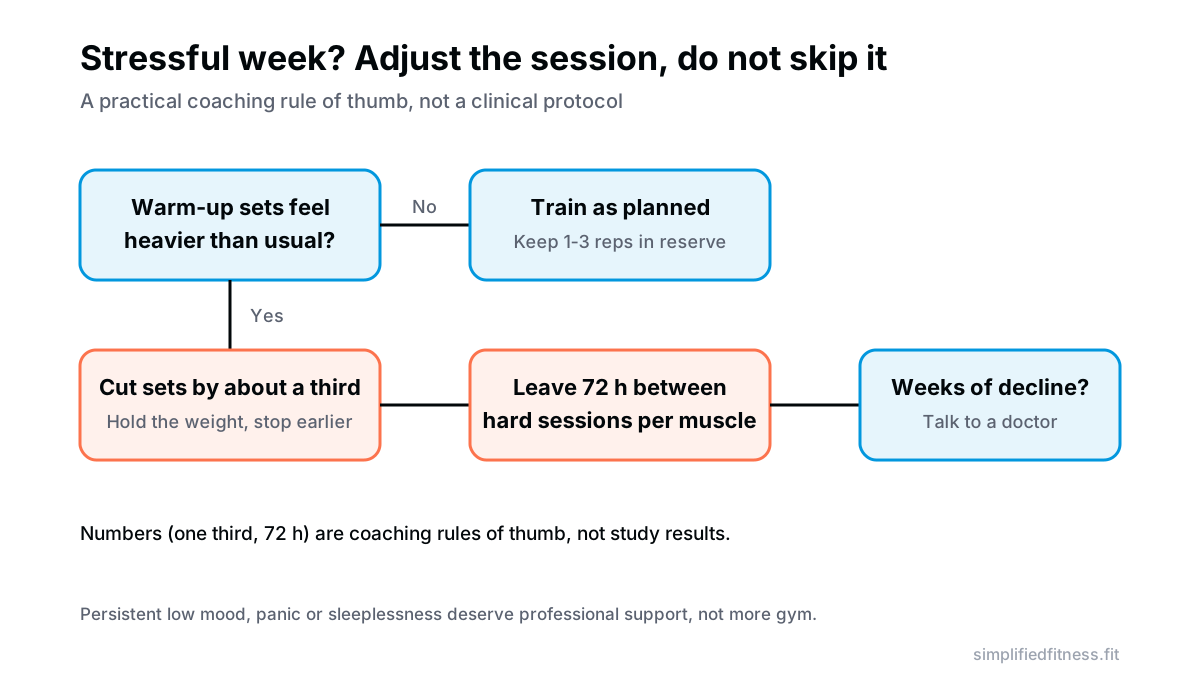
- Keep the weight, cut the sets. Strength is easier to hold than to build. Dropping about a third of your sets while keeping the load on the bar preserves skill and most of your strength for a few weeks.
- Stop earlier. Leave 2-3 reps in reserve instead of grinding to failure. Failure costs more recovery than it adds in a high-stress month.
- Spread hard sessions out. If you train each muscle every 48 hours, try 72. The 96-hour recovery data suggest longer may be needed, though they do not give an exact number.
- Fewer exercises, more consistency. Four big lifts done three times a week beat a ten-exercise program you skip.
- Protect sleep first. Fixed wake time, no screens in bed, and caffeine cut off by mid-afternoon. Our sleep hygiene checklist for lifters has the details.
- Do not cut food hard. Eating well matters more when stressed. In India that can be as simple as dal plus roti or rice with a paneer, curd or egg serving at each meal. Check your target with the protein calculator.
For a deeper look at fitting lifting around hectic careers, see our workout splits for high-stress careers, and for the broader coping side see fitness during life stress for exams and parents.
What if I only have 30 minutes and a bad mood?
Do your two or three main lifts for two to three sets each and go home. That is a perfectly good session. Our free push, pull and leg plans are easy to shorten this way.
Can lifting actually help with stress?
Yes, on average, and this is the part people forget. A meta-analysis of 16 randomized trials (922 participants) found that resistance training significantly reduced anxiety symptoms compared with non-active controls, with an effect size of 0.31, and the effect did not significantly differ by program length, intensity or frequency (Gordon et al., 2017). A separate meta-analysis of randomized trials found resistance training was associated with reduced depressive symptoms too (Gordon et al., 2018).
So there is a real loop. Stress makes training harder, and training can ease stress. The way to keep the loop positive is to keep sessions doable. A lighter session you finish will usually do more for you than a heavy one you dread.
One caution: these trials mostly involved structured programs, not people in acute crisis, and they were against non-active controls, not therapy. Exercise supports mental health. It does not replace treatment.
When stress is more than a training problem
See a doctor or mental health professional if you notice any of these for more than about two weeks:
- Low mood, hopelessness or loss of interest in things you used to enjoy
- Panic attacks, constant dread or racing thoughts
- Severely broken sleep, or early waking you cannot fix
- Big changes in appetite or weight you did not plan
- Fatigue that does not improve with rest
These are not signs of weak discipline, and they are not something a better program fixes. If you ever feel unsafe or have thoughts of harming yourself, contact local emergency services or a crisis line immediately. A recovery article cannot diagnose anything, and neither can a training log.
The bottom line
Life stress and training stress seem to share one recovery account. In small studies of university lifters, higher stress went with smaller strength gains and slower force recovery, even though everyone was in the same kind of training class. The mechanisms are not proven, but the practical response is clear: trim volume, stop short of failure, give hard sessions more space, and protect sleep.
Keep showing up, just with a smaller dose. Strength built over months does not vanish in a bad month, and a month of smart, lighter training usually puts you back on track faster than a month of stubborn grinding.
Frequently Asked Questions
How does stress affect muscle growth?
Direct evidence on muscle growth in humans is thin, but high life stress has been linked to smaller strength gains and slower recovery in two small student studies. Proposed pathways include poorer sleep, lower motivation and changes in stress hormones, though these have not been cleanly separated. If you are under heavy stress, plan on needing more recovery per session.
Can stress stop you from building muscle?
Stress alone is unlikely to stop muscle growth completely, but it can plausibly slow it. In a 12-week study of 135 students, the low-stress group gained more bench press and squat strength than the high-stress group, yet both groups trained. The practical move is to keep training at a lower dose and protect sleep and protein.
Why are my lifts stalling when my diet and training are perfect?
Diet and training are only two inputs, and sleep and life stress also draw on your recovery. Research suggests high stress can slow the return of muscle force after a hard session, so the same program may leave you less ready for the next one. Drop to roughly two thirds of your usual sets for two weeks and see whether your numbers stabilise.
How long does it take to recover from a workout when stressed?
In a 2014 study, force recovery was tracked for 96 hours, and higher-stress people recovered more slowly across that window. The study did not give a single number of extra days, so treat 'longer' as individual. If you usually train a muscle every 48 hours, try 72 hours during rough weeks.
Should I stop going to the gym when I am very stressed?
Usually no. Resistance training reduced anxiety symptoms in a meta-analysis of 16 randomized trials, so a lighter session can help rather than hurt. Cut volume and keep the habit going, and skip a session only when you are ill, exhausted or truly cannot sleep.
Does stress raise cortisol and does that kill gains?
Stress does raise cortisol, but a single hormone is not a reliable explanation for stalled progress. Human research on this is mixed, and several factors move together when life gets hard. We cover the hormone question in detail in our article on cortisol and resistance training, so use it for the deeper picture.
Does stress make you lose strength?
Short stressful periods do not usually erase strength, but they can make hard sets feel heavier and slow your progress. The 2008 study measured gains in 1RM over 12 weeks and found smaller gains with high stress, not losses. If numbers dip for a week or two, hold your weights and rebuild rather than chase PRs.
How can I tell if stress is hurting my training?
Common signs include warm-up sets feeling heavy, soreness lasting longer, poor sleep and low motivation across several sessions in a row. No single sign is diagnostic, so look for a cluster over one to two weeks. Track bar speed or reps in reserve, and if the pattern is clear, reduce sets before you hit a wall.
Is lifting good for stress and anxiety?
Yes, on average. A meta-analysis of 16 randomized trials with 922 participants found resistance training modestly reduced anxiety symptoms compared with non-active controls. It is not a replacement for therapy or medication when those are needed, but it is a reasonable part of a plan.
Does poor sleep from stress hurt strength?
It can. A systematic review of 17 studies found that several nights of restricted sleep could reduce force output in multi-joint lifts like squats and bench, while single-joint moves were less affected. Quality of the studies was rated moderate or weak, so treat it as likely rather than certain, and protect sleep first.
How many sets should I do when life is stressful?
There is no tested number for stressed lifters, so this is a coaching rule of thumb. Cutting about a third of your weekly sets, while keeping load on the bar and stopping 2-3 reps short of failure, keeps the habit and the skill without adding much recovery cost. Return to full volume when sleep and mood normalise.
When should I see a doctor about stress and fatigue?
See a doctor if low mood, anxiety, panic, loss of interest, or exhaustion lasts more than two weeks, or if your sleep has collapsed. These can be signs of conditions that need proper care, and the gym is not a treatment for them. If you ever feel unsafe, contact local emergency services or a crisis line right away.
Sources & References
Every claim above is checked against peer-reviewed research (PubMed, U.S. National Library of Medicine) or guidance from established health bodies. How we fact-check.
- Bartholomew JB, et al. Strength gains after resistance training: the effect of stressful, negative life events. J Strength Cond Res. 2008. PMID: 18545186
- Stults-Kolehmainen MA, et al. Chronic psychological stress impairs recovery of muscular function and somatic sensations over a 96-hour period. J Strength Cond Res. 2014. PMID: 24343323
- Stults-Kolehmainen MA, et al. Psychological stress impairs short-term muscular recovery from resistance exercise. Med Sci Sports Exerc. 2012. PMID: 22688829
- Knowles OE, et al. Inadequate sleep and muscle strength: Implications for resistance training. J Sci Med Sport. 2018. PMID: 29422383
- Gordon BR, et al. The effects of resistance exercise training on anxiety: a meta-analysis and meta-regression analysis of randomized controlled trials. Sports Med. 2017. PMID: 28819746
- Gordon BR, et al. Association of efficacy of resistance exercise training with depressive symptoms: meta-analysis and meta-regression analysis of randomized clinical trials. JAMA Psychiatry. 2018. PMID: 29800984
- Nedelec M, et al. Stress, sleep and recovery in elite soccer: a critical review of the literature. Sports Med. 2015. PMID: 26206724
- Helms ER, et al. Methods for regulating and monitoring resistance training. J Hum Kinet. 2020. PMID: 33312273

Umair Hazrami · Founder & Head Coach, Simplified Fitness
Umair Hazrami founded Simplified Fitness and the Simplified Lifter channel to cut through fitness noise. With 4+ years of consistent training and 10+ coaching clients, he writes every guide from the peer-reviewed research and links the sources so you can check them. Our editorial standards.
Educational content only, not medical advice. If you have a medical condition, are pregnant, or take medication, talk to a qualified doctor before changing your diet, supplements or training. Full disclaimer.
Keep reading

Recovery
Active Recovery on Rest Days: Walking, Light Cycling and Mobility
Active recovery vs passive rest for lifters: what the research says about walking, light cycling and mobility, plus a 20-minute rest day routine you can copy.
7 min read
Recovery
Afternoon Caffeine Cutoff: Half-Life, Deep Sleep and Pre-Workout
Afternoon caffeine cutoff for lifters: how caffeine's half-life cuts sleep time and deep sleep even if you fall asleep fine, plus a practical cutoff by bedtime.
9 min read

Recovery
Blue Light, Melatonin and Screen Time: Do Blue-Blockers Actually Help You Sleep?
Blue light screen time melatonin suppression is real, but do blue-blocking glasses fix it? See what the trials found and the free fixes that matter more.
7 min read

Recovery
Is Your CNS Fried? CNS Fatigue vs Plain Lethargy in the Gym
Is my CNS fried from lifting? See what central fatigue really is, how fast it recovers and how to tell it from low motivation or poor sleep. Studies linked.
9 min read