Why Rest Days Matter for Muscle Growth: What Your Body Does When You Skip the Gym
Why rest days are important for muscle growth: what protein synthesis, glycogen, tendons and your nervous system do on days off, and how many you really need.

TL;DR. The short answer
- Rest days matter because muscle is rebuilt after training, not during it. In one study, muscle protein synthesis was still 34% above resting levels 48 hours after a hard session (in untrained adults).
- Different systems recover on different clocks: heart rate variability was back to baseline within 24 hours in trained men, jump power and bar speed by 48 hours, and soreness and perceived recovery were still lagging at 48 hours.
- No study proves that every natural lifter needs exactly 2-3 full rest days. When weekly volume is matched, training frequency has not been shown to change muscle growth meaningfully, so the right number depends on your plan and recovery.
- A short break costs very little. Strength and muscle lost during a 10-week break were regained quickly in a 2024 trial, so one missed day is not a setback.
- Persistent fatigue, falling performance and low mood for weeks despite rest are reasons to lower volume and, if they continue, see a doctor.
Part of our complete guide: Sleep, Circadian Timing & Systemic Recovery: How Lifters Maximize Anabolic Rest & CNS Recovery
Table of contents
Why rest days are important for muscle growth comes down to one fact: training is the signal, and the rebuilding happens afterwards. Muscle protein synthesis stays elevated for a day or two after a hard session, glycogen gets refilled from your food, and tendons keep remodeling. A day off does not pause any of that. It protects it.
If you are the lifter who feels a twinge of guilt every time you skip the gym, this one is for you. It sits inside our wider guide to sleep, circadian timing and systemic recovery, and zooms in on what actually happens in your body on a full day off.
One honest caveat first. The popular line “natural lifters need 2-3 rest days a week” is a sensible rule of thumb, not a proven law. We will separate what the research shows from what is just coaching convention.
Do you actually grow on rest days?
Mostly, yes. The gym gives the stimulus. The building happens in the hours and days after.
The classic measurement comes from a 1997 study that tracked muscle protein synthesis after eight sets of eight reps at 80% of 1RM. Synthesis was 112% above rest at 3 hours, 65% at 24 hours and 34% at 48 hours (Phillips et al., 1997). The same study found net protein balance was improved for up to 48 hours.
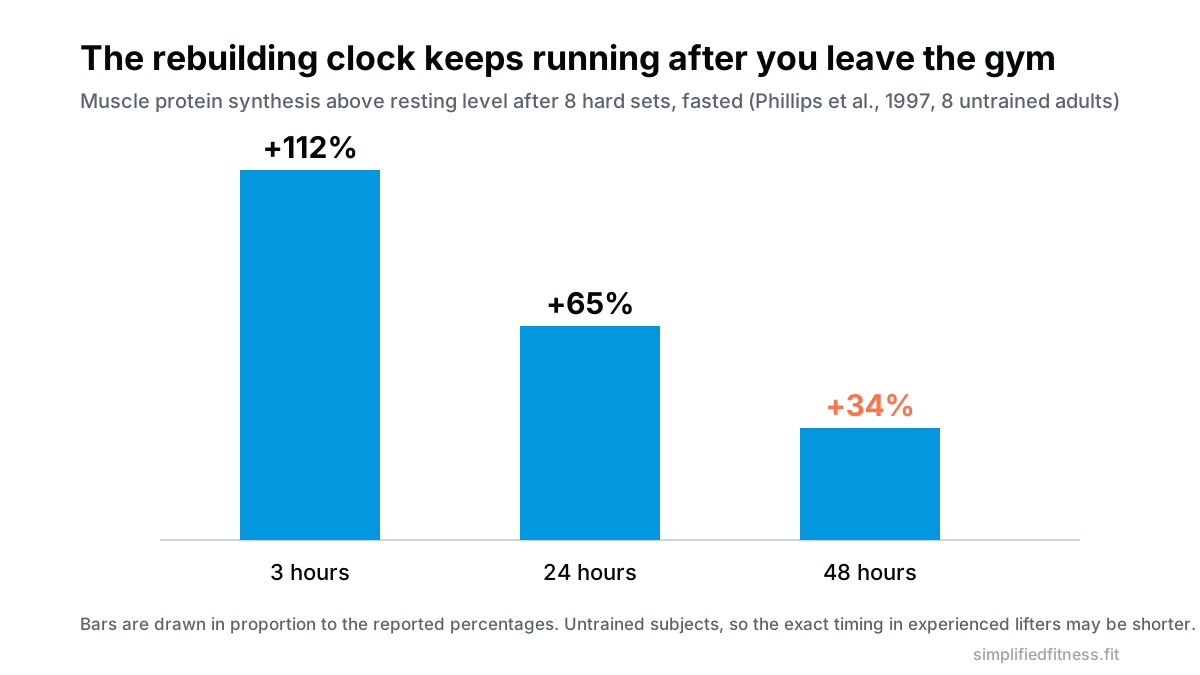
Two limits matter here. The eight volunteers were untrained, and they were studied fasted. In experienced lifters the response is usually thought to be shorter, and in the fasted state net balance stayed negative even though it improved. So eating protein across the day matters just as much as the timing.
What happens in your body on a rest day?
Several things run in parallel, each on its own schedule. Here is the short tour.
Muscle protein synthesis keeps going
This is the “myofibrillar accretion” bit, in plain terms: your muscle keeps laying down new contractile protein, using the amino acids from your meals. Dal, paneer, curd, eggs, soya chunks, chicken. Whatever your protein sources are, a rest day is not the day to under-eat them. Our protein calculator will give you a daily target that applies to training and rest days alike.
Glycogen gets restocked
Hard training burns through muscle glycogen. A 2017 review describes recovery as biphasic: in the first 4 hours, glycogen depletion itself drives resynthesis and about 1 g/kg of carbohydrate optimizes it. In the later phase (4 to 24 hours), total carbohydrate intake matters more than the type, form or pattern of eating (Burke et al., 2017).
Practical translation: roti, rice, poha, oats, bananas and potatoes on your day off are not “wasted carbs”. They are the refill.
Tendons and connective tissue remodel
Muscles get the attention, but tendons and the connective tissue inside muscle are adapting too. In a 2005 study, young men did one hour of one-legged kicking exercise. Collagen synthesis in the patellar tendon and in muscle, plus myofibrillar and sarcoplasmic protein synthesis, all rose and peaked at about 24 hours. By 72 hours most rates were heading back to baseline, though tendon collagen and myofibrillar synthesis were still raised (Miller et al., 2005).
The authors describe this as coordinated adaptation of muscle and tendon. Caveat: it was a small study (8 and 6 men) of non-damaging kicking, not heavy barbell work, so treat the exact timing as approximate.
Your nervous system settles
Heart rate variability (HRV) is a rough readout of how your autonomic nervous system is coping. In a 2019 study, ten men with over a year of lifting experience did six sets to failure at 90% of their 10RM on squat, bench press and pull-down. Morning HRV was back to baseline by 24 hours. Jump power and bar speed were back by 48 hours. Perceived recovery and soreness were still suppressed at 48 hours (Flatt et al., 2019).
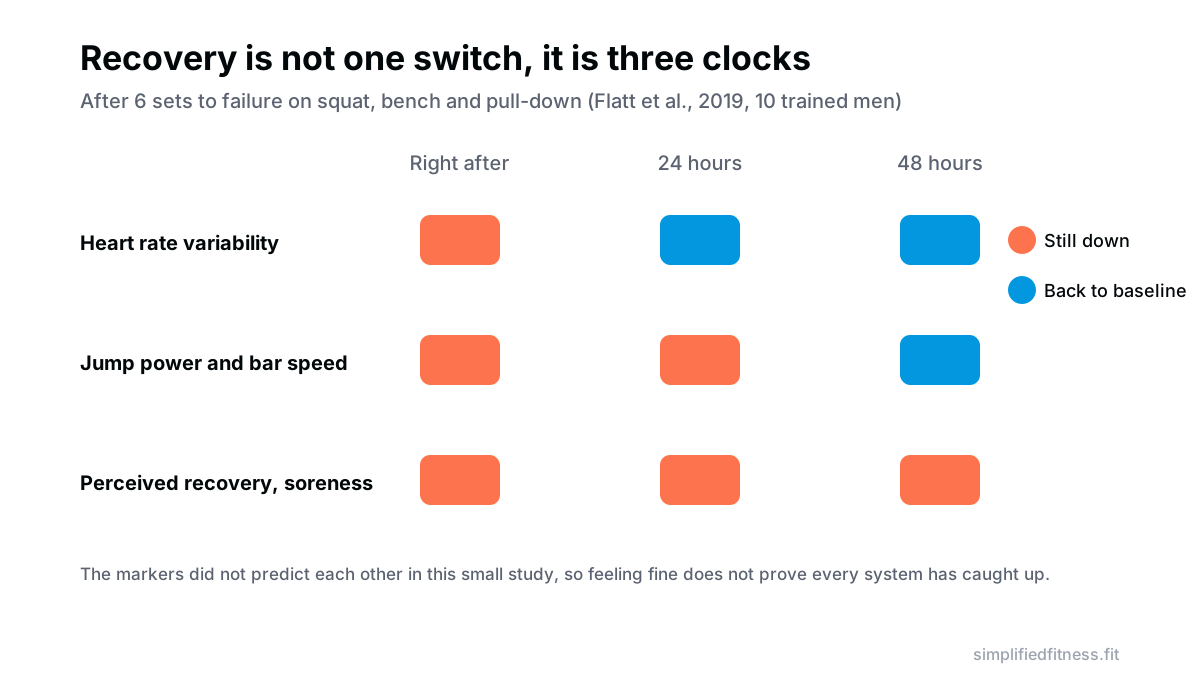
The same study found the changes did not predict each other. HRV looking normal did not mean your legs were ready. Ten people is a small sample, so use it as an illustration, not a rule.
Mental load drops
This one is the least studied. The ACSM and ECSS consensus statement on overtraining lists mood disturbance and fatigue among the signs of prolonged maladaptation when training and recovery are out of balance (Meeusen et al., 2013). It is reasonable to think a planned day off helps your motivation. We just do not have strong data showing exactly how much.
How many rest days per week do natural lifters need?
Here is where the confident gym advice runs ahead of the evidence.
A 2019 meta-analysis of 25 studies found no significant difference between higher and lower training frequency when volume was equated, including in resistance-trained people and for both upper and lower body. When volume was not equated, higher frequencies did show a modest edge, probably because they allowed more total work (Schoenfeld et al., 2019). The authors concluded that frequency per muscle group can be chosen by preference.
Volume itself does matter. A 2017 meta-regression found a graded relationship: more weekly sets were linked to more muscle growth, with each extra set associated with about a 0.37% bigger gain (Schoenfeld et al., 2017). But more sets only help if you can recover from them.
Put those together and you get the real answer: rest days are a tool for sustaining your volume, not a magic number. For most people that looks like this:
| Weekly plan | Typical rest days | Who it suits |
|---|---|---|
| 3 full-body sessions | 4 | Beginners, busy schedules |
| 4-day upper/lower | 3 | Most intermediate lifters |
| 5-day split | 2 | Experienced, good sleep and food |
| 6-day push/pull/legs | 1 | Only if recovery genuinely keeps up |
This table is coaching convention, not research output. If you are unsure, start at the lower-frequency end and add a session only when your numbers and energy are climbing. Our free push pull legs plans and the training volume calculator can help you check your weekly sets.
What about the guilt?
The guilt usually comes from a quiet assumption: more gym time equals more progress. The data does not say that.
Think of it this way. A rest day is not a gap in your plan, it is part of your plan. Your programme only works if the rebuilding gets finished before the next hard session. Skipping that part is like adding weight to the bar while forgetting to eat.
A common pattern is stacking 6 or 7 half-hearted sessions a week instead of 4 focused ones. The frequency research above suggests the extra days are not what drives growth. The quality and total number of hard sets is.
Will a break make me lose muscle?
Not a single day, and not even a longer one in a way that matters much.
In a 2024 randomized trial of 55 healthy untrained adults (42 finished), one group trained for 10 weeks, stopped for 10 weeks, and trained for 10 more, while a comparison group did one continuous 20-week block after a non-training period. Strength and muscle size fell during the break, then came back rapidly once training resumed, and both groups ended with similar gains (Halonen et al., 2024). The authors suggest trainees should not worry much about occasional short breaks.
Participants were untrained, so experienced lifters may behave differently. Still, if ten weeks off is recoverable, one Sunday is not a threat.
How do I know if I need more rest?
Rest-day need is individual. A sensible way to read your body:
- Lifts feel heavy even after a proper warm-up
- Reps fall across two or three sessions in a row
- Sleep gets worse, resting heart rate feels off, or mood drops
- Joint aches that do not settle with a day off
One bad day is noise. A trend over 2-3 weeks is a signal. Because recovery markers do not always agree, as the 2019 HRV study showed, look at several signals together. Our RIR and RPE calculator helps you track how hard sets actually feel.
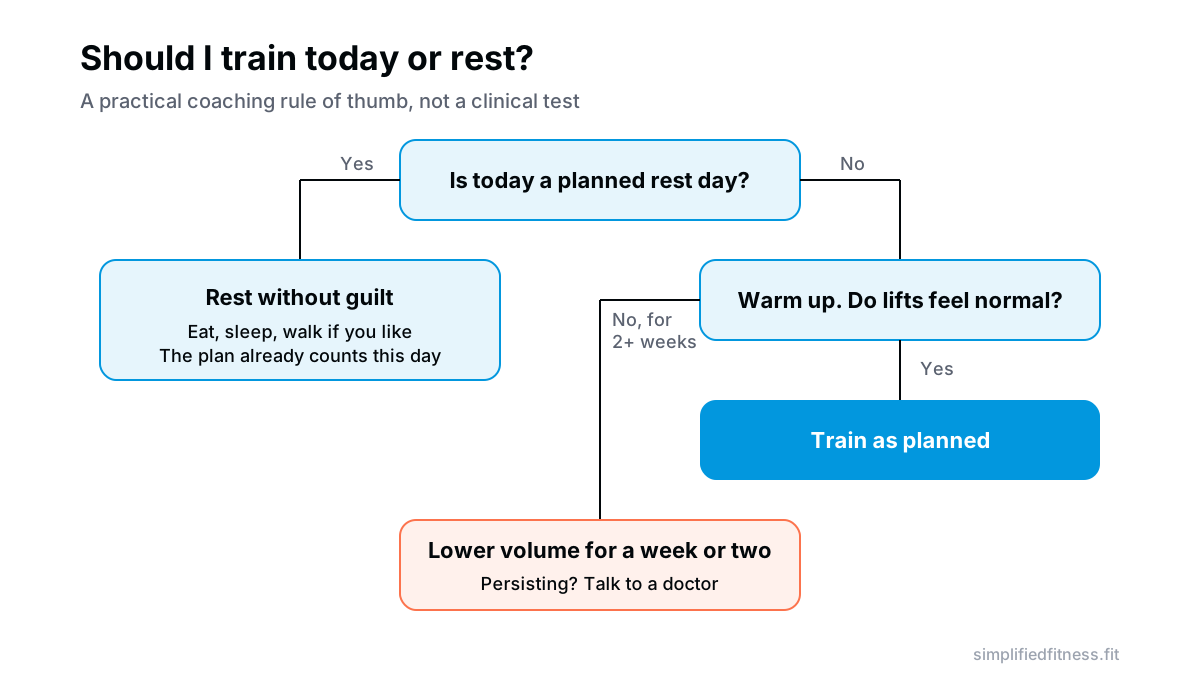
The ACSM and ECSS statement separates normal functional overreaching, where short-term performance dips are followed by improvement after rest, from nonfunctional overreaching and overtraining syndrome, which involve prolonged maladaptation. It also notes that no single marker is accepted for diagnosing it (Meeusen et al., 2013). It is unlikely in most recreational lifters, but if low energy, poor performance and low mood last for weeks despite rest, see a doctor. Do not assume it is just training fatigue, since other causes need ruling out.
Should I do active recovery or rest completely?
We cover this properly in active recovery modalities. The short version: gentle walking is fine and easy to fit into an Indian summer evening, but you do not need it. If you are drained, a lazy day is also a valid rest day.
For related reading, see how sleep architecture shapes growth hormone release, why CNS fatigue is often mislabeled, and how psychological stress slows recovery.
A simple rest-day checklist
- Eat your normal protein target. Do not cut it because you did not train.
- Keep carbohydrates in your meals (rice, roti, oats, fruit) to support glycogen.
- Sleep as you would on a training night. Sleep is a big part of recovery, not an extra.
- Walk if you feel like it. Skip it if you do not.
- Do not use the day to sneak in a “light” session that turns hard.
- Note how you feel before the next session, then decide whether the plan needs tweaking.
The bottom line
Rest days are when your body finishes the job your workout started. Protein synthesis, glycogen refilling, tendon remodeling and nervous system recovery all keep running after you leave the gym, each on its own timeline. No one can honestly promise you a perfect number of rest days, but the research supports a clear principle: protect your ability to train hard and consistently. A planned day off is part of that, not a failure of discipline.
Frequently Asked Questions
Do you actually grow on rest days?
Largely, yes. Muscle protein synthesis stays elevated for roughly 24 to 48 hours after a hard session, so much of the rebuilding happens while you are not lifting. This was measured in untrained adults, so timing in experienced lifters may differ. Eat enough protein on rest days so that rebuilding has the raw material it needs.
How many rest days per week do natural lifters need?
There is no single proven number. A meta-analysis found that when weekly volume is equal, training a muscle more or less often did not meaningfully change growth, so rest days are about managing fatigue rather than hitting a magic count. Most lifters do well with 1 to 3 days off depending on their split, and the rest-day plan should be one you can repeat for months.
Is it bad to take a rest day every other day?
No. A lifter training three or four days a week gets plenty of rest days and can still make good progress. Studies comparing frequencies with volume matched found similar growth, so a lower-frequency plan is not a handicap. Put more effort into hard, well-recorded sessions rather than adding extra days.
Will I lose muscle if I take a day off?
No, a single day off will not cost you measurable muscle. Even a 10-week break in a 2024 trial caused only a temporary loss of strength and size in beginners, which came back quickly once training resumed. Treat a day off as part of the plan, not a leak in it.
What happens to muscle on a rest day?
Your body keeps building new muscle proteins, replaces glycogen from the food you eat, and remodels collagen in tendons and muscle connective tissue. In a 2005 study of young men, collagen and muscle protein synthesis both peaked about 24 hours after a hard session. Eat well and sleep properly so these processes are fully supported.
Should I feel guilty about taking a rest day?
No. Rest is when the adaptation to your training is completed, so a planned day off is part of the work. Guilt often comes from treating the number of gym days as a score. Judge your week by progress in strength, reps and consistency instead.
How long does glycogen take to refill?
It depends mostly on how much carbohydrate you eat. A 2017 review describes a fast early phase in the first 4 hours and a later phase up to 24 hours where total carbohydrate intake matters more than type or timing. Include rotis, rice, oats or fruit across your rest-day meals rather than cutting carbs on days off.
Is active recovery better than complete rest?
Neither has been shown to be clearly superior for muscle growth, and easy walking is fine if you enjoy it. It keeps you moving without adding meaningful training stress when kept gentle. If you feel flat, a full day on the sofa is a perfectly good choice too.
How do I know if I need an extra rest day?
Warning signs are lifts that feel heavier than normal despite a good warm-up, falling reps for several sessions, poor sleep, low mood, and aches that do not settle. Recovery markers do not always agree with each other, as a 2019 study found, so look at several signals rather than one. Take a lighter week, and see a doctor if symptoms last more than a few weeks.
What is overtraining and how is it different from being tired?
Normal tiredness after hard training clears with rest, and short-term performance dips can be followed by improvement. Overtraining syndrome is a prolonged decline in performance and mood that does not resolve with usual rest, and a joint ACSM and ECSS statement says there is no single marker to diagnose it. It is rare in recreational lifters, but ongoing symptoms deserve a medical check.
Do I need to eat less on rest days?
Not by much. Your body is still rebuilding muscle and refilling glycogen, so cutting protein or carbohydrate heavily on rest days works against recovery. Keep protein steady, and trim calories only slightly if you are cutting.
Can I train a different muscle group on my rest day?
Yes, that is how most splits work, because a muscle rests while others train. Rest days are for full-body fatigue from hard sets, joint stress and mental load. If your total weekly volume is manageable, a push, pull, legs split rotates local fatigue without needing extra full rest.
Do rest days help with mental burnout?
Probably, though this is less well studied than muscle recovery. Overtraining statements list mood disturbance as part of prolonged maladaptation, so mental fatigue is a signal worth taking seriously. A planned day off often makes the next session feel better, which is what most lifters notice.
Sources & References
Every claim above is checked against peer-reviewed research (PubMed, U.S. National Library of Medicine) or guidance from established health bodies. How we fact-check.
- Phillips SM, et al. Mixed muscle protein synthesis and breakdown after resistance exercise in humans. Am J Physiol. 1997. PMID: 9252485
- Miller BF, et al. Coordinated collagen and muscle protein synthesis in human patella tendon and quadriceps muscle after exercise. J Physiol. 2005. PMID: 16002437
- Burke LM, et al. Postexercise muscle glycogen resynthesis in humans. J Appl Physiol. 2017. PMID: 27789774
- Flatt AA, et al. Heart Rate Variability, Neuromuscular and Perceptual Recovery Following Resistance Training. Sports (Basel). 2019. PMID: 31635206
- Schoenfeld BJ, et al. How many times per week should a muscle be trained to maximize muscle hypertrophy? A systematic review and meta-analysis of studies examining the effects of resistance training frequency. J Sports Sci. 2019. PMID: 30558493
- Schoenfeld BJ, et al. Dose-response relationship between weekly resistance training volume and increases in muscle mass: A systematic review and meta-analysis. J Sports Sci. 2017. PMID: 27433992
- Halonen EJ, et al. Does Taking a Break Matter-Adaptations in Muscle Strength and Size Between Continuous and Periodic Resistance Training. Scand J Med Sci Sports. 2024. PMID: 39364857
- Meeusen R, et al. Prevention, diagnosis, and treatment of the overtraining syndrome: joint consensus statement of the European College of Sport Science and the American College of Sports Medicine. Med Sci Sports Exerc. 2013. PMID: 23247672

Umair Hazrami · Founder & Head Coach, Simplified Fitness
Umair Hazrami founded Simplified Fitness and the Simplified Lifter channel to cut through fitness noise. With 4+ years of consistent training and 10+ coaching clients, he writes every guide from the peer-reviewed research and links the sources so you can check them. Our editorial standards.
Educational content only, not medical advice. If you have a medical condition, are pregnant, or take medication, talk to a qualified doctor before changing your diet, supplements or training. Full disclaimer.
Keep reading

Recovery
Active Recovery on Rest Days: Walking, Light Cycling and Mobility
Active recovery vs passive rest for lifters: what the research says about walking, light cycling and mobility, plus a 20-minute rest day routine you can copy.
7 min read

Recovery
Afternoon Caffeine Cutoff: Half-Life, Deep Sleep and Pre-Workout
Afternoon caffeine cutoff for lifters: how caffeine's half-life cuts sleep time and deep sleep even if you fall asleep fine, plus a practical cutoff by bedtime.
9 min read

Recovery
Blue Light, Melatonin and Screen Time: Do Blue-Blockers Actually Help You Sleep?
Blue light screen time melatonin suppression is real, but do blue-blocking glasses fix it? See what the trials found and the free fixes that matter more.
7 min read

Recovery
Is Your CNS Fried? CNS Fatigue vs Plain Lethargy in the Gym
Is my CNS fried from lifting? See what central fatigue really is, how fast it recovers and how to tell it from low motivation or poor sleep. Studies linked.
9 min read