Pre-Bed Eating and Sleep Quality: Do Late-Night Carbs or Protein Disrupt Sleep?
Does eating before bed ruin sleep? Research on late-night carbs, protein and heavy meals, plus when to stop eating and what to snack on if you train.

TL;DR. The short answer
- A small snack before bed does not appear to harm sleep in trained people. In a 2026 crossover trial in 21 elite female athletes, 40 g (160 kcal) of casein, alpha-lactalbumin or carbohydrate 30 minutes before bed left sleep time, onset and efficiency unchanged versus placebo.
- A full meal close to bedtime is the more likely problem, mainly for people prone to reflux. In one trial of reflux patients, a meal 2 hours before bed caused more lying-down acid reflux than the same meal 6 hours before, though an older trial found no difference.
- Carbohydrate is not a proven sleep aid. One small trial found a high-GI rice meal 4 hours before bed shortened time to fall asleep (9.0 vs 17.5 minutes), but a trial in basketball players found no effect, and the tryptophan explanation is weak.
- Aim to finish your main meal about 2-3 hours before sleep. If you are hungry or lifting hard, add a small protein-plus-carb snack rather than skipping food.
- Frequent night-time heartburn, waking with a sour taste or choking, or sleep that stays poor despite good habits is worth a doctor visit.
Part of our complete guide: Sleep, Circadian Timing & Systemic Recovery: How Lifters Maximize Anabolic Rest & CNS Recovery
Table of contents
Eating before bed does not automatically wreck your sleep. A small snack, even one with protein or carbohydrate, seems fine for most trained people, while a big, heavy, late meal is what tends to cause trouble. Research on eating before bed and sleep quality is thinner than gym forums suggest, so this guide separates what is actually shown from what is repeated.
This article sits inside our wider guide to sleep, circadian timing and recovery. It focuses on the plate, not the pillow.
Short version: finish your main meal about 2-3 hours before bed, keep any bedtime snack small, and do not fear a modest snack. Now the detail.
Does eating before bed ruin sleep?
It depends on what and how much you eat, and on your stomach.
Three different things get mixed up in this debate:
- A large meal close to bedtime. This can cause reflux and discomfort in people who are prone to it.
- A small snack before bed. Studies in athletes show it does not seem to harm sleep.
- A specific food that supposedly makes you sleepy. This is where the claims get shakier.
Most online arguments treat these as one question. They are three.
What does a heavy late meal do to sleep?
The cleanest evidence here is about reflux, not sleep stages.
In a randomized crossover trial of 30 patients with typical reflux symptoms, the same standard meal was eaten either 6 hours or 2 hours before bed. After the late meal there was significantly more reflux while lying down, especially in overweight patients and those with a hiatal hernia or esophagitis. Total symptom scores did not differ between the two days (Piesman et al., 2007). The authors concluded that eating dinner early supports advice given to reflux patients.
Not every study agrees. In an older experiment of 20 symptomatic reflux patients, a late non-provocative meal at 9 pm did not significantly change the number or duration of reflux events, acid exposure or sleep stage percentages compared with an early meal. The authors concluded that in some patients a late non-provocative meal may not increase reflux (Orr and Harnish, 1998).
Why might these differ? Different meals (the word “non-provocative” matters), small samples, and patients with different anatomy. A greasy biryani is not a bowl of oats.
Both trials were in people with reflux symptoms. They tell you what happens in a sensitive stomach, not what happens in every healthy lifter. If you have no heartburn, a late dinner may cost you little. If you do, timing and meal size are the first things to adjust.
There is also a bigger-picture pattern. In a survey of 2,050 Brazilian adults, each extra hour of later evening eating clock time was linked with higher odds of sleeping under 7 hours (odds ratio 1.30), taking over 30 minutes to fall asleep (1.14), poor sleep quality (1.21) and insomnia (1.12). The shortest sleep latency was seen when evening eating happened around 8 pm, roughly 7-8 hours before the midpoint of sleep (Nunes et al., 2024). That is an association from a survey, so it cannot prove that late eating causes poor sleep. People who eat late may also sleep late, work shifts or stress eat.
Do late-night carbs help you sleep?
You may have heard that carbs before bed “make you sleepy” by raising tryptophan in the brain. The truth is more complicated.
What one trial found. In a small crossover study, 12 healthy young men ate a very high-carb rice meal (90% of energy from carbohydrate). A high-GI jasmine rice meal 4 hours before bed shortened the time to fall asleep to 9.0 minutes, versus 17.5 minutes after a low-GI meal at the same time. The same high-GI meal only 1 hour before bed gave 14.6 minutes. No other sleep variables changed (Afaghi et al., 2007).
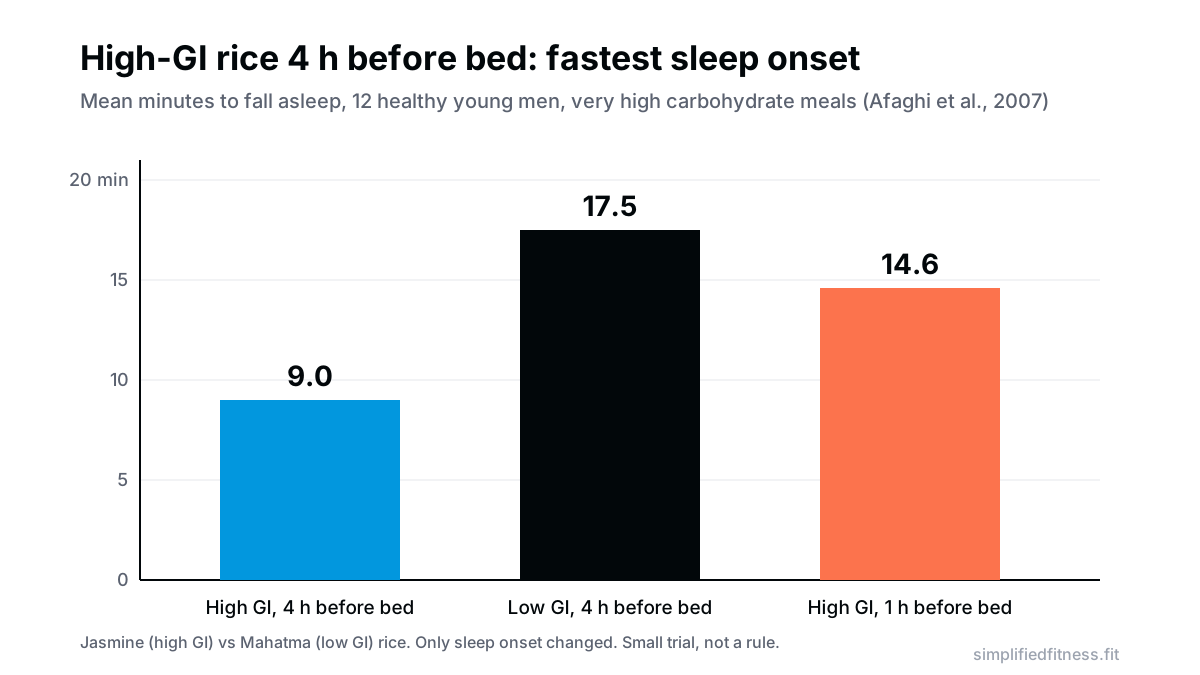
What another trial found. In nine basketball players eating high-carbohydrate dinners and snacks with either high or low GI, there was no difference in sleep or in salivary melatonin and cortisol. Total daily energy intake correlated with poorer sleep efficiency and shorter night sleep, regardless of GI (Daniel et al., 2019).
Why they may differ. Different populations, different meals (a single rice-only dinner versus real mixed meals), and very small samples. The first trial was a lab study with an unusual all-rice meal, the second looked at real match-week eating.
Is the tryptophan explanation true? A 2022 review argued it is shaky. Carbohydrate can raise tryptophan uptake into the brain, but the authors say this only occurs at such low protein intakes that it is not relevant to a normal diet, and the melatonin dose needed to affect sleep cannot credibly come from food. They also noted a meta-analysis in which lower carbohydrate intake was followed by more slow-wave sleep and less REM sleep (Benton et al., 2022). So the mechanism is debated, and the effect, if real, may not be a serotonin story at all.
Practical takeaway: carbs are not a proven sleep aid. If you like rice or roti at dinner, there is no strong reason to cut them for sleep’s sake, and no strong reason to add more either.
Does eating carbs before bed ruin growth hormone?
This worry is common in bodybuilding circles: carbs raise insulin, insulin blunts growth hormone, so a bedtime snack “kills” your overnight gains.
We did not find trial evidence in the sources reviewed for this article showing that a modest pre-bed snack harms muscle growth through hormones. The studies we did find on pre-sleep food measured sleep outcomes and overnight protein metabolism, and the pre-sleep protein research points toward a small benefit, not harm (more below). For the real story of deep sleep and growth hormone, see our article on sleep architecture, slow-wave sleep and growth hormone.
Practical position: sleep length, total protein and hard training matter far more than whether a banana sits in your stomach at 10:30 pm. Absence of evidence is not proof, so if you want a belt-and-braces approach, just keep the snack small.
Is protein before bed bad for sleep?
No evidence says so, and the newest trial is reassuring.
In a randomized, double-blind crossover trial, 21 NCAA Division I female athletes took 40 g of casein, 40 g of alpha-lactalbumin, 40 g of carbohydrate or a placebo (each 160 kcal except placebo) for three consecutive nights, about 30 minutes before bed. Sleep time, onset latency, efficiency, resting heart rate and heart rate variability, plus subjective sleep quality and recovery, did not differ between conditions. The authors concluded that pre-sleep feeding, regardless of macronutrient, did not impair sleep or recovery (Paterson et al., 2026). Caveats: it was only three nights per condition, the participants were young elite women, and the sleep data came from a wearable (WHOOP 4.0), which is less precise than lab sleep studies.
So protein is not a sleep disruptor in this trial, but it is not a sleep booster either. Hoping a tryptophan-rich whey will fix poor sleep is optimistic.
Does pre-bed protein help muscle?
That is a separate question, and it is covered in depth in our articles on pre-bed protein and overnight anabolism and micellar casein before sleep. The headline from a systematic review of nine studies: 20-40 g of casein about 30 minutes before sleep stimulated protein synthesis overnight in healthy young men, and over 10-12 weeks of resistance training it may augment gains in muscle fibre size, strength and muscle mass in young men. In older men the long-term evidence was too limited to conclude. The reviewers also cautioned that protein intakes were uneven between groups in some of the studies (Reis et al., 2021).
Takeaway: pre-bed protein can be a useful extra if you struggle to hit your daily protein target. It is not mandatory. Get your total daily number right first with the protein calculator.
When should you stop eating before bed?
There is no single proven cut-off, but the evidence points to a practical window.
| Situation | Practical guideline | Why |
|---|---|---|
| Full dinner (roti or rice, dal, sabzi, paneer or chicken) | Finish 2-3 hours before bed | Gives the stomach time to empty; reflux was higher at 2 h than at 6 h in sensitive patients |
| Small snack (150-300 kcal) | 30-60 minutes before bed is usually fine | Snacks of about 160 kcal did not impair sleep in athletes |
| Prone to heartburn or reflux | Finish 3+ hours before, smaller and lower-fat | Late meals raised lying-down reflux in a trial of patients |
| Late training (9 pm or later) | Eat a moderate protein-led meal when hungry, then sleep | Skipping food after hard training is rarely the better trade |
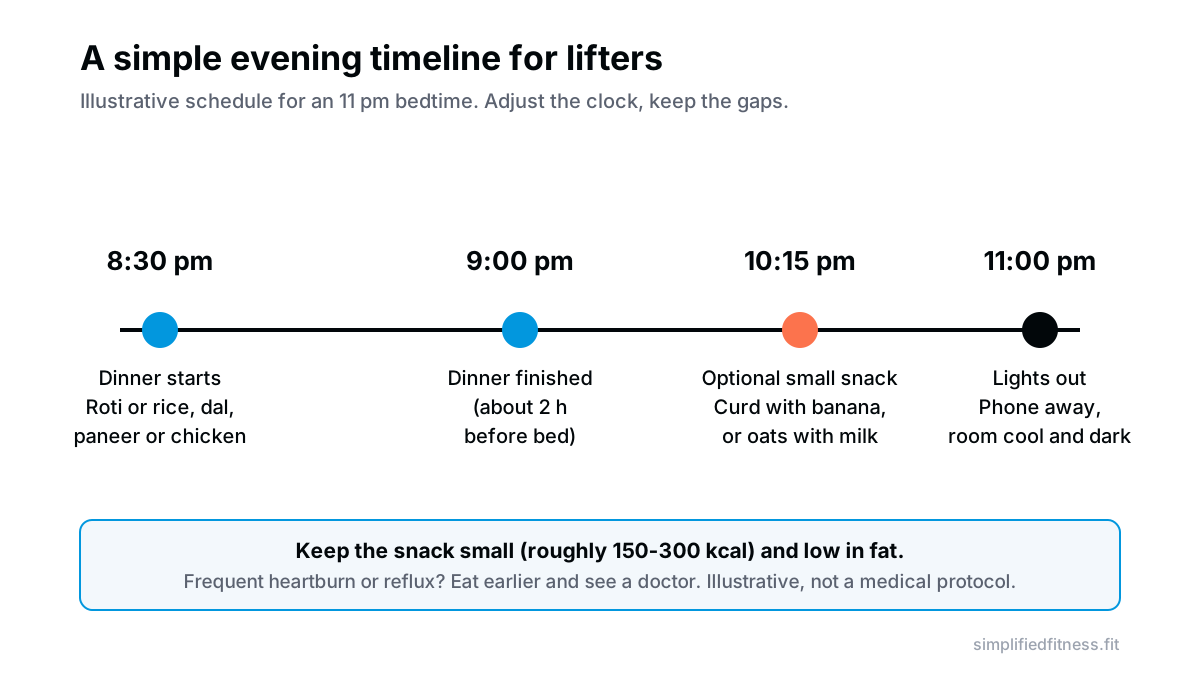
These numbers are practical rules of thumb built from the studies above, not a clinical protocol. Individual digestion varies a lot, so use them as a starting point and adjust to how you feel.
What should you eat before bed? Snacks for lifters
If you are hungry, or you are chasing a high protein target, pick something small, low in fat and easy on the stomach.
Good options in an Indian kitchen:
- Curd (dahi) with half a banana. Protein plus a simple carb. Cheap and easy to digest.
- A glass of warm milk and a handful of oats. Pairs casein-rich milk with slow carbs.
- A small bowl of oats cooked in milk.
- Paneer or hung curd with a few chana pieces. More protein, still light.
- A scoop of casein or whey in water or milk if you use powder.
What to avoid close to bed if you have reflux or sleep problems: deep-fried food, creamy gravies, very spicy meals, big portions and alcohol. Alcohol can feel sedating, but it is widely linked to more broken sleep later in the night, so it should not be part of any sleep strategy.
Common mistakes
Other common patterns worth checking:
- Skipping dinner out of fear then waking up starving at 3 am. Lying awake hungry does not help your sleep either.
- Chasing a “sleep food.” Bananas, almonds and warm milk are fine snacks, but no single food has been shown to fix poor sleep.
- Blaming food when the real problem is caffeine, screens or an irregular schedule. Check our afternoon caffeine cutoff guide and the sleep hygiene checklist for lifters before overhauling your dinner.
- Eating more in total on late nights. In the basketball study, higher total daily energy intake correlated with poorer sleep efficiency. Big overall days seem to cost sleep, whatever the timing.
When to see a doctor
Food tweaks are for ordinary sleep and ordinary indigestion. See a doctor if you:
- have heartburn or acid regurgitation more than a couple of times a week
- wake choking, coughing, or with a sour or burning throat
- have trouble swallowing, unexplained weight loss, or black stools
- have loud snoring with daytime sleepiness (this can point to sleep apnoea)
- sleep badly for weeks despite good habits
None of the studies above are a substitute for individual medical advice, and this article cannot diagnose you.
The bottom line
Eating before bed is not the sleep villain it is made out to be. A heavy, fatty meal close to bedtime can cause reflux and discomfort in people prone to it. A small snack, including protein, does not appear to disrupt sleep in trained athletes. Carbohydrate as a sleep aid has mixed, small and limited evidence, and the tryptophan explanation is doubtful.
So: finish dinner 2-3 hours before sleep, keep any late snack small and easy to digest, and spend your real effort on sleep duration and consistency. For the full picture of how sleep fits into recovery, return to our sleep and recovery guide.
Frequently Asked Questions
Does eating before bed ruin sleep?
Not necessarily. A small snack does not seem to hurt sleep, while a large late meal can, mostly because lying down soon after eating increases reflux in people prone to it. Finish big meals 2-3 hours before bed and keep any bedtime snack small.
How long before bed should I stop eating?
About 2-3 hours for a full meal is a practical target. In a trial of reflux patients, eating 2 hours before bed caused more supine acid reflux than eating 6 hours before, and a large survey linked later evening eating with worse sleep. A snack 30-60 minutes before bed is usually fine if it is small.
Do late night carbs help you sleep?
The evidence is mixed. One small trial in 12 young men found a high-glycaemic rice meal 4 hours before bed shortened sleep onset, but a trial in nine basketball players found no sleep difference between high and low GI evening meals. Treat carbs as a possible small help, not a sleep fix.
Does eating carbs before bed raise tryptophan and melatonin?
The popular story is that carbs raise brain tryptophan, which becomes serotonin and then melatonin. A 2022 review argued this only happens at very low protein intakes, not in a normal diet, and that food cannot supply a melatonin dose large enough to matter. Do not pick a bedtime snack for its melatonin effect.
Does eating carbs before bed stop growth hormone release?
There is no good evidence that a modest pre-bed snack ruins your muscle-building hormones. The research reviewed here measured sleep and overnight protein metabolism, not a growth hormone penalty from a small snack, and muscle gain depends far more on training, total protein and sleep duration. Do not skip a small snack out of fear of this myth.
Is protein before bed bad for sleep?
No. In 21 elite female athletes, 40 g of casein or alpha-lactalbumin 30 minutes before bed did not change sleep time, sleep efficiency, resting heart rate or subjective sleep quality versus placebo. Try 20-40 g if you need the protein, and watch how you feel.
What is the best snack to eat before bed for sleep?
A small, low-fat mix of protein and carbohydrate is the sensible choice. Good Indian options are curd with a banana, a glass of milk with a few oats, or a small bowl of oats. Keep it to roughly 150-300 kcal and eat it 30-60 minutes before lights out.
Does eating before bed cause weight gain?
Food timing itself matters less than total daily calories. A snack that fits within your daily target does not cause fat gain just because it is eaten at night, but mindless late-night eating on top of a full day can push you over. Plan the snack into your daily calories and protein.
Can a heavy dinner affect sleep stages?
It may, but the data are limited. Large late meals are linked with reflux, discomfort and later sleep onset, and observational data show worse sleep with later evening eating. Studies in this area are mostly small or observational, so keep dinner moderate and earlier.
Is eating before bed good for muscle growth?
It can help a little. A systematic review found 20-40 g of casein about 30 minutes before sleep raised the overnight protein synthetic response in healthy young men, with possible gains in muscle and strength over 10-12 weeks of training. Total daily protein still matters most, so treat it as an optional extra.
What should I do if I get acid reflux at night?
Eat your last meal earlier, keep it smaller and lower in fat, and avoid lying flat straight after eating. Meal timing helped in a trial of reflux patients, but individual responses vary. If heartburn happens more than a couple of times a week, see a doctor rather than self-treating.
I train at 9 pm. When should I eat?
Eat a normal-sized post-workout meal as soon as you are hungry, ideally a couple of hours before sleep if you can. Late training pushes everything later, so a smaller, protein-led meal with some carbohydrate is easier to digest. If sleep suffers, move training earlier or reduce the size of the meal.
Sources & References
Every claim above is checked against peer-reviewed research (PubMed, U.S. National Library of Medicine) or guidance from established health bodies. How we fact-check.
- Afaghi A, et al. High-glycemic-index carbohydrate meals shorten sleep onset. Am J Clin Nutr. 2007. PMID: 17284739
- Daniel NVS, et al. Effect of the intake of high or low glycemic index high carbohydrate-meals on athletes' sleep quality in pre-game nights. An Acad Bras Cienc. 2019. PMID: 30994759
- Benton D, et al. Carbohydrate and sleep: An evaluation of putative mechanisms. Front Nutr. 2022. PMID: 36211524
- Piesman M, et al. Nocturnal reflux episodes following the administration of a standardized meal. Does timing matter? Am J Gastroenterol. 2007. PMID: 17573791
- Orr WC, et al. Sleep-related gastro-oesophageal reflux: provocation with a late evening meal and treatment with acid suppression. Aliment Pharmacol Ther. 1998. PMID: 9798810
- Reis CEG, et al. Effects of pre-sleep protein consumption on muscle-related outcomes: a systematic review. J Sci Med Sport. 2021. PMID: 32811763
- Paterson KGP, et al. Pre-sleep milk-derived proteins do not impair sleep or recovery in elite female athletes. J Int Soc Sports Nutr. 2026. PMID: 42897977
- Nunes MEB, et al. Association of evening eating with sleep quality and insomnia among adults in a Brazilian national survey. Sleep Sci. 2024. PMID: 39698174

Umair Hazrami · Founder & Head Coach, Simplified Fitness
Umair Hazrami founded Simplified Fitness and the Simplified Lifter channel to cut through fitness noise. With 4+ years of consistent training and 10+ coaching clients, he writes every guide from the peer-reviewed research and links the sources so you can check them. Our editorial standards.
Educational content only, not medical advice. If you have a medical condition, are pregnant, or take medication, talk to a qualified doctor before changing your diet, supplements or training. Full disclaimer.
Keep reading

Recovery
Active Recovery on Rest Days: Walking, Light Cycling and Mobility
Active recovery vs passive rest for lifters: what the research says about walking, light cycling and mobility, plus a 20-minute rest day routine you can copy.
7 min read

Recovery
Afternoon Caffeine Cutoff: Half-Life, Deep Sleep and Pre-Workout
Afternoon caffeine cutoff for lifters: how caffeine's half-life cuts sleep time and deep sleep even if you fall asleep fine, plus a practical cutoff by bedtime.
9 min read

Recovery
Blue Light, Melatonin and Screen Time: Do Blue-Blockers Actually Help You Sleep?
Blue light screen time melatonin suppression is real, but do blue-blocking glasses fix it? See what the trials found and the free fixes that matter more.
7 min read

Recovery
Is Your CNS Fried? CNS Fatigue vs Plain Lethargy in the Gym
Is my CNS fried from lifting? See what central fatigue really is, how fast it recovers and how to tell it from low motivation or poor sleep. Studies linked.
9 min read