Power Napping for Athletes: 20-Minute Power Naps vs 90-Minute Full Sleep Cycle Naps
A power nap for athletes can help recovery if you keep it short and early. See how 20, 30 and 90 minute naps compare, plus the coffee nap and timing rules.

TL;DR. The short answer
- A 10-20 minute nap early in the afternoon is the lowest-risk way to cut sleepiness and usually will not wreck your night sleep. Longer naps can help more in some studies but carry more grogginess.
- Waking up groggy is called sleep inertia. In one lab trial it appeared after 30-60 minute naps and had cleared within 30 minutes of waking.
- A 90-minute nap can suit a bad night or a hard session later that day, but the research on athletic performance is mixed and there is no proof it builds muscle by itself.
- A coffee nap (caffeine, then a 20-minute nap) beat nap-only for sleepiness in a small 2003 trial. Keep the caffeine dose modest and take it at least 9 hours before bed, earlier for bigger doses.
- If you need long naps every day, or you fall asleep unintentionally, talk to a doctor. Chronic sleepiness can signal a sleep disorder.
Part of our complete guide: Sleep, Circadian Timing & Systemic Recovery: How Lifters Maximize Anabolic Rest & CNS Recovery
Table of contents
A power nap for athletes is worth it when you are tired and it is short and early: 10-20 minutes before about 3pm is the safest default. A 90-minute nap can help after a very bad night, but it carries more grogginess and more risk to your sleep that night.
That is the quick answer. Below is how nap length changes what you get, how to avoid that heavy, confused feeling on waking, and where the “coffee nap” fits. This article sits inside our wider guide on sleep, circadian timing and systemic recovery, and it focuses on the practical daytime side.
Does a power nap help recovery and performance?
It can, but the evidence is less tidy than nap advocates make out.
A 2021 narrative review of napping and athletic performance concluded that studies are “equivocal.” Prevailing findings suggest that after a normal night or after sleep loss, a mid-day nap may enhance or restore several exercise and cognitive measures, and may improve how athletes feel before or during exercise (Botonis et al., 2021). The same review says that studies showing no benefit, or even worse performance after a nap, were likely hit by sleep inertia.
A 2023 systematic review of 25 sleep intervention studies in athletes named sleep extension and naps as the most representative and most effective strategies to improve sleep and performance (Cunha et al., 2023). Note that this is a review of mixed study designs, not a single clean trial.
Outside sport, a meta-analysis of 11 laboratory studies (381 adults, mean nap about 55 minutes) found cognitive performance improved after a nap, especially alertness, with effects lasting up to about 120 minutes (Dutheil et al., 2021). Those were working-age adults in lab conditions, not lifters in a gym, so treat it as supporting evidence.
Why sleep debt makes a nap more useful
Naps matter most when your night was short. A systematic review of 17 studies found that a single night of no sleep had little effect on muscle strength in resistance exercise, but several consecutive nights of restricted sleep could reduce force output in multi-joint lifts, though not single-joint movements. The review rated study quality as moderate or weak (Knowles et al., 2018).
Translation for the gym: a bad night will not necessarily wreck one session, but a week of five-hour nights can drag squats and deadlifts down. A nap is a patch for that gap. It is not a fix. For the longer-term picture, see what sleep restriction does to muscle and fat loss.
20-minute nap vs 90-minute nap: what is the difference?
Sleep moves through stages across the night. Light sleep comes first, then deeper slow-wave sleep, and REM later, and a full cycle is often described as roughly 90 minutes. If you want more detail on those stages, see sleep architecture and slow-wave sleep.
The practical logic follows from that:
- About 20 minutes: you stay mostly in lighter sleep, so waking is easier.
- About 90 minutes: you may reach deeper sleep and possibly REM, which can feel more restorative but is harder to wake from if the timing is off.
That tidy picture is a simplification. In a randomized trial of 32 young adults with short habitual sleep, naps of 10, 30 and 60 minutes all increased positive mood and reduced sleepiness for up to 240 minutes. Only the 30 minute nap improved memory encoding compared with staying awake. Sleep inertia showed up for 30-60 minute naps but cleared within 30 minutes of waking, and there was “no clear winning nap duration” (Leong et al., 2023). That trial did not test a 90 minute nap.
For athletes, the Botonis review noted that most but not all studies suggest longer naps (more than 35 up to 90 minutes) give superior benefits compared with 20-30 minute naps (Botonis et al., 2021). So here is the conflict, stated plainly:
- Shorter naps: easier to fit in, less grogginess, smaller but real benefits for alertness.
- Longer naps: sometimes bigger performance benefits, but more risk of inertia and more impact on your night sleep.
The cautious takeaway: default to 20-30 minutes, and use a long nap only on days you are properly short of sleep and have time to come round afterwards.
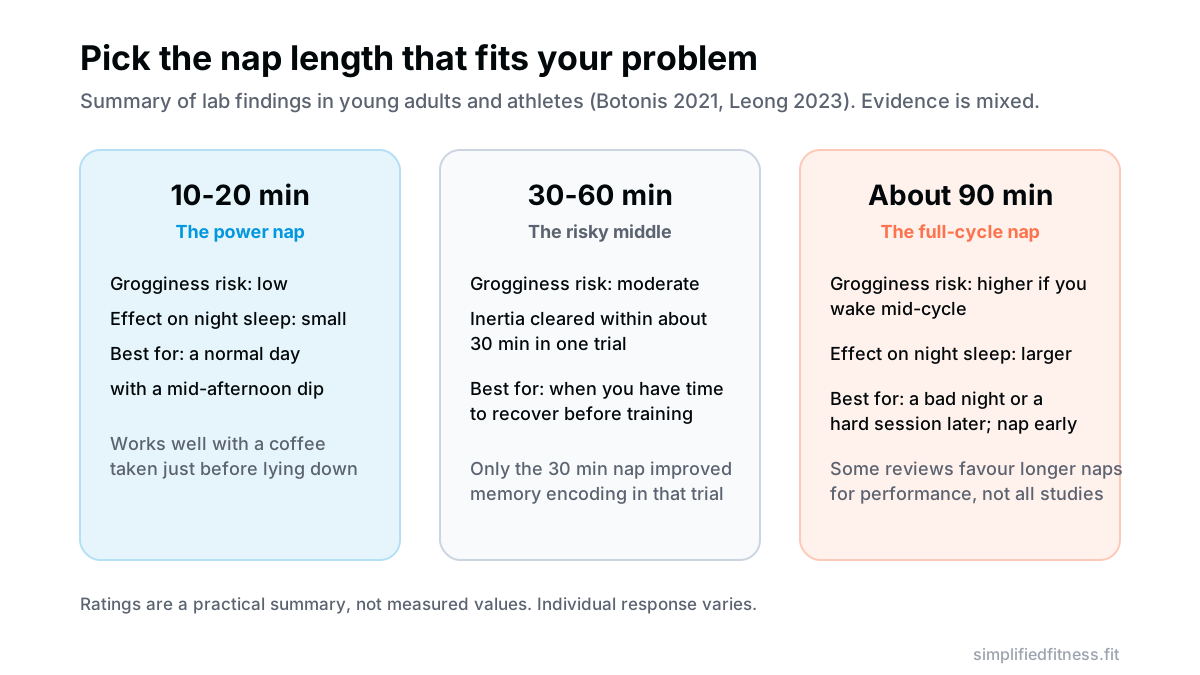
| Nap length | Grogginess risk | Best used when |
|---|---|---|
| 10-20 min | Low | Normal day, afternoon dip |
| 30-60 min | Moderate | You have 30 minutes to recover before training |
| About 90 min | Higher if you wake mid-cycle | Bad night, hard session later, plenty of time |
How to nap without waking up groggy
Sleep inertia is the foggy, slow feeling right after waking. It is worst when you are woken from deeper sleep.
Its effects are real in performance terms. In a lab study of simulated night shifts, a one-hour nap taken between 4 and 5 am was followed by slower reaction times and more lapses than no nap, even though people did not report feeling sleepier (Kubo et al., 2010). Those were 12 male students on a night-shift schedule, so it is not a direct model of a lifter’s afternoon nap, but it shows you can underperform without feeling it.
What helps in practice:
- Keep it to about 20 minutes unless you have a reason not to.
- Set an alarm so it does not drift into the awkward middle.
- Use light and water on waking. In the 2003 trial below, bright light and face washing after a short nap also reduced sleepiness, with face washing having milder and shorter effects (Hayashi et al., 2003).
- Leave a buffer of 20-30 minutes before a heavy lift.
- Do not worry if you do not fall asleep. Lying down with eyes closed still gives some rest.
What is the coffee nap?
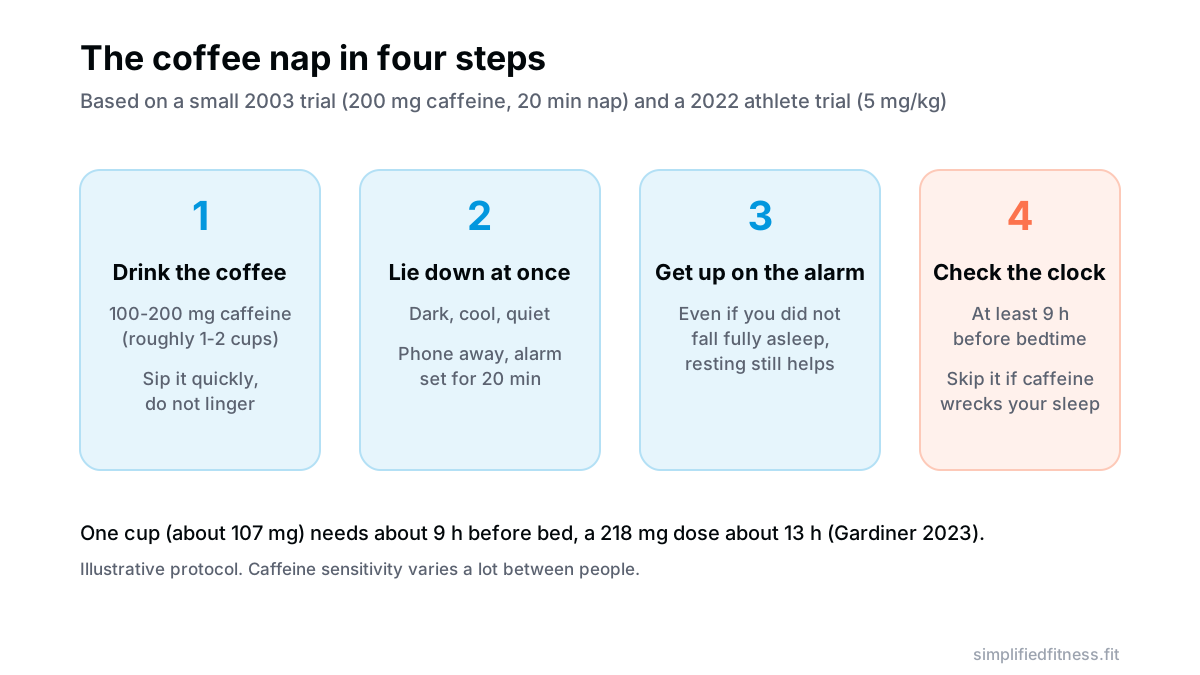
A coffee nap is exactly what it sounds like: caffeine first, then a short nap. Caffeine takes a while to kick in, so the idea is that it starts working around the time you wake.
In a small 2003 study, 10 young adults took a 20 minute nap at 12:40. Taking 200 mg of caffeine before the nap was the most effective option for subjective sleepiness and performance, and the effect lasted throughout the hour of testing after the nap. Bright light after the nap was comparable on sleepiness, and face washing helped mildly and briefly (Hayashi et al., 2003).
For athletes, a 2022 crossover trial in 14 highly trained men compared placebo, a 20 minute nap, 5 mg/kg caffeine, and both together. All treatments raised maximum and mean power on a running-based sprint test versus placebo, while caffeine (with or without a nap) gave better repeated-sprint results than the nap alone. Caffeine also raised creatine kinase, a muscle damage marker, whereas napping raised an antioxidant enzyme (Romdhani et al., 2022). It is a small study, so the lesson is modest: both tools can help, and caffeine looks stronger for sprint output.
A cup of chai or filter coffee has far less caffeine than a pre-workout, so check your total with the caffeine dosage calculator. If caffeine already makes you jittery, skip this trick.
Does a nap ruin your sleep at night?
It can, and the trap is often caffeine rather than the nap. A 2023 meta-analysis of 24 studies found caffeine reduced total sleep time by 45 minutes and shortened deep sleep, and suggested coffee should be taken at least 8.8 hours before bed, with a standard pre-workout at least 13.2 hours before (Gardiner et al., 2023).
If you sleep at 11pm, a one-cup coffee nap at 2pm leaves about 9 hours, which is right on that line. The 200 mg used in the 2003 trial is closer to the pre-workout serve, so by that estimate it would need to be taken in the late morning, not the afternoon. If you want an afternoon coffee nap, use a single cup. For a deeper look at the cut-off, see the afternoon caffeine cutoff.
A simple rule set:
- Nap before about 3pm. There is no exact nap cut-off in the research, so treat this as a sensible guideline. If the nap includes caffeine, go by the caffeine timing above instead, which is earlier.
- Keep it under 30 minutes if your night sleep is already fragile.
- Drop the nap for a week if you are lying awake at bedtime. If it fixes the problem, the nap was the cause.
When should a lifter nap?
Here is a practical decision guide, not a prescription:
- Normal sleep, afternoon slump: 10-20 minutes, before 3pm.
- Short night, session later: 20-30 minutes, or a longer nap if you have time to wake up fully, then finish 30 minutes before warming up.
- Training in the evening after work: an early afternoon nap is easier to protect than a late one. See circadian rhythms and afternoon strength peaks for why strength often peaks later in the day.
- Hot climate or long lunch gap: a short, dark, cool midday rest is a reasonable habit.
Naps do not replace the basics. If you need one every day, look at your night first with this sleep hygiene checklist.
Does napping build muscle?
Not directly. There is no solid evidence that napping itself drives muscle growth. Growth depends on progressive training, enough protein and sufficient total sleep. A nap helps indirectly if it lifts your alertness enough to make a session better. If you want a training plan that makes use of that energy, our push day is a good place to begin.
When to see a doctor
Occasional afternoon sleepiness is normal. But heavy daytime sleepiness despite 7-9 hours in bed, falling asleep without meaning to, loud snoring with gasping, or waking unrefreshed are not nap problems. They can point to a sleep disorder, and a doctor can check. This article is not a diagnosis tool.
The bottom line
Start with a 20 minute nap, an alarm, and a hard finish before about 3pm. Add caffeine only if you tolerate it, keep it to about one cup, and take it at least 9 hours before bed. Move to a longer nap only on days when you are properly short of sleep and have time to wake up before you train. Naps are a patch for a bad night, and a good night is still the real fix.
Frequently Asked Questions
Is a power nap good for athletes?
Often yes, especially after a short night. A 2021 narrative review found a mid-day nap may enhance or restore several exercise and cognitive performance measures, though the results across studies are mixed. Keep it short and early, and treat it as a backup to a proper night of sleep, not a replacement.
How long should a power nap be?
For most people 10-30 minutes is the practical sweet spot. In a 2023 trial of 32 young adults, naps of 10 to 60 minutes all improved mood and reduced sleepiness, and the authors judged a 30 minute nap the best trade-off between practicality and benefit. If grogginess is your main problem, stay closer to 20 minutes.
20 minute nap vs 90 minute nap: which is better?
It depends on the job. A 20 minute nap is easier to fit in and has less grogginess, while a review of athlete studies found that longer naps (35-90 minutes) often, but not always, gave superior benefits. Choose 20 minutes on a normal day and consider 90 minutes only when you are badly short on sleep and have time to wake up fully.
How do I nap without waking up groggy?
Cap the nap at about 20 minutes, or let a longer nap run long enough to leave time to recover before training. Grogginess after waking, called sleep inertia, was seen after 30-60 minute naps in a 2023 trial and cleared within 30 minutes. Set an alarm, get light and water straight after, and do not start a heavy lift for 20-30 minutes.
Does napping ruin your sleep at night?
It can, mainly when the nap is long or late. Napping uses up some of the sleep pressure that builds during the day, so you may feel less sleepy at bedtime. Keep naps short and finish them before about 3pm, and drop the nap if you notice you are lying awake at night.
What is a coffee nap and does it work?
A coffee nap means drinking caffeine and then immediately taking a short nap of about 20 minutes. In a small 2003 trial of 10 young adults, 200 mg of caffeine followed by a 20 minute nap was the most effective option for sleepiness and performance, and the effect lasted through the hour of testing. Try it once on a non-training day, and keep it early enough that the caffeine does not cut into your night.
Does napping help muscle growth?
There is no good evidence that napping directly builds muscle. Muscle growth depends on training, protein and total sleep, and a nap mainly helps by making up for lost sleep and improving alertness and training quality. Use a nap to protect a session that would otherwise be poor, not as a growth hack.
What is the best time of day to nap?
Early to mid afternoon is the usual window, roughly 1pm to 3pm for someone who sleeps around 11pm. A 2021 meta-analysis found a possible edge for early naps (before 1pm), though the confidence interval crossed zero, so that finding is not firm. Avoid napping after about 3pm if it makes falling asleep harder.
Should I nap before or after training?
Before is more useful when you are sleep-deprived, as long as you leave time to shake off grogginess. A review of athlete studies suggests the gap between waking and testing matters, because sleep inertia can cancel the benefit. Finish the nap at least 30 minutes before your warm-up.
Can a nap make up for a bad night of sleep?
Partly. Naps can reduce sleepiness and restore some performance after a short night, but they do not fully replace consolidated night sleep. Fix the cause of the poor night, and use the nap as a short-term patch.
Is it bad to need a nap every day?
Not necessarily, a planned short nap is a normal habit in many places. But needing long naps daily, or falling asleep without meaning to, can point to too little night sleep or a sleep disorder. See a doctor if sleepiness is heavy or persistent despite 7-9 hours in bed.
Does a nap work with a hot climate and late work hours?
Yes, a short midday rest is common in hot places for a reason, and it can fit a split schedule. Keep it dark and cool, and keep to 20-30 minutes. If you train late in the evening, an early afternoon nap is easier to protect than a late one.
Sources & References
Every claim above is checked against peer-reviewed research (PubMed, U.S. National Library of Medicine) or guidance from established health bodies. How we fact-check.
- Botonis PG, et al. The impact of daytime napping on athletic performance - A narrative review. Scand J Med Sci Sports. 2021. PMID: 34559915
- Dutheil F, et al. Effects of a Short Daytime Nap on the Cognitive Performance: A Systematic Review and Meta-Analysis. Int J Environ Res Public Health. 2021. PMID: 34639511
- Leong RLF, et al. Influence of mid-afternoon nap duration and sleep parameters on memory encoding, mood, processing speed, and vigilance. Sleep. 2023. PMID: 36775965
- Hayashi M, et al. The alerting effects of caffeine, bright light and face washing after a short daytime nap. Clin Neurophysiol. 2003. PMID: 14652086
- Romdhani M, et al. The effect of caffeine, nap opportunity and their combination on biomarkers of muscle damage and antioxidant defence during repeated sprint exercise. Biol Sport. 2022. PMID: 36247953
- Gardiner C, et al. The effect of caffeine on subsequent sleep: A systematic review and meta-analysis. Sleep Med Rev. 2023. PMID: 36870101
- Knowles OE, et al. Inadequate sleep and muscle strength: Implications for resistance training. J Sci Med Sport. 2018. PMID: 29422383
- Kubo T, et al. How do the timing and length of a night-shift nap affect sleep inertia? Chronobiol Int. 2010. PMID: 20636214
- Cunha LA, et al. The Impact of Sleep Interventions on Athletic Performance: A Systematic Review. Sports Med Open. 2023. PMID: 37462808

Umair Hazrami · Founder & Head Coach, Simplified Fitness
Umair Hazrami founded Simplified Fitness and the Simplified Lifter channel to cut through fitness noise. With 4+ years of consistent training and 10+ coaching clients, he writes every guide from the peer-reviewed research and links the sources so you can check them. Our editorial standards.
Educational content only, not medical advice. If you have a medical condition, are pregnant, or take medication, talk to a qualified doctor before changing your diet, supplements or training. Full disclaimer.
Keep reading

Recovery
Active Recovery on Rest Days: Walking, Light Cycling and Mobility
Active recovery vs passive rest for lifters: what the research says about walking, light cycling and mobility, plus a 20-minute rest day routine you can copy.
7 min read
Recovery
Afternoon Caffeine Cutoff: Half-Life, Deep Sleep and Pre-Workout
Afternoon caffeine cutoff for lifters: how caffeine's half-life cuts sleep time and deep sleep even if you fall asleep fine, plus a practical cutoff by bedtime.
9 min read
Recovery
Blue Light, Melatonin and Screen Time: Do Blue-Blockers Actually Help You Sleep?
Blue light screen time melatonin suppression is real, but do blue-blocking glasses fix it? See what the trials found and the free fixes that matter more.
7 min read

Recovery
Is Your CNS Fried? CNS Fatigue vs Plain Lethargy in the Gym
Is my CNS fried from lifting? See what central fatigue really is, how fast it recovers and how to tell it from low motivation or poor sleep. Studies linked.
9 min read