Indian Vegetarian Lean Bulking Diet: 2,500+ Clean Calories with Whole Grains, Dairy, and Soya
An Indian vegetarian bulking diet plan for 2,500-2,700 kcal and 130+ g protein using roti, dal, paneer, curd, soya and a homemade mass gainer shake.
TL;DR. The short answer
- A vegetarian bulk works with ordinary Indian food: roti, rice, oats, dal, paneer, curd, milk, soya chunks, peanut butter and almonds can reach 2,500-2,700 kcal and 130-150 g protein without junk.
- The practical trick is calories you can drink or add to meals you already eat. A homemade shake of milk, oats, peanut butter, banana and whey gives roughly 650-700 kcal and about 45 g protein.
- A surplus of roughly 300-500 kcal above maintenance is the usual starting guideline. Evidence on intentional weight gain is thin, so treat it as a starting point and adjust to your own scale trend.
- Protein gains flatten out around 1.6 g/kg/day in one large meta-analysis, so for most lifters 130 g is a comfortable target, not a magic number.
- If you cannot gain weight despite eating plenty, or you lose weight without trying, see a doctor before adding more food.
Part of our complete guide: Indian High-Protein Nutrition Guide: Cutting and Muscle Building on Vegetarian and Non-Veg Diets
Table of contents
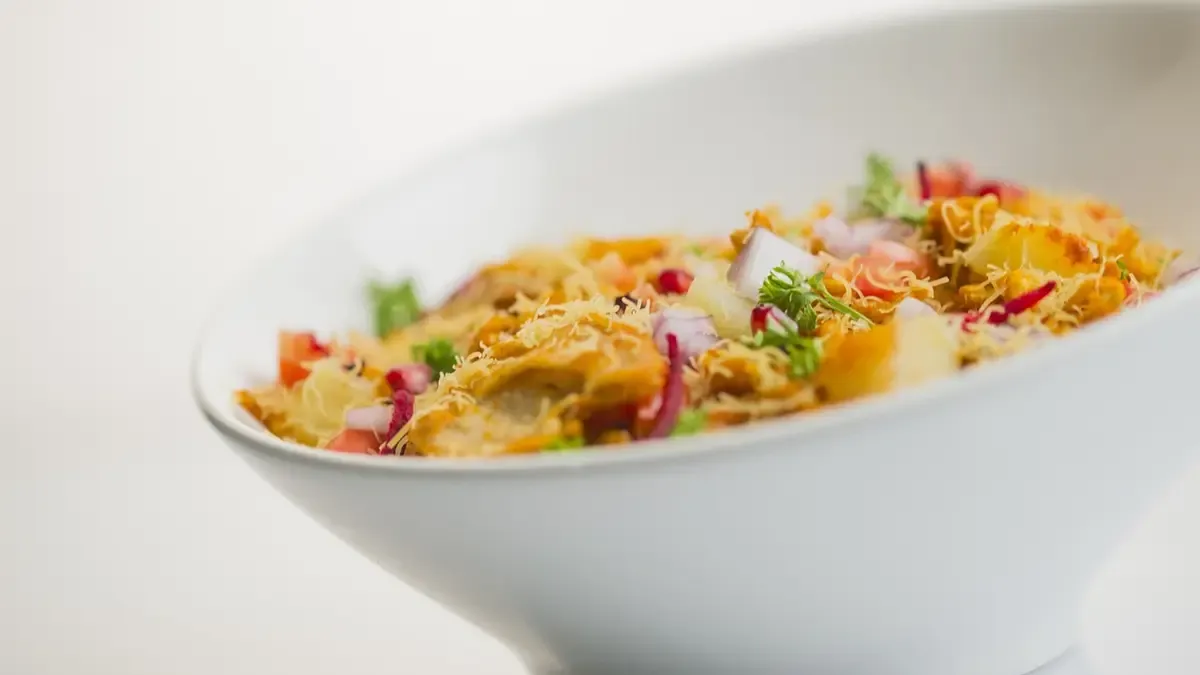
An Indian vegetarian bulking diet plan, built on the principles in our Indian high-protein nutrition guide, works when you stack calories onto food you already eat: oats cooked in milk, extra rotis with a spoon of ghee, paneer and soya curry, curd, peanut butter, and one homemade shake a day. That is how a lean vegetarian can reach 2,500-2,700 kcal and 130-150 g of protein without living on biscuits and fried snacks.
This article is the surplus counterpart to our vegetarian cutting plan.
The honest problem for a skinny vegetarian lifter is rarely knowledge. It is appetite. A plate of dal-chawal fills you up long before it fills your calorie budget. So the plan below is built around calorie density, liquid calories and meal structure, not around “eat more” willpower.
What does a clean bulk actually mean for a vegetarian?
A clean bulk means a small, controlled calorie surplus with enough protein and decent food quality, so most of the weight you gain is muscle and not just fat. It is a loose idea rather than a scientific category. Our breakdown of lean bulking, clean versus dirty covers the trade-offs, including why a smaller 200-300 kcal surplus can suit trained natural lifters.
The evidence on how big the surplus should be is limited. Sports nutrition guidance typically says to add about 300-500 kcal a day, with plenty of protein and carbohydrate, energy-dense foods and heavy resistance training. A 2022 critical review of that evidence found research on intentional weight gain is lacking, and that gaining 0.45 kg a week, mostly as lean mass, may be hard for some athletes (Larson-Meyer et al., 2022). The same review found that larger portions, energy-dense foods and drinking more of your calories may help.
One small trial points the same way. Twenty-one elite athletes were randomised to either a meal plan with a surplus of about 506 kcal a day or to eating freely while strength training four times a week. The planned-surplus group gained more body mass (4.3% versus 1.0%) and lean mass (2.8% versus no change) over the 8-12 week period (Garthe et al., 2011). These were elite, young athletes, so the result may not transfer directly to a beginner. But the message holds: eating “a lot” without a plan often means eating less than you think.
How many calories and how much protein do you need?
Work out maintenance first, then add the surplus. Our calorie calculator gives you a starting estimate, and it is only an estimate. Your real maintenance shows up in two to three weeks of tracked weight and food.
For protein, the best-known data come from a 2018 meta-analysis of 49 trials with 1,863 participants. Protein supplementation improved fat-free mass and strength during resistance training, and gains in fat-free mass stopped increasing beyond a total intake of about 1.62 g/kg/day (Morton et al., 2018). A 2022 meta-analysis of 74 trials reached a similar place: for adults under 65 lifting weights, benefit showed up at intakes of 1.6 g/kg/day or more, and the extra gain was small (Nunes et al., 2022).
Do the maths for yourself. A 65 kg lifter at 1.6 g/kg needs about 104 g. A 75 kg lifter needs about 120 g. So 130 g is a comfortable target for most people, and 150 g is plenty. More than that adds cost, not much else. The protein calculator will give you a range for your body weight, and our guide on optimal daily protein intake goes through the research.
Both of these meta-analyses pool varied groups of healthy adults, and some of their authors declare honoraria or funding from the dairy and food industries. That does not invalidate them, but it is a good reason to treat 1.6 g/kg as a sensible guide and not a hard ceiling.
The Indian vegetarian building blocks
Think of your plate in three layers: a carbohydrate base, a protein anchor and a calorie booster.
| Layer | Foods | Why it works |
|---|---|---|
| Carb base | Rotis, rice, oats, poha, potatoes, banana | Cheap calories, easy to scale up in portion |
| Protein anchor | Paneer, curd, milk, soya chunks, dal, whey | Gets total protein to your target |
| Calorie booster | Ghee, peanut butter, almonds, nuts, full-fat milk | Large calories in small volume |
Approximate figures, which will vary by brand and recipe: a medium roti is roughly 100 kcal, 100 g of paneer is about 260-270 kcal and 18 g of protein, 40 g of dry soya chunks gives around 20 g of protein, and a bowl of cooked dal gives about 10-12 g. Check your own labels.
A few notes on specific foods:
- Soya chunks are the cheapest protein per rupee for most vegetarians. Our soya chunks guide covers safety questions. Soak them well, squeeze out the water and cook them in a curry or tawa fry.
- Paneer brings calories and protein together, which suits a bulk. It is also easy to overdo in a curry swimming in oil.
- Curd and milk are protein sources and liquid calories at the same time.
- Dal is a useful anchor but a modest protein source by volume, so do not expect it to carry you alone.
For more calorie-dense ideas beyond Indian staples, see our list of high-calorie, nutrient-dense foods for hardgainers.
Is soya or dairy better for muscle gain?
Both work. Here the research is mixed, and the differences are small.
A 2018 meta-analysis of nine trials (266 participants) found soy protein supplementation produced similar strength and lean mass gains to whey or other animal proteins when combined with resistance training (Messina et al., 2018). A broader 2021 meta-analysis that pooled 16 studies found protein source did not change absolute lean mass or strength overall, though animal protein tended to favour lean mass, particularly in adults under 50 (Lim et al., 2021).
An older 12-week trial in 56 novice young men found that post-workout fat-free milk produced greater gains in muscle fibre size and fat- and bone-free mass than isoenergetic soy or carbohydrate drinks (Hartman et al., 2007). That study was in untrained men over a short time frame, and it compared drinks, not whole diets.
Why might the results differ? Study length, training status, dose, total protein and the specific soy product all vary. The cautious takeaway is simple. For a vegetarian who eats dairy, use both: milk, curd, paneer and whey for one side, and soya chunks and dal for the other. You do not need to pick a side, and you do not need to avoid soya.
The homemade mass gainer shake (about 700 kcal, 45 g protein)
This is the easiest lever you have. Liquid calories go down when solid food does not, and they do not need chewing.
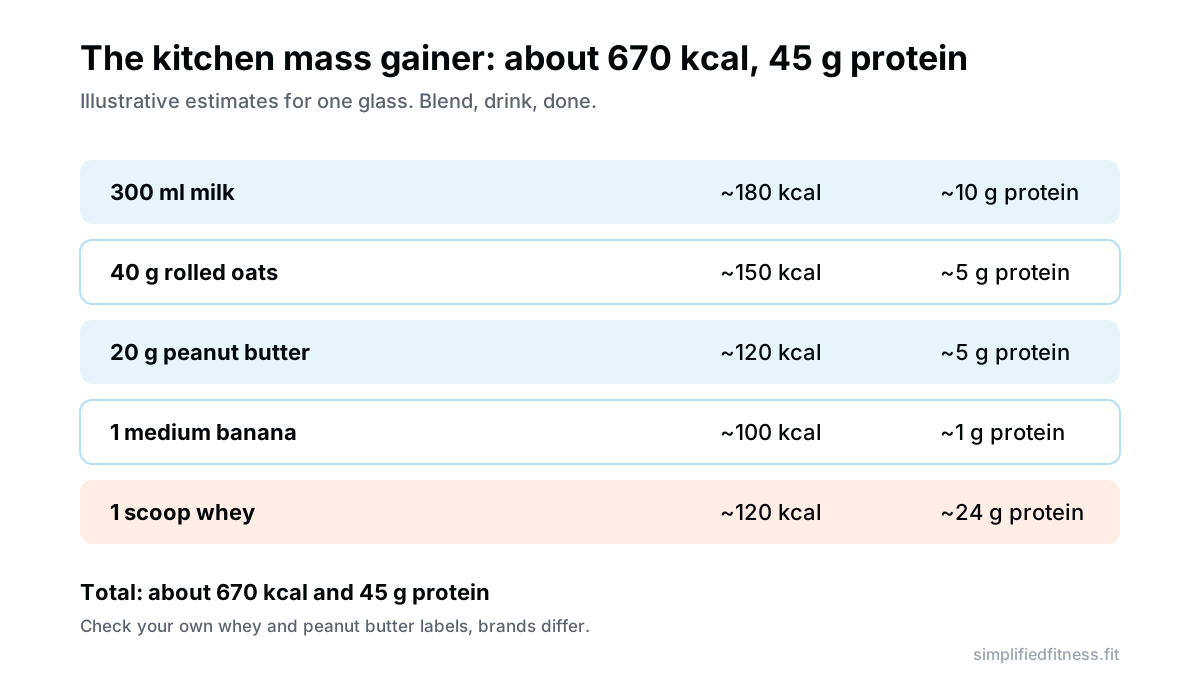
Blend 300 ml milk, 40 g rolled oats, 20 g peanut butter, one banana and one scoop of whey. By typical label values that comes to roughly 650-700 kcal and about 45 g of protein, though your products will differ.
Practical tips:
- Drink it between lunch and dinner so it does not kill your dinner appetite.
- Grind the oats first if you find the texture heavy.
- No whey? Use extra milk powder or a bowl of curd on the side, and accept slightly lower protein.
- Hot weather? Use cold milk and ice, and keep the shake fresh. Do not leave a blended shake sitting in the sun.
A sample 2,700 kcal, 135 g protein day
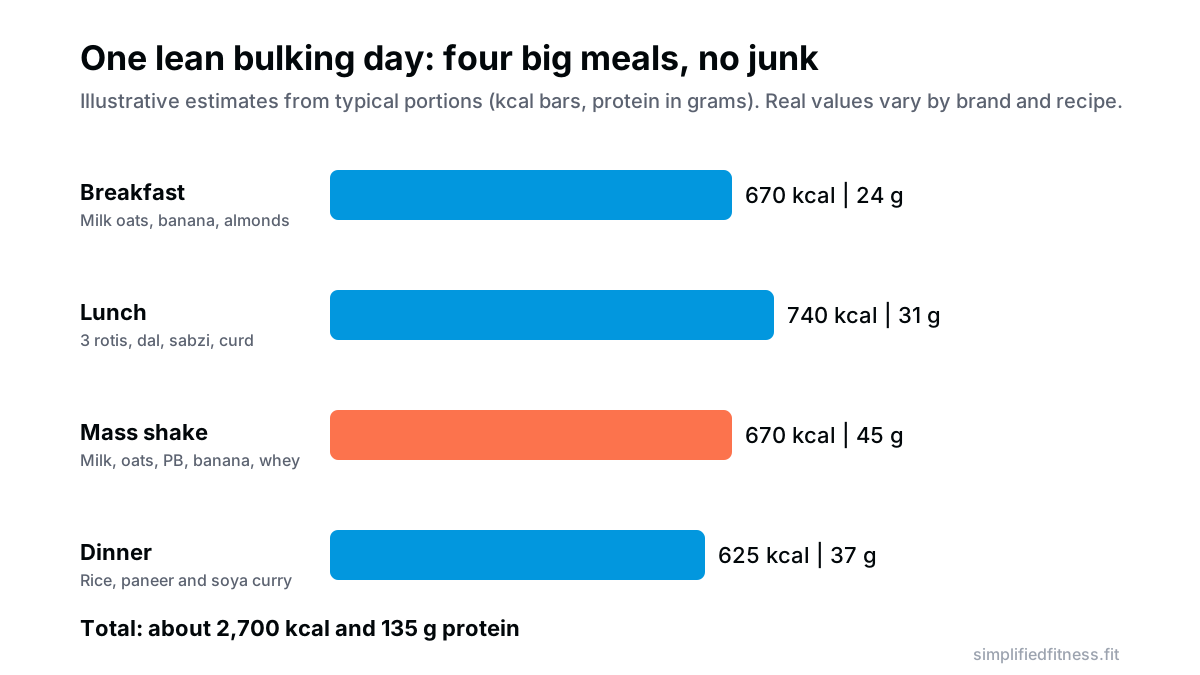
This is an illustration, not a prescription. Portions are approximate and meant to show how the pieces fit together.
| Meal | What | Approx. kcal | Approx. protein |
|---|---|---|---|
| Breakfast | 80 g oats cooked in 300 ml milk, 1 banana, 15 g almonds | 670 | 24 g |
| Lunch | 3 rotis, 1 bowl dal, sabzi with 1 tsp oil, 200 g curd | 740 | 31 g |
| Mass shake | 300 ml milk, oats, peanut butter, banana, whey | 670 | 45 g |
| Dinner | 1 cup rice, 100 g paneer curry, 30 g dry soya chunks | 625 | 37 g |
That is about 2,700 kcal and 135 g protein. If your maintenance is higher, add a second roti with ghee or a peanut butter sandwich. If you only need about 2,500 kcal, drop the almonds and the banana from breakfast.
On a tight budget, soya chunks, milk, oats, peanut butter and seasonal fruit do most of the work. Our meal prep blueprint shows how to cook for the week in one session, and our free diet plan has full templates.
How do you avoid feeling bloated and sluggish?
Most “clean bulk bloat” comes from changing too much too fast. Going from two light meals to five heavy ones overnight, plus more fibre and legumes, can leave you gassy and heavy.
- Step up gradually. Add 200-300 kcal for a week, then add more.
- Prefer liquid and soft calories when your stomach feels full.
- Watch the oil. A tadka or a curry floating in oil adds hundreds of calories fast. Our hidden calorie traps guide shows where it hides, and it is just as relevant when bulking, because oil is the easiest way to add calories you did not plan.
- Drink water through the day, particularly in hot weather.
- Soak and cook soya chunks well. Well-cooked chunks tend to sit easier, and a smaller portion helps if legumes bother you.
If you have persistent stomach pain, vomiting, black or bloody stools, or you cannot tolerate normal food portions, see a doctor. This article cannot tell you what is causing it.
How do you track scale weight while bulking?
Weigh yourself every morning after the toilet and before food, then judge the average over two weeks. A single weigh-in can swing by a kilo or more with water, salt and food in your gut.
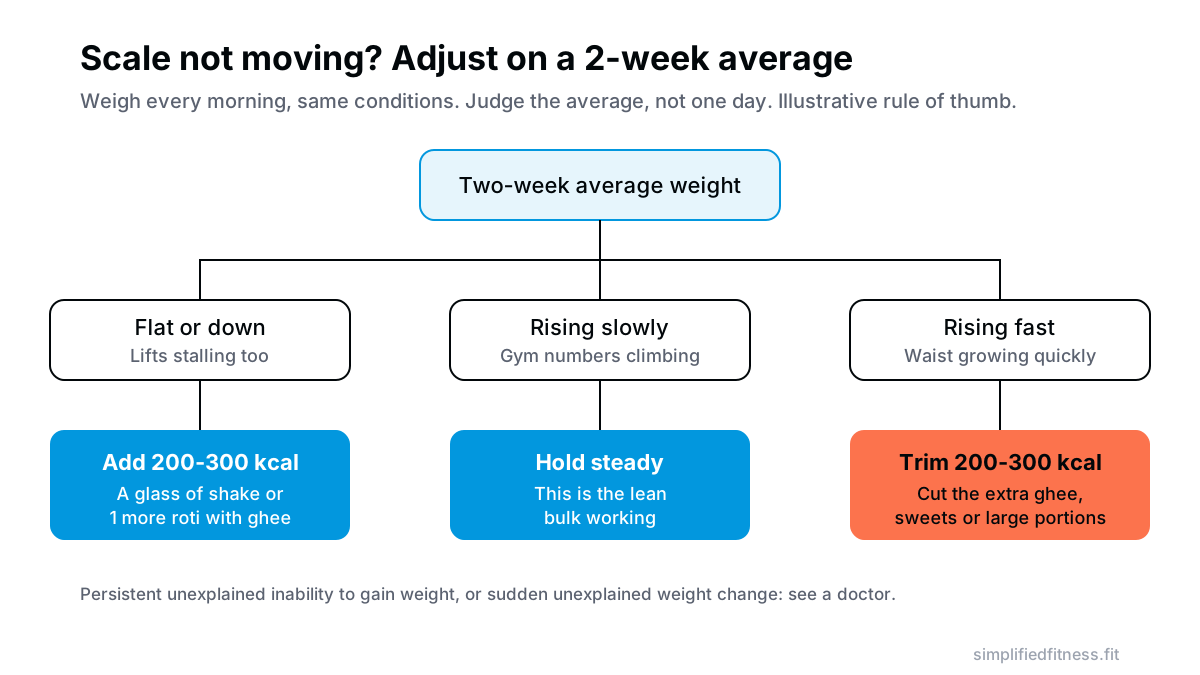
This is a rule of thumb, not something a trial has tested. If your two-week average is flat and your lifts are not going up, add 200-300 kcal. If it is rising slowly and your lifts are improving, hold steady. If it is rising fast and your waist is growing quickly, trim a little. Our guide to target rates of weight gain for natural lifters goes deeper on what is realistic.
Remember that the first week or two of a bulk often shows quick scale gain from extra food volume and glycogen and water, so do not mistake that for fat.
When should you see a doctor?
Talk to a doctor if you eat a lot and still cannot gain, if you lose weight without trying, if you are persistently underweight (check your BMI with our BMI calculator), or if you have ongoing digestive symptoms. Thyroid, digestive and other conditions can cause trouble gaining weight, and only a clinician can sort that out. The same applies if you have diabetes, kidney disease or a heart condition: ask before raising calories or protein sharply.
Putting it into practice this week
- Estimate maintenance with the calorie calculator and add roughly 300-500 kcal.
- Set protein around 1.6-2 g/kg, or about 130 g if you are 65-80 kg.
- Build four meals around a carb base, a protein anchor and a calorie booster.
- Add one homemade shake a day.
- Weigh daily, judge the two-week average, and adjust in 200-300 kcal steps.
Train hard too. Food builds nothing on its own, and the surplus only pays off if your lifting gives it a reason to become muscle. Our muscle hypertrophy guide for natural lifters covers the training side, and the energy balance guide explains how surplus, deficit and maintenance fit together.
Frequently Asked Questions
How do I eat 2,500 calories a day as an Indian vegetarian?
Spread the calories over four to five big meals instead of three, and make each one calorie dense. Add things like milk in your oats, ghee on rotis, peanut butter and a mass gainer shake rather than extra oily snacks. Build one meal at a time with our diet plan page and the calorie calculator so you know your own number.
How much protein do I need on a vegetarian bulk?
A large meta-analysis found that gains in fat-free mass did not increase further past roughly 1.6 g/kg/day in people lifting weights. For a 70 kg lifter that is about 112 g, so 130 g gives you a buffer. Use the protein calculator to find your own range and spread it across the day.
Can I build muscle on a vegetarian diet in India?
Yes, as long as total protein and calories are enough and you train progressively. A meta-analysis of nine trials found soy protein produced similar strength and lean mass gains to whey or other animal proteins. Combine dairy, soya, dal and a whey scoop if you like, and keep the training hard.
Is a homemade mass gainer better than a commercial one?
For most people it is cheaper and gives you control over the ingredients. Blending milk, oats, peanut butter, banana and whey gives roughly 650-700 kcal and about 45 g of protein, which matches many commercial products without added sugar or fillers. Check labels on your whey and peanut butter, since brands differ.
How fast should I gain weight while bulking?
Common sports nutrition guidance suggests about 0.45 kg per week, but a 2022 critical review noted this may be hard for many athletes to reach and that the evidence is limited. Slower gains of a few hundred grams a week are a realistic expectation for most natural lifters. Track a two-week average and adjust rather than reacting to a single weigh-in.
How many calories above maintenance do I need to bulk?
Guidelines usually suggest an increase of about 300-500 kcal a day over maintenance. In one trial of elite athletes, a planned surplus of about 506 kcal a day produced more weight and lean mass gain than eating freely. Work out maintenance first, add the surplus, then adjust after two weeks of data.
Why do I feel bloated and sluggish when I eat more?
A sudden jump in food volume, fibre or oil can leave you full and heavy, especially if you go from small meals to big ones overnight. Raise calories in steps over one to two weeks, favour liquid calories, and keep very oily or fried food limited. If you have persistent pain, vomiting or blood in the stool, see a doctor.
Is paneer or soya better for bulking?
Both work, and they do different jobs. Paneer is calorie dense and adds fat and protein, while soya chunks are very high in protein for few calories, so together they cover the protein and energy sides of a bulk. Rotate them across the week rather than relying on one.
Do I need whey protein on a vegetarian bulk?
No, but it is a convenient way to close a protein gap. Whey fits into a shake with milk and oats easily, and a large meta-analysis found the benefit of protein supplements for fat-free mass levelled off once total daily intake reached about 1.6 g/kg. If your food already gets you to your target, skip it.
Can I use dal and rice to reach my protein goal?
Dal and rice help, but they are not enough by themselves for a bulk. A bowl of cooked dal gives about 10-12 g of protein, so you still need paneer, curd, milk, soya or whey to reach 130 g. Treat dal and rice as the carbohydrate base and layer protein on top.
Is peanut butter a good choice for lean bulking?
Yes, because it packs a lot of calories into a small spoon, which helps when your appetite is the limit. Two tablespoons add roughly 190 kcal and about 8 g of protein, so one or two spoons a day in a shake or on bread is plenty. Pick a brand with minimal added sugar and oil.
Should I see a doctor if I cannot gain weight?
Yes, if you eat a lot, still cannot gain, or you are losing weight without trying. Unexplained weight loss or being persistently underweight can have medical causes such as thyroid or digestive problems. A doctor can check this properly, and no article can diagnose it.
Sources & References
Every claim above is checked against peer-reviewed research (PubMed, U.S. National Library of Medicine) or guidance from established health bodies. How we fact-check.
- Morton RW, et al. A systematic review, meta-analysis and meta-regression of the effect of protein supplementation on resistance training-induced gains in muscle mass and strength in healthy adults. Br J Sports Med. 2018. PMID: 28698222
- Nunes EA, et al. Systematic review and meta-analysis of protein intake to support muscle mass and function in healthy adults. J Cachexia Sarcopenia Muscle. 2022. PMID: 35187864
- Garthe I, et al. Long-term effect of nutritional counselling on desired gain in body mass and lean body mass in elite athletes. Appl Physiol Nutr Metab. 2011. PMID: 21851204
- Larson-Meyer DE, et al. Weight Gain Recommendations for Athletes and Military Personnel: a Critical Review of the Evidence. Curr Nutr Rep. 2022. PMID: 35233712
- Messina M, et al. No Difference Between the Effects of Supplementing With Soy Protein Versus Animal Protein on Gains in Muscle Mass and Strength in Response to Resistance Exercise. Int J Sport Nutr Exerc Metab. 2018. PMID: 29722584
- Hartman JW, et al. Consumption of fat-free fluid milk after resistance exercise promotes greater lean mass accretion than does consumption of soy or carbohydrate in young, novice, male weightlifters. Am J Clin Nutr. 2007. PMID: 17684208
- Lim MT, et al. Animal Protein versus Plant Protein in Supporting Lean Mass and Muscle Strength: A Systematic Review and Meta-Analysis of Randomized Controlled Trials. Nutrients. 2021. PMID: 33670701

Umair Hazrami · Founder & Head Coach, Simplified Fitness
Umair Hazrami founded Simplified Fitness and the Simplified Lifter channel to cut through fitness noise. With 4+ years of consistent training and 10+ coaching clients, he writes every guide from the peer-reviewed research and links the sources so you can check them. Our editorial standards.
Educational content only, not medical advice. If you have a medical condition, are pregnant, or take medication, talk to a qualified doctor before changing your diet, supplements or training. Full disclaimer.
Keep reading
Indian Diet
Budget Indian Diet for 120g Protein Under ₹100 a Day (Student Plan)
A budget Indian diet for 120g protein under 100 rupees a day: soya, eggs, milk and chana, with protein per rupee maths and two student plans you can copy.
8 min read
Indian Diet
Chicken Breast and Fish in India: Where to Buy, How to Cook, and Cost per 30 g Protein
Chicken breast price per kg India: compare wet market vs apps, learn safe handling, a brine method for juicy meat, and rohu vs chicken cost per 30 g protein.
11 min read

Indian Diet
How to Convince Indian Parents About Whey Protein: Kidney Fears, 'Chemicals' and the Real Evidence
How to convince Indian parents about whey protein: explain it as paneer-water dairy, answer the kidney fear with trial data, and read the label together.
9 min read
Indian Diet
Curd vs Greek Yogurt vs Hung Curd: Protein Yield and the Home Recipe
Curd vs Greek yogurt protein in India: plain dahi gives about 3-4 g per 100 g. See how straining it into hung curd can triple that, and what studies show.
9 min read