Navratri and Religious Fasting: How to Keep Your Protein Up and Hold Onto Muscle
Navratri diet for bodybuilding: how to reach roughly 100 g protein on vrat foods like paneer, curd, milk and kuttu, and what research says about muscle loss.
TL;DR. The short answer
- Yes, you can hold your muscle through Navratri. Studies of athletes who kept training through fasting periods (mostly Ramadan, the closest researched example) found body fat fell while lean mass did not change.
- A realistic vrat target is roughly 1.6 g of protein per kg of body weight, built from dairy: paneer, hung curd, milk and unflavoured whey if your tradition allows it.
- Kuttu (buckwheat) and nuts help, but they are supporting actors. Buckwheat protein is decent in quality, yet a roti or two only adds around 7 g.
- Fasting days usually cut calories and water without you noticing. Keep your lifting weights heavy, trim volume if you feel flat, and drink on purpose.
- Strict dry fasts, diabetes, pregnancy, or regular medication mean you should speak to your doctor before changing food or training.
Part of our complete guide: Indian High-Protein Nutrition Guide: Cutting and Muscle Building on Vegetarian and Non-Veg Diets
Table of contents
A navratri diet for bodybuilding works if you treat dairy as your protein engine and stop expecting grains to do the job. Aim for roughly 1.6 g of protein per kg of body weight, keep lifting, and do not let water slip. Muscle does not vanish in nine days of vrat.
This guide sits inside our Indian high-protein nutrition guide. Here we stay with one question: what do you eat, and how do you train, when eggs, meat, onion-garlic and normal grains are off the table? We respect the tradition. The numbers just have to work inside it.
Will fasting for Navratri cost me muscle?
Short answer: unlikely, as long as you keep training and your protein does not collapse.
The tricky part is that almost no research looks at Navratri itself. A review of dietary advice for Navratri in people with diabetes says plainly that literature on Hindu fasts is scarce compared with Ramadan (Gupta et al., 2017). So we borrow from the closest studies, and say so.
A systematic review of intermittent fasting combined with resistance training, which mentions religious fasts such as Ramadan in its introduction, found lean body mass was generally maintained across 8 studies, with fat mass or percentage falling significantly in 5 of them (Keenan et al., 2020). These were mostly sedentary or non-elite trainees, and the review calls for longer studies.
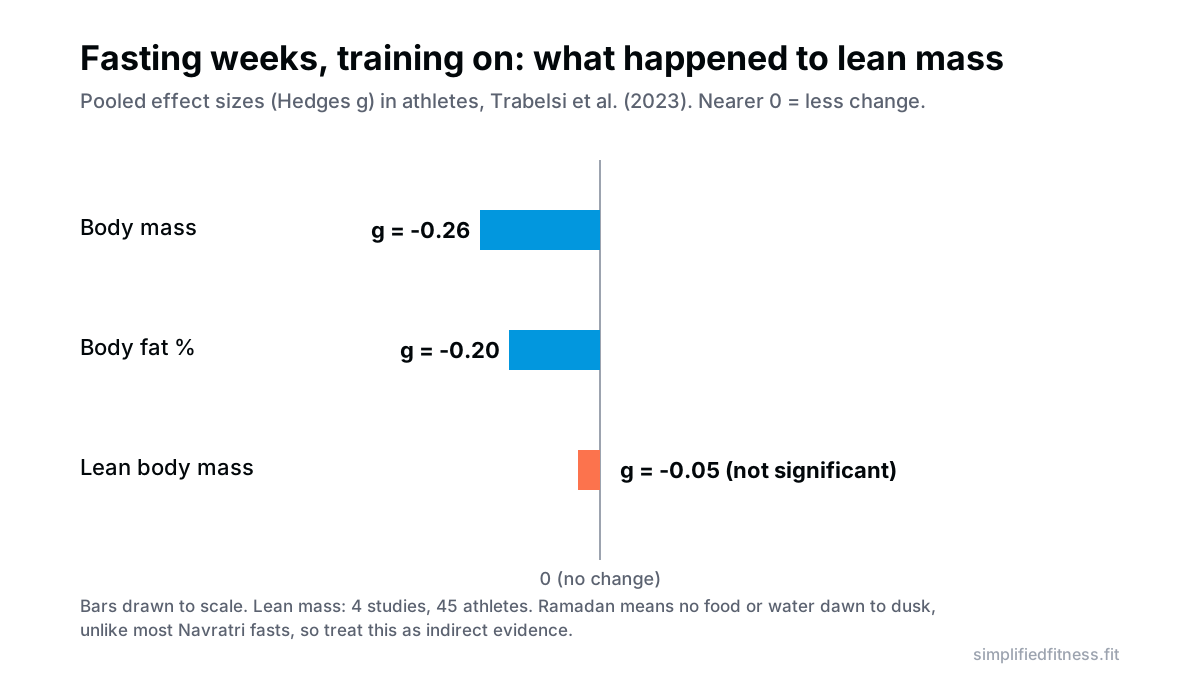
Then the athlete data. A 2023 meta-analysis of athletes observing Ramadan found energy, carbohydrate and water intake all dropped, while fat and protein intake did not change significantly. By week four, body mass and body fat percentage had fallen, but lean body mass did not change (Trabelsi et al., 2023). The lean mass result rests on only 4 studies with 45 athletes, and the authors flag that more rigorous studies are needed.
Why protein matters more when food is restricted
Fasts usually trim calories. A smaller intake means your body has less spare energy for building and more reason to be generous with amino acids elsewhere.
A review of six studies in resistance-trained lean athletes who were restricting calories concluded protein needs are likely 2.3-3.1 g per kg of fat-free mass, scaled up with the severity of the restriction and how lean the person is (Helms et al., 2014). That is a deep-cut, lean-athlete scenario. A nine-day vrat is usually a mild dip, so you do not need those numbers.
For everyone else, the practical anchor is the one from a meta-analysis of 49 trials: protein supplementation helped resistance-training gains, but beyond about 1.6 g/kg/day it did not add further fat-free mass gain on average (Morton et al., 2018). Our deeper breakdown is in how much protein you need for hypertrophy.
For a 70 kg lifter that is about 110 g a day. Hitting 100 g on vrat is close enough, and anything near it beats the common outcome: sabudana, potato and fruit all day with 30 g of protein.
Not sure of your own number? Use the protein calculator.
Which vrat foods actually give you protein?
Be honest about the list. Most “vrat staples” are carbohydrate and fat. Protein comes from only a handful of items.
| Food (typical vrat) | Protein role | Practical note |
|---|---|---|
| Low-fat paneer / chenna | Main source, roughly 18-20 g per 100 g (varies by brand) | Check label, grill or sauté in little ghee |
| Hung curd / Greek yogurt | Main source, around 9-10 g per 100 g | Strain overnight, add sendha namak or fruit |
| Milk | Steady supporter, roughly 3.4 g per 100 ml | A glass at each meal adds up |
| Unflavoured whey (if allowed) | Convenient top-up, about 20-25 g a scoop | Depends on your tradition and product |
| Kuttu atta | Supporter, modest protein | Mostly energy |
| Roasted peanuts, makhana | Small boosts | Peanuts are calorie-dense |
| Sabudana, potato, singhara flour | Energy only, very little protein | Do not count these |
Figures are approximate label values for typical products. Always check your own pack. Detail on the two dairy staples is in paneer vs low-fat paneer and curd, Greek yogurt and hung curd.
What about kuttu?
Kuttu is often sold as a “complete protein grain.” The truth is more modest.
Buckwheat is a pseudocereal, gluten-free, and a review of its proteins describes both common and tartary types as containing a considerable amount of indispensable amino acids (Jin et al., 2022). In a lab digestion study of foods made from millet, highland barley and buckwheat, buckwheat flour products scored the highest digestibility-adjusted amino acid score, and its first limiting amino acid was leucine, whereas lysine was the weak point for the other two grains (Fu et al., 2023). That was in vitro (a simulated digestion), not a trial in people.
So: good quality, low quantity. Two kuttu rotis are a fine carbohydrate source with a small protein bonus. They will not replace a bowl of paneer.
A sample vrat day that gets close to 100 g
Here is one illustrative layout. Portions are examples, not a prescription.
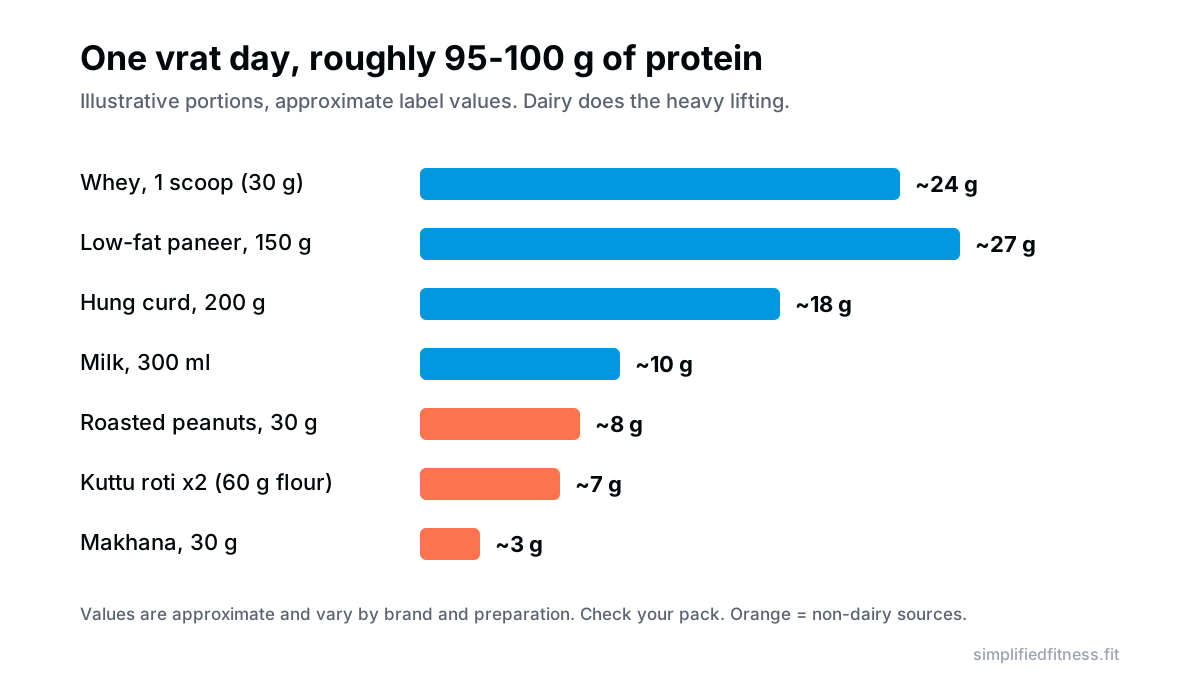
- Morning: 300 ml milk, plus a scoop of whey in it if your tradition allows.
- Lunch: 150 g low-fat paneer, sautéed with sendha namak and black pepper, with 2 kuttu rotis.
- Evening snack: 200 g hung curd with fruit and a handful of roasted peanuts.
- Dinner: makhana, more curd, or a second paneer portion if you are still short.
If you do not use whey, replace it with extra hung curd or paneer. A little arithmetic: 100 g is about 1.4 g/kg for a 70 kg lifter, a touch under the 1.6 g/kg anchor. That is fine for nine days.
More vrat-friendly snack ideas are in high-protein Indian snacks. For a wider meal plan once the fast ends, try the diet plan.
How do I split protein across fewer meals?
Many people eat two or three times on vrat days instead of four or five. That is fine, and the research on timing is gentler than gym lore suggests.
A 2018 review proposed about 0.4 g/kg per meal across at least four meals to reach 1.6 g/kg a day, and noted the old “25 g per meal ceiling” idea does not hold up well: bigger doses are used for tissue building too, just less efficiently (Schoenfeld & Aragon, 2018).
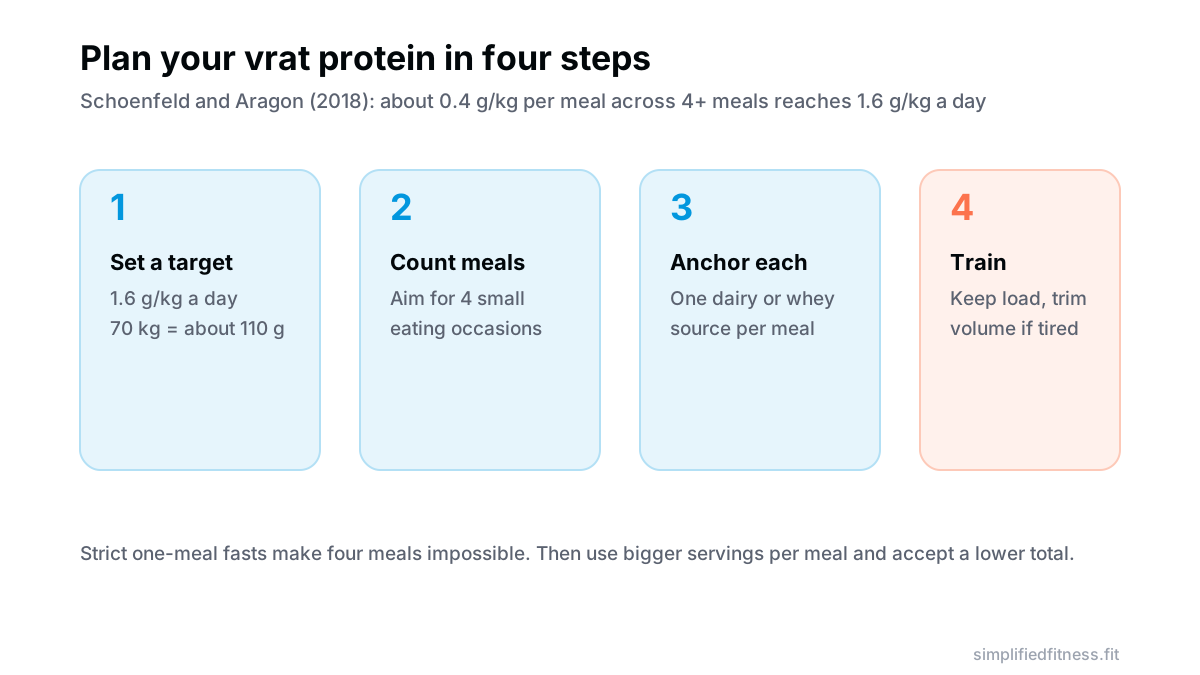
Practical read: if you can only fit two meals, make each one a proper serving, something like 150 g paneer or 250 g hung curd plus milk, rather than leaving protein for “later.” The full debate is covered in 3 vs 5 meals for protein distribution.
Training, hydration and heat
You are eating less food and probably less fluid. Both show up in the gym.
In the Ramadan meta-analysis, total water intake dropped significantly in athletes (Trabelsi et al., 2023). Navratri often falls in warm weather in much of India, and with sweaty commutes it is easy to do the same. Sip across the hours you are allowed to drink, include milk, buttermilk or coconut water if your fast allows them, and see our note on hydration and strength.
On the training side:
- Keep the load on the bar the same. Heavy training is the signal that tells your body to hold on to muscle.
- Trim a set or two per exercise if energy is flat. Quality beats volume.
- Train after a meal rather than at the end of a long gap, if you can.
- Stop if you feel dizzy, faint or unusually weak.
When to talk to a doctor
Fasting is not risk-free for everyone. Check with your doctor first if you have diabetes, kidney or heart conditions, take regular medication, are pregnant or breastfeeding, or are underweight or recovering from illness. The Navratri diabetes review stresses that advice depends on the fasting pattern and local customs, and that many people with diabetes fast without proper education or medical advice (Gupta et al., 2017).
If you are doing a strict fast without water, that is a medical decision, not a gym one. Nothing in this article is a recommendation to do it.
What to do after the fast ends
Do not “make up” for the nine days with a giant meal or a brutal leg day. Go back to your normal protein, your normal volume and your normal sleep, and let the first two sessions feel slightly easier than usual.
If your weight dipped by a kilo or two, much of that is likely water, stored carbohydrate and food in the gut, and it usually returns within days of eating normally. Read the bar, not the scale. If your lifts held, you did the job. If they dropped a little, give them a week or two of regular eating and training before you worry.
Plan the next fast before it arrives. Note which portions kept you full, which meal left you short on protein, and which snack you could actually carry to work. Next Navratri, Shravan or ekadashi, you start with a menu instead of improvising.
The bottom line
Nine days will not undo months of training. Eat dairy at every meal, aim near 1.6 g/kg, drink, and keep the bar heavy. Then go back to your regular plan when the fast ends.
Frequently Asked Questions
How can I get enough protein during Navratri?
Build every meal around a dairy source, because paneer, hung curd, milk and (if your family permits it) unflavoured whey are the only dense protein foods on most vrat lists. Roughly 100 g a day is realistic with about 150 g low-fat paneer, 200 g hung curd, 300 ml milk and a scoop of whey. Plan portions the night before so you are not guessing when hungry.
Will I lose muscle if I fast for Navratri?
Probably not, if you keep lifting and keep protein reasonable. A 2023 meta-analysis of athletes who kept training through Ramadan found body fat percentage fell while lean body mass did not significantly change. Ramadan is a different fast from Navratri, so treat it as indirect evidence, and keep your protein close to your normal intake.
Is kuttu a complete protein?
Kuttu (buckwheat) is a pseudocereal with a fairly good amino acid profile, and reviews describe it as containing considerable amounts of indispensable amino acids. One lab digestion study found the first limiting amino acid in buckwheat foods was leucine, while lysine was the weak point for the millet and barley foods it was compared with. It is still a modest protein source, so use it for energy and variety, not as your protein anchor.
How much protein is in kuttu atta?
It is modest, usually in the range of roughly 10-13 g per 100 g of flour, though brands differ. Two rotis made from about 60 g of flour give you around 7 g. Check the nutrition label on your pack and use paneer or curd for the real protein.
Can I take whey protein during Navratri?
That depends on your family and tradition, not on science. Whey is a milk product, so some people accept plain unflavoured whey while others avoid supplements or any added ingredients during vrat. If you use it, pick a simple product with a short ingredient list and ask yourself whether it fits how you observe the fast.
How many grams of protein should I eat on fasting days?
About 1.6 g per kg of body weight is a sensible target for most lifters, so around 110 g for a 70 kg person. Meta-analytic data show extra protein beyond roughly 1.6 g/kg does not add more muscle gain on average. If you are also cutting hard, needs may be higher, so use our protein calculator to get a number.
What is the best vrat food for muscle building?
Low-fat paneer and hung curd give the most protein per serving among common vrat foods. Both are dairy, so they also fit most fasting rules, and curd is easy to carry to work. Rotate in milk, makhana and roasted peanuts so you do not tire of the same plate.
Is sabudana a good protein source?
No, sabudana (tapioca pearls) is mostly starch and provides very little protein. It gives quick energy, which is useful, but it will not move your protein total. Pair sabudana khichdi with peanuts and a bowl of curd to lift the protein of that meal.
Should I train during Navratri fasting?
Yes, for most healthy people, and keeping some training is what protects muscle. Studies of athletes who continued to train through fasting periods found lean mass was generally maintained. Keep the weights heavy, cut a set or two if your energy is low, and skip hard sessions if you feel dizzy.
How should I split protein across vrat meals?
A reasonable starting point is about 0.4 g per kg per meal across at least four meals, which is what a 2018 review suggested for reaching 1.6 g/kg a day. For a 70 kg person that is roughly 28 g per meal. If you only eat two or three times, make each serving larger rather than skipping protein.
Do I need to drink more water during a fast?
Yes, because intake tends to drop without you noticing. A meta-analysis in athletes found total water intake fell significantly during Ramadan, and many Navratri fasts also remove large parts of your normal food and fluid. Sip through the permitted hours, and use our hydration guide and water intake calculator to set a target.
Is it safe to fast for Navratri if I have diabetes?
Talk to your doctor or diabetes team first. A review of dietary advice for people with diabetes during Navratri notes that research on Hindu fasts is thin, and that advice depends on the fasting pattern, religious beliefs and local customs. Do not change medication yourself.
Can I gain muscle during Navratri?
Gaining is possible but not the realistic goal, because fasts usually lower energy intake. Aim to maintain strength and lean mass for the nine days, and treat any fat loss as a bonus. Build back to normal intake and volume afterwards.
Sources & References
Every claim above is checked against peer-reviewed research (PubMed, U.S. National Library of Medicine) or guidance from established health bodies. How we fact-check.
- Morton RW, et al. A systematic review, meta-analysis and meta-regression of the effect of protein supplementation on resistance training-induced gains in muscle mass and strength in healthy adults. Br J Sports Med. 2018. PMID: 28698222
- Helms ER, et al. A systematic review of dietary protein during caloric restriction in resistance trained lean athletes: a case for higher intakes. Int J Sport Nutr Exerc Metab. 2014. PMID: 24092765
- Keenan S, et al. The effects of intermittent fasting combined with resistance training on lean body mass: a systematic review of human studies. Nutrients. 2020. PMID: 32781538
- Trabelsi K, et al. Dietary intake and body composition during Ramadan in athletes: a systematic review and meta-analysis with meta-regression. J Am Nutr Assoc. 2023. PMID: 35512756
- Schoenfeld BJ, Aragon AA. How much protein can the body use in a single meal for muscle-building? Implications for daily protein distribution. J Int Soc Sports Nutr. 2018. PMID: 29497353
- Gupta L, et al. Pragmatic dietary advice for diabetes during Navratris. Indian J Endocrinol Metab. 2017. PMID: 28217524
- Jin J, et al. Buckwheat proteins: functionality, safety, bioactivity, and prospects as alternative plant-based proteins in the food industry. Crit Rev Food Sci Nutr. 2022. PMID: 33191773
- Fu L, et al. Impact of processing methods on the in vitro protein digestibility and DIAAS of various foods produced by millet, highland barley and buckwheat. Foods. 2023. PMID: 37107509

Umair Hazrami · Founder & Head Coach, Simplified Fitness
Umair Hazrami founded Simplified Fitness and the Simplified Lifter channel to cut through fitness noise. With 4+ years of consistent training and 10+ coaching clients, he writes every guide from the peer-reviewed research and links the sources so you can check them. Our editorial standards.
Educational content only, not medical advice. If you have a medical condition, are pregnant, or take medication, talk to a qualified doctor before changing your diet, supplements or training. Full disclaimer.
Keep reading
Indian Diet
Budget Indian Diet for 120g Protein Under ₹100 a Day (Student Plan)
A budget Indian diet for 120g protein under 100 rupees a day: soya, eggs, milk and chana, with protein per rupee maths and two student plans you can copy.
8 min read
Indian Diet
Chicken Breast and Fish in India: Where to Buy, How to Cook, and Cost per 30 g Protein
Chicken breast price per kg India: compare wet market vs apps, learn safe handling, a brine method for juicy meat, and rohu vs chicken cost per 30 g protein.
11 min read
Indian Diet
How to Convince Indian Parents About Whey Protein: Kidney Fears, 'Chemicals' and the Real Evidence
How to convince Indian parents about whey protein: explain it as paneer-water dairy, answer the kidney fear with trial data, and read the label together.
9 min read
Indian Diet
Curd vs Greek Yogurt vs Hung Curd: Protein Yield and the Home Recipe
Curd vs Greek yogurt protein in India: plain dahi gives about 3-4 g per 100 g. See how straining it into hung curd can triple that, and what studies show.
9 min read