Indian Non-Vegetarian Cutting Diet: Structuring 1,800 Calories Around Chicken, Eggs, and Whey
An Indian non veg cutting diet at 1800 calories and about 150 g protein: a full day of chicken, eggs, fish and whey, low-oil cooking, a grocery list and swaps.
TL;DR. The short answer
- A workable Indian non veg cutting day at roughly 1,800 kcal: egg bhurji with toast, chicken curry with rice, whey with makhana, and tikka or fish with roti. It lands near 150 g of protein by my rounded estimates.
- Evidence supports protein of about 1.6-2.2 g/kg for muscle, and higher (1.9-3.2 g/kg) for lean, trained people in a deficit. For many lifters, 140-150 g sits comfortably inside that.
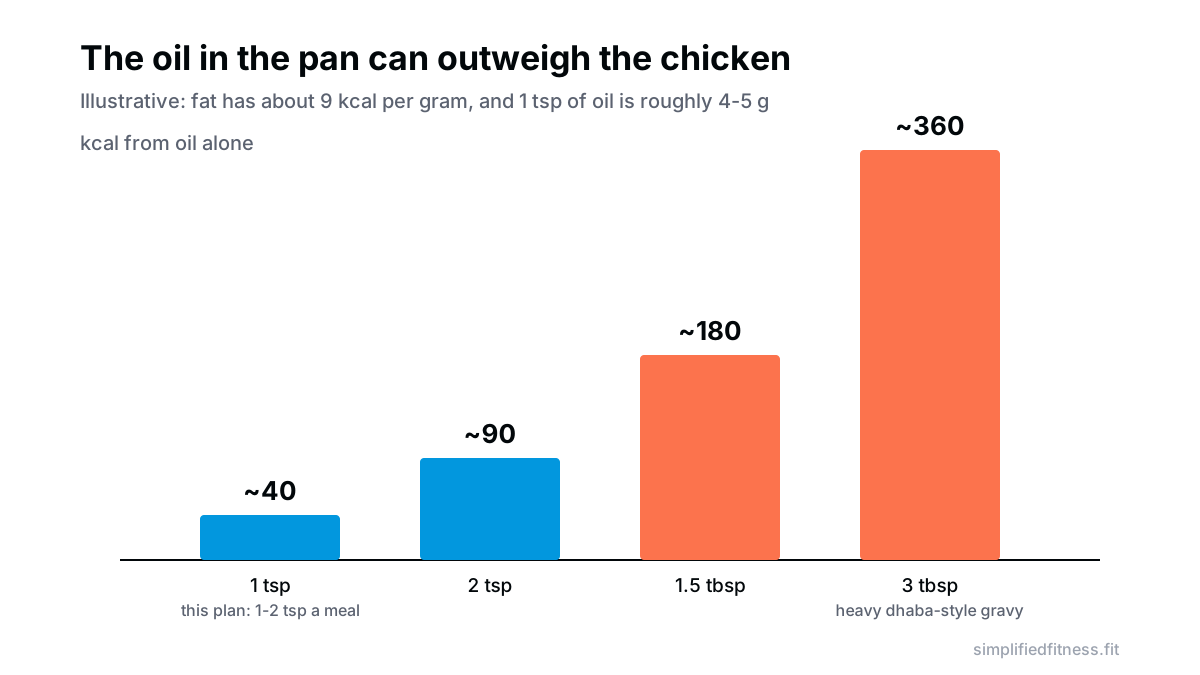
- Cooking oil is the easiest place to lose or gain 300 kcal. One to two teaspoons per meal keeps the plan on target, while a dhaba-style gravy can hide 350 kcal or more.
- 1,800 kcal is not right for everyone. Use a calculator to set a deficit of roughly 300-500 kcal below maintenance, and check with a doctor or dietitian if you have a medical condition.
- Spread protein over three or four meals. Total daily protein matters most, but even distribution is a sensible, low-effort habit.
Part of our complete guide: Indian High-Protein Nutrition Guide: Cutting and Muscle Building on Vegetarian and Non-Veg Diets
Table of contents
An Indian non veg cutting diet at 1800 calories can deliver about 150 g of protein using ordinary food: egg bhurji, chicken curry with rice, a whey scoop with makhana, and tikka or fish with roti. The structure is simple. Protein goes first in every meal, carbs are measured, and oil is counted instead of ignored.
This is the non-vegetarian counterpart to our vegetarian 1,800 kcal plan, and it sits inside our wider Indian high-protein nutrition guide. One caveat before the menu: 1,800 kcal is an example, not a prescription. We will cover how to check whether it suits you.
Is 1,800 calories the right number for you?
Honestly, it might not be. A cut works when you eat less than you burn, and what you burn depends on your size, steps, job and training. A 62 kg office worker and a 90 kg site engineer who lifts five days a week need very different numbers.
The practical method: find your maintenance with the calorie calculator, then subtract roughly 300-500 kcal. If that lands near 1,800, this plan fits as written. If you land at 2,200, add rice, roti and fruit and keep the protein. If you land at 1,500, scale the carbs down first and keep the protein.
The ISSN’s 2026 position stand notes that very-low-energy (under 800 kcal) and low-energy (800-1,200 kcal) diets give faster short-term weight loss but no long-term advantage over a moderate deficit. It also says these aggressive diets may increase lean mass loss (Aragon et al., 2026). A smaller deficit is slower, and for a lifter it is usually the better trade.
How much protein does a cutting diet need?
Protein is the lever that protects muscle while you eat less. The numbers depend on who you are.
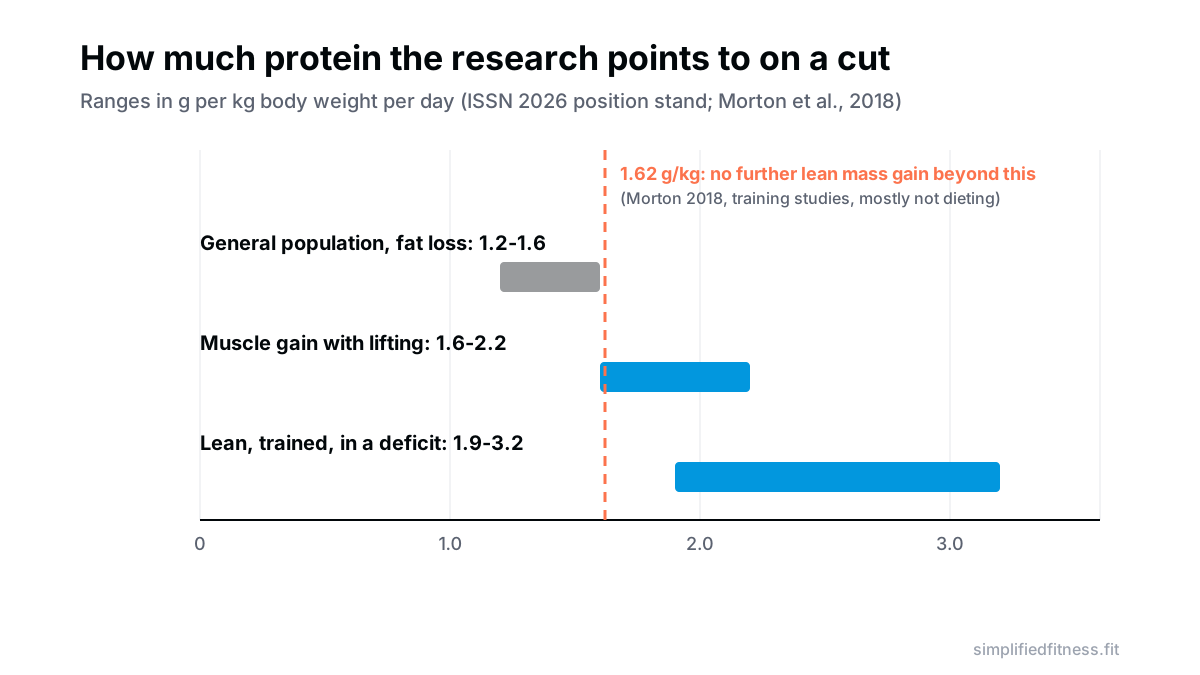
For the general population aiming at fat loss, the ISSN suggests 1.2-1.6 g/kg a day. With resistance training, 1.6-2.2 g/kg may optimise muscle, and 1.9-3.2 g/kg can maximise lean mass retention in lean, resistance-trained people in a calorie deficit (Aragon et al., 2026).
Two other studies give context. A meta-analysis of 49 trials (1,863 participants) found that protein supplementation increased fat-free mass, but beyond a total intake of 1.62 g/kg/day, there was no further gain (Morton et al., 2018). That is mostly about building muscle, not cutting. For cutting, a systematic review of resistance-trained lean athletes concluded that needs are likely 2.3-3.1 g/kg of fat-free mass, scaling up with leaner physiques and harsher deficits (Helms et al., 2014). That review covered only six studies, so treat it as a guide.
Does extra protein really help in a deficit? A 4-week randomized trial gave young men (n = 20 per group) a roughly 40% calorie deficit with intense training. The group on 2.4 g/kg gained 1.2 kg of lean mass and lost 4.8 kg of fat. The 1.2 g/kg group gained 0.1 kg of lean mass and lost 3.5 kg of fat (Longland et al., 2016). That was a short, high-volume trial in young men, so do not expect gaining muscle during a cut to be this easy for everyone, especially trained lifters or women.
A broader meta-analysis of 24 trials found that high-protein, energy-restricted diets gave modestly better outcomes than standard-protein diets: about 0.87 kg more fat mass lost and 0.43 kg more fat-free mass kept (Wycherley et al., 2012). It also noted greater satiety in 3 of 5 studies. Small gains, but they add up.
So for a 75 kg lifter, 150 g is about 2.0 g/kg. That is inside the evidence-supported range. Check yours with the protein calculator.
What does a full day of eating look like on 1,800 calories?
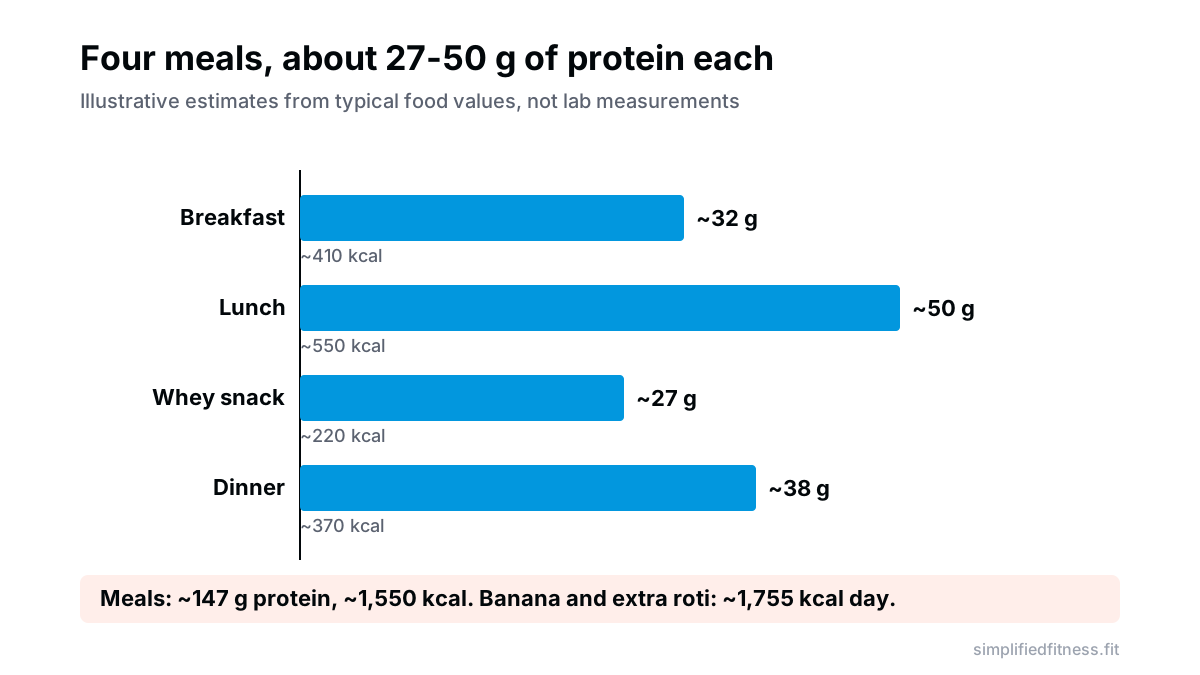
Here is the day. Protein and calories are my rounded estimates from typical food values, not lab measurements. Brands, oil and portion sizes will move them by 5-10%.
| Meal | What you eat | Protein | Calories |
|---|---|---|---|
| Breakfast | 4 egg whites + 2 whole eggs as bhurji (1 tsp oil), 2 slices brown bread toast | ~32 g | ~410 |
| Lunch | 200 g raw chicken breast curry (1-2 tsp oil), 1 cup cooked rice, cucumber salad | ~50 g | ~550 |
| Snack | 1 scoop whey (in water) + 30 g roasted makhana | ~27 g | ~220 |
| Dinner | 150 g chicken tikka or fish (raw weight), 1 roti, onion-cucumber salad | ~38 g | ~370 |
| Total | ~147 g | ~1,550 | |
| Flex | 1 banana + 1 extra roti | ~4 g | ~205 |
| Day | ~151 g | ~1,755 |
The last step is the gap you fill. Depending on your target, add a second roti, a bowl of curd, or a small spoon of ghee on the roti. The base meals total about 1,550 kcal, and the flex items bring the day to about 1,755. A spoon of ghee or a small bowl of curd takes you the rest of the way to 1,800 if your target allows it.
Why this layout works
Each meal has one clear protein anchor, which makes the day easy to repeat. You never have to calculate protein for a vegetable or a roti.
On distribution: meal frequency does not tend to crucially influence fat loss, according to the ISSN. For active people in a sustained deficit, they suggest spreading protein over at least three protein-rich meals may help lean mass retention, but total daily protein is more important than the exact split (Aragon et al., 2026). In one small crossover study (8 healthy adults), 24-hour muscle protein synthesis was 25% higher when protein was evenly spread than when it was skewed to dinner (Mamerow et al., 2014). A review suggested around 0.4 g/kg per meal across at least four meals to reach 1.6 g/kg a day (Schoenfeld & Aragon, 2018). For a 75 kg person that is about 30 g per meal, so this plan’s 27-50 g meals fit comfortably.
Whole eggs or egg whites on a cut?
Most Indian lifters either panic about yolks or dump them all. The evidence is more relaxed than the gym debate.
A 2021 narrative review reported that whole egg seems to promote greater myofibrillar protein synthesis than egg white in young men acutely. But the limited evidence on actual muscle growth shows no difference between whole egg and isonitrogenous egg white in young men training with weights. The authors say this rests on very limited evidence, and more studies are needed in women and older adults (Santos et al., 2021).
So the plan uses two whole eggs plus four whites. You keep some yolk, you save roughly 200 kcal compared with six whole eggs, and breakfast reaches around 30 g of protein. If you have high cholesterol or heart disease, ask your doctor how many yolks suit you. For a deeper look, see eggs in the Indian diet.
How do you cook this with low oil?
This is where a cut quietly succeeds or fails. Fat carries about 9 kcal per gram, so oil is the densest thing in your kitchen.
Practical methods that work with Indian food:
- Marinate first. Curd, ginger-garlic, turmeric, chilli and lemon for 30 minutes make chicken soft without a fat-heavy gravy.
- Use a non-stick pan. One teaspoon is enough to start onions if the pan is good. Add a splash of water when it sticks, not another spoon of oil.
- Build gravy with tomato and onion puree. Blend, cook down, and skip cream, cashew paste and extra butter.
- Air-fry, grill or bake tikka and fish. A tava or oven with a light brush of oil gives tikka-style char without deep fat.
- Measure the tadka. Pour oil with a teaspoon, not from the bottle.
- Pressure-cook or steam the rice and dal so no extra fat goes in.
What does the weekly grocery list look like?
Here is a quantity list for seven days of the base plan (not the flex items), so you can price it in your own city. Prices vary a lot between metros, towns and local markets, so I am not quoting rupees.
| Item | Per week (approx.) |
|---|---|
| Eggs | 42 (3.5 dozen) |
| Chicken breast (raw) | 1.4 kg for lunches |
| Fish or chicken for dinner (raw) | about 1 kg |
| Whey | 7 scoops (about 210 g) |
| Makhana | about 210 g |
| Rice (dry) | about 0.5 kg |
| Atta | about 250 g |
| Bread | 14 slices |
| Onion, tomato, cucumber, curd, spices | as needed |
A few cost notes without numbers: whole eggs are often the cheapest protein per gram here, so push them up if money is tight. Buying chicken from a local shop and asking for boneless breast, or comparing with frozen packs, is worth a quick price check. For sourcing and cooking tips, see chicken breast and fish in India. On a tighter budget, our under-100-rupee protein guide covers cheaper combinations.
What can you swap without wrecking the plan?
Keep the protein and the rough calories; change the form.
- Chicken breast to fish (rohu, surmai, pomfret). Most of these are lean, but they carry a little less protein than chicken breast, so a 150 g fish dinner lands a few grams lower. Grill or steam it.
- Whey to 250 g hung curd + 2 extra eggs. Similar protein from real food, but roughly 250 kcal more, so trim rice or roti to compensate.
- Rice to 2 rotis. Roughly similar calories, a little more fibre.
- Makhana to a fruit and a handful of roasted chana. Pick what keeps you full.
- Bread to poha or oats. Measure the dry weight, and remember the oil in the poha.
Hot climate and dal-rice tradition both fit. Add a bowl of dal at lunch if you want more fibre, then trim the rice slightly. Eating out? Our guide to healthy ordering at Indian restaurants covers tandoori versus gravy choices.
If you want a ready-made layout, open the free diet plan or the training plans to pair it with lifting. For the broader strategy, our high-protein cutting guide and setting the right calorie deficit go further.
When to adjust or see a professional
Weigh yourself 3-4 mornings a week and use the weekly average. As a coaching rule of thumb rather than a research cut-off, a loss of roughly 0.25-0.75 kg a week is a sensible pace for most people. If weight does not move for two to three weeks, check portions and oil before cutting calories again. If strength drops sharply, you are constantly dizzy, or you stop sleeping properly, raise calories and talk to a professional.
Please see a doctor or registered dietitian before starting if you have kidney disease, diabetes, high cholesterol, gout, a heart condition, are pregnant or breastfeeding, take regular medication, or have ever struggled with disordered eating. The numbers here are general and cannot diagnose or treat anything.
Frequently Asked Questions
Is 1,800 calories enough for an Indian man to lose fat?
It depends on your maintenance calories, which vary with size, job and training. For many moderately active men weighing 70-85 kg, 1,800 kcal is a deficit of several hundred calories, but for a small or very sedentary person it may be too low, and for a big, active person too mild. Run the calorie calculator, then set your target roughly 300-500 kcal below maintenance.
How much protein do I need on a cut?
The ISSN 2026 position stand says 1.6-2.2 g/kg a day with resistance training may optimise muscle, and 1.9-3.2 g/kg can maximise lean mass retention in lean, trained people in a deficit. That is why a 70-85 kg lifter often aims for 140-160 g. Use the protein calculator to get a number for your own weight.
Can I get 150 g of protein from Indian non veg food without supplements?
Yes, it is possible with eggs, chicken, fish and curd, but it takes more cooking and more food volume. Whey simply gives you about 24 g of protein for roughly 120 kcal with no cooking, which makes hitting a calorie cap easier. If whey is not in the budget, add three more eggs or a bowl of hung curd instead.
Should I eat egg whites or whole eggs while cutting?
Both work, and the best choice depends on your calorie budget. A 2021 review found that whole egg raised muscle protein synthesis more than whites in young men acutely, but the limited long-term evidence shows no extra muscle gain from yolks when protein is high. This plan uses two whole eggs plus whites so you keep the yolk's nutrients and still save calories.
Is chicken breast better than chicken thigh for cutting?
Breast is leaner, so you get more protein per calorie, which helps under a strict calorie cap. Skinless thigh is more flavourful and still fits if you budget a little extra, roughly 20-40 kcal more per 100 g raw depending on how well it is trimmed. Pick whichever you will actually keep eating for twelve weeks.
Is 200 g of chicken breast raw or cooked weight?
In this plan it is raw weight, which cooks down to roughly 150 g and provides around 45 g of protein by typical food values. Raw weight is easier to be consistent with because cooked weight changes with water loss. Weigh it raw on a cheap kitchen scale before it goes in the pan.
What can I eat instead of rice and roti on a cut?
You do not need to drop them, because carbohydrates support training and are interchangeable with fat for fat loss when calories and protein are matched. The ISSN 2026 position stand says carbohydrate-fat proportions can follow personal preference for weight loss. Keep rice to about one cup cooked and use roti and fruit to fill the remaining calories.
How do I cook chicken curry with less oil?
Dry-roast the spices, brown onions in a non-stick pan with one to two teaspoons of oil, and use tomato puree or a splash of water to build the gravy. This works because fat carries about 9 kcal per gram, so each tablespoon you remove saves about 120 kcal. Marinate in curd and spices first so the chicken stays soft without extra fat.
Do I need to eat protein every few hours?
No, total daily protein matters most and meal frequency has little effect on fat loss. A small 2014 crossover study found 24-hour muscle protein synthesis was 25% higher with protein spread evenly across three meals than with most of it at dinner. So aim for roughly 30-50 g at three or four meals, but do not stress about exact timing.
Can I follow this plan if I have high cholesterol or kidney problems?
Not without medical advice. Anyone with kidney disease, high cholesterol, diabetes, pregnancy, or a history of disordered eating should talk to a doctor or registered dietitian before changing protein or calories. This article is general education and cannot say what is safe for your body.
How long can I stay on an 1,800 calorie cut?
A common approach is to run a moderate deficit for 8-16 weeks, then reassess weight, energy, training performance and hunger. As you lose weight, maintenance falls, so the same 1,800 kcal becomes a smaller deficit. Take a maintenance week if training quality drops or you feel run down.
What should I do on days I eat out or have a family dinner?
Treat it as one meal, not a failed day. Choose tandoori or grilled options, skip the cream-based gravy, and keep your other meals on plan so the week still averages out. See our guide to ordering at Indian restaurants for specific swaps.
Will a high-protein diet make me lose muscle less?
Probably, if you also keep lifting heavy. A 2012 meta-analysis of 24 trials found high-protein, energy-restricted diets mitigated loss of fat-free mass by about 0.43 kg compared with standard-protein diets, and a 2016 trial in young men found 2.4 g/kg beat 1.2 g/kg for lean mass and fat loss. Keep training hard, because protein alone does not hold muscle.
Sources & References
Every claim above is checked against peer-reviewed research (PubMed, U.S. National Library of Medicine) or guidance from established health bodies. How we fact-check.
- Helms ER, et al. A systematic review of dietary protein during caloric restriction in resistance trained lean athletes: a case for higher intakes. Int J Sport Nutr Exerc Metab. 2014. PMID: 24092765
- Longland TM, et al. Higher compared with lower dietary protein during an energy deficit combined with intense exercise promotes greater lean mass gain and fat mass loss: a randomized trial. Am J Clin Nutr. 2016. PMID: 26817506
- Morton RW, et al. A systematic review, meta-analysis and meta-regression of the effect of protein supplementation on resistance training-induced gains in muscle mass and strength in healthy adults. Br J Sports Med. 2018. PMID: 28698222
- Aragon AA, et al. International Society of Sports Nutrition position stand: diets for body weight reduction. J Int Soc Sports Nutr. 2026. PMID: 42867412
- Wycherley TP, et al. Effects of energy-restricted high-protein, low-fat compared with standard-protein, low-fat diets: a meta-analysis of randomized controlled trials. Am J Clin Nutr. 2012. PMID: 23097268
- Schoenfeld BJ, et al. How much protein can the body use in a single meal for muscle-building? Implications for daily protein distribution. J Int Soc Sports Nutr. 2018. PMID: 29497353
- Mamerow MM, et al. Dietary protein distribution positively influences 24-h muscle protein synthesis in healthy adults. J Nutr. 2014. PMID: 24477298
- Santos HO, et al. The Effect of Whole Egg Intake on Muscle Mass: Are the Yolk and Its Nutrients Important? Int J Sport Nutr Exerc Metab. 2021. PMID: 34504041

Umair Hazrami · Founder & Head Coach, Simplified Fitness
Umair Hazrami founded Simplified Fitness and the Simplified Lifter channel to cut through fitness noise. With 4+ years of consistent training and 10+ coaching clients, he writes every guide from the peer-reviewed research and links the sources so you can check them. Our editorial standards.
Educational content only, not medical advice. If you have a medical condition, are pregnant, or take medication, talk to a qualified doctor before changing your diet, supplements or training. Full disclaimer.
Keep reading
Indian Diet
Budget Indian Diet for 120g Protein Under ₹100 a Day (Student Plan)
A budget Indian diet for 120g protein under 100 rupees a day: soya, eggs, milk and chana, with protein per rupee maths and two student plans you can copy.
8 min read
Indian Diet
Chicken Breast and Fish in India: Where to Buy, How to Cook, and Cost per 30 g Protein
Chicken breast price per kg India: compare wet market vs apps, learn safe handling, a brine method for juicy meat, and rohu vs chicken cost per 30 g protein.
11 min read

Indian Diet
How to Convince Indian Parents About Whey Protein: Kidney Fears, 'Chemicals' and the Real Evidence
How to convince Indian parents about whey protein: explain it as paneer-water dairy, answer the kidney fear with trial data, and read the label together.
9 min read
Indian Diet
Curd vs Greek Yogurt vs Hung Curd: Protein Yield and the Home Recipe
Curd vs Greek yogurt protein in India: plain dahi gives about 3-4 g per 100 g. See how straining it into hung curd can triple that, and what studies show.
9 min read