Hidden Calorie Traps in Indian Cooking: Mustard Oil, Ghee, Tadka, and Creamy Gravies
Hidden calories in Indian food usually come from cooking oil, ghee and gravies, not the dal or sabzi. See where they hide and how to cut hundreds of kcal daily.
TL;DR. The short answer
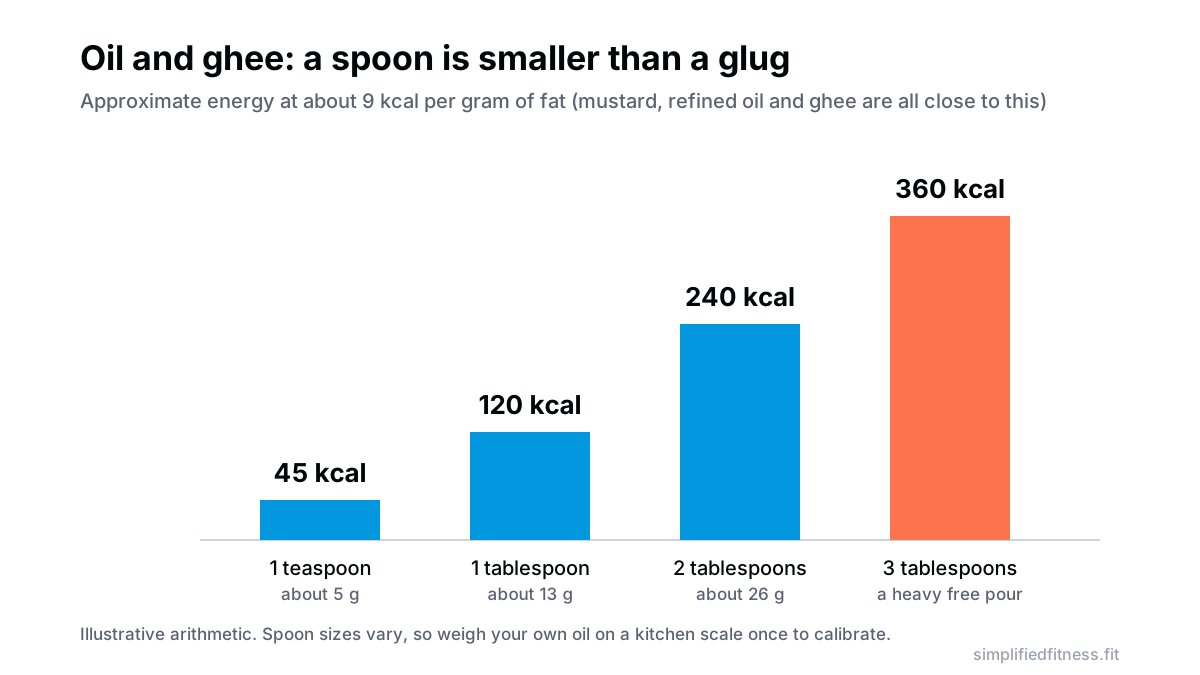
- The biggest hidden calories in Indian food are the fat you pour into the pan. Oil and ghee both carry about 9 kcal per gram, so one tablespoon is roughly 120 kcal whether it is mustard oil, refined oil or ghee.
- A free-poured sabzi for a family can easily hold 3-4 tablespoons of oil. That is 360-480 kcal that never shows up on your plate as a visible food.
- Research on people who say they eat little but do not lose weight points to under-reported intake, not a broken metabolism. Cooking fat is one of the easiest things to under-report.
- Weigh the oil once, cut the pour by roughly a third using a non-stick pan, a spoon or a spray, and log the fat as its own line. You can keep the same menu.
- Ghee is not poison and mustard oil is not magic. Both are calorie-dense, so the amount decides the result. If you have fatty liver, high cholesterol or diabetes, ask your doctor about the type of fat as well.
Part of our complete guide: Indian High-Protein Nutrition Guide: Cutting and Muscle Building on Vegetarian and Non-Veg Diets
Table of contents
You eat dal, sabzi and roti. No fried snacks, no takeaway, nothing “unhealthy”. Yet the belly stays. The usual culprit is hidden calories in Indian food, and almost all of them sit in the fat that goes into the pan before the vegetables do.
Oil and ghee carry about 9 kcal per gram, more than double protein or carbs. Because the fat melts into the gravy, you never see it on the plate. This guide shows where it hides, how to measure it, and how to cut a few hundred calories without changing what you cook. It builds on our complete Indian high-protein nutrition guide, where protein targets and food swaps are covered in full.
Why do I eat “clean” homemade food and still not lose belly fat?
Because “clean” describes ingredients, not energy. A bowl of moong dal, a bhindi sabzi and two rotis look light. Add a tablespoon of ghee in the tadka, three tablespoons of oil in the sabzi and a smear of ghee on each roti, and the meal can sit far above what you assumed.
This is not a metabolism problem in most cases. In a classic 1992 study, Lichtman et al. looked at obese people who said they could not lose weight on under 1200 kcal a day. Their energy expenditure was within 5 percent of predicted values. But they under-reported what they actually ate by an average of 47 percent and over-reported their physical activity by 51 percent. The group was small (ten people with a history of diet resistance) and not lifters, so do not read it as a verdict on you. It does show how large the gap between “what I think I eat” and “what I actually eat” can get.
A broader review of studies using doubly labelled water, a lab method for measuring real energy use, found that under-reporting is common when people record their own food, and that it is linked to factors such as dietary restraint as well as body size (Hill et al., 2001). A later review concluded that self-reported energy intake is systematically low, that the gap grows with body mass index, and that not every food is under-reported equally (Ravelli and Schoeller, 2020). None of these studies tested Indian cooking fat directly. The link is a reasonable inference: fat you cannot see is fat you do not count.
In the gym, this looks like a lifter who logs “dal 1 bowl” at 150 kcal and never enters the tadka. With a tablespoon of ghee split across four bowls, that is about 30 kcal a bowl, or 60 kcal a day over two meals. A heavier double tadka makes it 120 kcal a day, every day, for months.
Where are the hidden calories in Indian food actually hiding?
Think of five places. None of them needs a food you would call junk.
- The sabzi pot. A family pot cooked with free-poured oil is the largest single source. Three to four tablespoons (360-480 kcal) is easy to reach with a free pour, and it is spread across everyone who eats it.
- The tadka. Ghee or oil heated for cumin, garlic and chilli, then poured over dal. One tablespoon is about 120 kcal, and restaurant-style “double tadka” doubles it.
- Ghee on rotis, parathas and rice. A teaspoon is about 45 kcal. It feels like nothing when brushed on, but three rotis plus a spoonful on rice reaches 200 kcal quickly.
- Absorbent vegetables. Brinjal, bhindi and potatoes soak fat up like a sponge. Cooked with plenty of oil to stop them sticking, they take much of it with them.
- Creamy gravies. Butter, cream, cashew paste and oil all go into the base of paneer butter masala, korma and butter chicken. The gravy looks like a sauce but behaves like a fat source.
Does mustard oil or ghee have fewer calories than refined oil?
No. All common cooking fats are close to 9 kcal per gram, so a tablespoon of mustard oil, sunflower oil, groundnut oil or ghee lands within a few calories of the others. Ghee is almost pure fat, and refined oil is pure fat. There is no “light” version of a cooking fat.
Where they differ is the fatty acid profile. A review in Misra et al. (2010) describes a nutrition transition in South Asia toward calorie-dense foods, rising saturated fat from sources such as coconut oil, palm oil and ghee, and low intake of omega-3 fats in some vegetarian populations. It also says more research is needed on metabolic effects. That is a public-health review, not a trial of what happens if you eat a spoon of ghee.
There is one trial worth knowing about. In 110 people with fatty liver who normally ate ghee, Maleki Sedgi et al. (2024) swapped ghee for rapeseed oil, in the same amount, for 12 weeks. The swap group had significantly less liver fat than the group that kept ghee, and it also showed improvements in liver enzymes, blood sugar markers, weight and waist. It was done in Iran, in patients with a liver condition, and the control group was told to follow a healthy diet, so it does not prove ghee causes weight gain in healthy lifters. It does suggest that the type of fat can matter for people with metabolic problems, not only the amount.
Practical takeaway: do not switch from ghee to mustard oil to “save calories”. It will not. If you have fatty liver, raised cholesterol or diabetes, ask your doctor which fats suit you.
How much oil goes into a typical sabzi, and what does it cost you?
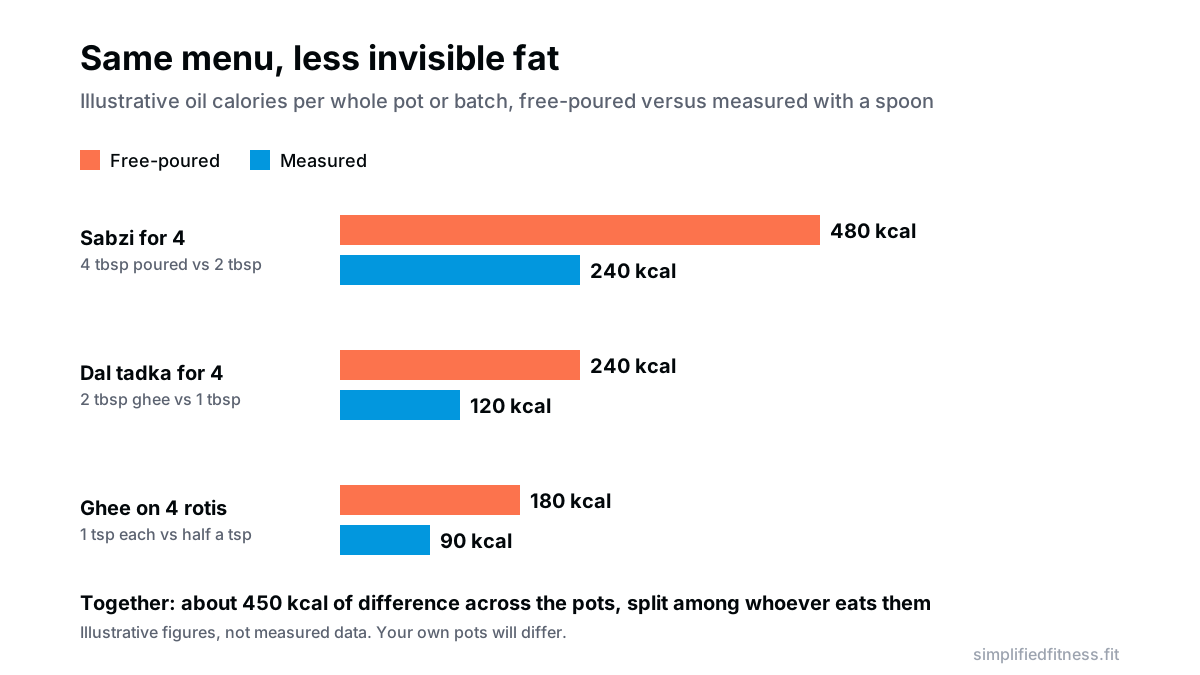
Here is a rough picture of one household’s day. These numbers are illustrative arithmetic, not measured data, and your own pots will differ.
| Item | Free-poured | Measured | Difference per pot |
|---|---|---|---|
| Sabzi for 4 | 4 tbsp (480 kcal) | 2 tbsp (240 kcal) | about 240 kcal |
| Dal tadka for 4 | 2 tbsp ghee (240 kcal) | 1 tbsp (120 kcal) | about 120 kcal |
| Ghee on 4 rotis | 1 tsp each (180 kcal) | half a tsp each (90 kcal) | about 90 kcal |
That is roughly 450 kcal across the pots. Whether you save all of it or a quarter of it depends on how many people share the food. If you cook for yourself, you save the lot. If four of you eat the pot, each person saves about 110 kcal a day, which adds up to more than 750 kcal a week.
How do I measure oil without ruining the taste?
The cheapest fix is a kitchen scale and one week of curiosity.
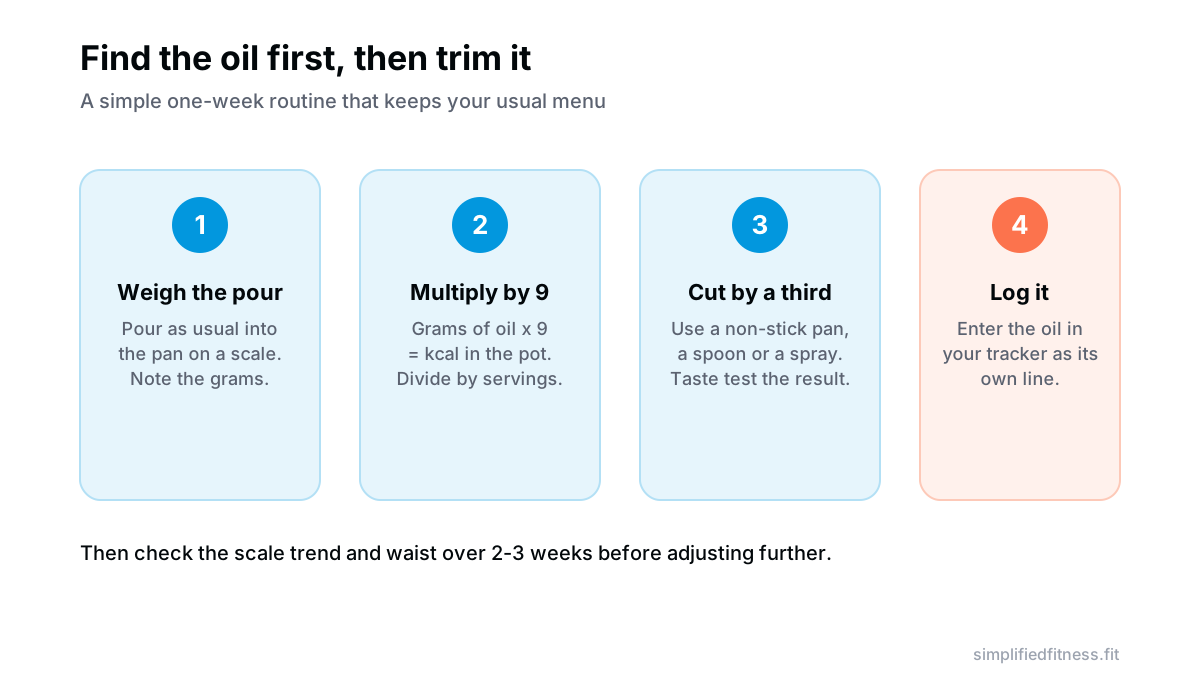
- Weigh your normal pour. Put the pan on a scale, zero it, pour as you usually do, and read the grams. Do it for the sabzi, the tadka and the paratha tawa.
- Multiply by 9. Grams of oil times 9 gives the calories. Divide by the number of servings.
- Cut by about a third. Not by half. A big sudden cut makes the food taste “wrong” and you will go back to pouring.
- Use a tool that makes small amounts easy. A measuring spoon, a pastry brush or a spray bottle all work. Wet-sauté with a splash of water to stop onions catching, and add the spice only at the end.
- Log the fat as its own line. Enter “1 tbsp ghee, 120 kcal” separately so it stops hiding in a generic “dal” entry.
Do non-stick pans, sprays and air frying actually work?
They help if they make you use less fat. A non-stick pan releases food with a teaspoon or two, where steel and cast iron often need a lot more to stop sticking. A spray puts out a tiny amount per press, so it is hard to overpour. An air fryer or a hot oven can crisp tikkis, pakoras and cutlets with a brush of oil instead of a deep pan.
I do not have a trial in lifters testing spray bottles or non-stick pans against measured spoons. What I can say is the logic: less oil in, fewer calories on the plate, same food. Look after the pan as well. A scratched or flaking non-stick surface should be replaced, and you should not overheat it.
Be honest about taste. Fat carries flavour, and a dal with almost no tadka can disappoint. That is why a one-third cut is a better start than a half. If you want a bigger flavour hit for few calories, use whole spices bloomed in a small amount of fat, fresh coriander, lemon, tomatoes and green chilli.
What about restaurant gravies, takeaways and festival food?
You cannot weigh restaurant oil. What you can do is choose.
Tandoori, grilled, dry and tawa preparations carry less added fat than “butter”, “makhani”, “malai” or “creamy” gravies. Ask for less gravy, no extra butter on the naan and no cream on top. Pick one rich item per meal, not three.
Part of the issue is judgement. In one small study of 78 nutrition students, only 18.5 percent of portion estimates were within 10 percent of the actual weight, and the error correlated with how energy-dense the food was, with a tendency to over-estimate high-energy items such as margarine and sugar and under-estimate low-energy ones (Japur et al., 2010). Those were trained students judging food they could see, and even they were rarely accurate. A gravy is a different problem: its fat is not visible at all, so there is nothing to estimate. That point is my inference, not a finding of the study. For a full approach to eating out, see our guide to healthy ordering in India.
Does tracking oil really help fat loss?
Mostly, yes, and the evidence is broader than “weigh your oil”. A 2021 systematic review of 59 weight loss interventions found that most studies using either high or low intensity dietary self-monitoring showed significant weight loss compared with controls (Raber et al., 2021). The authors note that adherence was measured inconsistently and the review could not say which approach was better, so the takeaway is modest: some tracking helps, and perfect tracking is not required.
You can apply this cheaply. Weigh the fat for each recipe once and reuse the number. Use your calorie calculator to set a sensible target, then see whether your oil-adjusted logging matches the scale. If you want a calmer way to diagnose a stall, our guide to breaking fat loss plateaus covers the rest of the usual suspects, and setting a realistic deficit helps you avoid over-cutting.
What should I cut first if I want results?
Work down this list, stopping when progress restarts.
- Sabzi fat first. The biggest pot, the easiest cut.
- Tadka second. Use a teaspoon per serving and no more.
- Ghee on rotis third. Keep it on one roti, not all of them.
- Creamy gravies fourth. Swap for tandoori, dal or a tomato-based curry more often.
- Fried sides last. Replace a couple of weekly pakoras with a grilled or air-fried version.
You do not need to give up the foods you love. A leaner version of the same dish usually keeps most of the flavour. It also keeps the protein: dal, curd, paneer, eggs and soya are still doing the heavy lifting. If you want ideas for a fuller plate with low-calorie volume, see high-volume, low-calorie foods for cutting, and for a worked eating plan see our vegetarian 1800 kcal, 140 g protein cutting diet.
When should I see a doctor?
Hidden oil explains a lot of stalled fat loss, but not all of it. See a doctor if your weight does not change after 3-4 weeks of carefully measured intake, or if you also have fatigue, cold intolerance, heavy hair shedding, irregular periods or unexplained swelling. Thyroid and other conditions can affect weight and need testing. If you have diabetes, fatty liver, high cholesterol or kidney or heart disease, ask before changing your fats. And if you use thyroid medication, do not stop or adjust it on your own.
The practical plan for this week
- Weigh your usual pour for the sabzi, the tadka and the paratha. Write the grams down.
- Cut each by about a third using a spoon, a spray or a non-stick pan.
- Log the oil as its own line, even if you reuse the number.
- Check your weekly average weight and waist after 2-3 weeks.
If the scale still does not move, look at drinks, snacks, weekend meals and weighing methods next. The oil is often the first leak, rarely the only one. For a ready-made structure, our free diet plan generator gives you a starting point to adjust.
Frequently Asked Questions
How many calories are in one tablespoon of oil or ghee?
One level tablespoon (about 13 g) of oil or ghee is roughly 115-120 kcal. Fat provides about 9 kcal per gram, and mustard oil, sunflower oil and ghee are all close to that. Weigh your own tablespoon once on a kitchen scale, because heaped spoons and free pours run much higher.
Why am I not losing belly fat even though I eat home-cooked food?
Home-cooked does not mean low-calorie, because the oil, ghee and gravy base are often not counted. Studies on people who report eating very little yet do not lose weight found their real intake was substantially higher than they reported, not that their metabolism was abnormal. Weigh your cooking fat for a week, log it honestly, and see whether your numbers change.
How much oil do I really need for a sabzi?
For a pot serving about four people, 1-2 tablespoons is enough for most dry and semi-gravy sabzis if you use a non-stick pan and a lid. Moisture from vegetables, a splash of water and a hot pan do much of the job that extra oil does. Start at 2 tablespoons, taste, and drop gradually rather than all at once.
Is ghee worse than mustard oil or refined oil for fat loss?
For calories, no: all of them are around 9 kcal per gram, so a spoon of ghee and a spoon of mustard oil cost about the same. Fat type may matter for blood lipids and liver health, and one 12-week trial in 110 people with fatty liver found less liver fat when ghee was replaced with rapeseed oil in the same amount. For fat loss itself, measure the quantity first and discuss the type with your doctor if you have a metabolic condition.
How many calories does a dal tadka add?
A tadka made with 1 tablespoon of ghee or oil adds about 120 kcal to the pot, and a restaurant-style double tadka can be double that. Split across four servings it is 30-60 kcal each, which sounds small but repeats at lunch and dinner. Use 1 teaspoon of ghee per serving at most and bloom the spices in it rather than pouring it over the top.
How many calories are in a ghee roti?
A plain roti made with no fat is a modest-calorie food, and each teaspoon of ghee brushed on adds about 45 kcal. Three rotis with a generous smear can add 150 kcal or more, which is easy to miss because it is spread thin. Try ghee on one roti rather than all of them, or skip it when the sabzi already has plenty of fat.
Do oil spray bottles actually help?
They can, because a spray delivers a fraction of a gram per press compared with a free pour. There is no trial in lifters testing spray bottles specifically, so treat this as practical coaching logic rather than proven fact. Pair a spray or a pastry brush with a non-stick pan, and check that you are not simply adding oil later at the table.
Are restaurant gravies like butter chicken or paneer butter masala really that high in calories?
Usually yes, because they combine butter, cream or cashew paste and oil in the base. A smooth gravy hides all of that fat, so there is nothing on the plate to help you estimate it. Choose tandoori or dry preparations more often and ask for less gravy and no extra butter or cream.
Does non-stick cookware reduce calories?
It lets you cook with less oil, so it reduces calories only if you actually pour less. Food releases from a non-stick pan with a teaspoon or two, whereas steel and cast iron usually need more to stop sticking. Use medium heat, replace worn pans, and measure what you add.
Should I use less oil or just eat less of the dish?
Cutting the oil in the pot is usually easier to stick to because your plate, your rotis and your protein stay the same. Eating less food also cuts fat, but you lose protein and fibre and you may feel hungrier. Trim oil first, then adjust portions of the energy-dense parts like rice or fried sides if the scale still does not move.
Do I have to track the oil to lose weight?
You do not have to track forever, but tracking oil for a couple of weeks is useful. A 2021 systematic review of 59 weight loss trials found that both high and low intensity dietary self-monitoring generally supported weight loss. A simple plan is to weigh the pour for each recipe once, write the number in your notes and reuse it.
How many calories can I save by cutting cooking fat?
If you cook two pots a day with a heavy hand, trimming a third to half of the fat can save several hundred calories across the household in a day. Your personal saving is that figure divided by the people who eat the pots, so it will be smaller if you share meals. Confirm the effect by watching your weekly average weight and waist over 2-3 weeks.
When should I see a doctor about not losing weight?
See a doctor if your weight does not move despite carefully measured intake for 3-4 weeks, or if you also have fatigue, heavy hair loss, cold intolerance, irregular periods or unexplained swelling. These can point to thyroid or hormonal conditions that need testing. Do not self-diagnose from blogs, including this one.
Sources & References
Every claim above is checked against peer-reviewed research (PubMed, U.S. National Library of Medicine) or guidance from established health bodies. How we fact-check.
- Lichtman SW, et al. Discrepancy between self-reported and actual caloric intake and exercise in obese subjects. N Engl J Med. 1992. PMID: 1454084
- Hill RJ, et al. The validity of self-reported energy intake as determined using the doubly labelled water technique. Br J Nutr. 2001. PMID: 11348556
- Ravelli MN, et al. Traditional Self-Reported Dietary Instruments Are Prone to Inaccuracies and New Approaches Are Needed. Front Nutr. 2020. PMID: 32719809
- Raber M, et al. A systematic review of the use of dietary self-monitoring in behavioural weight loss interventions: delivery, intensity and effectiveness. Public Health Nutr. 2021. PMID: 34412727
- Japur CC, et al. Food energy content influences food portion size estimation by nutrition students. J Hum Nutr Diet. 2010. PMID: 20337843
- Misra A, et al. Obesity, the metabolic syndrome, and type 2 diabetes in developing countries: role of dietary fats and oils. J Am Coll Nutr. 2010. PMID: 20823489
- Maleki Sedgi F, et al. The effects of replacing ghee with rapeseed oil on liver steatosis and enzymes, lipid profile, insulin resistance and anthropometric measurements in patients with non-alcoholic fatty liver disease: a randomised controlled clinical trial. Br J Nutr. 2024. PMID: 38501177

Umair Hazrami · Founder & Head Coach, Simplified Fitness
Umair Hazrami founded Simplified Fitness and the Simplified Lifter channel to cut through fitness noise. With 4+ years of consistent training and 10+ coaching clients, he writes every guide from the peer-reviewed research and links the sources so you can check them. Our editorial standards.
Educational content only, not medical advice. If you have a medical condition, are pregnant, or take medication, talk to a qualified doctor before changing your diet, supplements or training. Full disclaimer.
Keep reading
Indian Diet
Budget Indian Diet for 120g Protein Under ₹100 a Day (Student Plan)
A budget Indian diet for 120g protein under 100 rupees a day: soya, eggs, milk and chana, with protein per rupee maths and two student plans you can copy.
8 min read
Indian Diet
Chicken Breast and Fish in India: Where to Buy, How to Cook, and Cost per 30 g Protein
Chicken breast price per kg India: compare wet market vs apps, learn safe handling, a brine method for juicy meat, and rohu vs chicken cost per 30 g protein.
11 min read
Indian Diet
How to Convince Indian Parents About Whey Protein: Kidney Fears, 'Chemicals' and the Real Evidence
How to convince Indian parents about whey protein: explain it as paneer-water dairy, answer the kidney fear with trial data, and read the label together.
9 min read
Indian Diet
Curd vs Greek Yogurt vs Hung Curd: Protein Yield and the Home Recipe
Curd vs Greek yogurt protein in India: plain dahi gives about 3-4 g per 100 g. See how straining it into hung curd can triple that, and what studies show.
9 min read