Curd vs Greek Yogurt vs Hung Curd: Protein Yield and the Home Recipe
Curd vs Greek yogurt protein in India: plain dahi gives about 3-4 g per 100 g. See how straining it into hung curd can triple that, and what studies show.
TL;DR. The short answer
- Plain homemade dahi gives only about 3-4 g of protein per 100 g because most of its weight is water. Straining it into hung curd removes liquid whey, and draining it down to about a third of its starting weight concentrates protein to roughly 9-11 g per 100 g. Lighter straining gives less.
- Greek yogurt is essentially strained yogurt. A homemade hung curd made from toned or full-fat milk dahi is the cheapest way to get a similar texture and protein density in India.
- In trials, protein-rich yogurt has supported muscle gain: Greek yogurt beat a protein-free pudding in untrained young men, and a protein yogurt matched whey in older adults. Both studies were small, so treat them as encouraging, not final.
- Live yogurt cultures can reach the gut and help with lactose digestion, but the evidence does not say that curd is a strong probiotic supplement. Treat the gut benefit as a bonus.
- Buying commercial Greek-style tubs is fine. Compare grams of protein per 100 g and added sugar on the label, and prefer plain.
Part of our complete guide: Indian High-Protein Nutrition Guide: Cutting and Muscle Building on Vegetarian and Non-Veg Diets
Table of contents
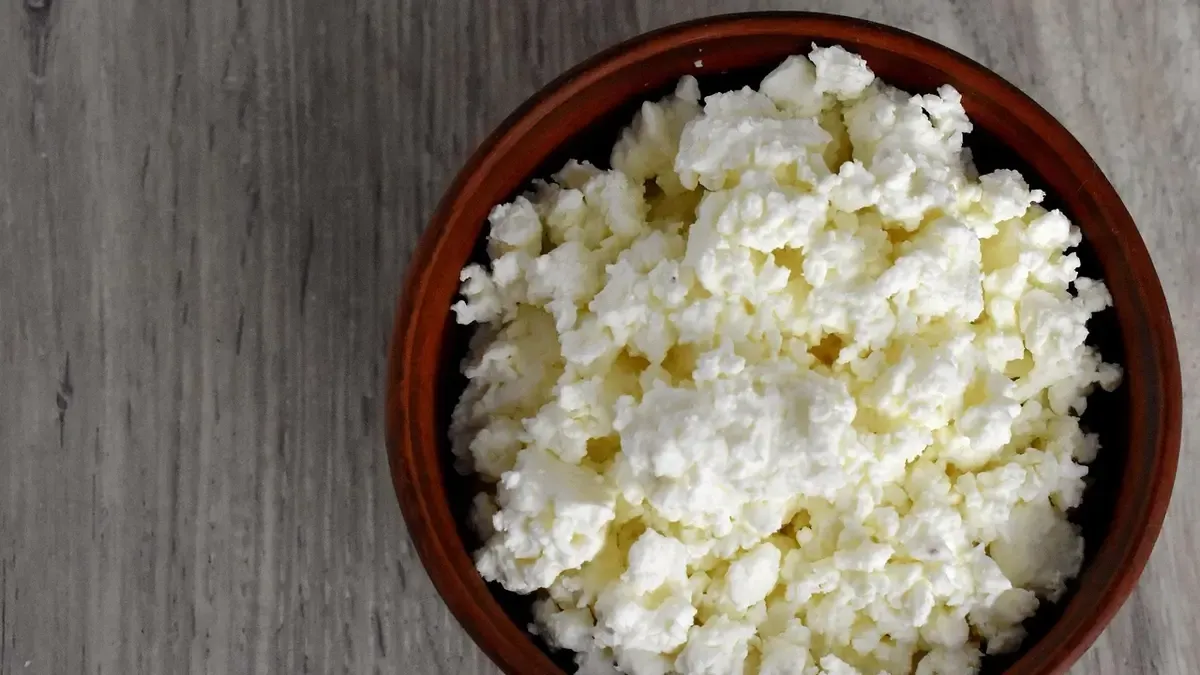
In the curd vs Greek yogurt protein India debate, the answer is mostly about water. Plain homemade dahi has only about 3-4 g of protein per 100 g, while hung curd or Greek-style yogurt packs roughly 9-11 g in the same weight, because straining removes the watery whey. You can make that at home with a muslin cloth and a few hours.
This article is part of our complete guide to Indian high-protein nutrition. It focuses on one cheap kitchen trick: turning ordinary dahi into something that actually moves your daily protein number.
Why plain curd is a weak protein source
Look at a typical katori of dahi. It feels substantial, but most of it is water. Milk protein is spread through that water, so a 100 g serving gives you only a few grams.
That is why “I eat curd every day, so my protein is fine” rarely adds up. Three katoris of plain dahi might give you roughly 10-12 g of protein. Useful, yes. A pillar of a muscle-building diet, no.
Dahi still has a place. It is cheap, it is familiar, and it works in raita, lassi, marinades and as a side to dal and rice. The mistake is counting it as a main protein source. If you want the bigger picture of where Indian diets fall short, see our look at the traditional Indian diet protein conundrum.
What straining actually does: hung curd protein yield
Dahi is made of two parts. Thick curds hold most of the milk’s casein protein and fat. The thin liquid, whey, holds water, lactose (milk sugar), minerals and a smaller share of the protein.
When you hang dahi in a cloth, the liquid drips out. The curds stay behind. Less water in the same protein means more protein per 100 g.
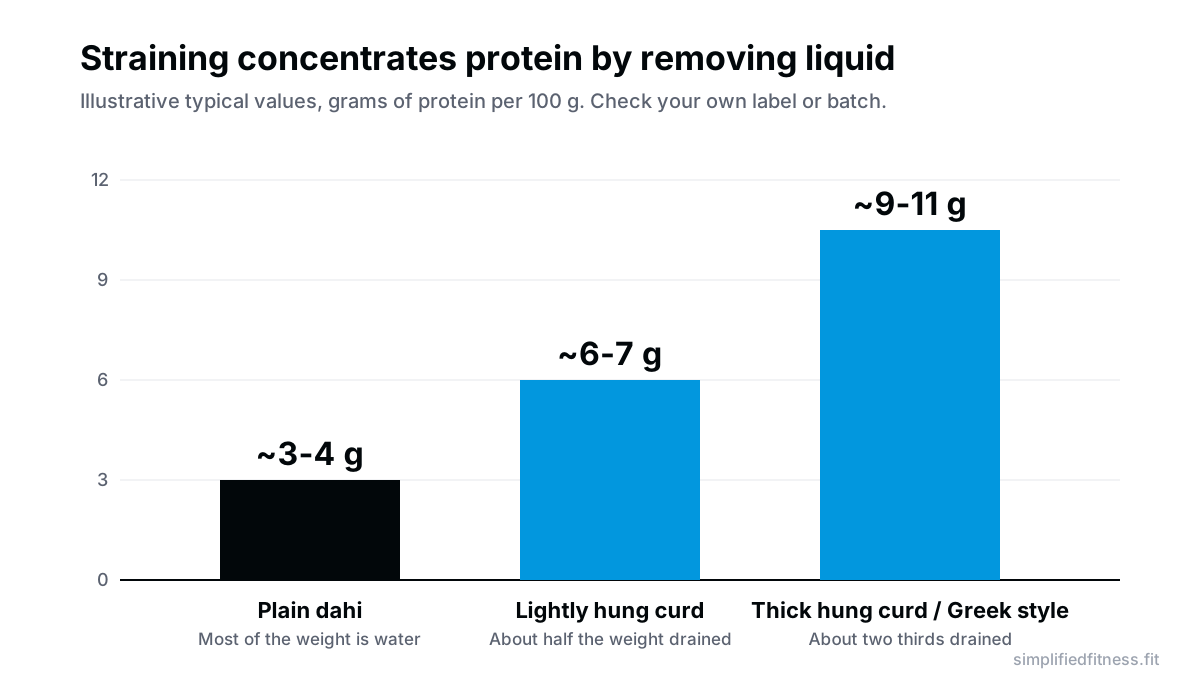
A simple way to think about it: if you start with 1 kg of dahi at about 3.5 g per 100 g, you hold roughly 35 g of protein. Drain it down to about a third of the weight and that protein, minus a bit lost in the whey, now sits in around 330 g. That is the logic behind the 9-11 g per 100 g range. Drain it only to half the weight and you land nearer 6-7 g.
You can check your own batch the same way: weigh the dahi before you hang it and the hung curd after. Take the starting protein (from the packet, or about 3.5 g per 100 g for homemade), knock off roughly a tenth for what leaves in the whey, and divide by the finished weight. Real results vary with the milk, the culture and how long you drain, and some protein does leave with the whey, so the numbers are estimates.
The trade-off is yield. Thicker yogurt means less of it from the same tub of dahi, which is why store-bought Greek tubs cost more.
How to make Greek yogurt at home from dahi
You do not need a special recipe. You need fresh dahi, a clean muslin or cheesecloth, a bowl and a fridge.
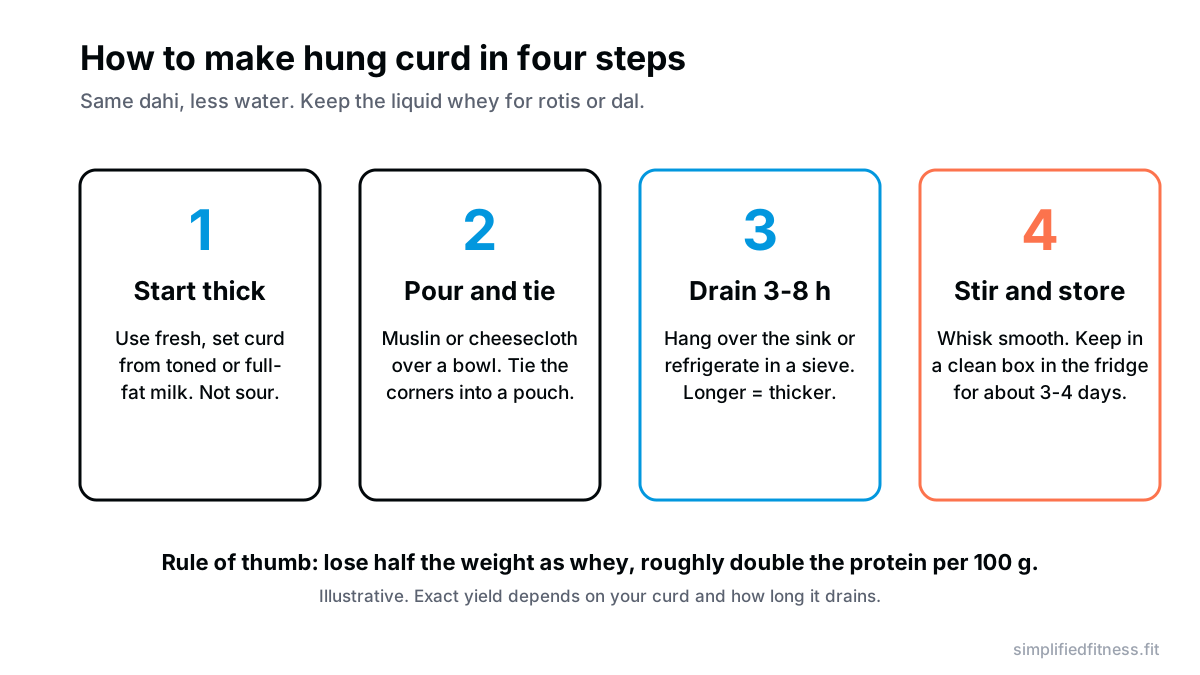
- Start with fresh, set curd. Avoid very sour dahi, because straining concentrates the sourness too. Toned milk dahi gives a lighter result, full-fat gives a creamier one.
- Line a sieve or tie a pouch. Put the cloth over a bowl, pour in the dahi, and tie the corners.
- Drain. About 3-4 hours gives a soft hung curd. Overnight in the fridge gives a thick, Greek-like texture. Squeezing the pouch gently near the end speeds it up. In hot weather, keep it refrigerated while it drains.
- Whisk and store. Stir it smooth, keep it in a clean airtight box, and finish it within a few days.
Do not throw away the liquid. Whey water can go into roti dough, dal, rice or a smoothie. It still carries some protein and minerals.
Make it more useful
- Mix with roasted jeera and salt for a savoury bowl.
- Top with fruit and a few nuts for breakfast.
- Blend into a thick lassi with a banana.
- Use as a marinade base for tandoori-style chicken or paneer.
- Swap it for cream or mayonnaise in dips.
If you also eat paneer, compare the two in our guide to paneer vs low-fat paneer and homemade chenna. Hung curd is the lighter, lower-effort option.
Does yogurt actually help build muscle?
Protein is protein, but the food it comes in matters for taste, cost and how easily you eat it. A few trials have looked at yogurt specifically.
Greek yogurt in young men. In a 12-week trial, 30 untrained university-aged men did resistance and plyometric training. One group had fat-free plain Greek yogurt (20 g protein per dose, three times on training days and twice on rest days) and the other a carbohydrate pudding with the same calories and no protein. Both groups improved, but the Greek yogurt group gained more total strength, more biceps thickness (about 0.46 cm vs 0.12 cm) and more fat-free mass (2.4 kg vs 1.3 kg) (Bridge et al., 2019). The control had no protein at all, so this shows that protein-rich yogurt beats none, not that it beats whey.
Protein yogurt vs whey in older adults. An 8-week randomized trial in 17 untrained adults aged 60-70 compared 24.5 g of protein yogurt with 25 g of whey alongside strength training. Skeletal muscle mass rose by about 0.50 kg with yogurt and 0.47 kg with whey, with no significant difference between groups (Monsalves-Alvarez et al., 2026). It was a small trial in older, untrained people, so the result may not carry over to trained young lifters.
Regular yogurt in women. A different design found a different answer. In 35 untrained women doing 8 weeks of training, adding three servings of fat-free yogurt per day did not improve body composition compared with a low-dairy diet (White et al., 2009). It used standard fat-free yogurt in untrained women, not a high-protein product, so it does not contradict the Greek yogurt result, but it shows yogurt is no magic by itself.
Fullness, snacks and calories
Yogurt is also a handy snack. In a small study of 15 healthy women, a 160 kcal afternoon snack of Greek yogurt with 24 g of protein reduced hunger and delayed the next meal request more than lower-protein yogurt snacks (178 vs 152 minutes for the low-protein version) (Douglas et al., 2013). That is a three-day study in women with a single snack type, so it is a pointer, not a promise for everyone.
On a cut, a thick bowl of plain hung curd is a decent trade: high protein for modest calories. Full-fat milk raises calories, so choose based on your target.
Probiotics: how much does curd really do?
This is the part where claims run ahead of evidence. Yogurt made with its usual starter bacteria, Streptococcus thermophilus and Lactobacillus delbrueckii subsp. bulgaricus, has been shown in human studies to improve lactose digestion and ease symptoms in people who are lactose intolerant (Guarner et al., 2005).
A later review found that many microbes from yogurt and other fermented foods do reach the gut, and that yogurt consumption is associated with several health benefits, though much of that comes from observational data (Kok and Hutkins, 2018). Association is not proof of cause.
So what can you say? Curd with live cultures is a reasonable gut-friendly food, especially for lactose digestion. It is not a precise probiotic dose, and a homemade batch will vary. Straining takes some bacteria out with the whey but leaves plenty behind. Heat kills them, so avoid cooking it or adding it to boiling gravy if you want the live cultures. For a deeper look, see our guide to probiotics for athletes and the gut-muscle axis.
Homemade hung curd vs commercial Greek yogurt
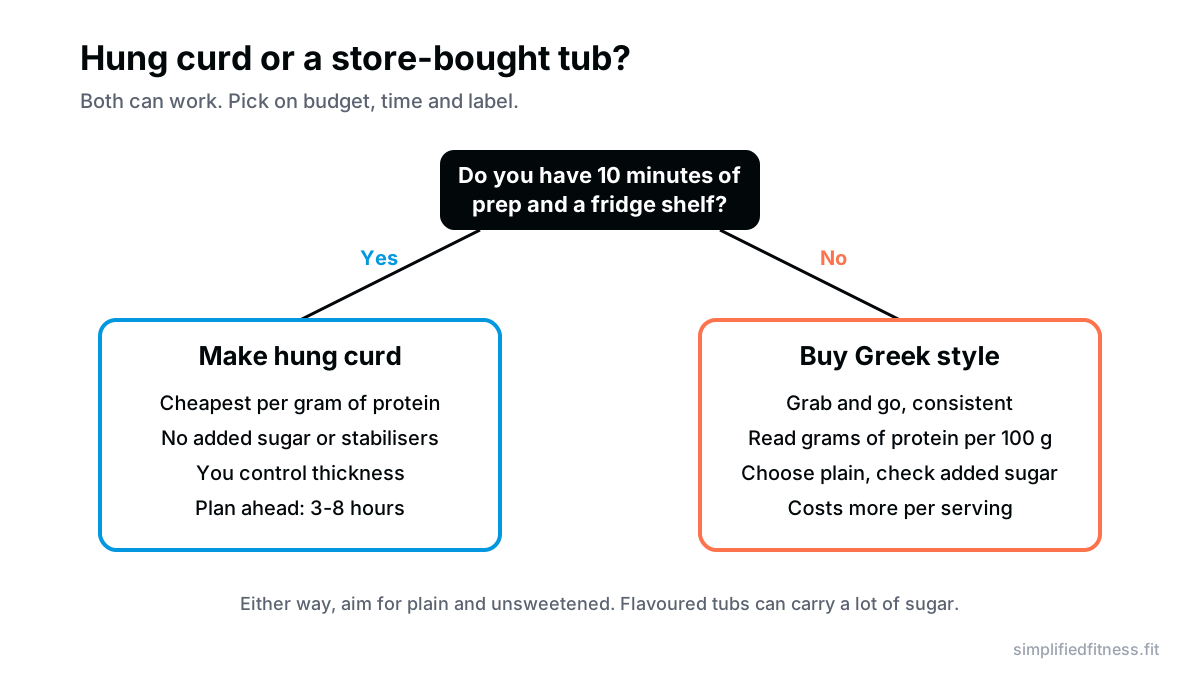
Indian brands such as Epigamia and Milky Mist sell Greek-style tubs, and they are handy. Labels vary by product and flavour, so rather than trust any number from an article, read the pack. Look at grams of protein per 100 g, and at added sugar. Flavoured and fruit versions can carry a lot of sugar.
| Plain dahi | Homemade hung curd | Store-bought Greek style | |
|---|---|---|---|
| Typical protein per 100 g | About 3-4 g | About 6-11 g, depending on draining | Varies by brand, read label |
| Cost | Lowest | Low | Highest |
| Effort | None | 10 min plus draining | None |
| Added sugar | None | None | Plain: low, flavoured: can be high |
| Consistency batch to batch | Variable | Variable | Consistent |
How to fit it into your day
- Breakfast: a bowl of thick hung curd with oats or fruit.
- Snack: hung curd with roasted chana or a handful of nuts.
- Pre-workout: a small trial in 30 active people found about 25 g of protein from yogurt before resistance training was well accepted, with few and mostly mild stomach symptoms (Portuguez-Molina et al., 2025). The study was funded by a dairy cooperative. Test it for yourself first, as tolerance differs.
- Dinner: a thick raita with dal and roti, or a marinade for chicken.
Start with a target, then add hung curd where it fills a gap. If you want a simple starting plan, our free diet plan page is a good place to begin.
Who should be careful
Lactose intolerance varies. Some people tolerate yogurt much better than milk, as the cultures help digest lactose, but not everyone does. Strained yogurt has less lactose than the original dahi because lactose leaves with the whey, though it is not lactose-free.
If you have a milk allergy, kidney disease or a medical diet, talk to a doctor or registered dietitian before changing your protein sources. Dairy allergy is different from lactose intolerance and can be serious.
The practical bottom line
Plain curd is a low-protein food, and the fix is simple: strain it. About 10 minutes of effort and a few hours of dripping turn cheap dahi into a thick, high-protein base. The research on yogurt and muscle is encouraging but small, and the probiotic story is more modest than the marketing. Use hung curd as a convenient, cheap protein source, check labels on anything you buy, and let your total daily intake do the heavy lifting.
Frequently Asked Questions
How much protein is in 100 g of curd (dahi)?
Plain homemade dahi typically provides around 3-4 g of protein per 100 g, depending on the milk used. Most of its weight is water, so a katori that looks filling is a modest protein source. Check your own packet label if you buy packaged curd, and count it as a supporting protein, not a main one.
How much protein does hung curd have?
Thick hung curd drained to about a third of its starting weight lands somewhere around 9-11 g of protein per 100 g, which is roughly what Greek-style yogurt offers. If only half the weight drains away, expect nearer 6-7 g. To estimate your batch, weigh the dahi before and the hung curd after, and divide the starting protein (minus about a tenth lost in the whey) by the finished weight.
Is hung curd the same as Greek yogurt?
Close, but not identical. Both are strained, thickened yogurt, and commercial Greek yogurt is made under controlled conditions so it is more consistent. At home, overnight-strained dahi gets you most of the way there for muscle-building purposes.
How long should I hang curd for?
About 3-4 hours gives a spreadable, hung-curd texture, and 6-8 hours (or overnight in the fridge) gives a thick, Greek-like result. Longer straining means thicker yogurt and a lower yield. Stop when it holds its shape on a spoon, and remember the thickest versions are great as dips or with fruit.
What do I do with the leftover whey water?
The liquid is whey, and it still carries some protein, lactose and minerals. You can use it to knead roti dough, cook dal or rice, or add it to smoothies. Keep it refrigerated and use it within a day or two so it does not spoil.
Does straining curd remove the probiotics?
Some live bacteria drain out with the whey, but plenty stay in the thick yogurt. The research on yogurt cultures is mostly about reaching the gut and helping lactose digestion, not about a precise bacterial dose. If gut health is your goal, think of strained curd as a food with a bonus, and keep fibre and variety in the diet as well.
Is dahi or Greek yogurt better for bodybuilding?
Greek-style yogurt is better per spoonful for protein, because plain dahi is roughly a third as concentrated. In a trial in untrained young men, daily Greek yogurt produced more strength and muscle thickness gain than a protein-free pudding. Hang your own dahi or buy plain Greek-style tubs, and hit your daily protein total with other foods as well.
Can hung curd replace whey protein?
Partly, for some people. A small 8-week trial in untrained older adults found protein yogurt and whey produced similar muscle gain, though it only had 17 participants. Whey is still easier to dose precisely, while hung curd is cheaper and a whole food, so many lifters use both.
How much hung curd can I eat in a day?
There is no set limit for healthy adults, but calories and fat add up, especially with full-fat milk. A bowl of roughly 150-200 g gives about 15-20 g of protein if it is thick. Fit it into your overall protein and calorie target, which you can work out with our protein calculator.
Does curd cause weight gain or cold and cough?
Curd does not cause weight gain on its own, because gain comes from total calories over time. The cold and cough belief is traditional, and I could not find strong trial evidence for it in this research. If dairy upsets your stomach, talk to a doctor or dietitian about lactose intolerance.
Is Greek yogurt good before a workout?
It can be. A small crossover trial in 30 active people, sponsored by a dairy cooperative, found about 25 g of protein from yogurt (200 mL) or milk (500 mL) before resistance training was well tolerated, with few and mostly mild stomach symptoms. Try it 1-2 hours before training first, and see how your stomach reacts.
Can I make hung curd from toned milk?
Yes. Toned milk makes a lighter, less creamy hung curd, while full-fat gives a richer one with more calories. Both work for protein, so choose based on your calorie budget and taste.
Sources & References
Every claim above is checked against peer-reviewed research (PubMed, U.S. National Library of Medicine) or guidance from established health bodies. How we fact-check.
- Bridge A, et al. Greek Yogurt and 12 Weeks of Exercise Training on Strength, Muscle Thickness and Body Composition in Lean, Untrained, University-Aged Males. Front Nutr. 2019. PMID: 31114790
- Monsalves-Alvarez M, et al. Protein yogurt and whey protein produce comparable muscle gains, but divergent microbiome shifts during strength training in older adults. Sci Rep. 2026. PMID: 42151371
- Morton RW, et al. A systematic review, meta-analysis and meta-regression of the effect of protein supplementation on resistance training-induced gains in muscle mass and strength in healthy adults. Br J Sports Med. 2018. PMID: 28698222
- Douglas SM, et al. Low, moderate, or high protein yogurt snacks on appetite control and subsequent eating in healthy women. Appetite. 2013. PMID: 23022602
- Guarner F, et al. Should yoghurt cultures be considered probiotic? Br J Nutr. 2005. PMID: 16022746
- Kok CR, et al. Yogurt and other fermented foods as sources of health-promoting bacteria. Nutr Rev. 2018. PMID: 30452699
- White KM, et al. Changes in body composition with yogurt consumption during resistance training in women. Int J Sport Nutr Exerc Metab. 2009. PMID: 19403951
- Portuguez-Molina P, et al. Pre-Workout Intake of High-Protein Products: Palatability and Gastrointestinal Effects of Milk vs. Yogurt. Nutrients. 2025. PMID: 41305591

Umair Hazrami · Founder & Head Coach, Simplified Fitness
Umair Hazrami founded Simplified Fitness and the Simplified Lifter channel to cut through fitness noise. With 4+ years of consistent training and 10+ coaching clients, he writes every guide from the peer-reviewed research and links the sources so you can check them. Our editorial standards.
Educational content only, not medical advice. If you have a medical condition, are pregnant, or take medication, talk to a qualified doctor before changing your diet, supplements or training. Full disclaimer.
Keep reading

Indian Diet
Budget Indian Diet for 120g Protein Under ₹100 a Day (Student Plan)
A budget Indian diet for 120g protein under 100 rupees a day: soya, eggs, milk and chana, with protein per rupee maths and two student plans you can copy.
8 min read

Indian Diet
Chicken Breast and Fish in India: Where to Buy, How to Cook, and Cost per 30 g Protein
Chicken breast price per kg India: compare wet market vs apps, learn safe handling, a brine method for juicy meat, and rohu vs chicken cost per 30 g protein.
11 min read

Indian Diet
How to Convince Indian Parents About Whey Protein: Kidney Fears, 'Chemicals' and the Real Evidence
How to convince Indian parents about whey protein: explain it as paneer-water dairy, answer the kidney fear with trial data, and read the label together.
9 min read
Indian Diet
Is Dal a Good Source of Protein? Moong, Chana and Rajma Reality Check
Is dal a good source of protein? Moong, chana and rajma give some protein but far more carbs. See the numbers and how to build a plate that works for lifters.
8 min read