Tofu and Edamame in Indian Cooking: Plant-Based Protein for Indian Vegans
Tofu in Indian cooking for bodybuilding: swap paneer for soya paneer in palak and matar gravies, add edamame chaat, and hit protein vegan. Evidence checked.
TL;DR. The short answer
- Firm tofu (soya paneer) gives roughly paneer-like protein per 100 g with much less fat, and it swaps 1:1 into palak, matar and bhurji if you press and sear it first. Macros vary by brand, so check the label.
- Soy is a high-quality plant protein. A quantitative review found mean DIAAS around 85 and PDCAAS around 86 across soy products, and a 2018 meta-analysis found soy and animal protein produced similar strength and lean mass gains.
- A 12-week trial in young men found a vegan diet and an omnivore diet matched at 1.6 g/kg/day protein gave similar muscle and strength gains, so total protein matters more than source.
- Edamame (whole young soybeans) works as a chaat or snack, but it is not a full replacement for tofu because a handful gives far less protein than a 150 g serving of tofu.
- Soy does not lower testosterone in men according to a 2021 meta-analysis of 41 studies. Vegans should still plan for iron, zinc, B12 and calcium, and see a doctor or dietitian if they have thyroid or kidney conditions.
Part of our complete guide: Indian High-Protein Nutrition Guide: Cutting and Muscle Building on Vegetarian and Non-Veg Diets
Table of contents
Tofu in Indian cooking works better than most people expect, and for bodybuilding it is the closest thing a vegan has to a direct paneer replacement. Firm tofu, sold in India as soya paneer, gives you a solid dose of complete protein with far less fat than dairy paneer, and it takes masala well if you treat it right.
This article is part of our complete guide to Indian high-protein nutrition. Here we stay narrow: how to cook tofu and edamame in the gravies you already eat, how the macros compare with paneer, and what the research says about getting enough protein on a vegan Indian diet.
Is tofu a complete protein?
Yes. Every plant food contains some of all nine essential amino acids, but soy is one of the few that supplies all of them in amounts close to what you need. That is why “plant-based complete protein” almost always means soy.
Protein quality scores put numbers on this. A 2022 quantitative review pooled studies on soy products and found a mean DIAAS of about 85 and a mean PDCAAS of about 86 across all soy products, with tofu at the lower end of the DIAAS ranking among soy foods and wide variation depending on processing (van den Berg et al., 2022). The authors concluded that most soy products have high protein quality scores. Two of the authors were connected to Unilever, which sells plant-protein foods. That is worth knowing, though the data it pooled comes from many independent studies.
Practical reading: soy is good, not perfect. Eaten alongside rice, roti and dal across the day, the gap is easy to close.
Soya paneer vs dairy paneer: the macros
Here is the pitch. Full-fat dairy paneer is protein plus a lot of milk fat. Firm tofu is protein plus much less fat, so the same 150 g portion leaves more calories free for other food.
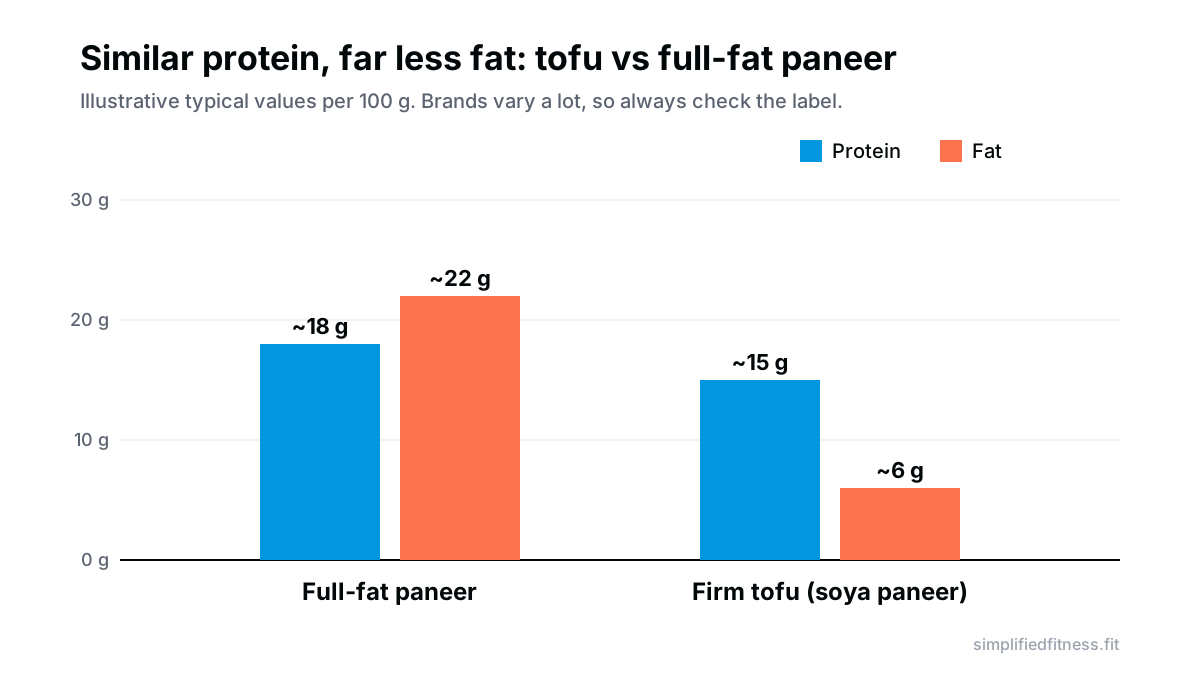
Because brands differ, I will not give you one magic number. Protein per 100 g changes with how firm the block is and how much water is pressed out. Silken tofu holds more water and carries less protein per gram. Many Indian brands label a firm block somewhere in the mid-teens of protein per 100 g, with single-digit fat, but check the pack in your hand and enter it in your tracker.
Cost is the other draw. In many Indian cities tofu or soya paneer costs noticeably less than dairy paneer per kg, though prices vary by city and store, so compare per-100 g protein, not per-pack price. For a wider look at stretching a food budget, see our budget Indian diet for 120 g protein.
If you want the dairy side of this comparison in detail, including lower-fat chenna, read paneer vs low-fat paneer. We do not repeat it here.
Can soy protein build muscle as well as animal protein?
The worry comes from acute studies. Whey, higher in leucine, stimulates muscle protein synthesis more than soy in a single meal. The question is whether that matters over months of training.
A 2018 meta-analysis looked at exactly that. It pooled nine studies with 266 participants who trained for at least 6 weeks while supplementing soy or animal protein (whey, beef, milk or dairy). Both groups gained strength, and soy did not differ from animal protein for strength or lean mass, although the lean mass changes themselves were small and not statistically significant in the whey and soy comparison (Messina et al., 2018). Nine studies is a small base, so treat this as encouraging rather than final.
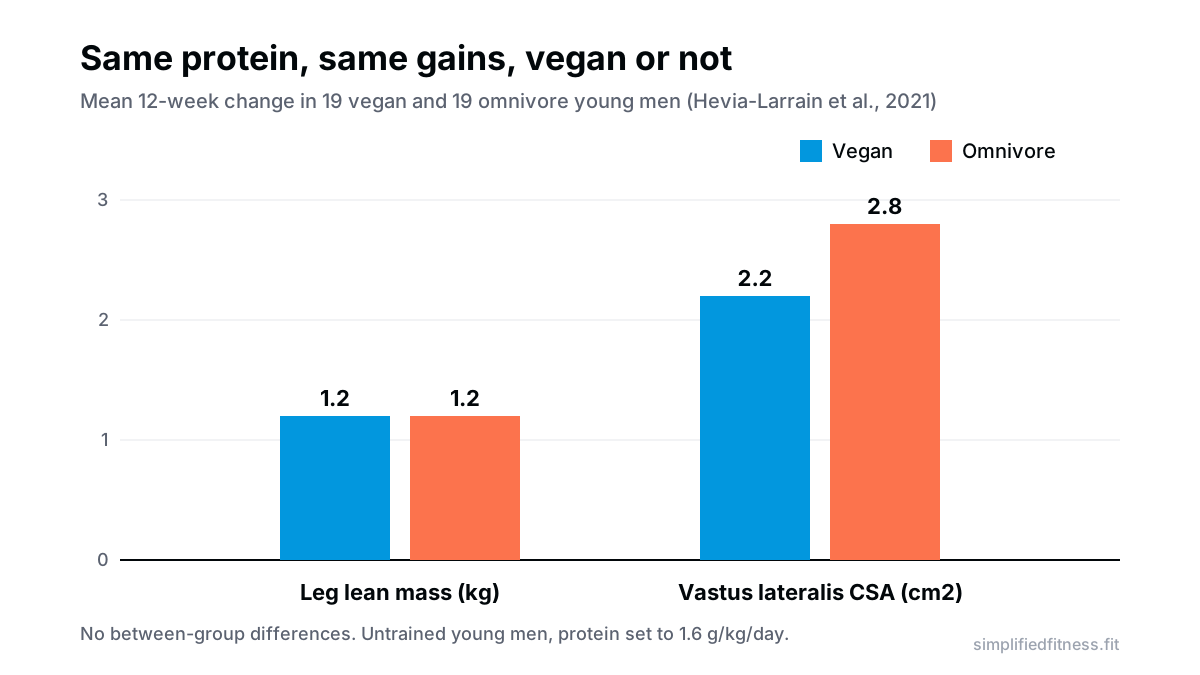
A trial in whole-diet vegans adds more. Nineteen habitual vegan men and nineteen omnivores did 12 weeks of supervised resistance training, with protein topped up to 1.6 g/kg/day. Leg lean mass rose by 1.2 kg in both groups, and no outcome differed between them (Hevia-Larraín et al., 2021). The participants were untrained young men, so the result may not carry over to advanced lifters, women or older adults.
How much protein does a vegan Indian lifter need?
A meta-analysis of 49 trials found that gains in fat-free mass did not rise further once total protein passed about 1.62 g/kg/day (Morton et al., 2018). That is the default target in the vegan trial too.
For a 70 kg lifter that is about 112 g a day. Some coaches nudge plant-based targets a little higher because plant proteins can be less digestible, but I am not aware of strong trial evidence that vegans need more than this, so I would not chase big numbers. Work out your own target with our protein calculator, then build the day around it.
Paneer swaps: palak, matar and bhurji
The most common mistake is dropping raw tofu cubes into a gravy and wondering why it tastes of nothing. Tofu is a sponge. You have to give it a surface worth soaking.
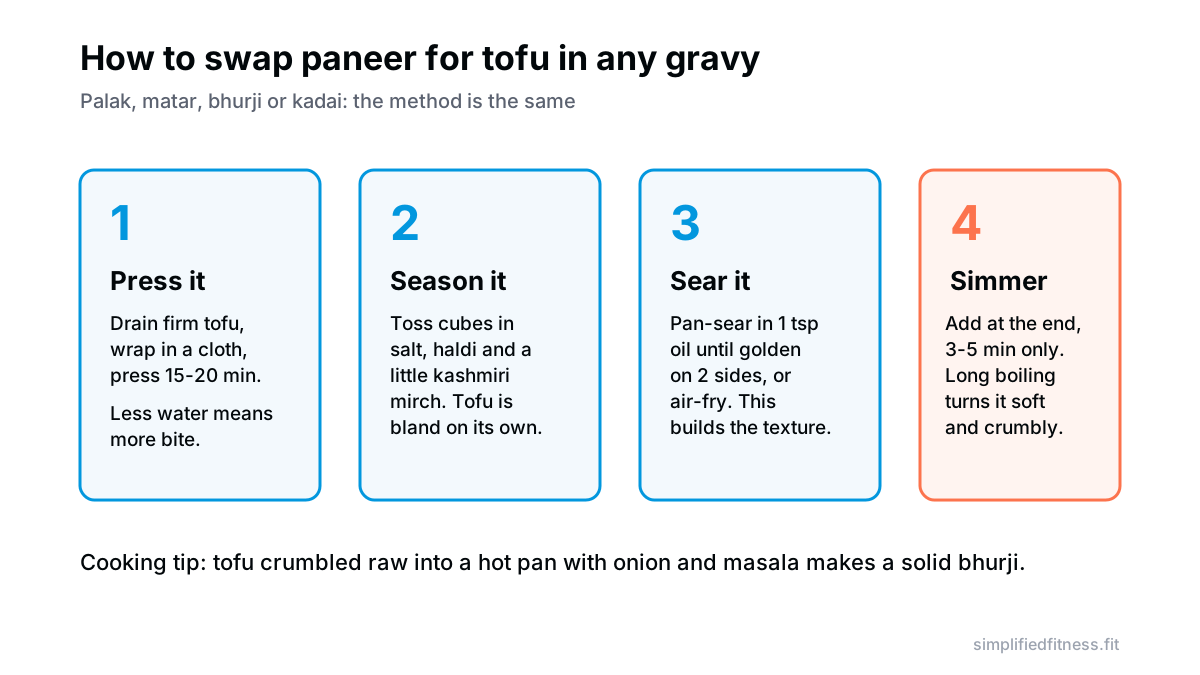
Tofu palak: Blanch and blend the spinach as usual. Sear pressed tofu cubes separately, then fold them into the gravy for the last few minutes. Finish with a little kasuri methi.
Tofu matar: Use the same sear step. Add the tofu after the peas, since matar needs longer than tofu does.
Tofu bhurji: The easiest swap. Crumble a pressed block into onion, tomato, haldi and green chilli, and cook it dry. This is the one dish where tofu is basically indistinguishable in a roti roll.
Tofu tikka: Marinate in dairy-free curd alternative or a besan and spice paste, then grill or air-fry.
If you cook in bulk, pressed and seared tofu keeps in the fridge for a few days in a closed container, so you can add it to meals through the week. Our vegetarian meal prep blueprint shows how to batch other proteins alongside it.
Edamame in India: chaat, snack and where it fits
Edamame is whole young soybeans, usually sold frozen in the shell or shelled. You get protein, fibre and a satisfying bite, which makes it a good snack. It is just not as dense as tofu per serving, so think of it as a protein-boosting side rather than a main source.
- Edamame chaat: Boil, shell, then toss with onion, tomato, chaat masala, lemon juice and coriander.
- Salted pods: Boil in salted water for a few minutes and eat as a snack.
- In sabzi or pulao: Use shelled edamame in place of green peas to lift the protein a little.
Availability and price vary by city. If edamame is hard to find or pricey, soya chunks and tofu are far easier to source. Read our soya chunks profile for the TVP side of this, and high-protein Indian snacks for other options.
What does a high-protein vegan Indian day look like?
Here is an illustrative structure, not a prescription. The point is to cover protein at every meal rather than load it all at dinner.
- Breakfast: tofu bhurji roll or moong chilla with a soy milk chai.
- Lunch: roti or rice, dal, a tofu palak, curd alternative or salad.
- Snack: edamame chaat or roasted chana.
- Dinner: soya chunk curry or tofu matar with rice.
- Top-up: a plant protein shake if your tracker says you are short. We compare options in our vegan protein blends guide.
Dals are useful but are mostly carbohydrate with an incomplete amino acid profile, which is why soy sits in the centre of a vegan day. We explain that in dals and pulses explained. Want a full day built for you? Use our free diet plan as a starting template.
Does soy lower testosterone?
No, according to the best human evidence. A 2021 meta-analysis of 41 clinical studies covering 1,753 men for total testosterone found no significant effect of soy protein or isoflavones on total or free testosterone, estradiol or estrone, regardless of dose or duration (Reed et al., 2021).
A 12-week trial in 47 untrained young men also found that soy protein did not appreciably change markers of androgen signalling in muscle or estrogen signalling in fat tissue, compared with whey or placebo (Haun et al., 2018). Whey raised testosterone slightly more with training in that study, but the authors did not conclude this affected muscle androgen activity.
Case reports describing “feminising” effects have been published, which is why the question keeps coming up, but the pooled clinical data above do not support it. Our full breakdown is in soy protein and testosterone myths.
What can go wrong on a vegan Indian diet?
Protein is the easy part. The harder part is micronutrients.
B12: Plant foods do not reliably provide it. A review in plant-based athletes lists B12 among the nutrients that need deliberate planning, along with iron and zinc (Shaw et al., 2022).
Iron and zinc: Absorption is lower from plant-heavy diets because of phytate in legumes and whole grains, and vegetarians tend to have lower iron stores, though adverse health effects have not been clearly shown in varied diets in wealthier countries (Hunt, 2003). Premenopausal women are the group most worth monitoring.
Calcium: Tofu set with calcium salts can contribute, but amounts depend on the coagulant, so check the label.
The bottom line
Press it, sear it, add it late. Do that and tofu becomes a believable paneer swap in palak, matar and bhurji, with less fat and a protein score that holds up in the research. Edamame is a good snack, not a staple. And the evidence so far says total protein, not whether it comes from soy or milk, drives your results. Set your target at about 1.6 g/kg, spread it across the day, and lift hard.
Frequently Asked Questions
Is tofu a complete protein?
Yes, soy protein supplies all nine essential amino acids in amounts close to human needs, which is why tofu is usually classed as a complete plant protein. A quantitative review of soy products found mean DIAAS of about 85 and PDCAAS of about 86, which are high for a plant source. Pair tofu with rice or roti in the same day and you are well covered.
How much protein is in 100 g of tofu?
It depends on firmness and brand, with firm and pressed blocks carrying clearly more than silken tofu. Water content is the reason, because softer tofu holds more water per 100 g. Read the nutrition label on the pack you actually buy, and weigh 150-200 g raw when you track.
Is soya paneer the same as tofu?
In most Indian stores, soya paneer is simply tofu sold under a familiar name. It is made by curdling soy milk and pressing the curds, in the same way dairy paneer is made from milk. Check the ingredient list, since some products add starch or flavour.
Is tofu better than paneer for muscle gain?
Tofu is not magically better, but it gives you protein with far less fat per 100 g, which leaves more calorie room for rice, roti or dal. A 2018 meta-analysis found soy and animal protein supplements gave similar gains in strength and lean mass over at least 6 weeks of training. Use tofu when you are cutting or vegan, and keep paneer if you eat dairy and enjoy it.
Can I build muscle on a vegan Indian diet?
Yes, if total protein and training are right. In a 12-week trial, vegan and omnivore young men eating 1.6 g/kg/day of protein gained similar leg lean mass (1.2 kg in both groups). Lift progressively, spread tofu, soya chunks, dals and a protein powder across the day, and track your intake for two weeks.
How much protein should a vegan lifter eat?
About 1.6 g/kg/day is a sensible target, since a meta-analysis found protein intakes above roughly 1.6 g/kg/day gave no further gains in fat-free mass in trained and untrained adults. Some plant protein is less digestible, so lifters sometimes aim a little higher, but evidence for that is limited. Use our protein calculator to set a number for your weight.
Does soy lower testosterone or cause man boobs?
No. A 2021 meta-analysis of 41 clinical studies found no effect of soy protein or isoflavones on total or free testosterone or on estradiol in men. A 12-week trial in young men also found soy protein did not shift androgen or estrogen signalling markers. Normal food amounts of tofu are fine, and we cover this in a dedicated soy myths article.
Is edamame a good protein source in India?
It is decent but not dense. Edamame is whole young soybean, so you get protein plus fibre, and you need a generous bowl to match one serving of tofu. Frozen shelled edamame is sold in larger Indian cities and online, so buy it only if the price works for you, otherwise tofu and soya chunks are cheaper.
Do I need to press tofu before cooking?
Pressing is optional but worth it for gravies and stir-fries. Removing surface water lets the cubes sear instead of steam, and it lets them absorb masala. Wrap the block in a clean cloth, put a plate and a heavy bowl on top, and leave it 15-20 minutes.
How long does tofu last in the fridge?
Unopened packs last until the date printed on them, and opened tofu should be eaten within a few days. Keep it submerged in fresh water in a closed container and change the water daily. Throw it away if it smells sour or feels slimy.
What do vegans in India need to supplement?
Vitamin B12 is the main one, since plant foods do not reliably supply it. Iron and zinc absorption is lower from plant-heavy diets because of phytate, according to a review in the American Journal of Clinical Nutrition. Get blood work done, and talk to a doctor or dietitian before choosing supplements.
Can I eat tofu if I have thyroid problems or kidney disease?
That is a question for your doctor, not a gym article. Soy foods are eaten widely and research in healthy men shows no hormone effect, but that does not cover medical conditions or medication timing. Ask your doctor or a dietitian for advice specific to your condition.
Sources & References
Every claim above is checked against peer-reviewed research (PubMed, U.S. National Library of Medicine) or guidance from established health bodies. How we fact-check.
- Messina M, et al. No Difference Between the Effects of Supplementing With Soy Protein Versus Animal Protein on Gains in Muscle Mass and Strength in Response to Resistance Exercise. Int J Sport Nutr Exerc Metab. 2018. PMID: 29722584
- van den Berg LA, et al. Protein quality of soy and the effect of processing: A quantitative review. Front Nutr. 2022. PMID: 36238463
- Hevia-Larraín V, et al. High-Protein Plant-Based Diet Versus a Protein-Matched Omnivorous Diet to Support Resistance Training Adaptations: A Comparison Between Habitual Vegans and Omnivores. Sports Med. 2021. PMID: 33599941
- Morton RW, et al. A systematic review, meta-analysis and meta-regression of the effect of protein supplementation on resistance training-induced gains in muscle mass and strength in healthy adults. Br J Sports Med. 2018. PMID: 28698222
- Reed KE, et al. Neither soy nor isoflavone intake affects male reproductive hormones: An expanded and updated meta-analysis of clinical studies. Reprod Toxicol. 2021. PMID: 33383165
- Haun CT, et al. Soy protein supplementation is not androgenic or estrogenic in college-aged men when combined with resistance exercise training. Sci Rep. 2018. PMID: 30042516
- Hunt JR. Bioavailability of iron, zinc, and other trace minerals from vegetarian diets. Am J Clin Nutr. 2003. PMID: 12936958
- Shaw KA, et al. Benefits of a plant-based diet and considerations for the athlete. Eur J Appl Physiol. 2022. PMID: 35150294

Umair Hazrami · Founder & Head Coach, Simplified Fitness
Umair Hazrami founded Simplified Fitness and the Simplified Lifter channel to cut through fitness noise. With 4+ years of consistent training and 10+ coaching clients, he writes every guide from the peer-reviewed research and links the sources so you can check them. Our editorial standards.
Educational content only, not medical advice. If you have a medical condition, are pregnant, or take medication, talk to a qualified doctor before changing your diet, supplements or training. Full disclaimer.
Keep reading
Indian Diet
Budget Indian Diet for 120g Protein Under ₹100 a Day (Student Plan)
A budget Indian diet for 120g protein under 100 rupees a day: soya, eggs, milk and chana, with protein per rupee maths and two student plans you can copy.
8 min read
Indian Diet
Chicken Breast and Fish in India: Where to Buy, How to Cook, and Cost per 30 g Protein
Chicken breast price per kg India: compare wet market vs apps, learn safe handling, a brine method for juicy meat, and rohu vs chicken cost per 30 g protein.
11 min read
Indian Diet
How to Convince Indian Parents About Whey Protein: Kidney Fears, 'Chemicals' and the Real Evidence
How to convince Indian parents about whey protein: explain it as paneer-water dairy, answer the kidney fear with trial data, and read the label together.
9 min read
Indian Diet
Curd vs Greek Yogurt vs Hung Curd: Protein Yield and the Home Recipe
Curd vs Greek yogurt protein in India: plain dahi gives about 3-4 g per 100 g. See how straining it into hung curd can triple that, and what studies show.
9 min read