Indian Vegetarian Cutting Diet: How to Hit 130-150g Protein on 1,800 Calories Without Meat
An Indian vegetarian cutting diet at 1800 calories with about 140 g protein: a full day of eating with macros, a grocery list, swaps and the research behind it.
TL;DR. The short answer
- An Indian vegetarian cutting diet at 1,800 calories can reach about 140 g protein with besan, low-fat paneer, soya chunks, hung curd, sprouted chana and one scoop of whey spread over four meals.
- Research on resistance-trained people who diet suggests higher protein than the usual 1.6 g/kg may help keep muscle, so 130-150 g suits roughly a 65-90 kg lifter, not everyone.
- On a vegetarian day, protein per calorie matters more than protein per rupee: low-fat paneer, soya chunks and whey give 12-20 g per 100 kcal, while roti, besan and regular paneer give 2.5-6 g.
- Meta-analyses find similar strength and lean mass gains from soy and animal protein, though one review hints at a small edge for animal protein in younger adults, so hit the number and keep training hard.
- 1,800 kcal is an example, not a prescription. Work out your own calories first, and see a doctor or dietitian if you have kidney disease, diabetes, pregnancy or a history of disordered eating.
Part of our complete guide: Indian High-Protein Nutrition Guide: Cutting and Muscle Building on Vegetarian and Non-Veg Diets
Table of contents
An Indian vegetarian cutting diet of 1800 calories can deliver about 140 g of protein, but only if you build it around concentrated sources: besan, low-fat paneer, soya chunks, hung curd, sprouted chana and one scoop of whey. Dal and roti alone will not get you there. Below is one full day of eating, the macros, a weekly grocery list and the swaps that keep it workable.
This is the exact, done-for-you version of the ideas in our Indian high-protein nutrition guide. If you want to prep it in bulk, our vegetarian meal prep blueprint covers the batch-cooking side. If you eat chicken and eggs, the non-vegetarian 1,800 kcal plan is the better fit.
One honest caveat first. 1,800 kcal is a sample, not a rule. Whether it is a sensible deficit for you depends on your size and activity, so check your own number in the calorie calculator before you copy anything.
Who is an 1,800-calorie, 140 g protein day actually for?
It suits a lifter of roughly 65-90 kg who maintains somewhere around 2,200-2,500 kcal. For that person 1,800 is a moderate deficit and 140 g works out to about 1.6-2.2 g/kg. For someone lighter and less active, 1,800 may be barely a deficit. For a bigger person, it may be too harsh.
Why protein matters more on a cut: when you eat less, your body is more willing to burn muscle. A 2018 meta-analysis of 49 trials (1,863 participants) found protein supplementation improved strength and fat-free mass gains during resistance training, with no further gains in fat-free mass beyond about 1.6 g/kg/day (Morton et al., 2018). Those were mostly people eating enough, not dieting.
Dieting changes the picture. A 2014 review of six studies in lean, resistance-trained athletes who were restricting calories suggested protein needs are likely 2.3-3.1 g per kg of fat-free mass, scaled up with the severity of the deficit and leanness (Helms et al., 2014). That is a small, older evidence base, and the range is a recommendation, not a measured threshold.
A 70 kg lifter at 15% body fat has about 60 kg of fat-free mass. Run the Helms range and you get roughly 138-186 g. So 140 g sits at the lower end for a lean person in a hard cut, and comfortably high for a beginner with some fat to lose. Use the protein calculator for your own range.
Higher protein also helps with the dieting itself. A 2012 meta-analysis of 24 trials (1,063 people) found energy-restricted high-protein diets produced modestly larger drops in fat mass (about 0.87 kg more) and preserved a little more fat-free mass (about 0.43 kg) than standard-protein diets, with greater satiety in 3 of 5 studies (Wycherley et al., 2012). Modest effects, in weight-loss trials that averaged about 12 weeks, so not specific to lifters.
What does an Indian vegetarian cutting diet of 1800 calories look like in a full day?
Here is the day. Numbers are estimates built from typical packet labels and standard food values, rounded. Brands vary a lot (low-fat paneer and soya chunks especially), so treat the totals as plus or minus 10%.
| Meal | What you eat | Protein | Calories |
|---|---|---|---|
| Breakfast | Besan paneer chilla (50 g besan, 80 g low-fat paneer, 1 tsp oil, onion, tomato, coriander) + 150 g hung curd | ~37 g | ~510 |
| Lunch | Soya chunks curry (60 g dry chunks, 1.5 tsp oil, onion-tomato masala) + 1 roti + 150 g curd + salad | ~40 g | ~555 |
| Snack | 1 scoop whey in water + 100 g sprouted chana | ~33 g | ~240 |
| Dinner | Low-fat paneer bhurji (150 g paneer, 1.5 tsp oil, onion, tomato, capsicum) + 1 roti + salad | ~30 g | ~505 |
| Day | ~140 g | ~1,810 |
Rough split: about 60 g fat and 175 g carbohydrate, which is an estimate from the foods above.
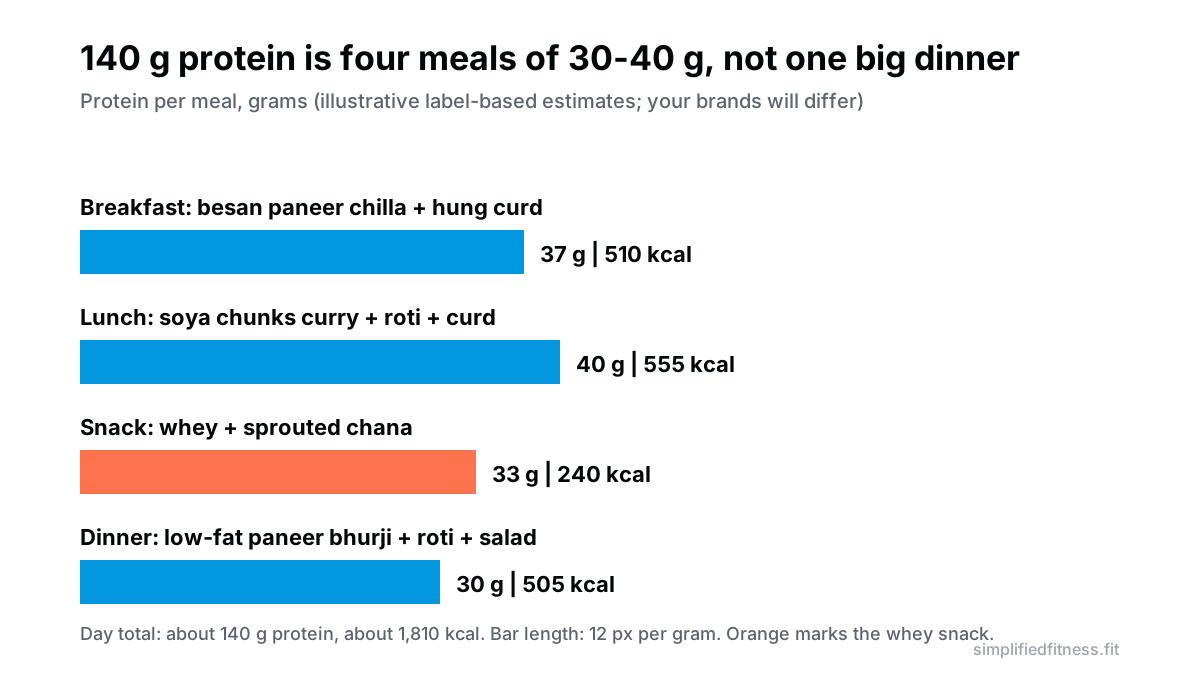
A few things to notice.
Weigh dry and raw. Soya chunks soak up a lot of water and end up two to three times heavier, so 60 g means dry, before boiling. Paneer is weighed raw too. This is where most people go wrong: weigh 60 g of soaked chunks and you get maybe half the protein the plan assumes, while an unweighed “bowl of soya” can easily be double the portion.
The oil is the budget item. 4 teaspoons across the day is about 180 kcal. Our article on hidden calorie traps in Indian cooking shows how a casual extra pour breaks an 1,800 kcal plan.
Spread the protein. A 2018 review concluded that, to maximise muscle building, intake of about 0.4 g/kg per meal across at least four meals is a reasonable target to reach 1.6 g/kg/day (Schoenfeld and Aragon, 2018). For a 70 kg person that is about 28 g per meal. This plan sits at or above that every time. The review itself notes the evidence is not settled, so do not stress over a meal that lands at 25 g.
Which foods give the most protein per calorie?
At 1,800 kcal you cannot afford foods that bring a lot of carbs or fat with a little protein. Think protein per 100 kcal.
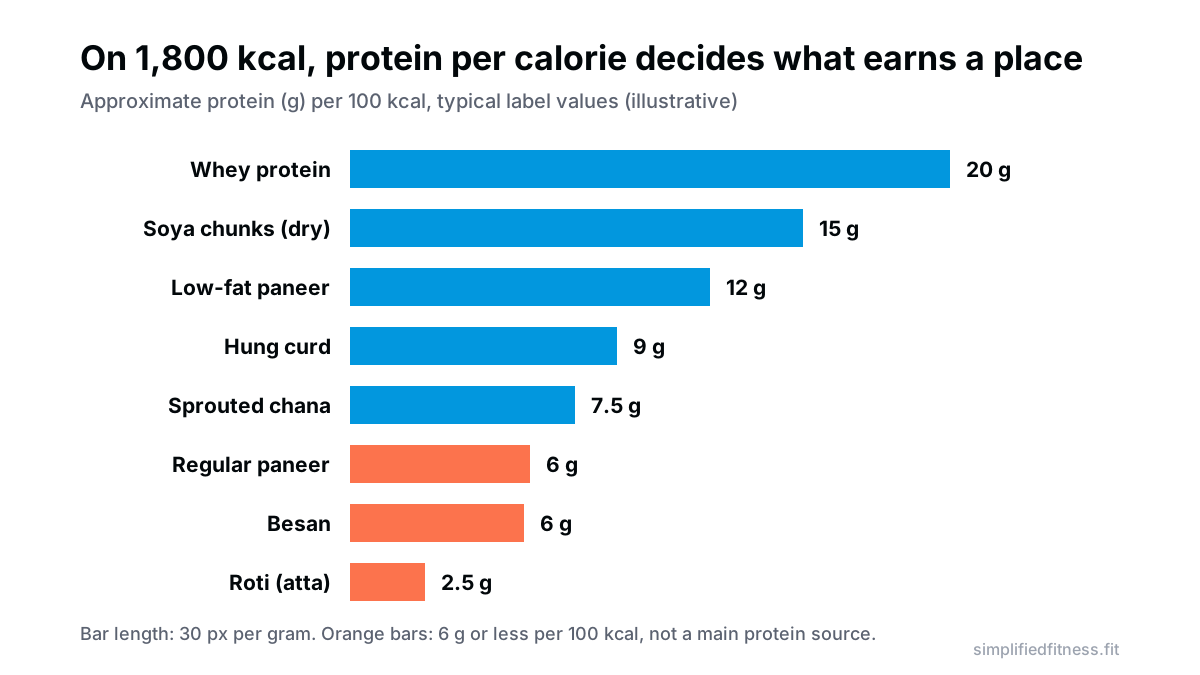
The takeaway is not that besan or roti are bad. It is that they are carb or fat foods that happen to contain some protein. Our article on dals and pulses explains why dal is mostly a carbohydrate source with partial protein. For the full numbers on the main workhorses, see soya chunks and paneer vs low-fat paneer.
Is vegetarian protein as good for muscle as animal protein?
Mostly yes when total protein is high enough, with a small caveat. Here is how the evidence splits.
A 2018 meta-analysis of nine studies (266 participants) found that soy protein produced similar gains in strength and lean body mass to animal protein (whey or other proteins) during resistance training (Messina et al., 2018). A 2021 trial matched 19 vegan and 19 omnivore young men at 1.6 g/kg/day for 12 weeks, using soy isolate for the vegans and whey for the omnivores, and found no between-group differences in lean mass, muscle size or strength (Hevia-Larrain et al., 2021). Note that these were untrained young men, so it may not map perfectly onto an experienced lifter.
On the other side, a 2021 meta-analysis of 18 articles (16 in the pooled analysis) found protein source did not change absolute lean mass or strength overall, but animal protein favoured percent lean mass, and in adults under 50 it was linked to about 0.41 kg more lean mass (Lim et al., 2021). The authors concluded animal protein tends to be more beneficial for lean mass, especially in younger adults.
Why might they differ? Study length, who was recruited, doses and whether people were already eating plenty of protein all vary. Whey also has more leucine than many plant proteins, which tends to show in short lab studies more than in training blocks.
My practical read: any gap is small, and a vegetarian can close it by hitting the total (and by using whey, which is a dairy product and fits a lacto-vegetarian diet). Eating 140 g of mixed vegetarian protein consistently beats eating 100 g of “perfect” protein.
What is the weekly grocery list for one person?
Rough quantities for seven days of the plan above:
- Besan: 350 g
- Low-fat paneer: about 1.6 kg
- Soya chunks: about 420 g
- Hung or thick curd: about 1 kg
- Regular toned curd: about 1 kg
- Whey: 7 scoops (about 210 g)
- Chana (dry, to sprout): about 250 g
- Atta: about 450 g
- Cooking oil: about 140 ml
- Onion, tomato, capsicum, coriander, cucumber, seasonal salad vegetables
- Spices: turmeric, cumin, chilli, garam masala (negligible calories)
The paneer line is the one that surprises people, since 1.6 kg of low-fat paneer a week is a real cost. If that does not fit your budget, our budget Indian fitness diet shows cheaper ways to build the protein. Eggetarian? Swap some paneer for egg whites using the Indian breakfast ideas.
What if I cannot find low-fat paneer or soya chunks?
Match grams of protein, not calories, and then check calories again. Some easy swaps:
- Low-fat paneer (150 g, about 27 g protein): tofu (about 200 g), or hung curd (roughly 300 g, depending on how thick it is) if you have the calorie room.
- Soya chunks (60 g dry, about 31 g protein): tofu plus a scoop less of whey elsewhere, or moong dal chilla with extra curd.
- Whey scoop (about 24 g): roughly 250-300 g hung curd, or a second serving of soya.
- Besan chilla: moong dal chilla (a bit lower protein, still useful) with the paneer stuffing.
- Sprouted chana: boiled chana or roasted chana in measured portions. Roasted snacks are covered in high-protein Indian snacks.
Every swap shifts calories a little, so re-add the day. Use a food database or the label.
Mistakes that break this plan
The most common problems are boring ones.
- Eyeballing instead of weighing. Covered above. Unweighed soya, paneer and besan are an easy way for the day to drift to 2,100 kcal instead of 1,800.
- Regular paneer instead of low-fat. Same grams, but roughly double the calories. The protein barely changes.
- Hidden oil. Tadka, ghee on roti and “just a little” extra in the pan.
- Eating the protein late. Saving 80 g for dinner usually fails because you cannot finish it. Front-load breakfast and lunch.
- Never testing the plan. If the scale does not move for two to three weeks while you are weighing everything, adjust calories, not protein.
What if I miss my protein target?
Use the order below. Log first, then change one thing at a time.
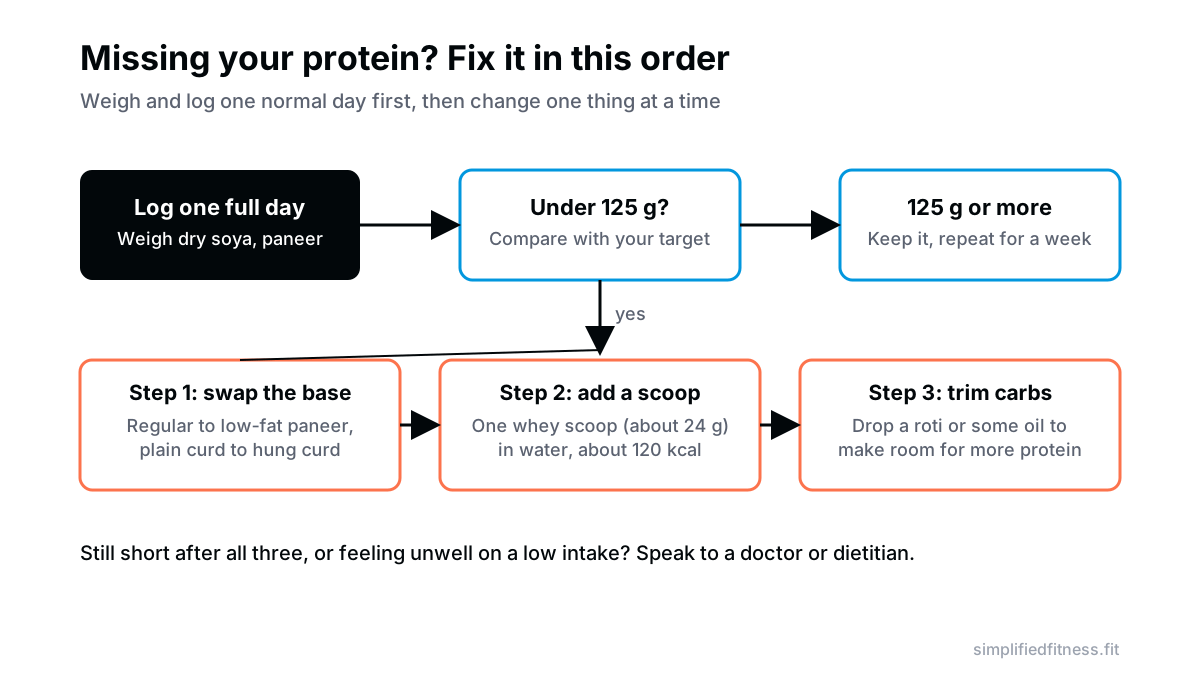
If your average sits at 125-130 g and your training is going well, you are probably fine. The difference between 125 and 140 g is smaller than the difference between tracking and guessing.
Who should be careful?
This plan is aimed at healthy adult lifters. See a doctor or dietitian before using it if you have kidney disease, diabetes, thyroid problems, are pregnant or breastfeeding, are under 18, take medication affected by diet, or have a history of disordered eating. Feeling dizzy, weak, losing your period or noticing hair and mood changes on a deficit are signals to eat more and get checked, not to push through.
If you use whey and it upsets your stomach (lactose intolerance is common), try an isolate or a plant protein instead. Hung curd is another option, since straining removes some of the lactose that stays in milk.
How do I run this for 8-12 weeks?
Keep it dull. Eat the same plan on weekdays and loosen the weekend a little. Weigh yourself daily or a few mornings per week and look at the weekly average. If it is dropping by roughly 0.25-0.75% of body weight a week, change nothing. If it has stalled for two to three weeks, remove about 100 kcal from carbs or oil. If you are exhausted, hungry and strength is falling, add 100-150 kcal back. Then pair the diet with a plan: our free training plans and diet plan page are a sensible starting place.
Cutting is a temporary tool. The plan above is not meant to be eaten forever.
Frequently Asked Questions
Can you get 140g protein on a vegetarian diet in India?
Yes, it is possible, but it takes planning because most Indian vegetarian staples carry more carbs than protein. Concentrated sources such as low-fat paneer, soya chunks, hung curd and a scoop of whey do the heavy lifting, as the sample day in this article shows. Weigh your food for a few days so you know the real numbers.
Is 1,800 calories right for fat loss?
It depends on your size, activity and job, so 1,800 kcal suits some people and is too low or too high for others. Fat loss needs a calorie deficit relative to what you burn, which you can estimate with a TDEE calculator and then adjust using your weekly weight trend. Start from your own maintenance number and subtract a moderate amount instead of copying a fixed figure.
How much protein do I need while cutting?
A common target is 1.6-2.2 g per kg of body weight, and a 2014 review of resistance-trained athletes in a deficit suggested 2.3-3.1 g per kg of fat-free mass for lean people dieting hard. Higher protein while eating less helps limit muscle loss and keeps you fuller. Use our protein calculator to get a range for your weight, then pick a number you can actually hit daily.
Is soya chunks protein as good as whey?
For muscle gain over weeks to months, a 2018 meta-analysis of nine studies (266 participants) found soy and animal protein gave similar gains in strength and lean mass. Whey has more leucine and does better in short acute studies, which is why the difference shows up in the lab but not clearly over a training block. Use soya chunks freely in meals and keep whey as a convenient top-up.
How many soya chunks can I eat per day?
This sample day uses 60 g of dry chunks, a normal food portion. Soy contains isoflavones, and normal food amounts are generally considered safe for healthy adults, but individual tolerance varies and thyroid or digestive conditions are worth discussing with a doctor. See our soya chunks article for the full safety discussion.
Is paneer good for fat loss?
Paneer can fit a cut, but regular paneer is calorie-dense, with a large share of its energy coming from fat. Low-fat paneer gives roughly twice the protein per 100 kcal, so you can eat a bigger portion for the same calories. Weigh it raw, because 150 g looks small on a plate.
Do I need whey protein on a vegetarian cutting diet?
No, but it makes the maths much easier. One scoop adds about 24 g of protein for roughly 120 kcal, which is hard to match from whole foods at that calorie cost. If whey does not suit you or you avoid it, add more hung curd, low-fat paneer or soya chunks and expect to eat a larger volume.
Can I eat roti and rice on a cutting diet?
Yes. Carbs are not the enemy on a cut, and a roti or a small portion of rice helps training performance and makes the plan sustainable. The calorie budget is just tight at 1,800, so keep portions measured and let protein foods take priority. If you are over budget, trim carbs or oil before you trim protein.
How fast should I lose weight on this plan?
A moderate pace is easier to sustain and gentler on muscle than crash dieting. Many coaches aim for roughly 0.25-0.75% of body weight per week, which is a coaching convention rather than a hard research rule. Track a weekly average and adjust only if the trend stalls for two to three weeks.
Will high protein harm my kidneys?
In healthy people, high protein intakes in training studies have not been shown to damage the kidneys, but those studies are mostly short-term. If you have kidney disease, a single kidney, diabetes with kidney involvement or a family history of kidney problems, get medical advice before raising protein. Drink water to thirst, especially in the Indian summer.
What can I swap if I do not eat paneer or soya?
Greek-style hung curd, tofu (if available locally), moong dal chilla with extra whey, and egg whites if you are eggetarian can fill the gap. Match the protein grams of the item you remove instead of the calories. Check the label or a food database because brands differ widely.
Does this plan work for vegans?
Not as written, because it relies on paneer, curd and whey. A vegan version would lean on soya chunks, tofu, pea or soy protein powder, and pulses, and it would need a vitamin B12 source. A 2021 study found vegans and omnivores gained similar muscle on 1.6 g/kg of protein, though it was in untrained young men.
How do I stay full on 1,800 calories?
Protein, fibre and volume help. Soya chunks, hung curd and sprouts are filling for their calories, and a big salad adds volume at almost no energy cost. If you are always starving, your deficit may be too aggressive, so raise calories by 100-150 kcal before you quit.
Sources & References
Every claim above is checked against peer-reviewed research (PubMed, U.S. National Library of Medicine) or guidance from established health bodies. How we fact-check.
- Morton RW, et al. A systematic review, meta-analysis and meta-regression of the effect of protein supplementation on resistance training-induced gains in muscle mass and strength in healthy adults. Br J Sports Med. 2018. PMID: 28698222
- Helms ER, et al. A systematic review of dietary protein during caloric restriction in resistance trained lean athletes: a case for higher intakes. Int J Sport Nutr Exerc Metab. 2014. PMID: 24092765
- Messina M, et al. No difference between the effects of supplementing with soy protein versus animal protein on gains in muscle mass and strength in response to resistance exercise. Int J Sport Nutr Exerc Metab. 2018. PMID: 29722584
- Hevia-Larrain V, et al. High-protein plant-based diet versus a protein-matched omnivorous diet to support resistance training adaptations: a comparison between habitual vegans and omnivores. Sports Med. 2021. PMID: 33599941
- Lim MT, et al. Animal protein versus plant protein in supporting lean mass and muscle strength: a systematic review and meta-analysis of randomized controlled trials. Nutrients. 2021. PMID: 33670701
- Schoenfeld BJ, et al. How much protein can the body use in a single meal for muscle-building? Implications for daily protein distribution. J Int Soc Sports Nutr. 2018. PMID: 29497353
- Wycherley TP, et al. Effects of energy-restricted high-protein, low-fat compared with standard-protein, low-fat diets: a meta-analysis of randomized controlled trials. Am J Clin Nutr. 2012. PMID: 23097268

Umair Hazrami · Founder & Head Coach, Simplified Fitness
Umair Hazrami founded Simplified Fitness and the Simplified Lifter channel to cut through fitness noise. With 4+ years of consistent training and 10+ coaching clients, he writes every guide from the peer-reviewed research and links the sources so you can check them. Our editorial standards.
Educational content only, not medical advice. If you have a medical condition, are pregnant, or take medication, talk to a qualified doctor before changing your diet, supplements or training. Full disclaimer.
Keep reading
Indian Diet
Budget Indian Diet for 120g Protein Under ₹100 a Day (Student Plan)
A budget Indian diet for 120g protein under 100 rupees a day: soya, eggs, milk and chana, with protein per rupee maths and two student plans you can copy.
8 min read
Indian Diet
Chicken Breast and Fish in India: Where to Buy, How to Cook, and Cost per 30 g Protein
Chicken breast price per kg India: compare wet market vs apps, learn safe handling, a brine method for juicy meat, and rohu vs chicken cost per 30 g protein.
11 min read

Indian Diet
How to Convince Indian Parents About Whey Protein: Kidney Fears, 'Chemicals' and the Real Evidence
How to convince Indian parents about whey protein: explain it as paneer-water dairy, answer the kidney fear with trial data, and read the label together.
9 min read
Indian Diet
Curd vs Greek Yogurt vs Hung Curd: Protein Yield and the Home Recipe
Curd vs Greek yogurt protein in India: plain dahi gives about 3-4 g per 100 g. See how straining it into hung curd can triple that, and what studies show.
9 min read