High-Protein Indian Vegetarian Meal Prep: Balancing Roti, Rice, Paneer, and Soya Chunks
Indian vegetarian meal prep bodybuilding made simple: a four-part dabba formula with roti, rice, paneer, soya chunks and curd, plus batch-cooking tips.
TL;DR. The short answer
- Build every dabba from four slots: one carb (1-2 rotis or 1 cup rice), one protein anchor (150 g low-fat paneer, 50 g dry soya chunks or 200 g tofu), one low-oil sabzi and one cup of curd.
- Roti and rice supply energy, not much protein. The protein slot is what makes a vegetarian lunch work for lifting, so never let it shrink to a spoonful.
- A reasonable target is about 0.4 g/kg of body weight per meal across at least four meals, aiming for roughly 1.6 g/kg a day. For a 70 kg lifter that is around 28 g per lunch.
- Batch-cook once or twice a week, cool food quickly, keep it in the fridge and aim to eat it within 3 days. Cooked rice that sits warm is the main food-safety trap.
- Office canteen meals usually lose on oil and protein. A homemade dabba gives you control over both.
Part of our complete guide: Indian High-Protein Nutrition Guide: Cutting and Muscle Building on Vegetarian and Non-Veg Diets
Table of contents
Part of our Indian high-protein nutrition guide: the simplest way to do Indian vegetarian meal prep for bodybuilding is to build every lunch dabba from four slots: one carb, one real protein source, one low-oil sabzi and one cup of curd. The protein slot (about 150 g low-fat paneer, 50 g dry soya chunks or 200 g tofu) is the part that decides whether the meal helps your training or just fills you up.
This is the practical kitchen layer of that guide, which explains why the traditional plate runs high in carbs and low in protein. Here we fix it, one dabba at a time.
What is the best structure for a high-protein Indian vegetarian lunch box?
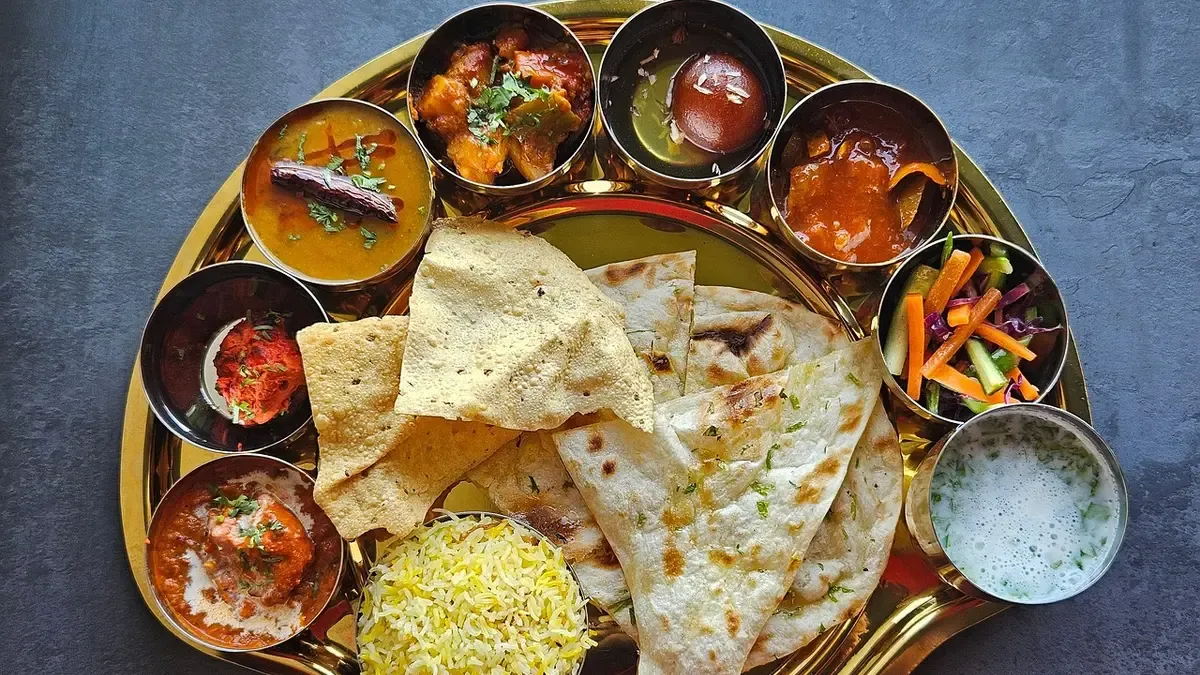
Think of the dabba as four compartments, each with a job.
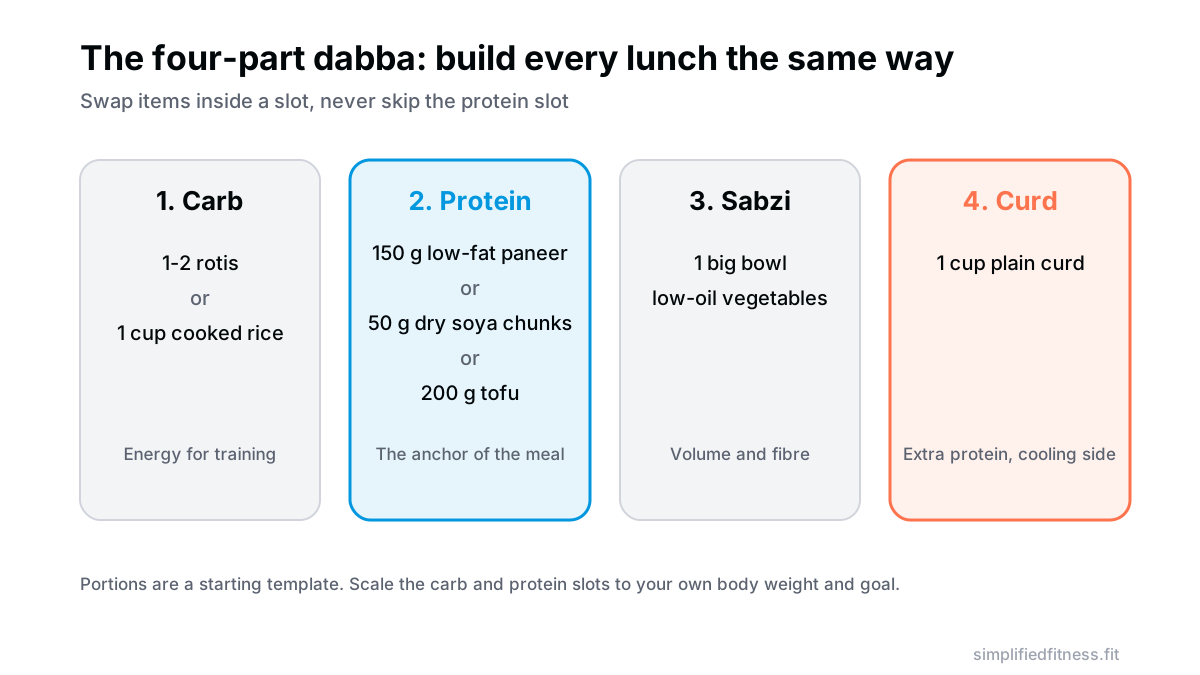
- Carb: 1-2 rotis or 1 cup of cooked rice. Energy for training, nothing more.
- Protein anchor: 150 g low-fat paneer, or 50 g dry soya chunks, or 200 g tofu.
- Sabzi: one big bowl of vegetables cooked with little oil. Volume and fibre.
- Curd: 1 cup, plain. A cooling side that adds a bit more protein.
Why a fixed template? Because decision fatigue at 6 am on a weekday is real, and “I’ll figure out lunch later” usually ends at the canteen. A formula turns shopping, cooking and packing into a routine.
How much protein should one dabba actually give you?
Pick a target first, then size the slot to hit it.
The most useful evidence here is a review of per-meal protein, which concluded that to maximise muscle building, a lifter should aim for about 0.4 g/kg per meal across a minimum of four meals, reaching at least 1.6 g/kg a day (Schoenfeld & Aragon, 2018). That is a review of acute and longer-term studies, so read the numbers as a sensible target, not a hard law.
A meta-analysis of 49 trials with 1,863 participants adds the daily ceiling. Protein supplementation helped resistance-training gains, but beyond total intakes of about 1.62 g/kg/day it produced no further gain in fat-free mass (Morton et al., 2018). More is not automatically better.
For a 70 kg lifter, 0.4 g/kg is about 28 g per meal. That is why a lunch with only a spoon of paneer in a gravy usually falls short, while a proper protein slot lands you in range. Use the protein calculator to get your own number.
Roti vs rice: how do you balance them with protein?
Neither is a villain. Both are mostly carbohydrate, and both give only a small amount of protein per portion.
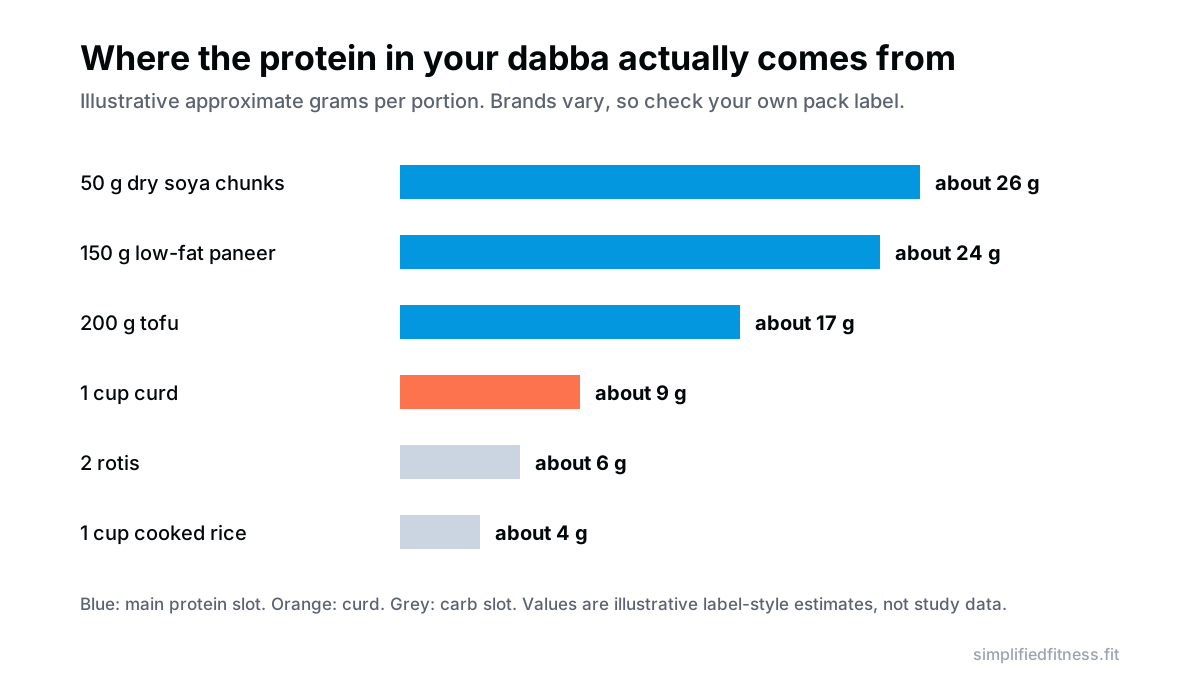
The numbers in Figure 2 are illustrative label-style estimates, not study data, and brands differ a lot, so check your own packs. The pattern is what matters: the protein slot is several times bigger than the carb slot.
How to choose between them:
- Roti is easier to portion by count, which makes it good for calorie control. Two medium rotis is a clear, repeatable unit.
- Rice is easier to eat when you are trying to gain, and it packs well. Measure with a cup, not a heap.
- Mix them across the week. There is no strong reason to pick one forever.
The most common mistake is the “fourth roti” creeping in because the sabzi is thin on protein. Fix the slot, not the roti count.
Soya chunks vs paneer vs tofu: which protein slot should you use?
Pick one per dabba and rotate across the week.
| Option | Typical portion | Strength | Watch out for |
|---|---|---|---|
| Soya chunks | 50 g dry | Cheapest, very protein-dense, high volume once soaked | Needs good seasoning, can taste dull plain |
| Low-fat paneer | 150 g | Familiar taste, easy to cook, adds calcium | Full-fat versions carry much more fat, so check the label |
| Tofu | 200 g | Mild, takes on any masala, good in bhurji | Needs pressing, less familiar to some families |
Weigh soya chunks dry, before soaking, because they swell with water. Weighing them after they are soaked will give you a very different number.
On quality: some people worry plant protein is “worse.” In a 2018 meta-analysis of 9 studies and 266 participants, supplementing with soy protein produced similar gains in strength and lean mass to animal protein alongside resistance training (Messina et al., 2018). A 2026 meta-analysis of 5 studies in untrained adults found no significant difference between plant-based and whey protein for lean mass or fat mass either, though it noted the small number of studies (Callegari et al., 2026).
A caveat worth stating: that research used protein supplements, not soya curry, and the second review was in untrained people. Still, the signal is that soya is a perfectly good option. For a deeper look at soya, read the soya chunks protein profile and isoflavone safety article. For paneer, see paneer vs low-fat paneer, and for the third option, tofu and edamame in Indian cooking.
How do you batch cook soya curry and other prep for the week?
The aim is one cooking session that covers several lunches.
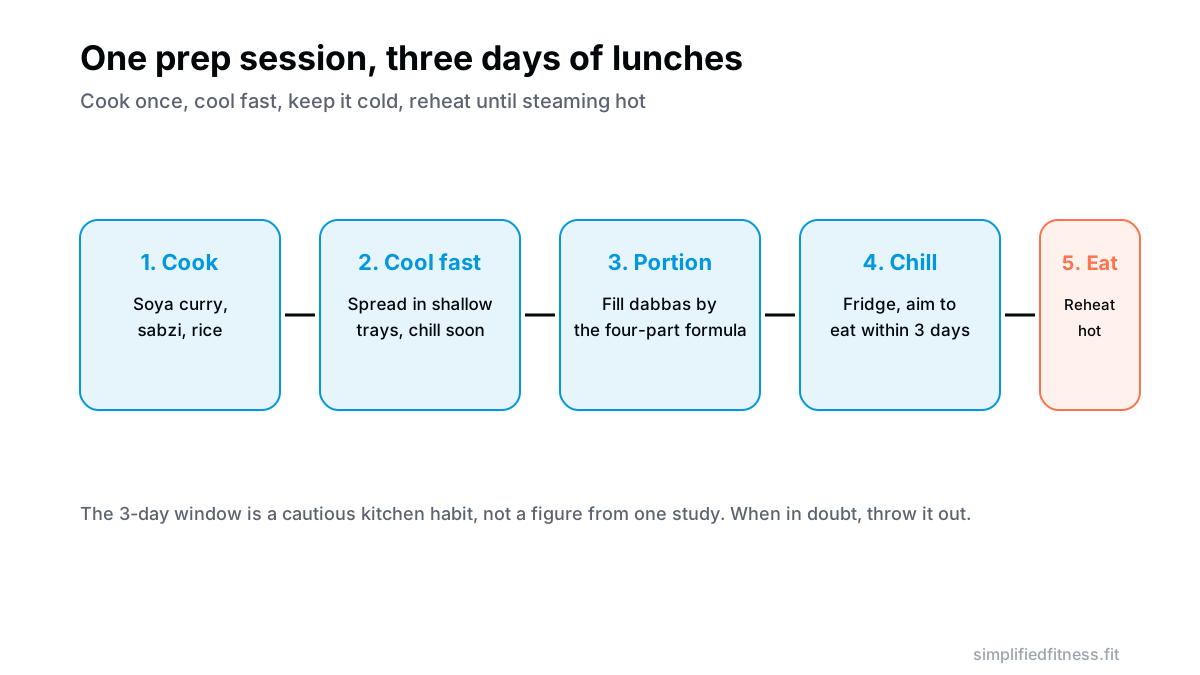
A workable prep session looks like this:
- Soya curry. Soak chunks in hot water until soft, squeeze out the water, then simmer in an onion-tomato masala with minimal oil. Squeezing matters, or the curry turns watery.
- Sabzi. Cook a dry, low-oil vegetable such as cabbage, beans or gobi. Dry sabzis pack and reheat better than gravies.
- Paneer or tofu. Cube it and either keep it plain for the dabba or fold it into the sabzi later in the week. Soft cubes can go rubbery after repeated reheating, so keep a day or two of this fresh if you can.
- Carb. Make rotis fresh if you can, or cook a pot of rice. See the storage notes below.
- Curd. Buy it plain and pack it separately.
Use oil by the teaspoon, not by eye. Tadka and ghee are where lunches quietly gain hundreds of calories, which we cover in hidden calorie traps in Indian cooking.
How long does meal prepped Indian food last in the fridge?
Here is the honest answer: there is no single magic number, and the research that exists is mostly about rice.
A common conservative habit is to eat refrigerated home-cooked meals within about 3 days. Treat that as a kitchen rule of thumb rather than a result from one study.
The reason rice gets special attention is that Bacillus cereus can survive cooking as heat-resistant spores. A systematic review of 29 studies on B. cereus in rice concluded that the main cause of contamination is improper handling and storage temperature during cooking, cooling and reheating (Woh & Ng, 2024). In a lab study of inoculated cooked rice, emetic toxin was produced at all the temperatures tested from 15 to 45 °C during the first 72 hours, and that toxin persisted even after heating at 100 °C for 2 hours (Wang et al., 2014). In plain terms, reheating may not fix rice that sat warm for too long.
That is a lab study of deliberately contaminated rice, so it shows what can happen, not how often it does. The practical takeaways are simple:
- Cool cooked rice quickly instead of leaving the pot on the counter.
- Refrigerate in shallow containers, not one big deep pot.
- Do not carry rice in a warm bag for hours in summer without a cold pack.
- If a dabba smells off or looks wrong, do not eat it.
If you want a longer buffer than 3 days, freeze single portions. If you have a weakened immune system, are pregnant, or care for young children or older relatives, be stricter with storage and talk to your doctor or dietitian about food safety.
How do you avoid the office canteen calorie trap?
The canteen is not evil, but it is built for taste and cost, not for your macros.
Typical issues:
- Oil you cannot see. Gravies and fried sides carry a lot of fat for very little protein.
- Small protein portion. A few paneer cubes in a creamy gravy rarely reach the 25-40 g range.
- Heavy carb side. Extra rice or naan fills the plate fast.
If you have to eat out, pick the simplest option: dal, a dry sabzi, plain roti and curd, and leave the fried items. For a longer list of ordering swaps, see dining out in India on a diet.
A sample week of dabbas
Here is how the four-slot formula plays out, with portions scaled for a moderate appetite:
| Day | Carb | Protein slot | Sabzi | Side |
|---|---|---|---|---|
| Mon | 2 rotis | 50 g soya chunk curry | Cabbage sabzi | 1 cup curd |
| Tue | 1 cup rice | 150 g low-fat paneer bhurji | Beans | 1 cup curd |
| Wed | 2 rotis | 200 g tofu masala | Mixed veg | 1 cup curd |
| Thu | 1 cup rice | 50 g soya chunks pulao | Cucumber salad | 1 cup curd |
| Fri | 2 rotis | 150 g paneer tikka-style | Gobi | 1 cup curd |
Cook soya on Sunday for Monday and Tuesday, paneer or tofu midweek, and keep Thursday and Friday for fresh cooking or freezer portions. If you want a full day built around a calorie target, our Indian vegetarian cutting diet and budget fitness diet show how a dabba fits in, and you can browse the free templates on the diet plan page.
Common mistakes with vegetarian meal prep
- Treating dal and rice as a complete protein meal. They help, but a normal bowl is nowhere near the 25-40 g target. Our dals and pulses article explains why.
- Underweighing soya. Weigh dry, not soaked.
- Skipping curd. It is an easy extra protein slot. See curd, Greek yogurt and hung curd.
- Prepping seven days at once. Three days of fresh-ish food beats seven days of tired food.
- Ignoring total daily protein. One great lunch does not fix a low-protein breakfast and dinner.
The bottom line
A good vegetarian lunch box for lifting is not complicated. One carb, one real protein source, one low-oil sabzi and a cup of curd, repeated with variety. Size the protein slot to roughly 0.4 g/kg for your body weight, cook in batches, cool and chill carefully, and eat within a few days.
If you have kidney disease, a medical condition affecting your diet, or you are unsure how much protein is right for you, check with your doctor or a registered dietitian before changing your intake. For a training plan to pair with the food, start with the free plans page.
Frequently Asked Questions
How much protein should an Indian vegetarian lunch box have?
For most lifters, about 25-40 g of protein per lunch is a sensible target. Research on per-meal protein suggests roughly 0.4 g/kg of body weight per meal across at least four meals to reach about 1.6 g/kg a day. Work out your own number with the protein calculator and size the paneer, soya or tofu slot to match.
Can roti and rice give enough protein for muscle gain?
Not on their own. Two rotis and a cup of rice together provide only a modest amount of protein, so they work as the energy slot rather than the protein slot. Pair them with paneer, soya chunks, tofu or a big bowl of dal plus curd so the meal reaches a useful protein number.
How many rotis or how much rice should I eat with a high-protein meal?
A starting template is 1-2 rotis or 1 cup of cooked rice per dabba. Carbs fuel training, so lean lifters who train hard can go to the top of that range, while people cutting often sit at the bottom. Adjust by one roti at a time based on energy in the gym and your weekly weight trend.
Is soya chunks or paneer better for meal prep?
Neither wins outright, they do different jobs. Dry soya chunks are cheap and very high in protein per gram, while low-fat paneer is softer, tastes familiar and adds calcium. Rotate them through the week so you get variety and so one food does not carry your whole diet.
Is soy protein as good as animal protein for building muscle?
In trials, it has performed similarly. A 2018 meta-analysis of 9 studies and 266 participants found no difference in strength or lean mass gains between soy and animal protein supplementation alongside resistance training. Five of the nine compared soy with whey. These studies used powders, not soya dishes, so treat it as encouraging rather than proof for every soya curry.
How long can I store cooked soya curry and rice in the fridge?
A cautious habit is to eat refrigerated home-cooked meals within about 3 days. Cooked rice carries heat-resistant Bacillus cereus spores that can multiply if rice cools slowly or sits warm, so chill it quickly. The 3-day figure is a conservative kitchen rule rather than a number from one study, so when in doubt throw it out.
Can I freeze meal-prepped Indian food?
Yes, many curries and cooked soya freeze well, and freezing lets you prep for more than 3 days. Portion into single dabba servings, cool them quickly before freezing, and thaw in the fridge rather than on the counter. Reheat until steaming hot throughout and do not refreeze leftovers.
How do I reheat a dabba safely at the office?
Reheat until the food is steaming hot all the way through, not just warm at the edges. This matters most for rice and cooked dishes that have been stored for a day or two. Stir halfway through the microwave time so the centre heats as much as the edges.
How do I keep a lunch box fresh in hot Indian weather?
Heat speeds up bacterial growth, so cool food fully before packing, use an insulated bag with a cold pack, and keep the dabba out of direct sun. Curd stays safer when packed cold and added right before eating. Consider carrying plain curd separately rather than mixing it into rice in the morning.
How do I avoid canteen calorie bombs at work?
Most canteen calories come from oil, cream gravies and fried sides, and the protein portion tends to be small. Carrying your own dabba removes the guesswork, and if you must buy, choose dal, sabzi, plain roti and curd, and skip fried items and creamy gravies. See our hidden calorie traps article for how oil adds up.
Is meal prep good for a vegetarian bodybuilding diet?
It is one of the easiest ways to hit a protein target consistently, because the protein slot is decided in advance instead of improvised. The research case for protein is about reaching a daily total, and meal prep makes that routine. Start with just your weekday lunches and expand once the routine sticks.
Do I need protein powder if I follow this dabba plan?
Not necessarily. A dabba with 25-40 g of protein plus curd and similar meals at other times can reach a daily target from food alone. A scoop of whey or plant protein is simply a convenient top-up if you fall short, and it is optional.
Sources & References
Every claim above is checked against peer-reviewed research (PubMed, U.S. National Library of Medicine) or guidance from established health bodies. How we fact-check.
- Morton RW, et al. A systematic review, meta-analysis and meta-regression of the effect of protein supplementation on resistance training-induced gains in muscle mass and strength in healthy adults. Br J Sports Med. 2018. PMID: 28698222
- Schoenfeld BJ, et al. How much protein can the body use in a single meal for muscle-building? Implications for daily protein distribution. J Int Soc Sports Nutr. 2018. PMID: 29497353
- Messina M, et al. No difference between the effects of supplementing with soy protein versus animal protein on gains in muscle mass and strength in response to resistance exercise. Int J Sport Nutr Exerc Metab. 2018. PMID: 29722584
- Callegari IOM, et al. Is plant-based protein supplementation as effective as whey protein? A systematic review and meta-analysis in untrained adults undergoing resistance training. J Int Soc Sports Nutr. 2026. PMID: 42954267
- Helms ER, et al. A systematic review of dietary protein during caloric restriction in resistance trained lean athletes: a case for higher intakes. Int J Sport Nutr Exerc Metab. 2014. PMID: 24092765
- Wang J, et al. Effect of temperatures on the growth, toxin production, and heat resistance of Bacillus cereus in cooked rice. Foodborne Pathog Dis. 2014. PMID: 24404779
- Woh PY, et al. Bacillus cereus in rice: A review on food poisoning, antimicrobial resistance, and control measures. Trop Biomed. 2024. PMID: 39548784

Umair Hazrami · Founder & Head Coach, Simplified Fitness
Umair Hazrami founded Simplified Fitness and the Simplified Lifter channel to cut through fitness noise. With 4+ years of consistent training and 10+ coaching clients, he writes every guide from the peer-reviewed research and links the sources so you can check them. Our editorial standards.
Educational content only, not medical advice. If you have a medical condition, are pregnant, or take medication, talk to a qualified doctor before changing your diet, supplements or training. Full disclaimer.
Keep reading
Indian Diet
Budget Indian Diet for 120g Protein Under ₹100 a Day (Student Plan)
A budget Indian diet for 120g protein under 100 rupees a day: soya, eggs, milk and chana, with protein per rupee maths and two student plans you can copy.
8 min read
Indian Diet
Chicken Breast and Fish in India: Where to Buy, How to Cook, and Cost per 30 g Protein
Chicken breast price per kg India: compare wet market vs apps, learn safe handling, a brine method for juicy meat, and rohu vs chicken cost per 30 g protein.
11 min read
Indian Diet
How to Convince Indian Parents About Whey Protein: Kidney Fears, 'Chemicals' and the Real Evidence
How to convince Indian parents about whey protein: explain it as paneer-water dairy, answer the kidney fear with trial data, and read the label together.
9 min read
Indian Diet
Curd vs Greek Yogurt vs Hung Curd: Protein Yield and the Home Recipe
Curd vs Greek yogurt protein in India: plain dahi gives about 3-4 g per 100 g. See how straining it into hung curd can triple that, and what studies show.
9 min read