High-Protein Indian Snacks: Makhana, Roasted Chana, Soya Chunks and Boiled Eggs Ranked
Looking for high protein Indian snacks for 4pm? We rank roasted chana, soya chunks, eggs, paneer and makhana by protein, calories and office practicality.
TL;DR. The short answer
- The best high protein Indian snacks are boiled eggs, spiced soya chunks, paneer cubes and roasted chana. Roasted makhana is a light, low-calorie crunch but gives only a few grams of protein per serving.
- A snack with roughly 15-25 g of protein is more likely to hold off 4pm hunger than a biscuit or a handful of namkeen. The best direct evidence is from small afternoon-snack trials in young women, so treat it as a useful guide, not a rule.
- Soya protein supplements performed similarly to whey for strength and lean mass in a 9-study meta-analysis, so soya chunks are a legitimate muscle-friendly snack.
- Peanuts are protein-rich but calorie-dense. In a 12-week crossover trial, adding them on top of the usual diet raised energy intake, so measure a small handful instead of eating from the packet.
- Pack a box with one protein anchor (eggs, soya or paneer) and one crunch (chana or makhana). Skip fried namkeen, biscuits and samosas on most days.
Part of our complete guide: Indian High-Protein Nutrition Guide: Cutting and Muscle Building on Vegetarian and Non-Veg Diets
Table of contents
The best high protein Indian snacks are boiled eggs, spiced soya chunks, paneer cubes and roasted chana. Roasted makhana is the odd one out: a great light crunch, but a minor protein source. If your 4pm snack is currently a samosa and a biscuit, any of these is a step up.
This guide ranks the popular options by what they actually give you, then shows how to pack them for the office. It sits inside our complete guide to Indian high-protein nutrition, so if you want the full daily picture, start there.
Why the 4pm snack matters more than it looks
A common pattern: decent meals, then the plot gets lost between lunch and dinner. Chai, biscuits, something fried from the canteen. Easily 300-400 kcal, with almost no protein.
Snacking itself is not the problem. In a small crossover trial of 15 healthy young women, an afternoon yogurt snack reduced hunger, increased fullness and delayed the request for dinner compared with no snack (Douglas et al., 2013). The version with 24 g of protein delayed dinner the longest (178 minutes versus 124 with no snack), and the lower-protein snacks fell in between.
What makes a snack “high protein”?
A packet that says “protein” on the front is not enough. Look at the actual grams per serving and the calories that come with them.
A useful working rule is about 15-25 g of protein for a proper afternoon snack, or 8-10 g if it is a small top-up and your meals are already strong. These are practical guide numbers, not research cut-offs. Your total day matters more: the 2018 meta-analysis of 49 trials found extra protein helped lean mass gains in training, but intakes beyond about 1.6 g/kg/day gave no further gain (Morton et al., 2018). Work out your own target with the protein calculator, then see how snacks fill the gap.
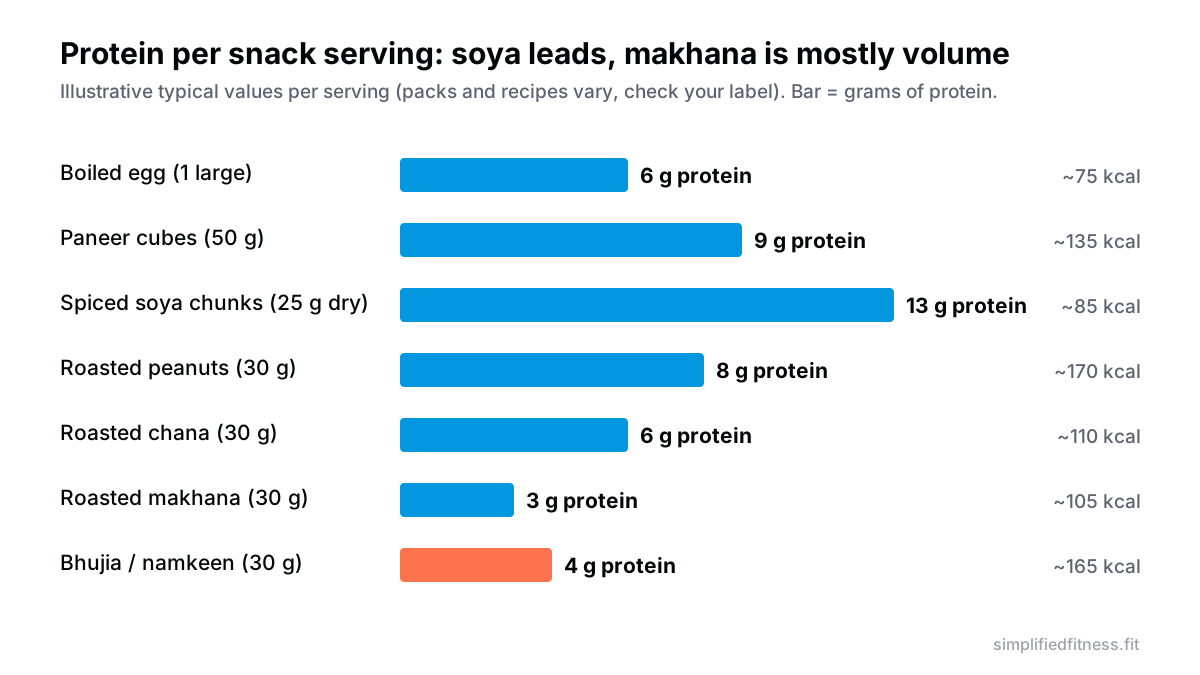
The values above are illustrative, typical ranges. Brands, moisture and cooking oil change them, so read the label on your own pack.
Ranking Indian snacks for protein and practicality
1. Spiced crispy soya chunks
Soya chunks are one of the cheapest proteins in an Indian kitchen. Soak them in hot water, squeeze out the water, toss with a little oil, chaat masala, salt and red chilli, then air-fry or dry-roast until crisp.
On quality, a meta-analysis of nine trials (266 participants) found soy protein supplementation produced similar strength and lean mass gains to whey and other animal proteins when combined with resistance training (Messina et al., 2018). That was soy protein supplements, not chunks specifically, but it supports soya as a useful lifter protein. For isoflavone worries, we go deeper in our soya chunks myths article.
2. Boiled eggs
Eggs are portable, cheap and ready in 10 minutes. Boil a batch on Sunday and carry two a day.
On the cholesterol question, evidence is mixed. A meta-analysis of prospective cohort studies found no clear association between egg intake (up to about one a day) and coronary heart disease, and a lower risk of stroke (Alexander et al., 2016). But a meta-analysis of 17 randomized trials in healthy people found higher egg intake produced modestly higher LDL cholesterol than control diets, with larger effects in trials longer than two months (Li et al., 2020). The two designs answer different questions, so a cautious approach is one or two eggs a day if your lipids are fine. If you have high cholesterol, diabetes or heart disease, ask your doctor. More on this in eggs in the Indian diet.
3. Paneer cubes
Paneer gives good protein and keeps well in a fridge. Cube 50-75 g, add black pepper and chaat masala, or grill it on a pan with no oil. It is the most calorie-dense of the protein anchors because of the fat, so check portions. For the full-fat versus low-fat decision, see paneer vs low-fat paneer.
4. Roasted chana
Roasted chana protein benefits come down to this: decent protein for a crunchy snack, plus fibre. A 30 g handful gives roughly 6 g protein, which is useful but not a full anchor.
On satiety, I will be honest: direct chana trials are limited. One crossover trial in 26 young adults tested extruded corn snacks with 40% pulse flour (including chickpea) and found lower pre-meal blood glucose for chickpea and pinto bean versions, but no differences in appetite or later food intake (Johnston et al., 2021). That is a processed snack in young adults, so it does not prove roasted chana will curb hunger. Treat chana as a decent, fibre-rich supporting snack. More on pulses in our dals and pulses protein guide, and see sattu for the ground version.
5. Roasted makhana
Fox nuts are light, crunchy and low in calories for the volume, which is why they work as a swap for chips. But they are not a high-protein food. A 30 g serving gives only a few grams.
Use makhana to fill the box and slow you down, not to hit protein. Dry-roast with a pinch of salt and pepper, or one teaspoon of ghee for the entire batch. We found no good human trials on makhana and satiety, so I would not oversell it.
Makhana vs peanuts: protein or volume?
Peanuts give more protein per 30 g, but more calories too, and they are easy to over-eat.
In a 12-week randomized crossover trial of 61 older adults (average BMI 31), adding peanuts to habitual diets raised total energy intake (about 9% in women and 17% in men) and body weight by about 0.5 kg. The authors noted peanuts should be substituted for other foods rather than added (Barbour et al., 2017). Total servings of other snacks did not change, although men ate fewer savory non-core snacks and women fewer sweet ones. Either way, it was not enough to cancel out the extra calories. Note the doses were large (56 g a day for women, 84 g for men).
Practical rule: measure peanuts into a small box (about 20-30 g). Use makhana when you want a big bowl for fewer calories.
Myth: “Fried namkeen is basically the same as roasted snacks”
It is not. Bhujia, sev and fried mixture are made mostly of oil-soaked flour. A 30 g handful gives only a few grams of protein for roughly 160-180 kcal (illustrative, check the pack). Because they are crunchy and salty, a handful becomes a bowl.
Roasting or air-frying keeps the same crunch for fewer calories. For more on how oil and tadka quietly add calories, see hidden calorie traps in Indian cooking.
How to build an office snack box
Think in two parts: a protein anchor and a crunch.
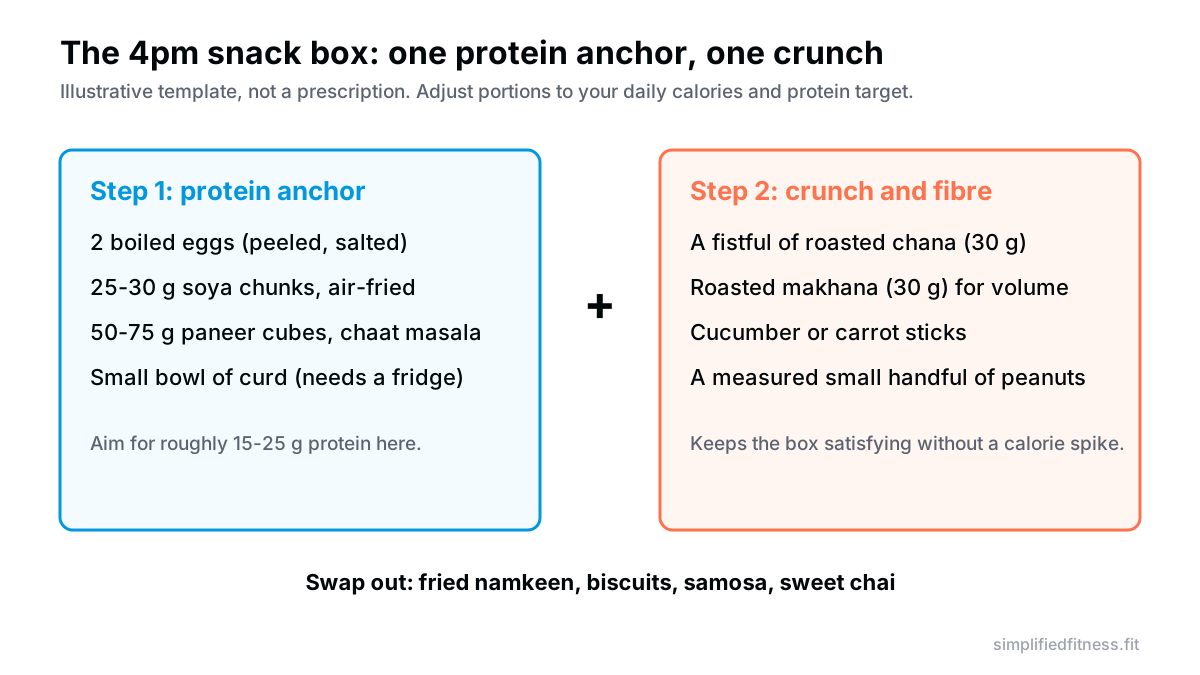
- With a fridge: 2 boiled eggs or paneer cubes, plus roasted chana.
- No fridge: air-fried soya chunks plus makhana, and a small handful of peanuts.
- Summer: keep eggs and paneer in an insulated bag and eat within a few hours.
- Prep time: soya, chana and makhana can be batch-cooked on Sunday and stored in airtight boxes.
A simple week of snack rotation
Eating the same box every day gets boring fast, and boredom is how the canteen wins. Rotate the anchor and keep the crunch flexible.
- Monday and Thursday: two boiled eggs with a handful of roasted chana.
- Tuesday and Friday: air-fried soya chunks with chaat masala, plus cucumber sticks.
- Wednesday: paneer cubes with black pepper, and a small bowl of makhana.
- Saturday: whatever you fancy, within reason. A flexible day keeps the plan sustainable.
Season with what you already have: chaat masala, black salt, roasted jeera powder, a squeeze of lime. None of it adds meaningful calories. Pair the snack with water or plain tea instead of sweet chai, since two cups of sugary chai can quietly add 100 kcal or more.
If the 4pm slot is still a struggle, look at lunch first. A lunch with plenty of dal, curd or eggs usually makes the afternoon easier than any snack can.
Do these snacks fit a fat-loss diet?
Yes, if you count them. A box with 2 eggs, 30 g chana and some veg lands around 250 kcal with close to 18 g of protein (rough estimate). That is a good deal. A box heavy on peanuts and paneer can reach 400 kcal fast.
For cutting, lean on volume snacks and read our piece on high-volume, low-calorie foods.
Who should be careful
These are everyday foods, but check with a doctor or dietitian if you have kidney disease, high cholesterol, a soy or peanut allergy, or digestive issues with legumes. Soya chunks and chana can cause gas if you ramp up quickly, so build up the portion over a week.
The bottom line
You do not need protein bars or imported snacks. Eggs, soya chunks, paneer and roasted chana cover most of the job for a few rupees, and makhana is a nice light filler. Start with one swap this week: replace the biscuit with a pre-packed box, and track whether you feel less ravenous at dinner.
Frequently Asked Questions
What are the best high protein Indian snacks?
Boiled eggs, spiced soya chunks, paneer cubes and roasted chana are the strongest options because they give a meaningful amount of protein per serving. Roasted makhana adds crunch and volume but is a minor protein source. Pair one protein anchor with one crunchy snack to build a proper 4pm box.
How much protein is in roasted chana?
Roughly 5-7 g of protein in a 30 g handful, though brands and moisture levels vary, so check the label. Chana also brings fibre, which slows eating down. It is a good supporting snack, but on its own it will not cover a big protein gap.
Is makhana high in protein?
Not really. Plain roasted makhana gives only a few grams of protein per 30 g serving; its strength is that it is light, crunchy and easy to eat in volume. Treat it as a smart swap for chips or namkeen, and add curd, eggs or paneer if protein is the goal.
Makhana vs peanuts: which has more protein?
Peanuts have clearly more protein per 30 g, but they also carry far more calories. A 12-week crossover trial found that adding peanuts to a habitual diet raised total energy intake and body weight slightly, so portion them out. Use peanuts when you need protein and energy, and makhana when you want volume for fewer calories.
Are soya chunks a good evening snack?
Yes, when they are air-fried or dry-roasted with chaat masala rather than deep-fried. A meta-analysis of nine trials found soy protein produced similar strength and lean mass gains to whey and other animal proteins when paired with resistance training. Soak and squeeze the chunks, then season and crisp them in an air fryer or tava.
How much protein should an evening snack have?
Around 15-25 g is a sensible target if you want real fullness. In a small trial of 15 healthy women, a 24 g protein yogurt snack delayed dinner requests longer than 5 g or 14 g versions, though a separate trial of 32 women found 14 g did not beat 5 g. Choose the higher end when your dinner is more than three hours away.
Are boiled eggs a healthy daily snack?
For most healthy people, one or two eggs a day fits a balanced diet. A meta-analysis of prospective cohort studies found no clear link between up to one egg daily and coronary heart disease, though trials show eggs can raise LDL cholesterol a little. If you have high cholesterol or heart disease, ask your doctor how many eggs suit you.
Is fried namkeen really that bad?
It is not poison, but it is a poor use of calories if you are trying to get lean or build muscle. A small bag packs a lot of fat and calories for just a few grams of protein, so it is easy to overeat. Keep it for occasional treats and plan a protein snack for your usual 4pm slot.
What can I carry in an office snack box without a fridge?
Roasted chana, roasted makhana, air-fried soya chunks and a measured handful of peanuts keep well at room temperature. Boiled eggs and paneer are better if you have access to a fridge, especially in summer. In hot weather, do not leave eggs or paneer sitting in a bag for hours.
Can I eat high protein snacks and still lose fat?
Yes, as long as the snack fits your daily calories. Protein tends to help with fullness, but it is not calorie free, so a 300 kcal snack still counts. Work out your daily protein and calorie needs with a calculator, then slot the snack into that budget.
Is roasted chana better than boiled chana?
Roasted chana is more convenient and crunchy, while boiled or sprouted chana is bulkier and lower in calories per gram because of the water. Both give protein and fibre. Choose roasted for a portable office snack and boiled for a fuller, more meal-like bowl at home.
Do I need protein powder if I snack on these foods?
Not necessarily. Whole-food snacks can cover a good share of your daily protein, and the Morton meta-analysis found gains stop improving beyond about 1.6 g/kg/day of total protein. If you are still short after counting your meals and snacks, a scoop of whey is a convenient top-up.
Sources & References
Every claim above is checked against peer-reviewed research (PubMed, U.S. National Library of Medicine) or guidance from established health bodies. How we fact-check.
- Douglas SM, et al. Low, moderate, or high protein yogurt snacks on appetite control and subsequent eating in healthy women. Appetite. 2013. PMID: 23022602
- Ortinau LC, et al. The effects of increased dietary protein yogurt snack in the afternoon on appetite control and eating initiation in healthy women. Nutr J. 2013. PMID: 23742659
- Johnston AJ, et al. Acute effects of extruded pulse snacks on glycemic response, insulin, appetite, and food intake in healthy young adults in a double blind, randomized, crossover trial. Appl Physiol Nutr Metab. 2021. PMID: 33347383
- Messina M, et al. No difference between the effects of supplementing with soy protein versus animal protein on gains in muscle mass and strength in response to resistance exercise. Int J Sport Nutr Exerc Metab. 2018. PMID: 29722584
- Morton RW, et al. A systematic review, meta-analysis and meta-regression of the effect of protein supplementation on resistance training-induced gains in muscle mass and strength in healthy adults. Br J Sports Med. 2018. PMID: 28698222
- Barbour JA, et al. The addition of peanuts to habitual diets is associated with lower consumption of savory non-core snacks by men and sweet non-core snacks by women. Nutr Res. 2017. PMID: 28506518
- Alexander DD, et al. Meta-analysis of egg consumption and risk of coronary heart disease and stroke. J Am Coll Nutr. 2016. PMID: 27710205
- Li MY, et al. Association between egg consumption and cholesterol concentration: a systematic review and meta-analysis of randomized controlled trials. Nutrients. 2020. PMID: 32635569

Umair Hazrami · Founder & Head Coach, Simplified Fitness
Umair Hazrami founded Simplified Fitness and the Simplified Lifter channel to cut through fitness noise. With 4+ years of consistent training and 10+ coaching clients, he writes every guide from the peer-reviewed research and links the sources so you can check them. Our editorial standards.
Educational content only, not medical advice. If you have a medical condition, are pregnant, or take medication, talk to a qualified doctor before changing your diet, supplements or training. Full disclaimer.
Keep reading
Indian Diet
Budget Indian Diet for 120g Protein Under ₹100 a Day (Student Plan)
A budget Indian diet for 120g protein under 100 rupees a day: soya, eggs, milk and chana, with protein per rupee maths and two student plans you can copy.
8 min read
Indian Diet
Chicken Breast and Fish in India: Where to Buy, How to Cook, and Cost per 30 g Protein
Chicken breast price per kg India: compare wet market vs apps, learn safe handling, a brine method for juicy meat, and rohu vs chicken cost per 30 g protein.
11 min read
Indian Diet
How to Convince Indian Parents About Whey Protein: Kidney Fears, 'Chemicals' and the Real Evidence
How to convince Indian parents about whey protein: explain it as paneer-water dairy, answer the kidney fear with trial data, and read the label together.
9 min read
Indian Diet
Curd vs Greek Yogurt vs Hung Curd: Protein Yield and the Home Recipe
Curd vs Greek yogurt protein in India: plain dahi gives about 3-4 g per 100 g. See how straining it into hung curd can triple that, and what studies show.
9 min read