Traditional Indian Diet and Protein Deficiency: Why Roti, Dal and Rice Stall Muscle Growth
Traditional Indian diet protein deficiency explained: why a roti, dal and rice plate often falls short for muscle gain, and how to fix it simply.
TL;DR. The short answer
- A plain roti, dal, sabzi and rice day usually delivers far less protein than a lifter needs. Eating to roughly 1.6 g/kg/day is where extra muscle gain stops improving in trials, which is about 110 g for a 70 kg person.
- Indian diets get close to 60% of their protein from cereals, which are lower in digestibility and quality, with lysine the usual weak link. Dal, milk and curd are the natural fix.
- Oil, ghee and tadka add energy without adding protein. A tablespoon of oil is about 120 kcal, so three spoons across a day can quietly equal 3-4 rotis.
- You do not need to abandon traditional food. Keep the roti and dal, then add one protein anchor per meal (curd, paneer, soya, eggs, sprouts, chicken) and measure your oil.
- Worried about your own diet or a medical condition? Get blood work and advice from a doctor or registered dietitian before making big changes.
Part of our complete guide: Indian High-Protein Nutrition Guide: Cutting and Muscle Building on Vegetarian and Non-Veg Diets
Table of contents
If you eat roti, dal, sabzi and rice every day and your lifting is going nowhere, the plate is the first suspect. Traditional Indian diet protein deficiency is not about the food being bad. It is about the maths: a staple-heavy plate is mostly carbohydrate, the protein it does carry comes largely from cereals of lower quality, and oil and ghee add calories that do nothing for muscle.
This article is the diagnosis. The fix, with specific foods and recipes, lives in our complete Indian high-protein nutrition guide.
Is the traditional Indian diet deficient in protein?
For many lifters, yes, relative to what they are trying to do. Be careful with the word “deficient” though.
Two different questions get mixed up. One is whether a population meets basic nutritional requirements. The other is whether you, lifting 4 days a week and trying to add muscle, are eating enough to support it. The second bar is higher.
On the first question, a review of Indian surveys found that Indian diets get almost 60% of their protein from cereals, which have relatively low digestibility and quality. Data from slum, tribal and sedentary rural groups showed intakes of about 1 g/kg/day, and quality-adjusted (using lysine as the limiting amino acid) the picture looked worse, with roughly one third of one sedentary rural group at risk of not meeting requirements (Swaminathan et al., 2012). That review covers disadvantaged and rural groups, not urban gym-goers, so do not read it as a verdict on your own diet.
You will often see “70% of urban Indians are protein deficient” online. I could not trace that exact figure to a study I could read, so I am not repeating it as fact.
Why the Indian diet lacks protein for muscle building
Three things stack up.
1. The plate is built around cereals. Rice and roti take up most of the volume. They are cheap, filling and culturally central, but they carry roughly 1.8 g and 3 g of protein per 100 kcal respectively, against 6 g or more for paneer, curd and eggs.
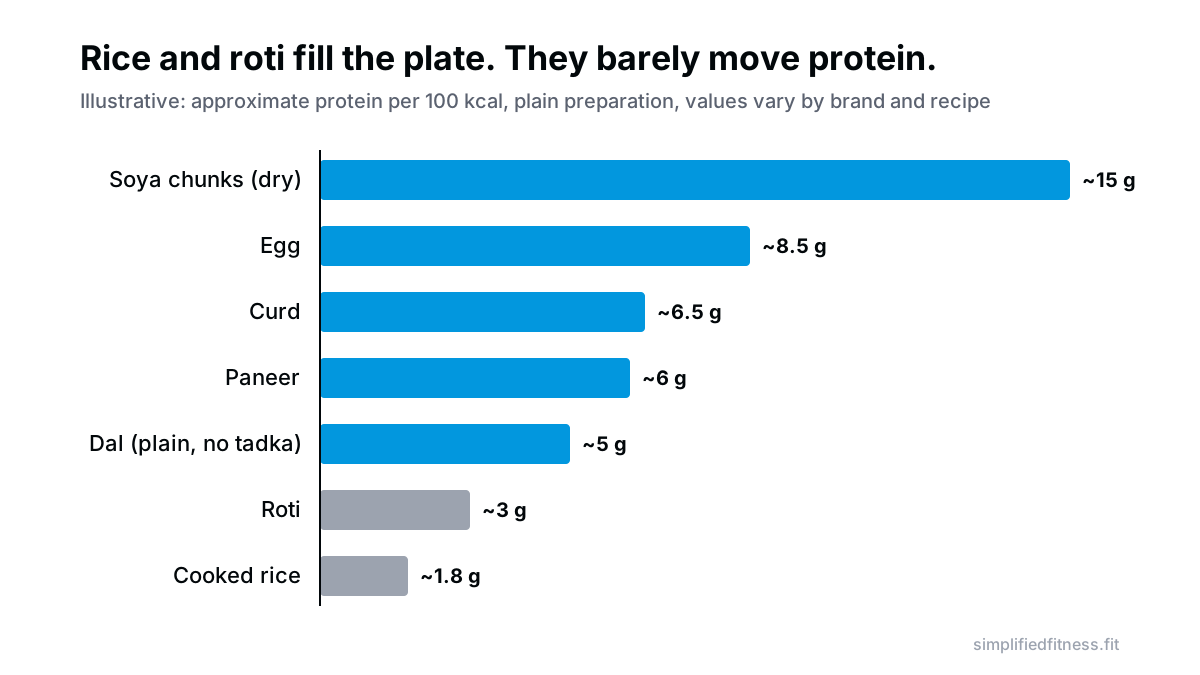
2. Dal is the hero, but the serving is small. A thin katori of dal gives somewhere around 5-7 g. Lovely food. Not enough on its own.
3. Cereals and pulses fix each other’s gaps. Cereals are low in lysine; milk and legumes are the classic additions that make up the difference. In a small study of 7 young Indian men, the metabolic availability of lysine was about 92% in milk powder and about 87% in a habitual cereal-legume vegetarian meal, which suggests a normal dal-and-roti style meal can supply usable lysine (Bandyopadhyay et al., 2020). Heat-treated milk powder dropped to about 70%, so processing matters. Seven men is a tiny sample, so take it as a hint rather than proof.
The upshot: quality is not hopeless. Quantity is the real problem for lifters.
How much protein is in roti, dal and rice?
These are approximate food-table style numbers. Your recipe, flour, katori size and brand will shift them.
| Item (typical portion) | Approx. protein | Approx. energy |
|---|---|---|
| Plain roti (1) | ~3 g | ~100 kcal |
| Cooked rice (1 cup) | ~3-4 g | ~200 kcal |
| Dal (1 katori, thin) | ~5-7 g | ~120 kcal before tadka |
| Sabzi (1 katori) | ~2 g | 100-150 kcal, mostly oil |
| Curd (1 katori, ~100 g) | ~4 g | ~60 kcal |
| Paneer (100 g) | ~18 g | ~270-300 kcal |
| Soya chunks (30 g dry) | ~15 g | ~100 kcal |
| Egg (1) | ~6 g | ~70 kcal |
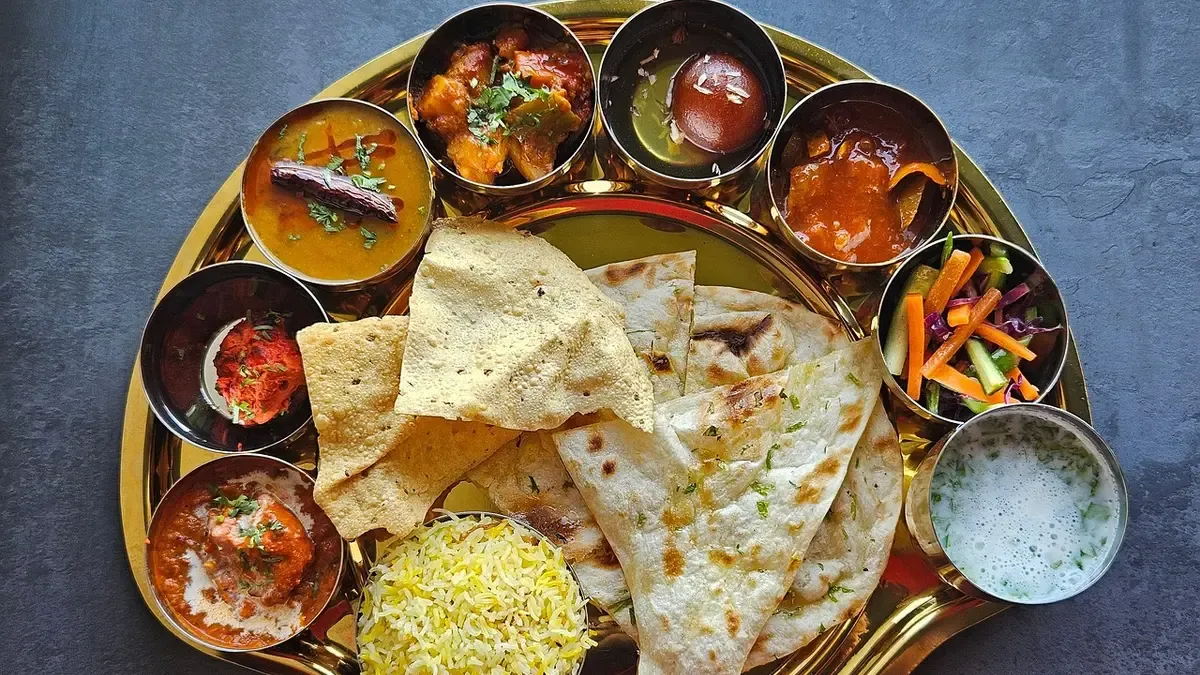
Now add up a standard meal. Two rotis, a katori of dal, a katori of sabzi and a cup of rice come to about 18-20 g of protein and 600-700 kcal. Swap one of those meals for a light breakfast like poha or a paratha, add chai and biscuits in the evening, and the day can land somewhere around 40-50 g while the calorie total looks perfectly normal.
That is simple arithmetic on illustrative numbers, not a survey result.
What is the right protein target for an Indian lifter?
Pick a target, then work backwards.
A meta-analysis of 49 trials (1,863 participants) found that protein supplementation increased fat-free mass gains during resistance training, and that benefits levelled off beyond total intakes of about 1.62 g/kg/day (Morton et al., 2018). For a 70 kg person, that is about 110 g. Some lifters go higher for comfort, but the data do not show extra muscle from it.
If you are cutting, the picture shifts. A systematic review of six studies in lean, resistance-trained athletes suggested protein needs during calorie restriction are likely 2.3-3.1 g/kg of fat-free mass, scaled up with the severity of the deficit and leanness (Helms et al., 2014). That is a small, specialised group, so it applies mainly to already-lean people dieting hard.
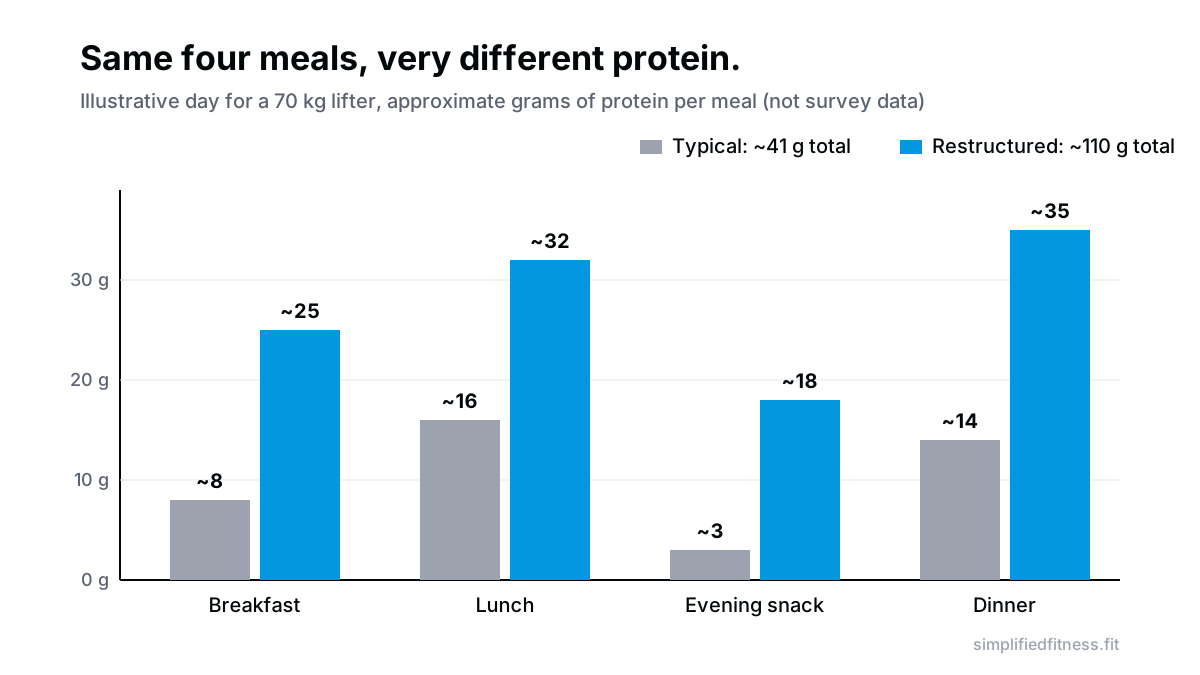
Spread matters too. A review of per-meal protein concluded that about 0.4 g/kg per meal across at least four meals reaches 1.6 g/kg/day (Schoenfeld & Aragon, 2018). For 70 kg that is about 28 g per meal.
Compare that with the 18-20 g a typical thali gives. This is the gap. Run your own numbers with the protein calculator and see our deeper look at the optimal daily protein intake for hypertrophy.
What are the hidden calories in Indian cooking?
Here is the other half of the conundrum. The calories you do not see.
Fat has about 9 kcal per gram, which works out to roughly 40 kcal a teaspoon and 120 kcal a tablespoon of oil. A tadka looks small. A sabzi gravy that starts with three or four spoons of oil for the family pot is not small once it is divided across plates. Parathas, puris, fried snacks, sweetened chai and mithai pile on top.
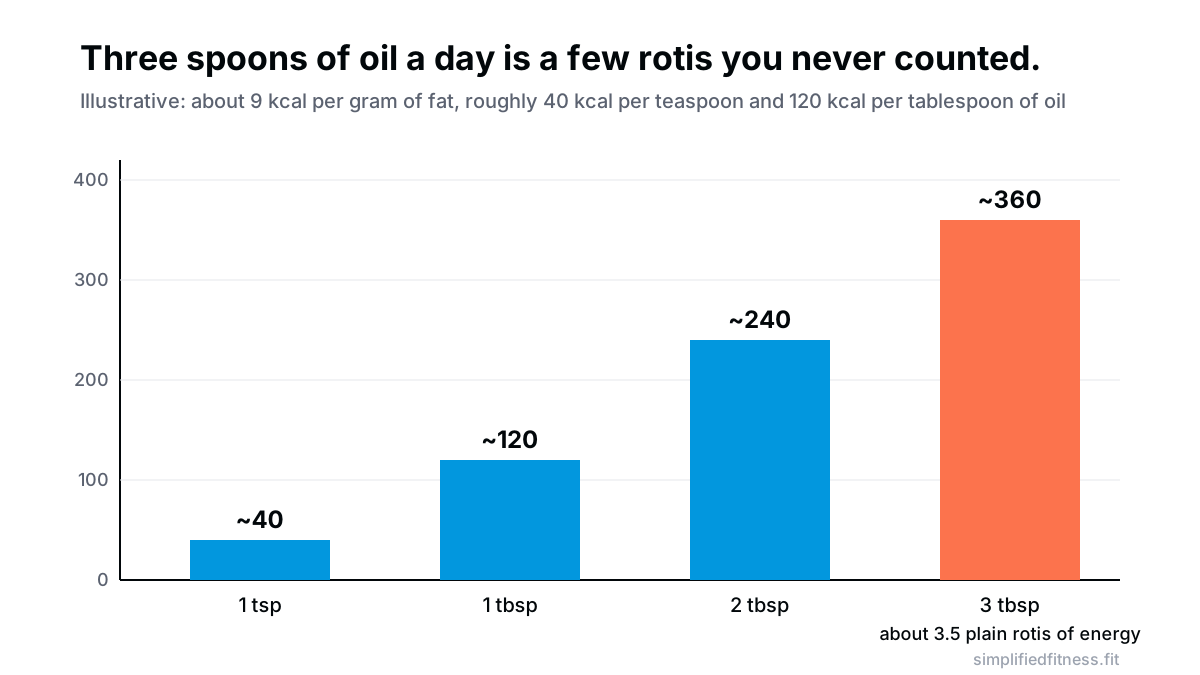
A very common mistake is blaming the roti. Plain roti is not the problem. The problem is oil poured by eye, then a dinner plate that has plenty of calories and a quiet 15 g of protein.
This is a topic of its own. See hidden calorie traps in Indian cooking for how to cut the oil without ruining the taste, and our guide to energy balance for fat loss and bulking for why calories decide the scale.
Can vegetarians build muscle on an Indian diet?
Yes. It takes planning, not an apology.
In a 12-week trial, 19 habitual vegan men and 19 omnivores were brought to 1.6 g/kg/day and did resistance training. Both groups gained leg lean mass (about 1.2 kg each), with no between-group differences in muscle size or strength gains (Hevia-Larraín et al., 2021). The vegans used soy protein; the omnivores used whey. Another trial of 22 young adults on a 10-week high-volume program at about 2 g/kg/day found similar lean mass and muscle volume gains on vegan (largely mycoprotein, not soy or dal) and omnivorous diets (Monteyne et al., 2023).
Both trials used young adults, were short, and were often well supervised. Real life is messier. But the message holds: protein source matters less than getting enough of it.
For Indian vegetarians, that means leaning on dairy and legumes, then adding soya or eggs if they fit your diet. Our pieces on dals and pulses, soya chunks and curd and hung curd go food by food.
How do I fix a roti, dal and rice plate for muscle gain?
You do not replace it. You rebuild around it.
- Anchor each meal. Pick one dense protein: curd, paneer, soya, eggs, sprouts, chicken or fish.
- Hit 25-30 g at each of four meals if you weigh around 70 kg.
- Keep the staples but size them to your energy needs. One extra roti is fine, three is optional.
- Measure oil with a spoon for a week. Many people are surprised by how much they were pouring.
- Fix breakfast first. Poha, paratha and chai tend to be the lowest-protein meal of the day.
- Make snacks work. Roasted chana, curd, a boiled egg or a shake beat biscuits.
Cost is a fair worry. Eggs, curd, soya chunks, dal and sprouts are among the cheapest protein sources in India, and we cover pricing in eating 120 g of protein on a tight budget. If you want a ready template, our free diet plan is a starting point.
Who should check with a doctor first?
Protein targets here are for healthy adults. Speak to a doctor or registered dietitian before raising protein sharply or changing your oil and ghee intake if you:
- have kidney disease or reduced kidney function
- have diabetes, high cholesterol or heart disease
- are pregnant or breastfeeding
- have unexplained fatigue, hair loss or weight loss, which can have medical causes
I cannot diagnose whether you are actually deficient. Blood tests and a clinician can look at that properly.
The bottom line
The traditional Indian plate is not a bad diet. It is a staple-heavy one, and for lifters it tends to miss on three counts: low protein per calorie, a modest share of dense protein sources, and oil you did not count. The evidence behind this is mixed in places (the survey data come from specific groups, and the lysine study is small), so treat the numbers as a direction, not a verdict.
The fix is unglamorous. Know your target, anchor each meal with a protein, measure the oil, and keep the dal and roti you grew up on.
Frequently Asked Questions
Is the traditional Indian diet deficient in protein?
It can be, depending on what is on the plate. Indian diets draw close to 60% of their protein from cereals, which are lower in digestibility and quality, and surveys of lower-income groups show intakes around 1 g/kg/day. For a lifter, add a protein anchor like curd, paneer, soya, eggs or chicken to each meal.
Why does the Indian diet lack protein for muscle building?
The bulk of a typical plate is rice and roti, which are mostly carbohydrate and supply protein with a weak amino acid profile. Dal helps, but one thin katori per meal gives only a small amount. Build each meal around a protein source first, then fit the staples around it.
How much protein is in roti, dal and rice?
Roughly 3 g in one plain roti, 5-7 g in a katori of dal, and 3-4 g in a cup of cooked rice, though recipes and portion sizes vary a lot. That means a standard thali often gives about 15-20 g per meal. Check your own portions against a food label or database rather than guessing.
How much protein do Indian lifters need per day?
Research on muscle gain suggests about 1.6 g/kg/day is where extra protein stops adding to lean mass gains, so a 70 kg person would aim for roughly 110 g. People cutting weight may benefit from more. Use our protein calculator to get a number for your body weight and goal.
Is dal a complete protein?
Not on its own by the strict definition. Pulses are relatively low in methionine and cereals are low in lysine, so dal with roti or rice, plus milk or curd, covers both gaps. In a small study of Indian men, lysine from a habitual cereal-legume meal was about 87% metabolically available. You do not need to match them in the same bite, but you do need enough total protein.
Can vegetarians build muscle on an Indian diet?
Yes, if total protein is high enough. In trials of young adults eating around 1.6-2 g/kg/day, plant-based and omnivorous diets produced similar gains from resistance training. Lean on dairy, soya, pulses and, if you eat them, eggs, and track your intake for a couple of weeks.
Where do the hidden calories in Indian cooking come from?
Mostly from oil and ghee used in sabzi gravies, tadka, parathas and fried snacks, plus sugar in chai and mithai. Fat has about 9 kcal per gram, so one tablespoon of oil is around 120 kcal. Measure the oil with a spoon for a week instead of pouring from the bottle.
Do I have to give up ghee and oil to get lean?
No. Fat is useful and ghee is fine in moderation, but it is the easiest source of unnoticed calories. Cutting a tablespoon or two a day, or switching some dishes to tawa or pressure cooking, trims energy without changing the food much. Keep enough fat in your diet and ask a doctor if you have cholesterol or heart concerns.
Is the claim that 70% of Indians are protein deficient true?
I could not verify that exact figure from the studies I reviewed, so treat it with caution. What the evidence does support is that protein quality is a real concern in cereal-heavy Indian diets, especially in lower-income groups. For you, the practical question is whether your own intake matches your training goal.
What should I add to dal and roti to get more protein?
Add one dense protein per meal, such as a katori of curd, 100 g of paneer, 30 g of soya chunks, two or three eggs, or chicken. These provide far more protein per calorie than the staples. Start with the meal you currently eat the least protein at, usually breakfast.
Is whey protein necessary if I eat Indian food?
No, whey is a convenience, not a requirement. It is useful when your whole-food options leave you short, because a scoop gives a fast 20-25 g with few calories. If you are already hitting your target from curd, dal, paneer and eggs, you can skip it.
How many meals should I split protein across?
A review of per-meal protein suggests about 0.4 g/kg per meal across at least four meals to reach 1.6 g/kg/day. For a 70 kg person that is roughly 28 g per meal. In practice, that means breakfast, lunch, an evening snack and dinner all carry a protein source.
Sources & References
Every claim above is checked against peer-reviewed research (PubMed, U.S. National Library of Medicine) or guidance from established health bodies. How we fact-check.
- Swaminathan S, et al. Protein intakes in India. Br J Nutr. 2012. PMID: 23107548
- Shivakumar N, et al. Protein quality & amino acid requirements in relation to needs in India. Indian J Med Res. 2018. PMID: 30666983
- Bandyopadhyay S, et al. Metabolic availability of lysine in milk and a vegetarian cereal-legume meal determined by the indicator amino acid oxidation method in Indian men. J Nutr. 2020. PMID: 32840572
- Morton RW, et al. A systematic review, meta-analysis and meta-regression of the effect of protein supplementation on resistance training-induced gains in muscle mass and strength in healthy adults. Br J Sports Med. 2018. PMID: 28698222
- Schoenfeld BJ, et al. How much protein can the body use in a single meal for muscle-building? Implications for daily protein distribution. J Int Soc Sports Nutr. 2018. PMID: 29497353
- Helms ER, et al. A systematic review of dietary protein during caloric restriction in resistance trained lean athletes: a case for higher intakes. Int J Sport Nutr Exerc Metab. 2014. PMID: 24092765
- Hevia-Larraín V, et al. High-protein plant-based diet versus a protein-matched omnivorous diet to support resistance training adaptations: a comparison between habitual vegans and omnivores. Sports Med. 2021. PMID: 33599941
- Monteyne AJ, et al. Vegan and omnivorous high protein diets support comparable daily myofibrillar protein synthesis rates and skeletal muscle hypertrophy in young adults. J Nutr. 2023. PMID: 36822394

Umair Hazrami · Founder & Head Coach, Simplified Fitness
Umair Hazrami founded Simplified Fitness and the Simplified Lifter channel to cut through fitness noise. With 4+ years of consistent training and 10+ coaching clients, he writes every guide from the peer-reviewed research and links the sources so you can check them. Our editorial standards.
Educational content only, not medical advice. If you have a medical condition, are pregnant, or take medication, talk to a qualified doctor before changing your diet, supplements or training. Full disclaimer.
Keep reading
Indian Diet
Budget Indian Diet for 120g Protein Under ₹100 a Day (Student Plan)
A budget Indian diet for 120g protein under 100 rupees a day: soya, eggs, milk and chana, with protein per rupee maths and two student plans you can copy.
8 min read
Indian Diet
Chicken Breast and Fish in India: Where to Buy, How to Cook, and Cost per 30 g Protein
Chicken breast price per kg India: compare wet market vs apps, learn safe handling, a brine method for juicy meat, and rohu vs chicken cost per 30 g protein.
11 min read
Indian Diet
How to Convince Indian Parents About Whey Protein: Kidney Fears, 'Chemicals' and the Real Evidence
How to convince Indian parents about whey protein: explain it as paneer-water dairy, answer the kidney fear with trial data, and read the label together.
9 min read
Indian Diet
Curd vs Greek Yogurt vs Hung Curd: Protein Yield and the Home Recipe
Curd vs Greek yogurt protein in India: plain dahi gives about 3-4 g per 100 g. See how straining it into hung curd can triple that, and what studies show.
9 min read