Full vs Partial Range of Motion: What the Hypertrophy Research Shows
Full vs partial ROM hypertrophy explained: what two meta-analyses and recent trials found, where lengthened partials fit, and how to set your range of motion.
TL;DR. The short answer
- Full range of motion (ROM) is the safer default for muscle growth. A 2021 meta-analysis of 16 studies found it beat partial ROM for lower-limb hypertrophy (effect size 0.88) and strength (0.56).
- Upper-body evidence is thinner and mixed. A 2020 systematic review called it limited and conflicting, so strong rules for biceps, triceps and chest are not justified yet.
- Not all partials are equal. Partials done in the stretched (lengthened) part of the lift have matched or beaten full ROM in several trials, while partials done only in the shortened part have done worse.
- Most trials are 8-12 weeks, small, and often use a single exercise or single limb comparisons, so the findings are best treated as strong tendencies, not laws.
- If a joint hurts at the bottom of a lift, do not force depth. See a doctor or physiotherapist rather than chasing range through pain.
Part of our complete guide: Muscle Length, Range of Motion and Stretch-Mediated Hypertrophy: What the Research Actually Shows
Table of contents
Full vs partial ROM hypertrophy is one of those debates where both camps have a study to wave around. Here is the short answer. Full range of motion is the better default for building muscle, especially in the legs, but partial reps done in the stretched part of a lift can hold their own.
This article is the broad review: what the meta-analyses actually found, where the evidence is thin, and how to set range of motion without overthinking it. It sits inside our wider guide on range of motion and stretch-mediated hypertrophy.
If you came here because someone in your gym told you half squats and short-range curls are “wasting your gains”, you deserve the actual data, not the gym floor version.
What counts as full vs partial range of motion?
Full ROM means moving the joint through the largest range you can control for that exercise. Think a squat to the deepest controlled depth, or a curl from nearly straight arms to a full squeeze. Partial ROM means you deliberately cut some of that range.
The cut can happen in three places, and this is where most arguments go wrong:
- Initial (lengthened) partials: you only train the stretched half, near the bottom of a curl or fly.
- Middle partials: you skip both the deepest stretch and the lockout.
- Final (shortened) partials: you only train the top, squeezed half.
Lumping these together as “partials” hides the one detail that explains most of the conflicting studies. We cover the stretched-only version in depth in our guide to lengthened partials, so here we keep it to what it means for the full-vs-partial question.
Does full range of motion build more muscle? The meta-analytic evidence
Three reviews carry most of the weight.
The 2020 systematic review. Schoenfeld and Grgic reviewed six studies with a combined 135 participants (127 men, 8 women), all rated “excellent” quality on the modified PEDro scale. They concluded that full ROM confers beneficial effects on lower-body hypertrophy compared with partial ROM (Schoenfeld & Grgic, 2020). For the upper limbs, they described the research as limited and conflicting. No study had looked at trunk muscles. They also noted some evidence that the response may be muscle-specific.
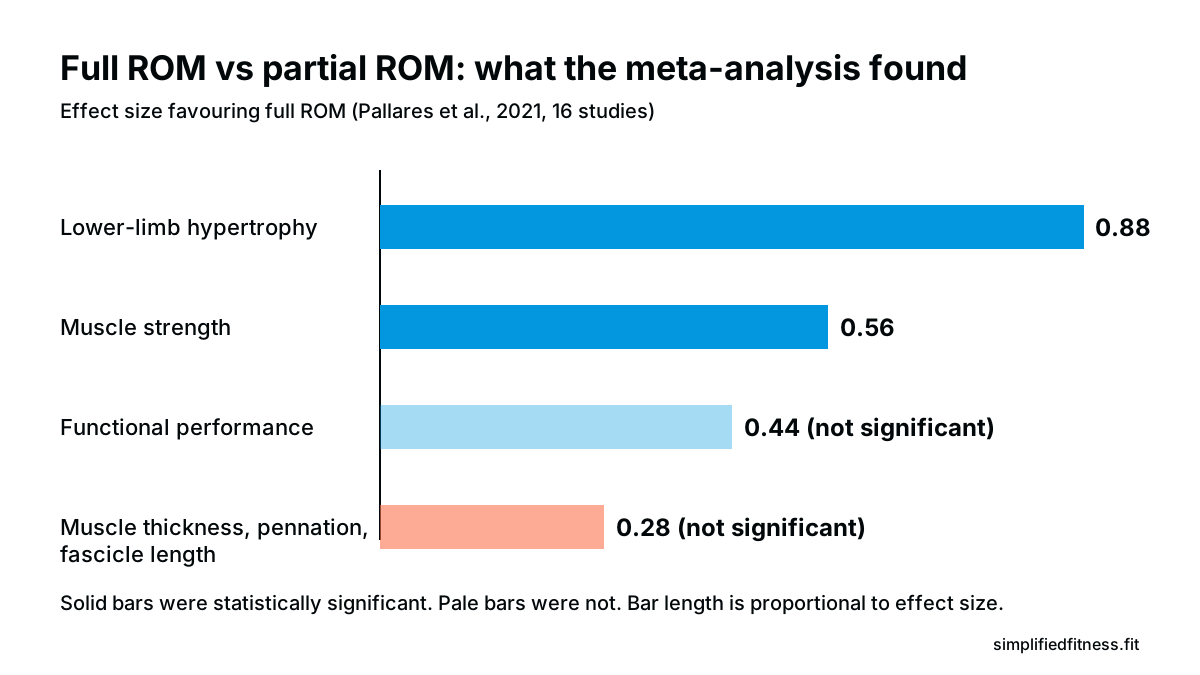
The 2021 meta-analysis. Pallares and colleagues pooled 16 studies. Full ROM produced significantly greater adaptations than partial ROM for muscle strength (effect size 0.56) and lower-limb hypertrophy (effect size 0.88). Functional performance favored full ROM too (0.44) but that was not statistically significant. Muscle thickness, pennation angle and fascicle length showed no significant superiority for either approach (0.28) (Pallares et al., 2021).
The 2023 systematic review. Kassiano and colleagues reviewed 11 studies and looked at where the partial was performed. Full ROM and partials in the initial (stretched) part produced greater growth of the rectus femoris, vastus lateralis, biceps brachii and the distal brachialis than partials in the final (shortened) part, with between-group effect sizes of 0.20-0.90. Initial partials even beat full ROM for growth of the upper (proximal) rectus femoris (0.35-0.38). Full ROM beat final-part partials for the gluteus maximus and adductors (0.24-0.25). One exception: partials in the middle of the range produced more triceps growth than full ROM (1.21) (Kassiano et al., 2023).
Why the studies seem to disagree
The conflict mostly dissolves once you split partials by position.
A 2022 trial in 45 untrained women compared knee extensions in four groups: full ROM (100-30 degrees of knee flexion), initial partial (100-65), final partial (65-30) and a varied group, plus a control. The initial-partial group showed greater relative growth than the full-ROM and final-partial groups at several thigh sites, while the final-partial group showed changes similar to the untrained control group at two of the four sites measured (Pedrosa et al., 2022).
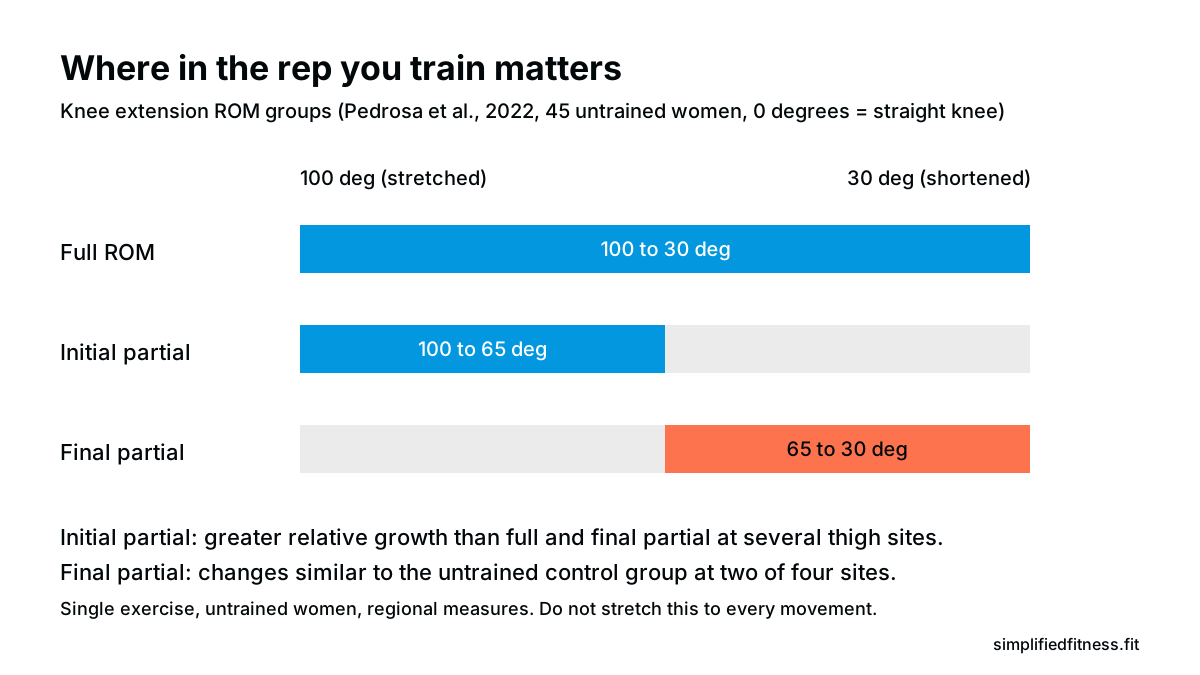
Same exercise. Same people. Different part of the rep.
Other differences that muddy the water:
- Many trials use untrained participants, who grow from almost anything.
- Muscles respond differently. The 2020 review flagged possible muscle-specific effects.
- Trials are short, often 8-12 weeks.
- “Partial” is defined differently from study to study.
A 2018 brief review pointed out that the pROM literature on hypertrophy was limited and that much of the earlier research focused on strength, not growth (Newmire & Willoughby, 2018). It has improved since, but the caution still applies.
Do lengthened partials match full ROM?
Recent trials in trained people say they can, with caveats.
In an 8-week within-participant study, Wolf and colleagues randomized the upper limbs of 30 resistance-trained people to lengthened partials or full ROM, with other variables matched (two sessions a week, four exercises per session, four sets each). Muscle thickness of the elbow flexors and extensors, and 10RM lat pulldown, improved similarly, with Bayes factors of 0.16-0.3 giving moderate support for no difference (Wolf et al., 2025).
A separate 8-week study of 13 trained people used unilateral preacher curls. Growth at 50% of upper-arm length was similar, with a trivial to small edge for initial partials at 70%, and negligible advantages for full ROM in strength tests (Havers et al., 2025). That is a very small sample, so treat it as a signal.
The largest trial so far randomized 297 people (163 lengthened partials, 134 full ROM) across 15 sites for 12 weeks. Changes in upper-arm and thigh muscle area were small and practically equivalent between groups, though the authors could not formally reject a difference at their strict statistical threshold (Gschneidner et al., 2025).
Put together (and see our deeper piece on long muscle length training): the stretched position seems to be doing the heavy lifting. Whether you reach it by full ROM or a lengthened partial matters less.
What about half squats and shallow leg work?
This is where the evidence is most consistent. The lower-body results in both the 2020 review and the 2021 meta-analysis favored full range. Kassiano also found full ROM beat shortened partials for glutes and adductors.
None of this means you must drop to the floor. Depth depends on hip structure, ankle mobility and limb proportions, which we cover in our article on squat depth for hypertrophy. The practical goal is the deepest position you can reach with control and without pain, with the load chosen to fit that depth.
The most common mistake: cutting range to move more weight
In the gym, this looks like loading a leg press until the knees barely bend, or curling with a swing that skips the bottom third. The bar moves, the ego is happy, and the stretched part of the muscle does very little.
Here is the trade. Partials let you handle heavier loads, but heavier load does not automatically mean more growth if the muscle spends less time loaded at long lengths. The evidence above suggests the stretched position is where partials earn their keep, so cutting the bottom is the costly mistake.
How to set your range of motion (a practical rule set)
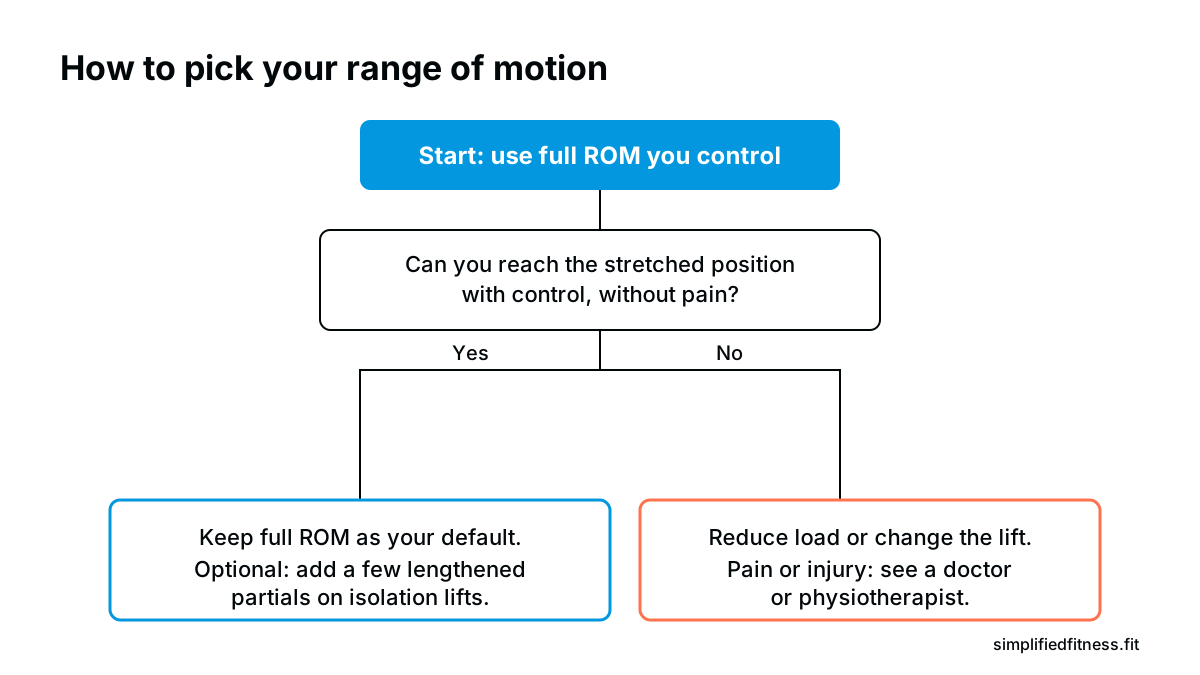
- Start with full ROM you control. No bouncing out of the bottom, no pain.
- Load the stretched position. On curls, flies, extensions and leg curls, make the bottom of the rep count.
- Use lengthened partials as an add-on. A few extra reps in the stretched range after your last full rep is a reasonable way to use them, especially on isolation lifts.
- Avoid training only the shortened range. It is the least supported option for growth.
- Let your anatomy set the limits. Some people cannot reach deep positions on certain lifts.
- Track for 8-12 weeks. Same exercise, same rep target, compare.
Indian gym context: machines, crowded floors and shared racks
If your gym has one squat rack and a queue, or machines with fixed ranges, that is fine. On a leg press, bring the platform down only as far as your lower back stays flat on the pad, and use a load that lets you do that. On crowded floors, a stretch-focused isolation lift such as a seated leg curl or cable curl is an easy place to use a full, controlled range with light plates.
Heat and long sets also tempt people to shorten reps when tired. If your last reps start shrinking, stop the set there.
Where this evidence is still weak
Be honest about the limits:
- The 2020 review included only six studies. The 2021 meta-analysis included 16.
- Many participants were untrained or young men, so results may not transfer to older adults, women, or people returning from injury.
- Upper-body evidence is mixed. Trunk muscles have barely been studied.
- Trained-lifter trials are short and often small, such as the 13-person elbow flexor study.
- Different studies define partial ROM differently, so effect sizes are not always comparable.
A cautious reading: full ROM is the best-supported default, stretched partials are a credible option, and shortened-only partials are the least supported for growth.
When to see a doctor
Joint pain at the bottom of a squat, a pinching shoulder in a deep press, or swelling after training are not range-of-motion problems you can solve with an article. A doctor or physiotherapist can tell you whether limited range is a mobility quirk or something that needs treatment. Do not train into sharp or lingering pain.
Bottom line
Full vs partial ROM hypertrophy comes down to this. Train through the range you can control, load the stretched position, and treat lengthened partials as a useful extra instead of a shortcut. For the legs especially, shortening the movement has not been shown to beat going deeper.
Frequently Asked Questions
Is full range of motion better than partial range of motion for muscle growth?
Usually yes, especially for the lower body. A 2021 meta-analysis of 16 studies found full ROM produced greater lower-limb hypertrophy than partial ROM (effect size 0.88). Make full range your default, and treat partials as a tool rather than a replacement.
Do partial reps build muscle at all?
Yes, they can. Muscle thickness, pennation angle and fascicle length did not differ significantly between full and partial ROM in the 2021 meta-analysis. Partials work best when done in the stretched part of the movement, so choose that part if you use them.
Are half squats bad for building legs?
For leg growth, the available evidence leans toward deeper squats. A 2020 systematic review concluded full ROM benefits lower-body hypertrophy compared with partial ROM, though only six studies were included. Squat to the deepest depth you can control, and read our squat depth article if you are unsure what that means for your build.
What are lengthened partials?
They are repetitions performed only in the stretched half of an exercise, such as the bottom of a curl or a fly. In an 8-week trial of 30 trained people, arm growth was similar between lengthened partials and full ROM. They are useful when you want to keep tension on the stretched muscle and load it heavily.
Why would partials in the shortened position work worse?
Several trials suggest muscles grow well when loaded at long muscle lengths. In one trial in untrained women, the group training only the final (shortened) part of a knee extension showed changes similar to the control group at some thigh regions. The mechanism is not settled, so use shortened-range partials as an add-on, not your main work.
Does range of motion matter for upper body exercises like curls and presses?
The evidence is limited and conflicting. The 2020 review said upper-limb research could not support strong practical conclusions. Lift with a range you can control, keep the stretched position loaded, and judge it by your own progress over 8-12 weeks.
Is ego lifting with partial reps wasting my time?
It can be, if the cut range also removes the stretched position and the load is chosen for ego rather than the target muscle. In the reviews above, full ROM consistently matched or beat partials done only in the shortened part of the lift. Lighter weight with a controlled full range is a safer bet for most lifters.
Is full ROM better for strength too?
The 2021 meta-analysis found greater strength gains with full ROM (effect size 0.56). Strength adaptations also tend to be specific to the range you train. If you test strength through a full range, train through a full range.
Do I need a full range on every exercise?
No. Pick a range that you can control, that loads the target muscle, and that does not cause pain. Some machines and body proportions restrict range naturally. Prioritize the stretched position on lifts where it is available.
How big is the difference between full and partial ROM in practice?
It depends which partial you compare. Against shortened-only partials, full ROM often wins. Against lengthened partials, the gap is small: a 12-week trial of 297 people at 15 sites found arm and thigh muscle area changes were small and practically equivalent. The stretched position seems to matter more than ticking every inch of range.
Should beginners use partials?
Beginners rarely need partials. Learning a full, controlled range builds technique, and the lower-body evidence favors it. Start with a load you can control through the whole movement.
Can I cut range if I have knee or shoulder pain?
Reducing range temporarily can be reasonable, but pain at a joint is a reason to get assessed, not a reason to diagnose yourself. A doctor or physiotherapist can tell you whether a range limit is a mobility issue or a medical one. Do not push into sharp or lingering pain.
How long before I can judge a range of motion change?
Most trials ran 8-12 weeks, so give a change at least that long. Track the same lifts, same reps and same loads. Judge it by progress, not by how it feels in week one.
Sources & References
Every claim above is checked against peer-reviewed research (PubMed, U.S. National Library of Medicine) or guidance from established health bodies. How we fact-check.
- Schoenfeld BJ, et al. Effects of range of motion on muscle development during resistance training interventions: a systematic review. SAGE Open Med. 2020. PMID: 32030125
- Pallares JG, et al. Effects of range of motion on resistance training adaptations: a systematic review and meta-analysis. Scand J Med Sci Sports. 2021. PMID: 34170576
- Kassiano W, et al. Which ROMs lead to Rome? A systematic review of the effects of range of motion on muscle hypertrophy. J Strength Cond Res. 2023. PMID: 36662126
- Pedrosa GF, et al. Partial range of motion training elicits favorable improvements in muscular adaptations when carried out at long muscle lengths. Eur J Sport Sci. 2022. PMID: 33977835
- Wolf M, et al. Lengthened partial repetitions elicit similar muscular adaptations as full range of motion repetitions during resistance training in trained individuals. PeerJ. 2025. PMID: 39959841
- Havers T, et al. Partial range, full gains? The effect of 8 weeks of partial range of motion training at long muscle lengths on elbow flexor hypertrophy and strength in trained individuals. Eur J Sport Sci. 2025. PMID: 41247250
- Gschneidner D, et al. The effects of lengthened-partial range of motion resistance training of the limbs on arm and thigh muscle area: a multi-site randomised trial. J Sports Sci. 2025. PMID: 41055237
- Newmire DE, et al. Partial compared with full range of motion resistance training for muscle hypertrophy: a brief review and an identification of potential mechanisms. J Strength Cond Res. 2018. PMID: 29985227

Umair Hazrami · Founder & Head Coach, Simplified Fitness
Umair Hazrami founded Simplified Fitness and the Simplified Lifter channel to cut through fitness noise. With 4+ years of consistent training and 10+ coaching clients, he writes every guide from the peer-reviewed research and links the sources so you can check them. Our editorial standards.
Educational content only, not medical advice. If you have a medical condition, are pregnant, or take medication, talk to a qualified doctor before changing your diet, supplements or training. Full disclaimer.
Keep reading

Hypertrophy
Active vs Passive Insufficiency: How Two-Joint Muscles Change Your Exercise Choice
Active vs passive insufficiency explained for lifters: why hamstrings, triceps, quads and calves grow differently depending on your second joint position.
10 min read

Hypertrophy
Squat Mobility With Long Femurs: Adapting Range of Motion to Your Hips
Squat mobility with long femurs is mostly a lever and hip-socket issue, not a flaw. Learn how to adjust depth, stance and heels without risking your hips.
10 min read
Hypertrophy
Dumbbell Pullovers vs Cable Lat Pull-ins: Training Lats at Long Muscle Lengths
Training lats at long muscle lengths: is the dumbbell pullover a lat or chest exercise, and why a cable lat pull-in may keep tension where you want it.
7 min read
Hypertrophy
Why Your Inner Thighs Burn After Deep Squats: Adductor Magnus vs Glute Max
The adductor magnus in a deep squat works as a hip extensor beside your glutes. See what the research shows and how to train depth for bigger thighs.
9 min read