Cable Lateral Raises: Behind-the-Back vs Cross-Body Setup, Which Is Better?
Cable lateral raise behind the back vs in front: what the research says, which setup suits most lifters, and a step-by-step guide to pulley height and cuffs.
TL;DR. The short answer
- No trial has compared behind-the-back and in-front cable lateral raises for muscle growth, so neither setup is proven better. The choice comes down to mechanics and comfort.
- A cross-body setup, with the cable passing in front of your legs, is a sensible default because the arm can rise in the scapular plane, about 30 degrees in front of straight sideways.
- Behind-the-back setups can feel fine for many lifters. The idea that they strain the front of the shoulder is a mechanical hypothesis, not something studied in lateral raise trials.
- A low pulley, a wrist cuff, a small fixed lean and a slow lowering phase matter more than which side the cable comes from.
- Pain at the front of the shoulder, pinching, or numbness is a reason to change the setup and, if it persists, to see a doctor or physiotherapist.
Part of our complete guide: Complete Shoulder, Delt & Neck Training Guide: 3D Deltoid Anatomy, Rotator Cuff & Traps
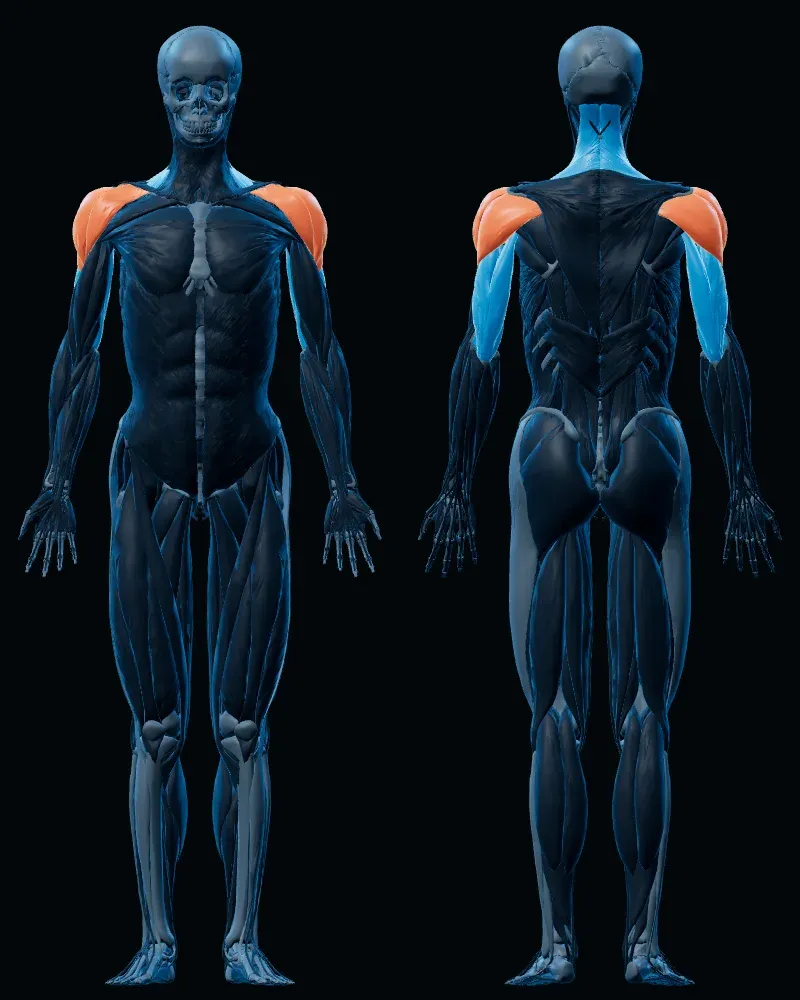
Muscles worked: shoulders
Main movers: all three heads of the deltoid
Assisting: supraspinatus, upper traps and triceps
Table of contents
For most lifters, a cross-body setup, with the cable passing in front of your legs, is the better default for cable lateral raises. But the honest answer to “cable lateral raise behind the back vs in front” is that nobody has tested the two head to head for muscle growth. What we have is mechanics, EMG work on lateral raise variations and plain comfort.
This guide sits inside our complete shoulder and delt training guide. Here we stay narrow: where to put the pulley, which hand to use, how to stand, and when to ignore all of it because something hurts.
Cable lateral raise behind the back vs in front: what actually differs
Both versions train the side (lateral) deltoid. What changes is the direction the cable pulls your arm.
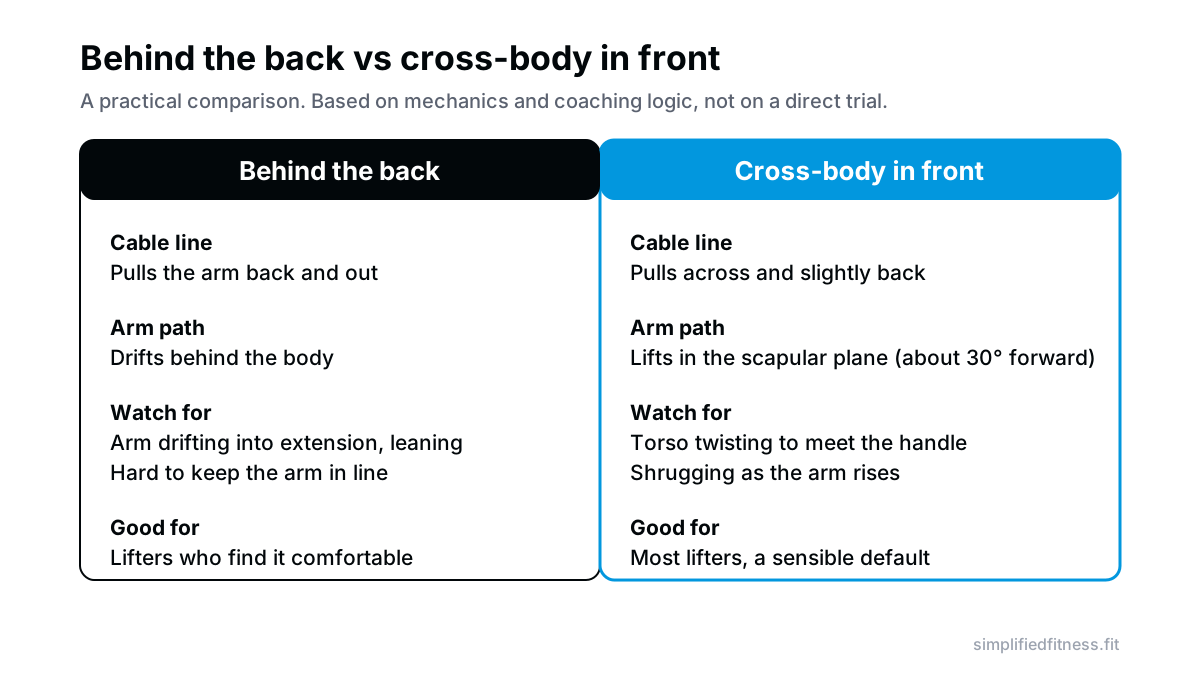
Behind the back: you stand with the stack at your side or slightly behind you, and the cable passes behind your body. The line of pull is back and out. The arm tends to travel a little behind the body as it rises.
In front (cross-body): you stand side-on to a low pulley, working with the arm furthest from the stack. The cable crosses in front of your legs. The line of pull is across and slightly back, and the arm can lift out and a little forward.
That small forward drift is the point. Your shoulder blade does not sit flat against your ribs facing sideways. It sits angled, so the natural plane for lifting the arm is about 30 degrees in front of straight out to the side, usually called the scapular plane. Rehab literature treats raising the arm in this plane (scaption) as a standard shoulder movement (Escamilla et al., 2009).
What does the research say about cable angle?
Short version: not much, and it is worth being clear about that.
I found no randomized trial comparing cable trajectories for lateral raises. The studies we do have are indirect:
- Muscle activation across exercises. A 2024 systematic review of 33 studies found that abductions and horizontal abductions produced the greatest middle deltoid activation, and that lateral raises with internal rotation produced the single highest value (Rabello et al., 2024). That is surface EMG, which tells you how active a muscle is, not how much it will grow.
- Humerus rotation changes who works. In 10 competitive bodybuilders, the medial deltoid was more active with the humerus in a neutral position than with external rotation, and more active than in a frontal raise or a flexed-elbow raise (Coratella et al., 2020). Turning the arm inward raised posterior deltoid, upper trap and triceps activity instead. Small sample, one session, but it is a useful warning: a thumb-down “pour the jug” style pulls the work toward the traps and rear delt. The 2024 review above ranked internally rotated raises highest for the middle deltoid, so the EMG data do not fully agree. That is one more reason not to treat any single cue as settled.
- Scapular plane. In 14 young, active people, standing scaption with a 1.8 kg load kept the anterior deltoid at about 39% of maximal voluntary contraction while serratus anterior reached about 43% (Tsuruike and Ellenbecker, 2019). That tells us the scapular plane is a manageable, well-studied position. It does not tell us it grows the side delt more than another plane.
Does behind-the-back strain the shoulder?
You will see claims that behind-the-back cable raises pull the arm into extension and stress the front of the shoulder capsule. The first half is plain mechanics: if the cable runs behind you, the arm can drift behind the body line. The second half, that this strains the anterior capsule in lifters, is a hypothesis. I did not find lateral raise studies that measured it.
What can be said carefully is this. Some lifters feel a pinch or ache at the front of the shoulder with the arm behind the body, and the fix is free: move the cable in front. If the setup feels fine and you stay pain-free, there is no evidence that you must abandon it.
The anatomy supports a cautious preference. The rotator cuff and deltoids share the job of lifting the arm, and the cuff matters most at lower angles, where it also resists the deltoid pulling the humeral head upward (Escamilla et al., 2009). Lifting in a plane that the shoulder tolerates keeps that system working as designed.
Why a low cable beats a dumbbell at the bottom
A dumbbell pulls straight down. With your arm hanging at your side, the weight is almost in line with the joint, so the side delt does very little at the start of the rep. The hardest part comes near the top.
A low cable crossing in front of you pulls at an angle, so there is resistance from the first centimetre. That is the practical argument for cable raises: you stay loaded where the dumbbell is slack.
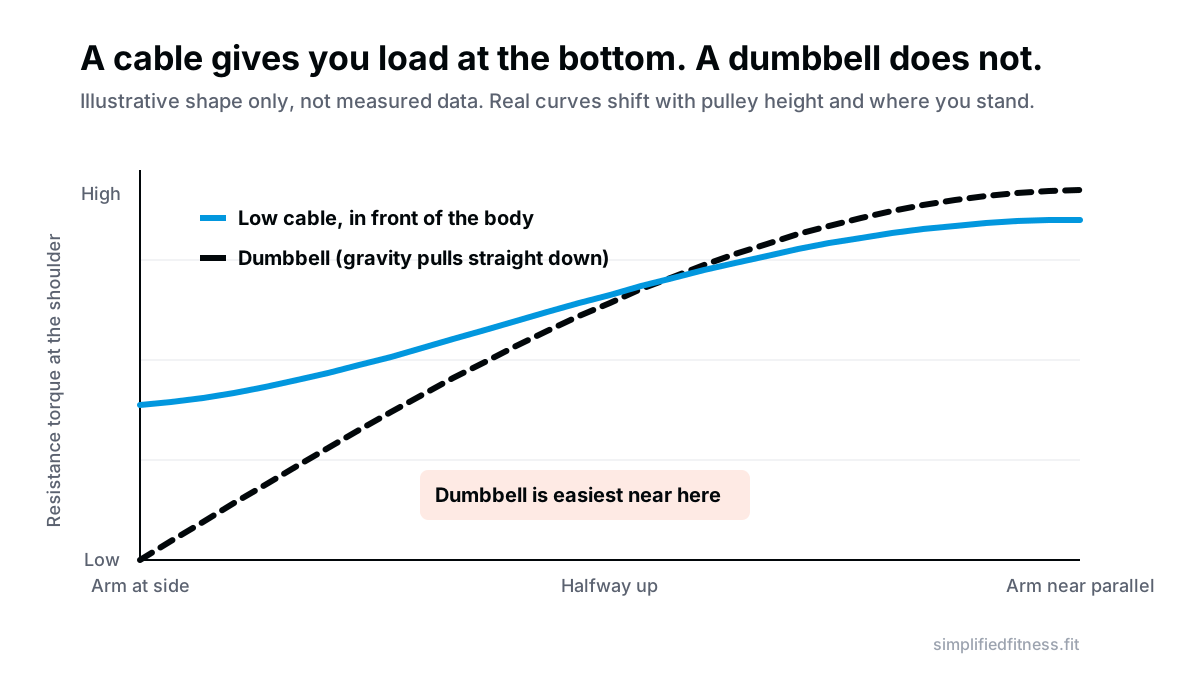
Whether that extra tension at short muscle length produces more growth is unsettled. A 2020 systematic review of full versus partial range of motion found a hypertrophy benefit of full range for lower body training, but called upper body evidence “limited and conflicting” (Schoenfeld and Grgic, 2020). Only two upper-limb studies were included. More directly, an 8-week trial in 24 trained lifters, with each arm assigned to cables or dumbbells and range of motion matched, found lateral deltoid thickness rose 3.3-4.6% with no meaningful difference between tools (Larsen et al., 2025). So the bottom-of-the-rep tension is a comfort and feel advantage, not a proven growth advantage. For the dumbbell side of that debate, see our guide on dumbbells vs cables and machines for the lateral delt, and for how range of motion and stretch relate to growth, range of motion and stretch-mediated hypertrophy.
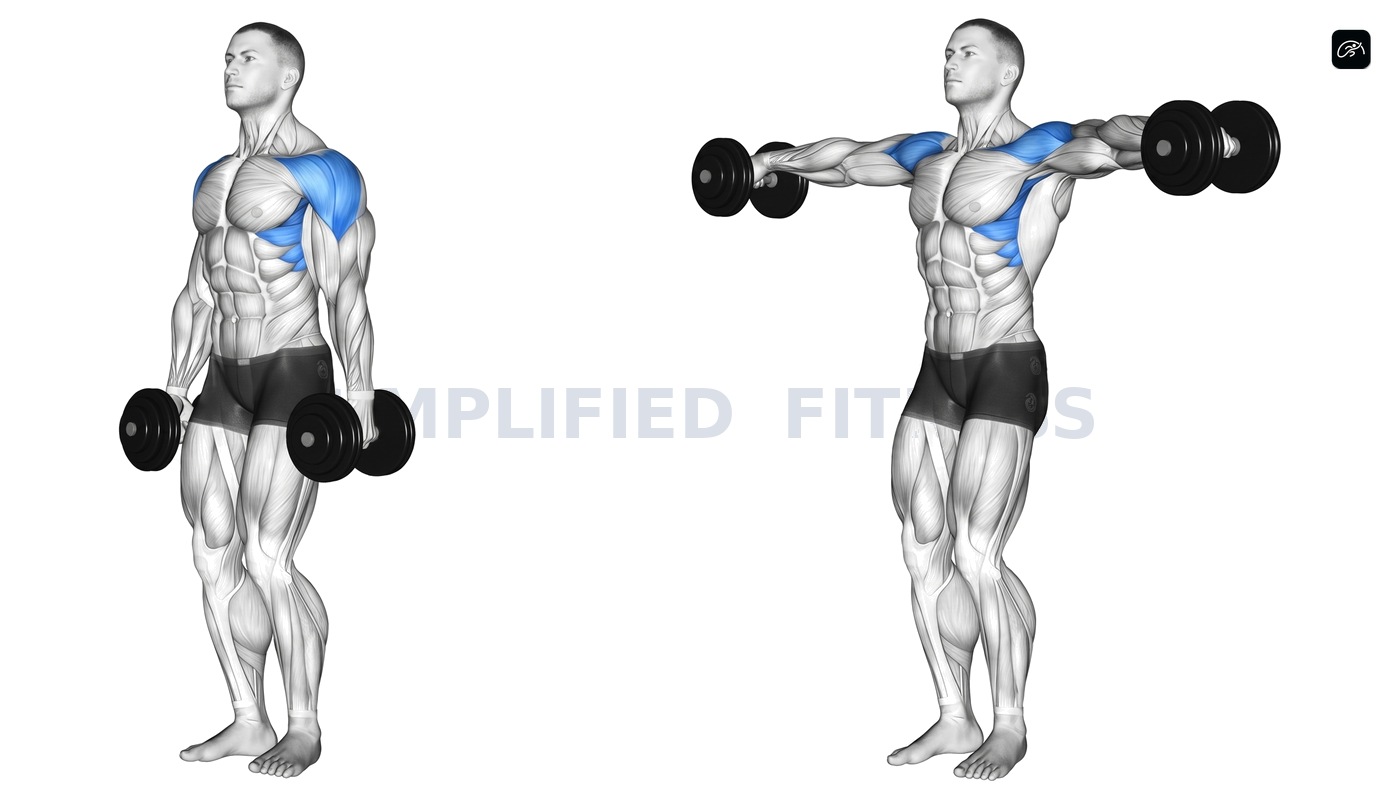
How to set up a cross-body cable lateral raise
Five steps. Set them once and do not fiddle.
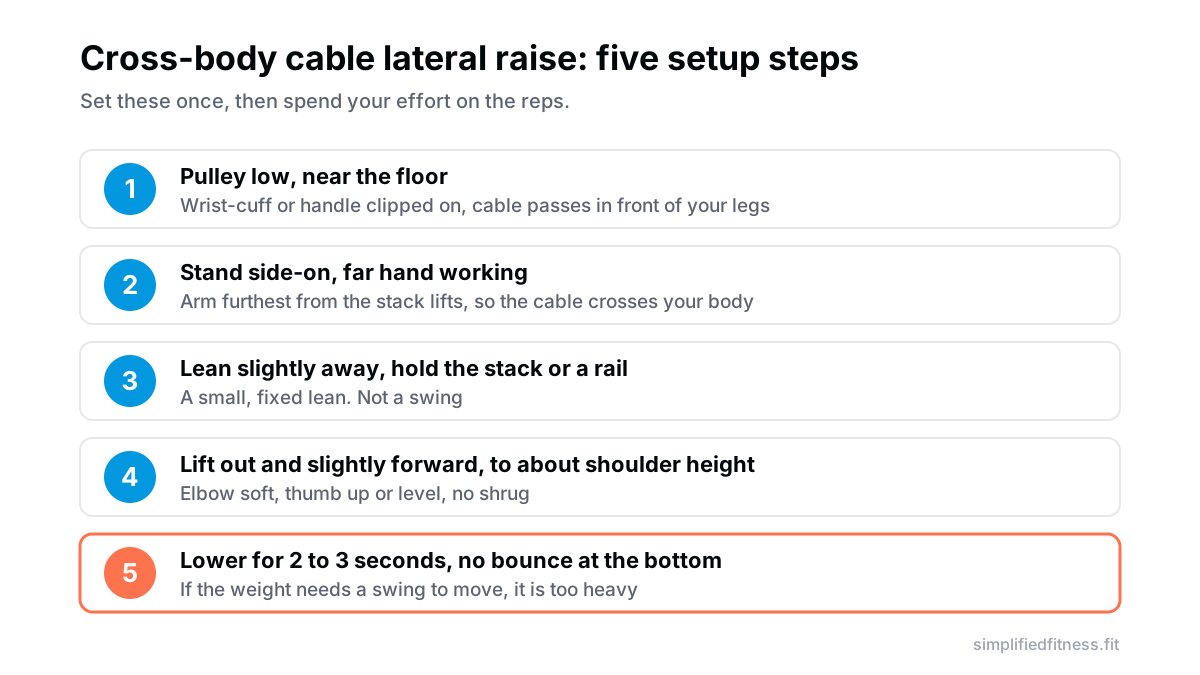
Pulley height
Start with the lowest setting. If the cable catches your leg or the first part of the rep feels slack, raise it a notch or two. Hip-height pulleys flatten the early part of the rep and shift the line of pull, which is not wrong, just different. Pick one and stay with it long enough to compare.
Wrist cuff or handle
A wrist cuff is the easier option. You stop squeezing a handle, which reduces forearm tension and makes it simpler to think about the elbow. A handle works too. If your gym only has handles, use them and keep the grip loose.
Stance and lean
Stand side-on, feet roughly shoulder-width, working with the arm furthest from the stack. A slight lean away from the stack is fine, and holding the upright or a rail with your free hand steadies it. Fix the angle before the set. If the lean changes as you tire, that is momentum, and momentum means the weight is too heavy.
The rep itself
Lift out and slightly forward, led by the elbow, and stop around shoulder height. Keep the thumb level or slightly up rather than pointing down. Lower for two to three seconds and do not let the weight stack bounce at the bottom.
Eliminating momentum
The most common mistake is using a heavy cable like a dumbbell you can heave. Cables punish this less obviously, because tension stays on even during a swing, so the rep feels fine while the side delt does less. A few fixes:
- Drop the weight by 20-30% and take the set closer to failure instead.
- Pause for a beat at the top for the first few reps.
- Film one set from the front and look for the torso swinging.
- Keep the free hand on the stack or rail.
- End the set when the shoulder starts to hike toward the ear.
Reps, load and how close to failure
Lateral raises are an easy exercise to overload with ego. Light-to-moderate loads work well because the lever arm is long. Schoenfeld and colleagues argue that muscle growth can be obtained across a wide spectrum of loading zones, not just a “hypertrophy range” of 8-12 reps (Schoenfeld et al., 2021). For cables, sets of 10-20 taken close to failure are a practical starting point.
To judge “close to failure” honestly, use our RIR and RPE calculator and read our guide to reps in reserve. If you want to explore the stretched-position angle, lengthened partials for hypertrophy covers it separately.
Which setup should you pick?
| Situation | Suggested setup | Why |
|---|---|---|
| New to cable raises | Cross-body, low pulley, wrist cuff | Easiest to keep in the scapular plane |
| Front-of-shoulder pinch with arm behind body | Cross-body, in front | Keeps the arm from drifting behind the torso |
| Feels fine behind the back, pain-free | Either, whichever you can progress | No evidence that one is unsafe or inferior |
| Traps take over | Lower weight, thumb level, stop at shoulder height | Internal rotation raises upper trap activity |
| Tall lifter, cable rubs the leg | Pulley a notch or two higher | Keeps the line of pull clear |
For dumbbell form and the hand-position debate, see our article on dumbbell lateral raise hand cues. If your shoulder is painful in general, subacromial shoulder impingement and lifting solutions is a better starting point than any setup tweak.
Indian gym context
Many commercial gyms in India have a single dual-pulley station that is crowded at peak hours, and wrist cuffs are not always available. A plain handle, held loosely, is fine. If the cable stack only moves in 5 kg jumps, stay on the lighter plate and progress by adding reps or slowing the tempo instead of forcing the next pin. Small pin-selector steps matter more on lateral raises than on almost any other exercise.
When to see a doctor
Occasional muscle burn in the side of the shoulder is normal. Sharp pain at the front or top of the shoulder, pain that wakes you at night, a catching sensation, weakness, or numbness or tingling in the arm are not. Stop the exercise, and see a doctor or physiotherapist if it lasts more than a few days. This article cannot diagnose a shoulder problem.
The practical bottom line
Start with a low pulley, a cross-body line of pull and a wrist cuff. Fix your lean, stop at shoulder height, and lower slowly. Run it for four to six weeks and track whether the load or reps go up.
If you prefer the behind-the-back version and it feels clean, no research says you must change. If your shoulder complains, move the cable in front. For a bigger picture of delt volume, frequency and exercise selection, return to the complete shoulder and delt training guide, and put your sets into a plan using our push day workout.
Frequently Asked Questions
Is a cable lateral raise behind the back or in front better?
Neither has been proven better for muscle growth, because no study has compared the two. In-front (cross-body) setups let the arm rise in the scapular plane, which many lifters find more comfortable. Try both for a few weeks and keep the one that lets you feel the side delt and finish pain-free.
Where should the pulley be for cable lateral raises?
Most lifters use the lowest or near-lowest setting. A low pulley gives resistance right from the bottom, where a dumbbell gives almost none. If you are tall or the cable rubs your leg, raise it to around hip height and see whether the first part of the rep still feels loaded.
Should I use a handle or a wrist cuff for cable side raises?
A wrist cuff is usually easier because it lets you stop gripping hard and think about moving the arm. Less forearm and hand tension makes it easier to keep the elbow leading. A plain handle works fine if you have no cuff, so do not skip the exercise for lack of one.
Do cable lateral raises work the side delts better than dumbbells?
Not on current evidence. An 8-week trial in 24 trained lifters, with range of motion matched, found dumbbell and cable lateral raises grew the lateral deltoid by a similar amount. Cables keep tension near the bottom of the rep, so many lifters use both. Pick based on how each feels and which one you can progress.
Why do I feel cable lateral raises in my traps?
Usually the shoulder is shrugging as the arm rises, or the load is too heavy to control. Internal rotation of the arm also raised upper trap activity in an electromyography study of bodybuilders. Lower the weight, keep your shoulder down and away from your ear, and stop the rep around shoulder height.
How high should I raise the arm on a cable lateral raise?
Around shoulder height is plenty for most people. Going higher tends to bring the traps in and shortens the time the side delt is doing the work. If your range feels cut short, check the lean and the load before chasing height.
How heavy should cable lateral raises be?
Light enough to control the lowering phase, usually in the 8-20 rep range. Research suggests muscle growth can occur across a wide range of loads when sets are taken close to failure. If you need to swing or lean hard to finish a rep, drop the weight.
Should I lean away from the cable stack?
A small, fixed lean is fine and can improve the line of pull. A lean that changes rep to rep turns the movement into a swing. Hold the stack or a rail, set the angle before you start, and keep it identical every rep.
Are behind-the-back cable lateral raises bad for your shoulders?
There is no evidence that they are harmful for healthy lifters. The concern is mechanical: the arm can drift into extension, which some people find uncomfortable at the front of the shoulder. If it bothers you, switch to the in-front setup, and see a doctor if pain continues.
Can I do cable lateral raises with one arm at a time?
Yes, and it is the standard way. Training one side at a time lets you set the line of pull for each arm and reduces the urge to lean on the stronger side. Start with the weaker arm and match its reps on the other side.
How many sets of cable lateral raises per week do I need?
There is no single number, but many lifters do well with roughly 6-12 hard sets of direct side delt work per week across two or three sessions. Cables suit higher-rep sets taken close to failure. Use our RIR calculator to judge how close to failure you are really going.
What is the cross-body cable lateral raise in simple terms?
You stand side-on to a low pulley and lift the arm that is furthest from the stack, so the cable crosses in front of your body. The cable pulls your arm across and slightly back while you lift out to the side. It is the same exercise as a lateral raise, with a cable providing the resistance.
Do cable lateral raises replace overhead presses?
No. Presses load the shoulders with heavy compound work, while lateral raises isolate the side delt with light loads. They do different jobs and most programs benefit from both. Keep a press for strength and use cable raises for the side delt volume.
Sources & References
Every claim above is checked against peer-reviewed research (PubMed, U.S. National Library of Medicine) or guidance from established health bodies. How we fact-check.
- Schoenfeld BJ, et al. Effects of range of motion on muscle development during resistance training interventions: A systematic review. SAGE Open Med. 2020. PMID: 32030125
- Schoenfeld BJ, et al. Loading Recommendations for Muscle Strength, Hypertrophy, and Local Endurance: A Re-Examination of the Repetition Continuum. Sports (Basel). 2021. PMID: 33671664
- Coratella G, et al. An Electromyographic Analysis of Lateral Raise Variations and Frontal Raise in Competitive Bodybuilders. Int J Environ Res Public Health. 2020. PMID: 32824894
- Rabello R, et al. Activation of the three deltoid muscle portions during common strengthening exercises: A systematic review. J Bodyw Mov Ther. 2024. PMID: 39593452
- Escamilla RF, et al. Shoulder muscle activity and function in common shoulder rehabilitation exercises. Sports Med. 2009. PMID: 19769415
- Tsuruike M, et al. Scapular muscle electromyographic activity during abduction exercises in the scapular plane in three positions. Int J Sports Phys Ther. 2019. PMID: 31803526
- Larsen S, et al. Dumbbell versus cable lateral raises for lateral deltoid hypertrophy: an experimental study. Front Physiol. 2025. PMID: 40692697

Umair Hazrami · Founder & Head Coach, Simplified Fitness
Umair Hazrami founded Simplified Fitness and the Simplified Lifter channel to cut through fitness noise. With 4+ years of consistent training and 10+ coaching clients, he writes every guide from the peer-reviewed research and links the sources so you can check them. Our editorial standards.
Educational content only, not medical advice. If you have a medical condition, are pregnant, or take medication, talk to a qualified doctor before changing your diet, supplements or training. Full disclaimer.
Keep reading
Exercise Technique
3D Shoulder Protocol: Weekly Volume, Frequency (2-3x/Week) and Rep Ranges
How to build 3D shoulders: how many weekly sets, how often to train side and rear delts, and which rep ranges to use, with an 8-week plan and the research.
8 min read

Exercise Technique
Are Front Raises Necessary? Why Bench Pressers Rarely Need Direct Front Delt Work
Are front raises necessary if you bench and overhead press? See what EMG and volume research says, when they can still help, and where to spend those sets.
8 min read

Exercise Technique
Behind-the-Neck Press: Shoulder Mobility, Neck Safety and Muscle Bias
Behind the neck press safety explained: who has the shoulder mobility for it, what EMG studies show for delts, and which swaps work if you do not.
10 min read
Exercise Technique
Converging Machine Shoulder Press: Why It Feels Easier on Your AC Joint
Why does a converging shoulder press machine feel smoother than a barbell press? Setup, grip, depth and failure rules for sore AC joints, with studies linked.
8 min read