Preacher Curls vs Bayesian Cable Curls: Which Loads the Biceps Better?
Preacher curl vs Bayesian curl: what the only head-to-head trial found, how torque curves differ, and how to program both for biceps growth without sore elbows.
TL;DR. The short answer
- A 10-week trial of 15 young men found cable preacher curls and Bayesian cable curls grew the biceps about equally, with no significant differences in muscle thickness or strength.
- That trial matched the resistance profile on purpose, so it tested shoulder angle only. It did not test a dumbbell or barbell preacher curl against the cable version.
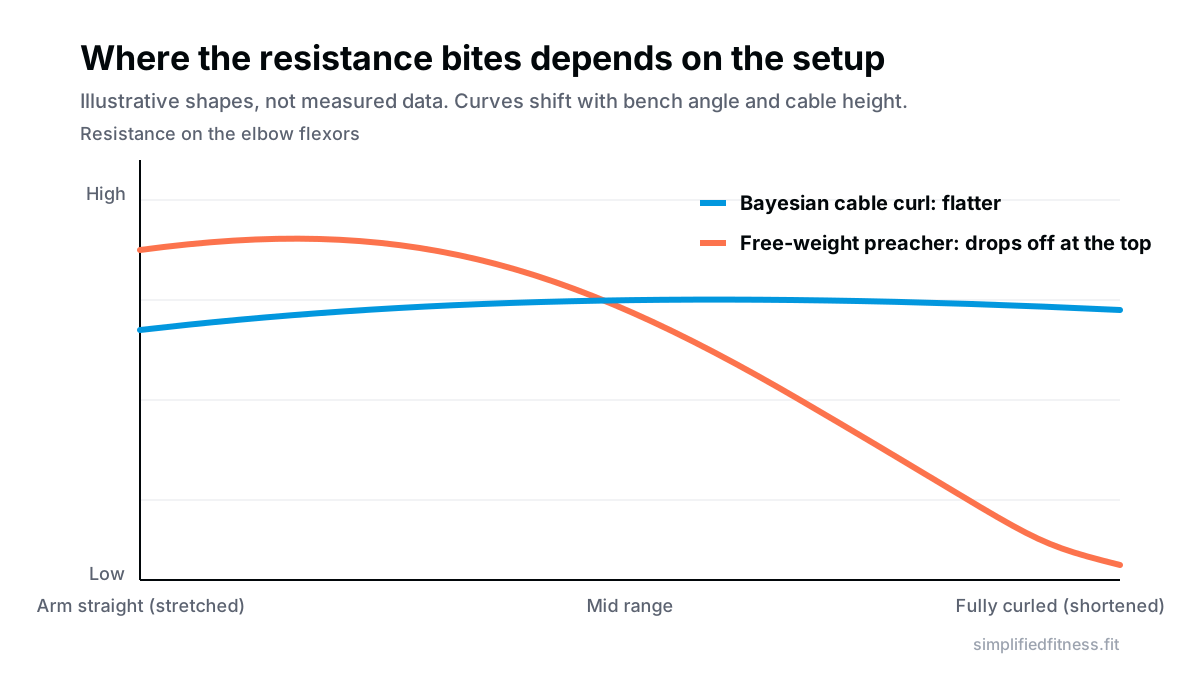
- The preacher curl loads the biceps hardest when it is stretched and tapers near the top. The Bayesian curl keeps the cable pulling through the whole range, so tension is flatter.
- Training the stretched half of the curl grew the distal (lower) biceps more in two trials on women, but the evidence is small and not fully consistent.
- Pick the version you can do pain-free and progress for months. Elbow or biceps tendon pain that lingers is a reason to see a doctor or physio.
Part of our complete guide: Muscle Length, Range of Motion and Stretch-Mediated Hypertrophy: What the Research Actually Shows
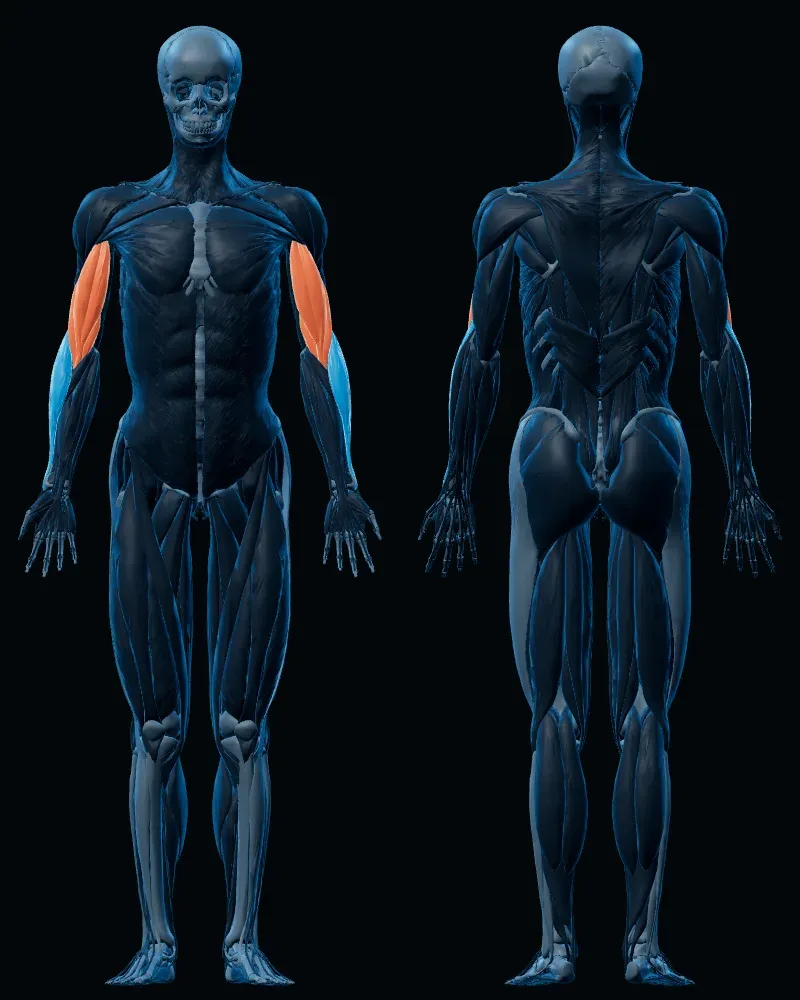
Muscles worked: biceps
Main movers: biceps brachii and brachialis
Assisting: brachioradialis
Table of contents
If you want one answer to the preacher curl vs bayesian curl debate: both grow the biceps, and the best head-to-head trial found no significant difference between them. The Bayesian curl keeps the cable pulling through the whole rep, while the preacher curl is hardest in the stretch and eases off near the top. That is a real mechanical difference, but so far it has not translated into clearly different muscle growth.
This article sits under our guide to range of motion and stretch-mediated hypertrophy. Here we do the narrow face-off. For single-exercise deep dives, see Bayesian cable curls and preacher curls for the distal biceps.
What is the difference between a preacher curl and a Bayesian curl?
Both exercises are elbow flexion. What changes is where your shoulder is and how the resistance pulls on the arm.
Preacher curl. Your upper arm rests on a pad in front of you, so the shoulder is flexed (arm pointing forward). This blocks swinging and keeps the biceps working on a fixed arm position.
Bayesian cable curl. You stand facing away from a low pulley and hold the handle behind you with the shoulder slightly extended (arm behind the torso). The cable pulls you backward, so your biceps have to resist from a lengthened position and keep pulling throughout.
Shoulder position matters because the biceps brachii crosses both the shoulder and the elbow. Moving the shoulder changes how stretched the long head is at the start of the curl. We cover that angle in long head vs short head biceps and shoulder position.
What does the resistance curve look like?
Resistance on the elbow is not the weight itself. It is the weight multiplied by how far the line of pull sits from the elbow joint (the lever arm). When the forearm is horizontal, that lever arm is longest. When the forearm is vertical, it shrinks.
On a free-weight preacher curl, the load usually feels heaviest in the stretched half of the range and fades toward the top, where the forearm is nearly vertical. One trial describes the barbell preacher curl as applying greater torque when the elbows are extended and the biceps are stretched (Nunes et al., 2020). Exactly where the peak lands depends on the bench angle and your grip position, so treat the common “peak at 90 degrees” line as a rough rule of thumb.
A cable that pulls from behind you changes the direction of the load as you curl, which tends to keep resistance more even across the range. That is the logic behind the “constant tension” label.
What does the research say about preacher vs Bayesian curls?
There is one direct trial, and it is small, so read it as a first data point rather than a verdict.
The head-to-head trial (2025). Fifteen young men trained for 10 weeks, twice a week, doing 3-5 sets of 8-12 reps. One arm did a unilateral cable curl with the shoulder flexed (preacher), the other did a cable curl with the shoulder extended (Bayesian). The researchers deliberately matched the resistance profiles. Both arms gained muscle thickness across the biceps proximal, mid and distal regions, and in the brachialis, with no significant differences between them. Biceps thickness rose about 6-7% on the preacher arm and about 9% on the Bayesian arm. Strength rose about 28% versus 37% (Attarieh et al., 2025). The authors concluded that shoulder angle did not seem to affect hypertrophy or strength gains when resistance profiles are matched.
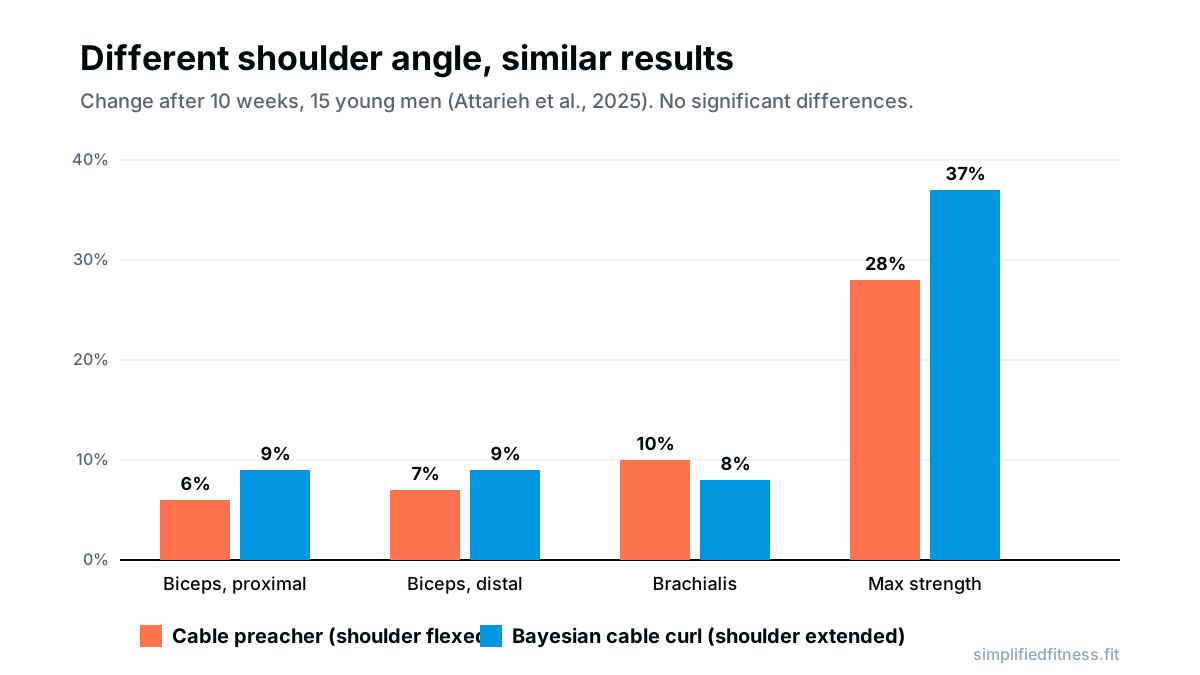
Two caveats matter. First, both exercises were cable-based, so this trial does not tell you whether a dumbbell preacher curl differs from a Bayesian curl. Second, the sample was 15 young men, so we do not know how well the result carries over to women, older lifters or very advanced trainees.
Where in the range to load the biceps. Other trials looked at the lengthened side directly:
- Cable preacher versus barbell preacher in 35 young adults (10 weeks): strength rose in both, with greater gains for the barbell version only at the longer muscle length, and biceps thickness grew similarly (7% vs 8%) (Nunes et al., 2020).
- Dumbbell preacher curls trained in the initial range (extended elbow) versus the final range in 19 young women: the initial range produced greater growth at 70% of biceps length (distal), similar growth at 50%, and a larger 1RM gain (Pedrosa et al., 2023).
- Incline versus preacher curls in 38 women (9 weeks): only the preacher group’s distal region grew significantly, but there were no significant differences between groups or regions (Zabaleta-Korta et al., 2023).
- Incline versus preacher dumbbell curls in 21 untrained adults, measured with MRI over 12 weeks: biceps growth was greater after incline (+22.1% vs +18.9%), brachialis and brachioradialis grew more after preacher, and total elbow flexor growth did not differ (Kobayashi et al., 2026).
Why do these results not line up neatly? The studies used different exercises, ranges, sexes, training backgrounds and measurement methods (ultrasound versus MRI). Some are tiny, and several used untrained people, who tend to grow from almost any reasonable program. A 2020 systematic review of range of motion studies concluded that research on the upper limbs is limited and conflicting (Schoenfeld and Grgic, 2020).
The practical read: the stretched half of the curl may matter for the distal biceps, the exact exercise probably matters less, and no trial has shown a clear winner. For the incline comparison, see our dedicated piece on incline curls vs preacher curls.
Preacher vs Bayesian curl at a glance
| Preacher curl | Bayesian cable curl | |
|---|---|---|
| Shoulder position | Flexed (arm forward on pad) | Extended (arm behind torso) |
| Where it feels hardest | Stretched half, fades near the top | Fairly even, with the stretch under load |
| Biceps long head stretch | Less | More |
| Equipment | Preacher bench plus dumbbell, EZ bar or cable | Single cable pulley, low |
| Cheating risk | Low, the pad blocks swing | Low if you stay still, but the cable can pull you out of position |
| Best for | Strict, simple stretched-range work | Keeping tension all the way up |
How do I program both without hurting my elbows?
The stretched start of both curls puts load on the biceps and its tendon in a long position, so ease into them.
- Start light. Use a weight you can control for 10-12 reps with a 2-3 second lowering phase. Add load slowly over weeks.
- Control the bottom. Do not drop into the stretch or bounce out of it. A fast, uncontrolled bottom puts a sudden load on the biceps tendon in its longest position.
- Use a comfortable range. Stop short of full lockout if the elbow or inner biceps complains. A slightly shorter range you can repeat beats a deep one that irritates you.
- Rotate them. A sensible week might use preacher curls in one arm session and Bayesian curls in the other, rather than stacking both in one workout.
- Count the volume. Many lifters do well on roughly 6-12 hard biceps sets a week including rows and pulldowns, though response varies. Our training volume calculator helps you keep track, and direct vs indirect arm volume shows how rows count.
- Mind effort. Finish most sets with about 1-3 reps left, and save the hardest set for the end. The RIR and RPE calculator can help you gauge it.
Which should you pick?
- Beginner or gym with no cables: dumbbell preacher curls. Strict, simple and well supported by the trials above.
- Intermediate wanting more stretch and constant pull: add the Bayesian curl on one session a week.
- Elbow or shoulder cranky: pick the version that causes no pain and use a shorter range. If neither works, drop curls for a couple of weeks and use rows and pulldowns as your biceps work.
- Plenty of equipment: alternate them across the week. Variety costs nothing, and the trial data do not show one as clearly better.
When should you see a doctor?
Soreness in the biceps after new exercises is normal. These signs are not, and deserve a medical assessment:
- Pain at the front of the elbow or inner biceps that persists or worsens over a couple of weeks
- A sudden pop or sharp pain in the arm during a curl, especially with bruising or a change in the shape of the biceps
- Numbness, tingling or weakness in the arm or hand
If elbow pain is already a pattern, read our guide to distal biceps tendonitis and golfer’s elbow. This article is not a diagnosis, and a physio or doctor can examine the arm in person.
The bottom line
The Bayesian curl is a clever way to keep a cable pulling on the biceps through the whole rep, and the preacher curl is a strict way to load the stretched half. The one trial that compared them while matching the resistance profile found similar growth. Use both if you like variety, pick one if you do not, and spend your effort on progressive overload, enough weekly sets and pain-free technique. For the bigger picture, pair your arm work with our free push, pull and legs plans.
Frequently Asked Questions
Is the Bayesian curl better than the preacher curl?
Not on current evidence. In a 2025 trial of 15 young men, cable preacher and Bayesian curls produced similar growth in the biceps and brachialis, with no significant differences. Choose the one that feels better on your shoulder and elbow and that you can progress.
What is a Bayesian cable curl?
It is a single-arm cable curl performed facing away from the stack, with the shoulder slightly behind the body and the cable low behind you. The setup keeps the cable pulling on the arm through the whole curl, so there is no easy spot at the top. Start with a light weight, since the stretched start position feels harder than it looks.
Why is it called a Bayesian curl?
The name is a gym nickname, not a scientific term. It comes from Bayesian Bodybuilding, the coaching brand that popularised the setup online. It describes a setup, not a different muscle action. What matters is the shoulder position and the line of the cable, so focus on those rather than the label.
Does the preacher curl hit the lower biceps?
It may favour the distal biceps, though evidence is limited. Two trials in women found the preacher-type or initial-range curl grew the distal region, while overall growth was similar to other curls in other trials. Treat 'lower biceps' as a modest tendency, not a guarantee.
Where does the preacher curl load the biceps most?
On a free-weight preacher curl the heaviest part is usually near the stretched half of the range, and resistance fades toward the top. The exact point shifts with bench angle and where the weight starts. Slow the lowering phase and keep the stretch under control rather than letting the weight drop.
Do cables give constant tension for biceps?
Cables keep the pull from going slack more than free weights can, but torque on the elbow still changes as the arm moves. A cable curl with the right angle keeps the load flatter across the range. Set the pulley height and your body position so you feel tension at both ends of the rep.
Is the Bayesian curl safe for the shoulder and elbow?
For most healthy lifters it is fine with sensible loads, but there is no trial data on injury rates. The shoulder sits slightly behind the body, so stop if you feel front-of-shoulder pinching, and keep the stretch comfortable rather than extreme. Sharp or lingering pain at the elbow or inner biceps deserves a check by a doctor or physio.
Can I do preacher curls and Bayesian curls in the same week?
Yes, and many people do. They load the arm slightly differently, so alternating them across sessions adds variety without adding much junk volume. Keep total weekly biceps sets in a range you can recover from, and use the same rep and effort targets for both.
How many sets of curls do I need per week?
There is no single perfect number, and individual response varies. Many lifters do well on roughly 6-12 hard biceps sets a week, counting rows and pulldowns as partial volume. Add sets only if progress stalls and recovery is good.
Should I train curls to failure?
Getting close to failure is useful, but you do not need to hit it on every set. Stopping one or two reps short keeps form tidy and the elbow happier. Use the last set of an exercise to push hard and leave the others slightly in reserve.
Which curl is better for tendonitis-prone elbows?
Neither has been shown safer, and pain responds more to load, speed and total volume than to exercise choice. Lighter loads, slower lowering and a pain-free range are the usual starting points. Persistent or worsening pain, or a sudden pop or bruise near the elbow, needs a medical assessment.
Do I need a cable machine, or can I do this with dumbbells?
You do not need either to grow biceps, since dumbbell preacher and incline curls work too. The research differences between versions are small, and the best curl is the one you can progress for months. Use whichever equipment your gym actually has free.
How heavy should Bayesian curls be?
Lighter than you expect, because the stretched position is tough and the biceps are weak there. Choose a load you can lift for 8-12 controlled reps, which matches what the trial used. Raise the weight only when you hit the top of that rep range with clean form.
Sources & References
Every claim above is checked against peer-reviewed research (PubMed, U.S. National Library of Medicine) or guidance from established health bodies. How we fact-check.
- Attarieh P, et al. Comparison between shoulder flexed and extended positions in elbow flexion resistance training on regional hypertrophy and maximum strength: preacher versus Bayesian cable curls. Eur J Sport Sci. 2025. PMID: 40082069
- Nunes JP, et al. Placing greater torque at shorter or longer muscle lengths? Effects of cable vs. barbell preacher curl training on muscular strength and hypertrophy in young adults. Int J Environ Res Public Health. 2020. PMID: 32823490
- Pedrosa GF, et al. Training in the initial range of motion promotes greater muscle adaptations than at final in the arm curl. Sports (Basel). 2023. PMID: 36828324
- Zabaleta-Korta A, et al. Regional hypertrophy: the effect of exercises at long and short muscle lengths in recreationally trained women. J Hum Kinet. 2023. PMID: 37559762
- Kobayashi Y, et al. Exercise-specific preferential hypertrophy of individual elbow flexor muscles after incline versus preacher dumbbell curl training. J Sports Sci. 2026. PMID: 42829982
- Schoenfeld BJ, et al. Effects of range of motion on muscle development during resistance training interventions: a systematic review. SAGE Open Med. 2020. PMID: 32030125

Umair Hazrami · Founder & Head Coach, Simplified Fitness
Umair Hazrami founded Simplified Fitness and the Simplified Lifter channel to cut through fitness noise. With 4+ years of consistent training and 10+ coaching clients, he writes every guide from the peer-reviewed research and links the sources so you can check them. Our editorial standards.
Educational content only, not medical advice. If you have a medical condition, are pregnant, or take medication, talk to a qualified doctor before changing your diet, supplements or training. Full disclaimer.
Keep reading
Hypertrophy
Active vs Passive Insufficiency: How Two-Joint Muscles Change Your Exercise Choice
Active vs passive insufficiency explained for lifters: why hamstrings, triceps, quads and calves grow differently depending on your second joint position.
10 min read
Hypertrophy
Squat Mobility With Long Femurs: Adapting Range of Motion to Your Hips
Squat mobility with long femurs is mostly a lever and hip-socket issue, not a flaw. Learn how to adjust depth, stance and heels without risking your hips.
10 min read
Hypertrophy
Dumbbell Pullovers vs Cable Lat Pull-ins: Training Lats at Long Muscle Lengths
Training lats at long muscle lengths: is the dumbbell pullover a lat or chest exercise, and why a cable lat pull-in may keep tension where you want it.
7 min read
Hypertrophy
Full vs Partial Range of Motion: What the Hypertrophy Research Shows
Full vs partial ROM hypertrophy explained: what two meta-analyses and recent trials found, where lengthened partials fit, and how to set your range of motion.
8 min read