Dumbbell Pullovers vs Cable Lat Pull-ins: Training Lats at Long Muscle Lengths
Training lats at long muscle lengths: is the dumbbell pullover a lat or chest exercise, and why a cable lat pull-in may keep tension where you want it.
TL;DR. The short answer
- The dumbbell pullover is a shared chest and lat exercise. In the EMG studies we have, it favored the pecs over the lats, so it is not a clean lat builder.
- A dumbbell pulls straight down with gravity, so the load is heaviest when your arms are overhead and fades toward zero as your arms come over your chest. The cable keeps the line of pull where you set it.
- A cable lat pull-in starts with the arm overhead and pulls the elbow down toward the hip, which loads the lat in a stretched position with steadier tension.
- No study has tested pullovers against cable pull-ins for lat growth. Long-muscle-length training looks promising for some muscles (triceps), but the evidence for lats is indirect.
- Use the pullover if you enjoy it and it feels good, but do not count it as your main lat work. Pulldowns, rows and a cable pull-in should carry the volume.
Part of our complete guide: Muscle Length, Range of Motion and Stretch-Mediated Hypertrophy: What the Research Actually Shows
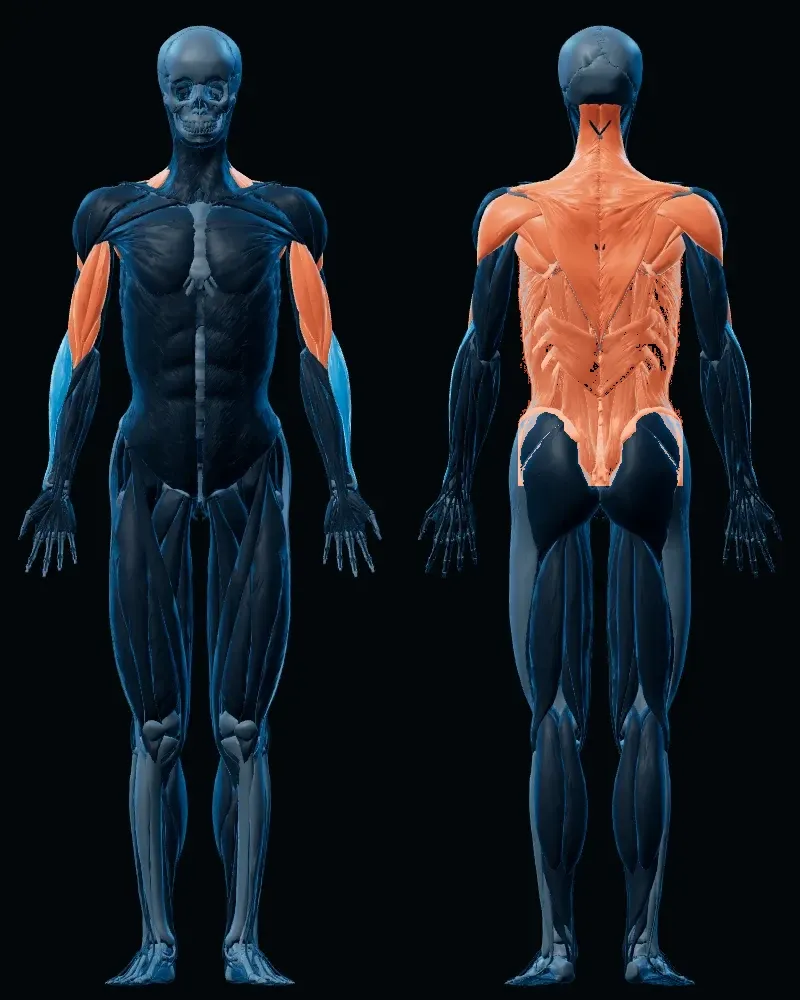
Muscles worked: pull day
Main movers: lats, upper back, rear delts, biceps and brachialis
Assisting: forearms
Table of contents
The dumbbell pullover is a chest-and-lat exercise, and the research we have leans toward the chest. If you want to focus on training lats at long muscle lengths, a cable lat pull-in is probably the cleaner tool, because the cable can keep tension on the lat where a dumbbell lets it drop away.
This is one of the long-muscle-length exercise comparisons in our guide to range of motion and stretch-mediated hypertrophy. Here we stay on one question: what does the pullover really train, and what do you do instead to load the lats in a stretch?
Is the dumbbell pullover a chest or lat exercise?
Both. That is the honest answer, and it is why the argument never ends.
The lats and the pecs both pull the arm down from an overhead position. A systematic review of shoulder moment arms (a measure of mechanical advantage) reports that the pectoralis major, latissimus dorsi and teres major all have large depressor and adduction moment arms, with the lats and teres major also strong in extension (Hik & Ackland, 2019). Two big muscles doing similar jobs means you cannot assume the lat is the one working.
Now the EMG. Eight men did a barbell pullover with about 30% of body weight. The pecs were emphasized more than the lats, and how much depended on the external lever arm (Marchetti & Uchida, 2011). A 2026 narrative review of 23 EMG studies reached the same loose conclusion: the pullover appeared to favor the pecs over the lats, with the authors warning these are acute EMG readings, not growth results (Di Fonza et al., 2026).
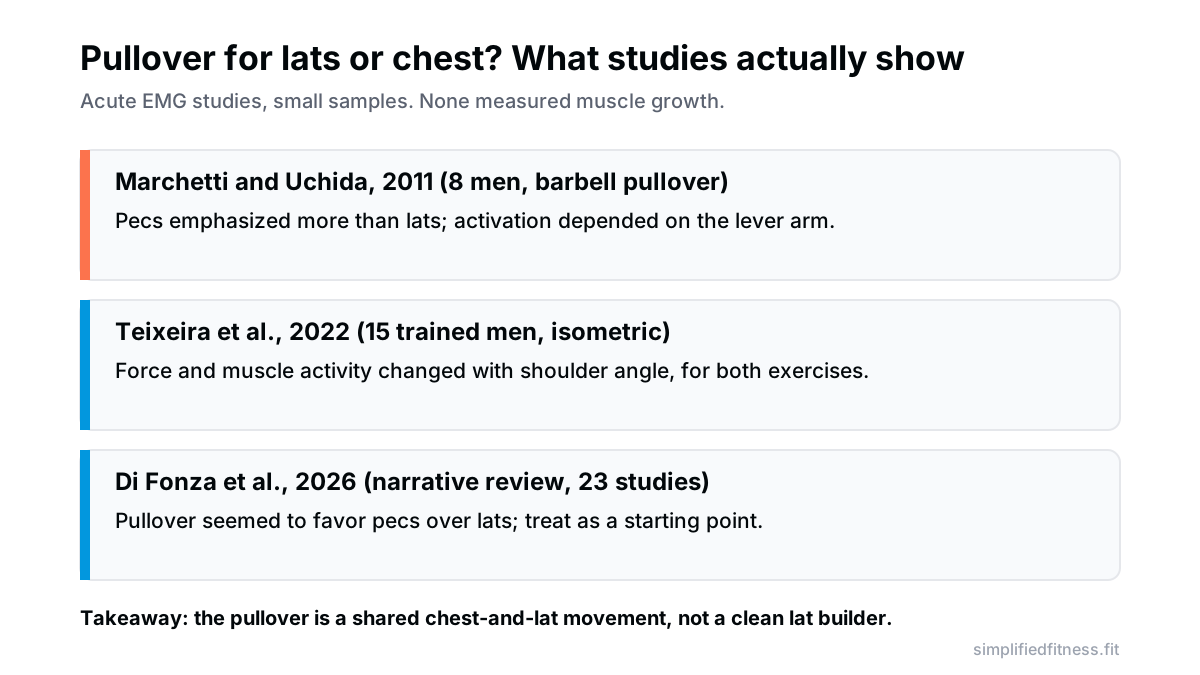
One more study muddies it in a useful way. Fifteen resistance-trained men did maximal isometric pullovers and pulldowns at five shoulder angles. Force and muscle activity changed with joint angle in both exercises (Teixeira et al., 2022). Shoulder angle matters a lot. Which brings us to the real problem with the dumbbell.
Why the dumbbell pullover loads the lats at the wrong time
A dumbbell weighs the same everywhere, and gravity only pulls down. What changes is how far that weight sits from your shoulder joint. Lying on a bench, with your arms back behind your head, the dumbbell is far from the joint and the torque is big. As you raise it over your chest, the weight sits almost directly over the joint and the torque shrinks toward zero.
That is simple physics, not a lab result. In the gym it feels like this: hard at the bottom, nearly weightless at the top.
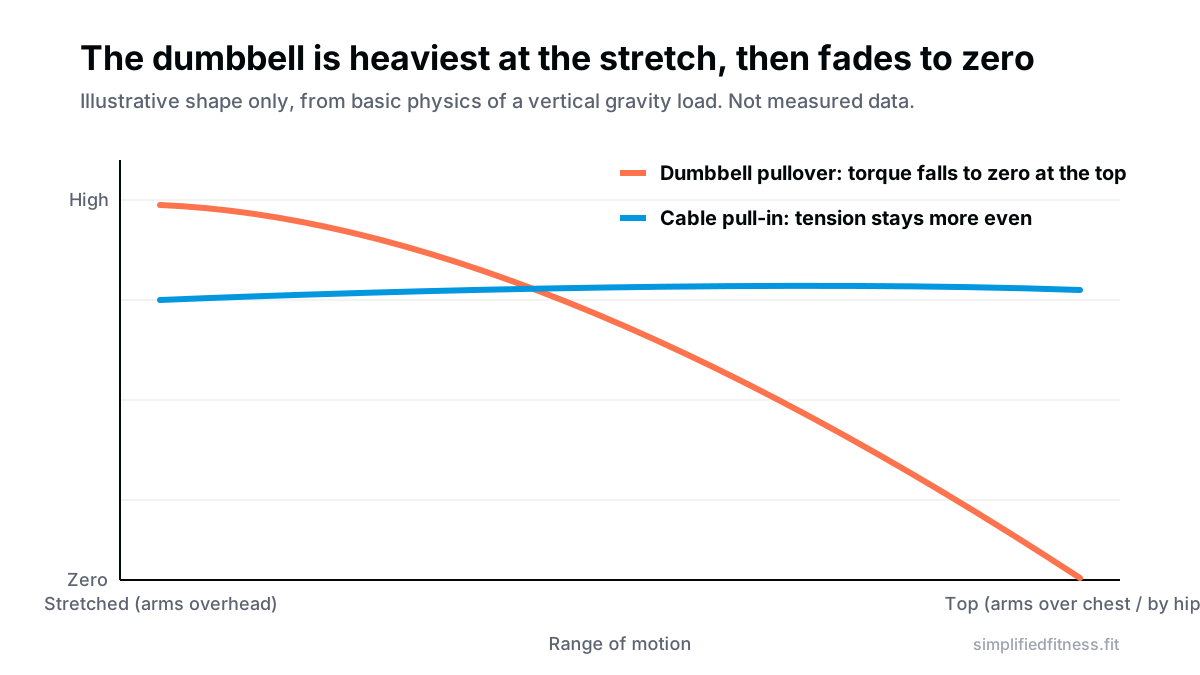
So where is the problem? The heaviest part of the pullover is also the position where chest, lats, rib cage and shoulder capsule are all being tugged at once. That is why many lifters feel the stretch in their chest and ribs rather than their lats. Whether the lat is the main driver there is not something the studies settle.
I would not call the pullover bad. I would call it a mixed exercise with a resistance profile that suits the pecs at least as much as the lats. If you love it, keep it. Just do not rely on it as your lat builder.
What does training lats at long muscle lengths actually do?
This is where we need to be careful, because the hype outruns the data.
For the triceps, the evidence is genuinely strong for one muscle. In a 12-week trial, 21 adults trained one arm overhead and the other in a neutral position. The overhead arm grew about 1.4 to 1.5 times more triceps muscle volume, even though lighter weights were used (Maeo et al., 2023).
But the wider picture is less dramatic. A 2025 Bayesian meta-analysis of 12 studies in young adults found trivial differences in regional hypertrophy between training at shorter and longer muscle lengths, and concluded both produce similar effects overall. The authors also warned that the length differences between conditions were small, so the result needs caution (Varovic et al., 2025).
And for the lats specifically? A 2020 systematic review found range-of-motion research for the upper body was limited and conflicting, and that no study had looked at trunk muscle growth (Schoenfeld & Grgic, 2020). There is no trial that tested pullovers against pull-ins for lat size.
Sarcomere talk is also easy to oversell. A 2025 review concluded that high forces at long fiber lengths seem to be a key stimulus for adding sarcomeres, but most of that evidence comes from animals, and the authors note that too few human studies exist to draw firm conclusions (Blazevich et al., 2025). Do not treat it as a promise that lats will grow faster.
Dumbbell pullover vs cable lat pull-in: how they compare
| Dumbbell pullover | Cable lat pull-in | |
|---|---|---|
| Load direction | Straight down (gravity) | Along the cable line you set |
| Heaviest at | The stretched position | Can stay steadier across the range |
| Chest involvement | High, from EMG studies | Probably lower if you cue the elbow to the hip (untested) |
| Equipment | One dumbbell and a bench | Cable stack with a high pulley |
| Direct growth evidence for lats | None | None |
| Best use | Shared chest and lat accessory | Stretched lat accessory |
Neither has trial data for lat growth. The cable’s edge is mechanical: you can keep tension on the lat as the arm moves, and you can aim the line of pull at the lat’s own direction.
How to set up a cable lat pull-in
Here is a practical setup. The long-length logic is mechanistic, so treat it as a good option, not a proven method.
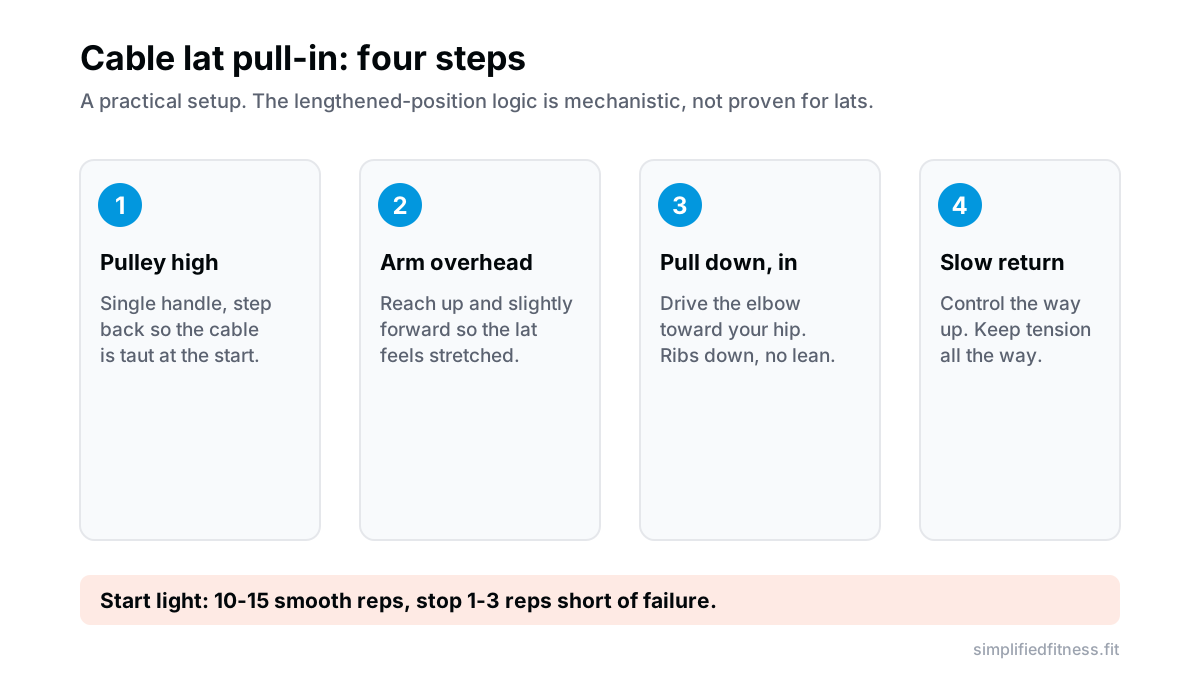
- Set a single handle on a high pulley.
- Step back until the cable is taut with your arm up and slightly forward.
- Let your lat lengthen, keeping your ribs down.
- Pull the elbow down and in toward your hip, not the hand to the floor.
- Return slowly and keep tension.
Common mistakes here are leaning back to move more weight, shrugging up into the handle, and cutting the stretch short. If you feel pinching at the top of the shoulder, shorten the reach and see a physio or doctor if it keeps happening.
For cable positioning in more detail, see our cable setup guide for pulley heights and angles.
How do you know if the stretch is actually on your lats?
Use simple checks rather than guessing. If you feel the stretch along your side and under the armpit, that is a good sign. If you mostly feel it across the front of the chest, or as a pinch at the top of the shoulder, change the angle or lower the load.
Another check is the load. If you need to heave, lean back or swing to move the weight, it is too heavy for a stretched movement. Drop 20-30% and make the reps slow and clean. Lifters often assume heavier is better here, and it usually just moves the work to the arms and traps.
Which lat exercises should carry your volume?
Pulldowns, rows and a stretched cable movement together cover the lat well. The real action is in the pulldown. A narrative review found an anterior bar path was the setup most consistently tied to higher lat EMG, while grip width effects were inconsistent (Di Fonza et al., 2026).
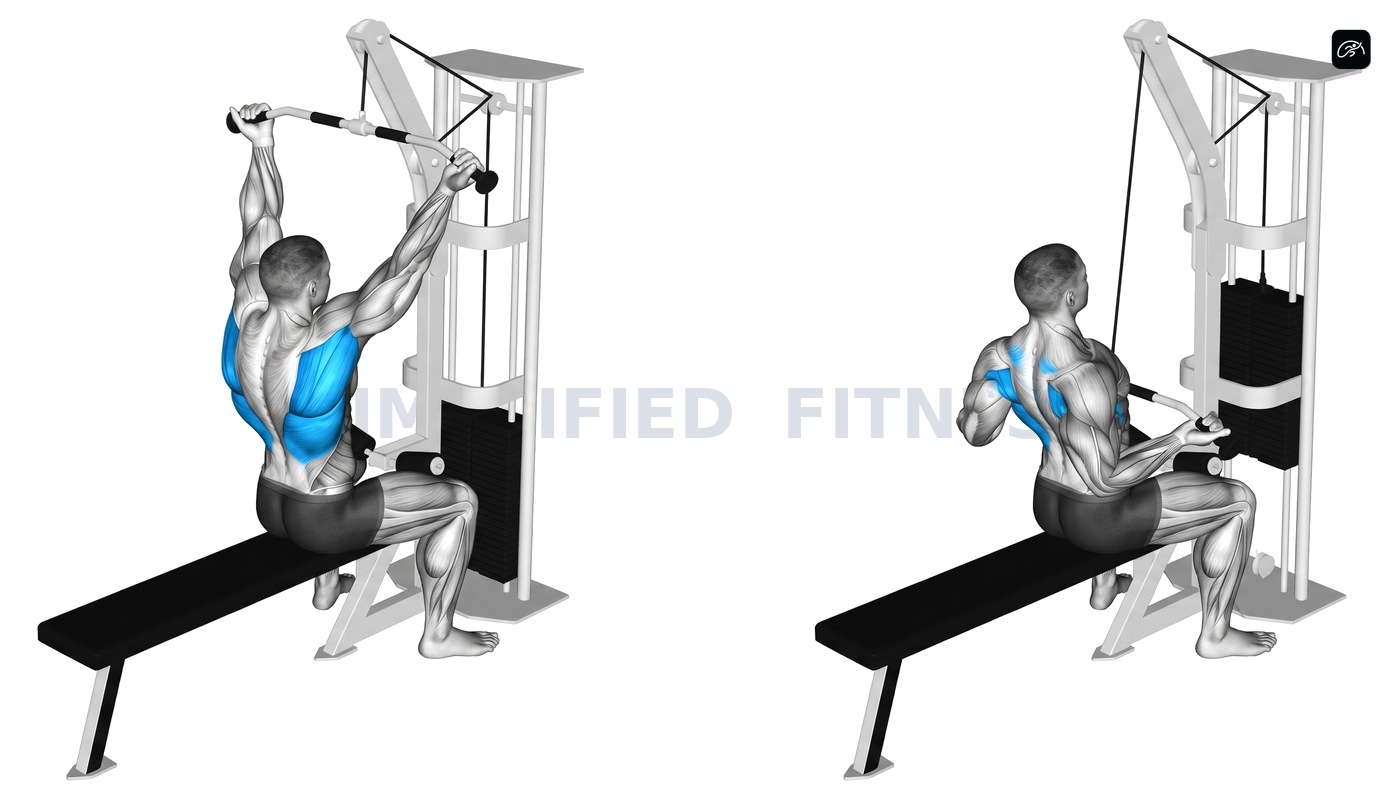
If you want depth on the pulldown itself, read our breakdown of wide versus close and neutral grip lat pulldowns. For the unilateral cable version aimed at the lower lat fibres, see single-arm lat pulldowns. Pair them with the complete back training guide and our deeper look at the pullover tension curve.
A simple weekly template, as a starting point and not a prescription:
- One heavy vertical pull, 3-4 sets of 6-10 reps
- One row variation, 3-4 sets of 8-12
- One stretched cable exercise (pull-in or single-arm pulldown), 2-4 sets of 10-15
- Optional dumbbell pullover as an accessory, 2-3 light sets of 10-15
If you want this inside a full session, our free pull day plan shows how the pieces fit.
Indian gym context
Plenty of smaller gyms in India have a single cable stack or a pulley station with limited attachments. If you only have a lat pulldown machine, you can still get a long-length stimulus by letting the arms reach fully overhead at the top of each rep and pausing briefly. Dumbbells and a flat bench are almost always available for pullovers. Home trainees can use a resistance band anchored high. Fuel matters too, so make sure your protein and total calories support growth, such as dal, paneer, curd, eggs or soya at each meal.
When to see a doctor
Sharp pain, pinching at the front or top of the shoulder, numbness or tingling in the arm, or soreness that lingers for days is not normal training soreness. Stop the exercise and see a doctor or physiotherapist. Pullovers and overhead cable work are not suitable if you have a recent shoulder injury until you are cleared.
What to do next
Keep your heavy pulldowns and rows. Add one stretched cable lat exercise and treat the pullover as optional. Track your reps and loads for 8-12 weeks, and keep whichever version you can progress with good form and no joint pain.
Frequently Asked Questions
Is the dumbbell pullover a chest or back exercise?
It is both, and the research leans toward chest. A small EMG study found the barbell pullover emphasized the pectoralis major more than the latissimus dorsi [(Marchetti & Uchida, 2011)](https://pubmed.ncbi.nlm.nih.gov/21975179/). If your goal is lat width, treat it as a bonus movement and keep pulldowns or cable work as the main lift.
Does the dumbbell pullover build lats?
It can train them, but it is not the most direct option. Both the lats and pecs pull the arm down from overhead, and in the one barbell pullover EMG study the pecs were more active, with the balance depending on the lever arm. Nobody has measured pullover-specific lat growth, so use it as a supplement, not a foundation.
What is a cable lat pull-in?
It is a single-arm cable movement where you start with the arm up and slightly forward and pull the elbow down and in toward your hip. The idea is to load the lat while it is lengthened and keep tension through the whole range. Set the pulley high, step back so the cable is taut, and move slowly.
Why is the pullover hard on the lats at the bottom?
At the stretched position the dumbbell's torque around the shoulder is at its highest, simply because gravity pulls straight down on a long lever. That is physics, not a measured lat effect. If the weight feels like it is stretching your chest and ribs more than your lats, drop the load.
What are the best lat stretch exercises under load?
Single-arm cable pulldowns from a full overhead reach, lat pulldowns with a full stretch at the top, and a cable pull-in are practical options. They load the muscle while the arm is overhead. Pick one, own the stretch with control, and stop short of any pinching in the shoulder.
Does training at long muscle lengths build more muscle?
For some muscles, yes. A 12-week trial found overhead cable triceps work grew the triceps about 1.4 to 1.5 times more than the neutral position [(Maeo et al., 2023)](https://pubmed.ncbi.nlm.nih.gov/35819335/), but a 2025 meta-analysis found trivial regional differences overall [(Varovic et al., 2025)](https://pubmed.ncbi.nlm.nih.gov/40570881/). Treat it as a useful tool, not a rule.
How many sets of pullovers or pull-ins should I do?
Two to four hard sets of 10-15 reps is a reasonable starting range, because the research on exact lat volume is limited. Add it after your main pulldown or row, not instead of it. Increase only if recovery and progress stay good.
Can pullovers hurt my shoulders?
Heavy pullovers can bother some lifters because the arm is held overhead under load. The mechanism is the long lever at end range, though there are no good injury trials on this. Use a lighter weight, stop where you feel pinching, and see a clinician if pain lingers.
Should I use a dumbbell, cable or machine for pullovers?
A cable or pullover machine keeps tension steadier than a dumbbell because the line of pull is not tied to gravity alone. A dumbbell works fine if you keep the load modest. Choose whichever you can control with a full stretch and no shoulder pain.
How do I feel my lats instead of my arms or chest?
Think elbow to hip, not hand to floor. Lats extend and adduct the arm, so driving the elbow down and in cues them better than squeezing the handle. Keep your ribs down and your shoulder blade moving freely.
Are pull-ins better than lat pulldowns?
Not proven. Pulldowns have more direct EMG evidence, and a narrative review noted an anterior bar path was most consistently linked with higher lat activation [(Di Fonza et al., 2026)](https://pubmed.ncbi.nlm.nih.gov/42647355/). A cable pull-in is a good complement for stretched-position work, not a replacement.
Can I do these at home without a cable?
You can approximate a pull-in with a resistance band anchored high, and pullovers work with one dumbbell. A band gives rising tension, which is different from a cable but still trains the lats. Choose whichever lets you reach the stretch and control the return.
Sources & References
Every claim above is checked against peer-reviewed research (PubMed, U.S. National Library of Medicine) or guidance from established health bodies. How we fact-check.
- Marchetti PH, et al. Effects of the pullover exercise on the pectoralis major and latissimus dorsi muscles as evaluated by EMG. J Appl Biomech. 2011. PMID: 21975179
- Teixeira LFM, et al. Differences between pullover and pulldown exercises on maximal isometric force and myoelectric activity in recreationally-trained men. Int J Exerc Sci. 2022. PMID: 35992501
- Di Fonza D, et al. Electromyographic analysis of latissimus dorsi activation during common resistance training exercises: a narrative review. J Funct Morphol Kinesiol. 2026. PMID: 42647355
- Hik F, et al. The moment arms of the muscles spanning the glenohumeral joint: a systematic review. J Anat. 2019. PMID: 30411350
- Varovic D, et al. Does muscle length influence regional hypertrophy? A systematic review and meta-analysis. Int J Sports Med. 2025. PMID: 40570881
- Schoenfeld BJ, et al. Effects of range of motion on muscle development during resistance training interventions: a systematic review. SAGE Open Med. 2020. PMID: 32030125
- Maeo S, et al. Triceps brachii hypertrophy is substantially greater after elbow extension training performed in the overhead versus neutral arm position. Eur J Sport Sci. 2023. PMID: 35819335
- Blazevich AJ, et al. Triggering sarcomerogenesis: examining key stimuli and the role attributed to eccentric training. J Sport Health Sci. 2025. PMID: 40623648

Umair Hazrami · Founder & Head Coach, Simplified Fitness
Umair Hazrami founded Simplified Fitness and the Simplified Lifter channel to cut through fitness noise. With 4+ years of consistent training and 10+ coaching clients, he writes every guide from the peer-reviewed research and links the sources so you can check them. Our editorial standards.
Educational content only, not medical advice. If you have a medical condition, are pregnant, or take medication, talk to a qualified doctor before changing your diet, supplements or training. Full disclaimer.
Keep reading

Hypertrophy
Active vs Passive Insufficiency: How Two-Joint Muscles Change Your Exercise Choice
Active vs passive insufficiency explained for lifters: why hamstrings, triceps, quads and calves grow differently depending on your second joint position.
10 min read

Hypertrophy
Squat Mobility With Long Femurs: Adapting Range of Motion to Your Hips
Squat mobility with long femurs is mostly a lever and hip-socket issue, not a flaw. Learn how to adjust depth, stance and heels without risking your hips.
10 min read

Hypertrophy
Full vs Partial Range of Motion: What the Hypertrophy Research Shows
Full vs partial ROM hypertrophy explained: what two meta-analyses and recent trials found, where lengthened partials fit, and how to set your range of motion.
8 min read
Hypertrophy
Why Your Inner Thighs Burn After Deep Squats: Adductor Magnus vs Glute Max
The adductor magnus in a deep squat works as a hip extensor beside your glutes. See what the research shows and how to train depth for bigger thighs.
9 min read