Subacromial Shoulder Impingement: What You Can Still Lift and How to Modify It
Shoulder impingement lifting modifications: what to avoid, which grips and angles help, and how to load a sore shoulder. Evidence-based, with swaps.
TL;DR. The short answer
- Most lifters with subacromial pain syndrome do not need to stop training. Research supports progressive strengthening exercise as the main treatment, with the dose adjusted to how the shoulder reacts.
- The big levers are load, how high the arm goes and how much the arm is turned in. Grip width, hand rotation and pressing angle are smaller tweaks, and the evidence for them is weaker.
- A placebo-controlled surgical trial and a BMJ guideline found subacromial decompression surgery gives no important benefit over placebo surgery, so rehab is the first-line route.
- Swap upright rows, behind-the-neck presses, deep dips and wide-grip barbell benching for neutral-grip dumbbell or machine versions, and add rows, rear delts and rotator cuff work.
- Night pain, arm weakness, numbness or pain after a fall are not gym problems. See a doctor or physiotherapist.
Part of our complete guide: Complete Shoulder, Delt & Neck Training Guide: 3D Deltoid Anatomy, Rotator Cuff & Traps
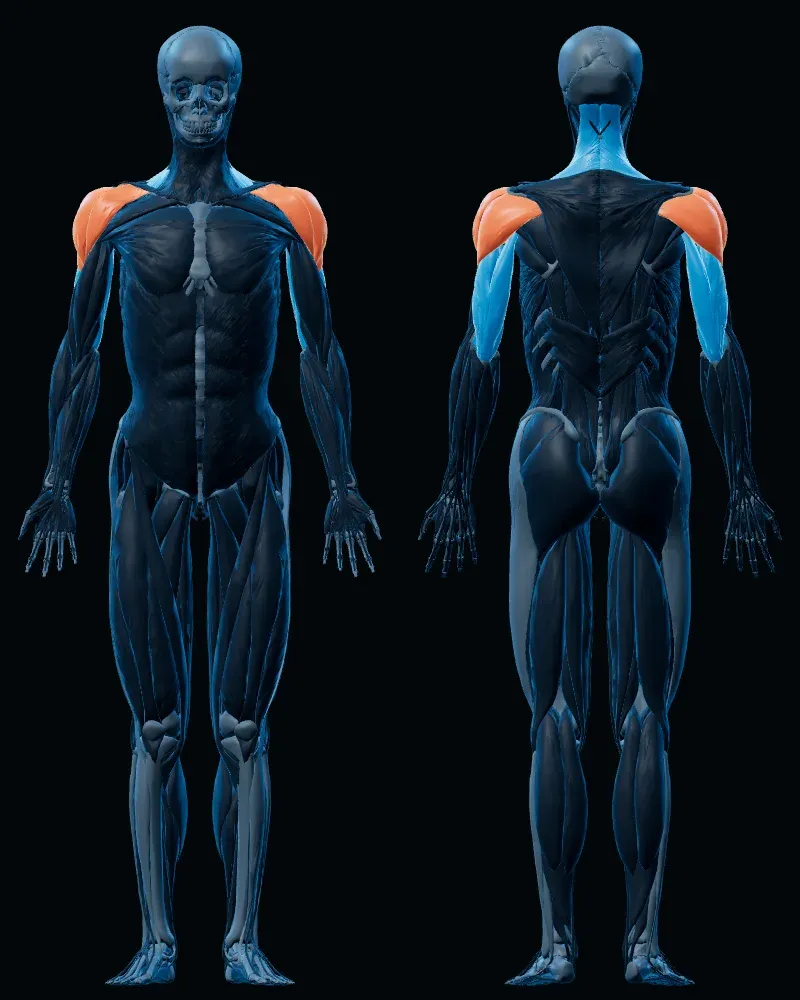
Muscles worked: shoulders
Main movers: all three heads of the deltoid
Assisting: supraspinatus, upper traps and triceps
Table of contents
Shoulder impingement lifting modifications come down to three things: keep loading the shoulder, change the positions that provoke it, and let pain over the next day or two guide how hard you push. For most lifters with subacromial pain, complete rest is not the answer. Smarter exercise choices, a bit less range on the angry movements and steady strengthening of the rotator cuff and upper back are.
This guide is part of our complete shoulder and delt training guide. It is for lifters who already have a pain pattern, ideally one a doctor or physio has looked at, and want to know what they can safely keep doing in the gym. It is not a diagnosis. If you have not been assessed, read the red-flag section below first.
What is subacromial shoulder impingement, really?
Your arm bone (humerus) sits in a shallow socket, and the rotator cuff tendons run through a narrow gap under a bony roof called the acromion. That gap is the subacromial space. A fluid-filled bursa and the supraspinatus tendon live in there.
“Impingement” suggests something is being pinched. In practice, clinicians now often prefer terms like subacromial pain syndrome or rotator cuff related shoulder pain, because pain in this area has several contributors: tendon load tolerance, irritated bursa, scapular movement, sleep, stress and training history. The tendon and bursa can get cranky when you suddenly do more than they are used to.
The mechanical story is real but not the whole picture. A 2020 review found that changes in shoulder and shoulder-blade movement are associated with changes in the subacromial space, but the size and direction of the effect varied between studies. Raising the arm higher consistently mattered. The plane of elevation mattered less, and the effect of scapular position was not absolute (Lawrence et al., 2020).
That is useful for a lifter. It says the biggest levers are how high the arm goes and how much load you put through it, not some magic grip.
Do I need surgery for subacromial impingement?
Probably not, and this shapes how aggressive you should be about rehab. In the CSAW trial, 313 patients with subacromial pain for at least 3 months, who had already tried exercise therapy and a steroid injection, were randomised to decompression surgery, placebo arthroscopy or no treatment. Decompression was no better than the placebo surgery at 6 months. Both surgical groups were slightly ahead of no treatment, but the difference was not clinically important (Beard et al., 2018).
A BMJ Rapid Recommendation built on that evidence made a strong recommendation against offering subacromial decompression to adults with atraumatic subacromial pain syndrome, noting surgery gave no important improvement over placebo surgery and frozen shoulder may be more common with it (Vandvik et al., 2019). The same panel admitted there is substantial uncertainty about which alternative treatment is best.
If you were told you need a “subacromial decompression,” ask your surgeon what the evidence says for your specific findings. This is a conversation to have with your doctor, not something to decide from a blog post. For the gym, it means the first-line work is on you: the exercises you choose and how you load them.
Which exercise approach works best for a sore shoulder?
Not the gentlest one, as it turns out. A 2025 network meta-analysis of 15 to 16 randomised trials (about 900 patients) compared seven exercise types for rotator cuff related shoulder pain. Concentric strengthening ranked first for both pain and dysfunction. Eccentric strengthening and traditional training were moderately effective, and ahead of motor control and scapula-focused training for dysfunction (Zhang et al., 2025). Differences between most other approaches on pain were not significant.
On the other side, a 2024 meta-analysis of 8 trials (387 participants) found scapular stabilisation exercises gave moderately better pain and function scores than conventional physical therapy, without any gain in range of motion (Zhong et al., 2024).
Why might these differ? They compare against different things and pool different programmes. The practical reading: both strengthening the cuff and training the shoulder blade muscles have support, but you should not rely on light scap drills alone. Progressive loading matters.
Another trial worth knowing about: in the SELF randomised trial, a self-managed programme built around a single loaded exercise performed about as well as usual physiotherapy at 3, 6 and 12 months. The study was small, with many patients lost to follow-up, so it suggests simple programmes can work rather than proving it (Littlewood et al., 2016).
A sports-physio statement paper graded the evidence for athletes with subacromial impingement. A rehab programme with stretching, strengthening and other modalities showed a large effect on pain and disability versus no intervention, but the quality of evidence ranged from very low to moderate (Liaghat et al., 2023).
Exercises to avoid with shoulder impingement (or modify first)
Nothing is permanently banned. These are the movements that most often provoke a sore shoulder, so they are the first to change or pause.
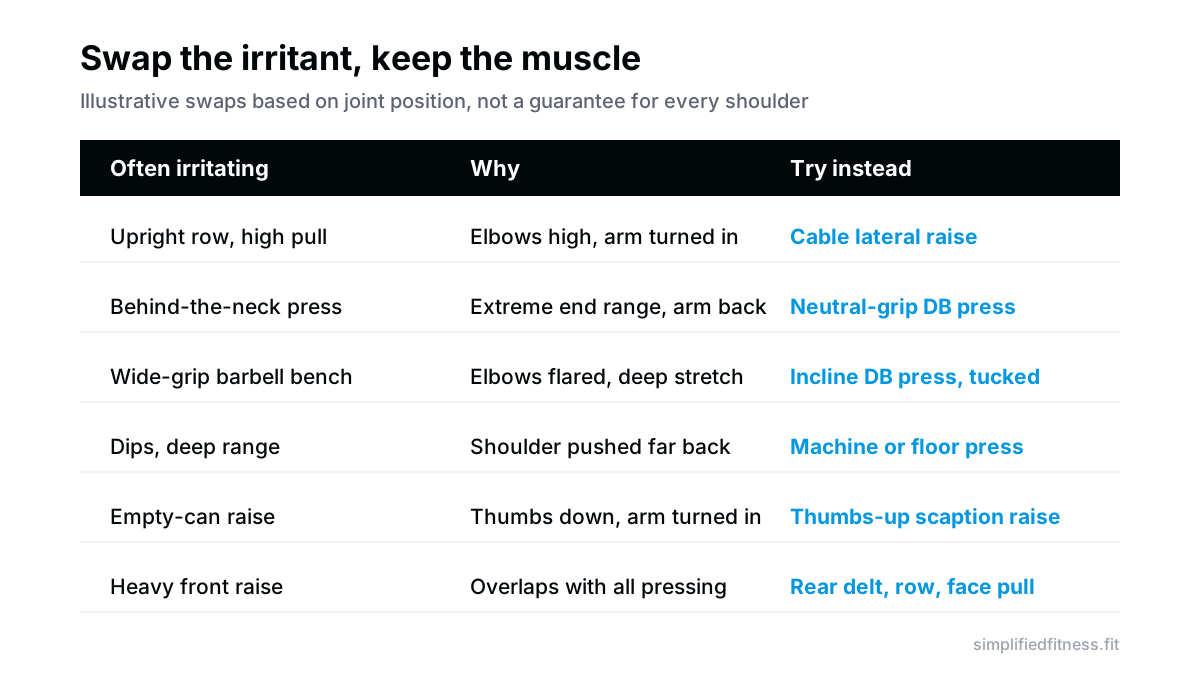
- Upright rows and high pulls. Elbows rise above the hands with the arm turned in. We cover this in detail in upright rows and shoulder impingement.
- Behind-the-neck press. Pushes the arm to an extreme end range. See behind-the-neck press safety.
- Deep dips and wide-grip barbell benching. Both stretch the front of the shoulder under heavy load.
- Empty-can raises. The EMG review by Escamilla lists both “empty can” and “full can” among exercises with high rotator cuff activity, but notes that empty can (thumbs down) brings more scapular internal rotation and anterior tilt, which narrow the subacromial space (Escamilla et al., 2009). If you want similar cuff work in a position less likely to narrow that space, use thumbs-up.
One note of caution. The idea that overhead pressing is always harmful is a myth, as we explain in the overhead press and impingement myth. The position, load and your current irritability matter more than the exercise name.
Shoulder impingement lifting modifications that actually help
Press with neutral grips and the scapular plane
A neutral grip, palms facing each other, usually lets the elbows sit in front of the body instead of flaring out. Dumbbells (or a Swiss bar if your gym has one) let each arm find its own path. Many lifters report this is more comfortable than a straight barbell. To be honest about the evidence, I could not find trials directly comparing grips in people with impingement, so treat it as a practical option with limited direct research.
Pressing in the scapular plane means the arms travel roughly 30 degrees in front of the sides of the body. This is a modest tweak. The review above found plane of elevation affects subacromial proximity less than the elevation angle (Lawrence et al., 2020). So use it if it feels better, but do not expect it to rescue a painful range.
Control the range, not just the angle
If the last 15 degrees of overhead pressing pinch, stop there for now. An incline dumbbell press or a landmine-style press keeps the arm lower. Our guide to the incline press covers angle choices. Floor presses are another gentle option; see floor press for shoulder rehab.
Swap laterals for variants that keep tension low
Lateral raises are not forbidden, but they push the arm higher with a long lever. Try these in order:
- Cable lateral raise to shoulder height, thumbs up, light load.
- Lateral raise stopping at about 70 to 80 degrees, rather than chasing height.
- A chest-supported Y or T raise on an incline bench, which takes momentum and the trunk out of it and trains the rear delt and upper back. This is a coaching choice, not a researched fix, and it works only if it stays pain-free.
If the lateral raise itself is the issue, our dumbbell lateral raise cues article explains hand position in detail.
Add pulling and cuff work every week
Escamilla’s review notes that scapular retraction, compared with protraction, increased subacromial space width and improved supraspinatus force during elevation, and that serratus anterior and the other scapular muscles help the shoulder blade rotate and tilt properly (Escamilla et al., 2009). In plain gym language: row more, and set the shoulder blades before you press.
Good options include chest-supported rows, seated cable rows, reverse pec dec flies and face pulls. For the rotator cuff itself, see our guide to rotator cuff strengthening. Given the loading evidence above, do not only use feather-light bands. Progress to cable or dumbbell external rotation with a load that feels challenging by the last two reps.
How do I know if a set was too much?
Use the next day as the judge, not only the set.
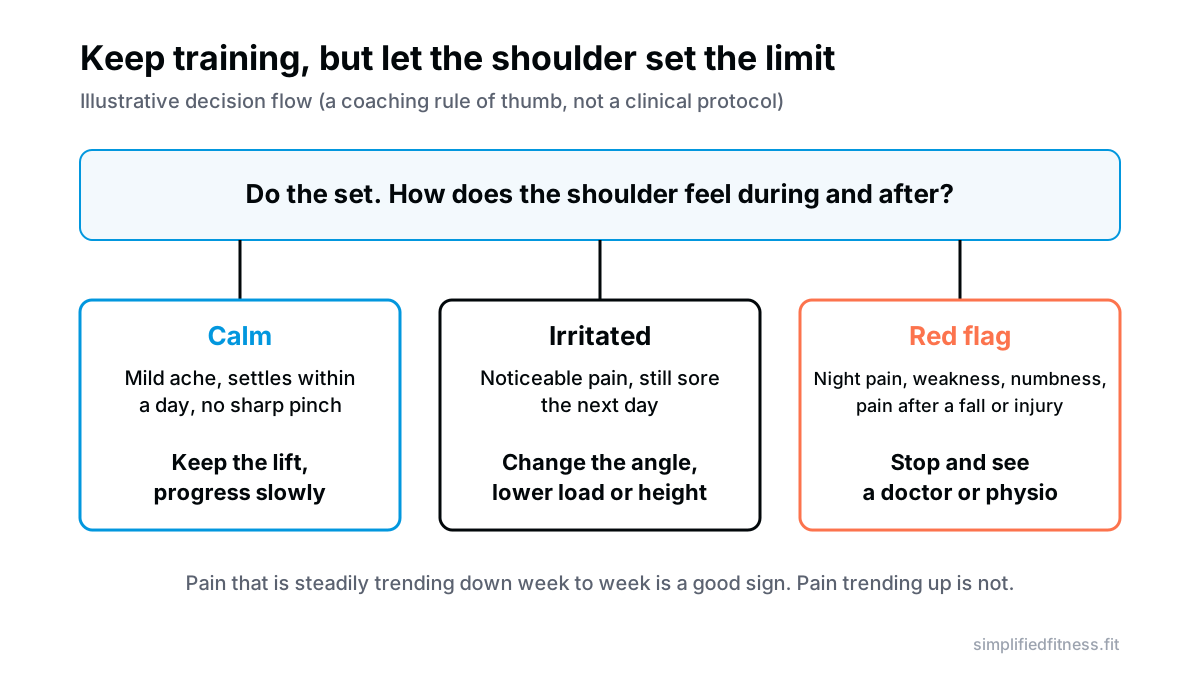
This is a rule of thumb, not a guideline. There is no research-backed pain number, and our article on good vs bad pain explains why the traffic-light idea is useful. If you are coming back after time off, the returning to the gym after injury article lays out a gradual ramp.
A sample modified push day (illustrative)
This is an example of structure, not a prescription. Adjust to your pain.
| Slot | Exercise | Sets x reps | Notes |
|---|---|---|---|
| Main press | Neutral-grip dumbbell press (incline or flat) | 3 x 6-10 | Stop 1-2 reps before failure, elbows tucked |
| Shoulder | Cable lateral raise, thumbs up | 2-3 x 12-15 | Shoulder height or just below |
| Pull | Chest-supported row | 3 x 8-12 | Pause with shoulder blades back |
| Rear delt | Reverse pec dec fly | 2-3 x 12-20 | Light, smooth |
| Cuff | Cable or dumbbell external rotation | 2-3 x 10-15 | Heavier over the weeks |
Want to see your weekly sets across muscle groups? Use our training volume calculator, or run the push day plan and swap in the modifications above. For machine pressing comfort, see converging machine shoulder press.
India-specific notes: sleep, desk posture and heat
Many of us spend most of the day at a desk or on a phone, and shoulder pain often shows up in people who suddenly start a gym routine on top of that. You do not need to fix your posture to train, but changing position through the day and taking a few minutes for rows and cuff work helps. If sleeping on the painful side hurts, a pillow hugged in front can help. In hot weather, warm up for slightly longer: shoulders feel stiffer when you go in cold.
There is no evidence that a particular food heals the rotator cuff. Eating enough protein (dal, paneer, curd, eggs, soya, chicken) and enough total calories supports training and recovery in general, and our protein calculator can give you a daily target.
When to see a doctor
See a doctor or physiotherapist, and do not train through it, if you have:
- pain that wakes you at night or does not ease at rest
- new weakness, such as trouble lifting the arm
- numbness, tingling or pain running down the arm, or neck pain with it
- a clear deformity, or pain after a fall or sudden pull
- no improvement after several weeks of sensible modification
These can point to a tendon tear, a neck or nerve problem or another condition that needs a proper assessment. This article cannot tell you which one you have.
The bottom line
Shoulder impingement lifting modifications are mostly common sense backed by decent rehab research: keep loading the shoulder, remove the worst positions, pull as much as you push and progress slowly. Surgery is rarely the first answer. The finer details, like grip type and scapular plane, are small tweaks with limited direct evidence, so use whichever feels best.
Pick two exercises to swap this week, track how the shoulder feels the next morning, and build from there.
Frequently Asked Questions
Can I still lift weights with shoulder impingement?
Usually yes, with changes. Exercise is the main treatment for rotator cuff related shoulder pain, and loaded strengthening ranked best in a 2025 network meta-analysis. Keep training pain-limited and tell a physio or doctor if it keeps worsening.
What exercises should I avoid with shoulder impingement?
The usual troublemakers are upright rows, behind-the-neck presses, deep dips, wide-grip barbell bench and heavy empty-can raises. They load the shoulder with the arm high, turned in or pulled far back, positions that tend to irritate a sore shoulder. Swap them for friendlier versions first rather than quitting pressing altogether.
Is overhead pressing safe with subacromial pain?
It depends on the person and the day. Some lifters tolerate neutral-grip dumbbell presses well while others need a lower range or an incline press for a while. Try a lighter, pain-free version and see how the shoulder feels the next morning.
Does a neutral grip really help shoulder impingement?
Many lifters find it more comfortable because the palms face each other and the elbows tuck in slightly. Direct research comparing grips in people with impingement is limited, so treat it as a practical option, not a proven fix. If it feels better and you can progress the load, use it.
What is scaption and why is it recommended?
Scaption means raising the arm in the scapular plane, roughly 30 degrees in front of straight to the side. A 2020 review found the plane of elevation affects subacromial space less than the elevation angle does, so it is a small tweak, not a cure. Use it because it often feels more natural, and keep the weight modest.
Are lateral raises bad for shoulder impingement?
Not automatically. The risk rises with load and with the arm travelling high, especially turned in. Raise to about shoulder height with thumbs up, use a light weight or a cable, and drop the exercise for a few weeks if it pinches.
How much pain is acceptable when training with impingement?
Many physios accept mild discomfort that settles within a day, but there is no single research-backed number. Sharp pinching, pain that lingers or pain trending upward week to week means change the exercise. Our guide on [good pain vs bad pain](/blog/no-pain-no-gain-myth-good-vs-bad-pain) explains the traffic-light idea.
Do I need surgery for subacromial impingement?
Probably not. A BMJ guideline made a strong recommendation against subacromial decompression for adults with atraumatic shoulder pain lasting over 3 months, after trials showed no important benefit over placebo surgery. Your doctor decides, but exercise therapy is where most people start.
How long does shoulder impingement take to heal?
It varies a lot and no honest answer fits everyone. Trials of exercise programmes typically follow patients for 3 to 12 months, so think in months, not weeks. Track pain and function monthly instead of daily.
Do rotator cuff exercises with a band help?
They can, but how you progress the load probably matters more than the gadget. In the small SELF trial, a single self-managed loaded exercise performed about as well as usual physiotherapy. Do cuff work that is progressively heavier over weeks, not only light band reps.
Should I do scapular stabilisation exercises?
A 2024 meta-analysis of 8 trials found them moderately effective for pain and function in subacromial pain syndrome versus conventional physical therapy. However, a 2025 network meta-analysis ranked scapula-focused training below concentric and eccentric strengthening. Do both: rows and cuff strengthening, not only scap drills.
Can I train chest and shoulders with impingement?
Yes, usually with modified exercises, a bit less range and a close eye on the next-morning feeling. Neutral-grip dumbbell, incline and machine presses are common starting points. Our [shoulder-pain bench press fixes](/blog/shoulder-pain-bench-press-biomechanical-fixes) article goes deeper on the bench.
When should I see a doctor about shoulder pain?
See one for pain at night that wakes you, new weakness, numbness or tingling down the arm, a visible deformity, or pain after a fall or sudden injury. Those can point to a tear or a nerve or neck problem, not simple impingement. A physio can also confirm what is going on before you guess.
Sources & References
Every claim above is checked against peer-reviewed research (PubMed, U.S. National Library of Medicine) or guidance from established health bodies. How we fact-check.
- Zhang W, et al. Effects of seven types of exercise in the treatment of rotator cuff-related shoulder pain (RCRSP): a systematic review and Bayesian network meta-analysis. J Orthop Surg Res. 2025. PMID: 41276811
- Zhong Z, et al. Effect of scapular stabilization exercises on subacromial pain (impingement) syndrome: a systematic review and meta-analysis of randomized controlled trials. Front Neurol. 2024. PMID: 38497039
- Beard DJ, et al. Arthroscopic subacromial decompression for subacromial shoulder pain (CSAW): a multicentre, pragmatic, parallel group, placebo-controlled, three-group, randomised surgical trial. Lancet. 2018. PMID: 29169668
- Vandvik PO, et al. Subacromial decompression surgery for adults with shoulder pain: a clinical practice guideline. BMJ. 2019. PMID: 30728120
- Lawrence RL, et al. Shoulder kinematics impact subacromial proximities: a review of the literature. Braz J Phys Ther. 2020. PMID: 31377124
- Escamilla RF, et al. Shoulder muscle activity and function in common shoulder rehabilitation exercises. Sports Med. 2009. PMID: 19769415
- Littlewood C, et al. A self-managed single exercise programme versus usual physiotherapy treatment for rotator cuff tendinopathy: a randomised controlled trial (the SELF study). Clin Rehabil. 2016. PMID: 26160149
- Liaghat B, et al. Diagnosis, prevention and treatment of common shoulder injuries in sport: grading the evidence. Br J Sports Med. 2023. PMID: 36261251

Umair Hazrami · Founder & Head Coach, Simplified Fitness
Umair Hazrami founded Simplified Fitness and the Simplified Lifter channel to cut through fitness noise. With 4+ years of consistent training and 10+ coaching clients, he writes every guide from the peer-reviewed research and links the sources so you can check them. Our editorial standards.
Educational content only, not medical advice. If you have a medical condition, are pregnant, or take medication, talk to a qualified doctor before changing your diet, supplements or training. Full disclaimer.
Keep reading
Exercise Technique
3D Shoulder Protocol: Weekly Volume, Frequency (2-3x/Week) and Rep Ranges
How to build 3D shoulders: how many weekly sets, how often to train side and rear delts, and which rep ranges to use, with an 8-week plan and the research.
8 min read
Exercise Technique
Are Front Raises Necessary? Why Bench Pressers Rarely Need Direct Front Delt Work
Are front raises necessary if you bench and overhead press? See what EMG and volume research says, when they can still help, and where to spend those sets.
8 min read
Exercise Technique
Behind-the-Neck Press: Shoulder Mobility, Neck Safety and Muscle Bias
Behind the neck press safety explained: who has the shoulder mobility for it, what EMG studies show for delts, and which swaps work if you do not.
10 min read
Exercise Technique
Cable Lateral Raises: Behind-the-Back vs Cross-Body Setup, Which Is Better?
Cable lateral raise behind the back vs in front: what the research says, which setup suits most lifters, and a step-by-step guide to pulley height and cuffs.
9 min read