Rotator Cuff Strengthening (SITS): Supraspinatus, Infraspinatus, Teres Minor Protocols
Rotator cuff strengthening exercises for lifters: what each SITS muscle does, which cable external rotations work best, and a simple 15-20 rep weekly protocol.
TL;DR. The short answer
- The rotator cuff is four small muscles (supraspinatus, infraspinatus, teres minor, subscapularis, or SITS) that hold the ball of your upper arm centred in the shoulder socket while the big muscles move the arm.
- In a 10-person EMG study, side-lying external rotation gave the highest infraspinatus (62% of max) and teres minor (67%) activity of seven exercises tested. Cable and band versions are a practical gym alternative.
- A simple lifter protocol is 2-3 sets of 15-20 controlled reps, 2-3 times a week, light enough that your traps and delts are not taking over. This is a coaching convention, not a trial-proven dose.
- Strengthening the cuff is not proven to prevent pain in lifters. For rotator cuff related shoulder pain, a 2025 network meta-analysis found concentric strengthening ranked best of the exercise types compared.
- Sharp pain, night pain, a sudden weakness after a heavy rep, or numbness down the arm means see a doctor or physio rather than training through it.
Part of our complete guide: Complete Shoulder, Delt & Neck Training Guide: 3D Deltoid Anatomy, Rotator Cuff & Traps
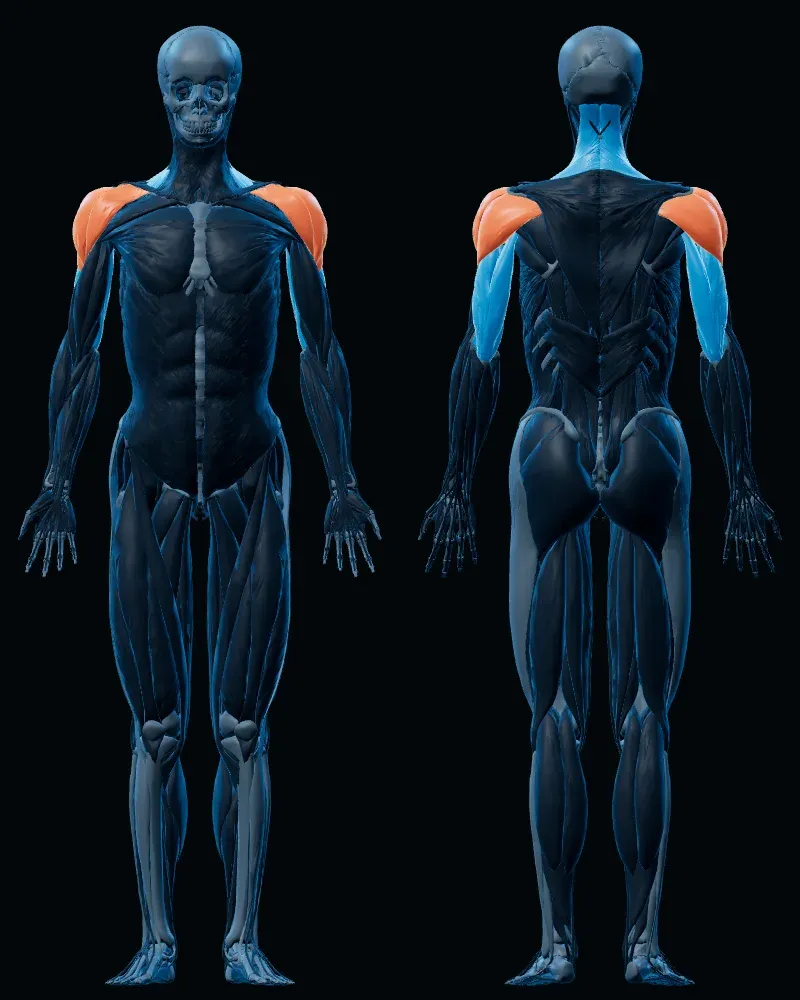
Muscles worked: shoulders
Main movers: all three heads of the deltoid
Assisting: supraspinatus, upper traps and triceps
Table of contents
The best rotator cuff strengthening exercises for lifters are light, controlled external rotations (cable or band, at your side and at about 90 degrees), with some internal rotation and face pulls alongside. Aim for 2-3 sets of 15-20 clean reps, 2-3 times a week. The cuff works mainly as a stabiliser rather than a prime mover, so most coaches train it with precise, low-fatigue work rather than heavy grinding.
This article is part of our complete shoulder and delt training guide. Here we focus on the four small muscles under your delts, what each one does, and how to train them without turning a warm-up into a second workout.
One honest caveat up front. Most of the research on cuff exercises measures muscle activity in small groups or treats painful shoulders. Almost none of it proves that a gym lifter who does cable rotations will avoid injury. What follows is the best-supported way to train them, with the gaps flagged.
What are the four rotator cuff muscles (SITS)?
The rotator cuff is four muscles whose tendons blend into a cuff around the head of your upper arm bone: Supraspinatus, Infraspinatus, Teres minor and Subscapularis.
Your shoulder is a ball in a shallow socket. That gives huge range of motion, and very little built-in stability. The cuff’s job is to compress the ball into the socket and keep it centred while bigger muscles like the delts and lats move the arm. A 2021 narrative review describes this as a force couple around the joint, and notes that when the muscular balance is lost, the humeral head can translate more, which may lead to shoulder dysfunction and pain (Akhtar et al., 2021).
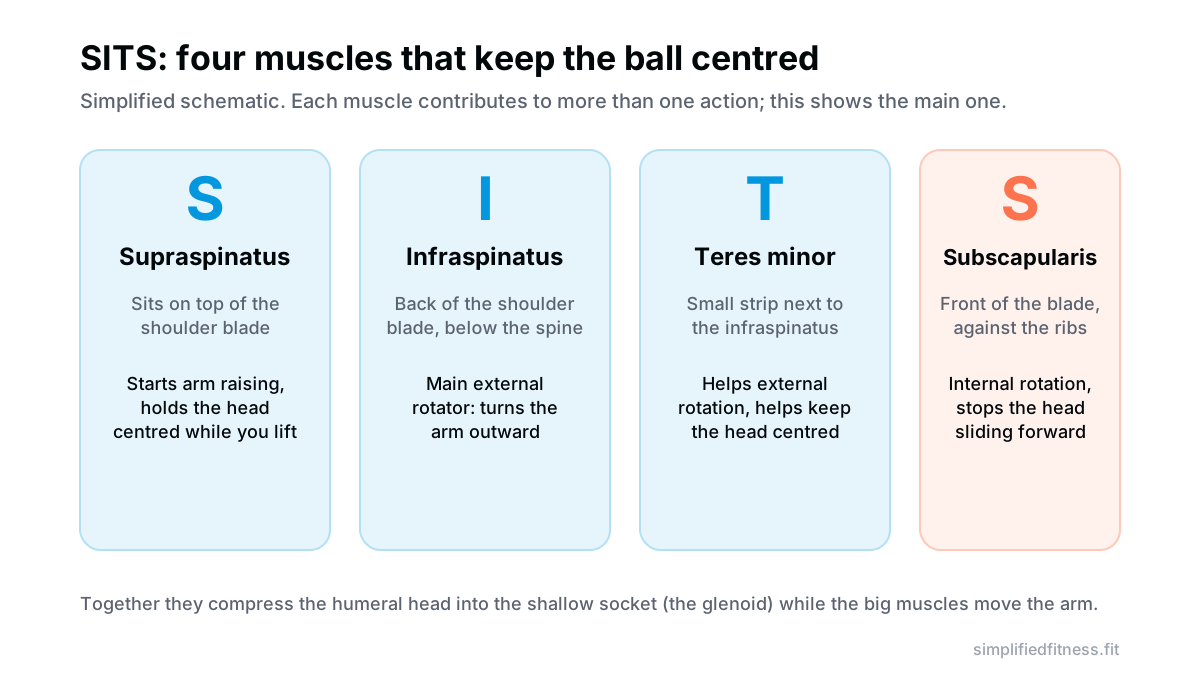
Here is the plain-language version of each:
- Supraspinatus: sits on top of the shoulder blade. Helps start arm raising and keeps the head centred as you lift.
- Infraspinatus: the main external rotator, on the back of the shoulder blade.
- Teres minor: a thin strip next to the infraspinatus that also externally rotates.
- Subscapularis: on the front of the shoulder blade. The main internal rotator, and a guard against the head sliding forward.
The cuff does more than rotate. A 2009 review estimated that during arm abduction the cuff muscles contribute meaningful force (modelling put the subscapularis around 30% of abduction torque, supraspinatus 25% and infraspinatus 10%), and that this force helps stabilise the joint as well as move the arm (Escamilla et al., 2009). Those are model estimates, so read them as rough proportions.
Why lifters should care
Every press, row and pull-up loads the shoulder joint heavily. The cuff keeps the joint centred under that load, and the muscles around it need to share the work. If your training is almost all pressing, with little external rotation or upper back work, you are practising one direction a lot and the other rarely.
That is a coaching observation, not a proven injury mechanism. Cuff weakness has not been shown to be the single cause of lifter shoulder pain, and pain has many contributors: volume spikes, grip width, bar path, sleep, stress and prior injury. If your shoulder already hurts when you bench, start with shoulder pain on bench press: biomechanical fixes and subacromial impingement and lifting solutions.
Which external rotation exercises work best?
External rotation is the cuff exercise most lifters skip, so it is the best place to start.
The most useful direct comparison comes from a 2004 study that placed intramuscular electrodes in 10 healthy people and compared seven exercises (Reinold et al., 2004). Side-lying external rotation at 0 degrees of abduction produced the greatest infraspinatus (62% of maximal voluntary contraction) and teres minor (67%) activity. The highest supraspinatus (82%), middle deltoid (87%) and posterior deltoid (88%) activity came from prone horizontal abduction at 100 degrees with full external rotation.
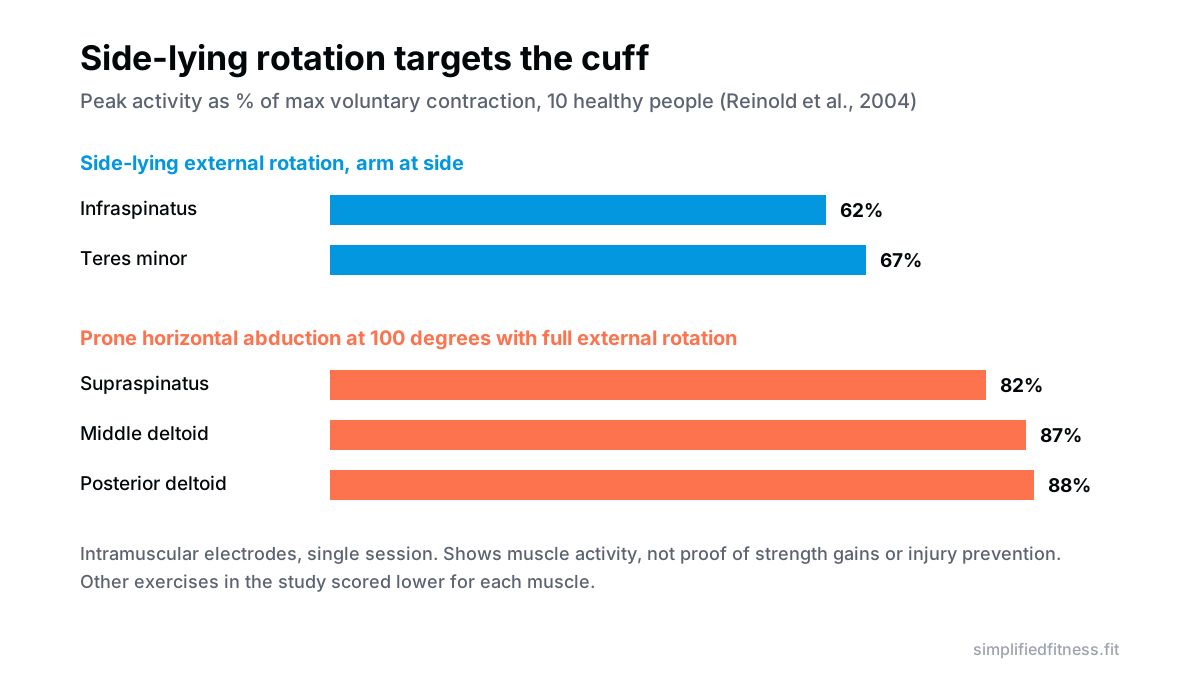
Read this carefully. It was 10 healthy people measured in one session, and it reports muscle activation, not strength gains or injury rates. It also did not test cable versions, so the cable and band variations below are a practical translation, not a tested equivalent.
Cable external rotation at your side (0 degrees)
This is the cable version of the side-lying movement.
- Set the cable at elbow height and stand side-on, with the cable in the hand farthest from the stack.
- Tuck a small folded towel between elbow and ribs. Keep the elbow bent about 90 degrees.
- Rotate your forearm outward, away from your belly, without moving your elbow off the towel.
- Pause briefly, then return slowly over about 2-3 seconds.
Use something like 2-5 kg. If your trap shrugs or your torso twists, the weight is too heavy.
External rotation at 90 degrees abduction
This is the “high five” position, closer to where you press and throw.
A fine-wire EMG study in 20 healthy people tested seven arm positions and found that regions of the cuff respond differently to posture. Inferior infraspinatus activity was higher at 90 degrees of scaption than at 0 degrees, while the anterior supraspinatus was most active at 90 degrees of abduction (Whittaker et al., 2022). Those were isometric holds, not dynamic reps.
The practical takeaway is to use more than one position across the week, since each loads the muscle slightly differently.
Where do face pulls and pull-aparts fit?
Face pulls and band pull-aparts are mostly rear delt and upper back work, with some external rotation at the end of the movement. They are good habits, and they sit well next to dedicated cuff work.
I could not find a study that measured rotator cuff activity in face pulls or pull-aparts, so I will not claim they train the cuff the way side-lying rotation does. The sensible reading is that face pulls and pull-aparts support the upper back muscles that position the shoulder blade, while cable external rotation covers the cuff more directly. For a deeper technique breakdown, see face pulls: form, scapular retraction and external rotation and rear delt training: reverse pec deck vs cables vs face pulls.
The serratus anterior also matters for how your shoulder blade moves under load. We cover it in serratus anterior anatomy and exercises.
How many reps and sets for rotator cuff exercises?
The 15-20 rep recommendation is common in coaching and physio practice, but I am not aware of a trial showing it is the best rep range for cuff exercises. It is a reasonable convention for two reasons: the muscles are small, and light loads keep the big shoulder muscles from taking over.
There is some support for the idea that you do not need heavy loads. A 2021 review argues that muscle adaptations can be obtained across a wide spectrum of loading zones, not just a narrow “hypertrophy range” (Schoenfeld et al., 2021). A randomised trial in 28 college baseball pitchers used light cable and dumbbell cuff work (about 20% of isometric max, 4 sets of 30/15/15/to fatigue) for 8 weeks, with or without blood flow restriction. The restricted group gained more shoulder-region lean mass (Lambert et al., 2023). That was a specific athlete group, so it does not translate directly to general lifters, and you do not need blood flow restriction.
A simple starting protocol:
| Item | Starting point |
|---|---|
| Exercises | 2 of: cable ER at side, ER at 90 degrees, light internal rotation |
| Sets | 2-3 per exercise |
| Reps | 15-20 controlled, last 2-3 reps hard |
| Load | Light, roughly 2-8 kg on a cable for most people |
| Frequency | 2-3 times per week |
| Tempo | About 1 second out, 2-3 seconds back |
| Progression | Add reps first, then small weight jumps |
A 5-minute rotator cuff warm-up before pressing
I am not aware of trials showing a cuff warm-up prevents injury, so treat this as a reasonable preparation habit:
- Band or cable external rotation at your side: 1 set of 15, light.
- External rotation at 90 degrees: 1 set of 12-15, light.
- Band pull-aparts: 1 set of 15-20.
- Then your normal bench or overhead press warm-up sets.
Stop while you still feel fresh. If the cuff is tired before your first working set, you did too much. On push days, slot this before your first press. You can see how that fits in our free push day plan.
Does rotator cuff strengthening help painful shoulders?
For people who already have rotator cuff related shoulder pain, exercise is a standard treatment, and strength training appears to be a strong option.
A 2025 Bayesian network meta-analysis of 15-16 randomised trials (913-947 participants) compared seven exercise types in rotator cuff related shoulder pain. Concentric strengthening ranked best for both pain and dysfunction, although for pain most of the other comparisons were not statistically significant. Eccentric strengthening and traditional training were moderately effective for dysfunction, and motor control and scapula-focused training ranked lower (Zhang et al., 2025). The authors suggest eccentric and motor control exercise as alternatives for patients not suited to concentric strengthening.
Two cautions. This is about people being treated for pain, not lifters trying to stay healthy, and a ranking of exercise types is not a prescription of exact sets and reps. If you have pain, have it assessed. The ranking says that progressive loading is worth doing, not that you should self-diagnose.
Weekly layout for lifters
A simple way to fit this into a normal split:
- Push day: cuff warm-up before pressing (above), 2 sets of cable external rotation at the end.
- Pull day: face pulls or reverse pec deck for the rear delts and upper back, plus 2 sets of internal rotation for balance.
- Leg day or rest day (optional): a third short cuff session if your shoulders feel good.
Budget tip for Indian gyms: if there is no free cable stack at peak hours, a loop band anchored to a rack costs a few hundred rupees and does the same rotation patterns. Light dumbbells (1-3 kg) work for side-lying rotation.
The takeaway
The rotator cuff is four small stabiliser muscles, and the EMG evidence says specific, controlled external and internal rotation work loads them well. Train them lightly and often, keep the big muscles out of the movement, and use more than one arm position. Do not expect cuff work to make a bad pressing setup safe, and do not treat it as a cure for pain you have not had assessed.
Start with two exercises, 2-3 sets of 15-20 reps, and pair it with a pressing program you can recover from. For the wider picture, head back to the complete shoulder and delt guide, and use the training volume calculator to check that your weekly pressing and pulling volume is not creeping up faster than you can recover from it.
Frequently Asked Questions
What are the rotator cuff muscles?
The rotator cuff is four muscles: supraspinatus, infraspinatus, teres minor and subscapularis, often remembered as SITS. They wrap around the head of the upper arm bone and compress it into the shoulder socket. This is why they matter for pressing, so learn what each one does and train the ones lifters usually skip.
What are the best rotator cuff strengthening exercises for lifters?
Cable or band external rotation at your side and at about 90 degrees of abduction, plus light face pulls, cover most of what a lifter needs. In an EMG study, side-lying external rotation gave the highest infraspinatus and teres minor activity of seven exercises tested. Pick two of these, do them 2-3 times a week, and keep the weight light.
How many reps and sets should I do for rotator cuff exercises?
A practical starting point is 2-3 sets of 15-20 controlled reps, which is a common coaching convention rather than a proven optimum. Research suggests muscle can adapt across a wide range of loads, not just one narrow rep range. Use a weight where the last few reps are hard but your form and shoulder position stay clean.
How often should I train my rotator cuff?
Two to three short sessions a week is plenty for most lifters. These muscles are small, so frequent low-fatigue work usually makes more sense than one punishing session, though trials comparing frequencies are lacking. Attach the work to a warm-up or the end of an upper body day so it actually happens.
Are external rotations better with the arm at 0 or 90 degrees?
Neither is universally better, because they bias the cuff differently. A fine-wire EMG study found inferior infraspinatus activity was higher at 90 degrees of scaption, while the supraspinatus worked harder at 90 degrees of abduction. Use both positions over the week, and choose the one that is pain-free.
Do face pulls work the rotator cuff?
Face pulls mainly train the rear delts and upper back, with some external rotation at the top. I could not find a study measuring cuff activity in face pulls, so treat them as a useful add-on rather than a replacement for direct external rotation. Keep the weight light enough that your upper arm finishes each rep rotating back, not just your elbows flaring.
Can strengthening the rotator cuff prevent shoulder pain?
It might help, but the evidence for prevention in gym lifters is limited. Most of the research is in painful shoulders or specific athletes such as throwers, and it measures muscle activity or short-term outcomes rather than injury rates. Treat cuff work as a sensible habit alongside good pressing technique and sensible volume.
What is the best exercise for the supraspinatus?
In a 2004 EMG study, prone horizontal abduction at 100 degrees with full external rotation produced the highest supraspinatus activity (82% of max), though it also fired the deltoids hard. The supraspinatus helps start arm raising and keeps the head centred. A light, controlled scaption or lateral raise also loads it, so you may not need a separate exercise.
How do I train the teres minor?
The teres minor works alongside the infraspinatus as an external rotator, so the same exercises train both. Side-lying external rotation gave the highest teres minor activity (67% of max) of seven exercises in one EMG study. Do slow reps with your elbow tucked and rotate through a comfortable range.
Should I train the subscapularis too?
Yes, a balanced program includes some internal rotation, since the subscapularis is the main internal rotator and helps stop the head sliding forward. Pressing and pulling already involve it, but a light cable internal rotation covers it directly. As a rule of thumb rather than a tested dose, one or two sets alongside your external rotations is enough to start.
Can I do rotator cuff exercises with a rotator cuff injury?
Only under guidance. For painful rotator cuff related shoulder pain, exercise therapy is widely used and a 2025 network meta-analysis found concentric strengthening ranked best, but the right load depends on the diagnosis. See a doctor or physiotherapist first if you have sharp pain, night pain or sudden weakness.
Do I need to warm up my rotator cuff before pressing?
It is a reasonable habit, though I am not aware of trials showing it prevents injury. A few light sets of external rotation before benching rehearse the shoulder position you want. Keep it to about 5 minutes at light effort so you are not tiring the muscles you need for the press.
Can I train my rotator cuff with a resistance band at home?
Yes. A band anchored at elbow height gives you the same external and internal rotation patterns as a cable. In one small EMG study, adding a second band around the shoulder blade increased trapezius and rhomboid activity without changing cuff activity. A loop band is cheap and fits in a gym bag.
Sources & References
Every claim above is checked against peer-reviewed research (PubMed, U.S. National Library of Medicine) or guidance from established health bodies. How we fact-check.
- Reinold MM, et al. Electromyographic analysis of the rotator cuff and deltoid musculature during common shoulder external rotation exercises. J Orthop Sports Phys Ther. 2004. PMID: 15296366
- Escamilla RF, et al. Shoulder muscle activity and function in common shoulder rehabilitation exercises. Sports Med. 2009. PMID: 19769415
- Tardo DT, et al. Rotator cuff muscles perform different functional roles during shoulder external rotation exercises. Clin Anat. 2013. PMID: 22836526
- Whittaker RL, et al. Regional electromyography of the infraspinatus and supraspinatus muscles during standing isometric external rotation exercises. Sports Health. 2022. PMID: 34657490
- Akhtar A, et al. The biomechanics of the rotator cuff in health and disease: a narrative review. J Clin Orthop Trauma. 2021. PMID: 34012769
- Zhang W, et al. Effects of seven types of exercise in the treatment of rotator cuff-related shoulder pain (RCRSP): a systematic review and Bayesian network meta-analysis. J Orthop Surg Res. 2025. PMID: 41276811
- Ganderton C, et al. Getting more from standard rotator cuff strengthening exercises. Shoulder Elbow. 2020. PMID: 32565922
- Schoenfeld BJ, et al. Loading recommendations for muscle strength, hypertrophy, and local endurance: a re-examination of the repetition continuum. Sports (Basel). 2021. PMID: 33671664
- Lambert BS, et al. Rotator cuff training with upper extremity blood flow restriction produces favorable adaptations in division IA collegiate pitchers: a randomized trial. J Shoulder Elbow Surg. 2023. PMID: 36933646

Umair Hazrami · Founder & Head Coach, Simplified Fitness
Umair Hazrami founded Simplified Fitness and the Simplified Lifter channel to cut through fitness noise. With 4+ years of consistent training and 10+ coaching clients, he writes every guide from the peer-reviewed research and links the sources so you can check them. Our editorial standards.
Educational content only, not medical advice. If you have a medical condition, are pregnant, or take medication, talk to a qualified doctor before changing your diet, supplements or training. Full disclaimer.
Keep reading
Exercise Technique
3D Shoulder Protocol: Weekly Volume, Frequency (2-3x/Week) and Rep Ranges
How to build 3D shoulders: how many weekly sets, how often to train side and rear delts, and which rep ranges to use, with an 8-week plan and the research.
8 min read

Exercise Technique
Are Front Raises Necessary? Why Bench Pressers Rarely Need Direct Front Delt Work
Are front raises necessary if you bench and overhead press? See what EMG and volume research says, when they can still help, and where to spend those sets.
8 min read
Exercise Technique
Behind-the-Neck Press: Shoulder Mobility, Neck Safety and Muscle Bias
Behind the neck press safety explained: who has the shoulder mobility for it, what EMG studies show for delts, and which swaps work if you do not.
10 min read
Exercise Technique
Cable Lateral Raises: Behind-the-Back vs Cross-Body Setup, Which Is Better?
Cable lateral raise behind the back vs in front: what the research says, which setup suits most lifters, and a step-by-step guide to pulley height and cuffs.
9 min read