Converging Machine Shoulder Press: Why It Feels Easier on Your AC Joint
Why does a converging shoulder press machine feel smoother than a barbell press? Setup, grip, depth and failure rules for sore AC joints, with studies linked.
TL;DR. The short answer
- A converging shoulder press machine guides your hands along a fixed arc that moves inward and upward, so you do not have to steer the weight. Many lifters with cranky shoulders find that easier to tolerate, though no trial has tested AC joint pain on these machines directly.
- For building muscle, machines and free weights have not been shown to differ. A 2023 meta-analysis of 13 studies found no difference in direct strength comparisons, and none in hypertrophy across the 5 studies that measured it.
- Set the seat so the handles start near upper-chest or chin height, pick a neutral or semi-neutral grip if offered, and lower only as far as the shoulder stays comfortable.
- You can train close to failure more safely on a machine, but meta-analytic evidence suggests going to absolute failure is not required for growth.
- A sharp pinch on top of the shoulder, pain at night, or a visible bump over the joint deserves a check by a doctor or physiotherapist rather than a new machine.
Part of our complete guide: Complete Shoulder, Delt & Neck Training Guide: 3D Deltoid Anatomy, Rotator Cuff & Traps
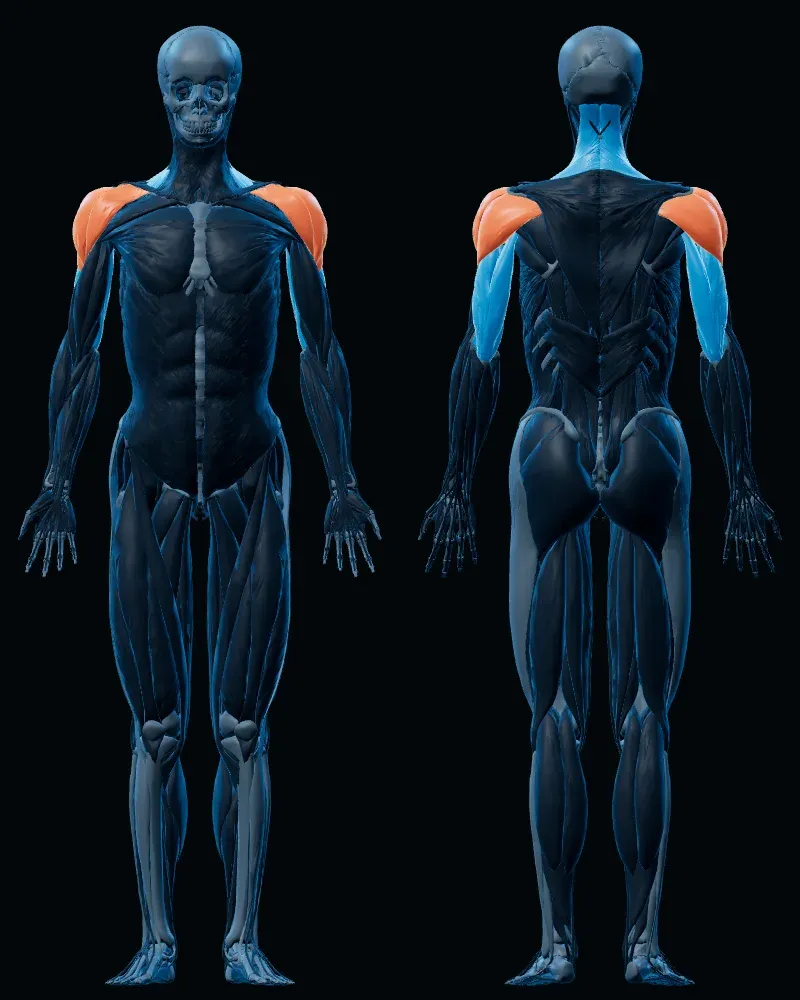
Muscles worked: shoulders
Main movers: all three heads of the deltoid
Assisting: supraspinatus, upper traps and triceps
Table of contents
A converging shoulder press machine feels smoother than a barbell press mostly because it takes jobs away from you. The handles follow a fixed arc, each arm moves on its own, you are seated and supported, and you do not have to balance a bar over your head. For many lifters with a touchy shoulder, that makes pressing easier to tolerate, although nobody has trialled these machines against a barbell for AC joint pain specifically.
This is a dedicated equipment tutorial for converging shoulder press machines. If you want the wider picture of how pressing fits into delt training, start with our complete shoulder and delt training guide. For the standing barbell versus seated dumbbell versus machine decision, see overhead pressing: standing barbell, seated dumbbell or machine.
What is a converging shoulder press machine?
On a converging machine the two handles sit on separate lever arms. As you press, the arms curve inward and upward, so your hands start wide at roughly shoulder level and finish closer together above your head. The Hammer Strength style press is the version most gyms have, and it comes in plate-loaded and pin-loaded forms.
Compare that with a straight barbell. The bar travels in a vertical line, your head has to move out of the way, and your hands are locked into one fixed width. Dumbbells give more freedom but ask you to control two weights in space.
Here is what changes on the machine:
- The path is guided, so you do not steer the load.
- Each arm works independently, so a stronger side cannot take over.
- Handles often offer neutral or semi-neutral positions.
- Your back is on a pad, so spinal balance and bracing demands drop.
None of this makes it magic. It just shifts effort from stabilising to pushing.
Why machine presses feel easier on the shoulder joint
Your shoulder sits on a moving base. The AC joint is where the outer end of the collarbone meets the shoulder blade (the acromion), and it moves every time you lift your arm. Anything that squeezes or loads that area, such as deep pressing, dips or wide-grip benching, can irritate it in some lifters.
A converging path may feel better for a few reasons. The arc brings hands in as they rise, which is closer to how many people naturally lift overhead than a rigid straight bar line. A semi-neutral grip lets the elbows sit slightly forward rather than flared directly out. And the stable seat means less compensating through the neck and trap area.
What is AC joint pain, and who gets it?
AC joint pain tends to be felt on the top of the shoulder, near the end of the collarbone. Pressing, bench press, flyes and dips often provoke it.
One well-described gym-related cause is distal clavicle osteolysis, a wearing away of the outer end of the collarbone. A clinical review notes that it most commonly affects weightlifters and other athletes who do repetitive overhead work, is mostly seen in young active men, and is becoming more common in women, with nonoperative care as first-line treatment (DeFroda et al., 2017). In a review of 1,432 consecutive shoulder MRI reports from patients aged 13-19, 6.5% showed this change. Combining an overhead sport with supplemental weight training was a risk factor (odds ratio 38), and 93% of affected patients responded to conservative treatment (Roedl et al., 2015). This was a retrospective imaging review in young athletes, so it tells us about risk, not about which machine to use.
Then there is plain AC joint osteoarthritis. A systematic review found changes consistent with it in 70% of MRI scans of shoulders without symptoms, and the authors argue that diagnosing symptomatic AC arthritis from imaging alone is often inaccurate (Rossano et al., 2022). Put simply, a scan showing “AC arthritis” does not prove the joint is the source of your pain.
Hammer Strength shoulder press vs barbell: does it build less muscle?
No, based on current trials. A 2023 meta-analysis pooled 13 studies and 1,016 adults aged 18-60 who trained for at least 6 weeks. In direct comparisons it found no difference between machines and free weights for dynamic strength (SMD 0.084), isometric strength (SMD -0.079) or hypertrophy (SMD -0.055, from the 5 studies that measured it) (Haugen et al., 2023). Strength did tend to be specific to the exercise you trained: free-weight tests improved more with free weights.
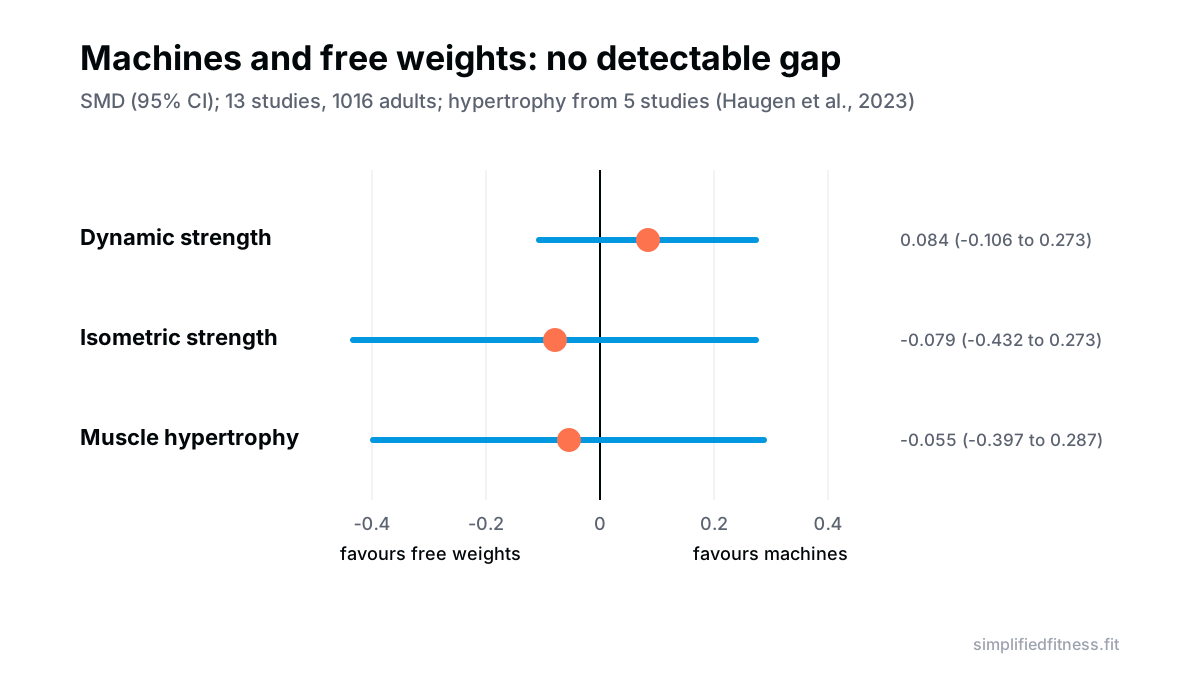
A separate 8-week trial in 34 resistance-trained men used the same training variables for both groups, with barbell or machine versions of the squat, bench press, bench pull and shoulder press, and found no between-group differences in athletic or muscle architecture outcomes (Hernandez-Belmonte et al., 2023). Note these were whole-body programs in trained men, not shoulder-specific trials.
Where the barbell still wins is skill transfer. If you compete in a barbell sport, or want the standing, whole-body demand of an overhead press, the machine will not fully replace it. For pure delt and triceps development, it is a fair stand-in. For a broader look, see our comparison of free weights, cables and machines for hypertrophy.
| Factor | Barbell overhead press | Converging machine press |
|---|---|---|
| Balance and bracing demand | High | Low |
| Bar path control | You steer it | Guided arc |
| Grip options | Fixed straight bar | Often neutral or semi-neutral |
| Left/right independence | No | Yes, each arm moves separately |
| Safety near failure | Needs spotter or safeties | Easier to bail out |
| Skill transfer to barbell sports | High | Low |
| Evidence for hypertrophy | Similar | Similar |
How to set up a converging shoulder press machine
The setup is where most of the comfort comes from. These are coaching guidelines drawn from biomechanics reasoning, not tested protocols.
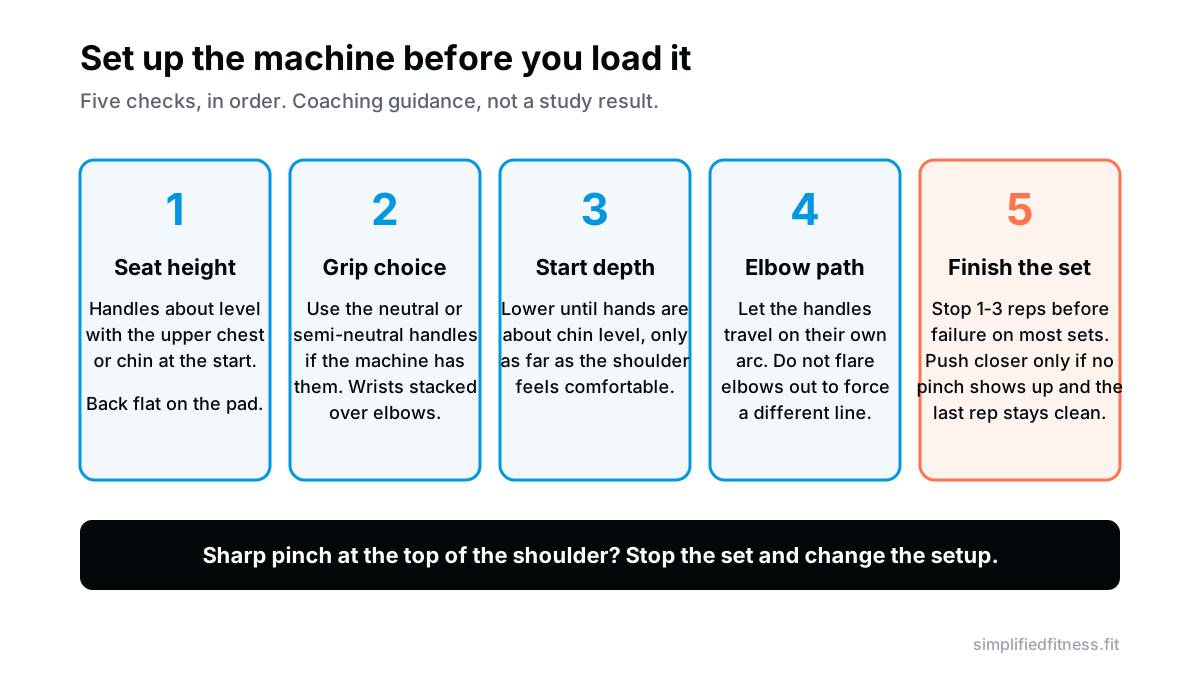
1. Seat height. Adjust the seat so the handles start around upper-chest to chin height when your hands are on them. If the handles begin well below your chest, your shoulders are pulled back and under load before you have moved. If they start above your chin, you lose range.
2. Grip. Use the neutral or semi-neutral handles if your machine has them. Keep wrists stacked over elbows and avoid cranking the wrists backwards.
3. Depth. Set the starting position so that your hands reach about chin level at the bottom. If the machine lets you lower further, that stretch may feel good for some people and bad for others with AC irritation. Use the shallower range for now and extend it later if it stays comfortable.
4. Elbow path. Let the handles follow their own arc. A common mistake is flaring the elbows wide to force the machine into a barbell-like line. Keep your shoulder blades gently pulled down and back against the pad, without shrugging toward your ears.
5. Lockout. Press until your arms are nearly straight, not locked hard, and keep the load moving smoothly. Do not slam the weight stack.
How hard can you push on a machine press?
This is where machines genuinely help. With no bar to drop on your head and no balance to lose, it is easier to take a set close to failure safely. Our article on machines, cables and free barbells near failure goes deeper on that.
But close is not the same as absolute. A 2023 meta-analysis of 15 studies found no evidence that training to momentary muscular failure beats stopping short for hypertrophy (effect size 0.12, 95% CI -0.13 to 0.37), though studies defining failure more loosely showed a trivial advantage (effect size 0.19) (Refalo et al., 2023). A later 8-week trial in 18 resistance-trained people found similar quadriceps growth with sets taken to failure versus 1-2 reps in reserve (Refalo et al., 2024). Note that was a leg trial, not a shoulder one.
My practical rule for a sore shoulder: leave 1-3 reps in reserve on most sets, and only grind the last set of the day if the pressing line stays smooth. Our RIR and RPE calculator can help you pick a working weight.
What rep range and load should you use?
A review of loading research concluded that muscle growth can occur across a wide range of loads when sets are taken close enough to failure, with heavier loads favouring maximal strength (Schoenfeld et al., 2021). For a joint-sensitive shoulder, that means you rarely need to go very heavy.
A simple start is 8-15 clean reps per set on the machine, with a controlled lowering phase of about two seconds and a brief pause at the bottom. If one handle feels clunky or painful, lighten up before changing anything else.
Is a converging press good for older lifters or people with AC arthritis?
It is often a practical choice, since the seat, back pad and guided path reduce balance demands. That said, I could not find trials of converging presses in older adults or in people with confirmed AC arthrosis, so this rests on clinical logic.
Because AC joint changes are common even without pain, a good approach is to follow symptoms, not scan wording. Start light, use neutral grips and shallow depth, and see a doctor or physiotherapist if there is night pain, loss of strength, a bump over the joint, numbness or pain that does not settle. If you have heart or blood pressure concerns, check before heavy overhead work.
Where does the machine fit in your week?
Do not make it your only shoulder exercise. A press mainly drives the front delt, triceps and upper chest, so pair it with lateral raises and rear delt work. Our shoulder guide covers how to balance the heads, and the push day plan shows one way to slot a machine press in after your chest work. In a hot, crowded Indian gym where the machine is often taken, a simple fix is to do it first when you are fresh and keep the rest of the session flexible.
Quick checklist before you press
- Seat so handles start near upper-chest to chin height.
- Neutral or semi-neutral grip first.
- Lower only to a comfortable chin-level depth.
- Let the handles choose their arc.
- Stop 1-3 reps short on most sets.
- Stop and get assessed if pain is sharp, at night or not settling.
Frequently Asked Questions
What is a converging shoulder press machine?
It is a selectorized or plate-loaded press where the two handles travel on arms that curve inward as they rise, so your hands finish closer together than they started. Each arm moves independently, which lets each shoulder find its own path. Look for the Hammer Strength style press in your gym, or any machine with a visibly curved handle track.
Is a converging shoulder press better than a barbell overhead press?
Not for muscle growth, since a 2023 meta-analysis found no difference in hypertrophy between machines and free weights. It is better at removing balance and bar-path demands, which makes it easier to push hard on tired shoulders. Use the barbell if you want the skill and total-body strength, and the machine if you want a stable way to load your delts.
Why does the machine feel better on my shoulders?
The fixed track removes the need to steer the load, and many machines offer a neutral grip with elbows slightly forward of a pure side-on position. That can reduce the awkward positions a straight bar forces on some people. This is biomechanical reasoning rather than proven protection, so treat it as a comfort tool, not a cure.
Does a machine shoulder press help with AC joint pain?
It can feel better for some lifters, but no study has tested it against a barbell for AC joint symptoms. AC joint pain is usually felt on top of the shoulder where the collarbone meets the shoulder blade, and pressing, dips and bench work often aggravate it. Try a lighter, shallower, neutral-grip setup and see a clinician if the pain persists.
How low should I lower a shoulder press machine?
Lower until your hands are about chin level, or as deep as stays pain-free if that is higher. Going deeper stretches the front of the shoulder under load, and some people feel joint irritation there first. Raise the seat a notch or use the start-position stop if the machine has one.
What grip is best on a shoulder press machine?
A neutral grip (palms facing each other) or semi-neutral grip is a sensible first choice for a grumpy shoulder. I could not find a trial on grip and AC joint comfort, so go by what your joint tolerates. Switch between grips across a few weeks rather than testing everything in one session.
Can I train to failure on a shoulder press machine?
It is safer than failing a barbell overhead press, because you can stop and let go without the weight dropping on you. A 2023 meta-analysis found no evidence that momentary failure beats stopping short for hypertrophy. Leave 1-3 reps in reserve most sets and use a true grind only on the final set.
How heavy should I go on a machine shoulder press?
Choose a load you can control for roughly 6-15 clean reps, because trials comparing low and high loads show similar hypertrophy when sets are taken close to failure. Heavy machine loads can still irritate a sore AC joint, so keep the first sets lighter. Add weight only when the top of your rep range feels smooth and pain-free.
Is the machine shoulder press good for older lifters?
It is often a practical choice, since seated support and a guided path reduce balance demands. Evidence here is mostly clinical logic rather than trials of this exact machine in older adults, so hedge your expectations. Start light, move slowly and check with a doctor if you have known joint disease or heart conditions.
What are the signs I should see a doctor about shoulder pain?
Pain at rest or at night, loss of strength, a visible step or bump over the collarbone joint, numbness, or pain that does not settle in a few weeks all warrant a professional look. AC joint changes on a scan are very common even in people without pain, so imaging should be interpreted with the symptoms. A physiotherapist or sports doctor can tell you whether the joint is the problem.
Do converging machines build the same delts as dumbbells?
Probably close enough for most trainees, since machine and free-weight training produced similar hypertrophy in the meta-analysis. The side delts still get more direct work from lateral raises, so keep those in your plan. A press, whether machine or dumbbell, mainly drives the front delt, triceps and upper chest.
How many sets of machine shoulder press do I need?
For most lifters two to four hard sets once or twice a week is a reasonable start alongside your chest pressing. Pressing volume already comes from bench and incline work, so more is not always better. Track your reps for a month and add a set only if progress stalls.
Sources & References
Every claim above is checked against peer-reviewed research (PubMed, U.S. National Library of Medicine) or guidance from established health bodies. How we fact-check.
- Haugen ME, et al. Effect of free-weight vs. machine-based strength training on maximal strength, hypertrophy and jump performance - a systematic review and meta-analysis. BMC Sports Sci Med Rehabil. 2023. PMID: 37582807
- Hernandez-Belmonte A, et al. Adaptations in athletic performance and muscle architecture are not meaningfully conditioned by training free-weight versus machine-based exercises: Challenging a traditional assumption using the velocity-based method. Scand J Med Sci Sports. 2023. PMID: 37340878
- Refalo MC, et al. Influence of Resistance Training Proximity-to-Failure on Skeletal Muscle Hypertrophy: A Systematic Review with Meta-analysis. Sports Med. 2023. PMID: 36334240
- Refalo MC, et al. Similar muscle hypertrophy following eight weeks of resistance training to momentary muscular failure or with repetitions-in-reserve in resistance-trained individuals. J Sports Sci. 2024. PMID: 38393985
- DeFroda SF, et al. Diagnosis and Management of Distal Clavicle Osteolysis. Orthopedics. 2017. PMID: 27925640
- Roedl JB, et al. Frequency, imaging findings, risk factors, and long-term sequelae of distal clavicular osteolysis in young patients. Skeletal Radiol. 2015. PMID: 25560997
- Rossano A, et al. Prevalence of acromioclavicular joint osteoarthritis in people not seeking care: A systematic review. J Orthop. 2022. PMID: 35638093
- Schoenfeld BJ, et al. Loading Recommendations for Muscle Strength, Hypertrophy, and Local Endurance: A Re-Examination of the Repetition Continuum. Sports (Basel). 2021. PMID: 33671664

Umair Hazrami · Founder & Head Coach, Simplified Fitness
Umair Hazrami founded Simplified Fitness and the Simplified Lifter channel to cut through fitness noise. With 4+ years of consistent training and 10+ coaching clients, he writes every guide from the peer-reviewed research and links the sources so you can check them. Our editorial standards.
Educational content only, not medical advice. If you have a medical condition, are pregnant, or take medication, talk to a qualified doctor before changing your diet, supplements or training. Full disclaimer.
Keep reading
Exercise Technique
3D Shoulder Protocol: Weekly Volume, Frequency (2-3x/Week) and Rep Ranges
How to build 3D shoulders: how many weekly sets, how often to train side and rear delts, and which rep ranges to use, with an 8-week plan and the research.
8 min read

Exercise Technique
Are Front Raises Necessary? Why Bench Pressers Rarely Need Direct Front Delt Work
Are front raises necessary if you bench and overhead press? See what EMG and volume research says, when they can still help, and where to spend those sets.
8 min read
Exercise Technique
Behind-the-Neck Press: Shoulder Mobility, Neck Safety and Muscle Bias
Behind the neck press safety explained: who has the shoulder mobility for it, what EMG studies show for delts, and which swaps work if you do not.
10 min read
Exercise Technique
Cable Lateral Raises: Behind-the-Back vs Cross-Body Setup, Which Is Better?
Cable lateral raise behind the back vs in front: what the research says, which setup suits most lifters, and a step-by-step guide to pulley height and cuffs.
9 min read