Behind-the-Neck Press: Shoulder Mobility, Neck Safety and Muscle Bias
Behind the neck press safety explained: who has the shoulder mobility for it, what EMG studies show for delts, and which swaps work if you do not.

TL;DR. The short answer
- Behind-the-neck press safety depends on the lifter. It needs a lot of shoulder external rotation and upper back extension, so it suits a small group with good mobility and no shoulder history, and it is a poor fit for most desk-bound lifters.
- In small EMG studies of trained men, the behind-the-neck version excited the rear delts more and the pecs less than a front barbell press. Those are muscle excitation findings, not proof of more growth.
- Lifters who regularly did exercises using the 'high-five' position, including behind-the-neck pulldowns and military press, showed more signs of anterior shoulder instability in one cross-sectional study. That is an association, not proof of cause.
- There is no direct research on neck (cervical) injury from this lift. Treat any neck strain or pinching as a stop sign.
- You lose very little by skipping it. Front presses, dumbbell presses, lateral raises and reverse pec deck cover the same delt heads with less risk.
Part of our complete guide: Complete Shoulder, Delt & Neck Training Guide: 3D Deltoid Anatomy, Rotator Cuff & Traps
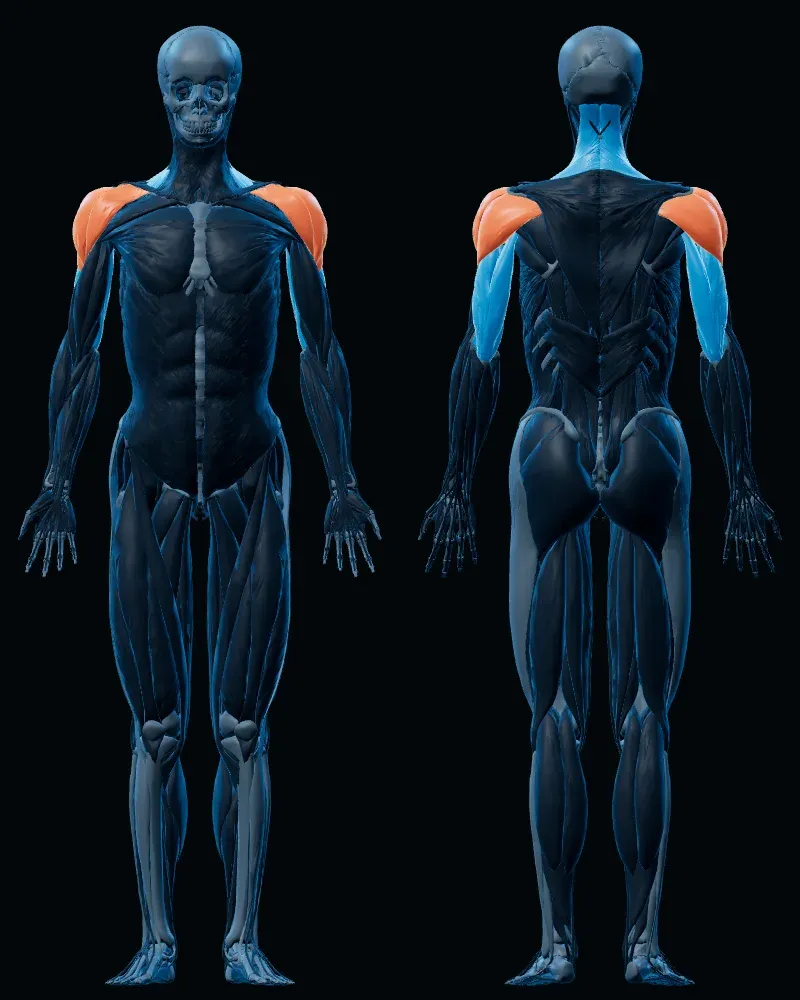
Muscles worked: shoulders
Main movers: all three heads of the deltoid
Assisting: supraspinatus, upper traps and triceps
Table of contents
Behind-the-neck press safety comes down to your shoulders, not the exercise’s reputation. The lift needs a lot of shoulder external rotation and upper back extension, so it can be fine for a lifter with good mobility and a clean shoulder history, and it is a poor bet for most people who sit all day. The evidence on it is thin, so treat this as a risk-versus-reward call rather than a rule.
This article is one piece of our complete shoulder and delt training guide. Here we look at one polarising golden-era lift: what it demands from your joints, what it does to the muscles, and what to do instead if you fail the mobility check.
Is the behind-the-neck press bad for your shoulders?
Not automatically. But it is more demanding than a front press, and that is the honest summary.
In the behind-the-neck press, the bar travels down behind your head. To get there, your arms go out to the side and your shoulders rotate outward, the so-called “high-five” position. Your joint has to allow that rotation, and your upper back has to extend enough to let your ribs and head stay out of the way. If either is short, the movement gets forced from somewhere else: the front of the shoulder, the lower back or the neck.
What does the research say? Not as much as the debate suggests. A review of resistance-training shoulder injuries reported that up to 36% of documented injuries and disorders in lifters occur at the shoulder, with poor technique and muscle imbalances among the risk factors (Kolber et al., 2010). Most of that literature is retrospective, based on surveys and descriptive reports, so it cannot tell us which lift causes which injury.
Bodybuilders, for what it is worth, have a lower injury rate than other barbell sports, though the shoulder is still one of the most common sites. In one questionnaire study of 71 competitive bodybuilders, the overall rate was 0.12 injuries per bodybuilder per year (Siewe et al., 2014). Self-reported and German-only, so hold it loosely.
What does the high-five position do to the front of the shoulder?
This is where the most relevant evidence sits. Researchers tested 159 healthy men: 123 who lifted weights at least twice a week and 36 who had never trained. The lifters showed significantly more anterior glenohumeral hyperlaxity, plus more positive apprehension and relocation tests, which are clinical signs linked to anterior instability (Kolber et al., 2013).
Within the lifters, doing exercises that require the high-five position, specifically behind-the-neck lat pulldowns and military press, was associated with those instability signs. Doing external rotator strengthening showed the opposite association.
Read that carefully, though.
- It was a cross-sectional study, one snapshot in time. It cannot show that the exercises caused the laxity. People with naturally loose shoulders might simply choose different exercises.
- Participants were healthy men averaging 28 years old, so the result may not apply to women, older lifters or people already in pain.
- The authors themselves say intervention trials are needed to test cause and effect.
A cautious practical takeaway: if your shoulder already feels loose, unstable or irritable, the high-five position is a poor place to add load. And external rotator work looks like cheap insurance either way. Our guide to rotator cuff strengthening walks through it.
What mobility do you need for the behind-the-neck press?
There is no research-backed pass mark here, so be wary of anyone who gives you an exact number of degrees. What we can say from the literature is that the movement leans on your upper back.
In a radiographic study of 21 healthy men, thoracic extension increased by about 10-13 degrees during full bilateral arm elevation, but the amount varied considerably between individuals (Edmondston et al., 2012). That is a good reminder that two lifters can look identical in a standing posture and have very different overhead capacity.
Here is a simple gym screen. It is a practical heuristic, not a validated clinical test.
- Wall check. Stand with your back, ribs and head against a wall. Raise your arms into a goalpost position, elbows bent, backs of the hands toward the wall. Keep your lower back from arching off the wall. Can you hold this for 20-30 seconds without pain or shrugging?
- Empty-bar set. Sit upright with back support. Lower an empty barbell slowly behind your head for 10 reps, keeping your head neutral and ribs down.
- Honest feedback. No pinching at the top or front of the shoulder, no neck strain, no wobble.
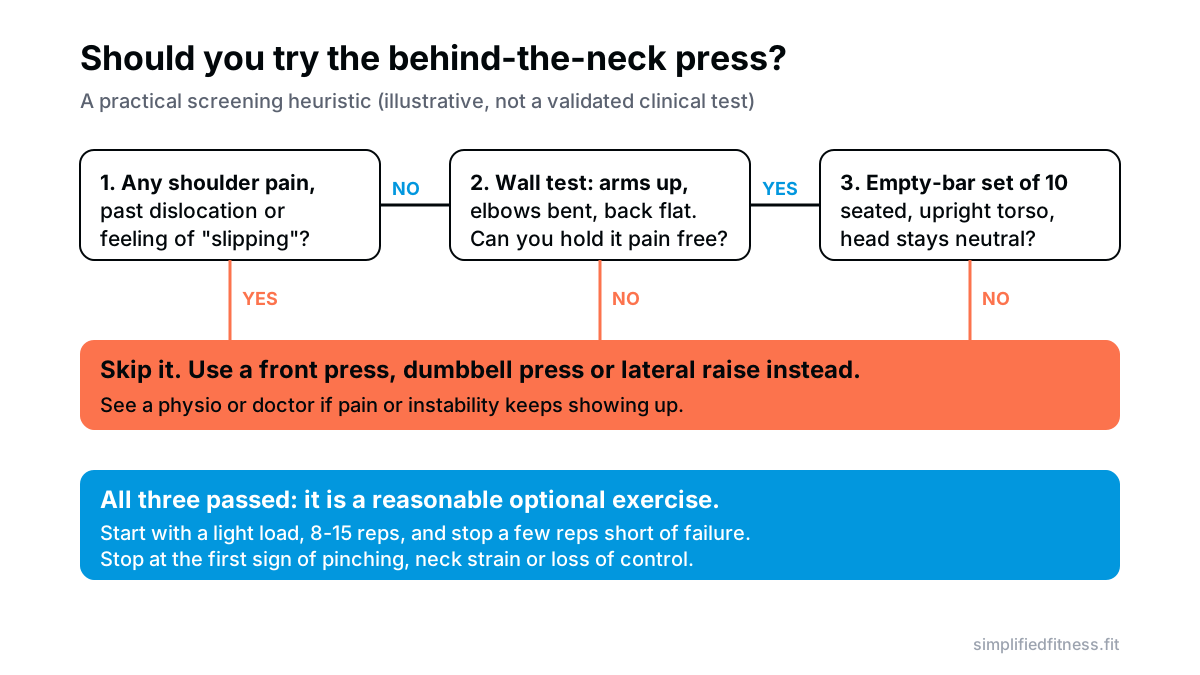
Fail the wall check? Plenty of lifters do. Hours at a desk, a rounded upper back and tight lats all make it harder, and that is not something you fix in one warm-up.
Is the behind-the-neck press dangerous for your neck?
Honestly, we do not know. We found no study that measured cervical spine loading or neck injury in this exercise, so any firm statement would be guesswork.
What we can reason from the setup: the bar travels very close to the back of the skull and upper spine, and lifters without the range tend to compensate by pushing the head forward. That is a plausible mechanism for neck strain, but it is a mechanism, not a measured outcome.
If you have a history of neck pain, numbness or tingling in the arms, or headaches that come with overhead lifting, skip the lift and see a doctor or physiotherapist. This is not something to push through in the gym.
Does the behind-the-neck press build more shoulder muscle?
This is the fun part of the debate, and it has some real data. Two EMG studies compared pressing in front of the head with pressing behind it.
In eight competitive bodybuilders, the behind-the-neck barbell press produced higher medial and posterior deltoid excitation than the front press, and the front press produced higher pectoralis major excitation (Coratella et al., 2022). The same study found the barbell versions excited muscles more than a machine press with a stabilised path.
A later study in 14 resistance-trained men used high-density EMG at an 8-rep-max load. The front press showed higher anterior deltoid and pectoralis major excitation, while the behind-the-neck version showed higher posterior deltoid, upper trapezius and triceps excitation in the lowering phase (Padovan et al., 2026). For the lateral deltoid, the abstract reports differences in where on the muscle the activity centred, not in how much.
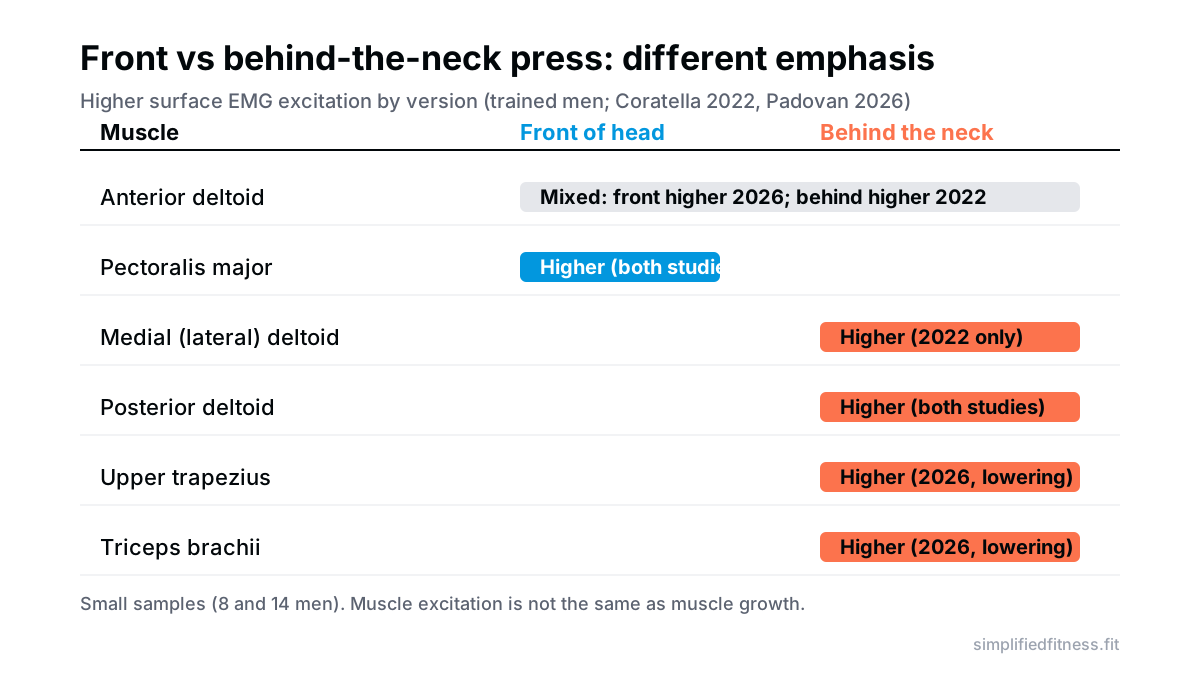
Where the studies disagree, the details differ. The 2022 study reported higher medial deltoid excitation behind the neck, while the later one did not report a difference in lateral delt amplitude. They also differ in anterior deltoid depending on phase. Possible reasons: small samples (8 and 14 men), different loads and bar paths, and different EMG methods. Treat the shared signal, rear delts up and pecs down behind the neck, as more believable than any single muscle result.
And keep the key limitation in view. EMG measures electrical excitation during a rep. It does not measure growth over months. Neither study tested hypertrophy, so “behind-the-neck builds bigger delts” is a hypothesis, not a finding.
Do side delts and the full range matter more than the bar position?
For most lifters, yes. In volume research, muscle growth tracks weekly hard sets, with diminishing returns, rather than any one special exercise (Pelland et al., 2026). If you want side delt width, direct work does that job more cleanly. In one EMG study of 10 bodybuilders, a lateral raise with the upper arm in a neutral rotation produced higher medial deltoid excitation than an externally rotated raise, a bent-elbow raise or a front raise (Coratella et al., 2020). We cover execution in lateral deltoid optimization.
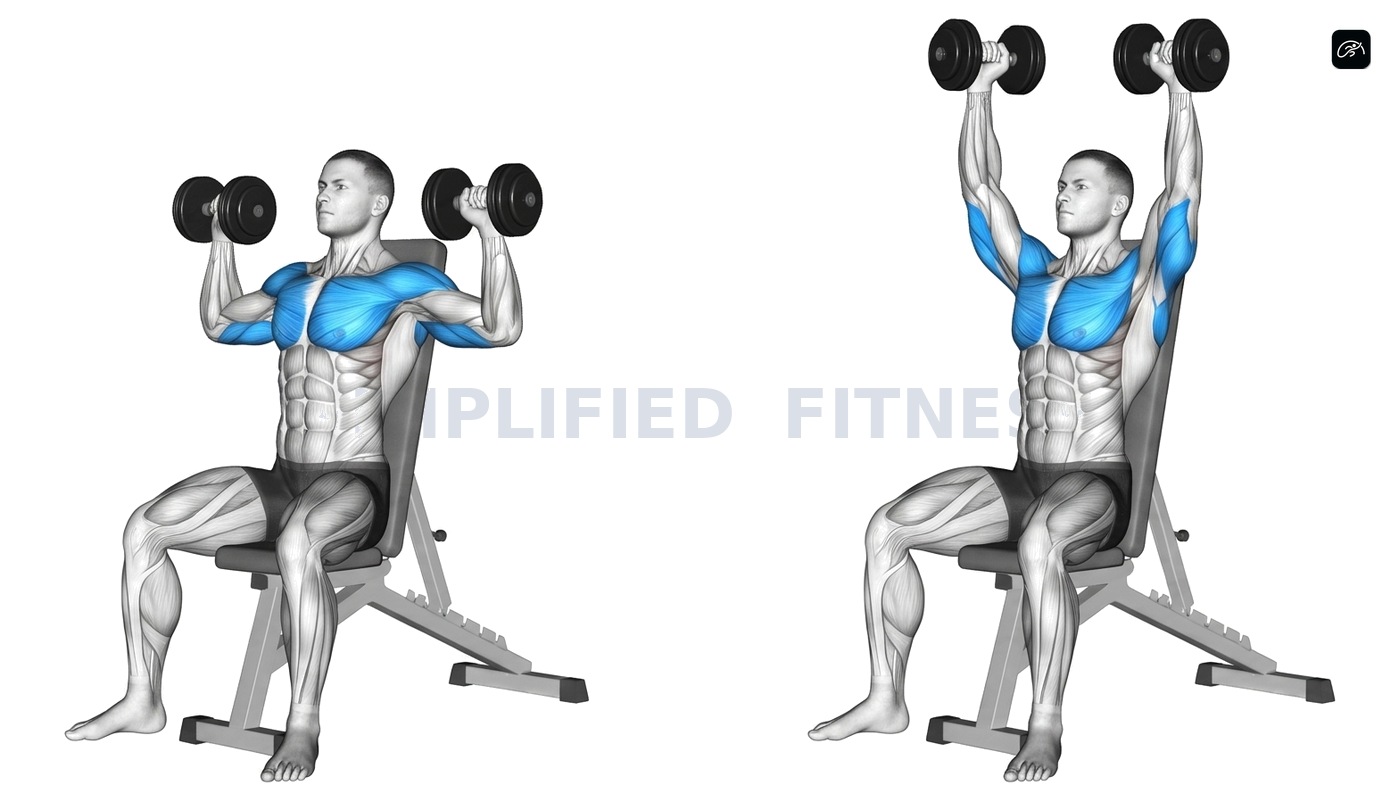
A seated dumbbell press lets your arms find a path that suits your joints, which is the main reason it is a comfortable default. For a deeper comparison of overhead options, see standing vs seated and dumbbell vs machine overhead pressing.
What about the Smith machine version?
Lifters often try the Smith machine to make the behind-the-neck press feel safer. A fixed track does remove balance, and it can feel more controlled. It does not change the arm position, though, and the position is the demanding part.
The one relevant study we found compared a machine press with the barbell press, finding lower muscle excitation on the machine for several muscles (Coratella et al., 2022). That study used a shoulder press machine, not a Smith machine, so do not over-read it. We found no safety data for a Smith machine behind-the-neck press specifically. If you try it, apply the same mobility screen, sit upright, and keep the load light.
If you still want to try it: a cautious protocol
Only if you passed the screen above and have no shoulder or neck history.
- Setup: seated, back supported, bar set low enough that you do not have to reach for the rack.
- Load: an empty bar first. Add small amounts over several weeks. Keep it clearly lighter than your front press.
- Reps: 8-15 controlled reps, stopping a few reps short of failure. Use our RIR and RPE calculator if you are unsure how close to failure you are.
- Bar path: lower only as far as your shoulders and head position allow. Ears level with the bar is plenty.
- Stop signs: pinching at the shoulder, neck strain, tingling, or losing control of the bar.
- Support work: pair it with external rotation or face pulls through the week.
Honestly, the most common mistake is treating it as a heavy lift. Heavy behind-the-neck pressing is where the risk-to-reward ratio gets worst.
What to do instead
You are not giving up much. The same delt heads can be trained with lifts that keep your arms in a friendlier position.
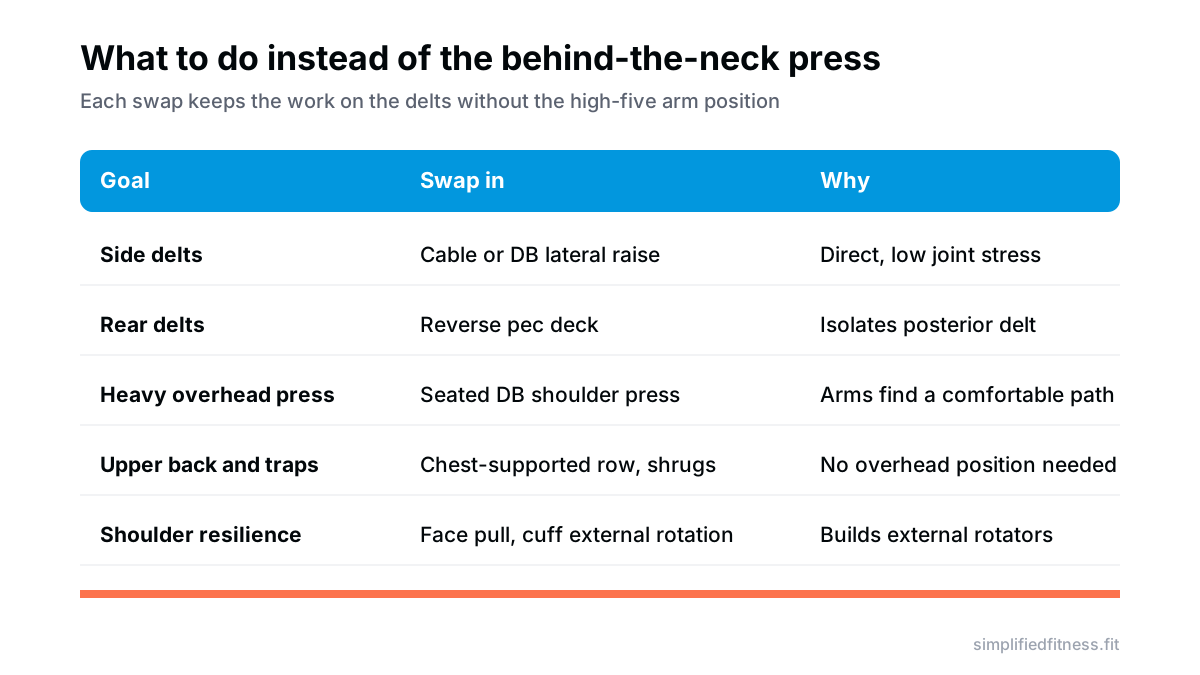
| If you wanted… | Do this instead | Notes |
|---|---|---|
| Heavy overhead pressing | Seated dumbbell or machine press | Pick the one that stays pain free; see our note on converging shoulder presses |
| Rear delt work | Reverse pec deck or cable rear delt fly | Easy to load, easy to stop short of failure |
| Side delt width | Lateral raises | Direct work, low joint stress |
| Upper back and traps | Chest-supported row, shrugs | No overhead position needed |
| Shoulder resilience | Face pulls, external rotations | Strengthens the external rotators |
If upright rows or other presses give you a pinching feeling at the front of the shoulder, our pages on subacromial impingement and safer upright row modifications are the better next read. Want these slotted into a weekly plan? Our push day template has a shoulder block that avoids the high-five position.
When to see a doctor
Any of these deserves a proper assessment before more overhead loading:
- A previous shoulder dislocation, or a feeling of the shoulder slipping or “catching”
- Pain at night, or pain that lingers more than a day or two after training
- Weakness, numbness or tingling in the arm
- Neck pain with overhead lifting
This article is general education and cannot diagnose anything. A physiotherapist can test your range directly, which beats any online screen.
The bottom line
The behind-the-neck press is a conditional exercise, not a villain and not a secret. It asks for a lot of shoulder and upper back mobility, shifts work toward the rear delts and upper back, and has no direct evidence for extra muscle growth. The best human data link the high-five position to instability signs in lifters, but only as an association.
For most people the smart move is simple: pass the screen or skip the lift, and put the effort into a pain-free press, lateral raises and rear delt work. That covers the same ground with far less to worry about.
Frequently Asked Questions
Is the behind-the-neck press bad for your shoulders?
It is not automatically bad, but it is a higher-demand position than a front press. The arms sit in a wide, externally rotated 'high-five' position that stresses the front of the shoulder joint, and one study linked that position to signs of anterior instability in lifters. If you have no shoulder history and pass a mobility check, light loads can be reasonable, otherwise swap it out.
Is the behind-the-neck press dangerous for your neck?
There is no direct research on cervical injury from this exercise, so any claim either way is an educated guess. The bar passes close to the back of the head and spine, and lifters with limited shoulder mobility tend to push the head forward to clear it. Keep the head neutral, never force the bar past your head, and stop if the neck strains.
How much mobility do you need for the behind-the-neck press?
You need enough shoulder external rotation and upper back extension to hold the bar slightly behind your head with your ribs down and your head neutral. Studies show upper back extension during arm raising varies a lot between people, so there is no single safe number. A simple wall check, described above, is a practical screen but not a validated clinical test.
Does the behind-the-neck press build more shoulder muscle than the front press?
It shifts which parts work harder, but there is no trial showing it builds more muscle. Small EMG studies found higher rear delt activity behind the neck and higher pec and front delt activity in front. Excitation is not growth, so choose based on comfort and what you can load and progress.
Does the behind-the-neck press hit the side delts?
One study of eight bodybuilders found higher medial deltoid excitation behind the neck than in a front barbell press. A later study of 14 trained men did not report a difference in lateral delt amplitude between the two. Treat it as a possible small bonus, and use lateral raises for direct side delt work.
Is the behind-the-neck press safer on a Smith machine?
The fixed track can make the movement feel more controlled, but it does not change the arm position that creates the demand. In one EMG study, a machine version of the behind-the-neck press produced lower anterior and medial deltoid excitation than the free barbell version. Safety data for Smith machine versions are lacking, so the same mobility rules apply.
Should I do behind-the-neck presses seated or standing?
Seated with a supportive upright back is the more forgiving option, because it removes balance and lower back arching from the picture. A standing version asks you to hold a rigid torso under a bar that sits close to your head. If you try the lift, use a seated setup and light weight first.
What weight should I use for behind-the-neck presses?
Use clearly lighter weight than your front press and stay well short of failure. One study of this exercise used an 8-rep-max load in trained men, but it was measuring muscle activity in one set, not long-term safety. Start with an empty bar, build up over weeks, and keep reps controlled.
What are the best alternatives to the behind-the-neck press?
A seated dumbbell press, lateral raises, and reverse pec deck cover the same delt heads without the high-five position. Research shows lateral raise variations and press variations shift emphasis among the delt heads, so a mix works well. Pick a press you can progress plus one side delt and one rear delt movement.
Can I do behind-the-neck presses with shoulder impingement or past dislocation?
It is best to avoid it. Pain at the top or front of the shoulder, or any history of dislocation or a feeling of the shoulder slipping, are reasons to see a physiotherapist or doctor before loading this position. Meanwhile, train around it with pain-free presses and external rotation work.
Do bodybuilders still use the behind-the-neck press?
Some do, and that is a fair part of why it keeps coming up. Golden-era training does not tell us it is optimal, and we have no data on how many lifters of that era quietly dropped it. Your own mobility and joint history matter more than what an old photo shows.
How do I fix shoulder mobility for overhead pressing?
Work on upper back extension and shoulder rotation with gentle, pain-free drills and strengthen the external rotators. In the study that linked high-five exercises to instability signs, lifters who did external rotator work had fewer of those signs. Add face pulls or cable external rotations 2-3 times a week and see our guide on rotator cuff strengthening.
Sources & References
Every claim above is checked against peer-reviewed research (PubMed, U.S. National Library of Medicine) or guidance from established health bodies. How we fact-check.
- Coratella G, et al. Front vs Back and Barbell vs Machine Overhead Press: An Electromyographic Analysis and Implications For Resistance Training. Front Physiol. 2022. PMID: 35936912
- Padovan R, et al. High-Density Surface Electromyography Excitation in Front vs. Back Overhead Press Prime Movers. J Hum Kinet. 2026. PMID: 42713087
- Kolber MJ, et al. Characteristics of anterior shoulder instability and hyperlaxity in the weight-training population. J Strength Cond Res. 2013. PMID: 22836608
- Kolber MJ, et al. Shoulder injuries attributed to resistance training: a brief review. J Strength Cond Res. 2010. PMID: 20508476
- Edmondston SJ, et al. Clinical and radiological investigation of thoracic spine extension motion during bilateral arm elevation. J Orthop Sports Phys Ther. 2012. PMID: 22523094
- Coratella G, et al. An Electromyographic Analysis of Lateral Raise Variations and Frontal Raise in Competitive Bodybuilders. Int J Environ Res Public Health. 2020. PMID: 32824894
- Pelland JC, et al. The Resistance Training Dose Response: Meta-Regressions Exploring the Effects of Weekly Volume and Frequency on Muscle Hypertrophy and Strength Gains. Sports Med. 2026. PMID: 41343037
- Siewe J, et al. Injuries and overuse syndromes in competitive and elite bodybuilding. Int J Sports Med. 2014. PMID: 24886919

Umair Hazrami · Founder & Head Coach, Simplified Fitness
Umair Hazrami founded Simplified Fitness and the Simplified Lifter channel to cut through fitness noise. With 4+ years of consistent training and 10+ coaching clients, he writes every guide from the peer-reviewed research and links the sources so you can check them. Our editorial standards.
Educational content only, not medical advice. If you have a medical condition, are pregnant, or take medication, talk to a qualified doctor before changing your diet, supplements or training. Full disclaimer.
Keep reading
Exercise Technique
3D Shoulder Protocol: Weekly Volume, Frequency (2-3x/Week) and Rep Ranges
How to build 3D shoulders: how many weekly sets, how often to train side and rear delts, and which rep ranges to use, with an 8-week plan and the research.
8 min read

Exercise Technique
Are Front Raises Necessary? Why Bench Pressers Rarely Need Direct Front Delt Work
Are front raises necessary if you bench and overhead press? See what EMG and volume research says, when they can still help, and where to spend those sets.
8 min read
Exercise Technique
Cable Lateral Raises: Behind-the-Back vs Cross-Body Setup, Which Is Better?
Cable lateral raise behind the back vs in front: what the research says, which setup suits most lifters, and a step-by-step guide to pulley height and cuffs.
9 min read
Exercise Technique
Converging Machine Shoulder Press: Why It Feels Easier on Your AC Joint
Why does a converging shoulder press machine feel smoother than a barbell press? Setup, grip, depth and failure rules for sore AC joints, with studies linked.
8 min read